ASSESMENT OF LUNG
PARENCHYMAL DAMAGE WITH
ARTERIAL BLOOD GAS ANALYSIS
(ABG)
PROF.N.K.AGRAWAL
OBJECTIVE
The objective of the study was to
assess the lung damage at alveoli
level with arterial blood gas analysis
(ABG)
The major task of the lung is to oxygenate the blood
and remove carbon dioxide, this happens by exchange
of gas between alveoli and blood capillary. Oxygen
diffuses passively from the alveoli to plasma. The
diffusion is affected by-
Surface
area
available
Thickness
of
membrane
Pressure
difference
of the gas
across the
barrier
Molecular
weight of
the gas
Solubility of
gas.
The alveoli are main respiratory surface in human being, they
are small sacs of branching of bronchioles, and they are one cell
thick and provide large area for gas exchange
If all other factors are kept constant the main factor are surface
area and thickness of alveoli. The gas exchange is hence
inversely proportionate to thickness, the more is the thickness
less will be diffusion. Patients with chronic bronchitis, COPD,
fibrosis pneumonia, ARDS etc have changes in thickness and
surface area.2
RESPIRATORY EQUATIONS
PATM = PN 2+Po2+Pco2+PH2O
P760 = P514 + P159 + P40 + P47
PI02 = FIO2 X ( PB - -- H2 0 )
PAO2 = FiO2 x ( Pb- 47 ) - 1.25 x PCO2
The normal P ( A-a) O2 difference at patient breathing air is 5
to 20 mm of Hg while at Fio2 of 1 it may go up to 110 mm of
Hg. The A-a gradient increases by5-7 mm of Hg with every
10% rise of FIO2
Expected Pao2 = PAo2 X ( 1- k ) (k = 0.05 at 20-40 %, 0.1 at 41-
60%,0.15 at 61-80%,0.2 at 81-100 % FIO2 )
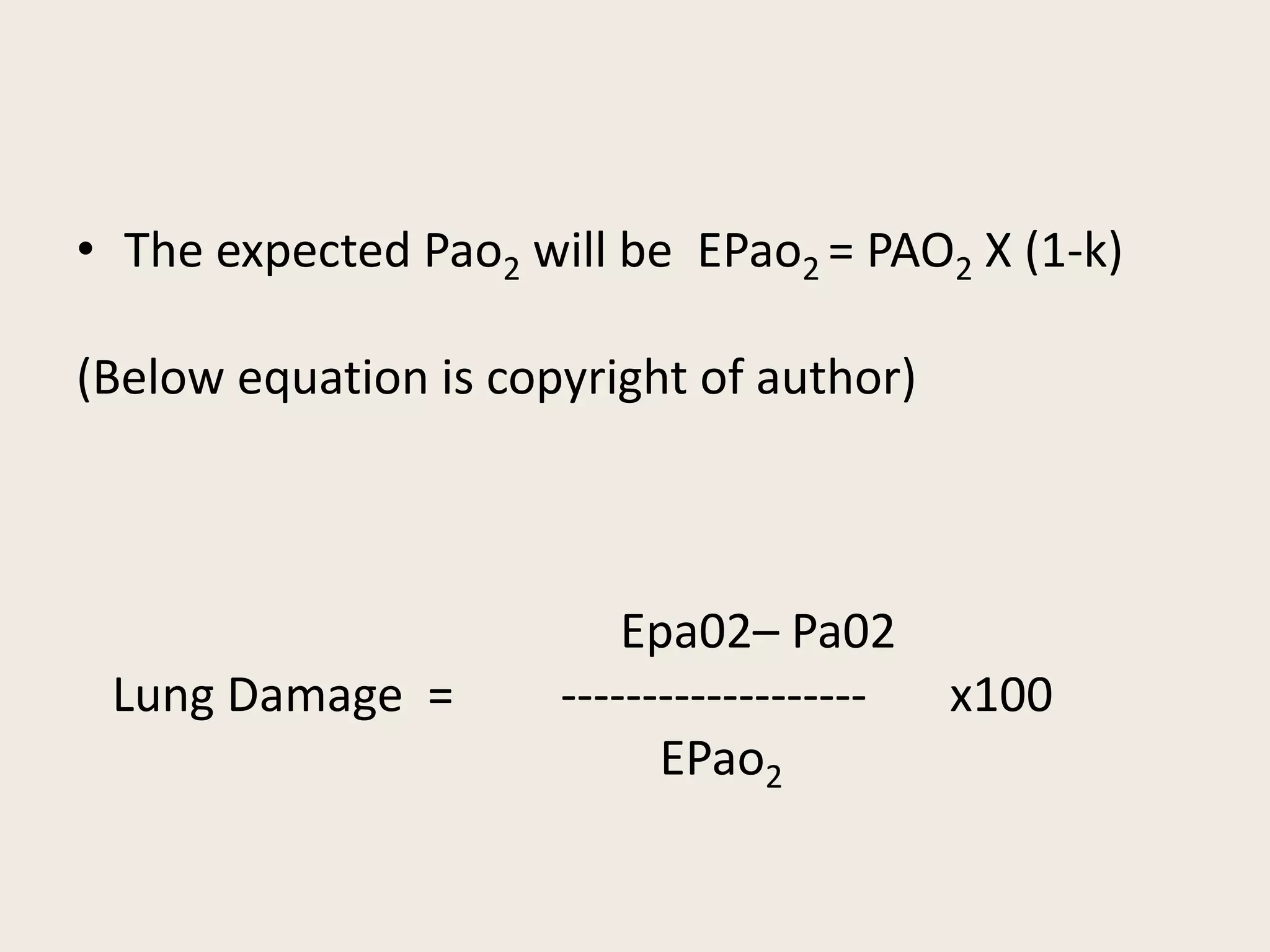
• The expected Pao2 will be EPao2 = PAO2 X (1-k)
(Below equation is copyright of author)
Epa02– Pa02
Lung Damage = ------------------- x100
EPao2
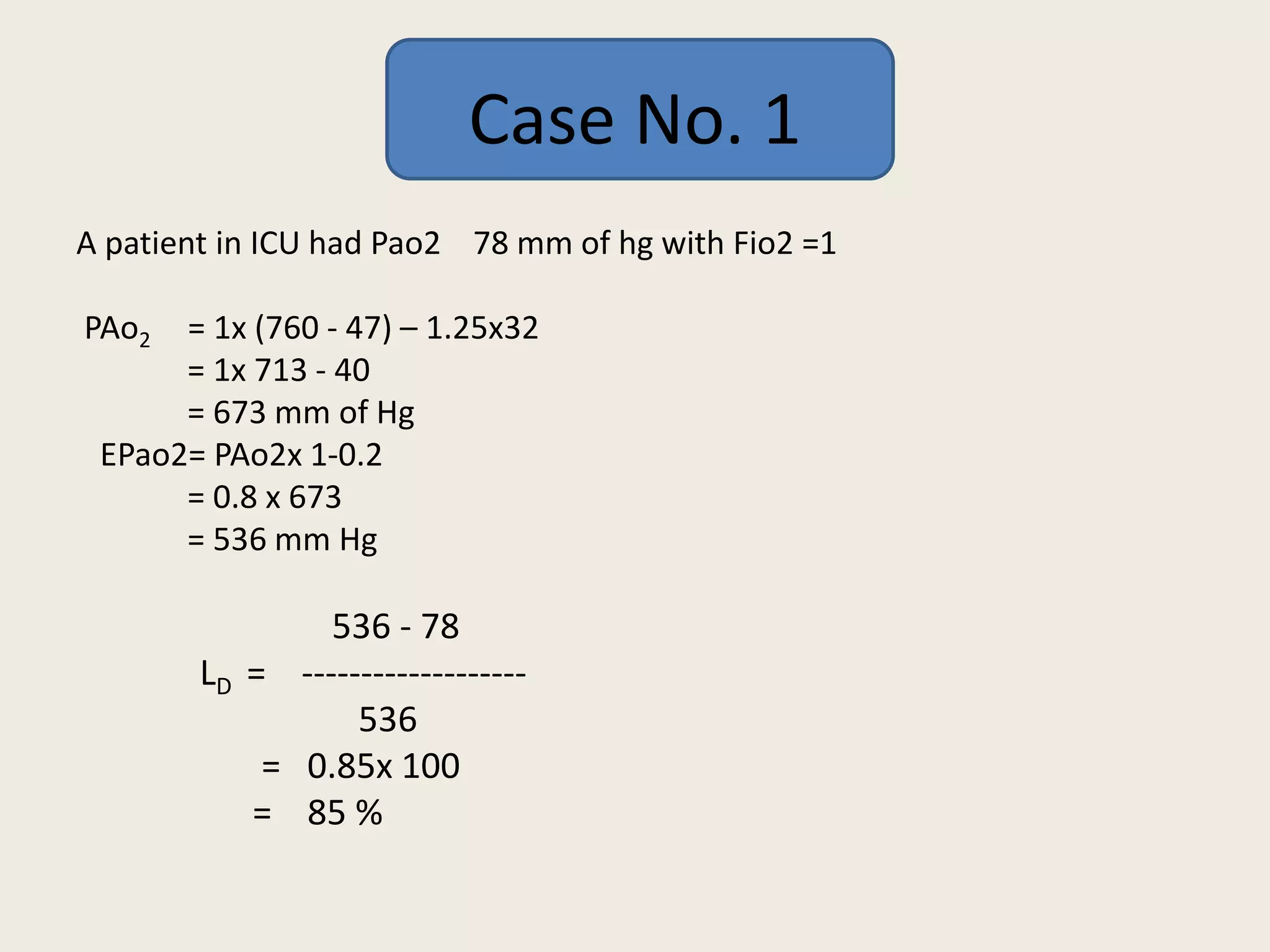
Case No. 1
A patient in ICU had Pao2 78 mm of hg with Fio2 =1
PAo2 = 1x (760 - 47) – 1.25x32
= 1x 713 - 40
= 673 mm of Hg
EPao2= PAo2x 1-0.2
= 0.8 x 673
= 536 mm Hg
536 - 78
LD = -------------------
536
= 0.85x 100
= 85 %
CASE NO.2
A patient posted for thoracotomy the ABG showed Pao2=57
PAo2 = 0.2 x (760-47) – 1.25x32
=147-40
=107
EPao2 = 0.95x PAo2
= 0.95 x 107
=101mm of Hg
101 - 57
LD = ----------------- x 100
101
= 44 %
CONCLUSION
Here we conclude that whenever the ABG reports
are read in one must take in account the Fio2 and
atmospheric pressure. Using the above equation we
will be able to assess the lung damage correctly to
manage the patients who are appearing normal as
per Pao2 available.

ABG ANALYSIS

  • 1.
    ASSESMENT OF LUNG PARENCHYMALDAMAGE WITH ARTERIAL BLOOD GAS ANALYSIS (ABG) PROF.N.K.AGRAWAL
  • 2.
    OBJECTIVE The objective ofthe study was to assess the lung damage at alveoli level with arterial blood gas analysis (ABG)
  • 3.
    The major taskof the lung is to oxygenate the blood and remove carbon dioxide, this happens by exchange of gas between alveoli and blood capillary. Oxygen diffuses passively from the alveoli to plasma. The diffusion is affected by- Surface area available Thickness of membrane Pressure difference of the gas across the barrier Molecular weight of the gas Solubility of gas.
  • 4.
    The alveoli aremain respiratory surface in human being, they are small sacs of branching of bronchioles, and they are one cell thick and provide large area for gas exchange If all other factors are kept constant the main factor are surface area and thickness of alveoli. The gas exchange is hence inversely proportionate to thickness, the more is the thickness less will be diffusion. Patients with chronic bronchitis, COPD, fibrosis pneumonia, ARDS etc have changes in thickness and surface area.2
  • 5.
    RESPIRATORY EQUATIONS PATM =PN 2+Po2+Pco2+PH2O P760 = P514 + P159 + P40 + P47 PI02 = FIO2 X ( PB - -- H2 0 ) PAO2 = FiO2 x ( Pb- 47 ) - 1.25 x PCO2
  • 6.
    The normal P( A-a) O2 difference at patient breathing air is 5 to 20 mm of Hg while at Fio2 of 1 it may go up to 110 mm of Hg. The A-a gradient increases by5-7 mm of Hg with every 10% rise of FIO2 Expected Pao2 = PAo2 X ( 1- k ) (k = 0.05 at 20-40 %, 0.1 at 41- 60%,0.15 at 61-80%,0.2 at 81-100 % FIO2 )
  • 7.
    • The expectedPao2 will be EPao2 = PAO2 X (1-k) (Below equation is copyright of author) Epa02– Pa02 Lung Damage = ------------------- x100 EPao2
  • 8.
    Case No. 1 Apatient in ICU had Pao2 78 mm of hg with Fio2 =1 PAo2 = 1x (760 - 47) – 1.25x32 = 1x 713 - 40 = 673 mm of Hg EPao2= PAo2x 1-0.2 = 0.8 x 673 = 536 mm Hg 536 - 78 LD = ------------------- 536 = 0.85x 100 = 85 %
  • 9.
    CASE NO.2 A patientposted for thoracotomy the ABG showed Pao2=57 PAo2 = 0.2 x (760-47) – 1.25x32 =147-40 =107 EPao2 = 0.95x PAo2 = 0.95 x 107 =101mm of Hg 101 - 57 LD = ----------------- x 100 101 = 44 %
  • 10.
    CONCLUSION Here we concludethat whenever the ABG reports are read in one must take in account the Fio2 and atmospheric pressure. Using the above equation we will be able to assess the lung damage correctly to manage the patients who are appearing normal as per Pao2 available.