The Assembled Web Getting Started with Social 25 August 2009 John Eckman, Sr. Practice Director, Optaros Labs
Agenda Context: The Assembled Web Social Media: How to Get Started Mobile: The iPhone Effect Social Networks: Facebook
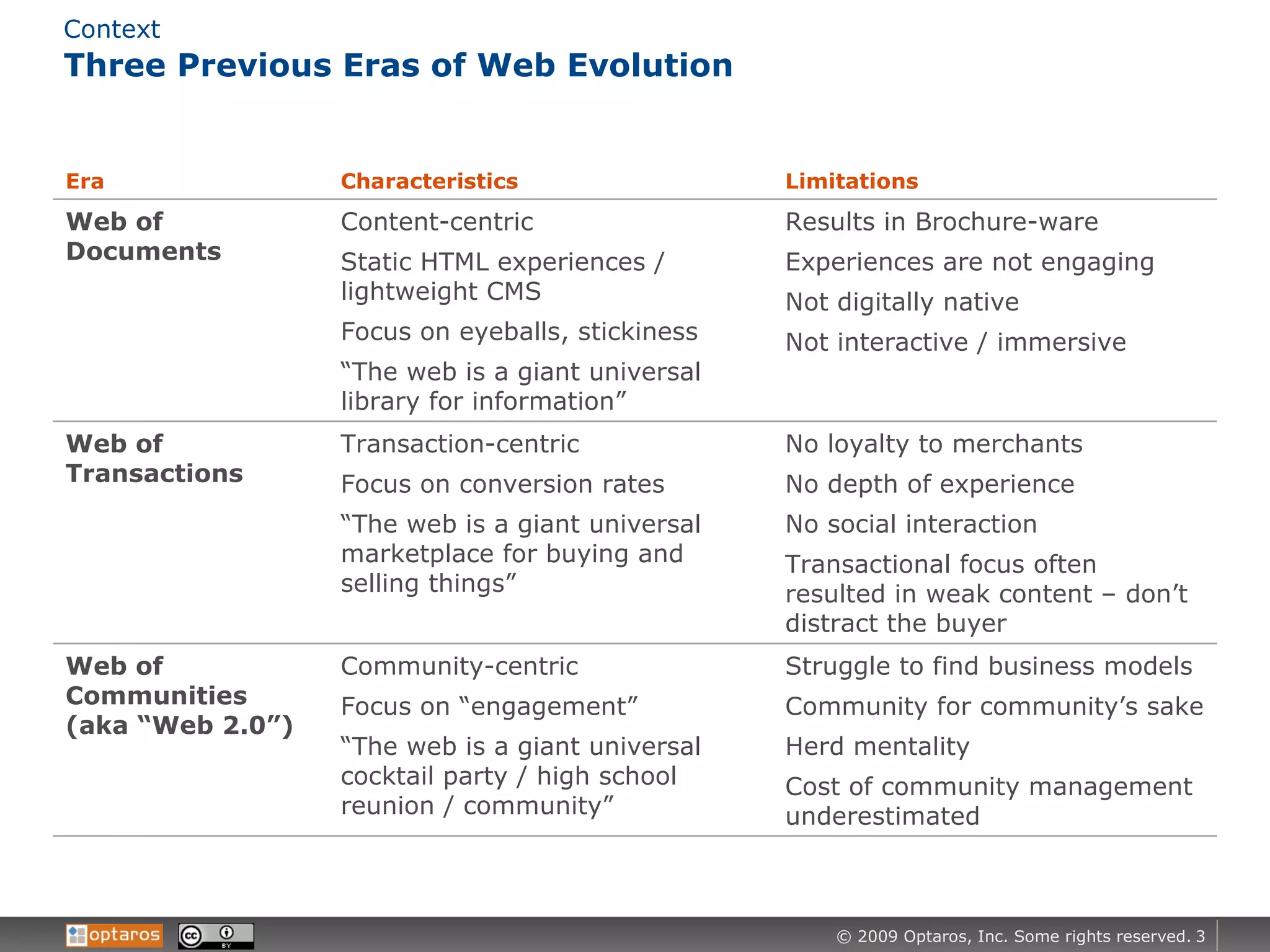
Three Previous Eras of Web Evolution Context Era Characteristics Limitations Web of Documents Content-centric Static HTML experiences / lightweight CMS Focus on eyeballs, stickiness “ The web is a giant universal library for information” Results in Brochure-ware Experiences are not engaging Not digitally native Not interactive / immersive Web of Transactions Transaction-centric Focus on conversion rates “ The web is a giant universal marketplace for buying and selling things” No loyalty to merchants No depth of experience No social interaction Transactional focus often resulted in weak content – don’t distract the buyer Web of Communities (aka “Web 2.0”) Community-centric Focus on “engagement”  “ The web is a giant universal cocktail party / high school reunion / community” Struggle to find business models Community for community’s sake Herd mentality Cost of community management underestimated
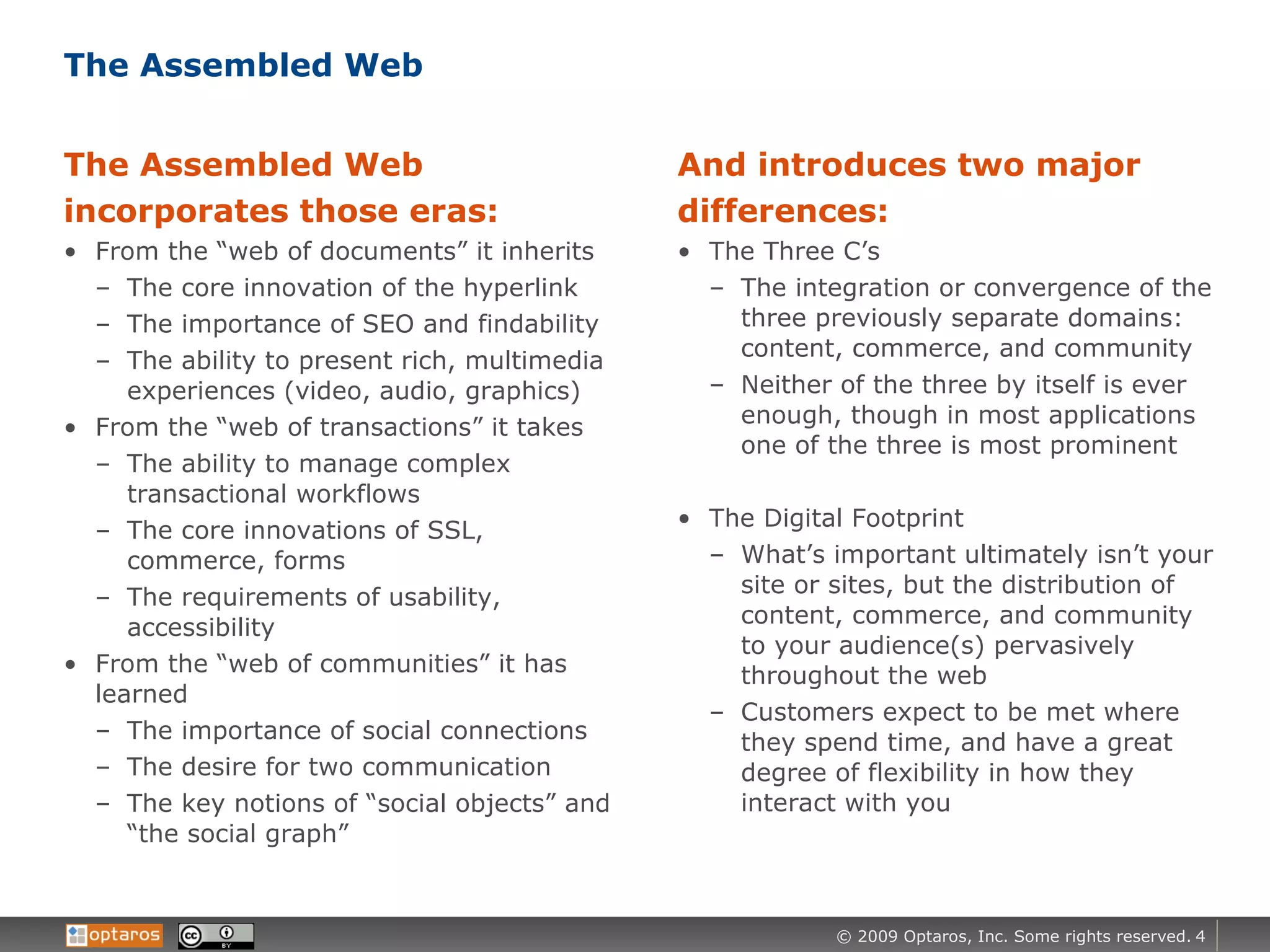
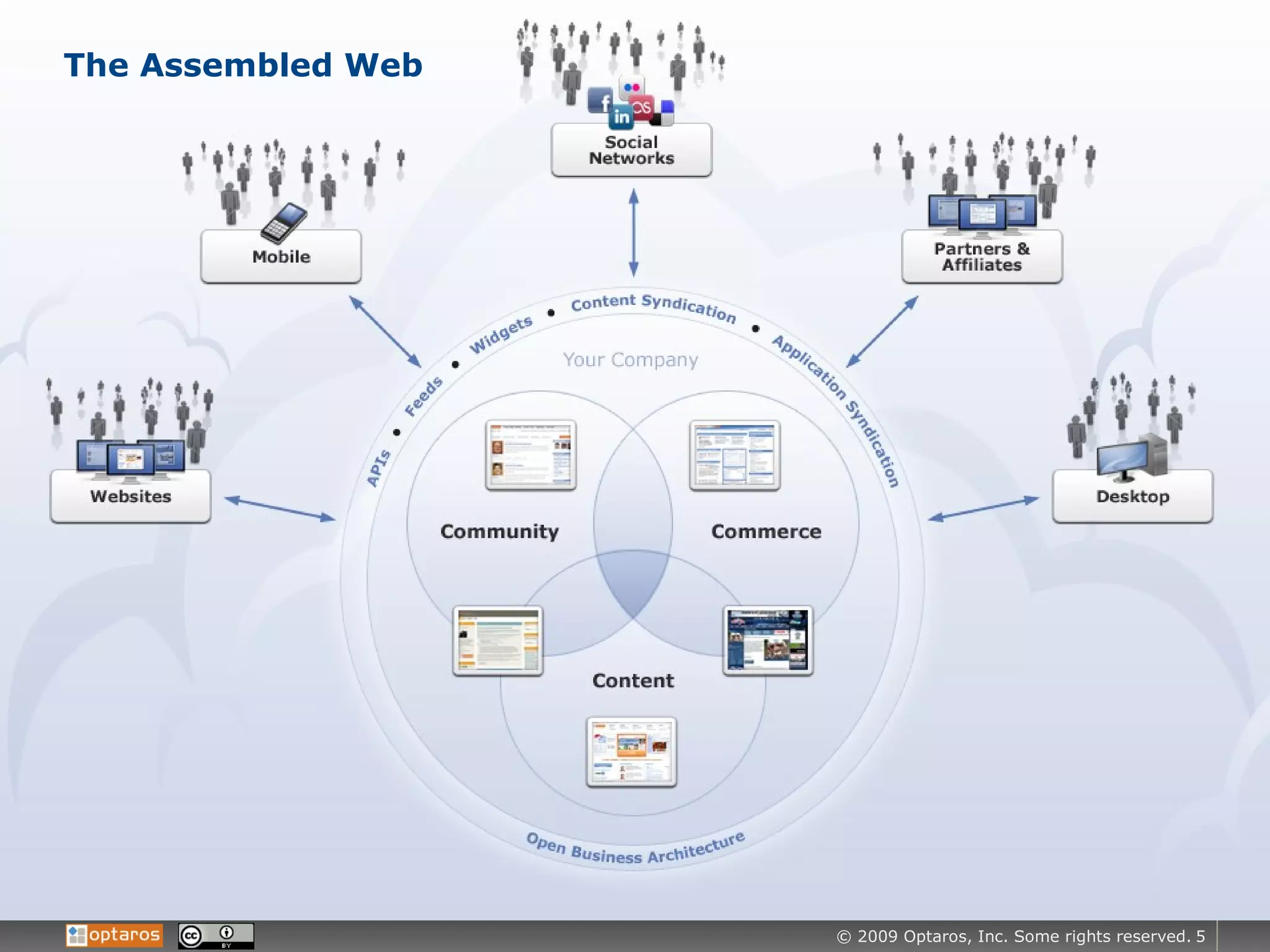
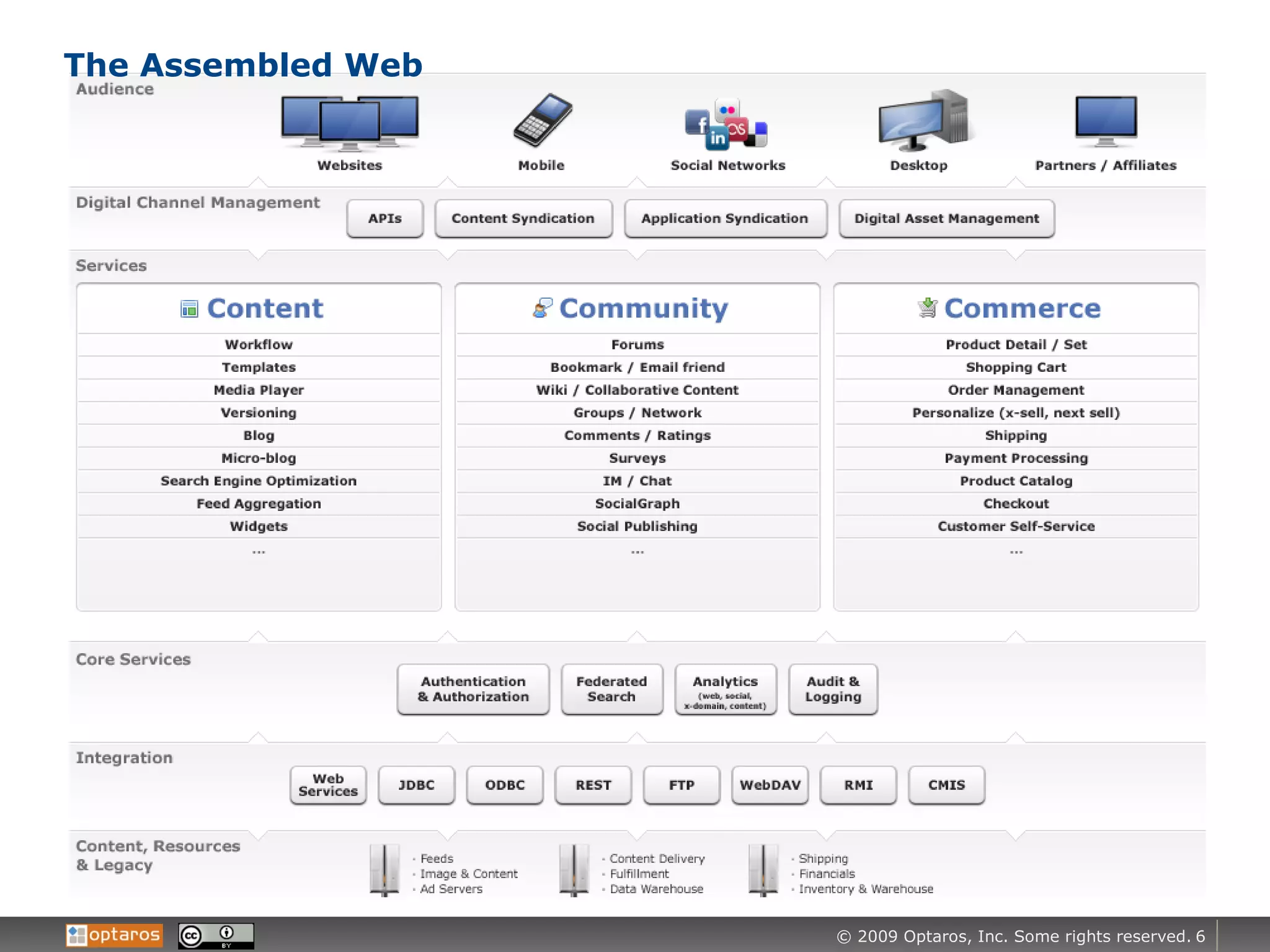
The Assembled Web The Assembled Web incorporates those eras: From the “web of documents” it inherits The core innovation of the hyperlink The importance of SEO and findability The ability to present rich, multimedia experiences (video, audio, graphics) From the “web of transactions” it takes The ability to manage complex transactional workflows The core innovations of SSL, commerce, forms The requirements of usability, accessibility  From the “web of communities” it has learned The importance of social connections The desire for two communication The key notions of “social objects” and “the social graph” And introduces two major differences: The Three C’s The integration or convergence of the three previously separate domains: content, commerce, and community Neither of the three by itself is ever enough, though in most applications one of the three is most prominent The Digital Footprint What’s important ultimately isn’t your site or sites, but the distribution of content, commerce, and community to your audience(s) pervasively throughout the web Customers expect to be met where they spend time, and have a great degree of flexibility in how they interact with you
The Assembled Web
The Assembled Web
Agenda Context: The Assembled Web Social Media: How to Get Started Mobile: The iPhone Effect Social Network Applications: Facebook, Open Social
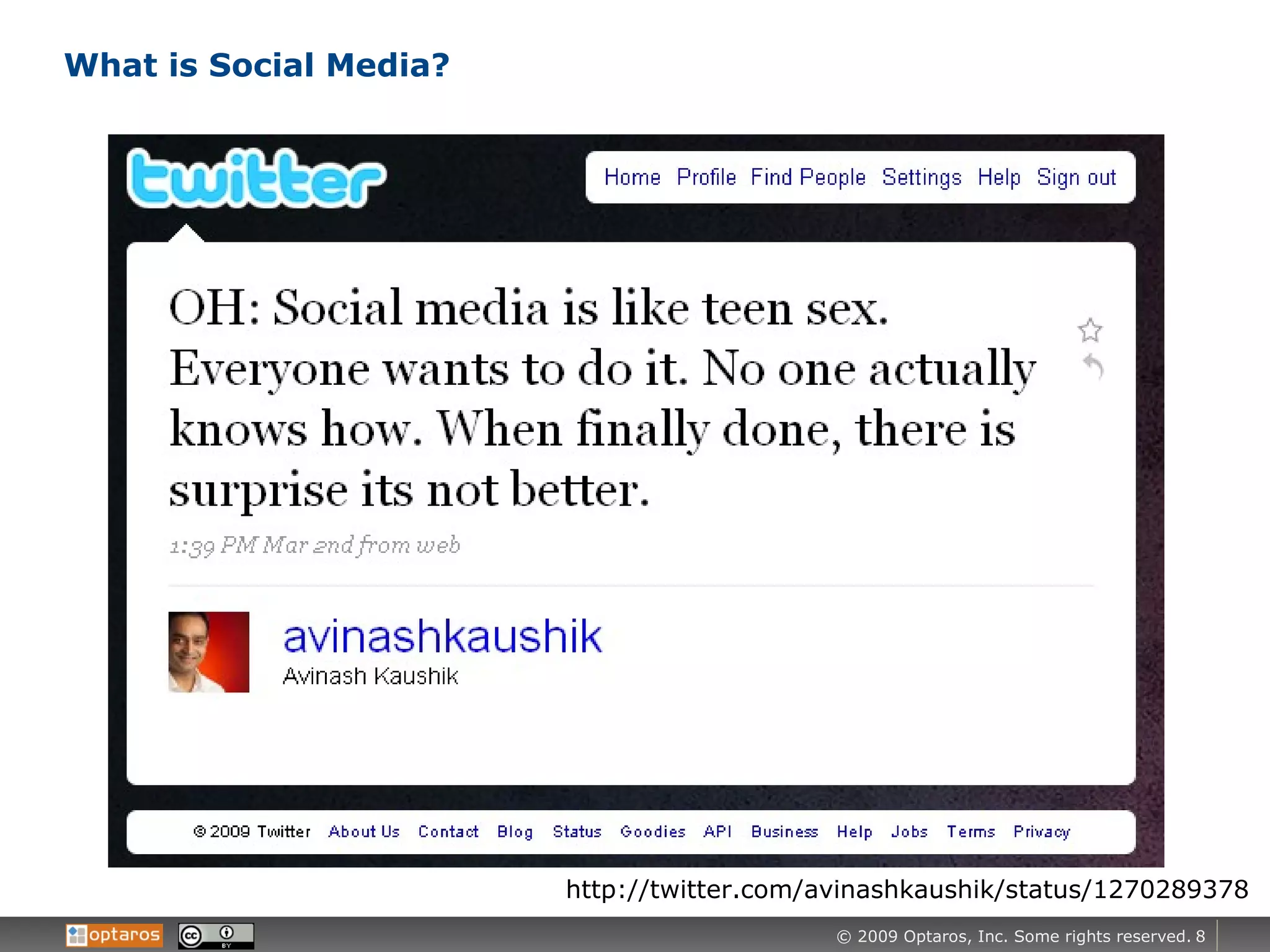
What is Social Media? http://twitter.com/avinashkaushik/status/1270289378
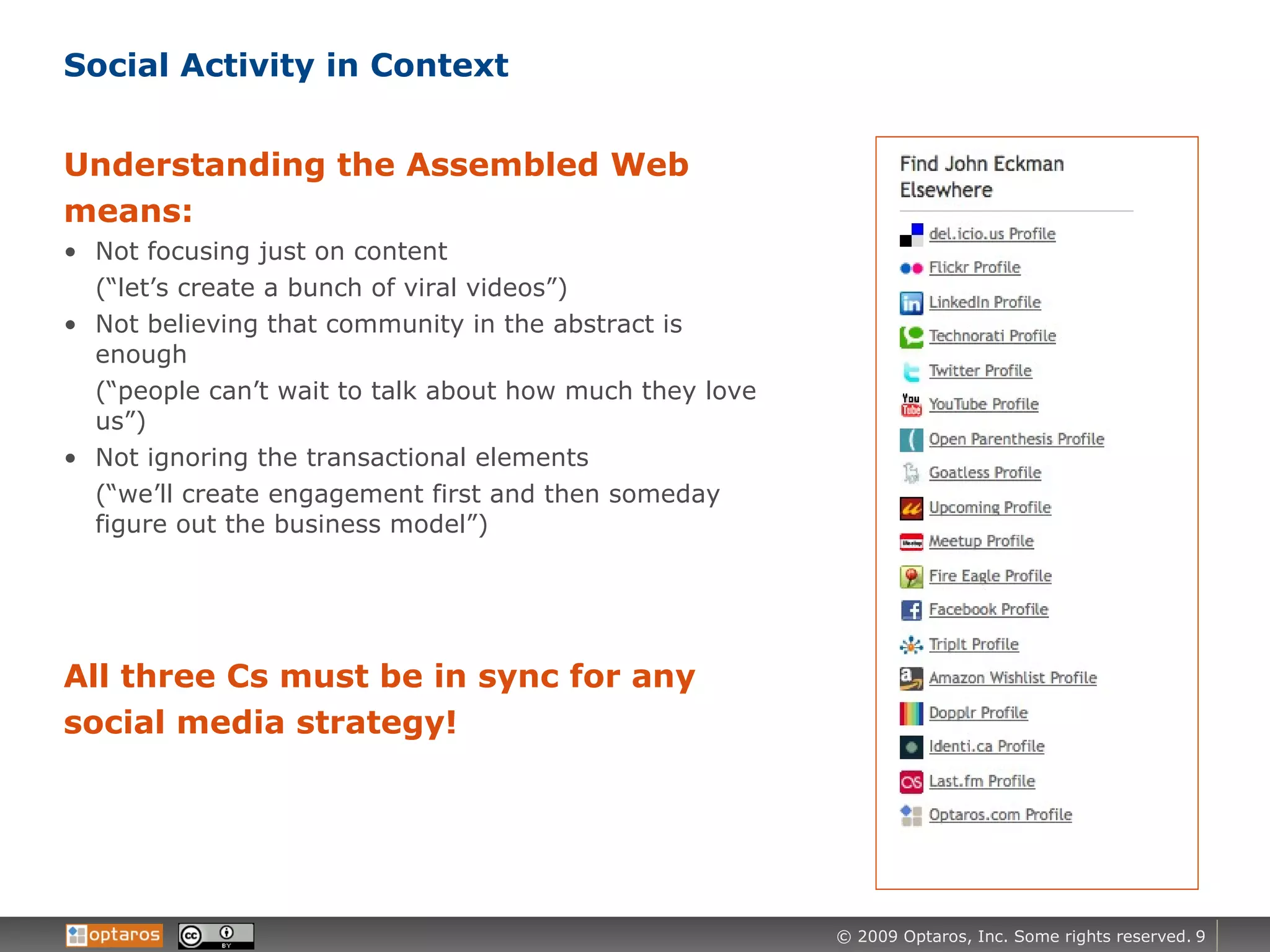
Social Activity in Context Understanding the Assembled Web means: Not focusing just on content  (“let’s create a bunch of viral videos”) Not believing that community in the abstract is enough  (“people can’t wait to talk about how much they love us”) Not ignoring the transactional elements  (“we’ll create engagement first and then someday figure out the business model”) All three Cs must be in sync for any social media strategy!
Two Models for Getting Started P.O.S.T.: People: Assess your customers social activities Objectives: Decide what you want to accomplish Strategy: Plan for how relationships with customers will change Tactics: Decide which social technologies to use Forrester Research, in  Groundswell L.E.A.D.: Listen: Understand what’s being said about you across the web in various contexts Experiment: Engage with customers in a controlled but real fashion - pilots Apply: Make those experiments useful, connect them to your existing web presence Develop: Build on existing successes, integrate more over time into core experience of the brand McKinsey Quarterly, “Managing Beyond Web 2.0”
Getting Started What kind of listening can you do? Real Time Search Engines: Scoopler, One Riot, Social Mention, Topsy, Twitter Search, Radian6, ScoutLabs, dna13 Alerts: Tweet Beep, Tweet Later, Google Alerts, Technorati Existing Public Communities: Where is the conversation happening? Hosted Private Communities: Customer council, advisory board, beta users group What audiences are you after? What do they want? No longer any rational excuse for guessing Decision makers & buyers versus end-users Broader community of interest  What do you hope to accomplish via social media & social networking? Better awareness of consumer attitudes, perceptions, feedback on programs? Influence over brand awareness? Increased enrollment in programs by eligible end users? (More users / more use?) Increased pool of eligible users / better market penetration? How can you achieve those objectives? List of potential platforms is large and growing  Align target platforms and actions to objectives
Key Social Computing Principles Primary Utility The best (and most sustained) social applications first provide value to the individual, even if he’s the only one who ever uses it Mutual Benefit The user(s) have to see benefit (in their terms) or they won’t return The host(s) have to see benefit (in their terms) or they will stop participating Social Media is not a Cure-All If you have an image problem, social media may be able to help; if you have a reality problem, social media will only make it worse If your core business fundamentals are poor, fix those before (or at least in parallel with) focusing on social media Social == Two Way If you are not as an organization willing to actually engage with users in the broader community, social media may not be for you If you intend to use social media purely to broadcast and not to listen, the community will learn (and quickly!) to ignore you
Agenda Context: The Assembled Web Strategy: How to Get Started Mobile: The iPhone Effect Social Network Applications: Facebook, Open Social
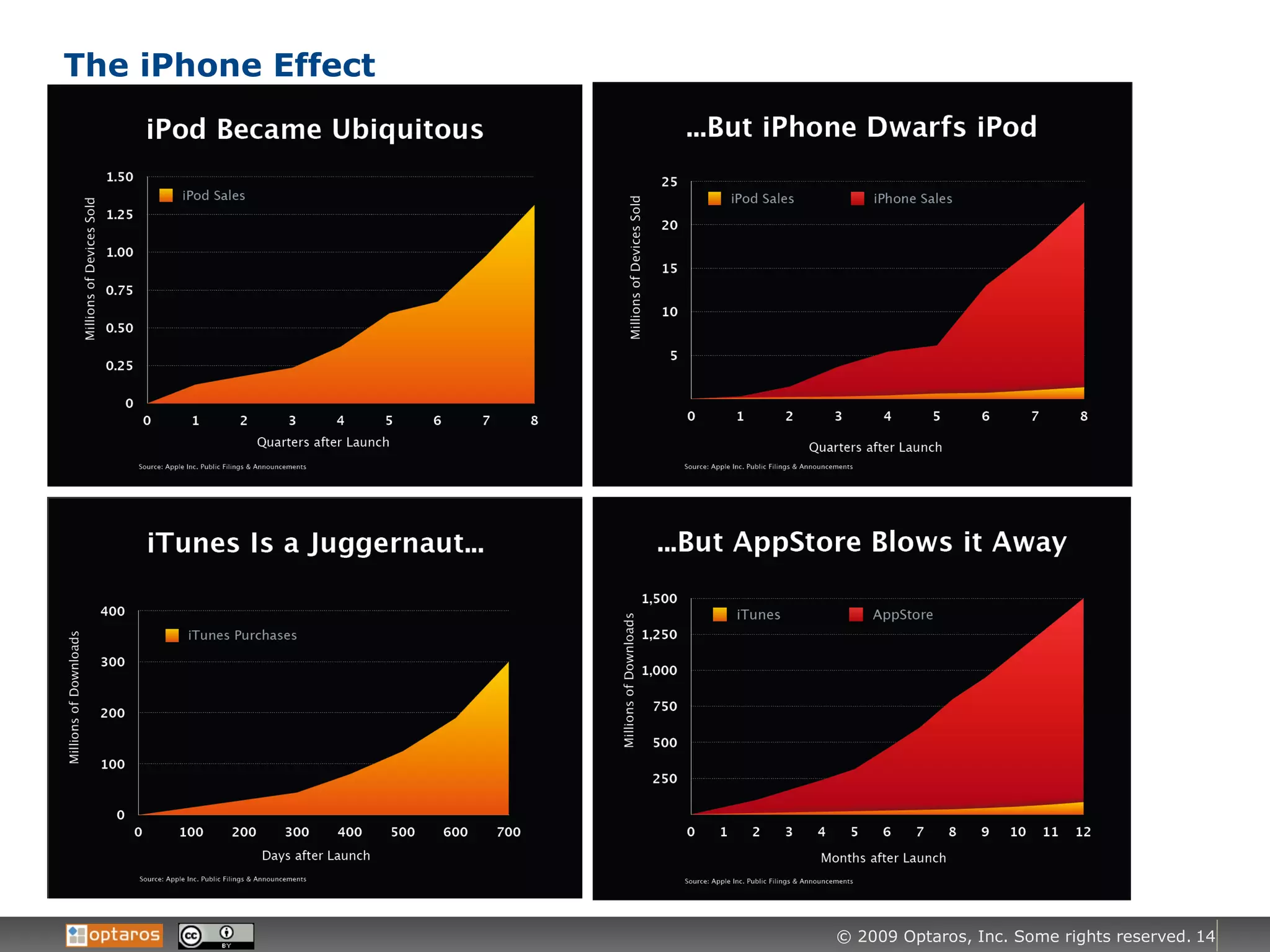
The iPhone Effect
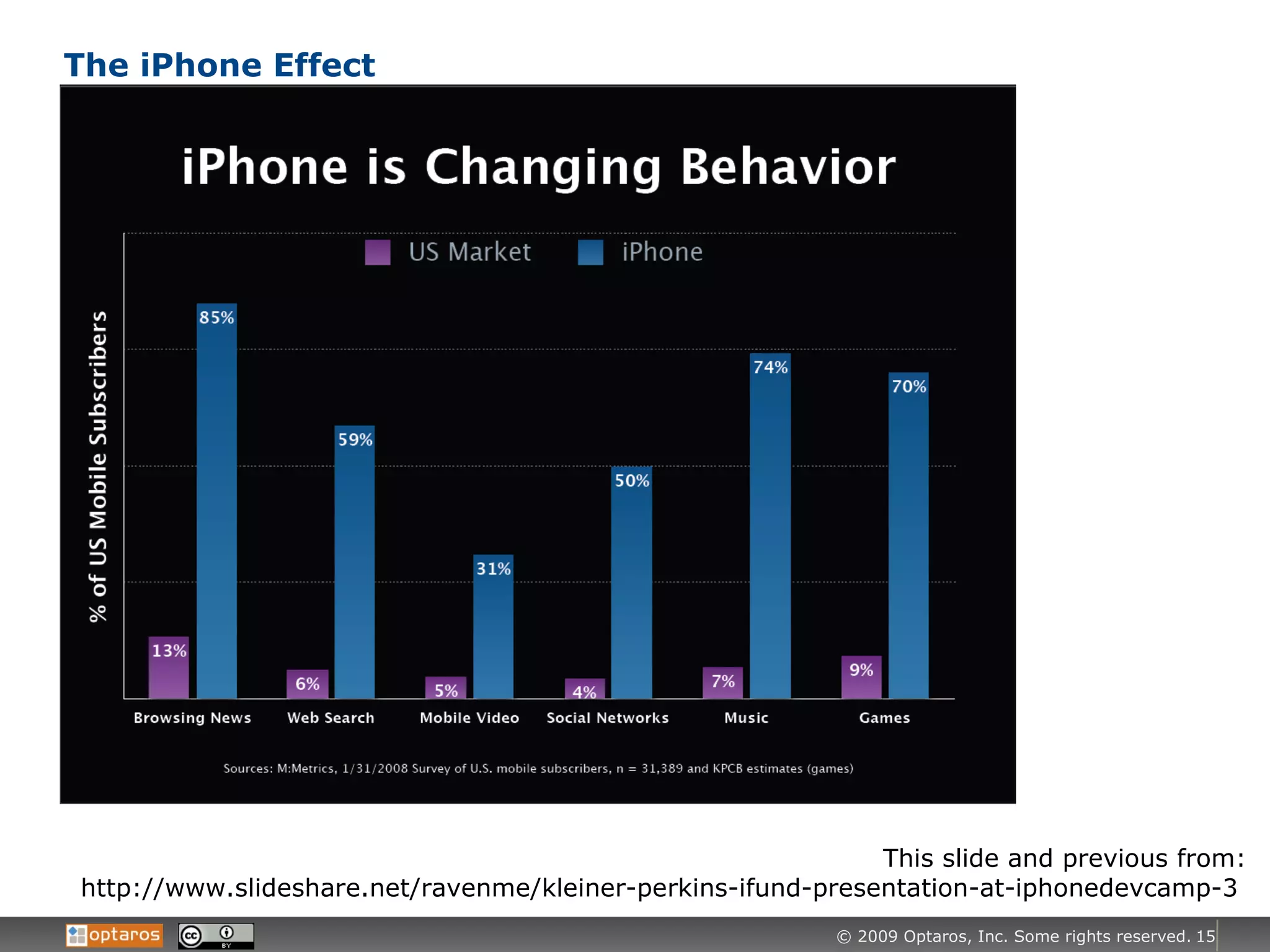
The iPhone Effect This slide and previous from: http://www.slideshare.net/ravenme/kleiner-perkins-ifund-presentation-at-iphonedevcamp-3
iPhone Considerations Mobile Web versus Installed Application iPhone native applications are developed with Apple SDK, have access to all native APIs (location awareness, push notification, orientation, stored data) iPhone mobile applications leverage existing web infrastructure and target Safari mobile browser “ Best on this device” = Native; “Most leverage for all devices, lower cost” = Web The importance of constrained design Don’t make a stripped down version of the web application – focus on key scenarios, activities What’s the minimum set of interactions which, if enabled, would make the application a compelling supplement to the web applications, first – then what set would make the application a compelling replacement Beware Shiny Object syndrome You do not need to have an iPhone application simply because others do It’s easy to get lost in the App Store, or on the phone once installed Be sure to align mobile strategy to broader business strategy Iterate Release early and often Prove out baseline functionality then build on success
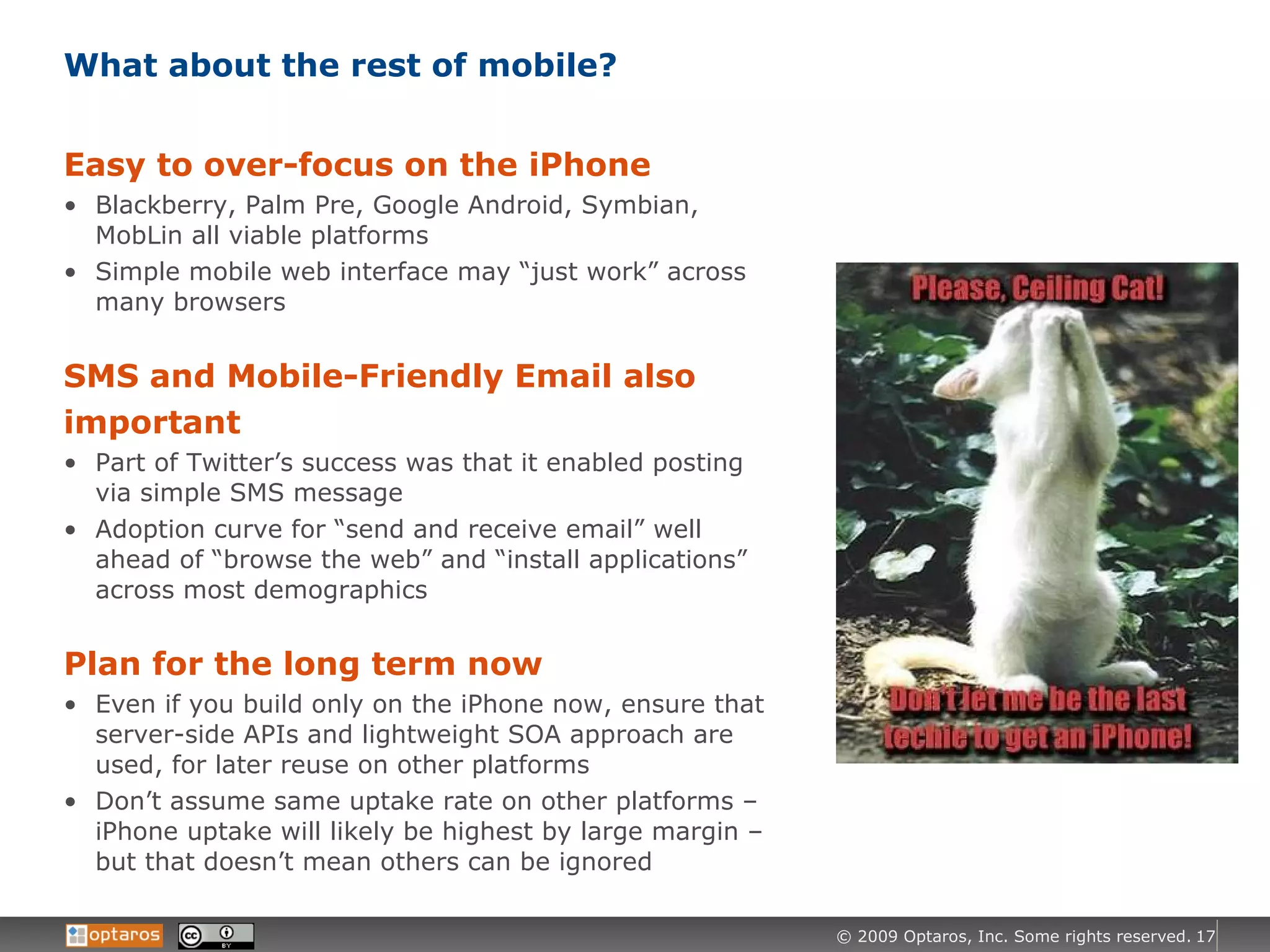
What about the rest of mobile? Easy to over-focus on the iPhone Blackberry, Palm Pre, Google Android, Symbian, MobLin all viable platforms Simple mobile web interface may “just work” across many browsers SMS and Mobile-Friendly Email also important Part of Twitter’s success was that it enabled posting via simple SMS message Adoption curve for “send and receive email” well ahead of “browse the web” and “install applications” across most demographics Plan for the long term now Even if you build only on the iPhone now, ensure that server-side APIs and lightweight SOA approach are used, for later reuse on other platforms Don’t assume same uptake rate on other platforms – iPhone uptake will likely be highest by large margin – but that doesn’t mean others can be ignored
Agenda Context: The Assembled Web Strategy: How to Get Started Mobile: The iPhone Effect Social Network Applications: Facebook, Open Social
Facebook
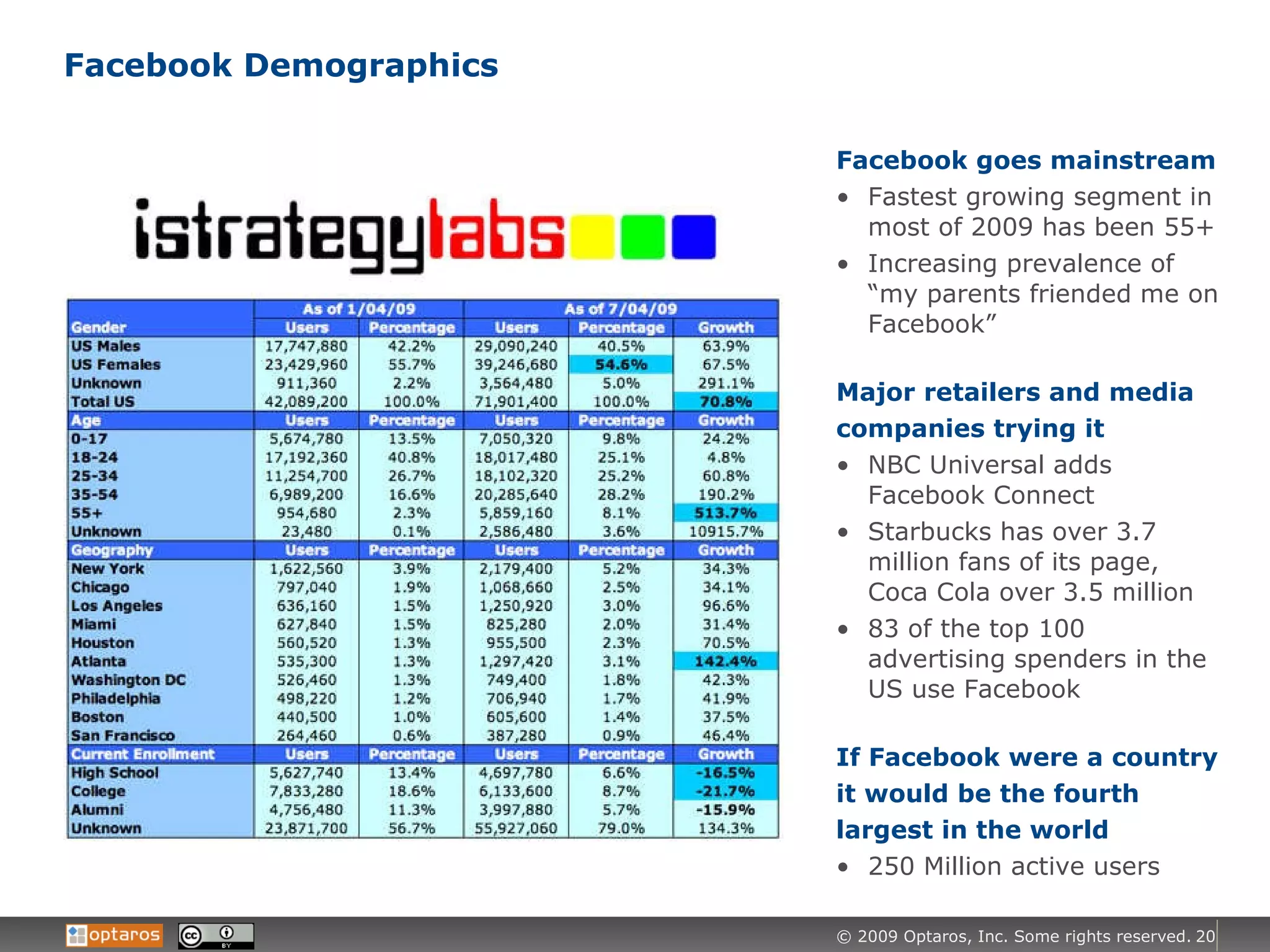
Facebook Demographics Facebook goes mainstream Fastest growing segment in most of 2009 has been 55+ Increasing prevalence of “my parents friended me on Facebook” Major retailers and media companies trying it NBC Universal adds Facebook Connect Starbucks has over 3.7 million fans of its page, Coca Cola over 3.5 million 83 of the top 100 advertising spenders in the US use Facebook If Facebook were a country it would be the fourth largest in the world 250 Million active users
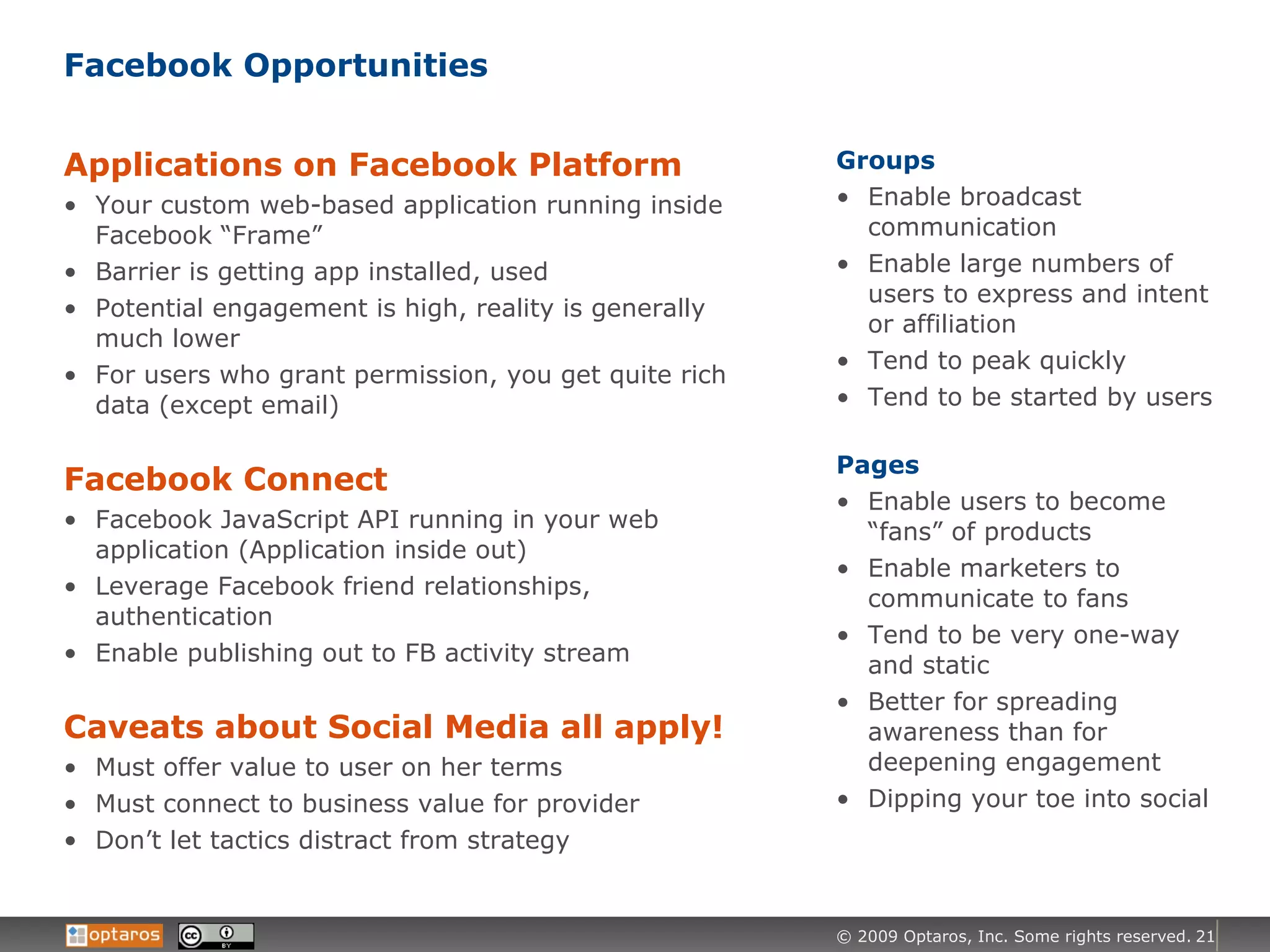
Facebook Opportunities Applications on Facebook Platform Your custom web-based application running inside Facebook “Frame” Barrier is getting app installed, used Potential engagement is high, reality is generally much lower For users who grant permission, you get quite rich data (except email) Facebook Connect Facebook JavaScript API running in your web application (Application inside out) Leverage Facebook friend relationships, authentication Enable publishing out to FB activity stream Caveats about Social Media all apply! Must offer value to user on her terms Must connect to business value for provider Don’t let tactics distract from strategy Groups Enable broadcast communication Enable large numbers of users to express and intent or affiliation Tend to peak quickly Tend to be started by users Pages Enable users to become “fans” of products Enable marketers to communicate to fans Tend to be very one-way and static Better for spreading awareness than for deepening engagement Dipping your toe into social
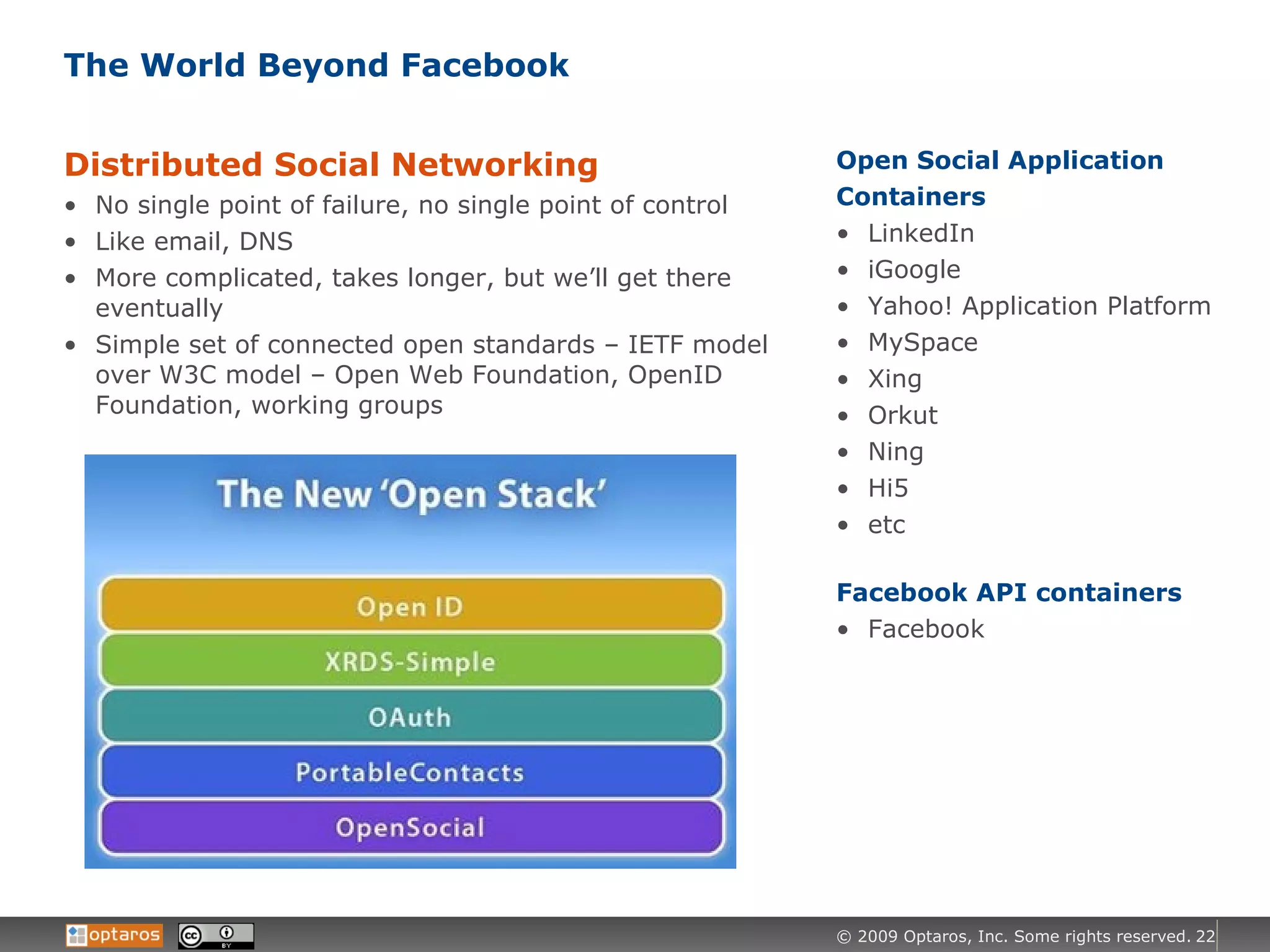
The World Beyond Facebook Distributed Social Networking No single point of failure, no single point of control Like email, DNS More complicated, takes longer, but we’ll get there eventually Simple set of connected open standards – IETF model over W3C model – Open Web Foundation, OpenID Foundation, working groups Open Social Application Containers LinkedIn iGoogle Yahoo! Application Platform MySpace Xing Orkut Ning Hi5 etc Facebook API containers Facebook
Thanks John Eckman [email_address] http://twitter.com/jeckman http://www.optaros.com/ http://www.openparenthesis.org/

Assembled Web And Social Media

  • 1.
    The Assembled WebGetting Started with Social 25 August 2009 John Eckman, Sr. Practice Director, Optaros Labs
  • 2.
    Agenda Context: TheAssembled Web Social Media: How to Get Started Mobile: The iPhone Effect Social Networks: Facebook
  • 3.
    Three Previous Erasof Web Evolution Context Era Characteristics Limitations Web of Documents Content-centric Static HTML experiences / lightweight CMS Focus on eyeballs, stickiness “ The web is a giant universal library for information” Results in Brochure-ware Experiences are not engaging Not digitally native Not interactive / immersive Web of Transactions Transaction-centric Focus on conversion rates “ The web is a giant universal marketplace for buying and selling things” No loyalty to merchants No depth of experience No social interaction Transactional focus often resulted in weak content – don’t distract the buyer Web of Communities (aka “Web 2.0”) Community-centric Focus on “engagement” “ The web is a giant universal cocktail party / high school reunion / community” Struggle to find business models Community for community’s sake Herd mentality Cost of community management underestimated
  • 4.
    The Assembled WebThe Assembled Web incorporates those eras: From the “web of documents” it inherits The core innovation of the hyperlink The importance of SEO and findability The ability to present rich, multimedia experiences (video, audio, graphics) From the “web of transactions” it takes The ability to manage complex transactional workflows The core innovations of SSL, commerce, forms The requirements of usability, accessibility From the “web of communities” it has learned The importance of social connections The desire for two communication The key notions of “social objects” and “the social graph” And introduces two major differences: The Three C’s The integration or convergence of the three previously separate domains: content, commerce, and community Neither of the three by itself is ever enough, though in most applications one of the three is most prominent The Digital Footprint What’s important ultimately isn’t your site or sites, but the distribution of content, commerce, and community to your audience(s) pervasively throughout the web Customers expect to be met where they spend time, and have a great degree of flexibility in how they interact with you
  • 5.
  • 6.
  • 7.
    Agenda Context: TheAssembled Web Social Media: How to Get Started Mobile: The iPhone Effect Social Network Applications: Facebook, Open Social
  • 8.
    What is SocialMedia? http://twitter.com/avinashkaushik/status/1270289378
  • 9.
    Social Activity inContext Understanding the Assembled Web means: Not focusing just on content (“let’s create a bunch of viral videos”) Not believing that community in the abstract is enough (“people can’t wait to talk about how much they love us”) Not ignoring the transactional elements (“we’ll create engagement first and then someday figure out the business model”) All three Cs must be in sync for any social media strategy!
  • 10.
    Two Models forGetting Started P.O.S.T.: People: Assess your customers social activities Objectives: Decide what you want to accomplish Strategy: Plan for how relationships with customers will change Tactics: Decide which social technologies to use Forrester Research, in Groundswell L.E.A.D.: Listen: Understand what’s being said about you across the web in various contexts Experiment: Engage with customers in a controlled but real fashion - pilots Apply: Make those experiments useful, connect them to your existing web presence Develop: Build on existing successes, integrate more over time into core experience of the brand McKinsey Quarterly, “Managing Beyond Web 2.0”
  • 11.
    Getting Started Whatkind of listening can you do? Real Time Search Engines: Scoopler, One Riot, Social Mention, Topsy, Twitter Search, Radian6, ScoutLabs, dna13 Alerts: Tweet Beep, Tweet Later, Google Alerts, Technorati Existing Public Communities: Where is the conversation happening? Hosted Private Communities: Customer council, advisory board, beta users group What audiences are you after? What do they want? No longer any rational excuse for guessing Decision makers & buyers versus end-users Broader community of interest What do you hope to accomplish via social media & social networking? Better awareness of consumer attitudes, perceptions, feedback on programs? Influence over brand awareness? Increased enrollment in programs by eligible end users? (More users / more use?) Increased pool of eligible users / better market penetration? How can you achieve those objectives? List of potential platforms is large and growing Align target platforms and actions to objectives
  • 12.
    Key Social ComputingPrinciples Primary Utility The best (and most sustained) social applications first provide value to the individual, even if he’s the only one who ever uses it Mutual Benefit The user(s) have to see benefit (in their terms) or they won’t return The host(s) have to see benefit (in their terms) or they will stop participating Social Media is not a Cure-All If you have an image problem, social media may be able to help; if you have a reality problem, social media will only make it worse If your core business fundamentals are poor, fix those before (or at least in parallel with) focusing on social media Social == Two Way If you are not as an organization willing to actually engage with users in the broader community, social media may not be for you If you intend to use social media purely to broadcast and not to listen, the community will learn (and quickly!) to ignore you
  • 13.
    Agenda Context: TheAssembled Web Strategy: How to Get Started Mobile: The iPhone Effect Social Network Applications: Facebook, Open Social
  • 14.
  • 15.
    The iPhone EffectThis slide and previous from: http://www.slideshare.net/ravenme/kleiner-perkins-ifund-presentation-at-iphonedevcamp-3
  • 16.
    iPhone Considerations MobileWeb versus Installed Application iPhone native applications are developed with Apple SDK, have access to all native APIs (location awareness, push notification, orientation, stored data) iPhone mobile applications leverage existing web infrastructure and target Safari mobile browser “ Best on this device” = Native; “Most leverage for all devices, lower cost” = Web The importance of constrained design Don’t make a stripped down version of the web application – focus on key scenarios, activities What’s the minimum set of interactions which, if enabled, would make the application a compelling supplement to the web applications, first – then what set would make the application a compelling replacement Beware Shiny Object syndrome You do not need to have an iPhone application simply because others do It’s easy to get lost in the App Store, or on the phone once installed Be sure to align mobile strategy to broader business strategy Iterate Release early and often Prove out baseline functionality then build on success
  • 17.
    What about therest of mobile? Easy to over-focus on the iPhone Blackberry, Palm Pre, Google Android, Symbian, MobLin all viable platforms Simple mobile web interface may “just work” across many browsers SMS and Mobile-Friendly Email also important Part of Twitter’s success was that it enabled posting via simple SMS message Adoption curve for “send and receive email” well ahead of “browse the web” and “install applications” across most demographics Plan for the long term now Even if you build only on the iPhone now, ensure that server-side APIs and lightweight SOA approach are used, for later reuse on other platforms Don’t assume same uptake rate on other platforms – iPhone uptake will likely be highest by large margin – but that doesn’t mean others can be ignored
  • 18.
    Agenda Context: TheAssembled Web Strategy: How to Get Started Mobile: The iPhone Effect Social Network Applications: Facebook, Open Social
  • 19.
  • 20.
    Facebook Demographics Facebookgoes mainstream Fastest growing segment in most of 2009 has been 55+ Increasing prevalence of “my parents friended me on Facebook” Major retailers and media companies trying it NBC Universal adds Facebook Connect Starbucks has over 3.7 million fans of its page, Coca Cola over 3.5 million 83 of the top 100 advertising spenders in the US use Facebook If Facebook were a country it would be the fourth largest in the world 250 Million active users
  • 21.
    Facebook Opportunities Applicationson Facebook Platform Your custom web-based application running inside Facebook “Frame” Barrier is getting app installed, used Potential engagement is high, reality is generally much lower For users who grant permission, you get quite rich data (except email) Facebook Connect Facebook JavaScript API running in your web application (Application inside out) Leverage Facebook friend relationships, authentication Enable publishing out to FB activity stream Caveats about Social Media all apply! Must offer value to user on her terms Must connect to business value for provider Don’t let tactics distract from strategy Groups Enable broadcast communication Enable large numbers of users to express and intent or affiliation Tend to peak quickly Tend to be started by users Pages Enable users to become “fans” of products Enable marketers to communicate to fans Tend to be very one-way and static Better for spreading awareness than for deepening engagement Dipping your toe into social
  • 22.
    The World BeyondFacebook Distributed Social Networking No single point of failure, no single point of control Like email, DNS More complicated, takes longer, but we’ll get there eventually Simple set of connected open standards – IETF model over W3C model – Open Web Foundation, OpenID Foundation, working groups Open Social Application Containers LinkedIn iGoogle Yahoo! Application Platform MySpace Xing Orkut Ning Hi5 etc Facebook API containers Facebook
  • 23.
    Thanks John Eckman[email_address] http://twitter.com/jeckman http://www.optaros.com/ http://www.openparenthesis.org/