HOW TO WRITE AN ARTICLE
To start – 1
Collect ideas and define the scope
What is your story (the subject of the research)?
How do you think you can draw more attention?
Which aspects of the topic do you want to convey to your
readers?
HOW TO WRITE AN ARTICLE
To start – 2
Identify an angle
Having defined the scope of what you want to
describe, consider how to capture the reader’s
attention via an original approach. Try to provide a
helpful contribution to any public debate on the topic.
HOW IS A NEWS
ARTICLE
STRUCTURED?
HOW TO WRITE AN ARTICLE
A concise and effective phrase, which must summarise the content of the text
and draw the reader’s attention.
Usually you write it after the article.
It can be a ‘warm’ title, intended to elicit emotions and create feeling (e.g. Terrible
fire devastates theatre), or ‘cold’, i.e. academic, intended solely to inform without
frills (e.g. Fire destroys theatre).
Sometimes, as you can see, a simple adjective can change the tone.
It is important that it reflects the truth.
THE TITLE
HOW TO WRITE AN ARTICLE
THE LEAD
Also known as the hook, i.e., the start of the article.
It is a very important part, as it aims to engage and start a
reflection on the topic.
The lead can be one of a number of types: enunciating
information, a fact or one of its peculiarities, a description of a
situation, the statement of one of the protagonists or witness of the
event, a question.
HOW TO WRITE AN ARTICLE
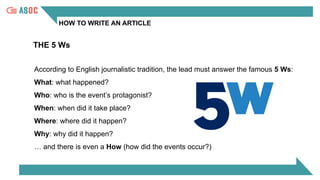
According to English journalistic tradition, the lead must answer the famous 5 Ws:
What: what happened?
Who: who is the event’s protagonist?
When: when did it take place?
Where: where did it happen?
Why: why did it happen?
… and there is even a How (how did the events occur?)
THE 5 Ws
HOW TO WRITE AN ARTICLE
THE BODY
The greater part of the article, where the central argument is made or
developed. It includes the "background", or contextual and surrounding
information, which can be helpful for framing the argument better.
In opinion articles, this section set out the idea and can rebut the opposing
position.
HOW TO WRITE AN ARTICLE
CONCLUSION
In the conclusion, summaries are drawn together and positions
restated. Usually, the article is concluded with an impactful phrase or
at least an incisive final thought.
10 HELPFUL TIPS
TO WRITE A GOOD ARTICLE
HOW TO WRITE AN ARTICLE
Create an outline
Develop an outline before starting to write.
It will serve as a guide to help you to understand where
you need more information and in what order to
present the information and facts. Follow a logical path
and avoid sudden jumps. Distribute balanced
information throughout the text.
1
HOW TO WRITE AN ARTICLE
Write the introduction (lead)
2
A convincing introductory paragraph is fundamental for capturing
attention.
While reading the initial phrases, the reader assesses whether it is
worth the effort to read the entire article. There are different ways
to start to write: use a direct quote from an interview, start with a
statistic …
HOW TO WRITE AN ARTICLE
3
Respect the rule of the 5 Ws
The best way to engage the reader is to respect the rule of the 5
Ws, or setting out who is the protagonist of the event you are
writing about, or Who, what happened, the What, plus When,
Where and Why.
HOW TO WRITE AN ARTICLE
4
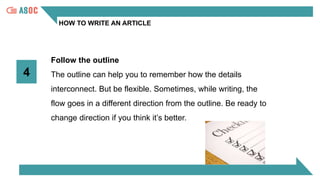
Follow the outline
The outline can help you to remember how the details
interconnect. But be flexible. Sometimes, while writing, the
flow goes in a different direction from the outline. Be ready to
change direction if you think it’s better.
HOW TO WRITE AN ARTICLE
5
Provide the right context
Do not presume that the reader knows as much as you do on the
subject. Think about the supporting information that the reader
needs. For example, you could write a paragraph that explains
the background of the argument before illustrating the data,
before then including and explaining the data itself.
HOW TO WRITE AN ARTICLE
6
Include transition words
Connect stand-alone ideas with transition terms, so that the
article forms a cohesive piece. Start each new paragraph with
a word that connects it to the previous one.
For example, words or expressions such as However,
Secondly or It’s worth remembering that.
HOW TO WRITE AN ARTICLE
7
Pay attention to the style, structure and tone
Use a style, structure and tone that makes sense for the chosen type
of article. Usually it’s better to write using accessible and direct
language.
Use hook phrases at the beginning of each paragraph. Vary the length
of phrases, both short and long. If you find that all phrases have more
or less the same number of words, you run the risk of sending the
reader to sleep with such a monotonous tone.
HOW TO WRITE AN ARTICLE
8
Write a convincing conclusion
Conclude the article dynamically. Depending on the piece, this part could
stimulate the reader to do something or learn more on the topic.
If you started with a statistic in the introduction, think about how to connect
this point in the conclusion.
Conclusions are more effective when they are direct and lead the public in
a direction that stimulates a thirst for more knowledge.
HOW TO WRITE AN ARTICLE
9
Correct the article
Take the time to reread and correct the piece.
Correct, rewrite certain paragraphs or even the entire article, if
necessary. Make sure that the writing has no grammatical
errors.
It can be helpful to print a copy of the article. Read it aloud and
ask someone to read it to you. Listen to the tone, rhythm, length
of phrases, coherence, grammatical errors or content… and
correct them.
HOW TO WRITE AN ARTICLE
10
Write the title
The article should have an appropriate and concise title, of
no more than 10 words.
It should effectively encapsulate the subject and even be
oriented towards action and convey the reason why the
story you told may be important. You should attract readers’
attention and continue to engage them throughout the piece.
HOW TO WRITE AN ARTICLE

ASOCEU - Lesson 2 - How to Write an Article

  • 1.
    HOW TO WRITEAN ARTICLE
  • 2.
    HOW TO WRITEAN ARTICLE To start – 1 Collect ideas and define the scope What is your story (the subject of the research)? How do you think you can draw more attention? Which aspects of the topic do you want to convey to your readers?
  • 3.
    HOW TO WRITEAN ARTICLE To start – 2 Identify an angle Having defined the scope of what you want to describe, consider how to capture the reader’s attention via an original approach. Try to provide a helpful contribution to any public debate on the topic.
  • 4.
    HOW IS ANEWS ARTICLE STRUCTURED? HOW TO WRITE AN ARTICLE
  • 5.
    HOW TO WRITEAN ARTICLE A concise and effective phrase, which must summarise the content of the text and draw the reader’s attention. Usually you write it after the article. It can be a ‘warm’ title, intended to elicit emotions and create feeling (e.g. Terrible fire devastates theatre), or ‘cold’, i.e. academic, intended solely to inform without frills (e.g. Fire destroys theatre). Sometimes, as you can see, a simple adjective can change the tone. It is important that it reflects the truth. THE TITLE
  • 6.
    HOW TO WRITEAN ARTICLE THE LEAD Also known as the hook, i.e., the start of the article. It is a very important part, as it aims to engage and start a reflection on the topic. The lead can be one of a number of types: enunciating information, a fact or one of its peculiarities, a description of a situation, the statement of one of the protagonists or witness of the event, a question.
  • 7.
    HOW TO WRITEAN ARTICLE According to English journalistic tradition, the lead must answer the famous 5 Ws: What: what happened? Who: who is the event’s protagonist? When: when did it take place? Where: where did it happen? Why: why did it happen? … and there is even a How (how did the events occur?) THE 5 Ws
  • 8.
    HOW TO WRITEAN ARTICLE THE BODY The greater part of the article, where the central argument is made or developed. It includes the "background", or contextual and surrounding information, which can be helpful for framing the argument better. In opinion articles, this section set out the idea and can rebut the opposing position.
  • 9.
    HOW TO WRITEAN ARTICLE CONCLUSION In the conclusion, summaries are drawn together and positions restated. Usually, the article is concluded with an impactful phrase or at least an incisive final thought.
  • 10.
    10 HELPFUL TIPS TOWRITE A GOOD ARTICLE
  • 11.
    HOW TO WRITEAN ARTICLE Create an outline Develop an outline before starting to write. It will serve as a guide to help you to understand where you need more information and in what order to present the information and facts. Follow a logical path and avoid sudden jumps. Distribute balanced information throughout the text. 1
  • 12.
    HOW TO WRITEAN ARTICLE Write the introduction (lead) 2 A convincing introductory paragraph is fundamental for capturing attention. While reading the initial phrases, the reader assesses whether it is worth the effort to read the entire article. There are different ways to start to write: use a direct quote from an interview, start with a statistic …
  • 13.
    HOW TO WRITEAN ARTICLE 3 Respect the rule of the 5 Ws The best way to engage the reader is to respect the rule of the 5 Ws, or setting out who is the protagonist of the event you are writing about, or Who, what happened, the What, plus When, Where and Why.
  • 14.
    HOW TO WRITEAN ARTICLE 4 Follow the outline The outline can help you to remember how the details interconnect. But be flexible. Sometimes, while writing, the flow goes in a different direction from the outline. Be ready to change direction if you think it’s better.
  • 15.
    HOW TO WRITEAN ARTICLE 5 Provide the right context Do not presume that the reader knows as much as you do on the subject. Think about the supporting information that the reader needs. For example, you could write a paragraph that explains the background of the argument before illustrating the data, before then including and explaining the data itself.
  • 16.
    HOW TO WRITEAN ARTICLE 6 Include transition words Connect stand-alone ideas with transition terms, so that the article forms a cohesive piece. Start each new paragraph with a word that connects it to the previous one. For example, words or expressions such as However, Secondly or It’s worth remembering that.
  • 17.
    HOW TO WRITEAN ARTICLE 7 Pay attention to the style, structure and tone Use a style, structure and tone that makes sense for the chosen type of article. Usually it’s better to write using accessible and direct language. Use hook phrases at the beginning of each paragraph. Vary the length of phrases, both short and long. If you find that all phrases have more or less the same number of words, you run the risk of sending the reader to sleep with such a monotonous tone.
  • 18.
    HOW TO WRITEAN ARTICLE 8 Write a convincing conclusion Conclude the article dynamically. Depending on the piece, this part could stimulate the reader to do something or learn more on the topic. If you started with a statistic in the introduction, think about how to connect this point in the conclusion. Conclusions are more effective when they are direct and lead the public in a direction that stimulates a thirst for more knowledge.
  • 19.
    HOW TO WRITEAN ARTICLE 9 Correct the article Take the time to reread and correct the piece. Correct, rewrite certain paragraphs or even the entire article, if necessary. Make sure that the writing has no grammatical errors. It can be helpful to print a copy of the article. Read it aloud and ask someone to read it to you. Listen to the tone, rhythm, length of phrases, coherence, grammatical errors or content… and correct them.
  • 20.
    HOW TO WRITEAN ARTICLE 10 Write the title The article should have an appropriate and concise title, of no more than 10 words. It should effectively encapsulate the subject and even be oriented towards action and convey the reason why the story you told may be important. You should attract readers’ attention and continue to engage them throughout the piece.
  • 21.
    HOW TO WRITEAN ARTICLE