Tips for Writing Articles for Your Newspaper
Food For Thought Here's something very few people realize: Writing news stories is not particularly difficult. It does take practice and not everyone will be an expert but if you follow the guidelines below you should be able to create effective news items without too much stress.
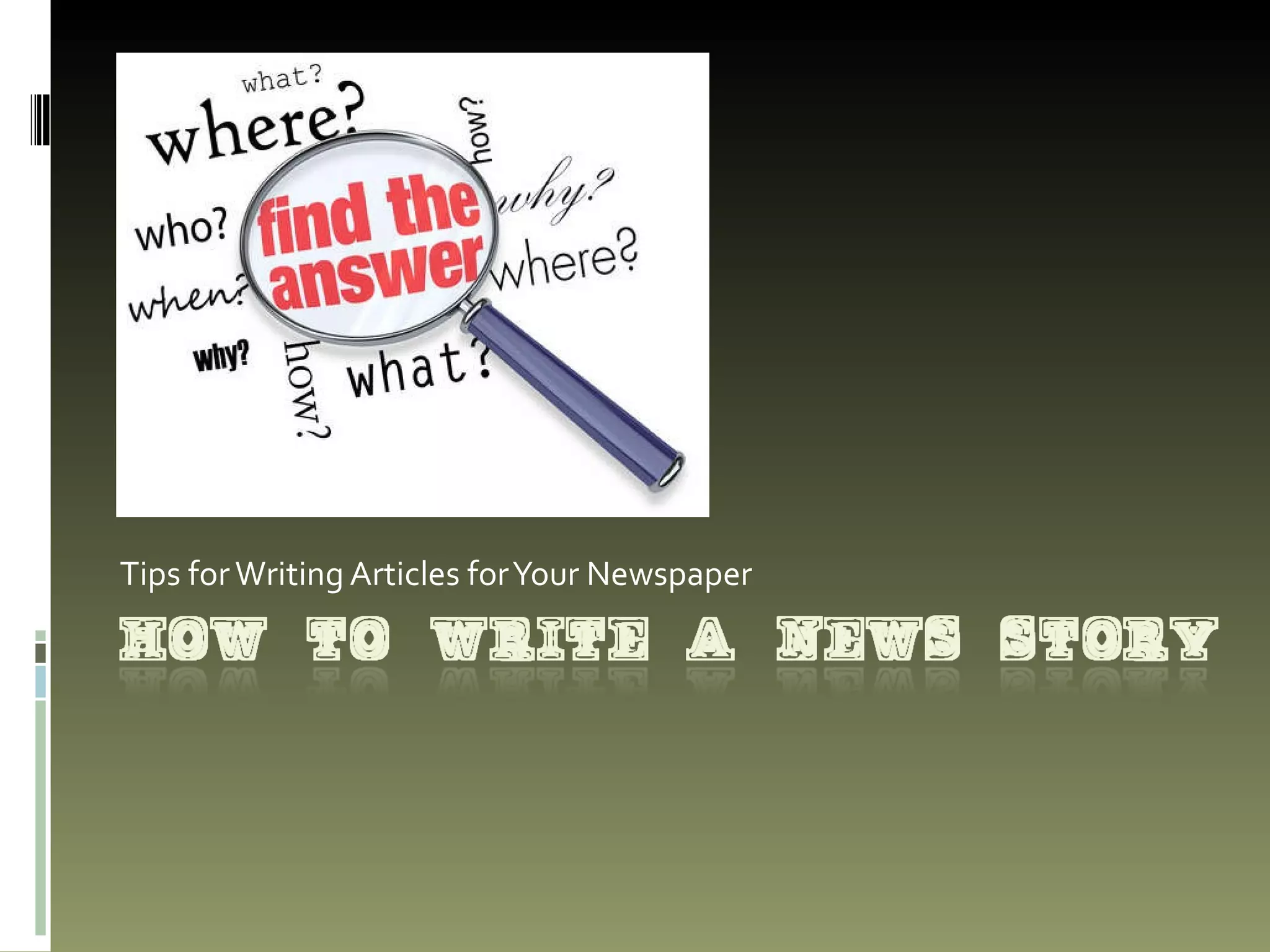
The Five Ws & an H This is the crux of all news—you need to know five things: Who? What? When? Where? Why? How? Any good news story provides answers to each of these questions.  For example, if you wish to cover a story about a local sports team entering a competition, you will need to answer these questions: Who  is the team? Who is the coach? Who are the prominent players? Who are the supporters?  What  sport do they play? What is the competition?  Where  is the competition? Where is the team normally based?  When  is the competition? How long have they been preparing? Are there any other important time factors?  Why  are they entering this particular competition? If it's relevant, why does the team exist at all?  How  are they going to enter the competition? Do they need to fundraise? How much training and preparation is required? What will they need to do to win?
The Inverted Pyramid This refers to the style of journalism which places the most important facts at the beginning and works "down" from there. Ideally, the first paragraph should contain enough information to give the reader a good overview of the entire story.  The rest of the article explains and expands on the beginning. A good approach is to assume that the story might be cut off at any point due to space limitations. Does the story work if the editor only decides to include the first two paragraphs? If not, re-arrange it so that it does.
Writing the Lead It is very important to have an engaging lead to capture the attention of the reader into your piece (it’s very similar to the “hook” of an essay…or a dangling carrot in front of a horse). The lead is a 1-2 sentence opening paragraph which attempts to answer only the most important 5 Ws and H. There are many different ways to grab a reader’s attention: 1. Dialogue 2. A scene with a character engaged in an activity 3. A startling argument 4. A contrast 5. A generalization 6. A question 7. An intriguing detail 8. An anecdote or short story 9. A quotation 10. A “face” for an issue or an event 11. A “what-if” or “might-have-been” 12. The effect (of a cause)
Tips to Writing Your Story Use a graphic organizer to brainstorm your ideas.  You’ll find several in “Resources” > “Mass Media: Advertising” folder. Answer the 5ws & H, including details. Write your lead to focus your story. Relate the most important facts first and the last important stuff toward the end of the story. Include quotations to give your news “sources” that you have interviewed. End your article with a strong summary of the event…try to be creative! Read it when you are finished: revise for stronger verbs and adjectives; run spell-check; keep working on putting all your articles together!

How To Write a News Story

  • 1.
    Tips for WritingArticles for Your Newspaper
  • 2.
    Food For ThoughtHere's something very few people realize: Writing news stories is not particularly difficult. It does take practice and not everyone will be an expert but if you follow the guidelines below you should be able to create effective news items without too much stress.
  • 3.
    The Five Ws& an H This is the crux of all news—you need to know five things: Who? What? When? Where? Why? How? Any good news story provides answers to each of these questions. For example, if you wish to cover a story about a local sports team entering a competition, you will need to answer these questions: Who is the team? Who is the coach? Who are the prominent players? Who are the supporters? What sport do they play? What is the competition? Where is the competition? Where is the team normally based? When is the competition? How long have they been preparing? Are there any other important time factors? Why are they entering this particular competition? If it's relevant, why does the team exist at all? How are they going to enter the competition? Do they need to fundraise? How much training and preparation is required? What will they need to do to win?
  • 4.
    The Inverted PyramidThis refers to the style of journalism which places the most important facts at the beginning and works "down" from there. Ideally, the first paragraph should contain enough information to give the reader a good overview of the entire story. The rest of the article explains and expands on the beginning. A good approach is to assume that the story might be cut off at any point due to space limitations. Does the story work if the editor only decides to include the first two paragraphs? If not, re-arrange it so that it does.
  • 5.
    Writing the LeadIt is very important to have an engaging lead to capture the attention of the reader into your piece (it’s very similar to the “hook” of an essay…or a dangling carrot in front of a horse). The lead is a 1-2 sentence opening paragraph which attempts to answer only the most important 5 Ws and H. There are many different ways to grab a reader’s attention: 1. Dialogue 2. A scene with a character engaged in an activity 3. A startling argument 4. A contrast 5. A generalization 6. A question 7. An intriguing detail 8. An anecdote or short story 9. A quotation 10. A “face” for an issue or an event 11. A “what-if” or “might-have-been” 12. The effect (of a cause)
  • 6.
    Tips to WritingYour Story Use a graphic organizer to brainstorm your ideas. You’ll find several in “Resources” > “Mass Media: Advertising” folder. Answer the 5ws & H, including details. Write your lead to focus your story. Relate the most important facts first and the last important stuff toward the end of the story. Include quotations to give your news “sources” that you have interviewed. End your article with a strong summary of the event…try to be creative! Read it when you are finished: revise for stronger verbs and adjectives; run spell-check; keep working on putting all your articles together!