The Planning Maturity Curve
               Where Are You?
           Where Do You Want to Be?


                   Ben Lamorte
            VP Marketing, Alight Planning

AGILE
Why Agile Planning?


          3-Minute Overview


AGILE
The Value of Traditional Planning Over Time


                                         But ROI
                                         diminishes
                                         quickly
                                         over time.
          VALUE


 High ROI at
 the early
 stages of
 planning…
                                  TIME


 Source: The Agile Planner Blog


AGILE
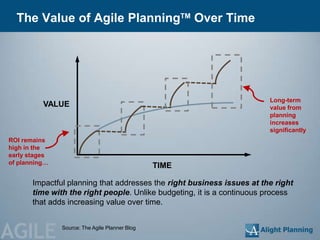
The Value of Agile PlanningTM Over Time


                                                                        Long-term
          VALUE                                                         value from
                                                                        planning
                                                                        increases
                                                                        significantly
ROI remains
high in the
early stages
of planning…
                                                TIME

       Impactful planning that addresses the right business issues at the right
       time with the right people. Unlike budgeting, it is a continuous process
       that adds increasing value over time.


AGILE          Source: The Agile Planner Blog
The Subtle Message


   1: Is it EVEN worth it to replace
   spreadsheets with a planning
   tool?

   2: If you already bought software,
   was it worth it?

   3: Either way, how do we make
   planning ADD VALUE?
AGILE
The Subtle Message


   1: Is it EVEN worth it to replace
   spreadsheets with a planning
   tool?

   2: If you already bought software,
   was it worth it?

   3: Either way, how do we make
   planning ADD VALUE?
AGILE
The Subtle Message


   1: Is it EVEN worth it to replace
   spreadsheets with a planning
   tool?

   2: If you already bought software,
   was it worth it?

   3: Either way, how do we make
   planning ADD VALUE?
AGILE
Rand Heer (He‘s ―Heer‖ In Spirit)

  Business Activities
       CEO, Alight Planning (Planning software)
       Co-Founder, Aspirity (Microsoft BI consulting)
       Founder, FP&A Train (Essbase training)
       Founder, Pillar Corporation
       CFO for 2 public companies
       Rockwell Int‘l, Business Unit CFO and Corporate

  Publications
       Author: The Planning Maturity Curve: Where Are You? Where Do You Want
        to Be?
       Author: How Agile is Your Planning: Find out by Measuring the ROI of Your
        Planning Software
       Coauthor: “Business Intelligence: Making Better Decisions Faster”.
        Published by Microsoft Press.
  Education

AGILE
       MBA degree Harvard Business School
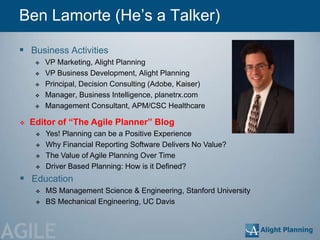
Ben Lamorte (He‘s a Talker)

  Business Activities
         VP Marketing, Alight Planning
         VP Business Development, Alight Planning
         Principal, Decision Consulting (Adobe, Kaiser)
         Manager, Business Intelligence, planetrx.com
         Management Consultant, APM/CSC Healthcare

    Editor of “The Agile Planner” Blog
         Yes! Planning can be a Positive Experience
         Why Financial Reporting Software Delivers No Value?
         The Value of Agile Planning Over Time
         Driver Based Planning: How is it Defined?
  Education
         MS Management Science & Engineering, Stanford University
         BS Mechanical Engineering, UC Davis


AGILE
Agenda
 The Planning Maturity Curve
      Level One: Seat of the Pants
      Level Two: Budgeting
      Level Three: Reporting
      Level Four: Forecasting
      Level Five: Agile Planning
 Case Study in Agile Planning: Pittsburgh Mercy
 5-Minute Break
 4 Steps to Agile Planning
      Out of Excel
      Level of Detail
      Driver-Based Planning
      Integrating Actuals
      Scenario Analysis
 Agile Assessment + Free ASMI Event Winner?
 Cocktails

AGILE
Stuff for After this Presentation -- Slides Coming in
Email and posted to SlideShare
 Follow up with Alight
      BLamorte@AlightPlanning.com
      Telephone: (415) 456-8528
      Join us! The Agile Planner Blog
         Blog.alightplanning.com

 Webinar Resources
      Transforming Planning at Pittsburgh Mercy
         www.Alightplanning.com/Webinars/PM/Video.html
      Application Requirements for Rolling Forecasts
         www.AlightPlanning.com/Workshop/Requirements-for-Rolling-Forecasts/Video.html

 FOCUS Podcast Featuring Sid Ghatak & Ben Lamorte
         http://www.focus.com/roundtables/avoiding-business-performance-
          mangement-software-failure-4-t/
         6% is not enough! The Case for Driver-Based Planning in 2012 with
          Rob Kugel, Ventana Research and John Miller, Arkonas moderated by
          Ben Lamorte

AGILE
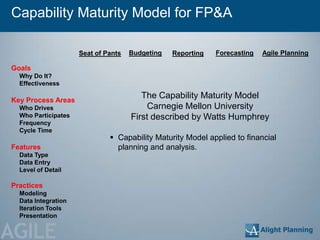
Capability Maturity Model for FP&A

                     Seat of Pants   Budgeting   Reporting   Forecasting   Agile Planning

Goals
  Why Do It?
  Effectiveness

Key Process Areas
                                        The Capability Maturity Model
  Who Drives                             Carnegie Mellon University
  Who Participates                   First described by Watts Humphrey
  Frequency
  Cycle Time
                               Capability Maturity Model applied to financial
Features                        planning and analysis.
  Data Type
  Data Entry
  Level of Detail

Practices
  Modeling
  Data Integration
  Iteration Tools
  Presentation


AGILE
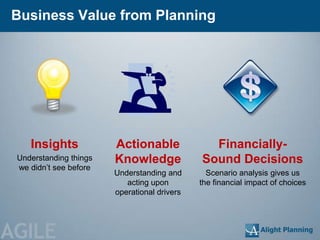
Business Value from Planning


    Insights            Actionable              Financially-
 Understanding things   Knowledge             Sound Decisions
 we didn‘t see before
                        Understanding and       Scenario analysis gives us
                           acting upon        the financial impact of choices
                        operational drivers


AGILE
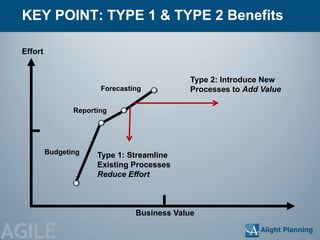
KEY POINT: TYPE 1 & TYPE 2 Benefits

 Effort


                                              Type 2: Introduce New
                        Forecasting           Processes to Add Value

                 Reporting


          Budgeting    Type 1: Streamline
                       Existing Processes
                       Reduce Effort


                                 Business Value

AGILE
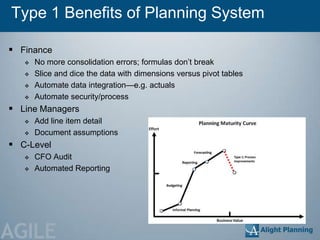
Type 1 Benefits of Planning System

 Finance
      No more consolidation errors; formulas don‘t break
      Slice and dice the data with dimensions versus pivot tables
      Automate data integration—e.g. actuals
      Automate security/process
 Line Managers
      Add line item detail
      Document assumptions
 C-Level
      CFO Audit
      Automated Reporting


AGILE
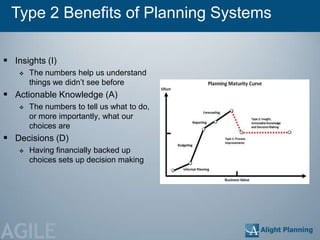
Type 2 Benefits of Planning Systems
 Insights (I)
       The numbers help us understand
        things we didn‘t see before
 Actionable Knowledge (A)
       The numbers to tell us what to do,
        or more importantly, what our
        choices are
 Decisions (D)
       Having financially backed up
        choices sets up decision making


AGILE
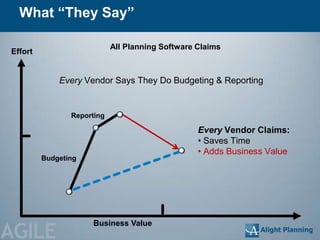
What “They Say”

                            All Planning Software Claims
Effort


             Every Vendor Says They Do Budgeting & Reporting


                Reporting

                                                  Every Vendor Claims:
                                                  • Saves Time
                                                  • Adds Business Value
         Budgeting


AGILE
                     Business Value
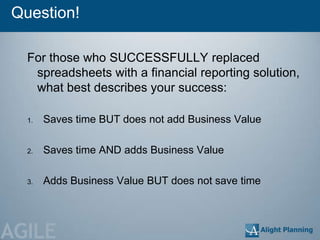
Question!

  For those who SUCCESSFULLY replaced
   spreadsheets with a financial reporting solution,
   what best describes your success:

  1.   Saves time BUT does not add Business Value

  2.   Saves time AND adds Business Value

  3.   Adds Business Value BUT does not save time


AGILE
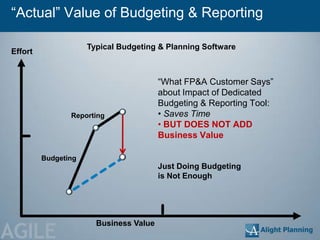
―Actual‖ Value of Budgeting & Reporting

                     Typical Budgeting & Planning Software
Effort


                                        ―What FP&A Customer Says‖
                                        about Impact of Dedicated
                                        Budgeting & Reporting Tool:
                Reporting               • Saves Time
                                        • BUT DOES NOT ADD
                                        Business Value

         Budgeting
                                        Just Doing Budgeting
                                        is Not Enough


AGILE
                       Business Value
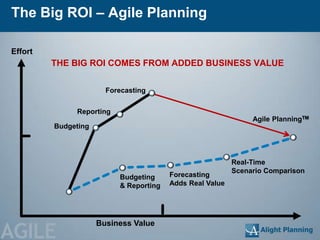
The Big ROI – Agile Planning

Effort
         THE BIG ROI COMES FROM ADDED BUSINESS VALUE


                       Forecasting

              Reporting
                                                               Agile PlanningTM
         Budgeting


                                                          Real-Time
                                                          Scenario Comparison
                          Budgeting     Forecasting
                          & Reporting   Adds Real Value


AGILE
                     Business Value
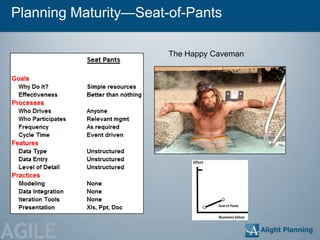
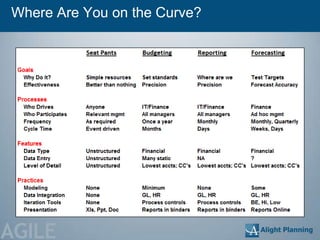
Planning Maturity—Seat-of-Pants

                       The Happy Caveman


AGILE
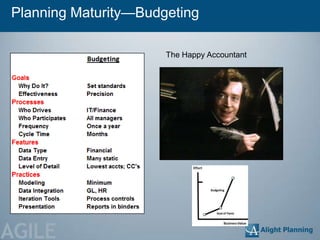
Planning Maturity—Budgeting

                      The Happy Accountant


AGILE
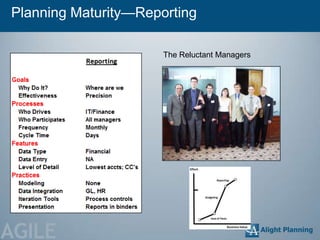
Planning Maturity—Reporting

                      The Reluctant Managers


AGILE
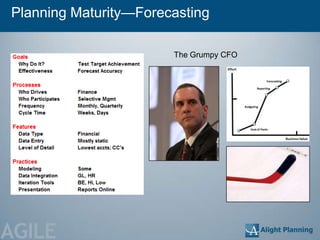
Planning Maturity—Forecasting

                       The Grumpy CFO


AGILE
Where Are You on the Curve?


AGILE
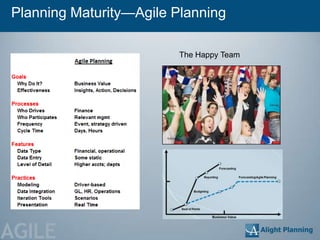
Planning Maturity—Agile Planning

                         The Happy Team


AGILE
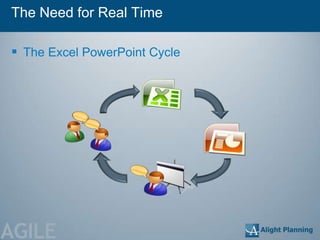
The Need for Real Time

 The Excel PowerPoint Cycle


AGILE
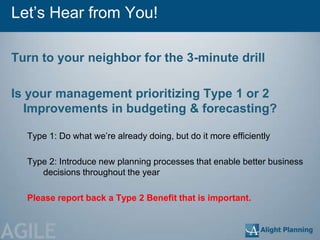
Let‘s Hear from You!

Turn to your neighbor for the 3-minute drill

Is your management prioritizing Type 1 or 2
  Improvements in budgeting & forecasting?

  Type 1: Do what we‘re already doing, but do it more efficiently

  Type 2: Introduce new planning processes that enable better business
     decisions throughout the year

  Please report back a Type 2 Benefit that is important.


AGILE
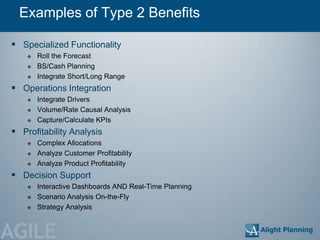
Examples of Type 2 Benefits

 Specialized Functionality
       Roll the Forecast
       BS/Cash Planning
       Integrate Short/Long Range
 Operations Integration
       Integrate Drivers
       Volume/Rate Causal Analysis
       Capture/Calculate KPIs
 Profitability Analysis
       Complex Allocations
       Analyze Customer Profitability
       Analyze Product Profitability
 Decision Support
       Interactive Dashboards AND Real-Time Planning
       Scenario Analysis On-the-Fly
       Strategy Analysis


AGILE
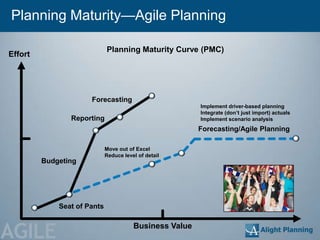
Planning Maturity—Agile Planning

                             Planning Maturity Curve (PMC)
Effort


                      Forecasting
                                                         Implement driver-based planning
                                                         Integrate (don‟t just import) actuals
                Reporting                                Implement scenario analysis
                                                         Forecasting/Agile Planning

                             Move out of Excel
                             Reduce level of detail
         Budgeting


             Seat of Pants


AGILE                                   Business Value
Case Study: Pittsburgh Mercy

 Ray Wolfe, CFO (now CEO)
  Business Activities
       Chief Financial Officer, Pittsburgh Mercy Health
        System 2006-present
       Director of Fiscal and Information Systems– Mercy
        Behavioral Health 1996-2006
       Chief Fiscal Officer, Summit Center for Human
        Development, 1988-1996


  Awards: Ventana Leadership 2010

  Education
       Juris Doctorate, West Virginia University 1977
       BA, Marshall University, 1974


AGILE
Case Study: Pittsburgh Mercy

 Community Mental Health and Health Care Related
      Mental Health, Mental Retardation, Drug/Alcohol, Homeless
      Prevention Services and a Private Foundation
      Serving Southwestern Pennsylvania
 Business Metrics
   Pittsburgh Mercy Health System has
    3 subsidiary corporations

    60 community locations

    27 major programs product lines

    260 revenue/cost center

    1,700 employees; 106 Managers & Supervisors

    Funded through traditional insurance billing, government grants and
      capitation contracts, Private Foundations


AGILE
Case Study: Pittsburgh Mercy

 Demographic Problems
      Managers with only clinical backgrounds/ no business skills
      60 sites yielded communication barriers and no common language
 Excel based —
      Overload mode of worksheets with link and formula errors
      Too much time to maintain and no certainty of integrity
      No way to import and compare actual data to the budget design
 Budgeting became a ritual without meaning
      Budgeting full-year totals with no seasonality
      Tops down budgets w/o manager buy in
      No P&L visibility by critical factors
      No operational integration


AGILE
Agile Planning Case Study: Pittsburgh Mercy


 Organization of Forecast Groups and Processes
     Group managers by functional areas—e.g.
        Community Treatment Teams
        Outpatient Clinics
        Child Services

     15 Groups each meet once a quarter
        3 to 12 managers per group
        4 members from accounting/finance

     Real time process elements
        Alight Planning displayed on Overhead Projector with Smart Board
        CFO is facilitator; Alight Admin on the mouse and keyboard
        Review/ make changes in real time
        Everyone sees everything!


AGILE
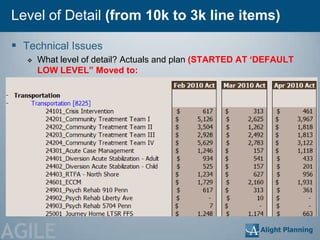
Level of Detail (from 10k to 3k line items)

 Technical Issues
      What level of detail? Actuals and plan (STARTED AT „DEFAULT
       LOW LEVEL” Moved to:


AGILE
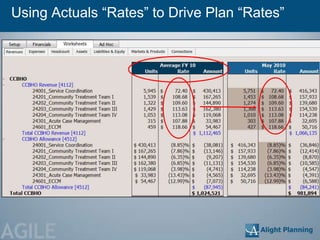
Using Actuals ―Rates‖ to Drive Plan ―Rates‖


AGILE
Case Study: Pittsburgh Mercy

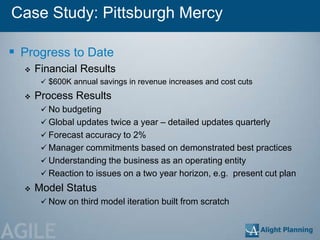
 Progress to Date
     Financial Results
        $600K annual savings in revenue increases and cost cuts

     Process Results
        No budgeting
        Global updates twice a year – detailed updates quarterly
        Forecast accuracy to 2%
        Manager commitments based on demonstrated best practices
        Understanding the business as an operating entity
        Reaction to issues on a two year horizon, e.g. present cut plan
     Model Status
        Now on third model iteration built from scratch


AGILE
Advantage from responsiveness and adaptability rather than scale


                                             ―It is not the strongest
                                                of the species that
                                             survive, nor the most
                                            intelligent, but the one
                                              most responsive to
                                                     change.‖


AGILE        Source: Commonly misattributed to Darwin, this quote was actually
                           written/said by Clarence Darrow
Guidelines for Agile PlanningTM

1. Move Out of Excel
         Deal with structure issues
         Deal with modeling issues
2.   Reduce Level of Detail
         Plan the way managers think; not the Happy Accountant
         Reduce detail to better integrate strategy
3. Implement Driver-Based Planning
        Reduce direct input data volumes
        Increase ‗modeled elements‘—operational/driver based planning
4. Integrate (Don‘t Just Import) Actuals
        ―Rolling over‖ actuals in plan files—apples to apples
        Using actuals to understand trends—focus on rates
5. Implement Scenario Analysis
        You can‘t predict the future, but you can construct scenarios
        You‘re looking for easy maintenance and comparisons at all levels

AGILE
1. Out of Excel

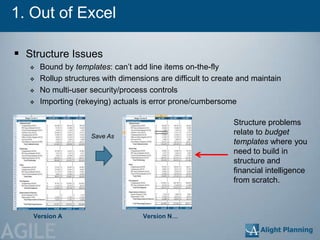
  Structure Issues
       Bound by templates: can‘t add line items on-the-fly
       Rollup structures with dimensions are difficult to create and maintain
       No multi-user security/process controls
       Importing (rekeying) actuals is error prone/cumbersome

                                                                Structure problems
                      Save As
                                                                relate to budget
                                                                templates where you
                                                                need to build in
                                                                structure and
                                                                financial intelligence
                                                                from scratch.


    Version A                        Version N…


AGILE
1. Out of Excel

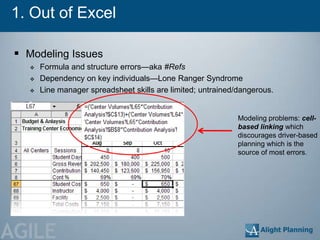
  Modeling Issues
       Formula and structure errors—aka #Refs
       Dependency on key individuals—Lone Ranger Syndrome
       Line manager spreadsheet skills are limited; untrained/dangerous.


                                                               Modeling problems: cell-
                                                               based linking which
                                                               discourages driver-based
                                                               planning which is the
                                                               source of most errors.


AGILE
1. Out of Excel

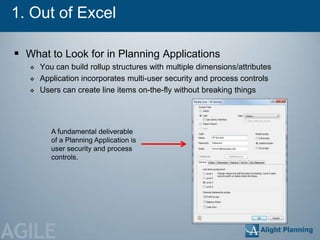
  What to Look for in Planning Applications
       You can build rollup structures with multiple dimensions/attributes
       Application incorporates multi-user security and process controls
       Users can create line items on-the-fly without breaking things


           A fundamental deliverable
           of a Planning Application is
           user security and process
           controls.


AGILE
1. Out of Excel

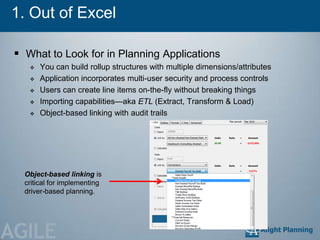
  What to Look for in Planning Applications
       You can build rollup structures with multiple dimensions/attributes
       Application incorporates multi-user security and process controls
       Users can create line items on-the-fly without breaking things
       Importing capabilities—aka ETL (Extract, Transform & Load)
       Object-based linking with audit trails


   Object-based linking is
   critical for implementing
   driver-based planning.


AGILE
2. Reduce Level of Detail
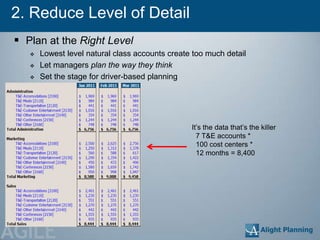
  Plan at the Right Level
       Lowest level natural class accounts create too much detail
       Let managers plan the way they think
       Set the stage for driver-based planning


                                                  It‘s the data that‘s the killer
                                                    7 T&E accounts *
                                                    100 cost centers *
                                                    12 months = 8,400


AGILE
2. Reduce Level of Detail

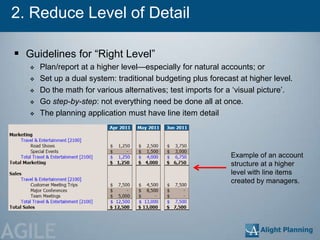
  Guidelines for ―Right Level‖
       Plan/report at a higher level—especially for natural accounts; or
       Set up a dual system: traditional budgeting plus forecast at higher level.
       Do the math for various alternatives; test imports for a ‗visual picture‘.
       Go step-by-step: not everything need be done all at once.
       The planning application must have line item detail


                                                               Example of an account
                                                               structure at a higher
                                                               level with line items
                                                               created by managers.


AGILE
2. Reduce Level of Detail

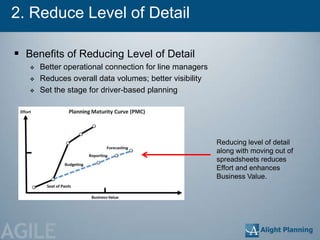
  Benefits of Reducing Level of Detail
       Better operational connection for line managers
       Reduces overall data volumes; better visibility
       Set the stage for driver-based planning


                                                          Reducing level of detail
                                                          along with moving out of
                                                          spreadsheets reduces
                                                          Effort and enhances
                                                          Business Value.


AGILE
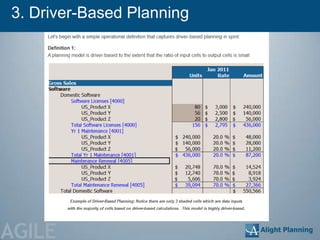
3. Driver-Based Planning


AGILE
3. Driver-Based Planning

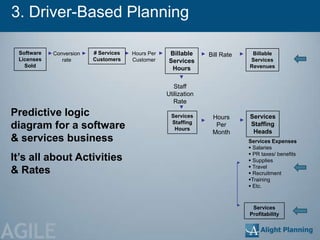
 Software   Conversion   # Services   Hours Per   Billable      Bill Rate    Billable
 Licenses      rate      Customers    Customer    Services                  Services
   Sold                                                                     Revenues
                                                   Hours

                                                     Staff
                                                  Utilization
                                                     Rate
Predictive logic                                   Services      Hours      Services
                                                   Staffing
diagram for a software                              Hours
                                                                  Per       Staffing
                                                                             Heads
                                                                 Month
& services business                                                         Services Expenses
                                                                             Salaries

It‟s all about Activities                                                    PR taxes/ benefits
                                                                             Supplies
                                                                             Travel
& Rates                                                                      Recruitment
                                                                            Training
                                                                             Etc.


                                                                             Services
                                                                            Profitability


AGILE
3. Driver-Based Planning

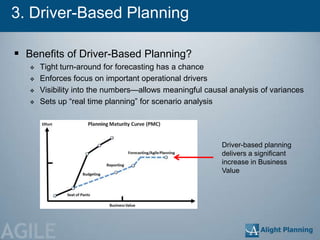
  Benefits of Driver-Based Planning?
       Tight turn-around for forecasting has a chance
       Enforces focus on important operational drivers
       Visibility into the numbers—allows meaningful causal analysis of variances
       Sets up ―real time planning‖ for scenario analysis


                                                           Driver-based planning
                                                           delivers a significant
                                                           increase in Business
                                                           Value


AGILE
4. Integrate Actuals

  Integration Issues
       Data spread across multiple sources
       Actuals and Plan at different levels
       No underlying activity drivers
       Actual and plan structures out of sync


AGILE
4. Integrate Actuals

  Import Actuals
       Metadata and data imports based on chart of accounts structures
       Monthly updates from the general ledger
       Automated with ―connectors‖ or semi-automated with ETL tools
  Integrate Actuals
       Any source—GL,HR, CRM, RDBMS, OLAP
       Any data type—text, number, currency, percentage
       Any level—line item, natural accounts, cost center, etc.
       Any modeling—simple of complex linking, back calculate rates


AGILE
5. Implement Scenario Analysis

  Deliverables
       Insights: What‘s Going On with the Numbers
       Actionable Knowledge: What Are Our Choices Between Things To Do
       Decisions: ―OK gang, here‘s what we‘re going to do!‖

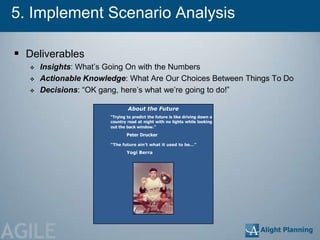
                                 About the Future
                         “Trying to predict the future is like driving down a
                         country road at night with no lights while looking
                         out the back window.”

                                 Peter Drucker

                         “The future ain’t what it used to be…”
                                 Yogi Berra


AGILE
5. Implement Scenario Analysis

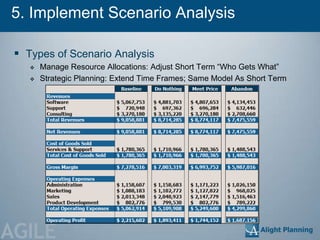
  Types of Scenario Analysis
       Manage Resource Allocations: Adjust Short Term ―Who Gets What‖
       Strategic Planning: Extend Time Frames; Same Model As Short Term


AGILE
5. Implement Scenario Analysis

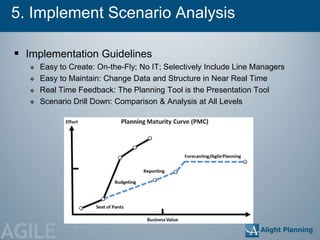
  Implementation Guidelines
       Easy to Create: On-the-Fly; No IT; Selectively Include Line Managers
       Easy to Maintain: Change Data and Structure in Near Real Time
       Real Time Feedback: The Planning Tool is the Presentation Tool
       Scenario Drill Down: Comparison & Analysis at All Levels


AGILE
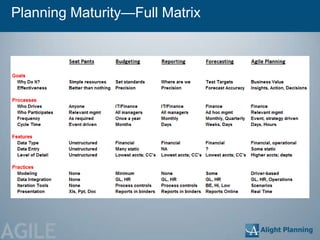
Planning Maturity—Full Matrix


AGILE
Agile Planning: How to do it

              5-Minute Overview


AGILE
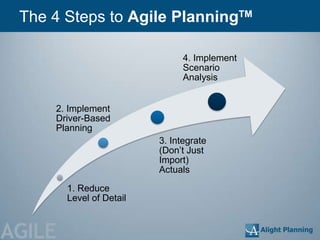
The 4 Steps to Agile PlanningTM

                                4. Implement
                                Scenario
                                Analysis


     2. Implement
     Driver-Based
     Planning
                          3. Integrate
                          (Don‘t Just
                          Import)
                          Actuals

        1. Reduce
        Level of Detail


AGILE
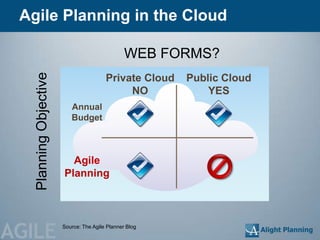
Agile Planning in the Cloud

                                                 WEB FORMS?
   Planning Objective

                                         Private Cloud   Public Cloud
                                              NO             YES
                           Annual
                           Budget


                          Agile
                        Planning


AGILE                   Source: The Agile Planner Blog
Finance on ―Agile Planning over the Web‖


   “I have used SaaS [Requires Web Forms] planning programs - and
   dislike them for a few reasons:

   1. Latency
   2. They can be ‘squirrely’- in terms of saving/not losing entered
      data (notably copied and pasted)
   3. File access without having to be connected”

                               -Stu Abrams, CFO/Controller, Magnet Systems
                               (Former User of Cloud-Based Planning App)


 Source:
 http://www.capterra.com/budgeting-software/reviews/52811/Alight%20Planning%20Enterprise/Alight


AGILE
Follow Up with Alight Planning
 Follow up with Alight
      BLamorte@AlightPlanning.com
      Telephone: (415) 456-8528
      Join us! The Agile Planner Blog
         Blog.alightplanning.com

 Webinar Resources
      Transforming Planning at Pittsburgh Mercy
         www.Alightplanning.com/Webinars/PM/Video.html
      Application Requirements for Rolling Forecasts
         www.AlightPlanning.com/Workshop/Requirements-for-Rolling-Forecasts/Video.html

 FOCUS Podcast Featuring Sid Ghatak & Ben Lamorte
         http://www.focus.com/roundtables/avoiding-business-performance-
          mangement-software-failure-4-t/
         6% is not enough! The Case for Driver-Based Planning in 2012 with
          Rob Kugel, Ventana Research and John Miller, Arkonas moderated by
          Ben Lamorte

AGILE
Why 1 in 3 Budgeting Software
   Solutions Fail, What to do about it!

            A 5-Minute Overview


AGILE
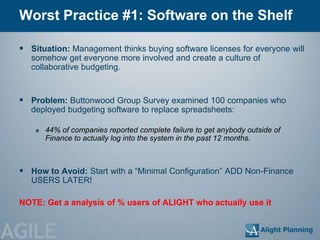
Worst Practice #1: Software on the Shelf

  Situation: Management thinks buying software licenses for everyone will
    somehow get everyone more involved and create a culture of
    collaborative budgeting.


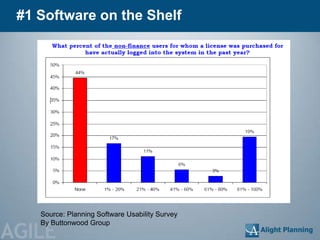
  Problem: Buttonwood Group Survey examined 100 companies who
    deployed budgeting software to replace spreadsheets:

        44% of companies reported complete failure to get anybody outside of
         Finance to actually log into the system in the past 12 months.


  How to Avoid: Start with a ―Minimal Configuration‖ ADD Non-Finance
    USERS LATER!

 NOTE: Get a analysis of % users of ALIGHT who actually use it


AGILE
#1 Software on the Shelf


    Source: Planning Software Usability Survey


AGILE
    By Buttonwood Group
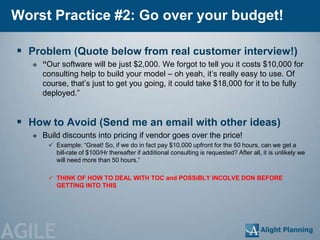
Worst Practice #2: Go over your budget!

  Problem (Quote below from real customer interview!)
       “Our software will be just $2,000. We forgot to tell you it costs $10,000 for
        consulting help to build your model – oh yeah, it‘s really easy to use. Of
        course, that‘s just to get you going, it could take $18,000 for it to be fully
        deployed.‖


  How to Avoid (Send me an email with other ideas)
       Build discounts into pricing if vendor goes over the price!
          Example: ―Great! So, if we do in fact pay $10,000 upfront for the 50 hours, can we get a
            bill-rate of $100/Hr thereafter if additional consulting is requested? After all, it is unlikely we
            will need more than 50 hours.‖

          THINK OF HOW TO DEAL WITH TOC and POSSiBLY INCOLVE DON BEFORE
            GETTING INTO THIS


AGILE
Worst Practice #3: Wrong Consultant

  Problem
      A month after you buy software, you find out you‘ve been assigned to a
       consultant who's built one model as practice and recently completed an
       MBA degree!


  How to Avoid
      Do not agree to purchase any software until you’ve at least met the
       consultant assigned to your project. If you don‘t click with your consultant,
       the project may be doomed from the start .


AGILE

ASMI Dallas March 2012 by Ben Lamorte

  • 1.
    The Planning MaturityCurve Where Are You? Where Do You Want to Be? Ben Lamorte VP Marketing, Alight Planning AGILE
  • 2.
    Why Agile Planning? 3-Minute Overview AGILE
  • 3.
    The Value ofTraditional Planning Over Time But ROI diminishes quickly over time. VALUE High ROI at the early stages of planning… TIME Source: The Agile Planner Blog AGILE
  • 4.
    The Value ofAgile PlanningTM Over Time Long-term VALUE value from planning increases significantly ROI remains high in the early stages of planning… TIME Impactful planning that addresses the right business issues at the right time with the right people. Unlike budgeting, it is a continuous process that adds increasing value over time. AGILE Source: The Agile Planner Blog
  • 5.
    The Subtle Message 1: Is it EVEN worth it to replace spreadsheets with a planning tool? 2: If you already bought software, was it worth it? 3: Either way, how do we make planning ADD VALUE? AGILE
  • 6.
    The Subtle Message 1: Is it EVEN worth it to replace spreadsheets with a planning tool? 2: If you already bought software, was it worth it? 3: Either way, how do we make planning ADD VALUE? AGILE
  • 7.
    The Subtle Message 1: Is it EVEN worth it to replace spreadsheets with a planning tool? 2: If you already bought software, was it worth it? 3: Either way, how do we make planning ADD VALUE? AGILE
  • 8.
    Rand Heer (He‘s―Heer‖ In Spirit)  Business Activities  CEO, Alight Planning (Planning software)  Co-Founder, Aspirity (Microsoft BI consulting)  Founder, FP&A Train (Essbase training)  Founder, Pillar Corporation  CFO for 2 public companies  Rockwell Int‘l, Business Unit CFO and Corporate  Publications  Author: The Planning Maturity Curve: Where Are You? Where Do You Want to Be?  Author: How Agile is Your Planning: Find out by Measuring the ROI of Your Planning Software  Coauthor: “Business Intelligence: Making Better Decisions Faster”. Published by Microsoft Press.  Education AGILE  MBA degree Harvard Business School
  • 9.
    Ben Lamorte (He‘sa Talker)  Business Activities  VP Marketing, Alight Planning  VP Business Development, Alight Planning  Principal, Decision Consulting (Adobe, Kaiser)  Manager, Business Intelligence, planetrx.com  Management Consultant, APM/CSC Healthcare  Editor of “The Agile Planner” Blog  Yes! Planning can be a Positive Experience  Why Financial Reporting Software Delivers No Value?  The Value of Agile Planning Over Time  Driver Based Planning: How is it Defined?  Education  MS Management Science & Engineering, Stanford University  BS Mechanical Engineering, UC Davis AGILE
  • 10.
    Agenda  The PlanningMaturity Curve  Level One: Seat of the Pants  Level Two: Budgeting  Level Three: Reporting  Level Four: Forecasting  Level Five: Agile Planning  Case Study in Agile Planning: Pittsburgh Mercy  5-Minute Break  4 Steps to Agile Planning  Out of Excel  Level of Detail  Driver-Based Planning  Integrating Actuals  Scenario Analysis  Agile Assessment + Free ASMI Event Winner?  Cocktails AGILE
  • 11.
    Stuff for Afterthis Presentation -- Slides Coming in Email and posted to SlideShare  Follow up with Alight  BLamorte@AlightPlanning.com  Telephone: (415) 456-8528  Join us! The Agile Planner Blog  Blog.alightplanning.com  Webinar Resources  Transforming Planning at Pittsburgh Mercy  www.Alightplanning.com/Webinars/PM/Video.html  Application Requirements for Rolling Forecasts  www.AlightPlanning.com/Workshop/Requirements-for-Rolling-Forecasts/Video.html  FOCUS Podcast Featuring Sid Ghatak & Ben Lamorte  http://www.focus.com/roundtables/avoiding-business-performance- mangement-software-failure-4-t/  6% is not enough! The Case for Driver-Based Planning in 2012 with Rob Kugel, Ventana Research and John Miller, Arkonas moderated by Ben Lamorte AGILE
  • 12.
    Capability Maturity Modelfor FP&A Seat of Pants Budgeting Reporting Forecasting Agile Planning Goals Why Do It? Effectiveness Key Process Areas The Capability Maturity Model Who Drives Carnegie Mellon University Who Participates First described by Watts Humphrey Frequency Cycle Time  Capability Maturity Model applied to financial Features planning and analysis. Data Type Data Entry Level of Detail Practices Modeling Data Integration Iteration Tools Presentation AGILE
  • 13.
    Business Value fromPlanning Insights Actionable Financially- Understanding things Knowledge Sound Decisions we didn‘t see before Understanding and Scenario analysis gives us acting upon the financial impact of choices operational drivers AGILE
  • 14.
    KEY POINT: TYPE1 & TYPE 2 Benefits Effort Type 2: Introduce New Forecasting Processes to Add Value Reporting Budgeting Type 1: Streamline Existing Processes Reduce Effort Business Value AGILE
  • 15.
    Type 1 Benefitsof Planning System  Finance  No more consolidation errors; formulas don‘t break  Slice and dice the data with dimensions versus pivot tables  Automate data integration—e.g. actuals  Automate security/process  Line Managers  Add line item detail  Document assumptions  C-Level  CFO Audit  Automated Reporting AGILE
  • 16.
    Type 2 Benefitsof Planning Systems  Insights (I)  The numbers help us understand things we didn‘t see before  Actionable Knowledge (A)  The numbers to tell us what to do, or more importantly, what our choices are  Decisions (D)  Having financially backed up choices sets up decision making AGILE
  • 17.
    What “They Say” All Planning Software Claims Effort Every Vendor Says They Do Budgeting & Reporting Reporting Every Vendor Claims: • Saves Time • Adds Business Value Budgeting AGILE Business Value
  • 18.
    Question! Forthose who SUCCESSFULLY replaced spreadsheets with a financial reporting solution, what best describes your success: 1. Saves time BUT does not add Business Value 2. Saves time AND adds Business Value 3. Adds Business Value BUT does not save time AGILE
  • 19.
    ―Actual‖ Value ofBudgeting & Reporting Typical Budgeting & Planning Software Effort ―What FP&A Customer Says‖ about Impact of Dedicated Budgeting & Reporting Tool: Reporting • Saves Time • BUT DOES NOT ADD Business Value Budgeting Just Doing Budgeting is Not Enough AGILE Business Value
  • 20.
    The Big ROI– Agile Planning Effort THE BIG ROI COMES FROM ADDED BUSINESS VALUE Forecasting Reporting Agile PlanningTM Budgeting Real-Time Scenario Comparison Budgeting Forecasting & Reporting Adds Real Value AGILE Business Value
  • 21.
    Planning Maturity—Seat-of-Pants The Happy Caveman AGILE
  • 22.
    Planning Maturity—Budgeting The Happy Accountant AGILE
  • 23.
    Planning Maturity—Reporting The Reluctant Managers AGILE
  • 24.
  • 25.
    Where Are Youon the Curve? AGILE
  • 26.
  • 27.
    The Need forReal Time  The Excel PowerPoint Cycle AGILE
  • 28.
    Let‘s Hear fromYou! Turn to your neighbor for the 3-minute drill Is your management prioritizing Type 1 or 2 Improvements in budgeting & forecasting? Type 1: Do what we‘re already doing, but do it more efficiently Type 2: Introduce new planning processes that enable better business decisions throughout the year Please report back a Type 2 Benefit that is important. AGILE
  • 29.
    Examples of Type2 Benefits  Specialized Functionality  Roll the Forecast  BS/Cash Planning  Integrate Short/Long Range  Operations Integration  Integrate Drivers  Volume/Rate Causal Analysis  Capture/Calculate KPIs  Profitability Analysis  Complex Allocations  Analyze Customer Profitability  Analyze Product Profitability  Decision Support  Interactive Dashboards AND Real-Time Planning  Scenario Analysis On-the-Fly  Strategy Analysis AGILE
  • 30.
    Planning Maturity—Agile Planning Planning Maturity Curve (PMC) Effort Forecasting Implement driver-based planning Integrate (don‟t just import) actuals Reporting Implement scenario analysis Forecasting/Agile Planning Move out of Excel Reduce level of detail Budgeting Seat of Pants AGILE Business Value
  • 31.
    Case Study: PittsburghMercy Ray Wolfe, CFO (now CEO)  Business Activities  Chief Financial Officer, Pittsburgh Mercy Health System 2006-present  Director of Fiscal and Information Systems– Mercy Behavioral Health 1996-2006  Chief Fiscal Officer, Summit Center for Human Development, 1988-1996  Awards: Ventana Leadership 2010  Education  Juris Doctorate, West Virginia University 1977  BA, Marshall University, 1974 AGILE
  • 32.
    Case Study: PittsburghMercy  Community Mental Health and Health Care Related  Mental Health, Mental Retardation, Drug/Alcohol, Homeless  Prevention Services and a Private Foundation  Serving Southwestern Pennsylvania  Business Metrics Pittsburgh Mercy Health System has  3 subsidiary corporations  60 community locations  27 major programs product lines  260 revenue/cost center  1,700 employees; 106 Managers & Supervisors  Funded through traditional insurance billing, government grants and capitation contracts, Private Foundations AGILE
  • 33.
    Case Study: PittsburghMercy  Demographic Problems  Managers with only clinical backgrounds/ no business skills  60 sites yielded communication barriers and no common language  Excel based —  Overload mode of worksheets with link and formula errors  Too much time to maintain and no certainty of integrity  No way to import and compare actual data to the budget design  Budgeting became a ritual without meaning  Budgeting full-year totals with no seasonality  Tops down budgets w/o manager buy in  No P&L visibility by critical factors  No operational integration AGILE
  • 34.
    Agile Planning CaseStudy: Pittsburgh Mercy  Organization of Forecast Groups and Processes  Group managers by functional areas—e.g.  Community Treatment Teams  Outpatient Clinics  Child Services  15 Groups each meet once a quarter  3 to 12 managers per group  4 members from accounting/finance  Real time process elements  Alight Planning displayed on Overhead Projector with Smart Board  CFO is facilitator; Alight Admin on the mouse and keyboard  Review/ make changes in real time  Everyone sees everything! AGILE
  • 35.
    Level of Detail(from 10k to 3k line items)  Technical Issues  What level of detail? Actuals and plan (STARTED AT „DEFAULT LOW LEVEL” Moved to: AGILE
  • 36.
    Using Actuals ―Rates‖to Drive Plan ―Rates‖ AGILE
  • 37.
    Case Study: PittsburghMercy  Progress to Date  Financial Results  $600K annual savings in revenue increases and cost cuts  Process Results  No budgeting  Global updates twice a year – detailed updates quarterly  Forecast accuracy to 2%  Manager commitments based on demonstrated best practices  Understanding the business as an operating entity  Reaction to issues on a two year horizon, e.g. present cut plan  Model Status  Now on third model iteration built from scratch AGILE
  • 38.
    Advantage from responsivenessand adaptability rather than scale ―It is not the strongest of the species that survive, nor the most intelligent, but the one most responsive to change.‖ AGILE Source: Commonly misattributed to Darwin, this quote was actually written/said by Clarence Darrow
  • 39.
    Guidelines for AgilePlanningTM 1. Move Out of Excel  Deal with structure issues  Deal with modeling issues 2. Reduce Level of Detail  Plan the way managers think; not the Happy Accountant  Reduce detail to better integrate strategy 3. Implement Driver-Based Planning  Reduce direct input data volumes  Increase ‗modeled elements‘—operational/driver based planning 4. Integrate (Don‘t Just Import) Actuals  ―Rolling over‖ actuals in plan files—apples to apples  Using actuals to understand trends—focus on rates 5. Implement Scenario Analysis  You can‘t predict the future, but you can construct scenarios  You‘re looking for easy maintenance and comparisons at all levels AGILE
  • 40.
    1. Out ofExcel  Structure Issues  Bound by templates: can‘t add line items on-the-fly  Rollup structures with dimensions are difficult to create and maintain  No multi-user security/process controls  Importing (rekeying) actuals is error prone/cumbersome Structure problems Save As relate to budget templates where you need to build in structure and financial intelligence from scratch. Version A Version N… AGILE
  • 41.
    1. Out ofExcel  Modeling Issues  Formula and structure errors—aka #Refs  Dependency on key individuals—Lone Ranger Syndrome  Line manager spreadsheet skills are limited; untrained/dangerous. Modeling problems: cell- based linking which discourages driver-based planning which is the source of most errors. AGILE
  • 42.
    1. Out ofExcel  What to Look for in Planning Applications  You can build rollup structures with multiple dimensions/attributes  Application incorporates multi-user security and process controls  Users can create line items on-the-fly without breaking things A fundamental deliverable of a Planning Application is user security and process controls. AGILE
  • 43.
    1. Out ofExcel  What to Look for in Planning Applications  You can build rollup structures with multiple dimensions/attributes  Application incorporates multi-user security and process controls  Users can create line items on-the-fly without breaking things  Importing capabilities—aka ETL (Extract, Transform & Load)  Object-based linking with audit trails Object-based linking is critical for implementing driver-based planning. AGILE
  • 44.
    2. Reduce Levelof Detail  Plan at the Right Level  Lowest level natural class accounts create too much detail  Let managers plan the way they think  Set the stage for driver-based planning It‘s the data that‘s the killer 7 T&E accounts * 100 cost centers * 12 months = 8,400 AGILE
  • 45.
    2. Reduce Levelof Detail  Guidelines for ―Right Level‖  Plan/report at a higher level—especially for natural accounts; or  Set up a dual system: traditional budgeting plus forecast at higher level.  Do the math for various alternatives; test imports for a ‗visual picture‘.  Go step-by-step: not everything need be done all at once.  The planning application must have line item detail Example of an account structure at a higher level with line items created by managers. AGILE
  • 46.
    2. Reduce Levelof Detail  Benefits of Reducing Level of Detail  Better operational connection for line managers  Reduces overall data volumes; better visibility  Set the stage for driver-based planning Reducing level of detail along with moving out of spreadsheets reduces Effort and enhances Business Value. AGILE
  • 47.
  • 48.
    3. Driver-Based Planning Software Conversion # Services Hours Per Billable Bill Rate Billable Licenses rate Customers Customer Services Services Sold Revenues Hours Staff Utilization Rate Predictive logic Services Hours Services Staffing diagram for a software Hours Per Staffing Heads Month & services business Services Expenses  Salaries It‟s all about Activities  PR taxes/ benefits  Supplies  Travel & Rates  Recruitment Training  Etc. Services Profitability AGILE
  • 49.
    3. Driver-Based Planning  Benefits of Driver-Based Planning?  Tight turn-around for forecasting has a chance  Enforces focus on important operational drivers  Visibility into the numbers—allows meaningful causal analysis of variances  Sets up ―real time planning‖ for scenario analysis Driver-based planning delivers a significant increase in Business Value AGILE
  • 50.
    4. Integrate Actuals  Integration Issues  Data spread across multiple sources  Actuals and Plan at different levels  No underlying activity drivers  Actual and plan structures out of sync AGILE
  • 51.
    4. Integrate Actuals  Import Actuals  Metadata and data imports based on chart of accounts structures  Monthly updates from the general ledger  Automated with ―connectors‖ or semi-automated with ETL tools  Integrate Actuals  Any source—GL,HR, CRM, RDBMS, OLAP  Any data type—text, number, currency, percentage  Any level—line item, natural accounts, cost center, etc.  Any modeling—simple of complex linking, back calculate rates AGILE
  • 52.
    5. Implement ScenarioAnalysis  Deliverables  Insights: What‘s Going On with the Numbers  Actionable Knowledge: What Are Our Choices Between Things To Do  Decisions: ―OK gang, here‘s what we‘re going to do!‖ About the Future “Trying to predict the future is like driving down a country road at night with no lights while looking out the back window.” Peter Drucker “The future ain’t what it used to be…” Yogi Berra AGILE
  • 53.
    5. Implement ScenarioAnalysis  Types of Scenario Analysis  Manage Resource Allocations: Adjust Short Term ―Who Gets What‖  Strategic Planning: Extend Time Frames; Same Model As Short Term AGILE
  • 54.
    5. Implement ScenarioAnalysis  Implementation Guidelines  Easy to Create: On-the-Fly; No IT; Selectively Include Line Managers  Easy to Maintain: Change Data and Structure in Near Real Time  Real Time Feedback: The Planning Tool is the Presentation Tool  Scenario Drill Down: Comparison & Analysis at All Levels AGILE
  • 55.
  • 56.
    Agile Planning: Howto do it 5-Minute Overview AGILE
  • 57.
    The 4 Stepsto Agile PlanningTM 4. Implement Scenario Analysis 2. Implement Driver-Based Planning 3. Integrate (Don‘t Just Import) Actuals 1. Reduce Level of Detail AGILE
  • 58.
    Agile Planning inthe Cloud WEB FORMS? Planning Objective Private Cloud Public Cloud NO YES Annual Budget Agile Planning AGILE Source: The Agile Planner Blog
  • 59.
    Finance on ―AgilePlanning over the Web‖ “I have used SaaS [Requires Web Forms] planning programs - and dislike them for a few reasons: 1. Latency 2. They can be ‘squirrely’- in terms of saving/not losing entered data (notably copied and pasted) 3. File access without having to be connected” -Stu Abrams, CFO/Controller, Magnet Systems (Former User of Cloud-Based Planning App) Source: http://www.capterra.com/budgeting-software/reviews/52811/Alight%20Planning%20Enterprise/Alight AGILE
  • 60.
    Follow Up withAlight Planning  Follow up with Alight  BLamorte@AlightPlanning.com  Telephone: (415) 456-8528  Join us! The Agile Planner Blog  Blog.alightplanning.com  Webinar Resources  Transforming Planning at Pittsburgh Mercy  www.Alightplanning.com/Webinars/PM/Video.html  Application Requirements for Rolling Forecasts  www.AlightPlanning.com/Workshop/Requirements-for-Rolling-Forecasts/Video.html  FOCUS Podcast Featuring Sid Ghatak & Ben Lamorte  http://www.focus.com/roundtables/avoiding-business-performance- mangement-software-failure-4-t/  6% is not enough! The Case for Driver-Based Planning in 2012 with Rob Kugel, Ventana Research and John Miller, Arkonas moderated by Ben Lamorte AGILE
  • 61.
    Why 1 in3 Budgeting Software Solutions Fail, What to do about it! A 5-Minute Overview AGILE
  • 62.
    Worst Practice #1:Software on the Shelf  Situation: Management thinks buying software licenses for everyone will somehow get everyone more involved and create a culture of collaborative budgeting.  Problem: Buttonwood Group Survey examined 100 companies who deployed budgeting software to replace spreadsheets:  44% of companies reported complete failure to get anybody outside of Finance to actually log into the system in the past 12 months.  How to Avoid: Start with a ―Minimal Configuration‖ ADD Non-Finance USERS LATER! NOTE: Get a analysis of % users of ALIGHT who actually use it AGILE
  • 63.
    #1 Software onthe Shelf Source: Planning Software Usability Survey AGILE By Buttonwood Group
  • 64.
    Worst Practice #2:Go over your budget!  Problem (Quote below from real customer interview!)  “Our software will be just $2,000. We forgot to tell you it costs $10,000 for consulting help to build your model – oh yeah, it‘s really easy to use. Of course, that‘s just to get you going, it could take $18,000 for it to be fully deployed.‖  How to Avoid (Send me an email with other ideas)  Build discounts into pricing if vendor goes over the price!  Example: ―Great! So, if we do in fact pay $10,000 upfront for the 50 hours, can we get a bill-rate of $100/Hr thereafter if additional consulting is requested? After all, it is unlikely we will need more than 50 hours.‖  THINK OF HOW TO DEAL WITH TOC and POSSiBLY INCOLVE DON BEFORE GETTING INTO THIS AGILE
  • 65.
    Worst Practice #3:Wrong Consultant  Problem  A month after you buy software, you find out you‘ve been assigned to a consultant who's built one model as practice and recently completed an MBA degree!  How to Avoid  Do not agree to purchase any software until you’ve at least met the consultant assigned to your project. If you don‘t click with your consultant, the project may be doomed from the start . AGILE

Editor's Notes

  • #3 Ben/Colleen to add NOTES HERE LATER
  • #57 Ben/Colleen to add NOTES HERE LATER