INSTITUTION
Asian development bank
Article analysis
PRESENTED BY
GOH CHUN HONG
WANG JOON ANN
WOO CHIA YUEN
• The ADB established on 22 August
1966. To facilitate economic development
of countries in Asia
• 1966 - 31 members ; now - 67 members (48
within Asia & the Pacific and 19 outside)
• After 1986, ADB committed itself to
increasing loans for social issues from 30%
↑ 40% .
• education, health and population,
urban development and environment
End of 2013, Japan holds the largest proportions of shares at 15.67% ,
follow by US – 15.56% and China – 6.47%. * Malaysia 10th – 2.734%.
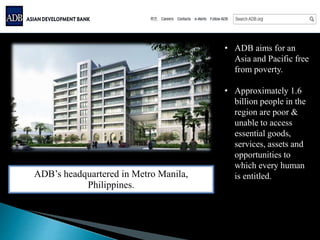
• ADB aims for an
Asia and Pacific free
from poverty.
• Approximately 1.6
billion people in the
region are poor &
unable to access
essential goods,
services, assets and
opportunities to
which every human
is entitled.ADB’s headquartered in Metro Manila,
Philippines.
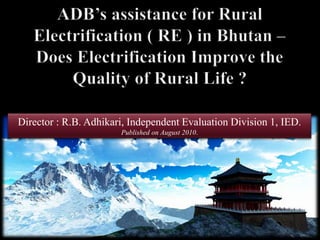
Director : R.B. Adhikari, Independent Evaluation Division 1, IED.
Published on August 2010.
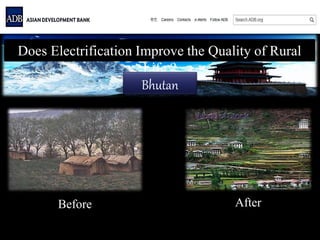
Does Electrification Improve the Quality of Rural
Life ?
Before After
Bhutan
SUMMAR
Y
• Strategy 2020 of ADB
• energy as a key component of the infrastructure core area of
operations.
• ADB invest in rural infrastructure, covering irrigation, water
management, rural roads, and RE.
• WB IEG noted quantification of RE benefits restricted to lighting
benefits, other not quantified.
• Objectives of this research paper – impact of 2 RE projects funded
by ADB in Bhutan.
• Energy policy governed by RE projects evaluated from 1995,
and updated by review in 2000.
• Provide energy to all, especially rural population.
Energy Policy and strategy
• Goal of the policy :
 Poverty reduction
 Private sector participation
 Regional and environmental
impacts
 Regional cooperation
Rural Electrification Operations
• Technical Assistance
• ADB support 50 TA projects for RE ( 1989- 2009 ), amount
$25.9million.
• Bhutan accounted for $4.2million of the TA for RE
• Grants
• ADB started extending projects financed through grants only in 2004 wit
renewable energy & LDP
• 2007-2009 recipients grants – Bhutan ( 2 projects ) - $26.3 million.
1995, 20% of rural household were electrified ;
2006 ↑ 32% .
Expected : electrify 8767 households, facilities & provide 119 solar
photovoltaic system to schools, clinics and other facilities.
The study confirms the ratings on overall performance on these 2 RE projects as
successful.
Benefits bring by the RE projects to Bhutan country and households
• Economic benefits
• Education
• Reduction on poverty
Recommendation by ADB management
• Building on success so far, stimulate
and manage household and
community demand for electricity.
• Ensure the sustainability of projects
benefits
Positive Negative
• Data collection based on face
to face interviewers. This can
make sure the data that collect
will be more accurate.
• Data collected through 2
ways, which is electrified and
unelectrified household in two
villages from Bhutan.
• This paper data may be
outdated, cause the data
collection end in 2010.
• Data collected might be not
accurate, cause Bhutan still
got a lot of rural area haven't
participate in the RE.
This study contributes new knowledge to the global body of
literature on impact of RE in developing countries.
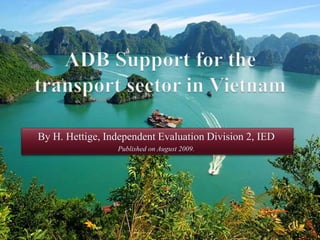
By H. Hettige, Independent Evaluation Division 2, IED
Published on August 2009.
 Vietnam transport sector have much contribution to the
country for the rapid economic growth
 The ADB focus in the roads subsector
 helps reduce poverty by improving links to:
Market
Education
Health facilities
• The important element of the
ADB’s strategy to support the
government is the rehabilitation
and the improvement of
transport infrastructure.
• The ADB strategy also include
the promotion of private sector
to involve in the construction
and maintenance.
• The ADB was a good
responsive to the Vietnam
government’s needs
• In this program, the ADB
also addressed the road
safety
• Improve the road safety
and contribute to a
reduction in incidence
and injured
Positive
• ADB have made the good
process in the operation
with the other donors in
the transport in Vietnam
• ADB operations have
successful in contributing
to the output and the
outcome to support
Vietnam.
• In this, the ADB have the
positive impact to the
economic development
Negative
• There have some of the difficulty that to
comply with the requirement to pay
replacement resettlement compensation to
affected the people disturbed by ADB project
• To process the project, the ministry of
transport’s debt have increase
• The other negative impact is when the project
start, there have some of the problem such as
• Noise pollution
• Carbon dioxide emission
• Safety impact and some social issues
• Study that provided by ADB to countries in fragile and
conflict-affected situation(FCAS)
• FCAS introduced in ADB in 2007
• In 2001, World bank began referring to nations facing these
kinds of conditions as “low income countries under stress”
• ADB then rephrase them as FCAS
 ADB’s current list of FCAS countries includes 10 DMCs in
the Pacific
 Kiribati
 Palau
 Afghanistan
 Republic of Marshall Islands
 etc
 Given the short period since the approach was adopted,
this SES limits its scope to four basic questions.
◦ Is ADB's approach in FCAS countries relevant?
◦ Has the approach been properly resourced?
◦ How have the countries that have exited FCAS status
performed compared with current FCAS countries?
◦ what are the lessons from general implementation
performance?
Is ADB’s approach in FCAS relevant?
• Need to meet individual country needs
• Differentiated approach to engaging FCAS countries
• According to the fragile characteristic (PDMC) &
those in post-conflict situation (Afghanistan)
• Most standard development approaches do not work in
FCAS countries due to fluid political conditions and
weakness of governments.
• ADB works in FCAS countries to enhance partnerships.
• Some of the partnerships in current and exited FCAS
countries include
• preparation of joint needs assessment
• portfolio, procurement, and public expenditure
reviews
• leadership in sectoral and thematic working groups in
most FCAS countries
• developing common strategy and project management
arrangements
Is ADB's approach to FCAS countries
properly resourced?
• Resource allocation to FCAS countries follows ADB
policies on PBA for ADF-eligible countries
• An exception is Afghanistan, which draws from the ADF's
special allocations.
• By comparison, other development institutions appeared to
have provided more resources to countries they consider to
be experiencing fragility and the effects of conflict
How have the countries that have exited FCAS status
performed compared
with current FCAS countries?
• In terms of development outcomes, no clear demarcation
exists between the exited and the current FCAS countries.
• There is no significant positive correlation between CPA
rankings and development outcome indicators.
What are the lessons from general implementation
performance?
• Significant implementation adjustments are highly likely
during project implementation in FCAS countries and
efficiency has suffered as a result
• It takes longer to process a project in FCAS countries (i.e.,
elapse time from approval to first disbursement)
• Exited FCAS countries are performing slightly better than
DMCs remaining in the FCAS category
• FCAS face greater efficiency problems and difficulties in
achieving outcomes
• Current FCAS countries’ project implementation also takes
longer compared with exited FCAS countries.
• Sustainability remains a critical issue due to
capacity constraints
• Cost recovery is a common problem for public
utilities.
• In policy-based support,
• complex civil service reforms,
• privatization of state-owned enterprises, and
• strengthening of public expenditure and
financial management are key areas that need
strengthening and greater follow-through by
ADB.
Recommendation
FCAS approach is young in ADB and has not yet taken root.
1. Classify FCAS countries at the CPS preparation stage based not only on
the CPA rating but also on other fragile and/or conflict characteristics of
the country
2. Develop a step-by-step plan for capacity development based on country
context, CPA assessment, and country diagnostics identified through a
needs assessment
3. Provide flexibility in the design of FCAS projects to accommodate
implementation adjustments and build in longerterm programmatic
approaches
4. Identify the external resource gaps and internal resource gaps for
working in FCAS countries in consultation with donors and other
development partners
TheEnd
Q & A

Asian Development Bank - Article Analysis

  • 1.
    INSTITUTION Asian development bank Articleanalysis PRESENTED BY GOH CHUN HONG WANG JOON ANN WOO CHIA YUEN
  • 2.
    • The ADBestablished on 22 August 1966. To facilitate economic development of countries in Asia • 1966 - 31 members ; now - 67 members (48 within Asia & the Pacific and 19 outside) • After 1986, ADB committed itself to increasing loans for social issues from 30% ↑ 40% . • education, health and population, urban development and environment End of 2013, Japan holds the largest proportions of shares at 15.67% , follow by US – 15.56% and China – 6.47%. * Malaysia 10th – 2.734%.
  • 3.
    • ADB aimsfor an Asia and Pacific free from poverty. • Approximately 1.6 billion people in the region are poor & unable to access essential goods, services, assets and opportunities to which every human is entitled.ADB’s headquartered in Metro Manila, Philippines.
  • 4.
    Director : R.B.Adhikari, Independent Evaluation Division 1, IED. Published on August 2010.
  • 5.
    Does Electrification Improvethe Quality of Rural Life ? Before After Bhutan
  • 6.
    SUMMAR Y • Strategy 2020of ADB • energy as a key component of the infrastructure core area of operations. • ADB invest in rural infrastructure, covering irrigation, water management, rural roads, and RE. • WB IEG noted quantification of RE benefits restricted to lighting benefits, other not quantified. • Objectives of this research paper – impact of 2 RE projects funded by ADB in Bhutan.
  • 7.
    • Energy policygoverned by RE projects evaluated from 1995, and updated by review in 2000. • Provide energy to all, especially rural population. Energy Policy and strategy • Goal of the policy :  Poverty reduction  Private sector participation  Regional and environmental impacts  Regional cooperation
  • 8.
    Rural Electrification Operations •Technical Assistance • ADB support 50 TA projects for RE ( 1989- 2009 ), amount $25.9million. • Bhutan accounted for $4.2million of the TA for RE • Grants • ADB started extending projects financed through grants only in 2004 wit renewable energy & LDP • 2007-2009 recipients grants – Bhutan ( 2 projects ) - $26.3 million. 1995, 20% of rural household were electrified ; 2006 ↑ 32% . Expected : electrify 8767 households, facilities & provide 119 solar photovoltaic system to schools, clinics and other facilities.
  • 9.
    The study confirmsthe ratings on overall performance on these 2 RE projects as successful. Benefits bring by the RE projects to Bhutan country and households • Economic benefits • Education • Reduction on poverty Recommendation by ADB management • Building on success so far, stimulate and manage household and community demand for electricity. • Ensure the sustainability of projects benefits
  • 10.
    Positive Negative • Datacollection based on face to face interviewers. This can make sure the data that collect will be more accurate. • Data collected through 2 ways, which is electrified and unelectrified household in two villages from Bhutan. • This paper data may be outdated, cause the data collection end in 2010. • Data collected might be not accurate, cause Bhutan still got a lot of rural area haven't participate in the RE. This study contributes new knowledge to the global body of literature on impact of RE in developing countries.
  • 11.
    By H. Hettige,Independent Evaluation Division 2, IED Published on August 2009.
  • 12.
     Vietnam transportsector have much contribution to the country for the rapid economic growth  The ADB focus in the roads subsector  helps reduce poverty by improving links to: Market Education Health facilities
  • 13.
    • The importantelement of the ADB’s strategy to support the government is the rehabilitation and the improvement of transport infrastructure. • The ADB strategy also include the promotion of private sector to involve in the construction and maintenance.
  • 14.
    • The ADBwas a good responsive to the Vietnam government’s needs • In this program, the ADB also addressed the road safety • Improve the road safety and contribute to a reduction in incidence and injured
  • 15.
    Positive • ADB havemade the good process in the operation with the other donors in the transport in Vietnam • ADB operations have successful in contributing to the output and the outcome to support Vietnam. • In this, the ADB have the positive impact to the economic development
  • 16.
    Negative • There havesome of the difficulty that to comply with the requirement to pay replacement resettlement compensation to affected the people disturbed by ADB project • To process the project, the ministry of transport’s debt have increase • The other negative impact is when the project start, there have some of the problem such as • Noise pollution • Carbon dioxide emission • Safety impact and some social issues
  • 18.
    • Study thatprovided by ADB to countries in fragile and conflict-affected situation(FCAS) • FCAS introduced in ADB in 2007 • In 2001, World bank began referring to nations facing these kinds of conditions as “low income countries under stress” • ADB then rephrase them as FCAS
  • 19.
     ADB’s currentlist of FCAS countries includes 10 DMCs in the Pacific  Kiribati  Palau  Afghanistan  Republic of Marshall Islands  etc
  • 20.
     Given theshort period since the approach was adopted, this SES limits its scope to four basic questions. ◦ Is ADB's approach in FCAS countries relevant? ◦ Has the approach been properly resourced? ◦ How have the countries that have exited FCAS status performed compared with current FCAS countries? ◦ what are the lessons from general implementation performance?
  • 21.
    Is ADB’s approachin FCAS relevant? • Need to meet individual country needs • Differentiated approach to engaging FCAS countries • According to the fragile characteristic (PDMC) & those in post-conflict situation (Afghanistan) • Most standard development approaches do not work in FCAS countries due to fluid political conditions and weakness of governments.
  • 22.
    • ADB worksin FCAS countries to enhance partnerships. • Some of the partnerships in current and exited FCAS countries include • preparation of joint needs assessment • portfolio, procurement, and public expenditure reviews • leadership in sectoral and thematic working groups in most FCAS countries • developing common strategy and project management arrangements
  • 23.
    Is ADB's approachto FCAS countries properly resourced? • Resource allocation to FCAS countries follows ADB policies on PBA for ADF-eligible countries • An exception is Afghanistan, which draws from the ADF's special allocations. • By comparison, other development institutions appeared to have provided more resources to countries they consider to be experiencing fragility and the effects of conflict
  • 24.
    How have thecountries that have exited FCAS status performed compared with current FCAS countries? • In terms of development outcomes, no clear demarcation exists between the exited and the current FCAS countries. • There is no significant positive correlation between CPA rankings and development outcome indicators.
  • 25.
    What are thelessons from general implementation performance? • Significant implementation adjustments are highly likely during project implementation in FCAS countries and efficiency has suffered as a result • It takes longer to process a project in FCAS countries (i.e., elapse time from approval to first disbursement) • Exited FCAS countries are performing slightly better than DMCs remaining in the FCAS category • FCAS face greater efficiency problems and difficulties in achieving outcomes • Current FCAS countries’ project implementation also takes longer compared with exited FCAS countries.
  • 26.
    • Sustainability remainsa critical issue due to capacity constraints • Cost recovery is a common problem for public utilities. • In policy-based support, • complex civil service reforms, • privatization of state-owned enterprises, and • strengthening of public expenditure and financial management are key areas that need strengthening and greater follow-through by ADB.
  • 27.
    Recommendation FCAS approach isyoung in ADB and has not yet taken root. 1. Classify FCAS countries at the CPS preparation stage based not only on the CPA rating but also on other fragile and/or conflict characteristics of the country 2. Develop a step-by-step plan for capacity development based on country context, CPA assessment, and country diagnostics identified through a needs assessment 3. Provide flexibility in the design of FCAS projects to accommodate implementation adjustments and build in longerterm programmatic approaches 4. Identify the external resource gaps and internal resource gaps for working in FCAS countries in consultation with donors and other development partners
  • 28.