A New Utility ScAle iNverter ANd wiriNg topology

                    peter gerhardinger                                                  Roger King, ph. D.
              Nextronex Energy Systems, LLC                                            University of Toledo
                 4400 Moline Martin Rd.                                                      MS 308
                   Millbury, ohio 43447                                                2801 W. Bancroft St.
                  peterg@nextronex.com                                                  Toledo, oh 43606
                                                                                      rking@eng.utoledo.edu


ABSTRACT                                                           microinverter on the left, and a MegaWatt in a box on the
                                                                   right. This follows the array size as you go up from a panel
Does the world need yet another solar inverter concept?            level inverter through iterations of string level inverters, to
Intermediate size inverters have grown; now there is a             large central inverters. All things being equal, the larger
MegaWatt in a box, and on the other end of the scale, panel        inverters are more cost effective and more efficient. But
level MicroInverters have hit the market. Manufacturers            there is more to the story than cost and efficiency.
have developed panel and string level DC to DC converters
that couple to a large central inverter, and increased
attention has been paid to the critical role of the inverter       2. MICRoINvERTERS
with respect to the economics of solar generated electricity.
                                                                   At the microinverter level, the driver is safety and ease of
Nextronex Energy Systems LLC, formed in 2008 from an
                                                                   installation. on residential and small commercial systems,
established design-engineering firm, looked at the offerings,
                                                                   microinverters eliminate DC wiring with potentially
talked with installers and specifiers, and concluded that the
                                                                   hazardous voltages. Case studies have identified DC arc
world would benefit from yet another solar inverter concept,
                                                                   flash as a contributor to fires, and worse, fire brigades will
one that we call “Distributed Architecture.”
                                                                   not attempt to douse a structure with a pv array on the roof,
Distributed Architecture goes beyond the inverter and              because even with the meter pulled, there are still hazardous
includes companion components that form a complete                 voltages present.
wiring and control system for utility scale solar arrays.
                                                                   A synchronous microinverter will not export any power,
This approach optimizes the performance and reliability of a
                                                                   or have any AC voltage at the output if the AC power is
solar array, reduces engineering and procurement time, and
                                                                   not on. Proper education and labeling can insure that fire
can save installation cost and time. As our industry matures,
                                                                   brigades are able to protect a structure once the meter has
the focus is shifting from installed cost (still very important)
                                                                   been pulled. Another benefit of the microinverter, especially
to expected revenue over the life of the array. Financiers
                                                                   when mounted to the panel, is the ease of installation.
have a critical interest in the revenue stream, uptime, and
operation and maintenance cost of solar projects, and we
                                                                   The disadvantages of the microinverter are cost, efficiency,
believe that our inverter and wiring technology offers the
                                                                   and longevity. Cost will come down, and longevity can
most cost-effective solution to maximizing the revenue
                                                                   only be assessed over time.
stream of the array.


                                                                   3. CENTRAL INvERTERS (MEgAWATT IN A Box)
1. SoLAR INvERTER TEChNICAL AppRoAChES
                                                                   At the MegaWatt in a box level, efficiency can be quite
Fig. 1 represents the continuum of solar inverters available       high, and the high voltage interconnect can be integral
in the market place today. The bookends are a panel level          to the box. The challenge can be installation cost and


                                                                                                                                     1
logistics. Basically, every solar panel must be connected to                                                                                                                  This is a unique approach to allow string level MppT
this inverter box, via a network of DC runs, combiners, DC                                                                                                                    management, then feeding a constant voltage DC bus to
trunk lines, and Recombiners, all of which must be custom                                                                                                                     a large central inverter. There is a lot of flexibility in
engineered and specified by the designers. Depending on                                                                                                                       this approach, and string level control is thought to be a
the panel type, a megawatt field will consist of 4000 to over                                                                                                                 desirable attribute. String level monitoring is a desirable
13000 panels, covering from 3 to 8 acres, and the DC wiring                                                                                                                   attribute, and that is enabled with this system.
can get quite complex and difficult to diagnose, and have
significant power losses.                                                                                                                                                     The disadvantages are cost, efficiency, and reliability – at
                                                                                                                                                                              least at the central inverter level.
The MegaWatt in a box is a large container. It requires a
                                                                                                                                                                              DC to DC conversion involves “chopping”; sampling
substantial foundation and large equipment to transport and
                                                                                                                                                                              the incoming DC at a high frequency (typically 100 khz
set it in place. By its nature, it’s a shadow producer, so it
                                                                                                                                                                              or more), using a small high frequency transformer to
must be to the North of the array, or removed some distance
                                                                                                                                                                              step this voltage up, then filtering the output to return to
from the array.
                                                                                                                                                                              a ripple-free DC waveform. Additional circuitry is used
Some of the newer central inverters incorporate a form                                                                                                                        to manage the MppT at the panel or string level, then
of Master/Slave switching, which does improve energy                                                                                                                          feeding a constant voltage DC (which must be identical
harvesting under marginal conditions, but redundancy and                                                                                                                      for each panel or string) to a combiner as input to a central
reliability is not necessarily improved, because the box has                                                                                                                  inverter. In this configuration, the inverter needs no MPPT
a number if interdependencies between modules, including                                                                                                                      tracking capability, and the various system voltages can be
cooling, and control.                                                                                                                                                         optimized.

                                                                                                                                                                              The problem is cost, efficiency, and reliability. The best
                                                                                                                                                                              DC-DC converters are 97 % efficient, and at the panel level,
4. DC-DC UpCoNvERTERS (STRINg LEvEL)
                                                                                                                                                                              you add another cost component to the system.
FEEDINg A CENTRAL INvERTER


              Solar Inverters – Technical Approaches

                                                                                                    go beyond inverters with a complete system for energy optimization
                       PA N E L L E V E L                                                                                 STRING LEVEL                                                                                                                            A R R AY L E V E L


            Microinverters                    Single Phase                                                                            DC-DC PowerGate Plus 1 MW                                                            Distributed                                            Central
                                                Inverters                                                                          Upconverters                                                                            Architecture                                          Inverters
                                                       PVS – 1000 (MVT)
                                                       Unparalleled Performance
                                                                                                                 Large Central Inverters
                                                                                                       PV Inverters | PowerGate Plus 1 MW

                                                       With their advanced system
                                                       intelligence, next-generation Edge™
                                                       MPPT technology, and industrial-grade
                                                       engineering, PowerGate® Plus inverters
                                                       maximize system uptime and power
                                                       production, even in cloudy conditions.

                                                       Power Efficiency (Inverter Only)
                                                        Power Level    Output Power      Efficiency

                                                             10%            100 kW        96.2%
                                                             20%            200 kW        97.4%
                                                             30%            300 kW        97.6%
                                                             50%            500 kW        97.8%
                                                             75%            750 kW        97.7%
                                                            100%           1000 kW        97.5%
                                                       Measured at 420V

                                                                                                       PowerGate Plus 1 MW Specifications                                                 UL/CSA                  CE


                                                                                                                                                                                                                       150kW Master/Slave
                                                       Edge MPPT

                  < 1kW                           1-10kW                                                                                    Up to 1MW                                                                                                                           330k to 1MW
                                                                                                       Input Parameters
                                                       Provides rapid and accurate control
                                                                                                       Maximum Array Input Voltage                          900 VDC                                              
                                                       that boosts PV plant kilowatt yield
                                                       Provides a wide range of operation              PV Array Configuration                                Floating                                                 Any size array in 1 to 1.5 MW increments
                                                       across all photovoltaic cell technologies       Input Voltage Range (MPPT; Full Power)               420–815 VDC                                          


                                                                                                       Maximum Input Current                                2,442 ADC                                            
                                                       Printed Circuit Board Durability
                                                       Wide thermal operating range: -40º C            Output Parameters
                                                       (-40º F) to 85º C (185º F)                      Nominal Output Voltage to Transformer                265 VAC                                              


                                                       Conformal coated to withstand extreme           Output Frequency Range                               59.3–60.5 Hz                     


           Residential Systems              Small & Residential                                                        DC-DC converters                                                                                Low profile inverters &                                Big centralized boxes
                                                       humidity and air-pollution levels
                                                                                                                                                            49.3–50.5 Hz                                          


                                                                                                       AC Voltage Range (Standard)                          -12%/+10%
                                                       Proven Reliability
                                                                                                                                                                                                                 


                                            Demonstration Systems
                                                       Rugged and reliable, PowerGate Plus
                                                                                                                       have losses, reliability
                                                                                                       Nominal Output Frequency                             60 Hz
                                                                                                                                                                                                                       wiring system
                                                                                                                                                                                             


                                                       PV inverters are engineered from the                                                                 50 Hz                                                 


           Expensive                                                                                                                                                                                                                                                         Inflexible costly wiring
                                                       ground up to meet the demands of

                                            (Schools)                                                                  questions
                                                       large-scale installations.                      Number of Phases                                     3                                                    


                                                                                                       Maximum Output Current per Phase                     2,178 A                                              


                                                                                                                                                                                                                       Max energy harvesting
                                                       Low Maintenance
                                                                                                       CEC Weighted Efficiency (Inverter/System)              97.5%/96%1                                           


                                                       Modular components make service efficient
                                                                                                       Maximum Continuous Output Power                      1000 kW (1000 kVA)                                   


           Safe (no DC arc-flash)                       Dual cooling fans

                                            SMA combines these in
                                                       Safety
                                                                                                       Tare Losses

                                                                                                                       What problem are they
                                                                                                       Power Factor at Full Load
                                                                                                                                                            396 W
                                                                                                                                                            >0.99
                                                                                                                                                                                             


                                                                                                                                                                                             
                                                                                                                                                                                                                  


                                                                                                                                                                                                                  
                                                                                                                                                                                                                       under all conditions
                                                                                                       Harmonic Distortion                                  <3% THD

                                            towers or arrays                                                           solving?
                                                       UBC Seismic Zone 4 compliant
                                                                                                                                                                                                                 


           Long-term reliability
                                                       Built-in DC and AC disconnect switches             Standard       1
                                                                                                                              System efficiency is calculated as combination of measured inverter efficiency and typical


                                                                                                                                                                                                                       Extremely fault tolerant
                                                       Integrated DC two-pole disconnect               o   Optional           transformer efficiency.
                                                       switch isolates the inverter (with the


           unproven
                                                       exception of the GFDI circuit) from the


                                                                                                                       Fault tolerant until you
                                                       photovoltaic power system to allow
                                                       inspection and maintenance


                                                                                                                                                                                                                       String level monitoring
                                                       Protective covers over exposed power


                                                                                                                       get to inverter
                                                       connections


                                                                                                                                                                                                                       & data transmittance
                                                                                                                                                                                                                       via Smart Controller

                                                                                                                                                                                                                       Smart grid ready

Fig. 1: Continuum of solar inverters available in the market place today


                                                                                                                                                                                                                                                                                                       2
Advocates of this approach maintain that you will get            zone box will contribute about 20 kW of panels. The zone
more energy from the array by optimizing the MppT at the         boxes incorporate fuses on both + and – legs (required for
panel or string level, because shading, panel mismatch, and      ungrounded operation), optional CT’s, an Mov lightning
uneven panel degradation may affect the ability to centrally     protection network, and a safety disconnect switch. The
manage the MppT. There are also claims that one can mix          output of the CT’s are sent to the smart controller, which
and match solar panels in an array. These are not substitutes    controls the overall inverter operation, reads the Zone
for proper engineering and layout and quality panels.            currents, and summarizes the array performance both on the
                                                                 internal hMI screen, and remotely via the built-in Ethernet
                                                                 connection.
5. ThE NExTRoNEx DISTRIBUTED ARChITECTURE
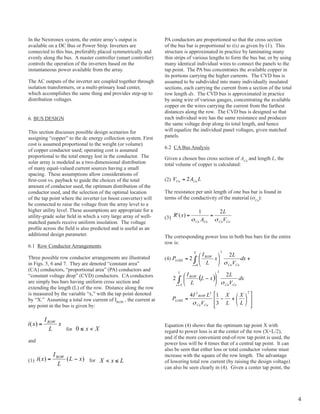
                                                                 Fig. 3 shows the default system screen and Fig. 4 shows
                                                                 a screen of the instantaneous row currents, useful as a
The Nextronex approach is a hybrid. We start with a highly-
                                                                 diagnostic tool to insure that the array is functioning as
efficient, robust inverter that is derived from a variable
                                                                 designed.
speed AC motor drive, package it in a low profile cabinet
that allows placement flexibility, and parallel these on a DC
bus to accommodate any array size from 100 kW up through
1.5 MegaWatts (Fig. 2). (Note that larger fields are simply
multiples of 1 to 1.5 Megawatts, further enhancing the
flexibility and reliability of the design.)

The operational strategy can be summarized very simply:
We can funnel the entire array output to as few inverters as
needed at any instant in time.

The Nextronex inverter is a transformerless design, that
nonetheless is coupled through a transformer for isolation.
There is a unique efficiency advantage of this design,
because the coupling transformer can be custom wound
for the application, and in larger installations, the separate
transformer functions (isolation and step-up to distribution     Fig. 3: Default system screen.
voltage) can be combined in one multi-primary unit,
eliminating a stage, which adds at least 2 % efficiency to the
system. We’ll return to the discussion of operating voltages
again later.

Connecting the solar array to the bus is accomplished via
multi-input zone boxes that are physically attached to
the bus, and allow up to 4 fused inputs. With most panel
types, each input will accommodate around 5 kW, so each


                                                                 Fig. 4: Zone box screen, instantaneous row currents.


                                                                 All the components in the Nextronex system are approved
                                                                 for 1000 v DC operation. The National Electrical Code
                                                                 allows this voltage on all installations other than one and
                                                                 two family dwellings, and the UL 1703 panel standard also
                                                                 recognizes this voltage level. operating at a 1000 v string
                                                                 voltage reduces the number of home runs by 40 %, and
                                                                 reduces IR losses, so this is another key advantage of the
Fig. 2: Nextronex distributed architecture.                      Nextronex system.


                                                                                                                               3
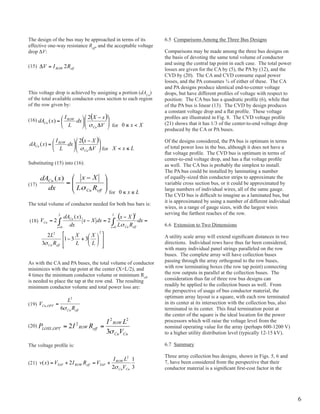
In the Nextronex system, the entire array’s output is            pA conductors are proportioned so that the cross section
available on a DC Bus or power Strip. Inverters are              of the bus bar is proportional to i(x) as given by (1). This
connected to this bus, preferably placed symmetrically and       structure is approximated in practice by laminating many
evenly along the bus. A master controller (smart controller)     thin strips of various lengths to form the bus bar, or by using
controls the operation of the inverters based on the             many identical individual wires to connect the panels to the
instantaneous power available from the array.                    tap point. The pA bus concentrates the available copper in
                                                                 its portions carrying the higher currents. The CvD bus is
The AC outputs of the inverter are coupled together through      assumed to be subdivided into many individually insulated
isolation transformers, or a multi-primary load center,          sections, each carrying the current from a section of the total
which accomplishes the same thing and provides step-up to        row length dx. The CvD bus is approximated in practice
distribution voltages.                                           by using wire of various gauges, concentrating the available
                                                                 copper on the wires carrying the current from the farthest
                                                                 distances along the row. The CvD bus is designed so that
6. BUS DESIgN                                                    each individual wire has the same resistance and produces
                                                                 the same voltage drop along its total length, and hence
This section discusses possible design scenarios for             will equalize the individual panel voltages, given matched
assigning “copper” to the dc energy collection system. First     panels.
cost is assumed proportional to the weight (or volume)
                                                                 6.2 CA Bus Analysis
of copper conductor used; operating cost is assumed
proportional to the total energy lost in the conductor. The      given a chosen bus cross section of ACu and length L, the
solar array is modeled as a two-dimensional distribution         total volume of copper is calculated:
of many equal-valued current sources having a small
spacing. These assumptions allow considerations of
first-cost vs. payback to guide the choices of the total         (2)
amount of conductor used, the optimum distribution of the
conductor used, and the selection of the optimal location        The resistance per unit length of one bus bar is found in
of the tap point where the inverter (or boost converter) will    terms of the conductivity of the material (sCu):
be connected to raise the voltage from the array level to a
higher utility level. These assumptions are appropriate for a
utility-grade solar field in which a very large array of well-   (3)
matched panels receive uniform insolation. The voltage
profile across the field is also predicted and is useful as an
additional design parameter.                                     The corresponding power loss in both bus bars for the entire
                                                                 row is:
6.1 Row Conductor Arrangements

Three possible row conductor arrangements are illustrated        (4)
in Figs. 5, 6 and 7. They are denoted “constant area”
(CA) conductors, “proportional area” (pA) conductors and
“constant voltage drop” (CvD) conductors. CA conductors
are simply bus bars having uniform cross section and
extending the length (L) of the row. Distance along the row
is measured by the variable “x,” with the tap point denoted
by “x.” Assuming a total row current of IRoW , the current at
any point in the bus is given by:


                                                                 Equation (4) shows that the optimum tap point x with
                  for                                            regard to power loss is at the center of the row (x=L/2),
                                                                 and if the more convenient end-of-row tap point is used, the
and
                                                                 power loss will be 4 times that of a central tap point. It can
                                                                 also be seen that either loss or total conductor volume must
                                                                 increase with the square of the row length. The advantage
(1)                           for                                of lowering total row current (by raising the design voltage)
                                                                 can also be seen clearly in (4). given a center tap point, the


                                                                                                                                   4
relationship between conductor volume and power loss is:


(5)                                                             for


The bus voltage profile, assuming a center tap point, is        The total power loss in both bus bars is found in the same
calculated:                                                     manner as in (4):


(6)                                                             (11)

for
                                                                As with the CA bus, the optimum tap point for the pA bus is
                                                                at the center (x=L/2), and the penalty for placing the tap at
A symmetric voltage profile will occur on the other side        either end is a 4-times increase in loss or conductor volume.
of the tap point. Given a fixed row length, the bus design      The optimum power loss design for the pA bus results in:
procedure will be to determine the maximum acceptable
voltage variation (Dv) from the center to the row end and
calculate the needed conductor volume from the following:       (12)


(7)
                                                                The voltage profile for the PA bus with center tap point is
                                                                calculated in the same manner as in (6):
6.3 pA Bus Analysis

The current distribution vs. position in the pA bus is          (13)
given by (1), but the bus cross section is proportioned to
the current at each location, as indicated in Fig. 6 for the
general case of an off-center tap point. The ratio of the two   for
maximal cross sections at the tap point is therefore:

                                                                Again, the profile for the other side of the center is
(8)                                                             symmetrical. Examination of (6) and (13) shows that the
                                                                CA and pA buses have the same center-to-end voltage drop
The total volume of conductor in both bus bars is:              for the same conductor volume, and that the design equation
                                                                given in (7) is also useful for the pA bus.

(9)                                                             6.4 CvD Bus Analysis

                                                                By design, the voltage profile along the length of the CVD
                                                                bus is uniform. This is accomplished by subdividing the
                                                                bus into many mutually-insulated segments, each having
                                                                the same end-to-end resistance, and each carrying the same
The resistance per unit length of the bus bar is:               current generated by a small segment of the row panels
                                                                spanning distance dx. In the following analysis, the location
                                                                variable x refers to the small section of panels located at
(10)                                                            this distance along the row, and to the small portion of bus
                                                                cross section dACu which services these panels. The current
for                                                             produced by the panels in dx (not the total bus current at that
                                                                point) is:

                                                                (14)


                                                                                                                                  5
The design of the bus may be approached in terms of its         6.5 Comparisons Among the Three Bus Designs
effective one-way resistance Reff, and the acceptable voltage
drop DV:                                                        Comparisons may be made among the three bus designs on
                                                                the basis of devoting the same total volume of conductor
                                                                and using the central tap point in each case. The total power
(15)
                                                                losses are given for the CA by (5), the pA by (12), and the
                                                                CvD by (20). The CA and CvD consume equal power
                                                                losses, and the pA consumes ¾ of either of these. The CA
                                                                and pA designs produce identical end-to-center voltage
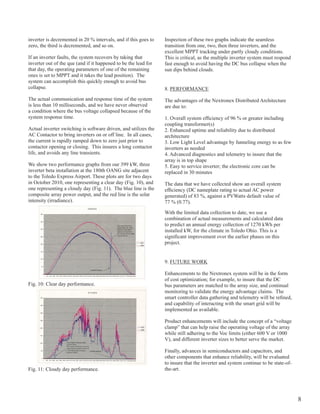
This voltage drop is achieved by assigning a portion (dACu)     drops, but have different profiles of voltage with respect to
of the total available conductor cross section to each region   position: The CA bus has a quadratic profile (6), while that
of the row given by:                                            of the pA bus is linear (13). The CvD by design produces
                                                                a constant voltage drop and a flat profile. These voltage
                                                                profiles are illustrated in Fig. 8. The CVD voltage profile
(16)
                                           for                  (21) shows that it has 1/3 of the center-to-end voltage drop
                                                                produced by the CA or pA buses.

                                                                of the designs considered, the pA bus is optimum in terms
                                    for                         of total power loss in the bus, although it does not have a
                                                                flat voltage profile. The CVD bus is optimum in terms of
                                                                center-to-end voltage drop, and has a flat voltage profile
Substituting (15) into (16):                                    as well. The CA bus is probably the simplest to install.
                                                                The pA bus could be installed by laminating a number
                                                                of equally-sized thin conductor strips to approximate the
(17)                                                            variable cross section bus, or it could be approximated by
                                                                large numbers of individual wires, all of the same gauge.
                                          for
                                                                The CVD bus is difficult to imagine as a laminated bus, but
                                                                it is approximated by using a number of different individual
The total volume of conductor needed for both bus bars is:
                                                                wires, in a range of gauge sizes, with the largest wires
                                                                serving the farthest reaches of the row.
(18)
                                                                6.6 Extension to Two Dimensions

                                                                A utility scale array will extend significant distances in two
                                                                directions. Individual rows have thus far been considered,
                                                                with many individual panel strings paralleled on the row
                                                                buses. The complete array will have collection buses
As with the CA and pA buses, the total volume of conductor      passing through the array orthogonal to the row buses,
minimizes with the tap point at the center (x=L/2), and         with row terminating boxes (the row tap point) connecting
4 times the minimum conductor volume or minimum Reff            the row outputs in parallel at the collection buses. The
is needed to place the tap at the row end. The resulting        consideration thus far of three row bus designs can
minimum conductor volume and total power loss are:              readily be applied to the collection buses as well. From
                                                                the perspective of usage of bus conductor material, the
                                                                optimum array layout is a square, with each row terminated
(19)                                                            in its center at its intersection with the collection bus, also
                                                                terminated in its center. This final termination point at
                                                                the center of the square is the ideal location for the power
                                                                processors which will raise the voltage level from the
(20)                                                            nominal operating value for the array (perhaps 600-1200 v)
                                                                to a higher utility distribution level (typically 12-15 kv).

The voltage profile is:                                         6.7 Summary

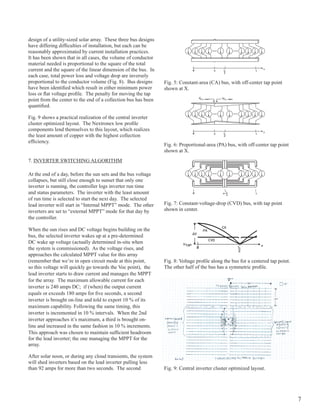
                                                                Three array collection bus designs, shown in Figs. 5, 6 and
(21)                                                            7, have been considered from the perspective that their
                                                                conductor material is a significant first-cost factor in the


                                                                                                                                  6
design of a utility-sized solar array. These three bus designs
have differing difficulties of installation, but each can be
reasonably approximated by current installation practices.
It has been shown that in all cases, the volume of conductor
material needed is proportional to the square of the total
current and the square of the linear dimension of the bus. In                                    Fig. 1(a). Constant-area (CA) bus, with off-center tap
                                                                                                                  point shown at x.
                                                                                                                                                              Fig. 2. voltage profile along the bus
                                                                                                                                                             point. The other half of the bus has a
each case, total power loss and voltage drop are inversely                                       Fig. 1(a). Constant-area (CA) bus, with off-center tap       Fig. 2. voltage profile along the bus
                                                                                                                  point shown at x.                          point. The other half of the bus has a
proportional to the conductor volume (Fig. 8). Bus designs                         Fig. 5:     Constant-area (CA)(CA) bus, with off-center tap
                                                                                                 Fig. 1(a). Constant-area bus, with off-center             tap point
                                                                                                                                                              Fig. 2. voltage profile along the bus
                                                                                                                  point shown at x.                          point. The other half of the bus has a
have been identified which result in either minimum power                          shown at x.
loss or flat voltage profile. The penalty for moving the tap
point from the center to the end of a collection bus has been
quantified.

Fig. 9 shows a practical realization of the central inverter
cluster optimized layout. The Nextronex low profile
components lend themselves to this layout, which realizes
the least amount of copper with the highest collection
                                                                                                  Fig. 1(b). proportional-area (pA) bus, with off-center
efficiency.                                                                                                 tap point shown at x.
                                                                                   Fig. 6: proportional-area (pA) bus, withoff-center
                                                                                             Fig. 1(b). proportional-area (pA) bus, with off-center tap point
                                                                                                            tap point shown at x.
                                                                                   shown at x. 1(b). proportional-area (pA) bus, with off-center
                                                                                             Fig.
                                                                                                                 tap point shown at x.
7. INvERTER SWITChINg ALgoRIThM

At the end of a day, before the sun sets and the bus voltage
collapses, but still close enough to sunset that only one
inverter is running, the controller logs inverter run time
and status parameters. The inverter with the least amount
of run time is selected to start the next day. The selected
lead inverter will start in “Internal MppT” mode. The other                        Fig. 7: Constant-voltage-drop (CvD) bus, with tap tap point
                                                                                             Fig. 1(c). Constant-voltage-drop (CvD) bus, with
                                                                                                            point shown in center.
inverters are set to “external MppT” mode for that day by                          shown in center. Constant-voltage-drop (CvD) bus, with tap
                                                                                             Fig. 1(c).
                                                                                                                 point shown in center.
the controller.                                                                                   Fig. 1(c). Constant-voltage-drop (CvD) bus, with tap
                                                                                                                 point shown in center.

When the sun rises and DC voltage begins building on the
bus, the selected inverter wakes up at a pre-determined
DC wake up voltage (actually determined in-situ when
the system is commissioned). As the voltage rises, and
approaches the calculated MppT value for this array
(remember that we’re in open circuit mode at this point,                         Fig. 8: Voltage profile along the bus for a centered tap point.
                                    Fig. 1(a). Constant-area (CA) bus, with off-center tap  Fig. 2. voltage profile along the bus for a centered tap
so this voltage will quickly go towards the vocpoint shown at x.
                                                        point), the              The other halfThe other half of has a has a symmetric profile.
                                                                                           point. of the bus the bus symmetric profile.
lead inverter starts to draw current and manages the MppT
for the array. The maximum allowable current for each
inverter is 240 amps DC; if (when) the output current
equals or exceeds 180 amps for five seconds, a second
inverter is brought on-line and told to export 10 % of its
maximum capability. Following the same timing, this
inverter is incremented in 10 % intervals. When the 2nd
inverter approaches it’s maximum, a third is brought on-
line and increased in the same fashion in 10 % increments.
This approach was chosen to maintain sufficient headroom with off-center
                                     Fig. 1(b). proportional-area (pA) bus,
for the lead inverter; the one managing the MppT for the x.
                                                    tap point shown at
array.

After solar noon, or during any cloud transients, the system
will shed inverters based on the lead inverter pulling less
than 92 amps for more than two seconds. The second                                 Fig. 9: Central inverter cluster optimized layout.


                                        Fig. 1(c). Constant-voltage-drop (CvD) bus, with tap                                                                                       7
                                                       point shown in center.
inverter is decremented in 20 % intervals, and if this goes to   Inspection of these two graphs indicate the seamless
zero, the third is decremented, and so on.                       transition from one, two, then three inverters, and the
                                                                 excellent MppT tracking under partly cloudy conditions.
If an inverter faults, the system recovers by taking that        This is critical, as the multiple inverter system must respond
inverter out of the que (and if it happened to be the lead for   fast enough to avoid having the DC bus collapse when the
that day, the operating parameters of one of the remaining       sun dips behind clouds.
ones is set to MppT and it takes the lead position). The
system can accomplish this quickly enough to avoid bus
collapse.                                                        8. pERFoRMANCE
The actual communication and response time of the system         The advantages of the Nextronex Distributed Architecture
is less than 10 milliseconds, and we have never observed         are due to:
a condition where the bus voltage collapsed because of the
system response time.                                            1. Overall system efficiency of 96 % or greater including
                                                                 coupling transformer(s)
Actual inverter switching is software driven, and utilizes the   2. Enhanced uptime and reliability due to distributed
AC Contactor to bring inverters on or off line. In all cases,    architecture
the current is rapidly ramped down to zero just prior to         3. Low Light Level advantage by funneling energy to as few
contactor opening or closing. This insures a long contactor      inverters as needed
life, and avoids any line transients.                            4. Advanced diagnostics and telemetry to insure that the
                                                                 array is in top shape
We show two performance graphs from our 399 kW, three            5. Easy to service inverter; the electronic core can be
inverter beta installation at the 180th oANg site adjacent       replaced in 30 minutes
to the Toledo Express Airport. These plots are for two days
in october 2010, one representing a clear day (Fig. 10), and     The data that we have collected show an overall system
one representing a cloudy day (Fig. 11). The blue line is the    efficiency (DC nameplate rating to actual AC power
composite array power output, and the red line is the solar      generated) of 83 %, against a pvWatts default value of
intensity (irradiance).                                          77 % (0.77).

                                                                 With the limited data collection to date, we use a
                                                                 combination of actual measurements and calculated data
                                                                 to predict an annual energy collection of 1270 kWh per
                                                                 installed kW, for the climate in Toledo ohio. This is a
                                                                 significant improvement over the earlier phases on this
                                                                 project.


                                                                 9. FUTURE WoRK

                                                                 Enhancements to the Nextronex system will be in the form
                                                                 of cost optimization; for example, to insure that the DC
Fig. 10: Clear day performance.                                  bus parameters are matched to the array size, and continual
                                                                 monitoring to validate the energy advantage claims. The
                                                                 smart controller data gathering and telemetry will be refined,
                                                                 and capability of interacting with the smart grid will be
                                                                 implemented as available.

                                                                 product enhancements will include the concept of a “voltage
                                                                 clamp” that can help raise the operating voltage of the array
                                                                 while still adhering to the voc limits (either 600 v or 1000
                                                                 v), and different inverter sizes to better serve the market.

                                                                 Finally, advances in semiconductors and capacitors, and
                                                                 other components that enhance reliability, will be evaluated
                                                                 to insure that the inverter and system continue to be state-of-
Fig. 11: Cloudy day performance.                                 the-art.


                                                                                                                                   8

Ases Paper 2011

  • 1.
    A New UtilityScAle iNverter ANd wiriNg topology peter gerhardinger Roger King, ph. D. Nextronex Energy Systems, LLC University of Toledo 4400 Moline Martin Rd. MS 308 Millbury, ohio 43447 2801 W. Bancroft St. peterg@nextronex.com Toledo, oh 43606 rking@eng.utoledo.edu ABSTRACT microinverter on the left, and a MegaWatt in a box on the right. This follows the array size as you go up from a panel Does the world need yet another solar inverter concept? level inverter through iterations of string level inverters, to Intermediate size inverters have grown; now there is a large central inverters. All things being equal, the larger MegaWatt in a box, and on the other end of the scale, panel inverters are more cost effective and more efficient. But level MicroInverters have hit the market. Manufacturers there is more to the story than cost and efficiency. have developed panel and string level DC to DC converters that couple to a large central inverter, and increased attention has been paid to the critical role of the inverter 2. MICRoINvERTERS with respect to the economics of solar generated electricity. At the microinverter level, the driver is safety and ease of Nextronex Energy Systems LLC, formed in 2008 from an installation. on residential and small commercial systems, established design-engineering firm, looked at the offerings, microinverters eliminate DC wiring with potentially talked with installers and specifiers, and concluded that the hazardous voltages. Case studies have identified DC arc world would benefit from yet another solar inverter concept, flash as a contributor to fires, and worse, fire brigades will one that we call “Distributed Architecture.” not attempt to douse a structure with a pv array on the roof, Distributed Architecture goes beyond the inverter and because even with the meter pulled, there are still hazardous includes companion components that form a complete voltages present. wiring and control system for utility scale solar arrays. A synchronous microinverter will not export any power, This approach optimizes the performance and reliability of a or have any AC voltage at the output if the AC power is solar array, reduces engineering and procurement time, and not on. Proper education and labeling can insure that fire can save installation cost and time. As our industry matures, brigades are able to protect a structure once the meter has the focus is shifting from installed cost (still very important) been pulled. Another benefit of the microinverter, especially to expected revenue over the life of the array. Financiers when mounted to the panel, is the ease of installation. have a critical interest in the revenue stream, uptime, and operation and maintenance cost of solar projects, and we The disadvantages of the microinverter are cost, efficiency, believe that our inverter and wiring technology offers the and longevity. Cost will come down, and longevity can most cost-effective solution to maximizing the revenue only be assessed over time. stream of the array. 3. CENTRAL INvERTERS (MEgAWATT IN A Box) 1. SoLAR INvERTER TEChNICAL AppRoAChES At the MegaWatt in a box level, efficiency can be quite Fig. 1 represents the continuum of solar inverters available high, and the high voltage interconnect can be integral in the market place today. The bookends are a panel level to the box. The challenge can be installation cost and 1
  • 2.
    logistics. Basically, everysolar panel must be connected to This is a unique approach to allow string level MppT this inverter box, via a network of DC runs, combiners, DC management, then feeding a constant voltage DC bus to trunk lines, and Recombiners, all of which must be custom a large central inverter. There is a lot of flexibility in engineered and specified by the designers. Depending on this approach, and string level control is thought to be a the panel type, a megawatt field will consist of 4000 to over desirable attribute. String level monitoring is a desirable 13000 panels, covering from 3 to 8 acres, and the DC wiring attribute, and that is enabled with this system. can get quite complex and difficult to diagnose, and have significant power losses. The disadvantages are cost, efficiency, and reliability – at least at the central inverter level. The MegaWatt in a box is a large container. It requires a DC to DC conversion involves “chopping”; sampling substantial foundation and large equipment to transport and the incoming DC at a high frequency (typically 100 khz set it in place. By its nature, it’s a shadow producer, so it or more), using a small high frequency transformer to must be to the North of the array, or removed some distance step this voltage up, then filtering the output to return to from the array. a ripple-free DC waveform. Additional circuitry is used Some of the newer central inverters incorporate a form to manage the MppT at the panel or string level, then of Master/Slave switching, which does improve energy feeding a constant voltage DC (which must be identical harvesting under marginal conditions, but redundancy and for each panel or string) to a combiner as input to a central reliability is not necessarily improved, because the box has inverter. In this configuration, the inverter needs no MPPT a number if interdependencies between modules, including tracking capability, and the various system voltages can be cooling, and control. optimized. The problem is cost, efficiency, and reliability. The best DC-DC converters are 97 % efficient, and at the panel level, 4. DC-DC UpCoNvERTERS (STRINg LEvEL) you add another cost component to the system. FEEDINg A CENTRAL INvERTER Solar Inverters – Technical Approaches go beyond inverters with a complete system for energy optimization PA N E L L E V E L STRING LEVEL A R R AY L E V E L Microinverters Single Phase DC-DC PowerGate Plus 1 MW Distributed Central Inverters Upconverters Architecture Inverters PVS – 1000 (MVT) Unparalleled Performance Large Central Inverters PV Inverters | PowerGate Plus 1 MW With their advanced system intelligence, next-generation Edge™ MPPT technology, and industrial-grade engineering, PowerGate® Plus inverters maximize system uptime and power production, even in cloudy conditions. Power Efficiency (Inverter Only) Power Level Output Power Efficiency 10% 100 kW 96.2% 20% 200 kW 97.4% 30% 300 kW 97.6% 50% 500 kW 97.8% 75% 750 kW 97.7% 100% 1000 kW 97.5% Measured at 420V PowerGate Plus 1 MW Specifications UL/CSA CE 150kW Master/Slave Edge MPPT < 1kW 1-10kW Up to 1MW 330k to 1MW Input Parameters Provides rapid and accurate control Maximum Array Input Voltage 900 VDC   that boosts PV plant kilowatt yield Provides a wide range of operation PV Array Configuration Floating   Any size array in 1 to 1.5 MW increments across all photovoltaic cell technologies Input Voltage Range (MPPT; Full Power) 420–815 VDC   Maximum Input Current 2,442 ADC   Printed Circuit Board Durability Wide thermal operating range: -40º C Output Parameters (-40º F) to 85º C (185º F) Nominal Output Voltage to Transformer 265 VAC   Conformal coated to withstand extreme Output Frequency Range 59.3–60.5 Hz  Residential Systems Small & Residential DC-DC converters Low profile inverters & Big centralized boxes humidity and air-pollution levels 49.3–50.5 Hz  AC Voltage Range (Standard) -12%/+10% Proven Reliability   Demonstration Systems Rugged and reliable, PowerGate Plus have losses, reliability Nominal Output Frequency 60 Hz wiring system  PV inverters are engineered from the 50 Hz  Expensive Inflexible costly wiring ground up to meet the demands of (Schools) questions large-scale installations. Number of Phases 3   Maximum Output Current per Phase 2,178 A   Max energy harvesting Low Maintenance CEC Weighted Efficiency (Inverter/System) 97.5%/96%1   Modular components make service efficient Maximum Continuous Output Power 1000 kW (1000 kVA)   Safe (no DC arc-flash) Dual cooling fans SMA combines these in Safety Tare Losses What problem are they Power Factor at Full Load 396 W >0.99     under all conditions Harmonic Distortion <3% THD towers or arrays solving? UBC Seismic Zone 4 compliant   Long-term reliability Built-in DC and AC disconnect switches  Standard 1 System efficiency is calculated as combination of measured inverter efficiency and typical Extremely fault tolerant Integrated DC two-pole disconnect o Optional transformer efficiency. switch isolates the inverter (with the unproven exception of the GFDI circuit) from the Fault tolerant until you photovoltaic power system to allow inspection and maintenance String level monitoring Protective covers over exposed power get to inverter connections & data transmittance via Smart Controller Smart grid ready Fig. 1: Continuum of solar inverters available in the market place today 2
  • 3.
    Advocates of thisapproach maintain that you will get zone box will contribute about 20 kW of panels. The zone more energy from the array by optimizing the MppT at the boxes incorporate fuses on both + and – legs (required for panel or string level, because shading, panel mismatch, and ungrounded operation), optional CT’s, an Mov lightning uneven panel degradation may affect the ability to centrally protection network, and a safety disconnect switch. The manage the MppT. There are also claims that one can mix output of the CT’s are sent to the smart controller, which and match solar panels in an array. These are not substitutes controls the overall inverter operation, reads the Zone for proper engineering and layout and quality panels. currents, and summarizes the array performance both on the internal hMI screen, and remotely via the built-in Ethernet connection. 5. ThE NExTRoNEx DISTRIBUTED ARChITECTURE Fig. 3 shows the default system screen and Fig. 4 shows a screen of the instantaneous row currents, useful as a The Nextronex approach is a hybrid. We start with a highly- diagnostic tool to insure that the array is functioning as efficient, robust inverter that is derived from a variable designed. speed AC motor drive, package it in a low profile cabinet that allows placement flexibility, and parallel these on a DC bus to accommodate any array size from 100 kW up through 1.5 MegaWatts (Fig. 2). (Note that larger fields are simply multiples of 1 to 1.5 Megawatts, further enhancing the flexibility and reliability of the design.) The operational strategy can be summarized very simply: We can funnel the entire array output to as few inverters as needed at any instant in time. The Nextronex inverter is a transformerless design, that nonetheless is coupled through a transformer for isolation. There is a unique efficiency advantage of this design, because the coupling transformer can be custom wound for the application, and in larger installations, the separate transformer functions (isolation and step-up to distribution Fig. 3: Default system screen. voltage) can be combined in one multi-primary unit, eliminating a stage, which adds at least 2 % efficiency to the system. We’ll return to the discussion of operating voltages again later. Connecting the solar array to the bus is accomplished via multi-input zone boxes that are physically attached to the bus, and allow up to 4 fused inputs. With most panel types, each input will accommodate around 5 kW, so each Fig. 4: Zone box screen, instantaneous row currents. All the components in the Nextronex system are approved for 1000 v DC operation. The National Electrical Code allows this voltage on all installations other than one and two family dwellings, and the UL 1703 panel standard also recognizes this voltage level. operating at a 1000 v string voltage reduces the number of home runs by 40 %, and reduces IR losses, so this is another key advantage of the Fig. 2: Nextronex distributed architecture. Nextronex system. 3
  • 4.
    In the Nextronexsystem, the entire array’s output is pA conductors are proportioned so that the cross section available on a DC Bus or power Strip. Inverters are of the bus bar is proportional to i(x) as given by (1). This connected to this bus, preferably placed symmetrically and structure is approximated in practice by laminating many evenly along the bus. A master controller (smart controller) thin strips of various lengths to form the bus bar, or by using controls the operation of the inverters based on the many identical individual wires to connect the panels to the instantaneous power available from the array. tap point. The pA bus concentrates the available copper in its portions carrying the higher currents. The CvD bus is The AC outputs of the inverter are coupled together through assumed to be subdivided into many individually insulated isolation transformers, or a multi-primary load center, sections, each carrying the current from a section of the total which accomplishes the same thing and provides step-up to row length dx. The CvD bus is approximated in practice distribution voltages. by using wire of various gauges, concentrating the available copper on the wires carrying the current from the farthest distances along the row. The CvD bus is designed so that 6. BUS DESIgN each individual wire has the same resistance and produces the same voltage drop along its total length, and hence This section discusses possible design scenarios for will equalize the individual panel voltages, given matched assigning “copper” to the dc energy collection system. First panels. cost is assumed proportional to the weight (or volume) 6.2 CA Bus Analysis of copper conductor used; operating cost is assumed proportional to the total energy lost in the conductor. The given a chosen bus cross section of ACu and length L, the solar array is modeled as a two-dimensional distribution total volume of copper is calculated: of many equal-valued current sources having a small spacing. These assumptions allow considerations of first-cost vs. payback to guide the choices of the total (2) amount of conductor used, the optimum distribution of the conductor used, and the selection of the optimal location The resistance per unit length of one bus bar is found in of the tap point where the inverter (or boost converter) will terms of the conductivity of the material (sCu): be connected to raise the voltage from the array level to a higher utility level. These assumptions are appropriate for a utility-grade solar field in which a very large array of well- (3) matched panels receive uniform insolation. The voltage profile across the field is also predicted and is useful as an additional design parameter. The corresponding power loss in both bus bars for the entire row is: 6.1 Row Conductor Arrangements Three possible row conductor arrangements are illustrated (4) in Figs. 5, 6 and 7. They are denoted “constant area” (CA) conductors, “proportional area” (pA) conductors and “constant voltage drop” (CvD) conductors. CA conductors are simply bus bars having uniform cross section and extending the length (L) of the row. Distance along the row is measured by the variable “x,” with the tap point denoted by “x.” Assuming a total row current of IRoW , the current at any point in the bus is given by: Equation (4) shows that the optimum tap point x with for regard to power loss is at the center of the row (x=L/2), and if the more convenient end-of-row tap point is used, the and power loss will be 4 times that of a central tap point. It can also be seen that either loss or total conductor volume must increase with the square of the row length. The advantage (1) for of lowering total row current (by raising the design voltage) can also be seen clearly in (4). given a center tap point, the 4
  • 5.
    relationship between conductorvolume and power loss is: (5) for The bus voltage profile, assuming a center tap point, is The total power loss in both bus bars is found in the same calculated: manner as in (4): (6) (11) for As with the CA bus, the optimum tap point for the pA bus is at the center (x=L/2), and the penalty for placing the tap at A symmetric voltage profile will occur on the other side either end is a 4-times increase in loss or conductor volume. of the tap point. Given a fixed row length, the bus design The optimum power loss design for the pA bus results in: procedure will be to determine the maximum acceptable voltage variation (Dv) from the center to the row end and calculate the needed conductor volume from the following: (12) (7) The voltage profile for the PA bus with center tap point is calculated in the same manner as in (6): 6.3 pA Bus Analysis The current distribution vs. position in the pA bus is (13) given by (1), but the bus cross section is proportioned to the current at each location, as indicated in Fig. 6 for the general case of an off-center tap point. The ratio of the two for maximal cross sections at the tap point is therefore: Again, the profile for the other side of the center is (8) symmetrical. Examination of (6) and (13) shows that the CA and pA buses have the same center-to-end voltage drop The total volume of conductor in both bus bars is: for the same conductor volume, and that the design equation given in (7) is also useful for the pA bus. (9) 6.4 CvD Bus Analysis By design, the voltage profile along the length of the CVD bus is uniform. This is accomplished by subdividing the bus into many mutually-insulated segments, each having the same end-to-end resistance, and each carrying the same The resistance per unit length of the bus bar is: current generated by a small segment of the row panels spanning distance dx. In the following analysis, the location variable x refers to the small section of panels located at (10) this distance along the row, and to the small portion of bus cross section dACu which services these panels. The current for produced by the panels in dx (not the total bus current at that point) is: (14) 5
  • 6.
    The design ofthe bus may be approached in terms of its 6.5 Comparisons Among the Three Bus Designs effective one-way resistance Reff, and the acceptable voltage drop DV: Comparisons may be made among the three bus designs on the basis of devoting the same total volume of conductor and using the central tap point in each case. The total power (15) losses are given for the CA by (5), the pA by (12), and the CvD by (20). The CA and CvD consume equal power losses, and the pA consumes ¾ of either of these. The CA and pA designs produce identical end-to-center voltage This voltage drop is achieved by assigning a portion (dACu) drops, but have different profiles of voltage with respect to of the total available conductor cross section to each region position: The CA bus has a quadratic profile (6), while that of the row given by: of the pA bus is linear (13). The CvD by design produces a constant voltage drop and a flat profile. These voltage profiles are illustrated in Fig. 8. The CVD voltage profile (16) for (21) shows that it has 1/3 of the center-to-end voltage drop produced by the CA or pA buses. of the designs considered, the pA bus is optimum in terms for of total power loss in the bus, although it does not have a flat voltage profile. The CVD bus is optimum in terms of center-to-end voltage drop, and has a flat voltage profile Substituting (15) into (16): as well. The CA bus is probably the simplest to install. The pA bus could be installed by laminating a number of equally-sized thin conductor strips to approximate the (17) variable cross section bus, or it could be approximated by large numbers of individual wires, all of the same gauge. for The CVD bus is difficult to imagine as a laminated bus, but it is approximated by using a number of different individual The total volume of conductor needed for both bus bars is: wires, in a range of gauge sizes, with the largest wires serving the farthest reaches of the row. (18) 6.6 Extension to Two Dimensions A utility scale array will extend significant distances in two directions. Individual rows have thus far been considered, with many individual panel strings paralleled on the row buses. The complete array will have collection buses As with the CA and pA buses, the total volume of conductor passing through the array orthogonal to the row buses, minimizes with the tap point at the center (x=L/2), and with row terminating boxes (the row tap point) connecting 4 times the minimum conductor volume or minimum Reff the row outputs in parallel at the collection buses. The is needed to place the tap at the row end. The resulting consideration thus far of three row bus designs can minimum conductor volume and total power loss are: readily be applied to the collection buses as well. From the perspective of usage of bus conductor material, the optimum array layout is a square, with each row terminated (19) in its center at its intersection with the collection bus, also terminated in its center. This final termination point at the center of the square is the ideal location for the power processors which will raise the voltage level from the (20) nominal operating value for the array (perhaps 600-1200 v) to a higher utility distribution level (typically 12-15 kv). The voltage profile is: 6.7 Summary Three array collection bus designs, shown in Figs. 5, 6 and (21) 7, have been considered from the perspective that their conductor material is a significant first-cost factor in the 6
  • 7.
    design of autility-sized solar array. These three bus designs have differing difficulties of installation, but each can be reasonably approximated by current installation practices. It has been shown that in all cases, the volume of conductor material needed is proportional to the square of the total current and the square of the linear dimension of the bus. In Fig. 1(a). Constant-area (CA) bus, with off-center tap point shown at x. Fig. 2. voltage profile along the bus point. The other half of the bus has a each case, total power loss and voltage drop are inversely Fig. 1(a). Constant-area (CA) bus, with off-center tap Fig. 2. voltage profile along the bus point shown at x. point. The other half of the bus has a proportional to the conductor volume (Fig. 8). Bus designs Fig. 5: Constant-area (CA)(CA) bus, with off-center tap Fig. 1(a). Constant-area bus, with off-center tap point Fig. 2. voltage profile along the bus point shown at x. point. The other half of the bus has a have been identified which result in either minimum power shown at x. loss or flat voltage profile. The penalty for moving the tap point from the center to the end of a collection bus has been quantified. Fig. 9 shows a practical realization of the central inverter cluster optimized layout. The Nextronex low profile components lend themselves to this layout, which realizes the least amount of copper with the highest collection Fig. 1(b). proportional-area (pA) bus, with off-center efficiency. tap point shown at x. Fig. 6: proportional-area (pA) bus, withoff-center Fig. 1(b). proportional-area (pA) bus, with off-center tap point tap point shown at x. shown at x. 1(b). proportional-area (pA) bus, with off-center Fig. tap point shown at x. 7. INvERTER SWITChINg ALgoRIThM At the end of a day, before the sun sets and the bus voltage collapses, but still close enough to sunset that only one inverter is running, the controller logs inverter run time and status parameters. The inverter with the least amount of run time is selected to start the next day. The selected lead inverter will start in “Internal MppT” mode. The other Fig. 7: Constant-voltage-drop (CvD) bus, with tap tap point Fig. 1(c). Constant-voltage-drop (CvD) bus, with point shown in center. inverters are set to “external MppT” mode for that day by shown in center. Constant-voltage-drop (CvD) bus, with tap Fig. 1(c). point shown in center. the controller. Fig. 1(c). Constant-voltage-drop (CvD) bus, with tap point shown in center. When the sun rises and DC voltage begins building on the bus, the selected inverter wakes up at a pre-determined DC wake up voltage (actually determined in-situ when the system is commissioned). As the voltage rises, and approaches the calculated MppT value for this array (remember that we’re in open circuit mode at this point, Fig. 8: Voltage profile along the bus for a centered tap point. Fig. 1(a). Constant-area (CA) bus, with off-center tap Fig. 2. voltage profile along the bus for a centered tap so this voltage will quickly go towards the vocpoint shown at x. point), the The other halfThe other half of has a has a symmetric profile. point. of the bus the bus symmetric profile. lead inverter starts to draw current and manages the MppT for the array. The maximum allowable current for each inverter is 240 amps DC; if (when) the output current equals or exceeds 180 amps for five seconds, a second inverter is brought on-line and told to export 10 % of its maximum capability. Following the same timing, this inverter is incremented in 10 % intervals. When the 2nd inverter approaches it’s maximum, a third is brought on- line and increased in the same fashion in 10 % increments. This approach was chosen to maintain sufficient headroom with off-center Fig. 1(b). proportional-area (pA) bus, for the lead inverter; the one managing the MppT for the x. tap point shown at array. After solar noon, or during any cloud transients, the system will shed inverters based on the lead inverter pulling less than 92 amps for more than two seconds. The second Fig. 9: Central inverter cluster optimized layout. Fig. 1(c). Constant-voltage-drop (CvD) bus, with tap 7 point shown in center.
  • 8.
    inverter is decrementedin 20 % intervals, and if this goes to Inspection of these two graphs indicate the seamless zero, the third is decremented, and so on. transition from one, two, then three inverters, and the excellent MppT tracking under partly cloudy conditions. If an inverter faults, the system recovers by taking that This is critical, as the multiple inverter system must respond inverter out of the que (and if it happened to be the lead for fast enough to avoid having the DC bus collapse when the that day, the operating parameters of one of the remaining sun dips behind clouds. ones is set to MppT and it takes the lead position). The system can accomplish this quickly enough to avoid bus collapse. 8. pERFoRMANCE The actual communication and response time of the system The advantages of the Nextronex Distributed Architecture is less than 10 milliseconds, and we have never observed are due to: a condition where the bus voltage collapsed because of the system response time. 1. Overall system efficiency of 96 % or greater including coupling transformer(s) Actual inverter switching is software driven, and utilizes the 2. Enhanced uptime and reliability due to distributed AC Contactor to bring inverters on or off line. In all cases, architecture the current is rapidly ramped down to zero just prior to 3. Low Light Level advantage by funneling energy to as few contactor opening or closing. This insures a long contactor inverters as needed life, and avoids any line transients. 4. Advanced diagnostics and telemetry to insure that the array is in top shape We show two performance graphs from our 399 kW, three 5. Easy to service inverter; the electronic core can be inverter beta installation at the 180th oANg site adjacent replaced in 30 minutes to the Toledo Express Airport. These plots are for two days in october 2010, one representing a clear day (Fig. 10), and The data that we have collected show an overall system one representing a cloudy day (Fig. 11). The blue line is the efficiency (DC nameplate rating to actual AC power composite array power output, and the red line is the solar generated) of 83 %, against a pvWatts default value of intensity (irradiance). 77 % (0.77). With the limited data collection to date, we use a combination of actual measurements and calculated data to predict an annual energy collection of 1270 kWh per installed kW, for the climate in Toledo ohio. This is a significant improvement over the earlier phases on this project. 9. FUTURE WoRK Enhancements to the Nextronex system will be in the form of cost optimization; for example, to insure that the DC Fig. 10: Clear day performance. bus parameters are matched to the array size, and continual monitoring to validate the energy advantage claims. The smart controller data gathering and telemetry will be refined, and capability of interacting with the smart grid will be implemented as available. product enhancements will include the concept of a “voltage clamp” that can help raise the operating voltage of the array while still adhering to the voc limits (either 600 v or 1000 v), and different inverter sizes to better serve the market. Finally, advances in semiconductors and capacitors, and other components that enhance reliability, will be evaluated to insure that the inverter and system continue to be state-of- Fig. 11: Cloudy day performance. the-art. 8