Component 1
Media Key Concepts
Research
Name: Zak
How is meaning created?
In media meaning is created in many ways. Symbolic and technical codes
through moving image, they are the prime elements that help you understand
how meaning is created. There are two different types of codes; symbolic and
technical codes.
Symbolic: mis- en -scene, colors, lighting, facial expressions etc.
Technical: Camera angles, Editing
Denotation – what we see
Connotation – what we can associate with the image.
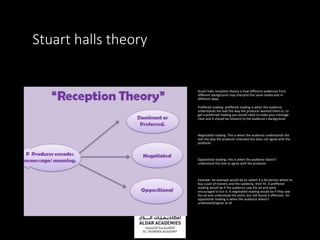
Stuart halls theory
Stuart halls reception theory is how different audiences from
different background may interpret the same media text in
different ways.
Preffered reading: preffered reading is when the audience
understands the text the way the producer wanted them to, to
get a preferred reading you would need to make your message
clear and it should be relavent to the audience's background.
Negotiated reading: This is when the audience understands the
text the way the producer intended but does not agree with the
producer.
Oppositinal reading: this is when the audience doesn’t
understand the text or agree with the producer.
Example: An example would be an advert if a fat person where to
buy a pair of trainers and the suddenly, their fit. A preffered
reading would be if the audience saw the ad and were
encouraged to but it. A negotiated reading would be if they saw
the ad and understood the point, but still found it offensive. An
oppositinal reading is when the audience doesn’t
understand/agree at all.
Symbolic codes
• Symbolic codes in media include setting
acting, color and mise en scene which is
what the film is made up of -
costumes/props (continue the stuff on ur
own) it’s used to create meaning to the
film to help the audience figure out the
theme/genre
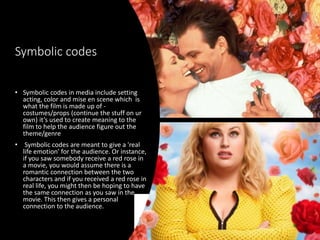
• Symbolic codes are meant to give a 'real
life emotion' for the audience. Or instance,
if you saw somebody receive a red rose in
a movie, you would assume there is a
romantic connection between the two
characters and if you received a red rose in
real life, you might then be hoping to have
the same connection as you saw in the
movie. This then gives a personal
connection to the audience.
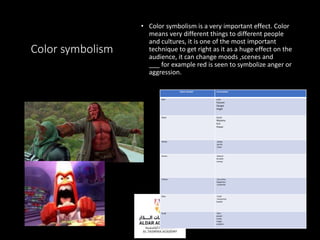
Color symbolism
• Color symbolism is a very important effect. Color
means very different things to different people
and cultures, it is one of the most important
technique to get right as it as a huge effect on the
audience, it can change moods ,scenes and
___ for example red is seen to symbolize anger or
aggression.
Colour Symbol Connotation
Red Love
Passion
Danger
Anger
Black Death
Mystery
Evil
Power
White safety
purity
clean
Green Nature
Growth
money
Yellow Sun shine
happiness
creativity
Blue truth
Innocence
loyalty
Gold Rich
power
cocky
magic
wisdom
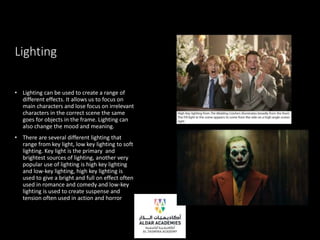
Lighting
• Lighting can be used to create a range of
different effects. It allows us to focus on
main characters and lose focus on irrelevant
characters in the correct scene the same
goes for objects in the frame. Lighting can
also change the mood and meaning.
• There are several different lighting that
range from key light, low key lighting to soft
lighting. Key light is the primary and
brightest sources of lighting, another very
popular use of lighting is high key lighting
and low-key lighting, high key lighting is
used to give a bright and full on effect often
used in romance and comedy and low-key
lighting is used to create suspense and
tension often used in action and horror
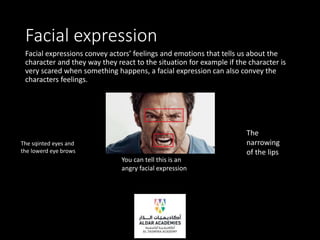
Facial expression
Facial expressions convey actors’ feelings and emotions that tells us about the
character and they way they react to the situation for example if the character is
very scared when something happens, a facial expression can also convey the
characters feelings.
You can tell this is an
angry facial expression
The
narrowing
of the lips
The sqinted eyes and
the lowerd eye brows
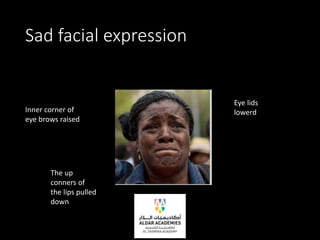
Sad facial expression
Inner corner of
eye brows raised
The up
conners of
the lips pulled
down
Eye lids
lowerd
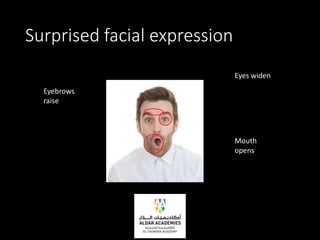
Surprised facial expression
Eyebrows
raise
Eyes widen
Mouth
opens
Technical codes
Technical codes are ways the camera shots, movements angles and editing
are used to create meaning.
Examples include:
Camera shots
Camera movement
Camera angles
Editing
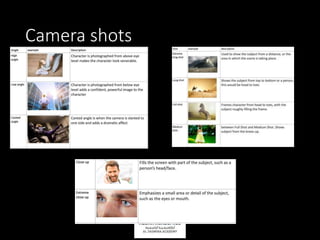
Camera shots
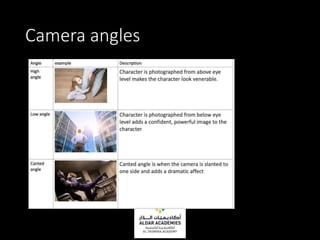
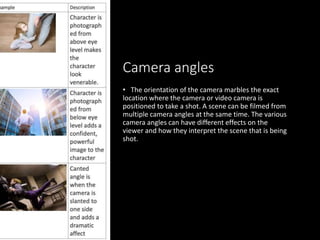
Camera angles
Camera angles
• The orientation of the camera marbles the exact
location where the camera or video camera is
positioned to take a shot. A scene can be filmed from
multiple camera angles at the same time. The various
camera angles can have different effects on the
viewer and how they interpret the scene that is being
shot.
Editing
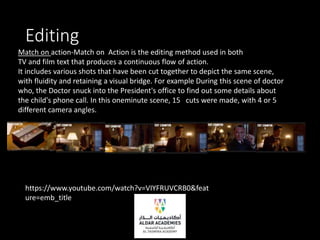
Match on action-Match on Action is the editing method used in both
TV and film text that produces a continuous flow of action.
It includes various shots that have been cut together to depict the same scene,
with fluidity and retaining a visual bridge. For example During this scene of doctor
who, the Doctor snuck into the President's office to find out some details about
the child's phone call. In this oneminute scene, 15 cuts were made, with 4 or 5
different camera angles.
https://www.youtube.com/watch?v=VIYFRUVCRB0&feat
ure=emb_title
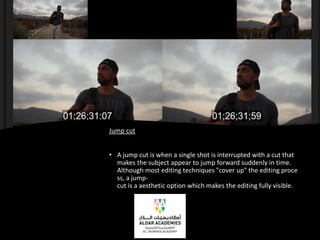
Jump cut
• A jump cut is when a single shot is interrupted with a cut that
makes the subject appear to jump forward suddenly in time.
Although most editing techniques "cover up" the editing proce
ss, a jump-
cut is a aesthetic option which makes the editing fully visible.
Shot reverse shot
Shot reverse shot,
is a film technique in which one character is shown looking at another
character, and then the other character is shown looking back at the first
character.
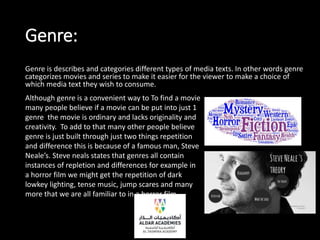
Genre:
Genre is describes and categories different types of media texts. In other words genre
categorizes movies and series to make it easier for the viewer to make a choice of
which media text they wish to consume.
Although genre is a convenient way to To find a movie
many people believe if a movie can be put into just 1
genre the movie is ordinary and lacks originality and
creativity. To add to that many other people believe
genre is just built through just two things repetition
and difference this is because of a famous man, Steve
Neale’s. Steve neals states that genres all contain
instances of repletion and differences for example in
a horror film we might get the repetition of dark
lowkey lighting, tense music, jump scares and many
more that we are all familiar to in a horror film
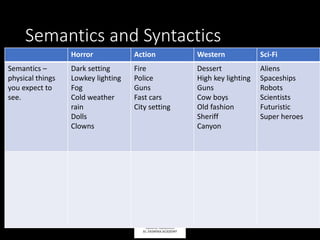
Semantics and Syntactics
Horror Action Western Sci-Fi
Semantics –
physical things
you expect to
see.
Dark setting
Lowkey lighting
Fog
Cold weather
rain
Dolls
Clowns
Fire
Police
Guns
Fast cars
City setting
Dessert
High key lighting
Guns
Cow boys
Old fashion
Sheriff
Canyon
Aliens
Spaceships
Robots
Scientists
Futuristic
Super heroes
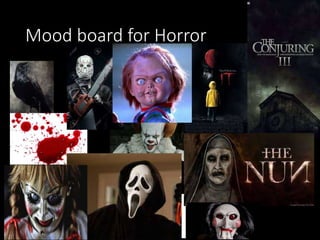
Mood board for Horror
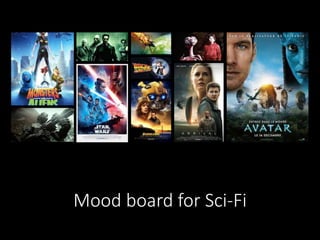
Mood board for Sci-Fi
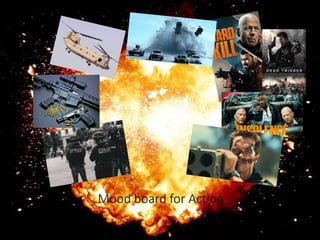
Mood board for Action
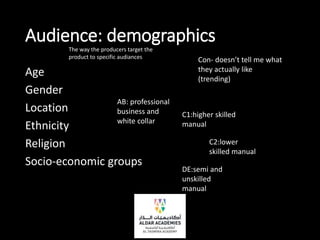
Audience: demographics
Age
Gender
Location
Ethnicity
Religion
Socio-economic groups
AB: professional
business and
white collar
C1:higher skilled
manual
C2:lower
skilled manual
DE:semi and
unskilled
manual
The way the producers target the
product to specific audiances
Con- doesn’t tell me what
they actually like
(trending)
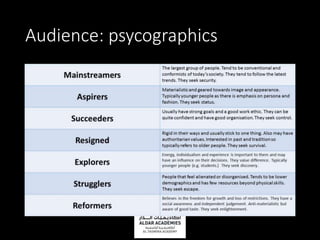
Audience: psycographics
Serveillance/informantion
The audience also often uses the
media as a form of finding out
information this could vary from
the news to people's personal
life. It allows the audience to
observe and feel what its like to
get away from there own
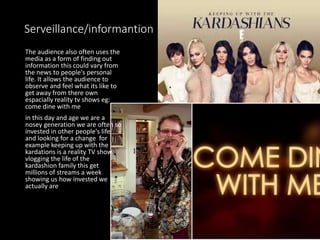
espacially reality tv shows eg:
come dine with me
in this day and age we are a
nosey generation we are often so
invested in other people's life
and looking for a change for
example keeping up with the
kardations is a reality TV show
vlogging the life of the
kardashion family this get
millions of streams a week
showing us how invested we
actually are
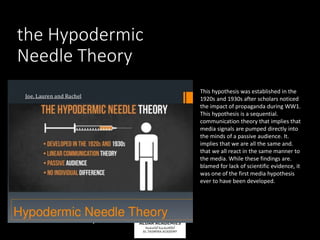
the Hypodermic
Needle Theory
The hypodermic needle theory
was developed in 1920-1930 after
researchers observed the effect
during world war one. it is a
linear communication theory
which suggests media messages
are injected directly into the brain
of an passive audience which
suggests we are all the same and
we’ll all respond to media the
same way.
This hypothesis was established in the
1920s and 1930s after scholars noticed
the impact of propaganda during WW1.
This hypothesis is a sequential.
communication theory that implies that
media signals are pumped directly into
the minds of a passive audience. It.
implies that we are all the same and.
that we all react in the same manner to
the media. While these findings are.
blamed for lack of scientific evidence, it
was one of the first media hypothesis
ever to have been developed.
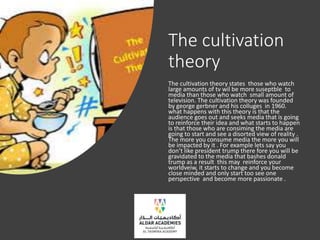
The cultivation
theory
The cultivation theory states those who watch
large amounts of tv wil be more suseptble to
media than those who watch small amount of
television. The cultivation theory was founded
by george gerbner and his colluges in 1960.
what happens with this theory is that the
audience goes out and seeks media that is going
to reinforce their idea and what starts to happen
is that those who are consiming the media are
going to start and see a disorted view of reality .
The more you consume media the more you will
be impacted by it . For example lets say you
don’t like president trump there fore you will be
gravidated to the media that bashes donald
trump as a result this may reinforce your
worldveiw, it starts to change and you become
close minded and only start too see one
perspective and become more passionate .
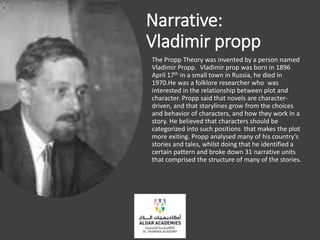
Narrative:
Vladimir propp
The Propp Theory was invented by a person named
Vladimir Propp. Vladimir prop was born in 1896
April 17th in a small town in Russia, he died in
1970.He was a folklore researcher who was
interested in the relationship between plot and
character. Propp said that novels are character-
driven, and that storylines grow from the choices
and behavior of characters, and how they work in a
story. He believed that characters should be
categorized into such positions that makes the plot
more exiting. Propp analysed many of his country’s
stories and tales, whilst doing that he identified a
certain pattern and broke down 31 narrative units
that comprised the structure of many of the stories.
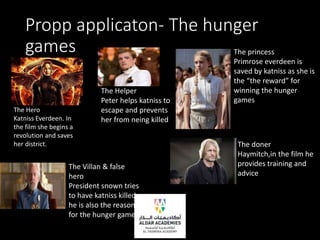
Propp applicaton- The hunger
games
The Hero
Katniss Everdeen. In
the film she begins a
revolution and saves
her district.
The Helper
Peter helps katniss to
escape and prevents
her from neing killed
The Villan & false
hero
President snown tries
to have katniss killed
he is also the reason
for the hunger games
The princess
Primrose everdeen is
saved by katniss as she is
the “the reward” for
winning the hunger
games
The doner
Haymitch,in the film he
provides training and
advice
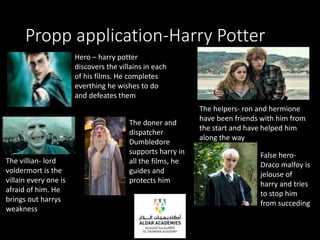
Propp application-Harry Potter
Hero – harry potter
discovers the villains in each
of his films. He completes
everthing he wishes to do
and defeates them
The villian- lord
voldermort is the
villain every one is
afraid of him. He
brings out harrys
weakness
The helpers- ron and hermione
have been friends with him from
the start and have helped him
along the way
False hero-
Draco malfoy is
jelouse of
harry and tries
to stop him
from succeding
The doner and
dispatcher
Dumbledore
supports harry in
all the films, he
guides and
protects him
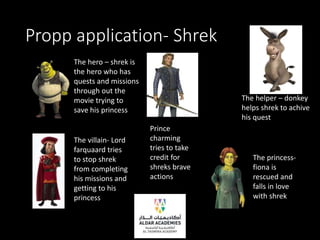
Propp application- Shrek
The hero – shrek is
the hero who has
quests and missions
through out the
movie trying to
save his princess
The villain- Lord
farquaard tries
to stop shrek
from completing
his missions and
getting to his
princess
The helper – donkey
helps shrek to achive
his quest
The princess-
fiona is
rescued and
falls in love
with shrek
Prince
charming
tries to take
credit for
shreks brave
actions
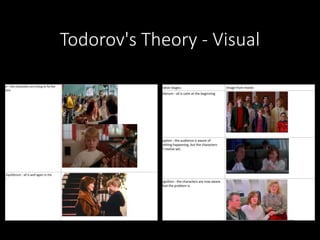
Todorov's Theory - Visual

Zak key concepts

  • 1.
    Component 1 Media KeyConcepts Research Name: Zak
  • 2.
    How is meaningcreated? In media meaning is created in many ways. Symbolic and technical codes through moving image, they are the prime elements that help you understand how meaning is created. There are two different types of codes; symbolic and technical codes. Symbolic: mis- en -scene, colors, lighting, facial expressions etc. Technical: Camera angles, Editing Denotation – what we see Connotation – what we can associate with the image.
  • 3.
    Stuart halls theory Stuarthalls reception theory is how different audiences from different background may interpret the same media text in different ways. Preffered reading: preffered reading is when the audience understands the text the way the producer wanted them to, to get a preferred reading you would need to make your message clear and it should be relavent to the audience's background. Negotiated reading: This is when the audience understands the text the way the producer intended but does not agree with the producer. Oppositinal reading: this is when the audience doesn’t understand the text or agree with the producer. Example: An example would be an advert if a fat person where to buy a pair of trainers and the suddenly, their fit. A preffered reading would be if the audience saw the ad and were encouraged to but it. A negotiated reading would be if they saw the ad and understood the point, but still found it offensive. An oppositinal reading is when the audience doesn’t understand/agree at all.
  • 4.
    Symbolic codes • Symboliccodes in media include setting acting, color and mise en scene which is what the film is made up of - costumes/props (continue the stuff on ur own) it’s used to create meaning to the film to help the audience figure out the theme/genre • Symbolic codes are meant to give a 'real life emotion' for the audience. Or instance, if you saw somebody receive a red rose in a movie, you would assume there is a romantic connection between the two characters and if you received a red rose in real life, you might then be hoping to have the same connection as you saw in the movie. This then gives a personal connection to the audience.
  • 5.
    Color symbolism • Colorsymbolism is a very important effect. Color means very different things to different people and cultures, it is one of the most important technique to get right as it as a huge effect on the audience, it can change moods ,scenes and ___ for example red is seen to symbolize anger or aggression. Colour Symbol Connotation Red Love Passion Danger Anger Black Death Mystery Evil Power White safety purity clean Green Nature Growth money Yellow Sun shine happiness creativity Blue truth Innocence loyalty Gold Rich power cocky magic wisdom
  • 6.
    Lighting • Lighting canbe used to create a range of different effects. It allows us to focus on main characters and lose focus on irrelevant characters in the correct scene the same goes for objects in the frame. Lighting can also change the mood and meaning. • There are several different lighting that range from key light, low key lighting to soft lighting. Key light is the primary and brightest sources of lighting, another very popular use of lighting is high key lighting and low-key lighting, high key lighting is used to give a bright and full on effect often used in romance and comedy and low-key lighting is used to create suspense and tension often used in action and horror
  • 7.
    Facial expression Facial expressionsconvey actors’ feelings and emotions that tells us about the character and they way they react to the situation for example if the character is very scared when something happens, a facial expression can also convey the characters feelings. You can tell this is an angry facial expression The narrowing of the lips The sqinted eyes and the lowerd eye brows
  • 8.
    Sad facial expression Innercorner of eye brows raised The up conners of the lips pulled down Eye lids lowerd
  • 9.
  • 10.
    Technical codes Technical codesare ways the camera shots, movements angles and editing are used to create meaning. Examples include: Camera shots Camera movement Camera angles Editing
  • 11.
  • 12.
  • 13.
    Camera angles • Theorientation of the camera marbles the exact location where the camera or video camera is positioned to take a shot. A scene can be filmed from multiple camera angles at the same time. The various camera angles can have different effects on the viewer and how they interpret the scene that is being shot.
  • 14.
    Editing Match on action-Matchon Action is the editing method used in both TV and film text that produces a continuous flow of action. It includes various shots that have been cut together to depict the same scene, with fluidity and retaining a visual bridge. For example During this scene of doctor who, the Doctor snuck into the President's office to find out some details about the child's phone call. In this oneminute scene, 15 cuts were made, with 4 or 5 different camera angles. https://www.youtube.com/watch?v=VIYFRUVCRB0&feat ure=emb_title
  • 15.
    Jump cut • Ajump cut is when a single shot is interrupted with a cut that makes the subject appear to jump forward suddenly in time. Although most editing techniques "cover up" the editing proce ss, a jump- cut is a aesthetic option which makes the editing fully visible.
  • 16.
    Shot reverse shot Shotreverse shot, is a film technique in which one character is shown looking at another character, and then the other character is shown looking back at the first character.
  • 17.
    Genre: Genre is describesand categories different types of media texts. In other words genre categorizes movies and series to make it easier for the viewer to make a choice of which media text they wish to consume. Although genre is a convenient way to To find a movie many people believe if a movie can be put into just 1 genre the movie is ordinary and lacks originality and creativity. To add to that many other people believe genre is just built through just two things repetition and difference this is because of a famous man, Steve Neale’s. Steve neals states that genres all contain instances of repletion and differences for example in a horror film we might get the repetition of dark lowkey lighting, tense music, jump scares and many more that we are all familiar to in a horror film
  • 18.
    Semantics and Syntactics HorrorAction Western Sci-Fi Semantics – physical things you expect to see. Dark setting Lowkey lighting Fog Cold weather rain Dolls Clowns Fire Police Guns Fast cars City setting Dessert High key lighting Guns Cow boys Old fashion Sheriff Canyon Aliens Spaceships Robots Scientists Futuristic Super heroes
  • 19.
  • 20.
  • 21.
  • 22.
    Audience: demographics Age Gender Location Ethnicity Religion Socio-economic groups AB:professional business and white collar C1:higher skilled manual C2:lower skilled manual DE:semi and unskilled manual The way the producers target the product to specific audiances Con- doesn’t tell me what they actually like (trending)
  • 23.
  • 24.
    Serveillance/informantion The audience alsooften uses the media as a form of finding out information this could vary from the news to people's personal life. It allows the audience to observe and feel what its like to get away from there own espacially reality tv shows eg: come dine with me in this day and age we are a nosey generation we are often so invested in other people's life and looking for a change for example keeping up with the kardations is a reality TV show vlogging the life of the kardashion family this get millions of streams a week showing us how invested we actually are
  • 25.
    the Hypodermic Needle Theory Thehypodermic needle theory was developed in 1920-1930 after researchers observed the effect during world war one. it is a linear communication theory which suggests media messages are injected directly into the brain of an passive audience which suggests we are all the same and we’ll all respond to media the same way. This hypothesis was established in the 1920s and 1930s after scholars noticed the impact of propaganda during WW1. This hypothesis is a sequential. communication theory that implies that media signals are pumped directly into the minds of a passive audience. It. implies that we are all the same and. that we all react in the same manner to the media. While these findings are. blamed for lack of scientific evidence, it was one of the first media hypothesis ever to have been developed.
  • 26.
    The cultivation theory The cultivationtheory states those who watch large amounts of tv wil be more suseptble to media than those who watch small amount of television. The cultivation theory was founded by george gerbner and his colluges in 1960. what happens with this theory is that the audience goes out and seeks media that is going to reinforce their idea and what starts to happen is that those who are consiming the media are going to start and see a disorted view of reality . The more you consume media the more you will be impacted by it . For example lets say you don’t like president trump there fore you will be gravidated to the media that bashes donald trump as a result this may reinforce your worldveiw, it starts to change and you become close minded and only start too see one perspective and become more passionate .
  • 27.
    Narrative: Vladimir propp The ProppTheory was invented by a person named Vladimir Propp. Vladimir prop was born in 1896 April 17th in a small town in Russia, he died in 1970.He was a folklore researcher who was interested in the relationship between plot and character. Propp said that novels are character- driven, and that storylines grow from the choices and behavior of characters, and how they work in a story. He believed that characters should be categorized into such positions that makes the plot more exiting. Propp analysed many of his country’s stories and tales, whilst doing that he identified a certain pattern and broke down 31 narrative units that comprised the structure of many of the stories.
  • 28.
    Propp applicaton- Thehunger games The Hero Katniss Everdeen. In the film she begins a revolution and saves her district. The Helper Peter helps katniss to escape and prevents her from neing killed The Villan & false hero President snown tries to have katniss killed he is also the reason for the hunger games The princess Primrose everdeen is saved by katniss as she is the “the reward” for winning the hunger games The doner Haymitch,in the film he provides training and advice
  • 29.
    Propp application-Harry Potter Hero– harry potter discovers the villains in each of his films. He completes everthing he wishes to do and defeates them The villian- lord voldermort is the villain every one is afraid of him. He brings out harrys weakness The helpers- ron and hermione have been friends with him from the start and have helped him along the way False hero- Draco malfoy is jelouse of harry and tries to stop him from succeding The doner and dispatcher Dumbledore supports harry in all the films, he guides and protects him
  • 30.
    Propp application- Shrek Thehero – shrek is the hero who has quests and missions through out the movie trying to save his princess The villain- Lord farquaard tries to stop shrek from completing his missions and getting to his princess The helper – donkey helps shrek to achive his quest The princess- fiona is rescued and falls in love with shrek Prince charming tries to take credit for shreks brave actions
  • 31.