CONNECT
• Watch the following extract
• What do you notice about the Characters?
• How do the Characters make you feel?
Connect
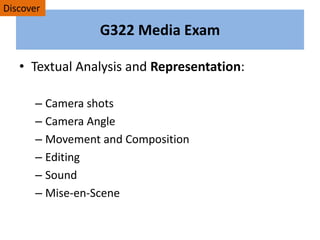
G322 Media Exam
• Textual Analysis and Representation:
– Camera shots
– Camera Angle
– Movement and Composition
– Editing
– Sound
– Mise-en-Scene
Discover
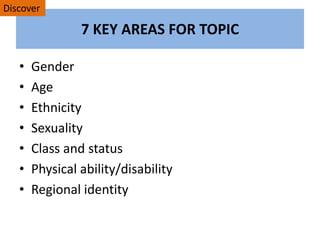
7 KEY AREAS FOR TOPIC
• Gender
• Age
• Ethnicity
• Sexuality
• Class and status
• Physical ability/disability
• Regional identity
Discover
How do we Analyse a TV Drama
– Mise-en-Scene
– Camera shots / Camera Angle / Movement and
Composition
– Editing
– Sound
Discover
How do we Analyse a TV Drama
– Mise-en-Scene
– Camera shots / Camera Angle / Movement and
Composition
– Editing
– Sound
Discover
How do we Analyse a TV Drama
– Mise-en-Scene
– Camera shots / Camera Angle / Movement and
Composition
– Editing
– Sound
Discover
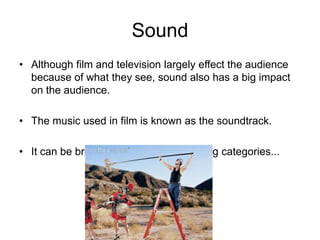
Sound
• Although film and television largely effect the audience
because of what they see, sound also has a big impact
on the audience.
• The music used in film is known as the soundtrack.
• It can be broken down into the following categories...
Diagetic Sound:
Sound or music that is recorded on set as it happens. This will
include dialogue and sounds which take place within the film e.g. a
door closing, gun being fired, police siren.
Non-Diagetic Sound:
Music or sound which is added to the film during the editing process.
Most often, non-diagetic sound is music, which is used to create
atmosphere or emotion.
SOUND
• Score – The musical component of a programme’s
soundtrack, usually composed specifically for the scene.
• Sound Effects – sounds that are added to a film during the
post-production stage. Sound Motif- A sound effect or
combination of sound effects that are associated with a
particular character, setting, situation or idea.
• Sound Bridge— Can lead in or out of a scene. They can
occur at the beginning of one scene when the sound from
the previous scene carries over briefly before the sound
from the new scene begins.
SOUND
• Dialogue— Words spoken by the characters Incidental music— non-diegetic sounds which add
atmosphere to an action or revelation.
• Ambient sound—the background sounds which are present in a scene or location. Common
ambient sounds include wind, water, birds, crowds, office noises, traffic, etc. It performs a number
of functions including: Providing audio continuity between shots, reventing an unnatural silence
when no other sound is present and establishing or reinforcing the mood.
• Sound Perspectives—The sense of a sound's position in space, yielded by volume and pitch. Used
to create a more realistic sense of space, with events happening (that is, coming from) closer or
further away.
• Voiceover—When a voice, often that of a character in the film, is heard while we see an image of a
space and time in which that character is not actually speaking. The voice over is often used to give
a sense of a character's subjectivity or to narrate an event told in flashback.
• Contrapuntal– When the score juxtaposes the action in the scene for dramatic effect
Representation
Representation
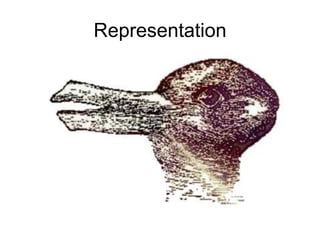
An image+ a point of view =
representation
In exploring representation you need
to establish....
• What view of people or issues is being
conveyed to audiences?
• How far is that view conveyed?
• How far are audiences positioned to take up a
preferred view?
• How far do the representations challenge or
conform to dominant representations and
ideologies?
Representation
• Representation refers to the construction
in any medium of aspects of ‘reality’ such
as people, places, objects, events, cultural
identities and other abstract concepts.
Such representations may be in speech or
writing as well as still or moving pictures.
• A key aspect in the study of representation
concern is with the way in which
representations are made to seem
‘natural’.
Representation
• Media is all about taking reality (real life) and
re-presenting it to an audience in a different
way. This might be a re-presentation of real
life e.g. BBC news, a manipulation of real life
e.g. The Only Way is Essex or Made in
Chelsea, or a fictional account e.g.
Eastenders or Coronation Street.
• All Media has a base in reality and the way
we see different events or characters can
have a real impact on the way we feel about
a group of people or a major issue.
Representation
• Representation plays a major role in our
enjoyment of a Media text. The audience
reads and decodes information in a number
of ways, and this helps them to understand
who a character is or what they might be
feeling.
• The audience is also influenced by what they
see represented on screen
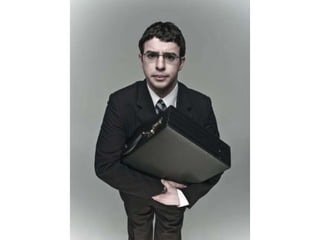
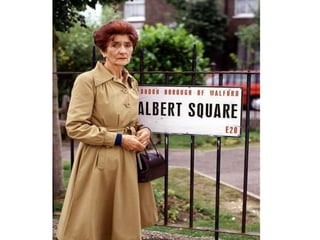
• Look at the following TV characters – how do
they make you feel about them?
Stereotypes
• The easiest way for the audience to relate
to a character or characters is to use
Stereotypes
• Stereotypes are when a character is
created using a common set of ideas
about a group of people. These ideas can
be both positive and negative and can
influence the way we view groups of
people
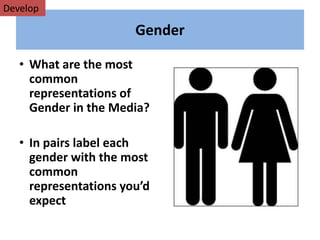
Gender
• What are the most
common
representations of
Gender in the Media?
• In pairs label each
gender with the most
common
representations you’d
expect
Develop
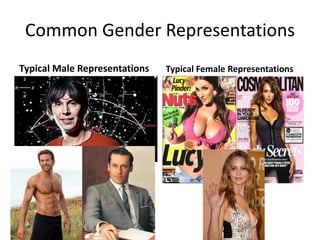
Common Gender Representations
Typical Male Representations Typical Female Representations
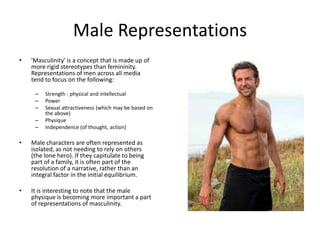
Male Representations
• 'Masculinity' is a concept that is made up of
more rigid stereotypes than femininity.
Representations of men across all media
tend to focus on the following:
– Strength - physical and intellectual
– Power
– Sexual attractiveness (which may be based on
the above)
– Physique
– Independence (of thought, action)
• Male characters are often represented as
isolated, as not needing to rely on others
(the lone hero). If they capitulate to being
part of a family, it is often part of the
resolution of a narrative, rather than an
integral factor in the initial equilibrium.
• It is interesting to note that the male
physique is becoming more important a part
of representations of masculinity.
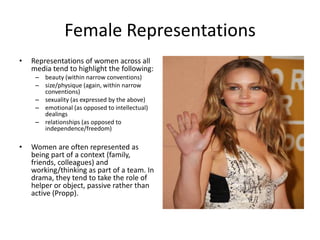
Female Representations
• Representations of women across all
media tend to highlight the following:
– beauty (within narrow conventions)
– size/physique (again, within narrow
conventions)
– sexuality (as expressed by the above)
– emotional (as opposed to intellectual)
dealings
– relationships (as opposed to
independence/freedom)
• Women are often represented as
being part of a context (family,
friends, colleagues) and
working/thinking as part of a team. In
drama, they tend to take the role of
helper or object, passive rather than
active (Propp).
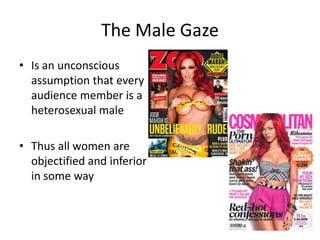
The Male Gaze
• Is an unconscious
assumption that every
audience member is a
heterosexual male
• Thus all women are
objectified and inferior
in some way
Textual Analysis
• In pairs, watch the following extract
• Can you identify what the representation is?
• Is it a positive or negative
• Casulty - Gender
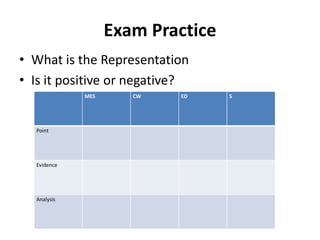
Exam Practice
MES CW ED S
Point
Evidence
Analysis
• What is the Representation
• Is it positive or negative?
Practice Pieces
• Dr Who - Jan 2009 Exam
• Primevil - June 2010 Exam
• Fat Friends
HOMEWORK!
• Watch the Clip from the January 2011 exam
from HUSTLE
• Hustle - Jan 2011 Exam
• Write an essay answer to the question
Age
Develop

As level tv drama 3 gender

  • 1.
    CONNECT • Watch thefollowing extract • What do you notice about the Characters? • How do the Characters make you feel? Connect
  • 2.
    G322 Media Exam •Textual Analysis and Representation: – Camera shots – Camera Angle – Movement and Composition – Editing – Sound – Mise-en-Scene Discover
  • 3.
    7 KEY AREASFOR TOPIC • Gender • Age • Ethnicity • Sexuality • Class and status • Physical ability/disability • Regional identity Discover
  • 4.
    How do weAnalyse a TV Drama – Mise-en-Scene – Camera shots / Camera Angle / Movement and Composition – Editing – Sound Discover
  • 5.
    How do weAnalyse a TV Drama – Mise-en-Scene – Camera shots / Camera Angle / Movement and Composition – Editing – Sound Discover
  • 6.
    How do weAnalyse a TV Drama – Mise-en-Scene – Camera shots / Camera Angle / Movement and Composition – Editing – Sound Discover
  • 7.
    Sound • Although filmand television largely effect the audience because of what they see, sound also has a big impact on the audience. • The music used in film is known as the soundtrack. • It can be broken down into the following categories...
  • 8.
    Diagetic Sound: Sound ormusic that is recorded on set as it happens. This will include dialogue and sounds which take place within the film e.g. a door closing, gun being fired, police siren. Non-Diagetic Sound: Music or sound which is added to the film during the editing process. Most often, non-diagetic sound is music, which is used to create atmosphere or emotion.
  • 9.
    SOUND • Score –The musical component of a programme’s soundtrack, usually composed specifically for the scene. • Sound Effects – sounds that are added to a film during the post-production stage. Sound Motif- A sound effect or combination of sound effects that are associated with a particular character, setting, situation or idea. • Sound Bridge— Can lead in or out of a scene. They can occur at the beginning of one scene when the sound from the previous scene carries over briefly before the sound from the new scene begins.
  • 10.
    SOUND • Dialogue— Wordsspoken by the characters Incidental music— non-diegetic sounds which add atmosphere to an action or revelation. • Ambient sound—the background sounds which are present in a scene or location. Common ambient sounds include wind, water, birds, crowds, office noises, traffic, etc. It performs a number of functions including: Providing audio continuity between shots, reventing an unnatural silence when no other sound is present and establishing or reinforcing the mood. • Sound Perspectives—The sense of a sound's position in space, yielded by volume and pitch. Used to create a more realistic sense of space, with events happening (that is, coming from) closer or further away. • Voiceover—When a voice, often that of a character in the film, is heard while we see an image of a space and time in which that character is not actually speaking. The voice over is often used to give a sense of a character's subjectivity or to narrate an event told in flashback. • Contrapuntal– When the score juxtaposes the action in the scene for dramatic effect
  • 11.
  • 12.
    Representation An image+ apoint of view = representation
  • 13.
    In exploring representationyou need to establish.... • What view of people or issues is being conveyed to audiences? • How far is that view conveyed? • How far are audiences positioned to take up a preferred view? • How far do the representations challenge or conform to dominant representations and ideologies?
  • 14.
    Representation • Representation refersto the construction in any medium of aspects of ‘reality’ such as people, places, objects, events, cultural identities and other abstract concepts. Such representations may be in speech or writing as well as still or moving pictures. • A key aspect in the study of representation concern is with the way in which representations are made to seem ‘natural’.
  • 15.
    Representation • Media isall about taking reality (real life) and re-presenting it to an audience in a different way. This might be a re-presentation of real life e.g. BBC news, a manipulation of real life e.g. The Only Way is Essex or Made in Chelsea, or a fictional account e.g. Eastenders or Coronation Street. • All Media has a base in reality and the way we see different events or characters can have a real impact on the way we feel about a group of people or a major issue.
  • 16.
    Representation • Representation playsa major role in our enjoyment of a Media text. The audience reads and decodes information in a number of ways, and this helps them to understand who a character is or what they might be feeling. • The audience is also influenced by what they see represented on screen • Look at the following TV characters – how do they make you feel about them?
  • 20.
    Stereotypes • The easiestway for the audience to relate to a character or characters is to use Stereotypes • Stereotypes are when a character is created using a common set of ideas about a group of people. These ideas can be both positive and negative and can influence the way we view groups of people
  • 21.
    Gender • What arethe most common representations of Gender in the Media? • In pairs label each gender with the most common representations you’d expect Develop
  • 22.
    Common Gender Representations TypicalMale Representations Typical Female Representations
  • 23.
    Male Representations • 'Masculinity'is a concept that is made up of more rigid stereotypes than femininity. Representations of men across all media tend to focus on the following: – Strength - physical and intellectual – Power – Sexual attractiveness (which may be based on the above) – Physique – Independence (of thought, action) • Male characters are often represented as isolated, as not needing to rely on others (the lone hero). If they capitulate to being part of a family, it is often part of the resolution of a narrative, rather than an integral factor in the initial equilibrium. • It is interesting to note that the male physique is becoming more important a part of representations of masculinity.
  • 24.
    Female Representations • Representationsof women across all media tend to highlight the following: – beauty (within narrow conventions) – size/physique (again, within narrow conventions) – sexuality (as expressed by the above) – emotional (as opposed to intellectual) dealings – relationships (as opposed to independence/freedom) • Women are often represented as being part of a context (family, friends, colleagues) and working/thinking as part of a team. In drama, they tend to take the role of helper or object, passive rather than active (Propp).
  • 25.
    The Male Gaze •Is an unconscious assumption that every audience member is a heterosexual male • Thus all women are objectified and inferior in some way
  • 26.
    Textual Analysis • Inpairs, watch the following extract • Can you identify what the representation is? • Is it a positive or negative • Casulty - Gender
  • 27.
    Exam Practice MES CWED S Point Evidence Analysis • What is the Representation • Is it positive or negative?
  • 28.
    Practice Pieces • DrWho - Jan 2009 Exam • Primevil - June 2010 Exam • Fat Friends
  • 29.
    HOMEWORK! • Watch theClip from the January 2011 exam from HUSTLE • Hustle - Jan 2011 Exam • Write an essay answer to the question
  • 30.

Editor's Notes

  • #11 http://www.youtube.com/watch?v=VV4v4LjBEXQ