CHAPTER III
Brief Overviewof Philippine
Arts and Crafts
Different Types of Indigenous arts and crafts
in the Philippines
2.
The Philippines isa treasure trove of indigenous arts and
crafts, a vibrant testament to the creativity and ingenuity
of its diverse cultural tapestry. From the intricate weaves
of Inabel and T'nalak, reflecting the unique artistry of
Ilocano and T'boli weavers, to the exquisite
woodcarvings of Paete and the intricate metalwork of
Mindanao, each craft tells a story of cultural heritage
and artistic expression. The artistry extends beyond
textiles and wood, encompassing the delicate pottery of
Vigan, the intricate basketry traditions woven from
bamboo and rattan, and the vibrant jewelry crafted from
shells and precious metals. These crafts not only
showcase the skill and artistry of Filipino artisans but also
provide a glimpse into the rich history, beliefs, and
traditions of the various ethnic groups that make up the
What are the arts and crafts in the
Philippines?
3.
Art was embeddedin our culture from the
beginning of time up to the present. It is one
thing that can never be lost in a culture no
matter what it goes through. The Philippines,
having a rich culture, also has its share of art
discovered, practiced, and applied in day-to-day
living.
Weaving
• Weaving isa centuries-old tradition in
the Philippines which is deeply rooted in
the culture of many tribes and
provinces, who each have their own
particular pattern or style to tell their
history or way of life. It has also become
a source of livelihood for many
communities.
• Through weaving, they are able to make
clothing, textiles, banigs (or woven
mats), and other items with different
materials.
6.
Ikat Weaving
Ifugao (Kiangan,Banaue &Hungduan)
• Kiangan, the birthplace of Ifugao, weaving
has always been a part of the community’s
daily activities. May it be for economic
purposes, cultural preservation or personal
use.
• The Ifugaos of Kiangan either practice
traditional weaving which follows old-age
techniques passed on through generations,
or the ikat, where bundles of yarn are tightly
wrapped together and dyed as many times to
create a desired pattern or design.
• The patterns used are mostly traditional
ones, typically nature-inspired and beliefs-
7.
Bolinao Mats
Pangasinan (weaving)
•In Bolinao, Pangasinan, the buri palm material is
used for mat-making; a double-layered mat with
one side using a tartan- or gingham-like
coloured design while the reverse is kept plain.
• It is a smooth weaved made from buri or rafia
leaves. The art beauty of banig weaving life in
the intricacy of folding over the strips of the
materials to yield a design of interlaced folds and
entails a sequential order of steps to create a
geometric pattern.
• These mats from the buri/rafia palm are used
traditionally as the liner for the wedding dance
performed by the newlyweds. Weaving mats is
the pride of thier Town. Love begins with mats.
8.
Kalinga Textiles
province ofKalinga
• The Kalinga weavers, particularly in the upper
Kalinga area, put textures on the striped bands
using twill-weave technique. Tiny motifs, patterns,
and embellishments have characterised Kalinga
textile.
• Kalinga hand woven fabrics are characterized by
dominant red stripes and motifs of geometric
patterns with nature symbols interlaced with white
yellow and black fibers. including miniature lattice,
continuous lozenge pattern locally called inata-ata,
and pawekan or mother-of-pearl platelets, among
others.
• Originally woven in Lubuagan, the “ka-in” (wrap
around skirt) is now more known as the Kalinga.
The different types of “ka-in” are gilamat, silugwid,
9.
Inabel
Ilocos Norte
• Handeddown from generation to generation, the
art of inabel weaving is a golden thread entwined in
the Ilocano culture.
• Manually woven through a wooden loom, an abel
fabric is made up of pure creativity, imagination,
positivity, respect, discipline and keenness. The
various abel weave designs are inspired by natural
elements. It maybe land formation patterns, the
colors of flowers and vegetation, the ripples of a
calm blue ocean, or the sky on a bright night.
• The Ilocanas of the olden times were taught this
textile craft which once bolstered the economy of
the Ilocos region during the colonial times, when
abel products were largely exported to foreign
lands. Spanish galleons sailed the seas with pieces
of inabel sailcloth. The abel is certainly a
10.
Gaddang Textile
Gaddang tribeof Nueva Vizcaya
• The Gaddang tribe is unique among northem Luzon
communities for being so lavish with its use of beadworks that
is elevated to an art form. Gaddangs' are fond of wearing seed
beads around their heads, necklaces, and wrists.
• The Gaddang textiles, with exquisite beadwork, used for these
costumes are woven by the women themselves from
homegrown cotton, and dyed in bright natural colors.
• Gaddang women attire includes the "tapis" or skirt, a lengthy
piece of cotton cloth worn around the waistline down to the
knees, and a long-sleeved, round-necked collarless and waist-
length blouse. The traditional costume for the Gaddang male
is the G-string, which is held by a girdle, whose flap is
weighted on the hem by beaded tassels.
11.
Gaddang Textile
Gaddang tribeof Nueva Vizcaya
• Traditional attire for “ ” or “ ’ ” includes the
𝙂𝙖𝙙𝙙𝙖𝙣𝙜 𝙂𝙖 𝙙𝙖𝙣𝙜
tapis or “ ”, a lengthly piece of cotton cloth wound around
𝙖𝙠𝙚𝙣
the waistline down to he knees that made of “ ” (threads)
𝙪𝙬𝙖𝙮
and “ ” (beads), the upper garment called “ ” a
𝙗𝙪𝙠𝙖𝙩 𝙗𝙖𝙧𝙖𝙬𝙖𝙨𝙞
long sleeved, round-necked collarless and waist-length blouse
with colorful beads and the belt called “ ” is a thing to
𝙗𝙖𝙠𝙬𝙖𝙩
enclose the skirt so that the skirt will not be fall and designed
with colorful beads. The cloth used for these costumes are
woven by the women themselves from homegrown ,
𝙘𝙤𝙩𝙩𝙤𝙣
and dyed in bright natural colors. The native headdress worn
by Gaddang women is called as " ," which indicates
𝙗𝙞𝙣𝙖𝙠𝙖𝙬
status and it is placed on the head before “ ” (like a
𝙨𝙞𝙣𝙜𝙖𝙩
head band that place on the head) and “ ” (it is placed on
𝙖𝙥𝙖𝙜𝙞
the head before singat and binakaw). In olden days, Gaddang
women did not have upper garments except during feast
days.
12.
Ulbong
Ifugao & Cordilleras
•Ulbong or Orpfong
• Woven container with cover. It was used
for storing husked or pounded rice (from
the mortar and pestle). Before the
introduction of plastic and ceramic rice
bins, each house owned one of this.
• The container was primarily used to
protect the rice from unwanted insects
and kept the desired rice moisture and
taste for days. Each household would
store pounded rice so it will be ready for
cooking. Containers like this were kept
inside the Ifugao traditional house.
• It was a practice to keep this container
filled with some rice contents. In recent
times in Ifugao and other parts of the
Cordilleras, containers similar to this are
13.
Pasiking
Ifugao, Mountain province
•Pasiking (PAH-see-king) is a rattan backpack made or
crafted by the mountain tribes in Northern Luzon,
particularly by the Igorot ethnic groups in the Cordillera
Region.
• Pasiking designs have sacred allusions, although most
are purely aesthetic. These artifacts, whether
handwoven traditionally or with contemporary
variations, are considered exemplars of functional
basketry in the Philippines and among Filipinos.
• To the Igorot makers and highland
tribes the pasiking has long served as a handy carry-all,
a multi-purpose bag used in farm work, when travelling
or simply as a container for personal items or knick-
knacks. The rattan pasiking are known for its durability
even in inclement or rainy weather since the rattan
contracts when wet, making the weave tighter and less
14.
Biday
Palawan
• Biday ismade from rattan, a wood product. A Biday is one of
the NATRIPAL (Nagkakaisang Tribo ng Palawan or United
Tribal People of Palawan) various native product in the
Philippines especially in Palawan. It is for the tribal to be
supported by others.
• This craft is usually made of wood that they harvest from
their environment – mostly the forest and in the mountains –
it depicts their art and culture which adds up to the cultural
and heritage value of the indigenous peoples of Palawan.
• Biday is a handicraft that may be used in many differentways,
some use it as blinds for their windows, or a wall decoration
while others prefer utilizing it by making it a divider or a
floor mat. Biday is made from rattan, a wood product. To
records, most of the handicrafts that are sold as souvenirs are
made by the Batak Tribe.
15.
Bul-ul Carving
Ifugao, NorthernLuzon
• Bulul, also known as bul-ul or tinagtaggu, is a carved
wooden figure used to guard the rice crop by the
Ifugao (and their sub-tribe Kalanguya) peoples of
northern Luzon.
• The bulul has a simplified form, and is traditionally
carved from narra or ipil wood. The bulul is touched by
hands dipped in blood of a chicken or pig in ritual
called tunod during the rice planting season. Over time
the blood imparts a dark color to the figures, overlaid
with a patina of grease from food offerings.
• The sculptures are highly stylized representations of
ancestors and are thought to gain power and wealth
from the presence of the ancestral spirit. The Ifugao are
particularly noted for their skill in carving bulul.
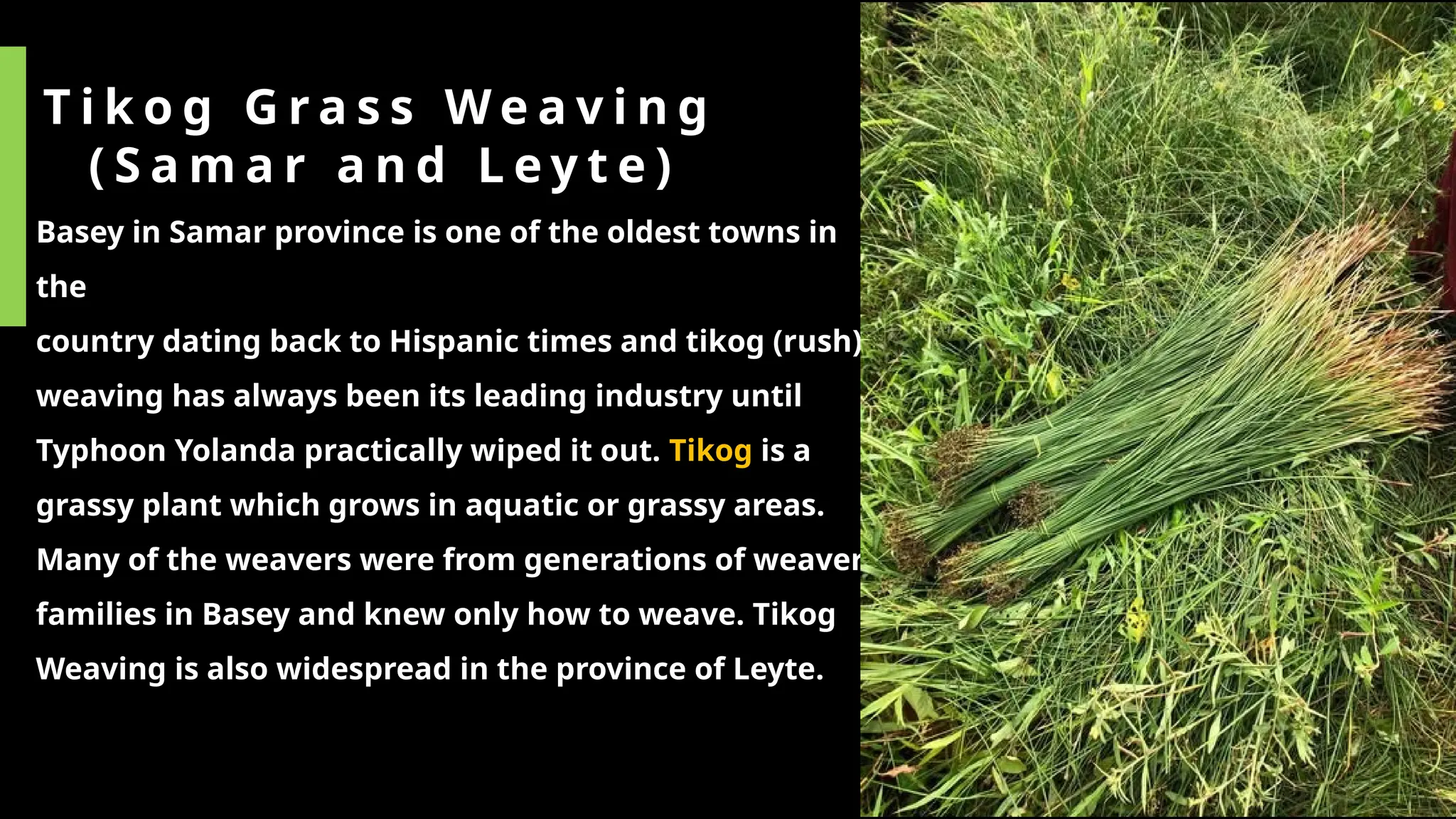
T i ko g G r a s s W e a v i n g
( S a m a r a n d L e y t e )
Basey in Samar province is one of the oldest towns in
the
country dating back to Hispanic times and tikog (rush)
weaving has always been its leading industry until
Typhoon Yolanda practically wiped it out. Tikog is a
grassy plant which grows in aquatic or grassy areas.
Many of the weavers were from generations of weaver
families in Basey and knew only how to weave. Tikog
Weaving is also widespread in the province of Leyte.
18.
Abaca fiber isin demand globally as a raw material for
coarse and stiff clothing, foot wear and cordage, textile,
handicraft and specialty paper products like tea bags,
sausage casings, cigarette papers, non-woven and
disposables and as natural fiber material for dashboards
and car interiors.
Markets of Southern Leyte abaca fiber included the local
abaca handicrafts processors in the province, whose
workers were mostly women as well as the pulp, paper
and cordage factories in Manila, Cebu, Iligan, and Bicol.
Abaca Fiber
Products (Leyte)
19.
Hinablon, is aproduct in a
traditional process of weaving
known in the town of Argao. The
weaving process itself is called
hablon. Produced with local fibres
such as piña, cotton, and abaca,
the "hablon” comes from the
Visayan word “habol,” which
means blanket.
H a b l o n W e a v i n g
( C e b u )
H a b l o n W e a v i n g
( I l o - i l o )
Hablon, taken from the Hiligaynon word
"habol” meaning “to weave", refers to both
the process of making the fabric and the end
product. It is traditionally made of locally-
made fibers such as piña, abaca, and cotton.
The municipalities of Miagao and Oton are
still the top producers of the hablon weave in
the province. They also manufacture and sell
export-quality products such as traditional
patadyong skirts, Barong Tagalog, saya, and
bandana; as well as household and novelty
items like table runners, picture frames,
20.
A n ti q u e r a
W e a v i n g ( B o h o l )
These handicrafts are made
out of whatever native
material is on hand: from
bamboo, rattan, wicker,
nito, buri, sig-id and other
vines.
Antequera baskets,
including other native
products such as hampers,
home furnishings, wall
decors, furniture, bags and
fashion accessories, come in
all shapes and sizes.
21.
S i na m a y We a v i n g
( N e g ro s O r i e n t a l )
Sinamay is one of the most popular hat-
making foundations in the world. It is
woven from the processed stalks of the
abaca tree, a banana palm native to the
Philippines. Less gossamer tissue, but
almost transparent and far more durable
than the fabrics made from pineapple
fiber.
Sinamay materials are used in making gift
boxes; packaging materials, decorative
22.
Pinya Weaving (Aklan)
"Piña”fiber is extracted from the leaves of
a pineapple plant. Its scientific name is
ananas comosus. Piña fiber is often
blended with cotton, abaca, silk, or
polyester to create wonderful light,
breezy fabrics.
The weavers decided on their own design.
The designs usually took the form of flowers,
fruits, coconut trees, nipa huts or other
designs concocted by the weaver’s
imagination.
The traditional decoration for this fabric is a
style of hand
embroidery called calado. An embroidered
piña garment is called piña calado.
It is considered the finest of
Philippine textiles mainly because of
its delicacy and its natural creamy
hue.
It is made of fibres from the inner
layer of the leaves of the native
pineapple plant of the red bisaya
variety (Ananascomosus).
Since the barong and saya are
"National Costumes," each barong
and saya made of pina cloth are
National Treasures of the Filipino
Culture.
The combination of piña and silk is
what is popularly known as Piña-Jusi.
23.
Tanauan, Leyte acclaimsas the home
of fine quality bamboo furnitures,
bamboo gazebos, bamboo living room
sets, bamboo dining room sets,
bamboo beds and bamboo accessories.
For the locals, bamboo, in a skillful
work of art, with the
beauty of its own forms and its warm
character the precious natural
material bamboo is destined to fullfil
the natural human desire at home.
B a m b o o
H a n d i c r a f t s a n d
F u r n i t u r e
( Ta n a u a n , L e y t e )
24.
Traditional pottery makingin the
area starts with the gathering the
clay from natural deposits.
In Iloilo, pottery making has been
a thriving industry since. One of
the ancient means of livelihood
and crafts, “Pottery” still holds
true to residents of two barangays
of Municipality of Pavia, Pandac
and Jibao-an, providing activities
in those barangays and improving
their way of life.
Products include flower pots,
cooking pot, kalan (stove), vases,
jars, and other décor.
Pottery in Ilo-
Ilo
25.
Ot her Handicraft s
Capiz comes from the shell of the Placuna
placenta mollusk, which is native to the seas
of Southeast Asia, specifically Indonesia and
the Philippines. The mollusks are edible,
which means fisherman can harvest them for
their meat and reduce waste by reusing their
shells for décor and handicrafts,
Traditionally, capiz shell was used as a
substitute for glass, which is why the Placuna
placenta mollusk is nicknamed the
“windowpane oyster”.
Capiz Shell Crafts
Capiz, officially the Province of Capiz, is
a province in the Philippines located in
the central section of Western Visayas
region. Its capital is the city of Roxas.
Capiz is known for the Placuna placenta
oyster shell that has the same name
locally and is used for decoration and
making lampshades, trays, window and
doors. Likewise, the province is known
as the "Seafood Capital of the
Philippines"
26.
GUITAR HANDICRAFTS
Cebuanos areknown for their impeccable love for
music which is something that is rooted deep in the
island's history.
Guitars, or "gitaras" as their known locally, were first
introduced to the island during the Spanish Era, with
their name derived from the Spanish word "kitara".
Guitars and other stringed instruments, such as
ukuleles and banjos, are not just popular locally but
globally, exporting as many as 300,000 pieces per
quarter to countries such as the United Kingdom,
United States, and other parts of Asia.
27.
COCO HANDICRAFTS
Other Handicrafts
( SIQUIJOR)
Coco handicrafts in Siquijor showcase the
island’s rich cultural heritage and its close
relationship with the coconut tree, which is
abundant in the region.
Artisans carefully carve and shape coconut
shells into bowls, cups, spoons, and other
kitchenware, each showcasing the unique
texture and color of the material.
28.
BAMBOO CRAFTS
Leyte
Bamboo craftsin Tanauan, Leyte, encompass
a rich tradition of skilled craftsmanship and
cultural heritage.
Renowned for their expertise in bamboo
weaving, artisans in Tanauan create a diverse
array of products, including baskets,
furniture, handicrafts, and even musical
instruments.
29.
SAMAR WOOD CARVING
Samaris home to skilled woodcarvers
who transform locally sourced wood
into exquisite works of art.
Wooden sculptures depicting local
deities, mythical creatures, and
everyday scenes are common, as well
as functional items like furniture,
utensils, and religious artifacts.
30.
T’NALAK WEAVING
T’nalak weavingis a distinctive and intricate
craft that holds deep cultural significance for
the T’boli people of South Cotabato,
Mindanao. This ancient tradition involves
weaving delicate and colorful fabrics from
abaca fibers, with patterns and designs
passed down through generations. The
process is highly revered, often seen as a
spiritual and cultural practice, with the
weavers—mostly women—guided by dreams
or visions to create the intricate motifs that
are believed to hold symbolic meanings.
T’nalak is not only a form of artistic
expression but also a representation of the
T’boli people’s connection to their ancestry,
beliefs, and the natural world. The vibrant
textiles produced are used in traditional
clothing, ceremonies, and rituals, making
T’nalak weaving an important cultural legacy
that continues to thrive and evolve in modern
times.
31.
Intricate Brassware
Intricate brasswareis an essential part of the Lumad heritage, reflecting the rich cultural and
artistic legacy of the indigenous groups in Mindanao. The Lumad people, with their deep-rooted
traditions, create stunning brass artifacts through meticulous handcrafting techniques passed
down for generations. These brass items, ranging from household tools to decorative pieces,
are often adorned with intricate patterns and symbols that hold cultural significance. The
designs are influenced by nature, spiritual beliefs, and ancestral stories, showcasing the
craftsmanship and creativity of the Lumad.
Brassware also plays a role in
various rituals, ceremonies, and
community events, where it serves
as a symbol of status, spirituality,
and identity. As both functional
and ornamental, intricate
brassware is a testament to the
Lumad people’s artistic prowess
and their enduring connection to
their traditions.
32.
COLORFUL BEADWORK
Colorful beadworkis a vibrant
and essential craft in Mindanao,
showcasing the artistic flair and
cultural richness of the region’s
indigenous communities. Using
tiny, meticulously threaded
beads, artisans create stunning
jewelry, accessories, and
decorative pieces that are not
only visually striking but also
steeped in cultural symbolism.
Each beadwork pattern and
design reflects the traditions,
beliefs, and identities of the
ethnic groups, with some
patterns representing personal
stories, social status, or spiritual
connections.
33.
Beadwork plays asignificant role in various festivals and ceremonies, where it is worn
as a symbol of festivity, pride, and unity. The intricate designs, often made with locally
sourced materials, burst with colors that mirror the region’s lively spirit and joyful
celebrations. Through beadwork, the indigenous people of Mindanao express their
creativity, maintain their cultural heritage, and celebrate their connection to the past
and present.
34.
WOOD CARVING
Mindanao’s forestshave long
served as both inspiration and
material for the region’s skilled
carvers, whose works reflect a
deep reverence for nature and
its spiritual significance. The
dense forests provide not only
the raw materials—such as
hardwoods and bamboo—but
also a profound connection to
the land’s myths, stories, and
traditions. Artisans shape these
natural resources into
beautifully crafted furniture,
sculptures, and intricate
architectural details, each piece
imbued with meaning.
The carvings often feature motifs of animals, spirits, and ancestral symbols, serving as a
visual narrative of the forest’s lore. For these artisans, the act of carving is not merely a
craft, but a sacred practice that honors the trees’ spirits and the life that flourishes within
the forest. Through their craftsmanship, Mindanao’s native artisans continue to preserve
their cultural heritage, weaving together art, nature, and spirituality into every detailed
49.
Our time togetherhas left me wanting more. I can't wait
to see you again next week!
Kuya Jim ❤️