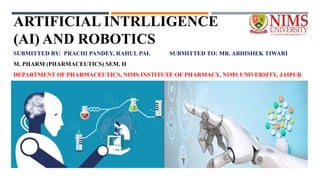
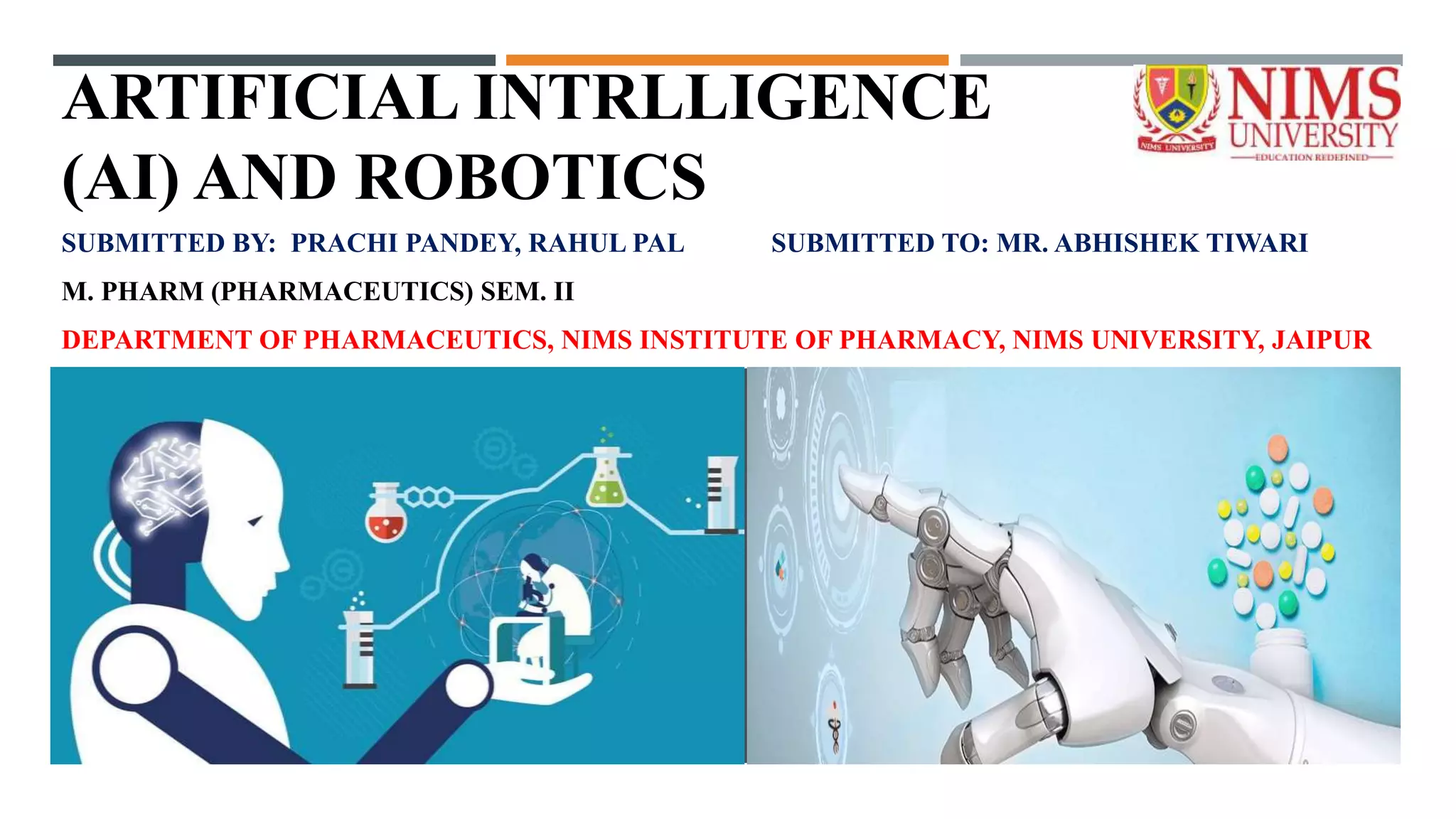
ARTIFICIAL INTRLLIGENCE
(AI) AND ROBOTICS
SUBMITTED BY: PRACHI PANDEY, RAHUL PAL SUBMITTED TO: MR. ABHISHEK TIWARI
M. PHARM (PHARMACEUTICS) SEM. II
DEPARTMENT OF PHARMACEUTICS, NIMS INSTITUTE OF PHARMACY, NIMS UNIVERSITY, JAIPUR
INTRODUCTION: ATIFICIAL INTELLIGENCE
According to the father of artificial intelligence, John McCarthy,
defined as “Thee science and engineering of making intelligent machines
, especially intelligent computer programs”.
 Generally, artificial intelligence is a way of making a computer, a computer-controlled robot or a software
think intelligently, in the similar manner the intelligent humans think.
 AI, intelligence distinguish us from everything in the world and it is also improved the skills that played a
significant role in our evaluation.
DEFINITION OF ARTIFICIAL INTELLIGENCE
AI may be defined as in the very simple words, “It is the study of such ideas which are enable computers to
do the things make people seem intelligent”.
 The goal of AI system is to develop system capable to tacking complex problems in ways similar to
human logic and reasoning.
 AI is the branch of science which delas with the helping machines to find the solutions of he complex
problems in a more human like fashions.
 It is the process includes learning, reasoning and self correction.
AI WITH PHARMACEUTICALS
The current pharmacy environments is expensive and lengthy drug discovery cycles coupled with pricing
pressures by both payers and consumers.
 The overall probability of the clinical success is estimated to be less than 12%.
 The pharmaceutical R&D suffers from declining success rates and a stagnant pipeline.
 With applying data strategies will eventually lead to optimizing innovation, improving the efficiency of
research and clinical trials, and building new tools for physicians, consumers and regulators to meet the
promise of more individualized approaches.
THE ADOPTION OF ARTIFICIAL INTELLIGENCE
(AI)
Here, the lots of adoption behind reasons for the adopting the artificial intelligence such as including:
 It play an important role and allows for learning from the real time data.
 It identify the right candidates for the clinical trials.
 Reducing the costs.
 Increasing the productivity.
 It mainly performs the analysis faster and more accurately.
AI AREAS IN PHARMACEUTICAL
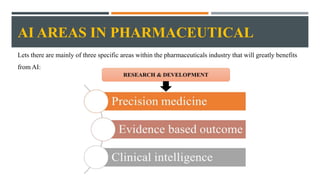
Lets there are mainly of three specific areas within the pharmaceuticals industry that will greatly benefits
from AI:
AI IN PHARMACEUTICAL INDUSTRY
 Fuzzy logic- especially useful in describing the target proteins for optimization, process controls.
 Genetic logarithms- they provide a search techniques which is particularly suited to optimization.
 Drug repositioning.
 To predict the drug resistance.
 Alternative indication identification and clinical trials research.
 Correlation detection and personalizing the treatment.
VARIOUS APPLICATION IN
PHARMACEUTICALS
AI having the various applications in health care and pharmacy which are as follows:
 Disease identification.
 Drugs discovery/manufacturing.
 Clinical trials research.
 Radiology and radiotherapy.
 Smart electronic health records.
 Personalized treatment.
CURRENT CHALLENGES AND FUTURE ASPECTS
 Lots of big pharmaceutical companies began investing in AI in order to develop better diagnostic or
biomarkers, to identify drug targets and to design new drugs and products.
 In December, 2016, Pfizer and IBM announced partnership to accelerate drug discovery in immuno-
oncology.
 Merck partnership with numerate generating novel small molecules cardiovascular disease target, in
March 2012 focusing n drug leads for unnamed.
ROBOTICS
 Robotics may defined as, “Intelligent machine and systems used in space, exploration, human
services and manufacturing where as automation includes the use of automated methods in various
applications”.
 Robots in laboratory, life science and pharmaceutical applications performs tasks at rates beyond human
capability.
 Robots are doing assay analysis and automating the movement of test tube in research laboratory.
 In pharmaceutical applications, hospitals use robots to mix potentially hazards cancer drugs and those
associated with radiation.
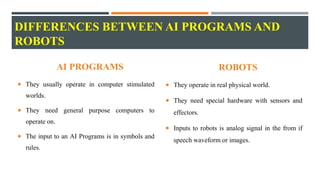
DIFFERENCES BETWEEN AI PROGRAMS AND
ROBOTS
AI PROGRAMS
 They usually operate in computer stimulated
worlds.
 They need general purpose computers to
operate on.
 The input to an AI Programs is in symbols and
rules.
ROBOTS
 They operate in real physical world.
 They need special hardware with sensors and
effectors.
 Inputs to robots is analog signal in the from if
speech waveform or images.
ROBOTS USED IN PHARMACEUTICAL INDUSTRY
 Pharmaceutical container replacement robot.
 Cylindrical robot for high throughput screening.
 Six-axis robots suit class I clean room application.
 Space saving ceiling mounted robot.
 Metal detector targets pharmaceutical industry.
APPLICATION OF ROBOTS IN PHARMACEUTICAL
INDUSTRY
 Research and development (R&D)
 Controls systems
 Sterilization and cleans rooms
 Packing operations.
 Vision systems.
 Grinding applications.
 Sterile syringes filling.
 Flexible feeding 3.
Artificial Intelligence and Robotics

Artificial Intelligence and Robotics

  • 1.
    ARTIFICIAL INTRLLIGENCE (AI) ANDROBOTICS SUBMITTED BY: PRACHI PANDEY, RAHUL PAL SUBMITTED TO: MR. ABHISHEK TIWARI M. PHARM (PHARMACEUTICS) SEM. II DEPARTMENT OF PHARMACEUTICS, NIMS INSTITUTE OF PHARMACY, NIMS UNIVERSITY, JAIPUR
  • 2.
    INTRODUCTION: ATIFICIAL INTELLIGENCE Accordingto the father of artificial intelligence, John McCarthy, defined as “Thee science and engineering of making intelligent machines , especially intelligent computer programs”.  Generally, artificial intelligence is a way of making a computer, a computer-controlled robot or a software think intelligently, in the similar manner the intelligent humans think.  AI, intelligence distinguish us from everything in the world and it is also improved the skills that played a significant role in our evaluation.
  • 3.
    DEFINITION OF ARTIFICIALINTELLIGENCE AI may be defined as in the very simple words, “It is the study of such ideas which are enable computers to do the things make people seem intelligent”.  The goal of AI system is to develop system capable to tacking complex problems in ways similar to human logic and reasoning.  AI is the branch of science which delas with the helping machines to find the solutions of he complex problems in a more human like fashions.  It is the process includes learning, reasoning and self correction.
  • 4.
    AI WITH PHARMACEUTICALS Thecurrent pharmacy environments is expensive and lengthy drug discovery cycles coupled with pricing pressures by both payers and consumers.  The overall probability of the clinical success is estimated to be less than 12%.  The pharmaceutical R&D suffers from declining success rates and a stagnant pipeline.  With applying data strategies will eventually lead to optimizing innovation, improving the efficiency of research and clinical trials, and building new tools for physicians, consumers and regulators to meet the promise of more individualized approaches.
  • 5.
    THE ADOPTION OFARTIFICIAL INTELLIGENCE (AI) Here, the lots of adoption behind reasons for the adopting the artificial intelligence such as including:  It play an important role and allows for learning from the real time data.  It identify the right candidates for the clinical trials.  Reducing the costs.  Increasing the productivity.  It mainly performs the analysis faster and more accurately.
  • 6.
    AI AREAS INPHARMACEUTICAL Lets there are mainly of three specific areas within the pharmaceuticals industry that will greatly benefits from AI:
  • 7.
    AI IN PHARMACEUTICALINDUSTRY  Fuzzy logic- especially useful in describing the target proteins for optimization, process controls.  Genetic logarithms- they provide a search techniques which is particularly suited to optimization.  Drug repositioning.  To predict the drug resistance.  Alternative indication identification and clinical trials research.  Correlation detection and personalizing the treatment.
  • 8.
    VARIOUS APPLICATION IN PHARMACEUTICALS AIhaving the various applications in health care and pharmacy which are as follows:  Disease identification.  Drugs discovery/manufacturing.  Clinical trials research.  Radiology and radiotherapy.  Smart electronic health records.  Personalized treatment.
  • 9.
    CURRENT CHALLENGES ANDFUTURE ASPECTS  Lots of big pharmaceutical companies began investing in AI in order to develop better diagnostic or biomarkers, to identify drug targets and to design new drugs and products.  In December, 2016, Pfizer and IBM announced partnership to accelerate drug discovery in immuno- oncology.  Merck partnership with numerate generating novel small molecules cardiovascular disease target, in March 2012 focusing n drug leads for unnamed.
  • 10.
    ROBOTICS  Robotics maydefined as, “Intelligent machine and systems used in space, exploration, human services and manufacturing where as automation includes the use of automated methods in various applications”.  Robots in laboratory, life science and pharmaceutical applications performs tasks at rates beyond human capability.  Robots are doing assay analysis and automating the movement of test tube in research laboratory.  In pharmaceutical applications, hospitals use robots to mix potentially hazards cancer drugs and those associated with radiation.
  • 11.
    DIFFERENCES BETWEEN AIPROGRAMS AND ROBOTS AI PROGRAMS  They usually operate in computer stimulated worlds.  They need general purpose computers to operate on.  The input to an AI Programs is in symbols and rules. ROBOTS  They operate in real physical world.  They need special hardware with sensors and effectors.  Inputs to robots is analog signal in the from if speech waveform or images.
  • 12.
    ROBOTS USED INPHARMACEUTICAL INDUSTRY  Pharmaceutical container replacement robot.  Cylindrical robot for high throughput screening.  Six-axis robots suit class I clean room application.  Space saving ceiling mounted robot.  Metal detector targets pharmaceutical industry.
  • 13.
    APPLICATION OF ROBOTSIN PHARMACEUTICAL INDUSTRY  Research and development (R&D)  Controls systems  Sterilization and cleans rooms  Packing operations.  Vision systems.  Grinding applications.  Sterile syringes filling.  Flexible feeding 3.