P R E P A R E D B Y .
J A Y B H A V S A R
M . P H A R M ( P H A R M A C E U T I C S )
G U I D E D B Y .
D R . T E J A S P A T E L
P H A R M A C E U T I C S D E P A R T M E N T ,
F A C U L T Y O F P H A R M A C Y ,
D H A R M S I N H D E S A I U N I V E R S I T Y ,
N A D I A D .
Artificial Intelligence : Role
in Pharma Sector
1
Introduction:
 Artificial Intelligence (AI) is the branch of engineering
science which deals with making of intelligent machines,
especially intelligent computer programs.
 It is the ability of a computer or a robotic computer
enabled system to process the given information and
produce outcomes in a manner similar to the attention
process of humans in learning, decision making and
solving problems.
 AI is a branch of computer science that aims to create
intelligent machines, which becomes an essential part of
the technology industry.
 Research associated with AI is highly technical and
specialized.
2
Introduction:
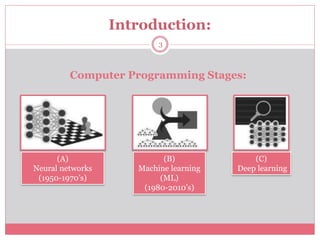
Computer Programming Stages:
(A)
Neural networks
(1950-1970’s)
(B)
Machine learning
(ML)
(1980-2010’s)
(C)
Deep learning
3
Introduction:
 Mile Stones In The Artificial Intelligence Process:
Year Milestone
1943 Neurons can do logical operations like “and”, “or” or “not”, when they are connected as a network. This
process was proved by Walter Pitts and Warren McCulloch.
1951 First neuronal network, which solved a problem from the real world i.e. SNARC (Stochastic Neural Analog
Reinforcement Computer) was by Marvin Minsky.
1956 At Dartmouth college conference the term “Artificial Intelligence” was coined.
1958 Perceptrons (neuronal networks that transmit information in one direction) was created by the Frank
Rosenblatt which is the origin for todays AI progress.
1969 Minsky supported the symbolic representation of problems in his book - “Perceptrons”.
1974-80 During this period, interest on AI was dropped, which is called as “First AI Winter”.
1986 Back propagation algorithm design was developed by Georey Hinton which is widely using in deep learning
nowadays.
1987-93 This phase is called as “AI winter”
1997 This year IBM Deep blue defeated the Garry Kasparov (Russian grandmaster).
2013 Google used the British technology to perform efficient research on photos.
2016 Google DeepMind, software AlphaGo defeated the Go Champion Lee Sedol.
4
Introduction:
5
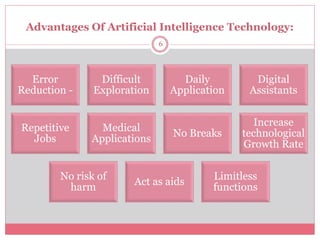
Advantages Of Artificial Intelligence Technology:
Error
Reduction -
Difficult
Exploration
Daily
Application
Digital
Assistants
Repetitive
Jobs
Medical
Applications
No Breaks
Increase
technological
Growth Rate
No risk of
harm
Act as aids
Limitless
functions
6
Disadvantages Of Artificial Intelligence Technology:
High Cost
No Replicating
Humans
No
Improvement
with Experience
No Original
Creativity
Unemployment
7
Types Of Artificial Intelligence:
• This system is designed and trained to perform a
narrow task, such as facial recognition, driving a
car, playing chess, traffic signalling. E.g.: Apple
SIRI virtual personal assistance, tagging in social
media.
Weak Intelligence
Or Artificial Narrow
Intelligence (ANI)
• It is also called as Human Level AI. It has the
ability to simplify human intellectual abilities.
Due to this, when it exposed to an unfamiliar task,
it has the ability to find the solution. AGI can
perform all the things as humans.
Artificial General
Intelligence (AGI)
Or Strong AI
• It is a brain power, which is more active than
smart humans drawing, mathematics, space, etc;
in each and every field from science to art. It
ranges from the computer just little than the
human to trillion times smarter than humans.
Artificial Super
Intelligence (ASI):
8
Applications of AI:
1. AI In Drug Discovery Process:
 The progress of a new drug costs an average of $ 2.6 billion and takes over a
period of 14 years.
 Insilico medicine is getting next generation AI to solve problems. Generative
adversarial networks (GANs) have the ability to design drug
molecules. This is a deep learning developed by Google AI team
in 2014. The technology is useful to produce photo-realistic
pictures from text description. It can image or create new data
based on real data.
 The GAN technique is a confrontational game between two deep neural
networks. One deep neural network evaluates the output of the
other and in the adversarial game. two networks learn how to
generate more perfect objects or perfect molecules.
 Next generation AI is reinforcement learning, which is used by Insilico.
9
Applications of AI:
1. AI In Drug Discovery Process:
 In present days, new methods of AI are showing the
ability to solve the problems that were difficult to
tackle previously.
 The team designed algorithms, which are able to
reconstruct features missing from half-full datasets
and understand differences in normal and diseased
profiles within complex data.
 e.g. To recognize the cardiotoxic and non-cardiotoxic
drugs of anticancer category by using AI algorithm.
10
Applications of AI:
2. AI And Machine Learning :
 Machine learning technology is assisting the research and
development scientists to analyse the mass of scientific data to get
essential new knowledge.
 e.g. To carry out research on Amyotrophic Lateral Sclerosis (ALS),
they developed “Judgement Correlation System”(JACS), which is
able to check billions and trillions of sentences and paragraphs of
various abstracts and research and review articles. A direct link
between data and regulation process was established by JACS as
known facts.
 These facts are useful to design possible number of hypothesis using
developed by scientists i.e. 200 to 250.
 The hypothesis are validated by the expert team of scientists. The
worthful hypotheses are finalized.
 Out of those nearly 5 hypotheses only are applied in the laboratory
for designing and synthesising new chemical molecule or formulae.
11
Applications of AI:
3. Hastening Drug Discovery With Technology:
 New technologies give systematic insights to diseases and help the
scientists to identify promising agents.
 Technology helps in compound design, broader chemical space,
picking best chemical molecule.
 It is also helpful in issues such as selection of compounds based
upon efficacy, safety and selection of patients to clinical trials.
 AI can be used to identify new drug targets and to develop better
drugs, diagnostics or biomarkers.
 One of the most widespread use is for re-purposing drugs to find
new uses for existing drugs or late stage drug candidates.
 If this happens there is no need to repeat all the phase I tests and
toxicology testing, directly phase II trial can be done for a different
indication.
 So, the process of medicine development can accelerate
dramatically.
12
AI In Health Care System:
Maintaining Of
Medical Records
Treatment Plan
Designing
Helping In
Repetitive Jobs
Attainment Of In
Person And
Online
Consultation
Health Support
And Medication
Assistance
Accuracy Of
Medicine
Drug Creation
AI Help To
People In Health
Care System
Healthcare
System
Analysing
Diagnostic And
Imaging Sector
Prognosis
AI Financing
Activity In
Healthcare
System
13
Health Care Application Of AI System:
Health Care
Application
Representative
Company
AI Technology
Platform
Key Benefits
Intelligent
Diagnostics
Analytics 4 life is pioneering digital health
using AI to develop a completely new form
of medical imaging. With an initial focus
on coronary artery disease (CAD). It is a
nove radiation free and exercise free
cardiac imaging technology.
Physicians can noninvasively assess
the presence of significant CAD in a
single office visit without radiation,
exercise or pharmacological stressors
using physiologic signals naturally
emitted by the body.
By using this platform to cardiac phase
space tomography analysis (cPSTA) data
and paired coronary angiography results
it developed its initial product focused on
CAD.
Delivers an improved diagnostic
solution previously available only
through invasive, expensive tests
providing immediate and measurable
benefits to patients, payers and
providers.
Patient And
Provider Data Base
It offers a machine intelligence software
platform, Topological data analysis (TDA),
that enables organizations to analyse and
build predictive models using big data or
highly dimensional data sets.
It allow healthcare providers and
pharmaceut i cal companies to
automatically stratify complex data and
uncover relationships to optimize
patent care paths., procedures and
protocols for personalized medicine
leading to faster and more effective
outcomes.
The TDA platform draws on a range of
machine learning statistical and genomic
algorithms to combine and synthesize
them in accordance with the data.
Drug Discovery Process
With Advanced Analytics
It uses it's advanced proprietary AI that
can be applied to manage publicly and
privately available noisy data.
Helps uncover valuable biology not
easily translated by the traditional
approaches enabling faster lead design
and candidate identification while
reducing development costs and
attrition rates.
It developed a technology that can model
most important absorption, distribution,
metabolism and excretion properties in the
drug development process
14
Health Care Application Of AI System:
Health Care
Application
Representative
Company
AI Technology
Platform
Key Benefits
Medical Devices
And Robotics
It developed robotic assisted surgical
products with a platform that includes
advanced imaging, robotics, big data
management and machine learning to
provide advanced surgical tools and
capabilities to surgeons.
Expected to be only 20% the size of and
considerabley less expensive than
current systems, while improving
quality of precision and patient
outcomes significantly.
Focus on improving and standardizing
the outcomes in challenging
procedures such as thoracic lobectomy,
gastrectomy and low anterior
resection.
Home Health
Using Artificial
Intelligence
It uses AI to contextualize data
regarding a patient’s health status and
self management behaviour to provide
early detection of potentially harmful
health events.
Significantly impacts health care
quality and cost by improving self
management and enabling protective
interventions.
With this system, upto 80% comply
with their care plan versus a control
50% norm.
At the core of Ibis platform lies Scio, an
AI brain which allows complex health
management via a continuous five step
AI process including observation,
learning, discovering, anticipating and
prompting.
Significantly reduces acute care
utilization.
15
AI Healthcare Diagnostic Land Scape:
16
References:
 S.S. Manikiran, N.L. Prasanthi*, Artificial Intelligence:
Milestones and Role in Pharma and Healthcare Sector,
Pharma Times - Vol. 51 - No. 01 - January 2019.
 Artificial Intelligence: Milestones and role in Pharma and
Healthcare Sector, Pharma Times, ISSN 0031-6849, Vol. 51
No. 01 | January 2019.
 Shapiro SC. Artificial intelligence. Encyclopedia of Artificial
intelligence, Vol. 1, 2ndedn. New York; Wiley 1992.
 Dasta JF. Application of artificial intelligence to pharmacy
and medicine. Hosp Pharm 1992. 27; 312-5:319-22.
 Flasinski M. Introduction to Artificial Intelligence. 1st ed.
Switzerland: Springer International Publishing; 2016. p. 4.
17

Artificial Intelligence: Role In Pharma Sector

  • 1.
    P R EP A R E D B Y . J A Y B H A V S A R M . P H A R M ( P H A R M A C E U T I C S ) G U I D E D B Y . D R . T E J A S P A T E L P H A R M A C E U T I C S D E P A R T M E N T , F A C U L T Y O F P H A R M A C Y , D H A R M S I N H D E S A I U N I V E R S I T Y , N A D I A D . Artificial Intelligence : Role in Pharma Sector 1
  • 2.
    Introduction:  Artificial Intelligence(AI) is the branch of engineering science which deals with making of intelligent machines, especially intelligent computer programs.  It is the ability of a computer or a robotic computer enabled system to process the given information and produce outcomes in a manner similar to the attention process of humans in learning, decision making and solving problems.  AI is a branch of computer science that aims to create intelligent machines, which becomes an essential part of the technology industry.  Research associated with AI is highly technical and specialized. 2
  • 3.
    Introduction: Computer Programming Stages: (A) Neuralnetworks (1950-1970’s) (B) Machine learning (ML) (1980-2010’s) (C) Deep learning 3
  • 4.
    Introduction:  Mile StonesIn The Artificial Intelligence Process: Year Milestone 1943 Neurons can do logical operations like “and”, “or” or “not”, when they are connected as a network. This process was proved by Walter Pitts and Warren McCulloch. 1951 First neuronal network, which solved a problem from the real world i.e. SNARC (Stochastic Neural Analog Reinforcement Computer) was by Marvin Minsky. 1956 At Dartmouth college conference the term “Artificial Intelligence” was coined. 1958 Perceptrons (neuronal networks that transmit information in one direction) was created by the Frank Rosenblatt which is the origin for todays AI progress. 1969 Minsky supported the symbolic representation of problems in his book - “Perceptrons”. 1974-80 During this period, interest on AI was dropped, which is called as “First AI Winter”. 1986 Back propagation algorithm design was developed by Georey Hinton which is widely using in deep learning nowadays. 1987-93 This phase is called as “AI winter” 1997 This year IBM Deep blue defeated the Garry Kasparov (Russian grandmaster). 2013 Google used the British technology to perform efficient research on photos. 2016 Google DeepMind, software AlphaGo defeated the Go Champion Lee Sedol. 4
  • 5.
  • 6.
    Advantages Of ArtificialIntelligence Technology: Error Reduction - Difficult Exploration Daily Application Digital Assistants Repetitive Jobs Medical Applications No Breaks Increase technological Growth Rate No risk of harm Act as aids Limitless functions 6
  • 7.
    Disadvantages Of ArtificialIntelligence Technology: High Cost No Replicating Humans No Improvement with Experience No Original Creativity Unemployment 7
  • 8.
    Types Of ArtificialIntelligence: • This system is designed and trained to perform a narrow task, such as facial recognition, driving a car, playing chess, traffic signalling. E.g.: Apple SIRI virtual personal assistance, tagging in social media. Weak Intelligence Or Artificial Narrow Intelligence (ANI) • It is also called as Human Level AI. It has the ability to simplify human intellectual abilities. Due to this, when it exposed to an unfamiliar task, it has the ability to find the solution. AGI can perform all the things as humans. Artificial General Intelligence (AGI) Or Strong AI • It is a brain power, which is more active than smart humans drawing, mathematics, space, etc; in each and every field from science to art. It ranges from the computer just little than the human to trillion times smarter than humans. Artificial Super Intelligence (ASI): 8
  • 9.
    Applications of AI: 1.AI In Drug Discovery Process:  The progress of a new drug costs an average of $ 2.6 billion and takes over a period of 14 years.  Insilico medicine is getting next generation AI to solve problems. Generative adversarial networks (GANs) have the ability to design drug molecules. This is a deep learning developed by Google AI team in 2014. The technology is useful to produce photo-realistic pictures from text description. It can image or create new data based on real data.  The GAN technique is a confrontational game between two deep neural networks. One deep neural network evaluates the output of the other and in the adversarial game. two networks learn how to generate more perfect objects or perfect molecules.  Next generation AI is reinforcement learning, which is used by Insilico. 9
  • 10.
    Applications of AI: 1.AI In Drug Discovery Process:  In present days, new methods of AI are showing the ability to solve the problems that were difficult to tackle previously.  The team designed algorithms, which are able to reconstruct features missing from half-full datasets and understand differences in normal and diseased profiles within complex data.  e.g. To recognize the cardiotoxic and non-cardiotoxic drugs of anticancer category by using AI algorithm. 10
  • 11.
    Applications of AI: 2.AI And Machine Learning :  Machine learning technology is assisting the research and development scientists to analyse the mass of scientific data to get essential new knowledge.  e.g. To carry out research on Amyotrophic Lateral Sclerosis (ALS), they developed “Judgement Correlation System”(JACS), which is able to check billions and trillions of sentences and paragraphs of various abstracts and research and review articles. A direct link between data and regulation process was established by JACS as known facts.  These facts are useful to design possible number of hypothesis using developed by scientists i.e. 200 to 250.  The hypothesis are validated by the expert team of scientists. The worthful hypotheses are finalized.  Out of those nearly 5 hypotheses only are applied in the laboratory for designing and synthesising new chemical molecule or formulae. 11
  • 12.
    Applications of AI: 3.Hastening Drug Discovery With Technology:  New technologies give systematic insights to diseases and help the scientists to identify promising agents.  Technology helps in compound design, broader chemical space, picking best chemical molecule.  It is also helpful in issues such as selection of compounds based upon efficacy, safety and selection of patients to clinical trials.  AI can be used to identify new drug targets and to develop better drugs, diagnostics or biomarkers.  One of the most widespread use is for re-purposing drugs to find new uses for existing drugs or late stage drug candidates.  If this happens there is no need to repeat all the phase I tests and toxicology testing, directly phase II trial can be done for a different indication.  So, the process of medicine development can accelerate dramatically. 12
  • 13.
    AI In HealthCare System: Maintaining Of Medical Records Treatment Plan Designing Helping In Repetitive Jobs Attainment Of In Person And Online Consultation Health Support And Medication Assistance Accuracy Of Medicine Drug Creation AI Help To People In Health Care System Healthcare System Analysing Diagnostic And Imaging Sector Prognosis AI Financing Activity In Healthcare System 13
  • 14.
    Health Care ApplicationOf AI System: Health Care Application Representative Company AI Technology Platform Key Benefits Intelligent Diagnostics Analytics 4 life is pioneering digital health using AI to develop a completely new form of medical imaging. With an initial focus on coronary artery disease (CAD). It is a nove radiation free and exercise free cardiac imaging technology. Physicians can noninvasively assess the presence of significant CAD in a single office visit without radiation, exercise or pharmacological stressors using physiologic signals naturally emitted by the body. By using this platform to cardiac phase space tomography analysis (cPSTA) data and paired coronary angiography results it developed its initial product focused on CAD. Delivers an improved diagnostic solution previously available only through invasive, expensive tests providing immediate and measurable benefits to patients, payers and providers. Patient And Provider Data Base It offers a machine intelligence software platform, Topological data analysis (TDA), that enables organizations to analyse and build predictive models using big data or highly dimensional data sets. It allow healthcare providers and pharmaceut i cal companies to automatically stratify complex data and uncover relationships to optimize patent care paths., procedures and protocols for personalized medicine leading to faster and more effective outcomes. The TDA platform draws on a range of machine learning statistical and genomic algorithms to combine and synthesize them in accordance with the data. Drug Discovery Process With Advanced Analytics It uses it's advanced proprietary AI that can be applied to manage publicly and privately available noisy data. Helps uncover valuable biology not easily translated by the traditional approaches enabling faster lead design and candidate identification while reducing development costs and attrition rates. It developed a technology that can model most important absorption, distribution, metabolism and excretion properties in the drug development process 14
  • 15.
    Health Care ApplicationOf AI System: Health Care Application Representative Company AI Technology Platform Key Benefits Medical Devices And Robotics It developed robotic assisted surgical products with a platform that includes advanced imaging, robotics, big data management and machine learning to provide advanced surgical tools and capabilities to surgeons. Expected to be only 20% the size of and considerabley less expensive than current systems, while improving quality of precision and patient outcomes significantly. Focus on improving and standardizing the outcomes in challenging procedures such as thoracic lobectomy, gastrectomy and low anterior resection. Home Health Using Artificial Intelligence It uses AI to contextualize data regarding a patient’s health status and self management behaviour to provide early detection of potentially harmful health events. Significantly impacts health care quality and cost by improving self management and enabling protective interventions. With this system, upto 80% comply with their care plan versus a control 50% norm. At the core of Ibis platform lies Scio, an AI brain which allows complex health management via a continuous five step AI process including observation, learning, discovering, anticipating and prompting. Significantly reduces acute care utilization. 15
  • 16.
  • 17.
    References:  S.S. Manikiran,N.L. Prasanthi*, Artificial Intelligence: Milestones and Role in Pharma and Healthcare Sector, Pharma Times - Vol. 51 - No. 01 - January 2019.  Artificial Intelligence: Milestones and role in Pharma and Healthcare Sector, Pharma Times, ISSN 0031-6849, Vol. 51 No. 01 | January 2019.  Shapiro SC. Artificial intelligence. Encyclopedia of Artificial intelligence, Vol. 1, 2ndedn. New York; Wiley 1992.  Dasta JF. Application of artificial intelligence to pharmacy and medicine. Hosp Pharm 1992. 27; 312-5:319-22.  Flasinski M. Introduction to Artificial Intelligence. 1st ed. Switzerland: Springer International Publishing; 2016. p. 4. 17