HEALTH CARE
USING AI
NAME - ALIBHA SAHOO
BRANCH - CST (A)
REDG NO -
ROLL NO -
UNDER THE GUIDANCE OF
CONTENTS
 INTRODUCTION
 HISTORY OF AI HEALTH CARE
 WORKING PRINCIPLE OF HEALTH CARE USING AI
 APPLICATIONS OF AI HEALTH CARE
 ADVANTAGES OF HEALTH CARE USING AI
 DISADVANTAGES OF HEALTH CARE USING AI
 CONCLUSION
 REFERENCES
Artificial Intelligence (AI) is revolutionizing the healthcare industry by
providing innovative solutions to improve patient care, diagnostic
accuracy, treatment effectiveness, and healthcare management. AI
technologies encompass a range of techniques such as machine
learning, deep learning, natural language processing, robotics, and
predictive analytics. By harnessing the power of AI, healthcare
systems can leverage vast amounts of data and sophisticated
algorithms to drive advancements in medical research, clinical
decision-making, and patient outcomes.
INTRODUCTION
HISTORY OF AI HEALTH CARE
 In the 1960s and 1970s, early AI systems were
developed for medical diagnosis and decision-
making. These systems used rule-based expert
systems to mimic the knowledge and decision-
making abilities of human experts.
 In the 1980s and 1990s, machine learning
techniques started to be applied in
healthcare. These algorithms could analyze
large amounts of data and identify patterns,
aiding in tasks such as disease diagnosis,
prognosis, and treatment planning.
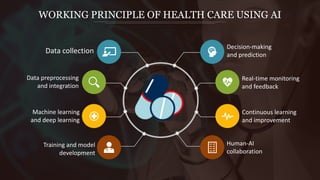
Data collection
Data preprocessing
and integration
Machine learning
and deep learning
Training and model
development
Decision-making
and prediction
Human-AI
collaboration
Real-time monitoring
and feedback
Continuous learning
and improvement
WORKING PRINCIPLE OF HEALTH CARE USING AI
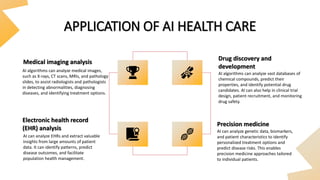
APPLICATION OF AI HEALTH CARE
Medical imaging analysis
Electronic health record
(EHR) analysis
Drug discovery and
development
Precision medicine
AI algorithms can analyze medical images,
such as X-rays, CT scans, MRIs, and pathology
slides, to assist radiologists and pathologists
in detecting abnormalities, diagnosing
diseases, and identifying treatment options.
AI algorithms can analyze vast databases of
chemical compounds, predict their
properties, and identify potential drug
candidates. AI can also help in clinical trial
design, patient recruitment, and monitoring
drug safety.
AI can analyze EHRs and extract valuable
insights from large amounts of patient
data. It can identify patterns, predict
disease outcomes, and facilitate
population health management.
AI can analyze genetic data, biomarkers,
and patient characteristics to identify
personalized treatment options and
predict disease risks. This enables
precision medicine approaches tailored
to individual patients.
ADVANTAGES
OF
HEALTH CARE USING AI
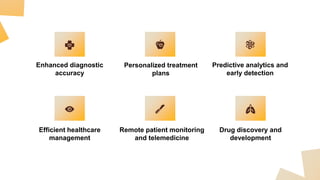
Enhanced diagnostic
accuracy
Personalized treatment
plans
Predictive analytics and
early detection
Efficient healthcare
management
Remote patient monitoring
and telemedicine
Drug discovery and
development
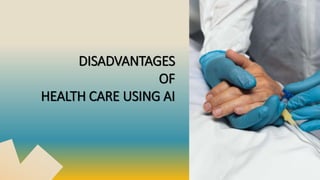
DISADVANTAGES
OF
HEALTH CARE USING AI
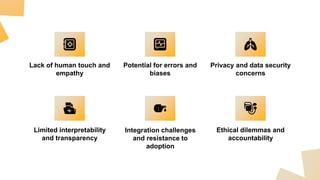
Lack of human touch and
empathy
Potential for errors and
biases
Privacy and data security
concerns
Limited interpretability
and transparency
Integration challenges
and resistance to
adoption
Ethical dilemmas and
accountability
CONCLUSION
The application of AI in healthcare offers numerous advantages,
including enhanced diagnostic accuracy, personalized treatment
plans, predictive analytics, efficient healthcare management,
remote patient monitoring, drug discovery, and surgical precision.
AI has the ability to analyze vast amounts of data, identify patterns,
and provide valuable insights to healthcare professionals.
REFERENCES
 https://designshack.net/articles/inspiration/medi
cal-powerpoint-templates/
 https://builtin.com/artificial-intelligence/artificial-
intelligence-healthcare
 https://en.wikipedia.org/wiki/Artificial_intelligenc
e_in_healthcare
THANK YOU

healthcare using artificial intelligence

  • 2.
    HEALTH CARE USING AI NAME- ALIBHA SAHOO BRANCH - CST (A) REDG NO - ROLL NO - UNDER THE GUIDANCE OF
  • 3.
    CONTENTS  INTRODUCTION  HISTORYOF AI HEALTH CARE  WORKING PRINCIPLE OF HEALTH CARE USING AI  APPLICATIONS OF AI HEALTH CARE  ADVANTAGES OF HEALTH CARE USING AI  DISADVANTAGES OF HEALTH CARE USING AI  CONCLUSION  REFERENCES
  • 4.
    Artificial Intelligence (AI)is revolutionizing the healthcare industry by providing innovative solutions to improve patient care, diagnostic accuracy, treatment effectiveness, and healthcare management. AI technologies encompass a range of techniques such as machine learning, deep learning, natural language processing, robotics, and predictive analytics. By harnessing the power of AI, healthcare systems can leverage vast amounts of data and sophisticated algorithms to drive advancements in medical research, clinical decision-making, and patient outcomes. INTRODUCTION
  • 5.
    HISTORY OF AIHEALTH CARE  In the 1960s and 1970s, early AI systems were developed for medical diagnosis and decision- making. These systems used rule-based expert systems to mimic the knowledge and decision- making abilities of human experts.  In the 1980s and 1990s, machine learning techniques started to be applied in healthcare. These algorithms could analyze large amounts of data and identify patterns, aiding in tasks such as disease diagnosis, prognosis, and treatment planning.
  • 6.
    Data collection Data preprocessing andintegration Machine learning and deep learning Training and model development Decision-making and prediction Human-AI collaboration Real-time monitoring and feedback Continuous learning and improvement WORKING PRINCIPLE OF HEALTH CARE USING AI
  • 7.
    APPLICATION OF AIHEALTH CARE Medical imaging analysis Electronic health record (EHR) analysis Drug discovery and development Precision medicine AI algorithms can analyze medical images, such as X-rays, CT scans, MRIs, and pathology slides, to assist radiologists and pathologists in detecting abnormalities, diagnosing diseases, and identifying treatment options. AI algorithms can analyze vast databases of chemical compounds, predict their properties, and identify potential drug candidates. AI can also help in clinical trial design, patient recruitment, and monitoring drug safety. AI can analyze EHRs and extract valuable insights from large amounts of patient data. It can identify patterns, predict disease outcomes, and facilitate population health management. AI can analyze genetic data, biomarkers, and patient characteristics to identify personalized treatment options and predict disease risks. This enables precision medicine approaches tailored to individual patients.
  • 8.
  • 9.
    Enhanced diagnostic accuracy Personalized treatment plans Predictiveanalytics and early detection Efficient healthcare management Remote patient monitoring and telemedicine Drug discovery and development
  • 10.
  • 11.
    Lack of humantouch and empathy Potential for errors and biases Privacy and data security concerns Limited interpretability and transparency Integration challenges and resistance to adoption Ethical dilemmas and accountability
  • 12.
    CONCLUSION The application ofAI in healthcare offers numerous advantages, including enhanced diagnostic accuracy, personalized treatment plans, predictive analytics, efficient healthcare management, remote patient monitoring, drug discovery, and surgical precision. AI has the ability to analyze vast amounts of data, identify patterns, and provide valuable insights to healthcare professionals.
  • 13.
  • 14.