Agenda
 Introduction
 Motivation
 Generation
 Application
 Conclusion
What is artificial intelligence
 Artificial = a human creation that did not
occur naturally
 Intelligence = the ability to learn and
apply knowledge
 Even before computers and internet
being so popular
 They can help them in different field
Motivation
 For more complex problems, things get more
difficult... Unlike humans, computers have trouble
understanding specific situations, and adapting to
new situations.
 Artificial Intelligence aims to improve machine
behavior in tackling such complex tasks.
 AI research is allowing us to understand our
intelligent behavior.
A.I. in Fiction
How Does One Make A.I?
 Symbolic
 Sub-Symbolic
 Statistical
Symbolic Approach
 Logic-based
 All knowledge is “taught” by humans
 Everything is in a controlled environment
 To mimic human-intellect, it would take
millions of trigger conditions and rules
 This approach was popular in the 60s
and 70s
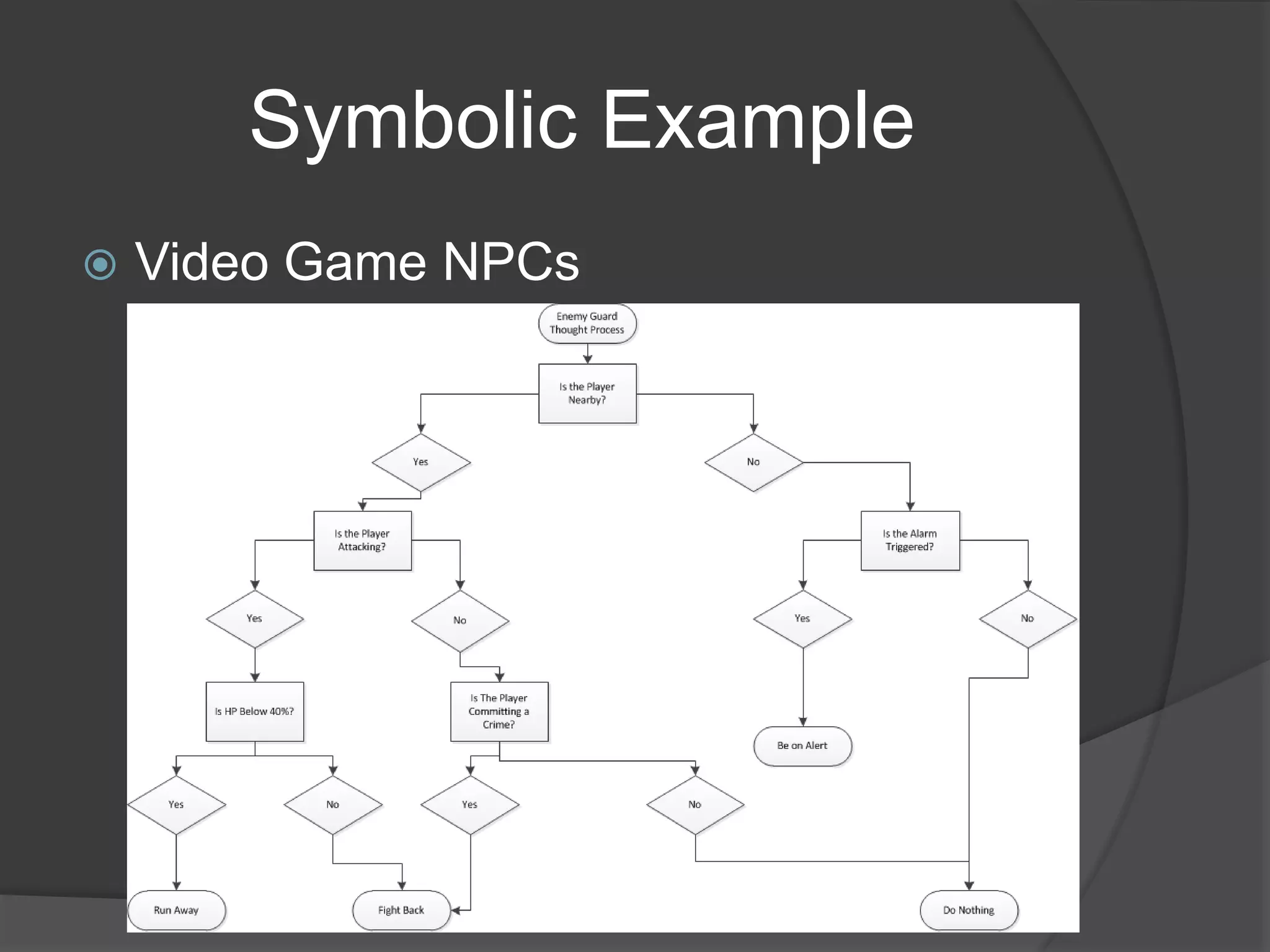
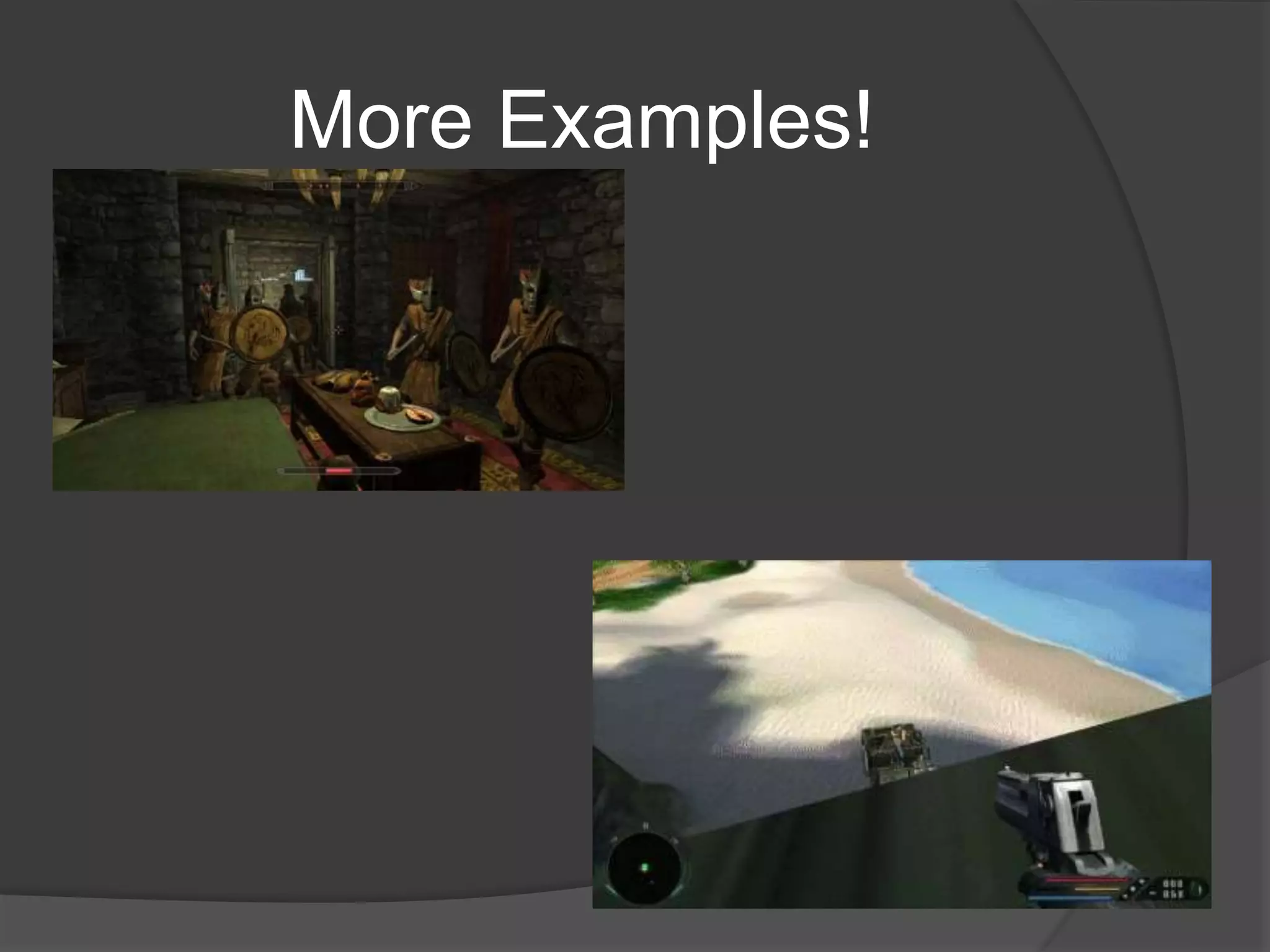
Symbolic Example
 Video Game NPCs
More Examples!
Sub-Symbolic Approach
 Pattern-based is applied to determine the
result of decisions
 Uses a bottom-up/inductive approach
 Information is processed in parallel via
neurons
 This mimics the structure of the human
brain
 Improves on the Symbolic Approach
 This approach was popular in the 80s-00s
Sub Symbolic Examples
 Neural Networks
Statistical Approach
 Database-based
 The A.I. is programmed with functions to
analyze data and creates its own
conclusion
 Uncontrolled environment, although
certain parameters are provided
 Improves on Sub-Symbolic approach
 This approach began in 2000s
Statistical Example
81.7% 76.7%74.8%
Applications of AI:
 Natural Language Understanding
 Expert Systems
 Face Recognition
 Planning and Robotics
 Game Playing
Speech Recognition
 Process of converting sound signal
captured by microphone or
mobile/telephone to a set of words.
 70-100 words / min with accuracy of
90%
Face Recognition
 Ability of a machine to extract
information from an image that is
necessary to solve a task
 Image Acquisition
 Image Processing
 Image Analysis
 Image understanding
Intelligent Robot
 Tend to mimic
human sensing
and decision
making abilities so
that they can
adopt themselves
to certain
conditions and
modify their
actions.
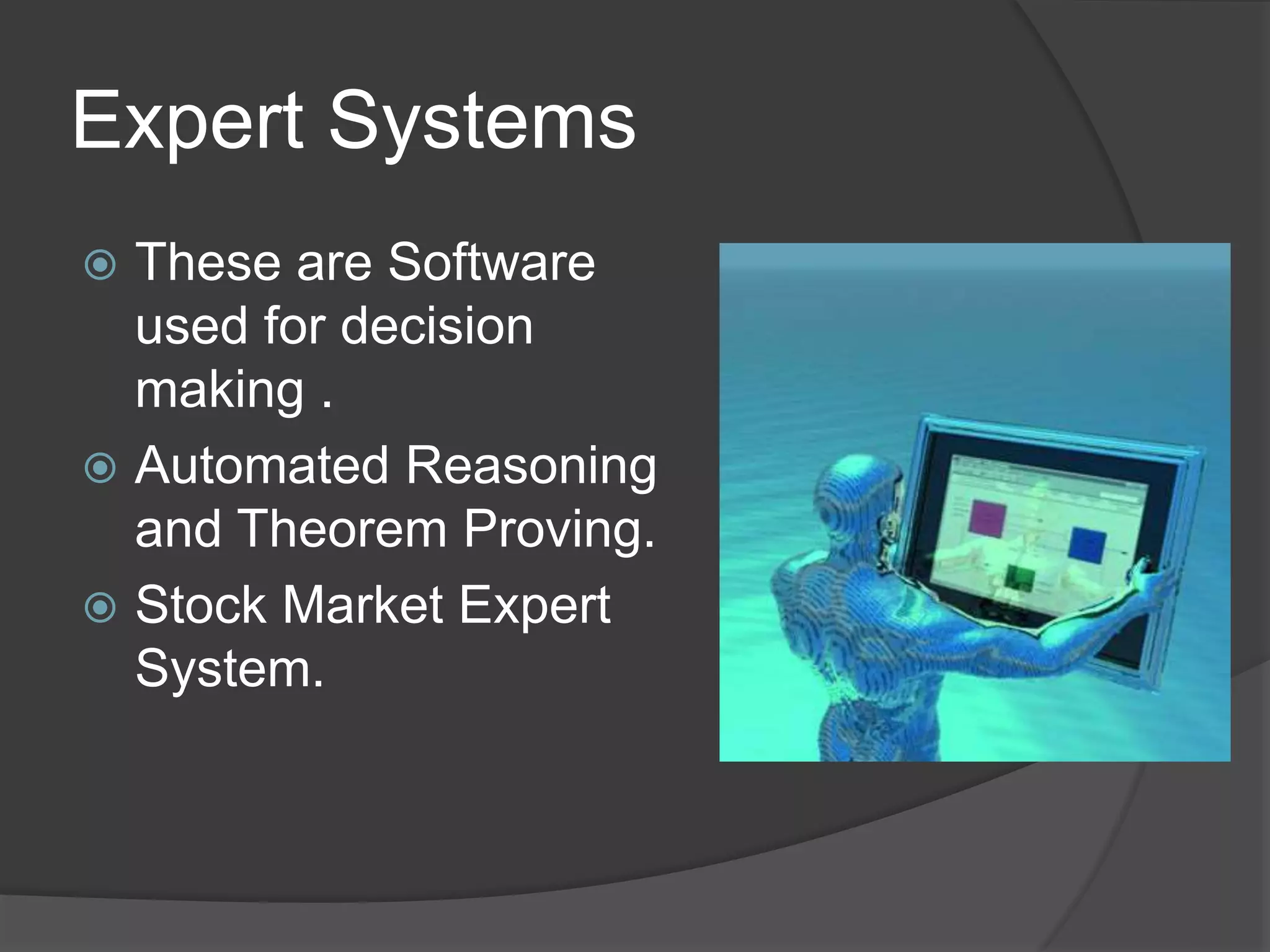
Expert Systems
 These are Software
used for decision
making .
 Automated Reasoning
and Theorem Proving.
 Stock Market Expert
System.
So Are We Close to Strong A.I?
 A.I. is present in everyday life
 Examples: Google, Siri, video games
 But are they “intelligent?”
 Functional by still far from human
intelligence.
Work Cited
 Jesus Suarez. “Intro to Neural Networks." Online video clip.
YouTube. YouTube, 14 Dec. 2009. Web. 14 Nov. 2013. http://youtu.be/DG5-UyRBQD4
 GoogleTechTalks. “Google Faculty Summit 2009: Statistical Machine Translation.” Online video clip. Youtube. Youtube, 5 Oct. 2009.
Web. 14 Nov. 2013. http://youtu.be/y_PzPDRPwlA
 PBS Idea Channel. “Is Developing Artificial Intelligence (AI) Ethical? | Idea Channel | PBS Digital Studios.” Online video clip. Youtube.
Youtube, 29 May, 2013. Web. 8 Nov. 2013. http://youtu.be/95KhuSbYJGE
 PBSoffbook. “The Rise of Artificial Intelligence | Off Book | PBS Digital Studios.” Online video clip. Youtube. Youtube, 11 Jul. 2013. Web.
8 Nov. 2013. http://youtu.be/53K1dMyslJg
 Computerphile. “How Intelligent is Artificial Intelligence? – Computerphile.” Online video clip. Youtube. Youtube, 27 Sept. 2013. Web. 8
Nov. 2013. http://youtu.be/hcoa7OMAmRk
 Vojteek. “How to steal in Skyrim.” Online video clip. Youtube. Youtube, 10 Nov. 2011. Web. 8 Nov. 2013. http://youtu.be/rt5aUdijAN8
 “Strong AI." Wikipedia: The Free Encyclopedia. Wikimedia Foundation, Inc. 21 Oct. 2013. Web. 8 Nov. 2013.
http://en.wikipedia.org/wiki/Strong_AI
 “Artificial Intelligence." Wikipedia: The Free Encyclopedia. Wikimedia Foundation, Inc. 11 Nov. 2013. Web. 8 Nov. 2013.
http://en.wikipedia.org/wiki/Artificial_intelligence
 “Artificial Intelligence (video games)." Wikipedia: The Free Encyclopedia. Wikimedia Foundation, Inc. 23 Oct. 2013. Web. 8 Nov. 2013.
http://en.wikipedia.org/wiki/Artificial_intelligence_%28video_games%29
 “Intelligence." Wikipedia: The Free Encyclopedia. Wikimedia Foundation, Inc. 5 Nov.. 2013. Web. 8 Nov. 2013.
http://en.wikipedia.org/wiki/Intelligence
 “Artificiality." Wikipedia: The Free Encyclopedia. Wikimedia Foundation, Inc. 9 Oct. 2013. Web. 8 Nov. 2013.
http://en.wikipedia.org/wiki/Artificiality
 P.B. Khanale and S.D. Chitnis. “Handwritten Devanagari Character Recognition using Artificial Neural Network." Journal of Artificial
Intelligence, 4,1 (2011): 55-62. Print.
 Vardi, Moshe Y. “Artificial Intelligence: Past and Future.“Communications of the ACM, 55,1 (2012): 5. Print.
 Barbrook, Richard. “New York Prophecies: The Imaginary Future of Artificial Intelligence.." Science as Culture, 16,2 (2007): 151-167.
Print.
 Clark, Liat. Google Brain Simulator Identifies Cats on Youtube. Wired.CO.UK, 26 Jun. 2012. Web. 8 Nov. 2013.
http://www.wired.co.uk/news/archive/2012-06/26/google-brain-recognises-cats
 Jeff [Jeff Wofford]. “How Siri Works” Holy Ghost Stories. Holy Ghost Stories, 5 Oct. 2011. Web. 14 Nov. 2013.
http://www.jeffwofford.com/?p=817
 GameTrailers. “The Science of Games – Artificial Intelligence.” Online video clip. Gametrailers. Gametrailers, 21 July. 2013. Web. 8 Nov.
2013. http://www.gametrailers.com/videos/fr3sos/science-of-games-artificial-intelligence

Artificial inteligence

  • 3.
    Agenda  Introduction  Motivation Generation  Application  Conclusion
  • 4.
    What is artificialintelligence  Artificial = a human creation that did not occur naturally  Intelligence = the ability to learn and apply knowledge  Even before computers and internet being so popular  They can help them in different field
  • 5.
    Motivation  For morecomplex problems, things get more difficult... Unlike humans, computers have trouble understanding specific situations, and adapting to new situations.  Artificial Intelligence aims to improve machine behavior in tackling such complex tasks.  AI research is allowing us to understand our intelligent behavior.
  • 6.
  • 7.
    How Does OneMake A.I?  Symbolic  Sub-Symbolic  Statistical
  • 8.
    Symbolic Approach  Logic-based All knowledge is “taught” by humans  Everything is in a controlled environment  To mimic human-intellect, it would take millions of trigger conditions and rules  This approach was popular in the 60s and 70s
  • 9.
  • 10.
  • 11.
    Sub-Symbolic Approach  Pattern-basedis applied to determine the result of decisions  Uses a bottom-up/inductive approach  Information is processed in parallel via neurons  This mimics the structure of the human brain  Improves on the Symbolic Approach  This approach was popular in the 80s-00s
  • 12.
  • 13.
    Statistical Approach  Database-based The A.I. is programmed with functions to analyze data and creates its own conclusion  Uncontrolled environment, although certain parameters are provided  Improves on Sub-Symbolic approach  This approach began in 2000s
  • 14.
  • 15.
    Applications of AI: Natural Language Understanding  Expert Systems  Face Recognition  Planning and Robotics  Game Playing
  • 16.
    Speech Recognition  Processof converting sound signal captured by microphone or mobile/telephone to a set of words.  70-100 words / min with accuracy of 90%
  • 17.
    Face Recognition  Abilityof a machine to extract information from an image that is necessary to solve a task  Image Acquisition  Image Processing  Image Analysis  Image understanding
  • 18.
    Intelligent Robot  Tendto mimic human sensing and decision making abilities so that they can adopt themselves to certain conditions and modify their actions.
  • 19.
    Expert Systems  Theseare Software used for decision making .  Automated Reasoning and Theorem Proving.  Stock Market Expert System.
  • 20.
    So Are WeClose to Strong A.I?  A.I. is present in everyday life  Examples: Google, Siri, video games  But are they “intelligent?”  Functional by still far from human intelligence.
  • 21.
    Work Cited  JesusSuarez. “Intro to Neural Networks." Online video clip. YouTube. YouTube, 14 Dec. 2009. Web. 14 Nov. 2013. http://youtu.be/DG5-UyRBQD4  GoogleTechTalks. “Google Faculty Summit 2009: Statistical Machine Translation.” Online video clip. Youtube. Youtube, 5 Oct. 2009. Web. 14 Nov. 2013. http://youtu.be/y_PzPDRPwlA  PBS Idea Channel. “Is Developing Artificial Intelligence (AI) Ethical? | Idea Channel | PBS Digital Studios.” Online video clip. Youtube. Youtube, 29 May, 2013. Web. 8 Nov. 2013. http://youtu.be/95KhuSbYJGE  PBSoffbook. “The Rise of Artificial Intelligence | Off Book | PBS Digital Studios.” Online video clip. Youtube. Youtube, 11 Jul. 2013. Web. 8 Nov. 2013. http://youtu.be/53K1dMyslJg  Computerphile. “How Intelligent is Artificial Intelligence? – Computerphile.” Online video clip. Youtube. Youtube, 27 Sept. 2013. Web. 8 Nov. 2013. http://youtu.be/hcoa7OMAmRk  Vojteek. “How to steal in Skyrim.” Online video clip. Youtube. Youtube, 10 Nov. 2011. Web. 8 Nov. 2013. http://youtu.be/rt5aUdijAN8  “Strong AI." Wikipedia: The Free Encyclopedia. Wikimedia Foundation, Inc. 21 Oct. 2013. Web. 8 Nov. 2013. http://en.wikipedia.org/wiki/Strong_AI  “Artificial Intelligence." Wikipedia: The Free Encyclopedia. Wikimedia Foundation, Inc. 11 Nov. 2013. Web. 8 Nov. 2013. http://en.wikipedia.org/wiki/Artificial_intelligence  “Artificial Intelligence (video games)." Wikipedia: The Free Encyclopedia. Wikimedia Foundation, Inc. 23 Oct. 2013. Web. 8 Nov. 2013. http://en.wikipedia.org/wiki/Artificial_intelligence_%28video_games%29  “Intelligence." Wikipedia: The Free Encyclopedia. Wikimedia Foundation, Inc. 5 Nov.. 2013. Web. 8 Nov. 2013. http://en.wikipedia.org/wiki/Intelligence  “Artificiality." Wikipedia: The Free Encyclopedia. Wikimedia Foundation, Inc. 9 Oct. 2013. Web. 8 Nov. 2013. http://en.wikipedia.org/wiki/Artificiality  P.B. Khanale and S.D. Chitnis. “Handwritten Devanagari Character Recognition using Artificial Neural Network." Journal of Artificial Intelligence, 4,1 (2011): 55-62. Print.  Vardi, Moshe Y. “Artificial Intelligence: Past and Future.“Communications of the ACM, 55,1 (2012): 5. Print.  Barbrook, Richard. “New York Prophecies: The Imaginary Future of Artificial Intelligence.." Science as Culture, 16,2 (2007): 151-167. Print.  Clark, Liat. Google Brain Simulator Identifies Cats on Youtube. Wired.CO.UK, 26 Jun. 2012. Web. 8 Nov. 2013. http://www.wired.co.uk/news/archive/2012-06/26/google-brain-recognises-cats  Jeff [Jeff Wofford]. “How Siri Works” Holy Ghost Stories. Holy Ghost Stories, 5 Oct. 2011. Web. 14 Nov. 2013. http://www.jeffwofford.com/?p=817  GameTrailers. “The Science of Games – Artificial Intelligence.” Online video clip. Gametrailers. Gametrailers, 21 July. 2013. Web. 8 Nov. 2013. http://www.gametrailers.com/videos/fr3sos/science-of-games-artificial-intelligence