Knowledge Representation
• KnowledgeRepresentation helps to represent
information from the real world for a computer
to understand
• Knowledge representation in AI is not just
about storing data in a database
• Knowledge representation allows a machine to
learn from that knowledge and behave
intelligently like a human being
2.
Need for KnowledgeRepresentation
• One of the primary purposes of Knowledge Representation
is modeling intelligent behavior like humans
• Humans tackle difficult real-world problems by using their
knowledge(from experience, training)
• The problem-solving agents have only limited knowledge
– (eg. actions available, the result of a specific action from a
specific state)
• They don’t know general facts
– (eg. The length of a road cannot be a negative number, two tiles
cannot occupy the same space etc.)
• Intelligent Systems cannot achieve anything useful unless
they contain a large amount of real-world/domain-specific
knowledge
Components of an
ArtificialIntelligent System
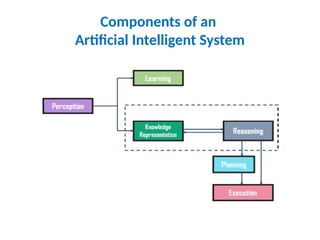
1. Perception component retrieves information from
the environment
2. Knowledge Representation component represents
that information
3. Reasoning component utilizes this knowledge to
solve problems
4. Learning Component learns from the captured data
5. Planning components finds a sequence of actions to
achieve the goal state (given an initial state,
preconditions and effects)
6. The Execution component executes the plan
5.
Kinds of Knowledge
•The different kinds of knowledge that need to
be represented in AI include:
1. Objects(Structural Knowledge)
2. Actions(Procedural knowledge)
3. Facts (Declarative Knowledge)
4. Meta-Knowledge
5. Heuristic Knowledge
6. Events (temporal knowledge)
6.
Knowledge Representation
• Formalism:The notation and structure in which
information is expressed (eg. Symbols,
language)
• Knowledge Base: A model represented using
formalisms
– A knowledge base is a collection of facts and beliefs
– Knowledge bases help to model a domain of discourse and
to draw inferences about the objects in the domain
(reasoning)
7.
Desirable Properties ofa
Knowledge Representation System
• Representational Adequacy: ability to represent the
required knowledge
• Inferential Efficiency: ability to direct the inferential
mechanisms into the most productive directions (to
respond with limited resources)
• Inferential Adequacy: ability to manipulate the
knowledge represented to produce new knowledge
corresponding to that inferred from the original
• Acquisitional Efficiency: ability to acquire new
knowledge using automatic methods wherever possible
rather than reliance on human intervention
Knowledge Engineering
• Theprocess of assessing problems, acquiring
knowledge and building knowledge based
systems
• Activities
1. Problem assessment
2. Data and knowledge acquisition
3. Development of a prototype system
4. Evaluation and revision of the system
5. Development of a complete system
6. Integration and maintenance of the system
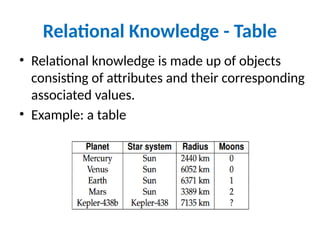
Relational Knowledge -Table
• Relational knowledge is made up of objects
consisting of attributes and their corresponding
associated values.
• Example: a table
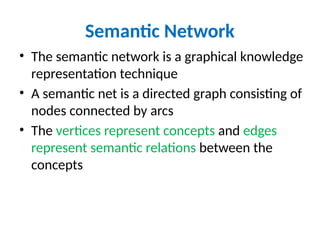
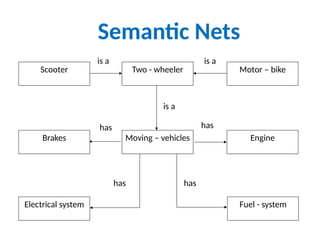
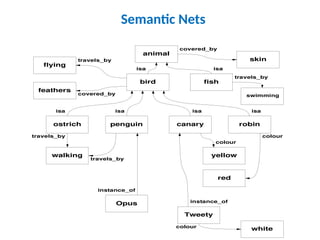
Semantic Network
• Thesemantic network is a graphical knowledge
representation technique
• A semantic net is a directed graph consisting of
nodes connected by arcs
• The vertices represent concepts and edges
represent semantic relations between the
concepts
15.
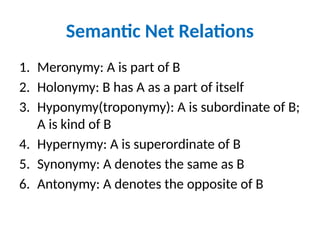
Semantic Net Relations
1.Meronymy: A is part of B
2. Holonymy: B has A as a part of itself
3. Hyponymy(troponymy): A is subordinate of B;
A is kind of B
4. Hypernymy: A is superordinate of B
5. Synonymy: A denotes the same as B
6. Antonymy: A denotes the opposite of B
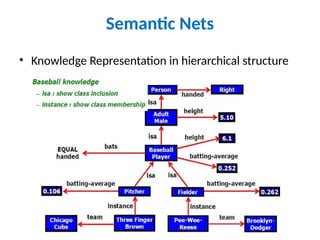
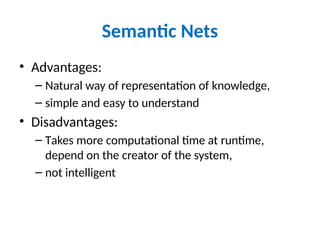
Semantic Nets
• Advantages:
–Natural way of representation of knowledge,
– simple and easy to understand
• Disadvantages:
– Takes more computational time at runtime,
depend on the creator of the system,
– not intelligent
20.
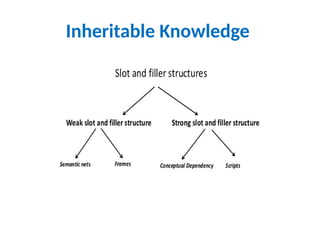
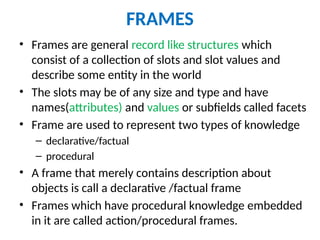
FRAMES
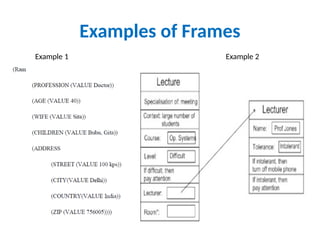
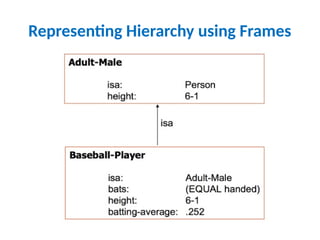
• Frames aregeneral record like structures which
consist of a collection of slots and slot values and
describe some entity in the world
• The slots may be of any size and type and have
names(attributes) and values or subfields called facets
• Frame are used to represent two types of knowledge
– declarative/factual
– procedural
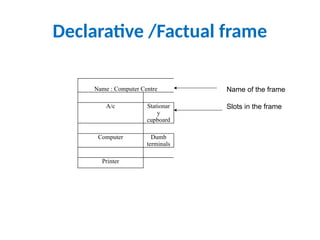
• A frame that merely contains description about
objects is call a declarative /factual frame
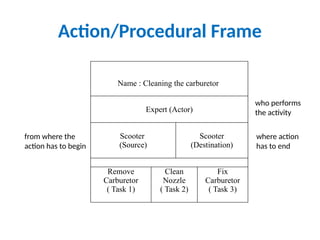
• Frames which have procedural knowledge embedded
in it are called action/procedural frames.
21.
Slots in aFrame
• Slots in a frame can contain
– information for choosing a frame in a situation
– relationship between this and other frames
– procedures to carry out after various slots filled
– default information to use when input is missing
– blank slots
– other frames, which gives a hierarchy
22.
Declarative /Factual frame
Name: Computer Centre
A/c Stationar
y
cupboard
Computer Dumb
terminals
Printer
Name of the frame
Slots in the frame
23.
Action/Procedural Frame
Name :Cleaning the carburetor
Expert (Actor)
Scooter
(Source)
Scooter
(Destination)
Remove
Carburetor
( Task 1)
Clean
Nozzle
( Task 2)
Fix
Carburetor
( Task 3)
who performs
the activity
from where the
action has to begin
where action
has to end
Frames
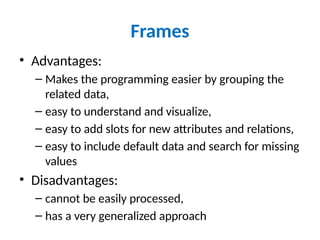
• Advantages:
– Makesthe programming easier by grouping the
related data,
– easy to understand and visualize,
– easy to add slots for new attributes and relations,
– easy to include default data and search for missing
values
• Disadvantages:
– cannot be easily processed,
– has a very generalized approach
27.
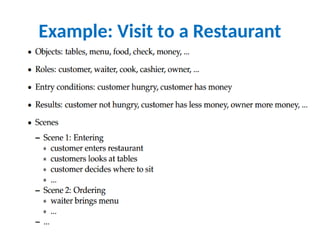
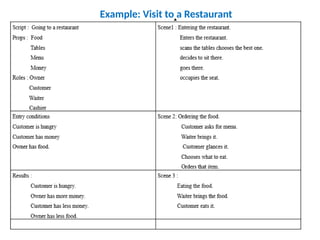
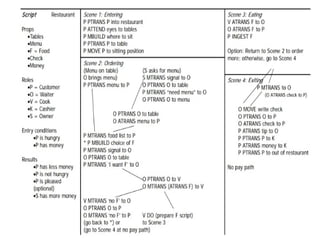
Scripts
• A scriptis a structured representation describing
a stereotyped sequence of events in a particular
context
• Scripts are used to organize events in knowledge
bases
28.
Components of Scripts
•Entry conditions that must be true for the script to
be called
• Results or facts that are true once the script has
terminated
• Props or the ”things” that make up the content of
the script
• Roles are the actions that the individual participants
perform
• Scenes which present temporal aspects of the script
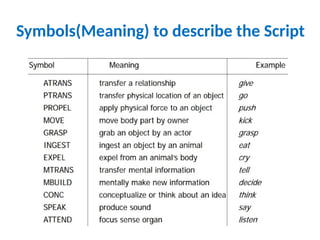
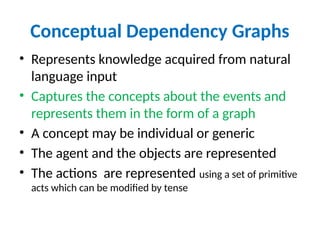
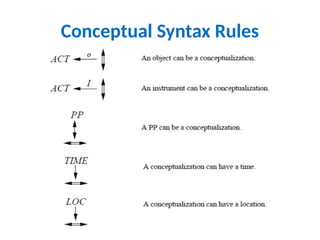
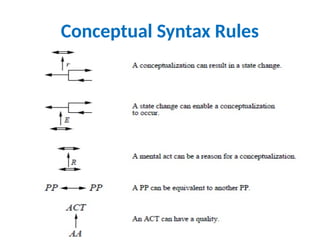
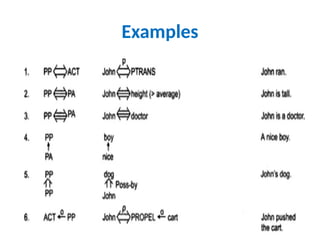
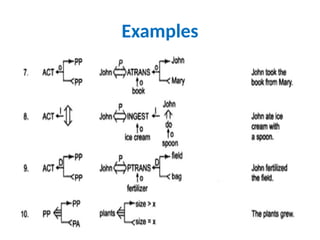
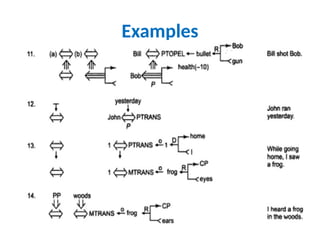
Conceptual Dependency Graphs
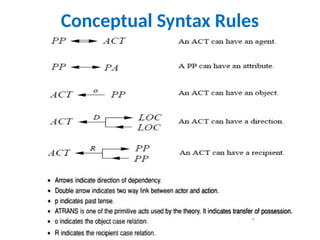
•Represents knowledge acquired from natural
language input
• Captures the concepts about the events and
represents them in the form of a graph
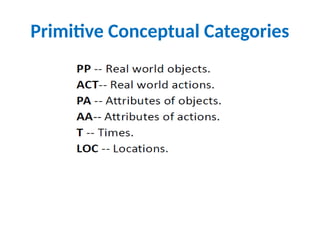
• A concept may be individual or generic
• The agent and the objects are represented
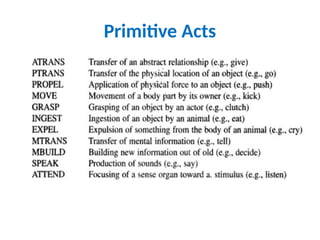
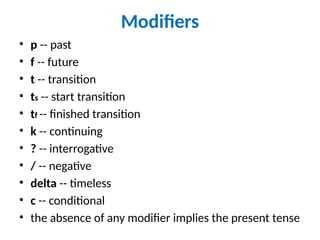
• The actions are represented using a set of primitive
acts which can be modified by tense