Presented By : Siddhesh Aniruddha
Jadhav
Class : BSc II ( Sem III )
Roll No.: B027
Contents
 INTRODUCTION TO A.I.
 EVOLUTION OF A.I.
 IMPORTANCE OF A.I.
 APPLICATIONS OF A.I.
 CONCLUSIONS ON A.I.
INTRODUCTION
Artificial Intelligence is a branch of Science which deals
with helping machines in a human-like fachion.
In short it can be described as:
Simple things turn out to be the hardest to
automate:
1.Recognizing a face.
2.Navigating a busy street.
3.Understanding what someone says.
HISTORY
In 1956 John McCarthy regarded as the
father of AI, Organized a conference to
draw the talent and expertise of others
interested in machine intelligence.
Why Artificial Intelligence?
Computers are well studied to perform mechanical
computations.
Unlike humans ,computers have trouble understanding
specific situations ,and adapting to new situations.
 Artificial Intelligence aims to improve machine behavior n
tackling complex tasks.
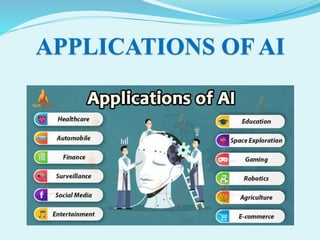
APPLICATIONS OF AI
ROBOTICS
 Robotics is the study of how to design,build,use,and work with
robots.
 They are used in laboratories , and in situations , which would be
dangerous for humans such as cleaning toxic waste or defusing
bombs.
 Robots are widely used in such industries as automobile
manufacture to perform simple repetitive tasks.
 Many aspects of robotics involve artificial intelligence; robots
may be equipped with the equivalent of human senses such as
vision, touch, and the ability to sense temperature.
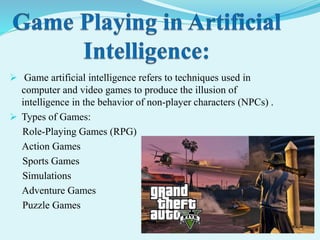
 Game artificial intelligence refers to techniques used in
computer and video games to produce the illusion of
intelligence in the behavior of non-player characters (NPCs) .
 Types of Games:
Role-Playing Games (RPG)
Action Games
Sports Games
Simulations
Adventure Games
Puzzle Games
 The goal of the Natural Language Processing (NLP) group is
to design and build software that will analyze, understand,
and generate languages that humans use naturally.
 NLP drives computer programs that translate text from one
language to another, respond to spoken commands, and
summarize large volumes of text rapidly—even in real
time. There’s a good chance you’ve interacted with NLP in
the form of voice-operated GPS systems, digital assistants,
speech-to-text dictation software, customer service chat-
bots, and other consumer conveniences.
The main focus in AI today is getting a computer
to recognize, make senses and recreate in what it
sees and hears.
 Pattern-Recognition-Vision:
Its goal is to get a computer to recognize pictures
so that it can recognize objects in its
surroundings that would be helpful in robotics.
 Pattern-Recognition-Sound:
It wants to achieve a similar goal but is a primary
concern with companies that want to produce a
new means in which a person interacts with a
computer by talking.
 A computer intercepts the voice, translates what was said,
and synthetically generate the appropriate words to the
person on the other line.
 The translator needs an advanced voice recognition, natural
language processing and inferencing to extract what was
spoken by the people on phone.
 The day is not far when you will just sit back in your cozy
little beds and just command your personal Robot's to
entirely do your work . It will be a perfect companion for
you. Just enjoy the Technology.
 Beyond negotiation,CMU is betting several other AI areas
are going to be hugely important in the near future.
o Self Driving cars.
o Improved Medical Care & Treatment.
o Open up doors to future exploration.
o Etc.
• Turing Test :
• Alan Turing, a British mathematician developed a test in
1950 to determine if a program was intelligent:
• It has the following features:
– A human tester was connected to 2 terminals and asked a series
of questions.
– One of the terminals had another human making the responses
and the other used a computer program to make the responses
– If the human tester could not distinguish between the human
responder and the program response then the software was
said to be intelligent.
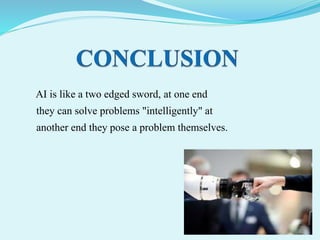
AI is like a two edged sword, at one end
they can solve problems "intelligently" at
another end they pose a problem themselves.
Seminarppt_095008.pptx

Seminarppt_095008.pptx

  • 2.
    Presented By :Siddhesh Aniruddha Jadhav Class : BSc II ( Sem III ) Roll No.: B027
  • 3.
    Contents  INTRODUCTION TOA.I.  EVOLUTION OF A.I.  IMPORTANCE OF A.I.  APPLICATIONS OF A.I.  CONCLUSIONS ON A.I.
  • 4.
    INTRODUCTION Artificial Intelligence isa branch of Science which deals with helping machines in a human-like fachion. In short it can be described as: Simple things turn out to be the hardest to automate: 1.Recognizing a face. 2.Navigating a busy street. 3.Understanding what someone says.
  • 5.
  • 6.
    In 1956 JohnMcCarthy regarded as the father of AI, Organized a conference to draw the talent and expertise of others interested in machine intelligence.
  • 7.
    Why Artificial Intelligence? Computersare well studied to perform mechanical computations. Unlike humans ,computers have trouble understanding specific situations ,and adapting to new situations.  Artificial Intelligence aims to improve machine behavior n tackling complex tasks.
  • 8.
  • 9.
    ROBOTICS  Robotics isthe study of how to design,build,use,and work with robots.  They are used in laboratories , and in situations , which would be dangerous for humans such as cleaning toxic waste or defusing bombs.  Robots are widely used in such industries as automobile manufacture to perform simple repetitive tasks.  Many aspects of robotics involve artificial intelligence; robots may be equipped with the equivalent of human senses such as vision, touch, and the ability to sense temperature.
  • 10.
     Game artificialintelligence refers to techniques used in computer and video games to produce the illusion of intelligence in the behavior of non-player characters (NPCs) .  Types of Games: Role-Playing Games (RPG) Action Games Sports Games Simulations Adventure Games Puzzle Games
  • 11.
     The goalof the Natural Language Processing (NLP) group is to design and build software that will analyze, understand, and generate languages that humans use naturally.  NLP drives computer programs that translate text from one language to another, respond to spoken commands, and summarize large volumes of text rapidly—even in real time. There’s a good chance you’ve interacted with NLP in the form of voice-operated GPS systems, digital assistants, speech-to-text dictation software, customer service chat- bots, and other consumer conveniences.
  • 12.
    The main focusin AI today is getting a computer to recognize, make senses and recreate in what it sees and hears.  Pattern-Recognition-Vision: Its goal is to get a computer to recognize pictures so that it can recognize objects in its surroundings that would be helpful in robotics.  Pattern-Recognition-Sound: It wants to achieve a similar goal but is a primary concern with companies that want to produce a new means in which a person interacts with a computer by talking.
  • 13.
     A computerintercepts the voice, translates what was said, and synthetically generate the appropriate words to the person on the other line.  The translator needs an advanced voice recognition, natural language processing and inferencing to extract what was spoken by the people on phone.
  • 15.
     The dayis not far when you will just sit back in your cozy little beds and just command your personal Robot's to entirely do your work . It will be a perfect companion for you. Just enjoy the Technology.  Beyond negotiation,CMU is betting several other AI areas are going to be hugely important in the near future. o Self Driving cars. o Improved Medical Care & Treatment. o Open up doors to future exploration. o Etc.
  • 16.
    • Turing Test: • Alan Turing, a British mathematician developed a test in 1950 to determine if a program was intelligent: • It has the following features: – A human tester was connected to 2 terminals and asked a series of questions. – One of the terminals had another human making the responses and the other used a computer program to make the responses – If the human tester could not distinguish between the human responder and the program response then the software was said to be intelligent.
  • 18.
    AI is likea two edged sword, at one end they can solve problems "intelligently" at another end they pose a problem themselves.