

ART
ICUL ORS
AT
INDIAN
ACADEMY

DENTAL

Leader in continuing dental education
www.indiandentalacademy.com

www.indiandentalacademy.com
ART
ICUL ORS
AT
Definition: Articulator may be defined as a mechanical
device that represents human Temporomandibular
joint and jaw members to which maxillary ands
mandibular cast are attached to simulate jaw
movements.
GPT
www.indiandentalacademy.com
FUNCTIONS
The primary function of the articulator is to act
as a representative in patients
It is used to simulate the patients
Temporomandibular
joint,
muscles
of
mastication, mandibular ligaments, maxilla and
mandible and the complex neuromuscular
mechanism that programmes the mandibular
movements.
www.indiandentalacademy.com
The articulator is made to simulate the equivalent
movements of the TMJ but does not duplicate or
produce identical movements as in the human
mouth
It forms an important instrument to the dentist as it
can be programmed with certain patients records
allowing the operator and laboratory technician to
fabricate a restoration that will be physiologically
and psychologically acceptable.
www.indiandentalacademy.com
ADVANTAGES
Properly mounted cast allow the operated to better
visualize the patient occlusion from the lingual side.
Patient’ s co-operation is not required once the
Interocclusal records are obtained from the patients
Refinement of the complete dentures in the patient’ s
mouth is extremely difficult because of shifting of
denture bases and resiliency of the supporting
tissues. This does not take place in the articulator.
www.indiandentalacademy.com
Chair side appointment is reduced and more
work can be designated to the auxiliary
personnel.
Patient’ s tongue saliva, check etc. are not a
factors of hinderence under using the
articulator

www.indiandentalacademy.com
LIMITATIONS
An articulator is a mechanical device made by
metal hence is subjected to error in tooling and
there by resulting from fatigue and bear
Articulator will not duplicate but simulates the
condylar movements of TMJ

www.indiandentalacademy.com
REQUIREMENTS
It should hold casts in correct horizontal and vertical
relationships i.e., centric relations.
It should provide a positive anterior vertical stop.
It should accept a face bow transfer record. It should open
and close in a hinge movement.
It should allow protrusive and lateral jaw motions
Moving parts should move freely and accurately
Moving parts should be often rigid construction
Should be easy to fix and attach the maxillary and
mandibular cast to the articulator and also to attach from the
articulators
www.indiandentalacademy.com
Additional Requirements
Adjustable horizontal, lateral condylar guide element &
allow protrusive movements
A mechanism to accept the 3rd point of reference from
a face bow
A terminal hinge locking positional device
Removable mounting plates that can be positioned
accurately
An adjustable incisal guide table
Adjustable intercondylar width of the condylar element
www.indiandentalacademy.com
Classification of Articulators

An
articulator
classification
was
developed based on the instruments
function, instrument capability, intent,
registration procedure and registration
acceptance were considered.
www.indiandentalacademy.com
Classification based on Theories of
Occlusion
BONWILLS THEORY OF OCCLUSION
CONICAL THEORY OF OCCLUSION
 ( R.E.Hall )
SPHERICAL THEORY OF OCCLUSION
(G.S.Monson 1918 )

www.indiandentalacademy.com
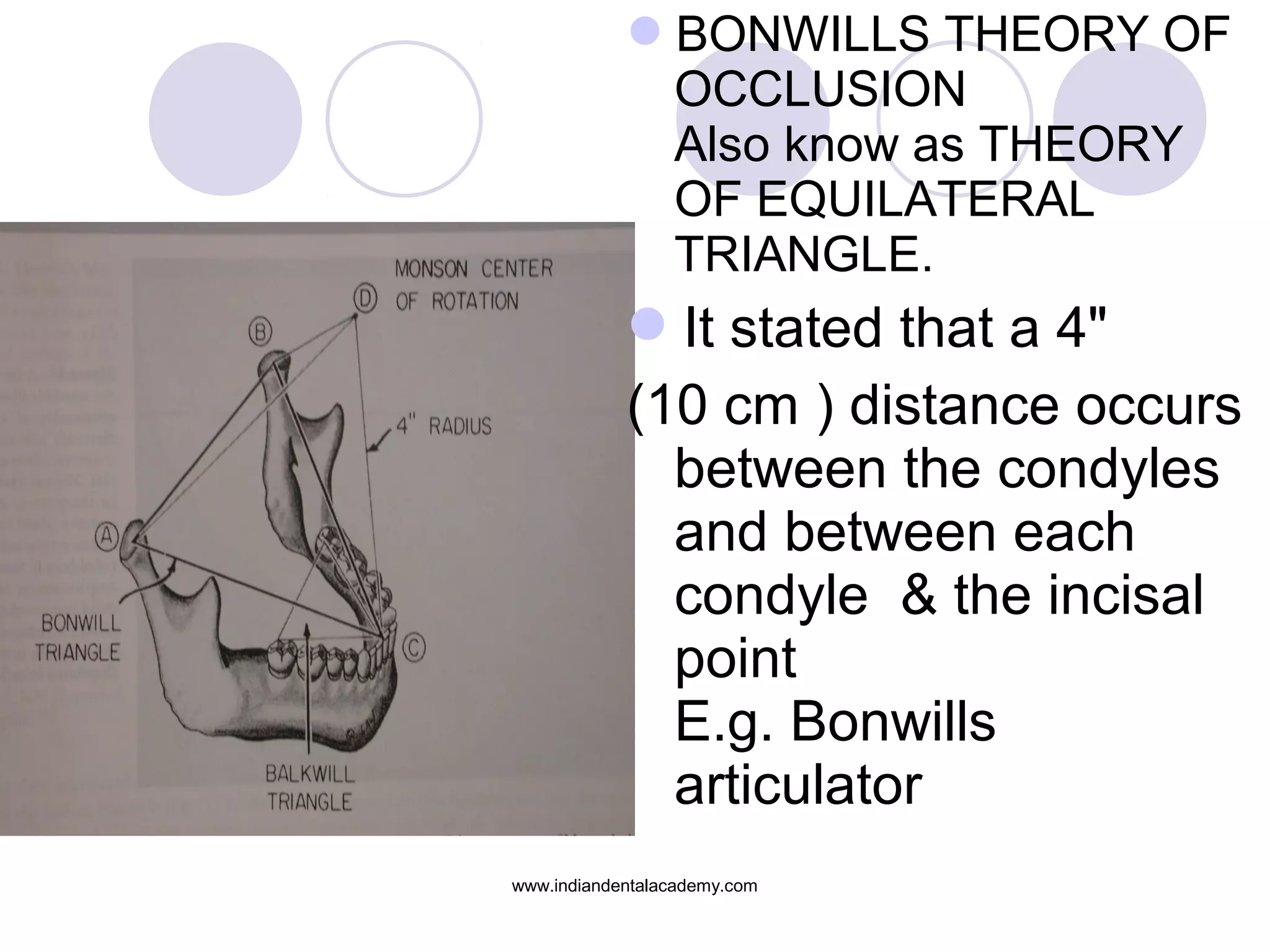
BONWILLS THEORY OF
OCCLUSION
Also know as THEORY
OF EQUILATERAL
TRIANGLE.

It stated that a 4"
(10 cm ) distance occurs
between the condyles
and between each
condyle & the incisal
point
E.g. Bonwills
articulator
www.indiandentalacademy.com
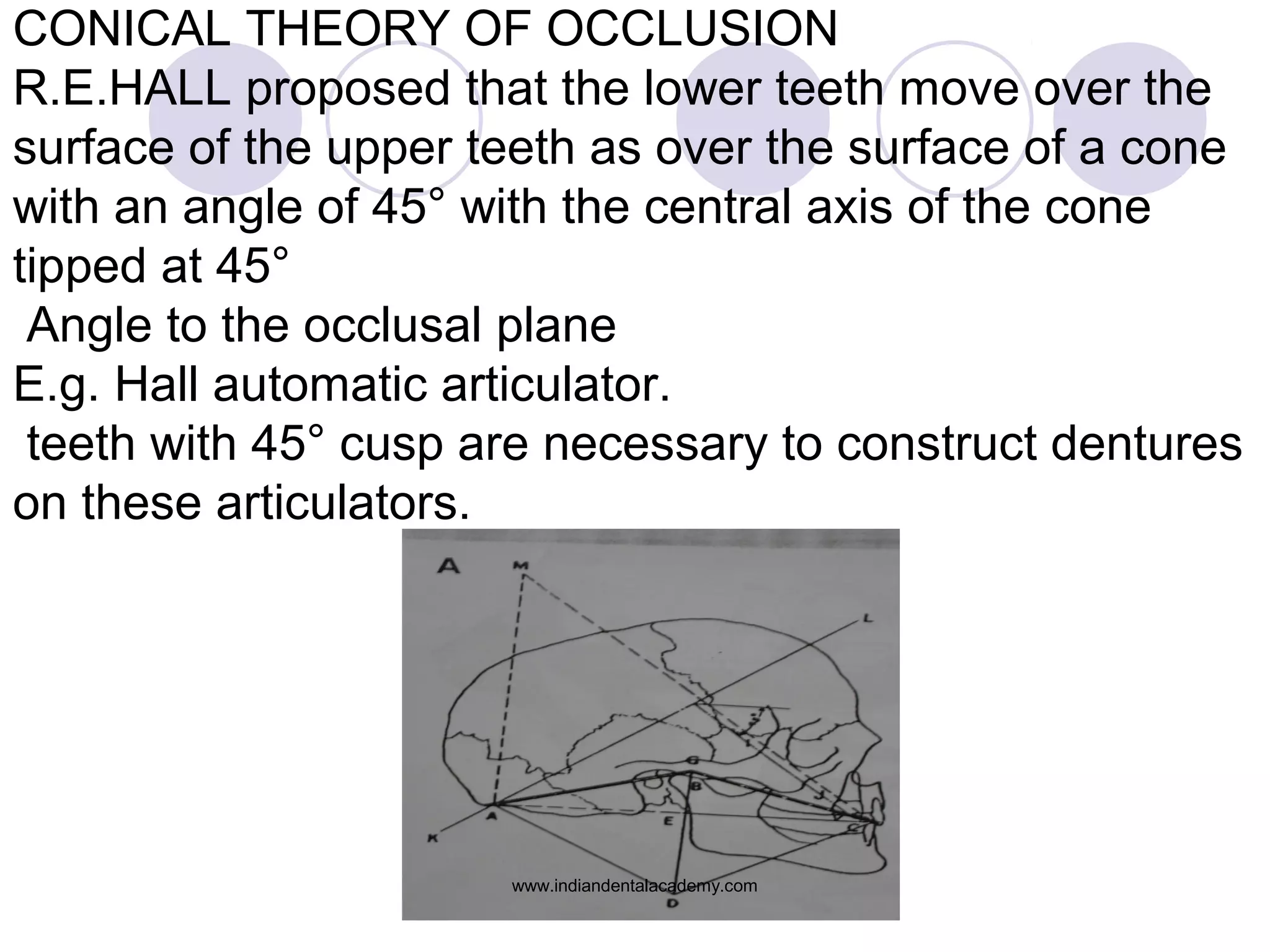
CONICAL THEORY OF OCCLUSION
R.E.HALL proposed that the lower teeth move over the
surface of the upper teeth as over the surface of a cone
with an angle of 45° with the central axis of the cone
tipped at 45°
Angle to the occlusal plane
E.g. Hall automatic articulator.
teeth with 45° cusp are necessary to construct dentures
on these articulators.

www.indiandentalacademy.com
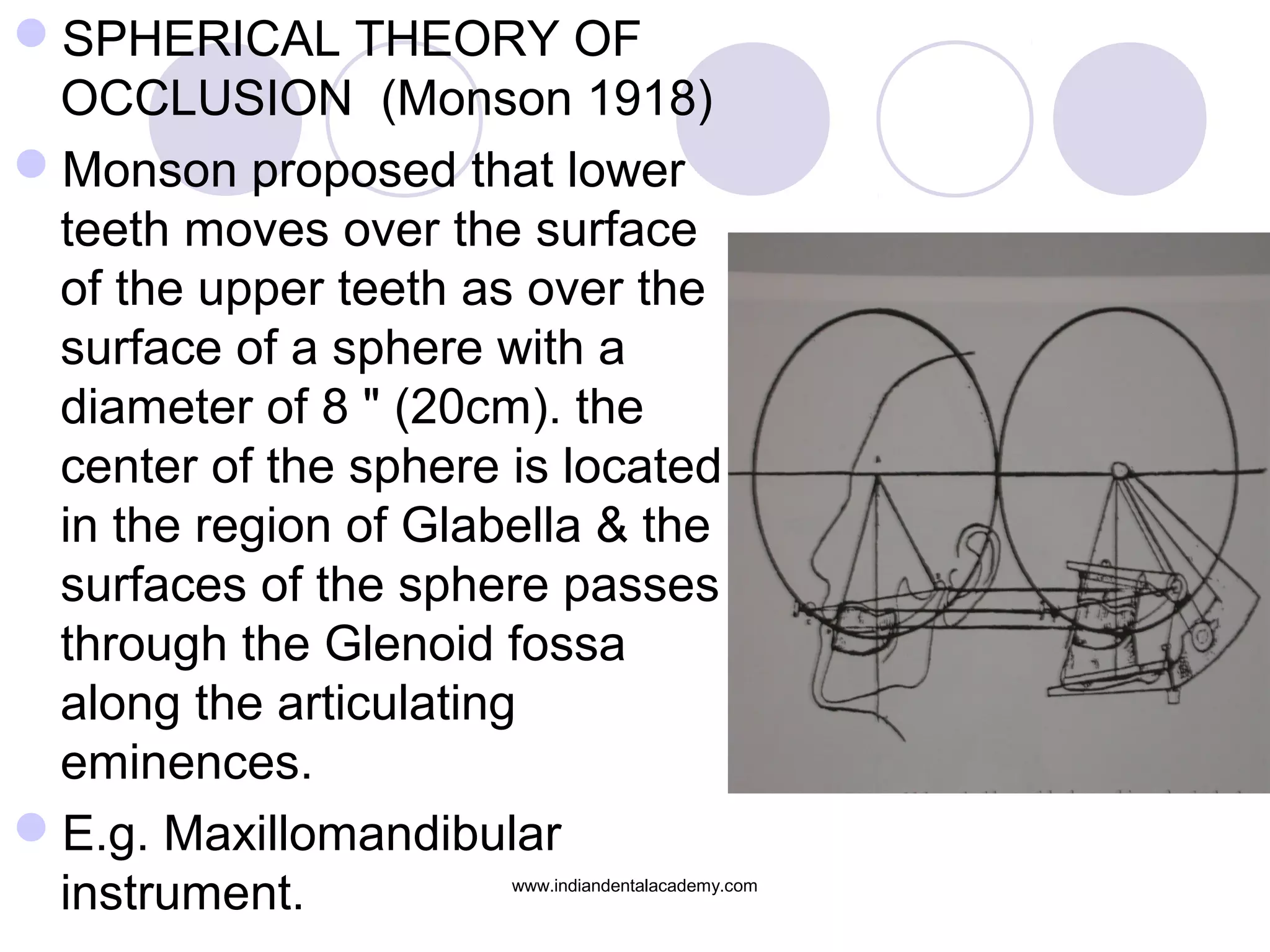
SPHERICAL THEORY OF
OCCLUSION (Monson 1918)
Monson proposed that lower
teeth moves over the surface
of the upper teeth as over the
surface of a sphere with a
diameter of 8 " (20cm). the
center of the sphere is located
in the region of Glabella & the
surfaces of the sphere passes
through the Glenoid fossa
along the articulating
eminences.
E.g. Maxillomandibular
instrument.

www.indiandentalacademy.com
Drawbacks
Articulators based on theories of occlusion
was that they made no provision for
variation from the theoretical relationships
that occurs in different people.

www.indiandentalacademy.com
CLASSIFICATION BASED ON THE TYPES
OF RECORDS USED FOR THEIR
ADJUSTMENT
 INTEROCCLUSAL RECORD ADJUSTMENT
 GRAPHIC RECORD ADJUSTMENT
 HINGE AXIS LOCATION FOR ADJUSTING
ARTICULATORS

www.indiandentalacademy.com
INTEROCCLUSAL RECORD
ADJUSTMENT
These records may be made in wax, dental
plaster ZnOE paste or cold-cure acrylic resin.
Each of these records are of only one positional
relationship of the lower jaw to the upper jaw
Either centric or to protrusive
OR
Centric or to lateral record
E.g. Hanau articulators
www.indiandentalacademy.com
GRAPHIC RECORD ADJUSTMENT
The graphic records consists of records of the
extreme border positions of mandibular
movement which are curved and the
articulators must be capable of producing at
least the equivalent of curved movements
simple procedure if natural teeth exists in both
jaws & it becomes difficult and unreliable in
edentulous patients
www.indiandentalacademy.com
HINGE AXIS LOCATION FOR ADJUSTING
ARTICULATOR

Correct location of the opening axis of
mandibular hinge axis is essential for the
correct adjustment of instrument

www.indiandentalacademy.com
CLASSIFICATION OF ARTICULATORS
USING NEW SYSTEMS
FULLY ADJUSTABLE ARTICULATORS
SEMI ADJUSTABLE ARTICULATORS
NON ADJUSTABLE ARTICULATORS

www.indiandentalacademy.com
FULLY ADJUSTABLE ARTICULATORS
Articulators which can accept all the following 5
records
1).Face bow transfer
2) Centric jaw relation record
3) Protrusive record
4) Lateral records
5) Intercondylar distance record
E.g.. Hanau kinescope(1923)
Mc Collum Gnathoscope(1935)
Granger Gnatholator (1950)
Stuarticulator(1955)
Ney-Depietro(1962)
Hanau 130-21 (1953)
Simulator (1968)
Dentar D4-A (1968)
www.indiandentalacademy.com
SEMIADJUSTABLE ARTICULATORS
Articulators which can accept the following
3 record
1).Face bow transfer
2) Centric jaw relation record
3) Protrusive record

www.indiandentalacademy.com
E.g.
Snow Acme (1910)
Gysi Adaptable (1910)
(does not accept lateral record )
Wadsworth (1924)
Hanau H (1922)
Gysi Trubyte (1926)
(does not accept intercondylar records )
House(1927)
(does not accept intercondylar records & satisfies
Bonwills principle)
Dentatus (1944)
Bergstorm Arcon(1950)
Hanau 130-28 (1963)
Whip-mix (1968)
www.indiandentalacademy.com
NONADJUSTABLE ARTICULATORS
Articulators which can accept 1 OR 2 of the following 3
records
1).Face bow transfer
2) Centric jaw relation record
3) Protrusive record
Gariot (1805)
Evans (1840)
Barn door hinge (1858)
Bonwill (1858)
Walker (1896)
Has adjustable condylar guidance but does not accept
face bow record
www.indiandentalacademy.com
Gritman (1899)
Snow (1906)
Gysisimplex (1912 ) Monson (1918)
Stansbery (1929)
 Based on Tripod theory (no condylar control )
Phillips Occlusoscope (1931) (tripod theory &
does not accept face bow record )
Kile Dentograph (1945 ) ( tripod principle )
Transograph (1952 )
( contains 2 face
bows & no condylar guidance )
Pankey-Mann (1955)
(Based on spherical
theory )
www.indiandentalacademy.com
BASED ON INSTRUMENT FUNCTION
International Prosthodontics workshop
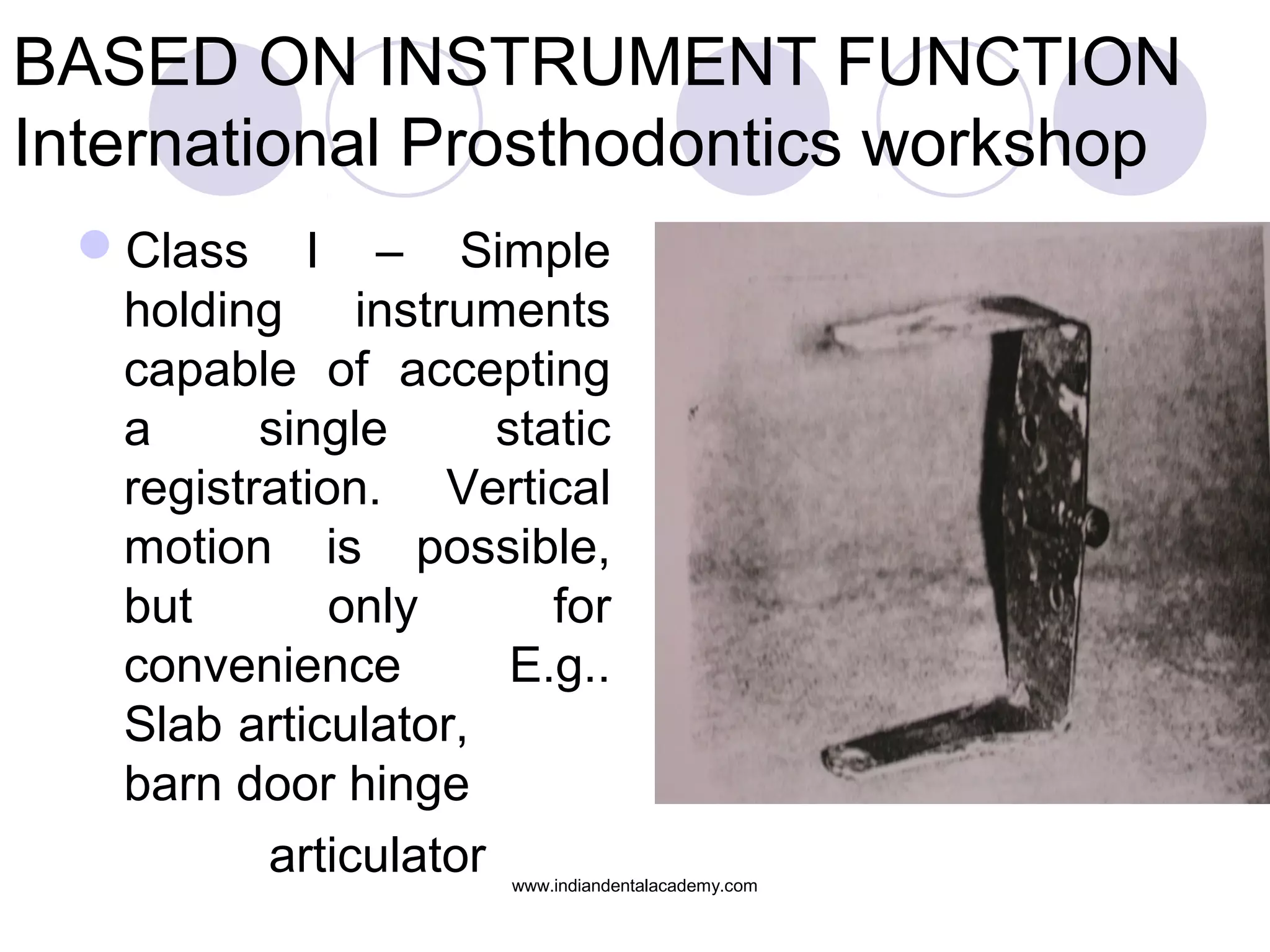
Class I – Simple
holding instruments
capable of accepting
a
single
static
registration. Vertical
motion is possible,
but
only
for
convenience
E.g..
Slab articulator,
barn door hinge
articulator

www.indiandentalacademy.com
Class II – Instrument that
permit horizontal as well
as vertical motion but do
not orient the motion to
the TMJ via, a face bow
transfer.
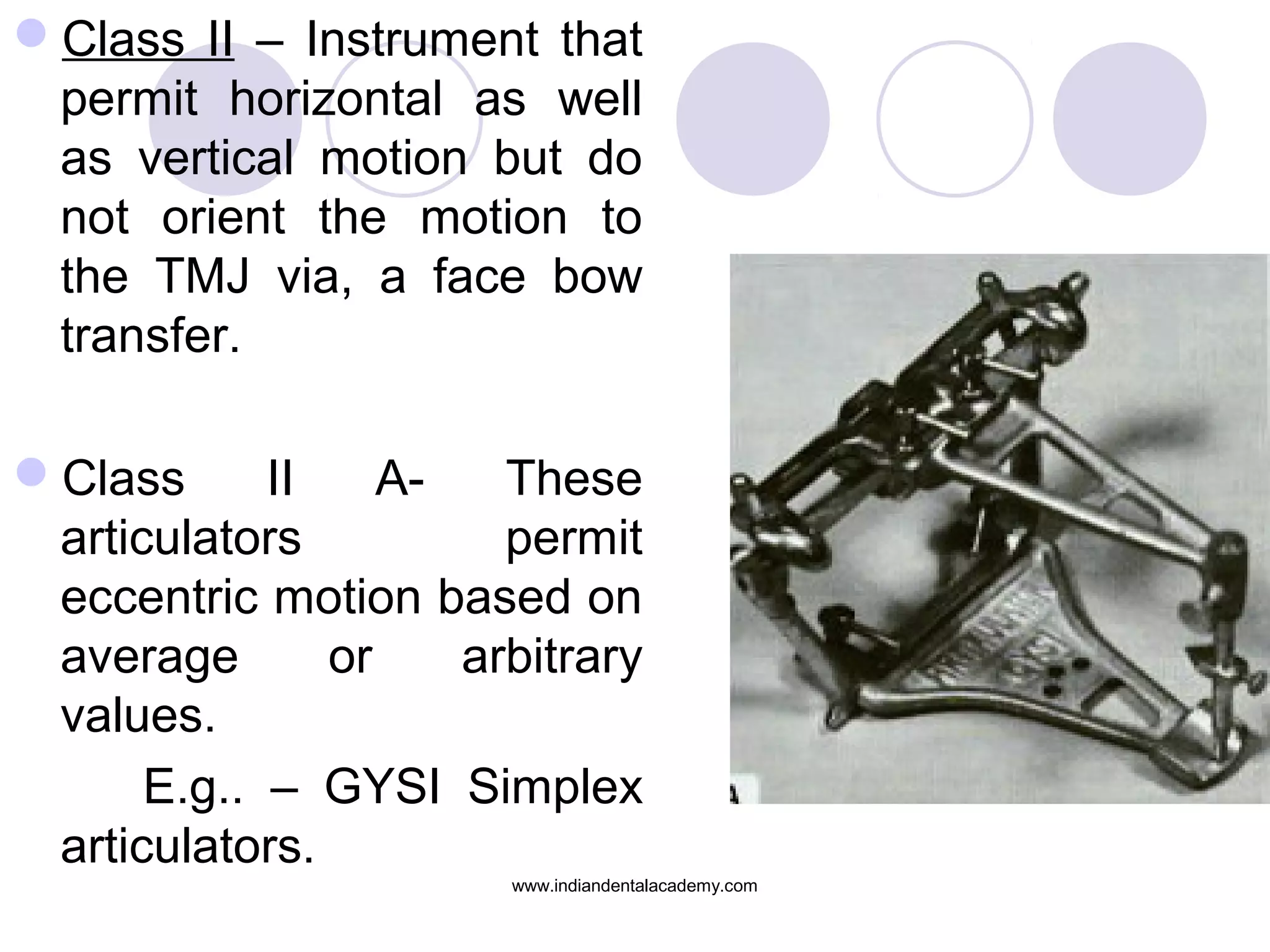
Class
II
AThese
articulators
permit
eccentric motion based on
average
or
arbitrary
values.
E.g.. – GYSI Simplex
articulators.
www.indiandentalacademy.com
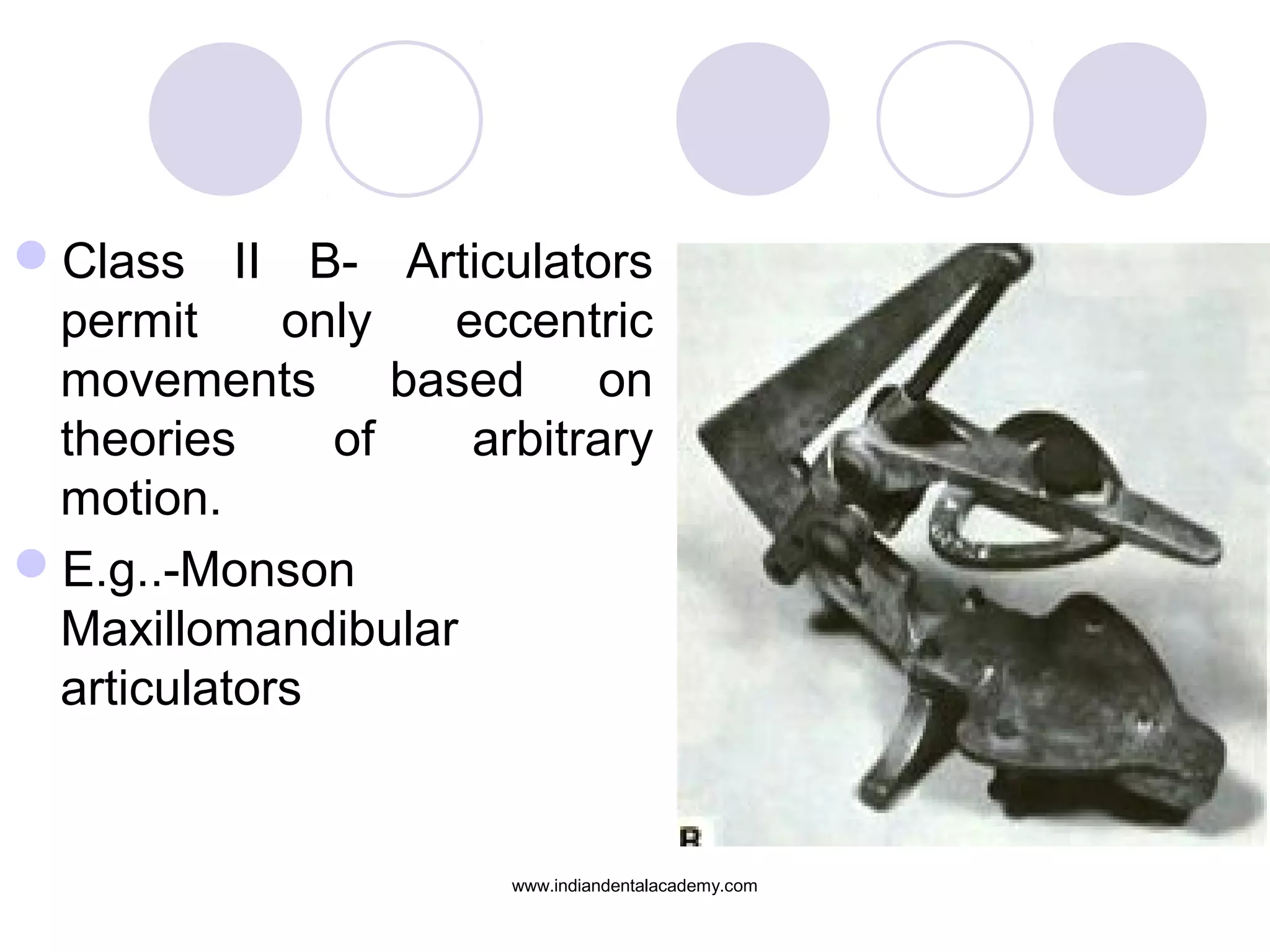
Class II B- Articulators
permit
only
eccentric
movements based on
theories
of
arbitrary
motion.
E.g..-Monson
Maxillomandibular
articulators

www.indiandentalacademy.com
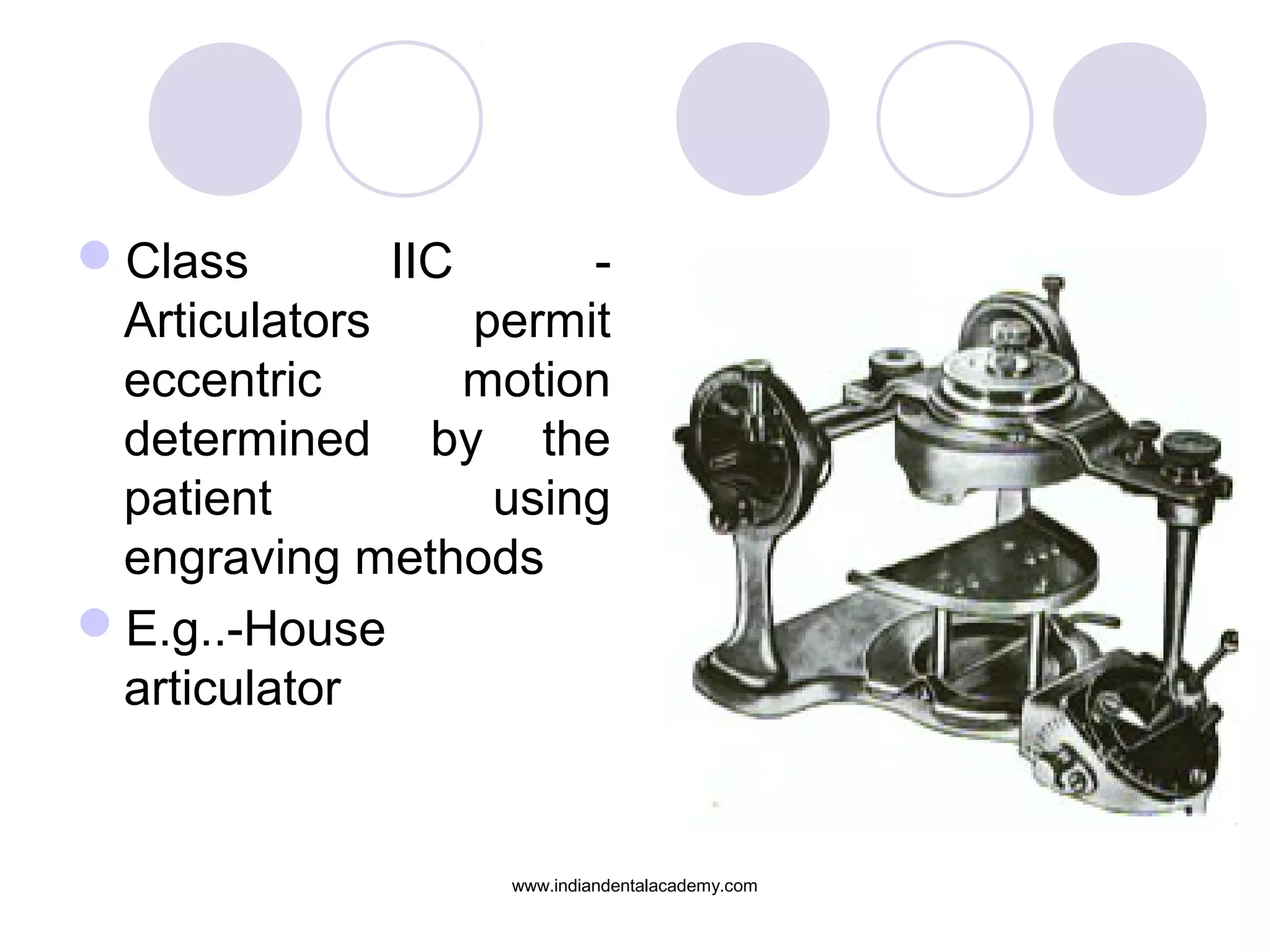
Class
IIC
Articulators
permit
eccentric
motion
determined by the
patient
using
engraving methods
E.g..-House
articulator

www.indiandentalacademy.com
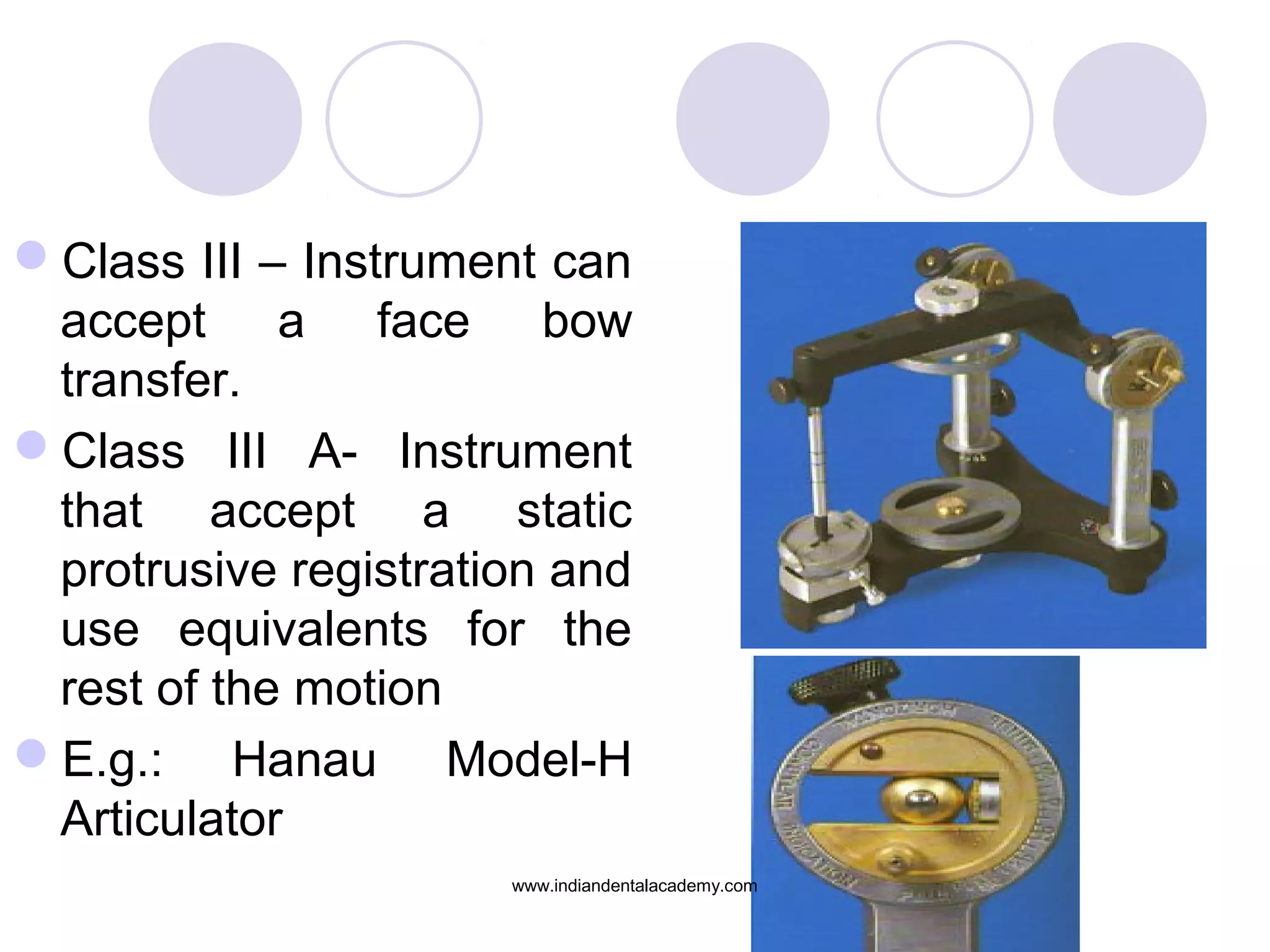
Class III – Instrument can
accept a face bow
transfer.
Class III A- Instrument
that accept a static
protrusive registration and
use equivalents for the
rest of the motion
E.g.: Hanau Model-H
Articulator
www.indiandentalacademy.com
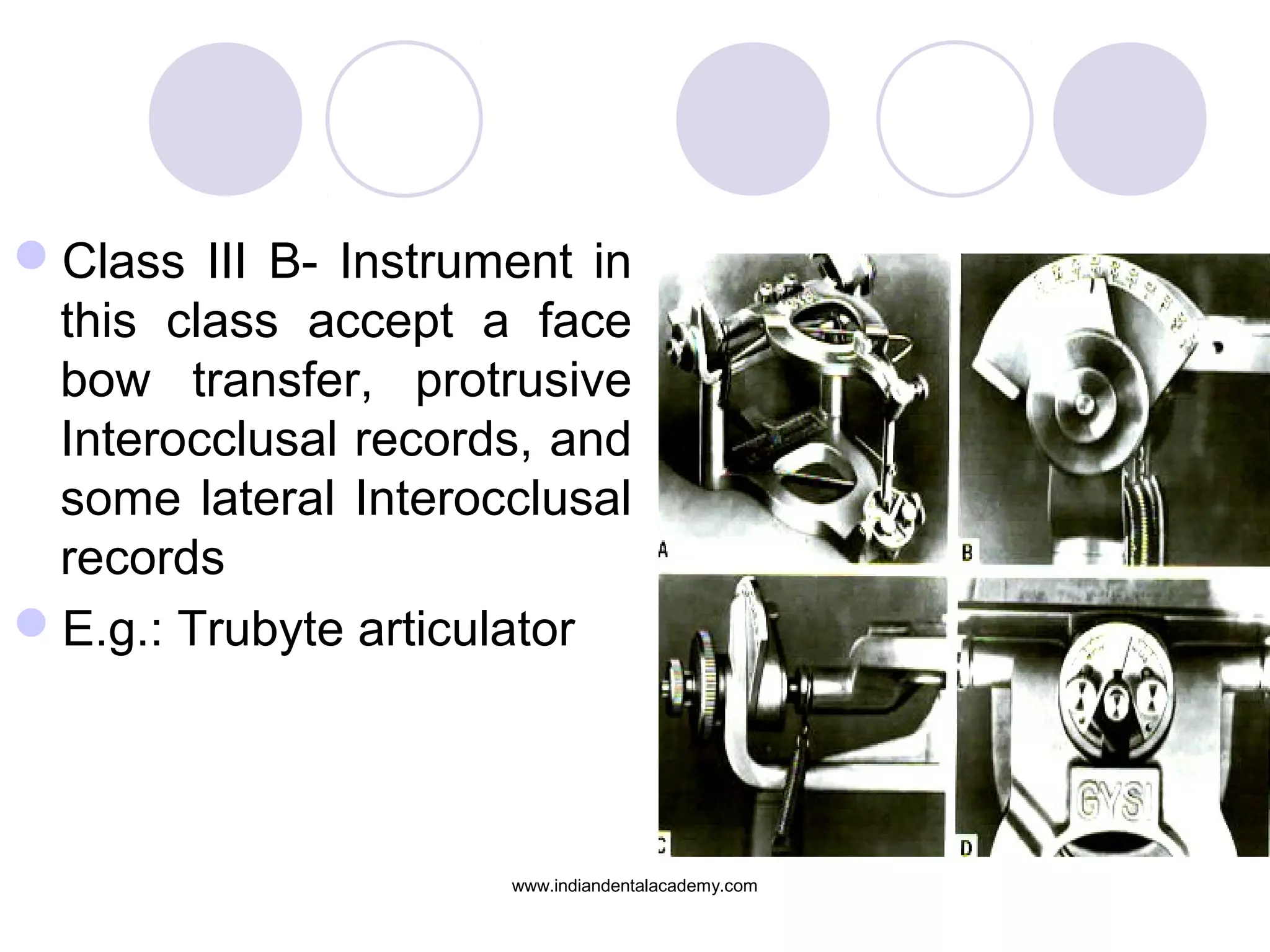
Class III B- Instrument in
this class accept a face
bow transfer, protrusive
Interocclusal records, and
some lateral Interocclusal
records
E.g.: Trubyte articulator

www.indiandentalacademy.com
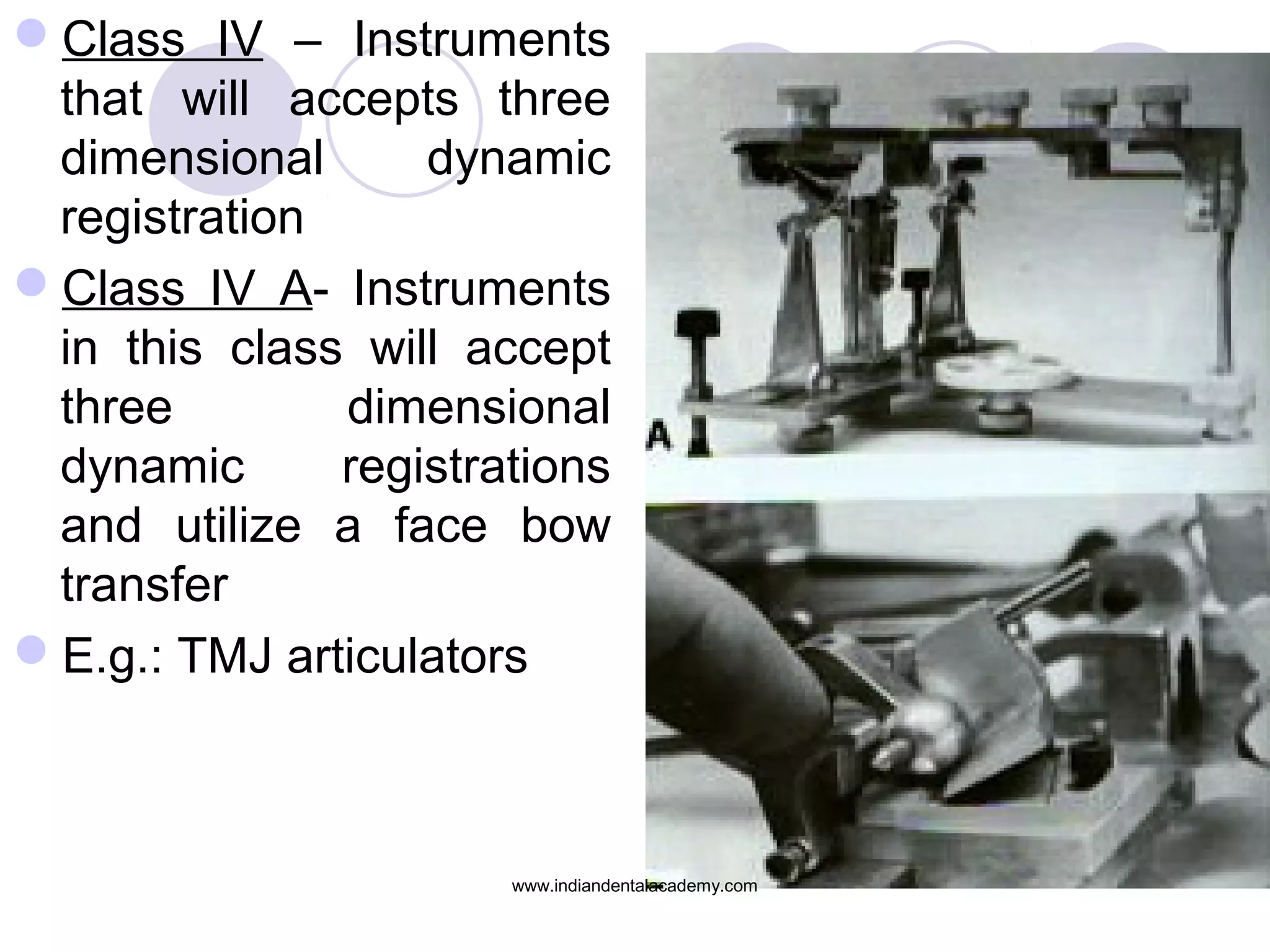
Class IV – Instruments
that will accepts three
dimensional
dynamic
registration
Class IV A- Instruments
in this class will accept
three
dimensional
dynamic
registrations
and utilize a face bow
transfer
E.g.: TMJ articulators

www.indiandentalacademy.com
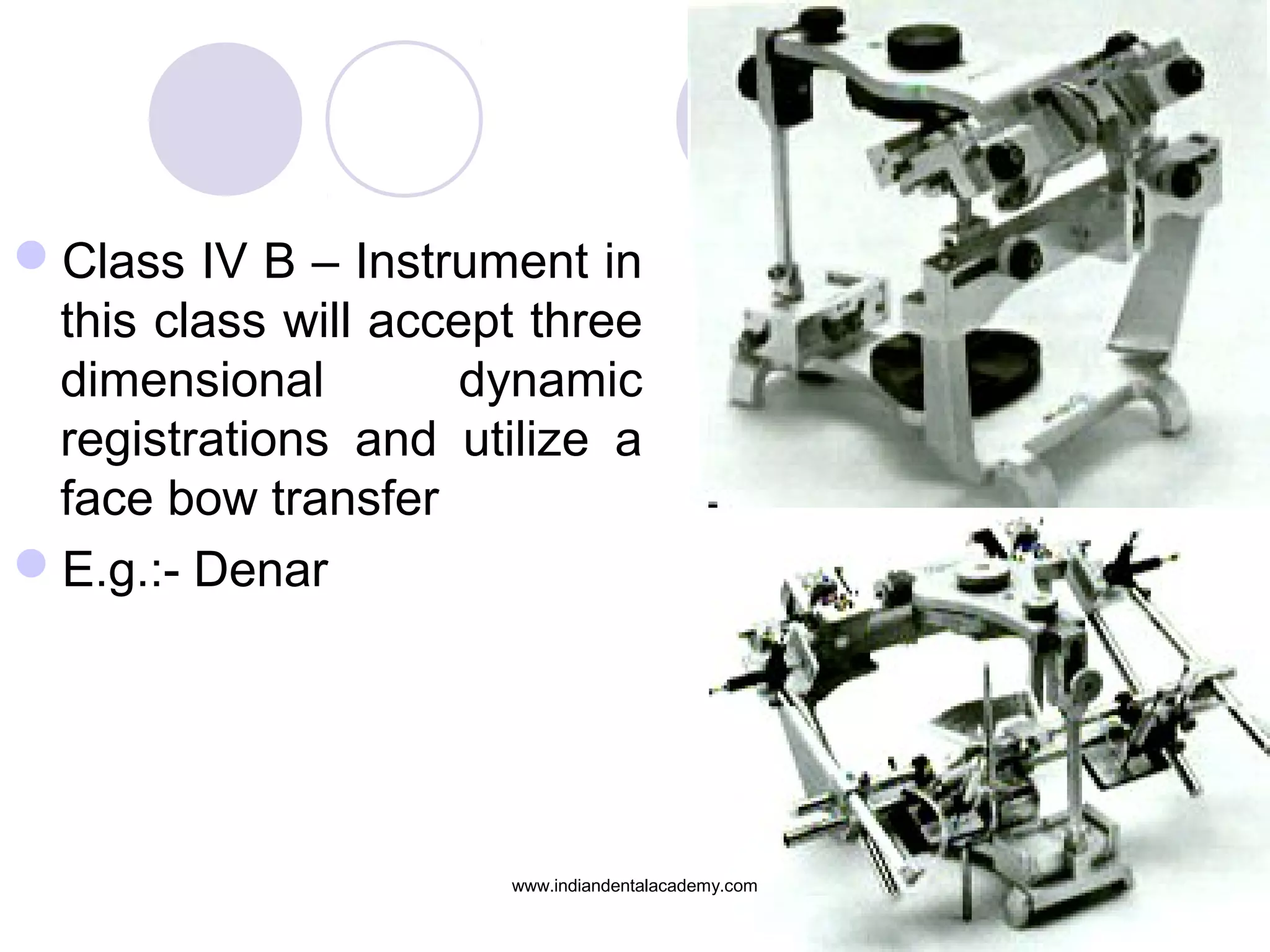
Class IV B – Instrument in
this class will accept three
dimensional
dynamic
registrations and utilize a
face bow transfer
E.g.:- Denar

www.indiandentalacademy.com
Posselt Classification
Plane line or simple hinge type
Mean value type with fixed condylar part
Adjustable type
In the first two types no control mechanism
exists. Only the Interocclusal centric relation
can be recorded. They lack individualized
information concerning spatial relationship and
occlusal arrangement of artificial teeth. So may
not resemble patient actual jaw movements
www.indiandentalacademy.com
Arcon and Non-Arcon articulators
Arcon Type: Instruments with condyles in the
lower member and condylar guides on the
upper. i.e., lower member is movable.
Non-Arcon type: Condyles are on the upper
member and condylar guides on the lower
member

www.indiandentalacademy.com
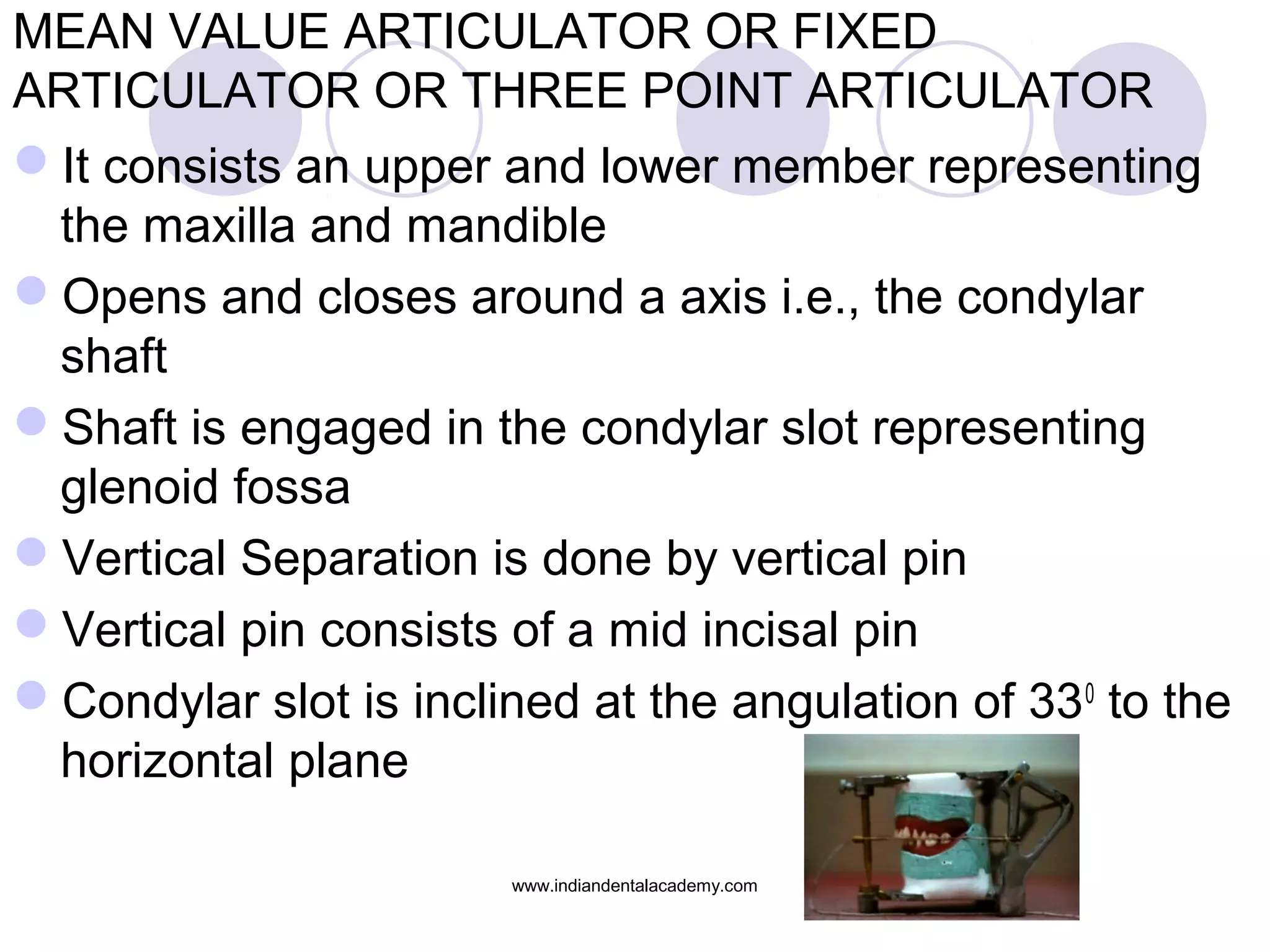
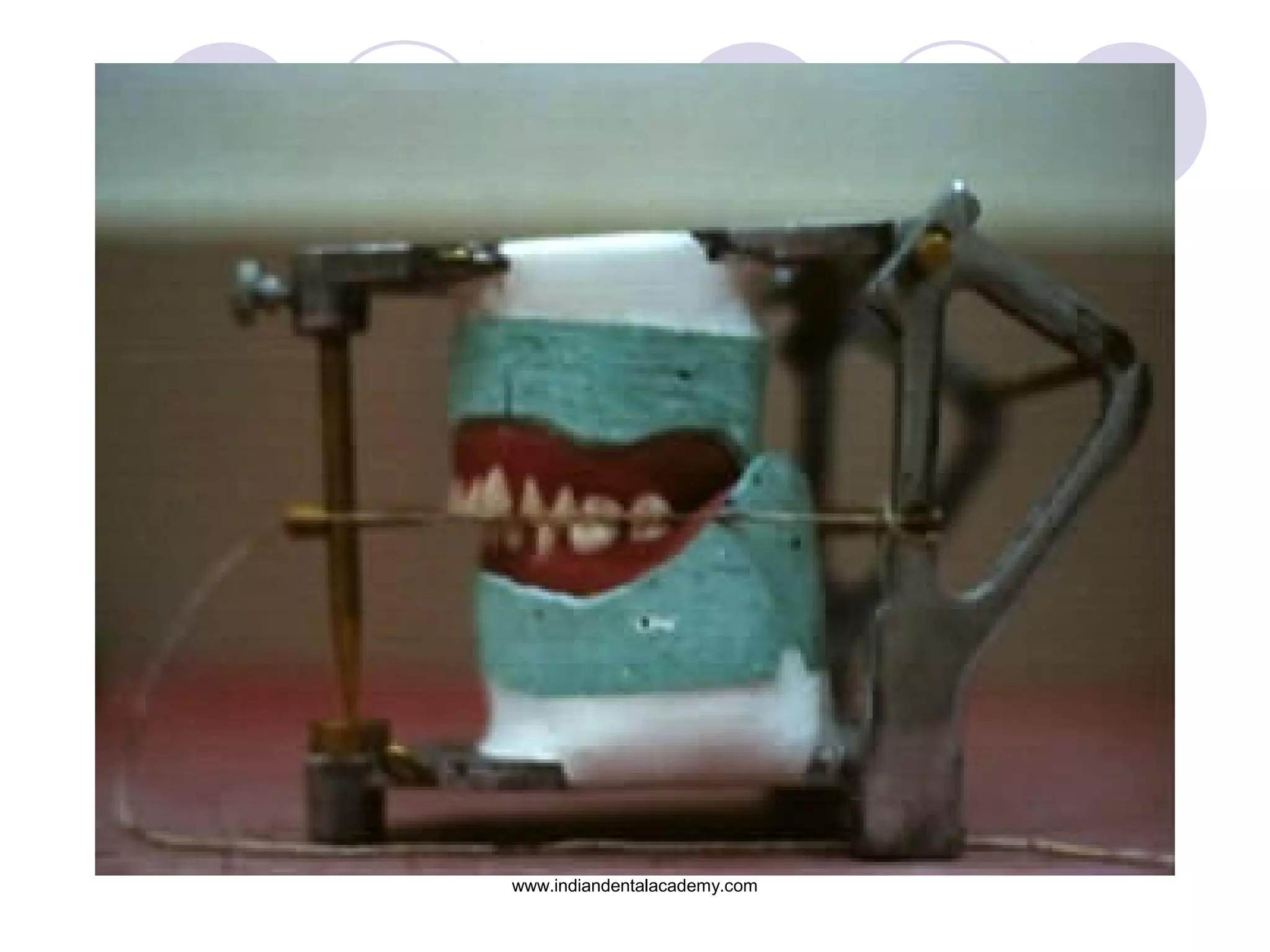
MEAN VALUE ARTICULATOR OR FIXED
ARTICULATOR OR THREE POINT ARTICULATOR
It consists an upper and lower member representing
the maxilla and mandible
Opens and closes around a axis i.e., the condylar
shaft
Shaft is engaged in the condylar slot representing
glenoid fossa
Vertical Separation is done by vertical pin
Vertical pin consists of a mid incisal pin
Condylar slot is inclined at the angulation of 33 0 to the
horizontal plane
www.indiandentalacademy.com
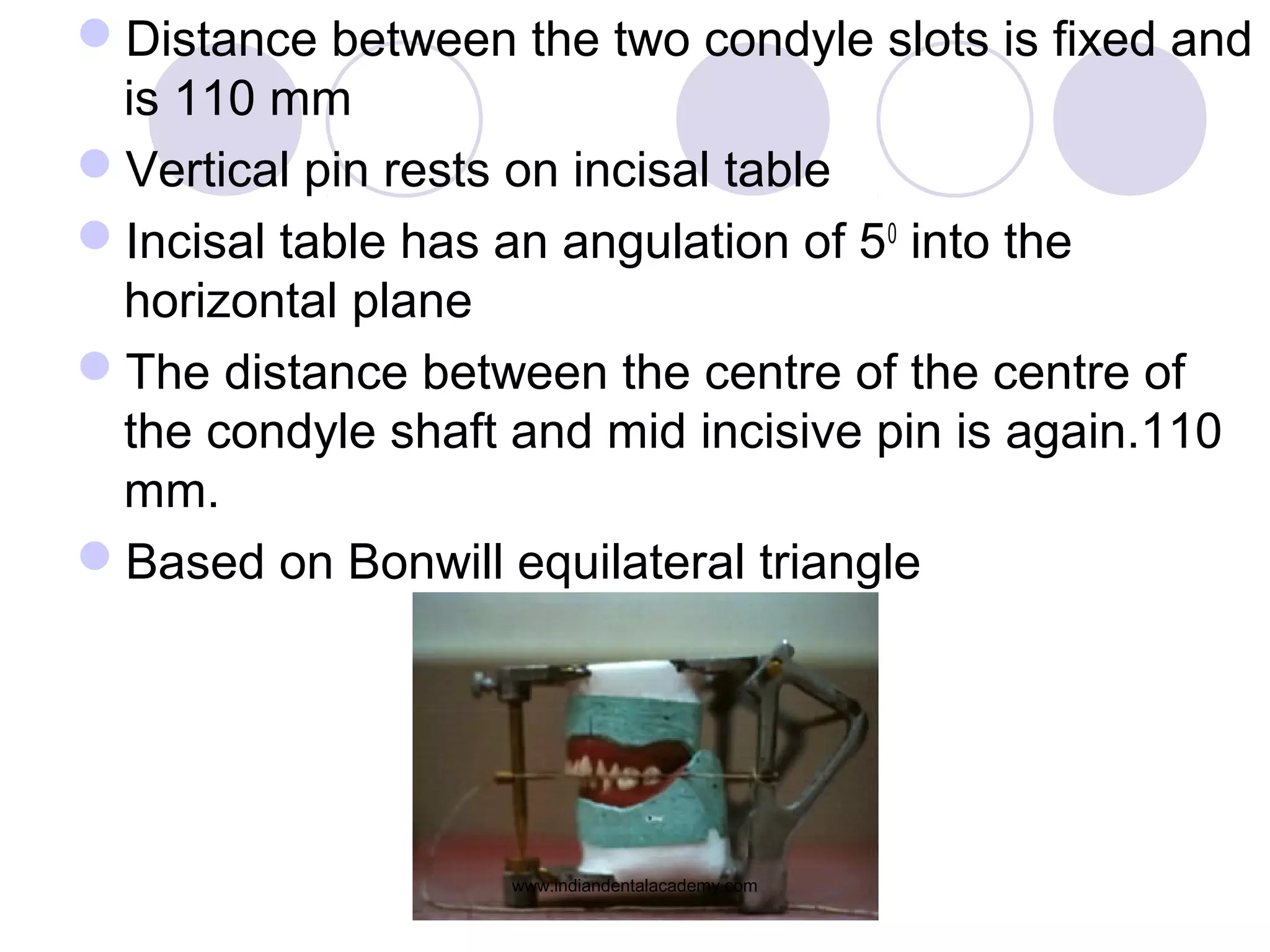
Distance between the two condyle slots is fixed and
is 110 mm
Vertical pin rests on incisal table
Incisal table has an angulation of 50 into the
horizontal plane
The distance between the centre of the centre of
the condyle shaft and mid incisive pin is again.110
mm.
Based on Bonwill equilateral triangle

www.indiandentalacademy.com
HISTORY OF ARTICULATORS
UPTO 1940

www.indiandentalacademy.com
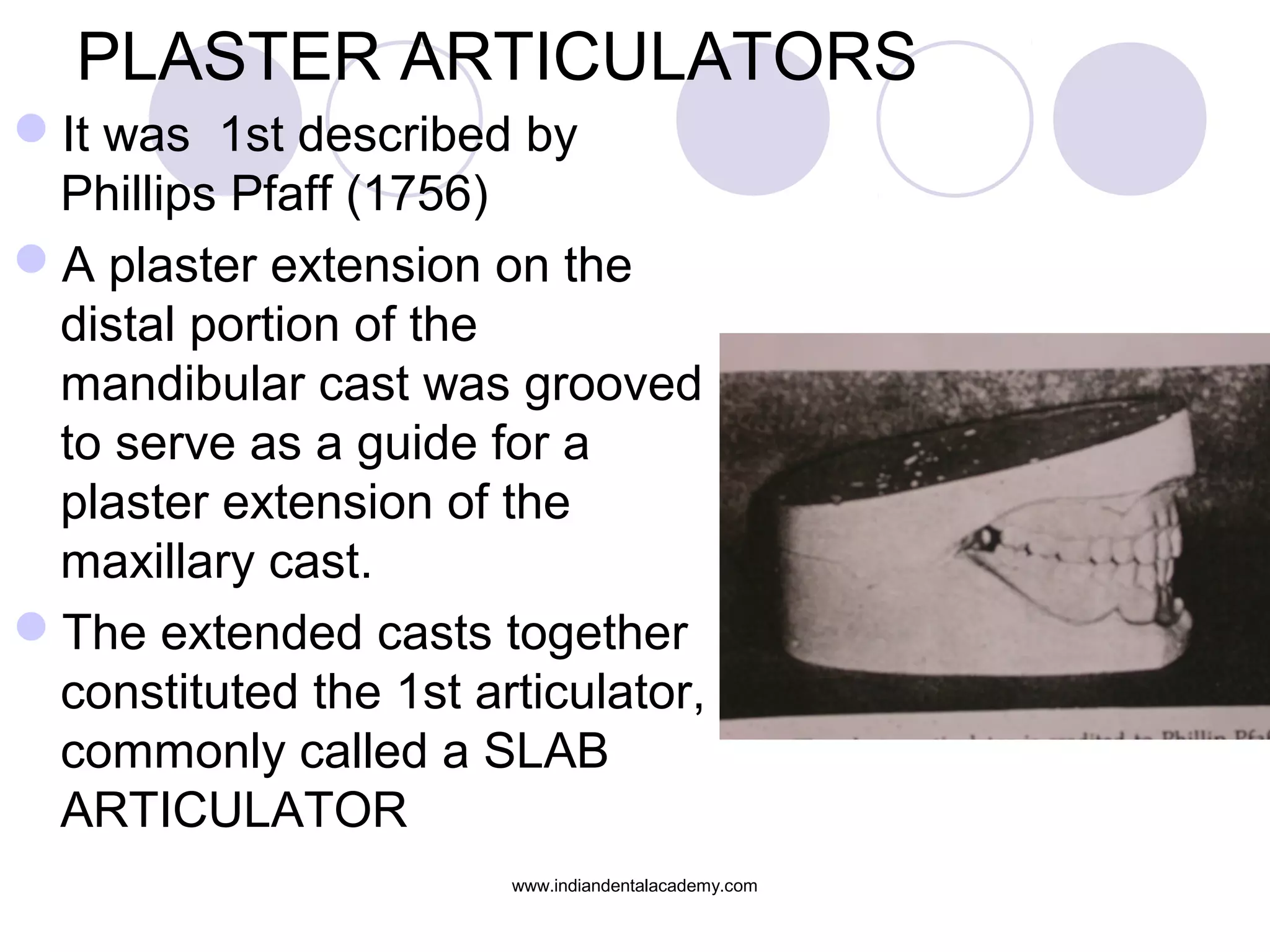
PLASTER ARTICULATORS
It was 1st described by
Phillips Pfaff (1756)
A plaster extension on the
distal portion of the
mandibular cast was grooved
to serve as a guide for a
plaster extension of the
maxillary cast.
The extended casts together
constituted the 1st articulator,
commonly called a SLAB
ARTICULATOR
www.indiandentalacademy.com
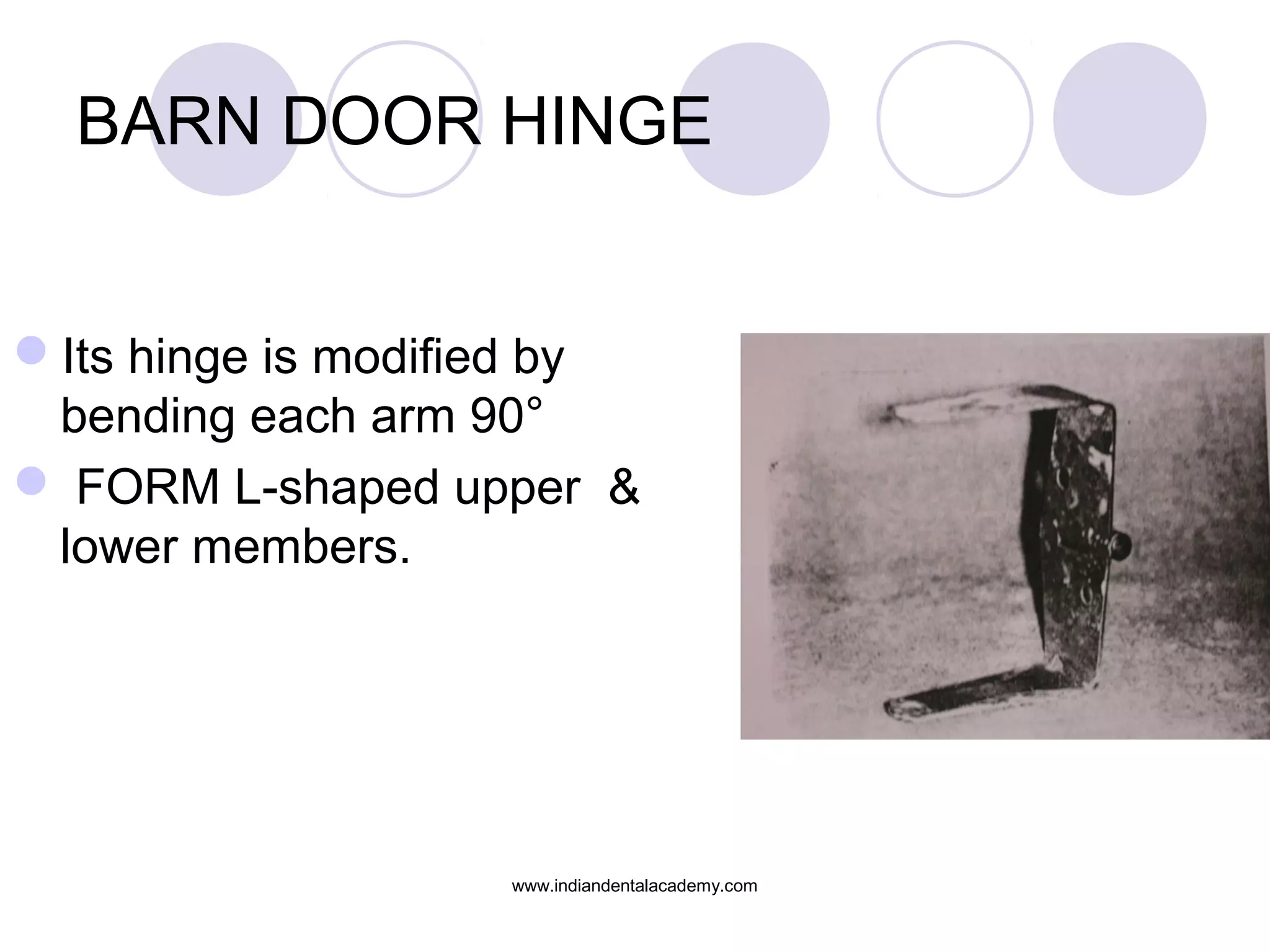
BARN DOOR HINGE

Its hinge is modified by
bending each arm 90°
 FORM L-shaped upper &
lower members.

www.indiandentalacademy.com
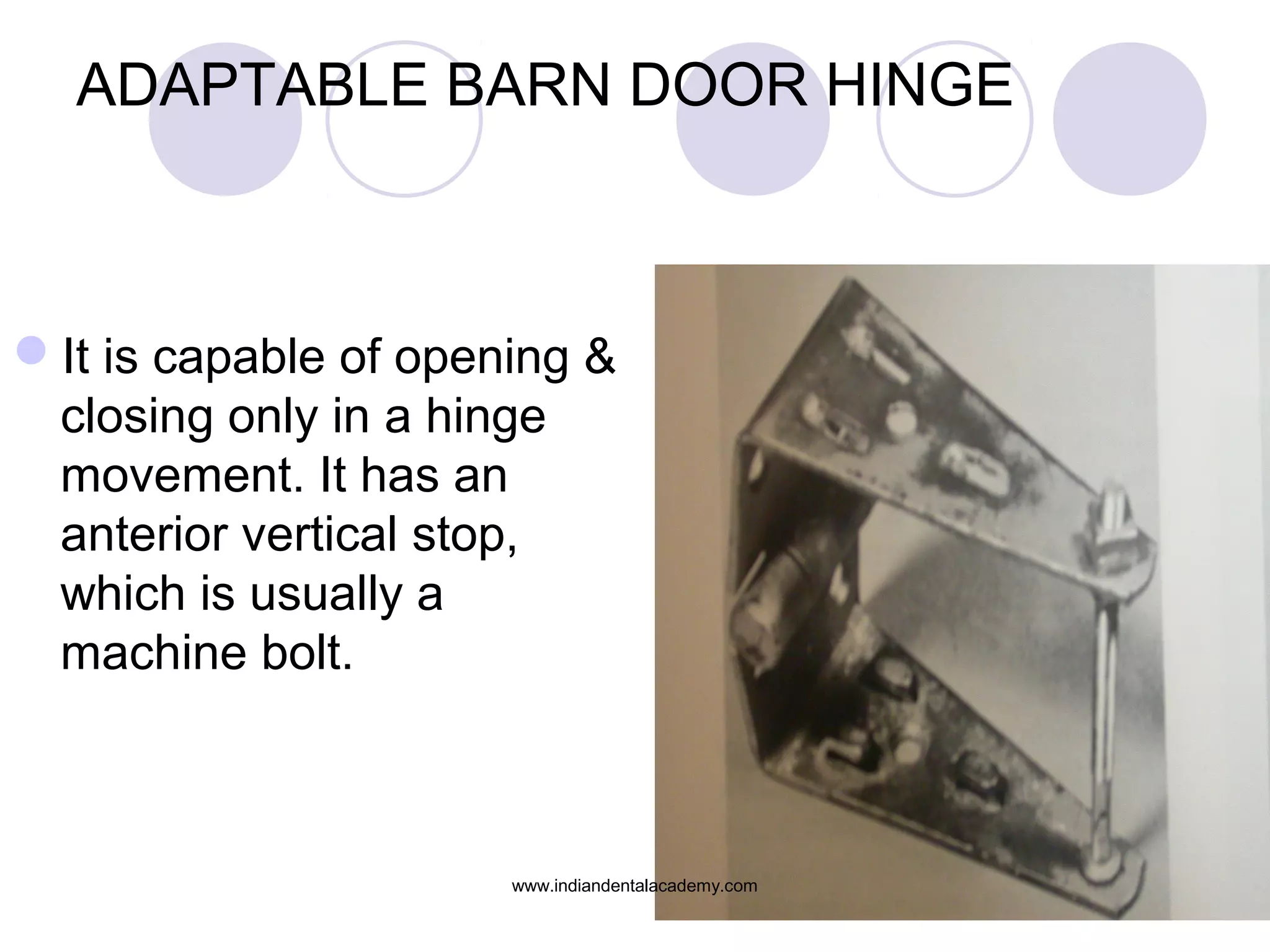
ADAPTABLE BARN DOOR HINGE

It is capable of opening &
closing only in a hinge
movement. It has an
anterior vertical stop,
which is usually a
machine bolt.

www.indiandentalacademy.com
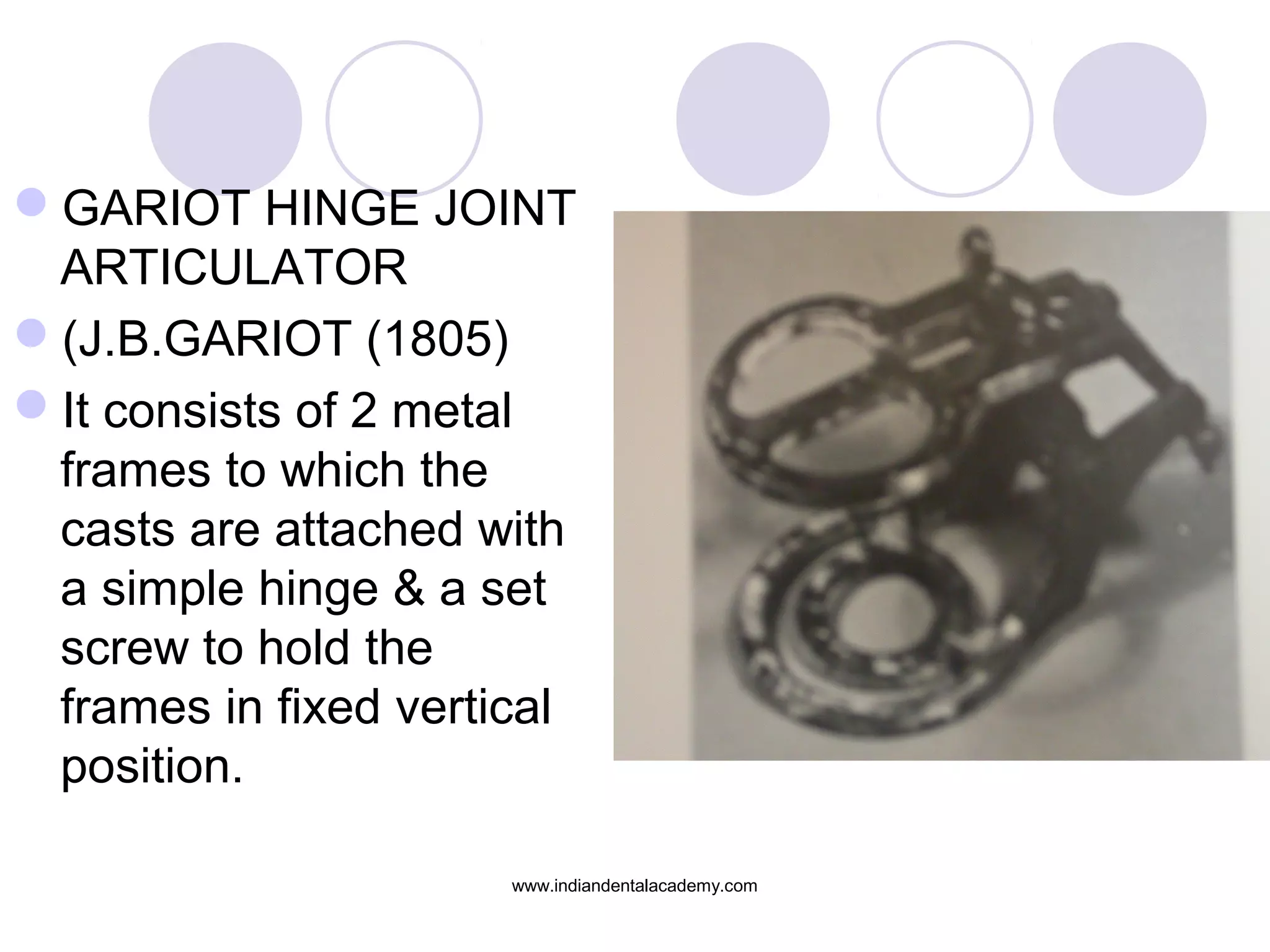
GARIOT HINGE JOINT
ARTICULATOR
(J.B.GARIOT (1805)
It consists of 2 metal
frames to which the
casts are attached with
a simple hinge & a set
screw to hold the
frames in fixed vertical
position.
www.indiandentalacademy.com
BOWILLS
ARTICULATOR(1858
)
It’s the 1st articulator
developed to imitate
the movements of the
mandible in eccentric
position.
Based on Bonwills
theory of equilateral
triangle
www.indiandentalacademy.com
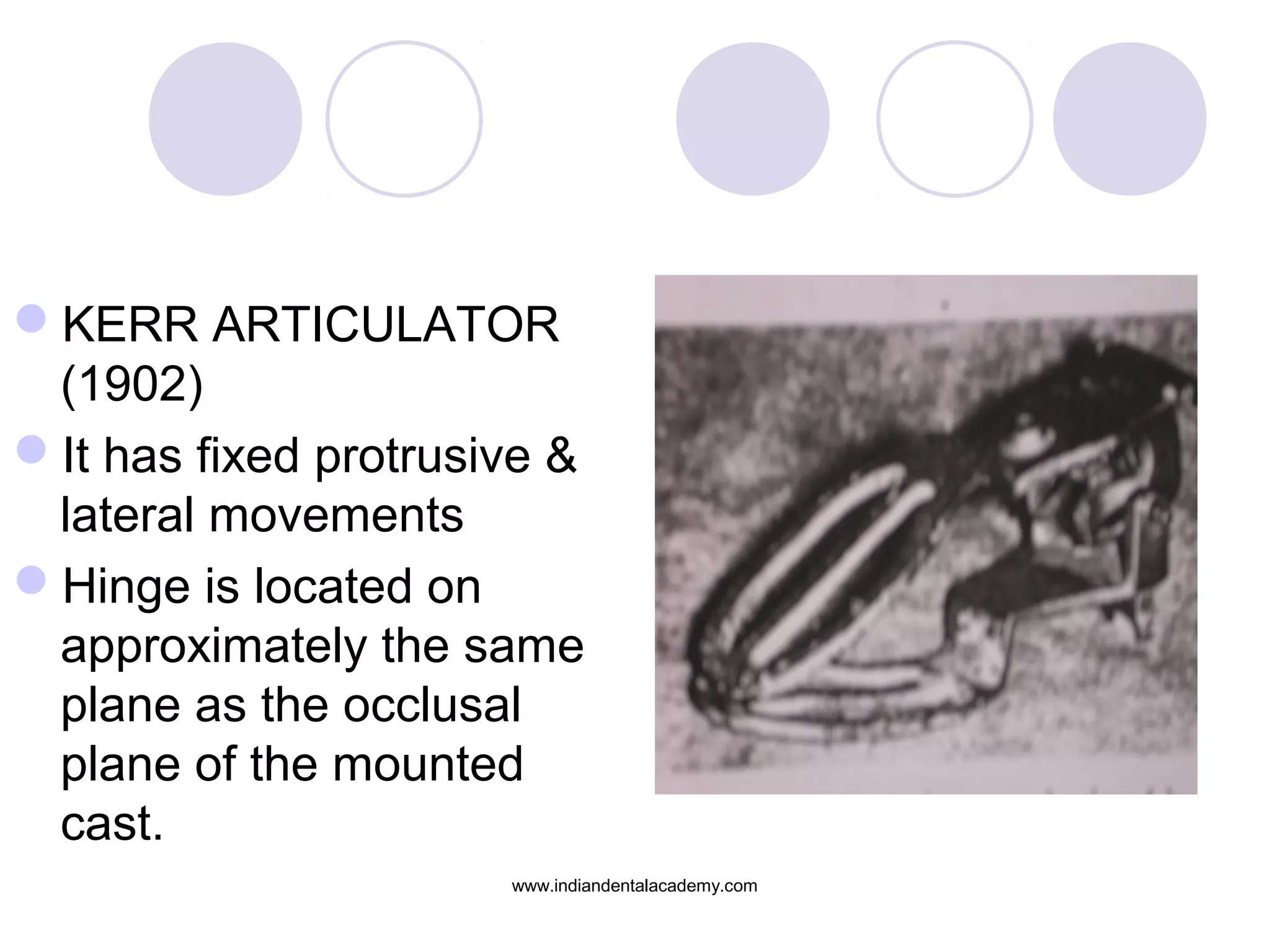
KERR ARTICULATOR
(1902)
It has fixed protrusive &
lateral movements
Hinge is located on
approximately the same
plane as the occlusal
plane of the mounted
cast.
www.indiandentalacademy.com
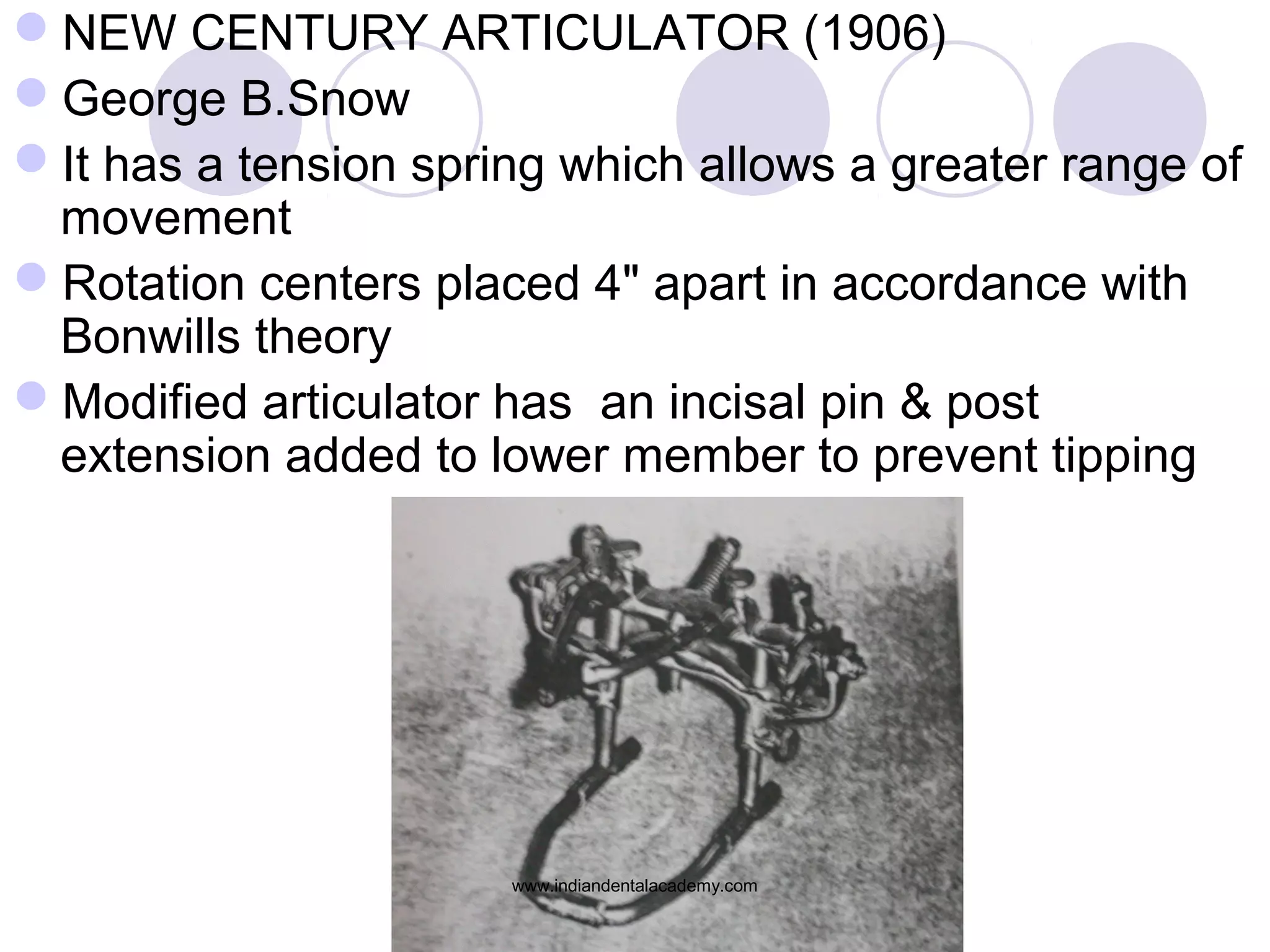
NEW CENTURY ARTICULATOR (1906)
George B.Snow
It has a tension spring which allows a greater range of
movement
Rotation centers placed 4" apart in accordance with
Bonwills theory
Modified articulator has an incisal pin & post
extension added to lower member to prevent tipping

www.indiandentalacademy.com
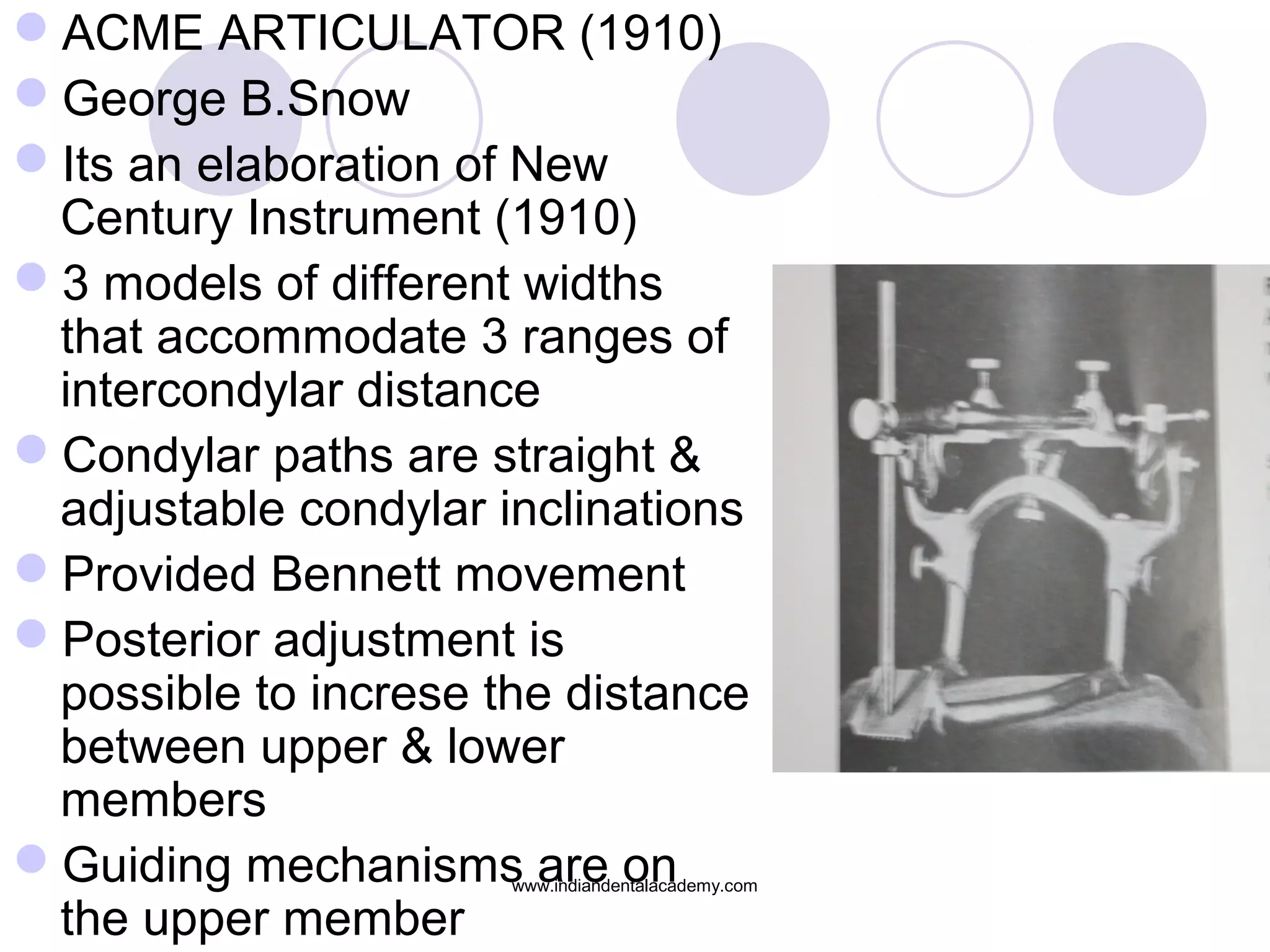
ACME ARTICULATOR (1910)
George B.Snow
Its an elaboration of New
Century Instrument (1910)
3 models of different widths
that accommodate 3 ranges of
intercondylar distance
Condylar paths are straight &
adjustable condylar inclinations
Provided Bennett movement
Posterior adjustment is
possible to increse the distance
between upper & lower
members
Guiding mechanisms are on
the upper member

www.indiandentalacademy.com
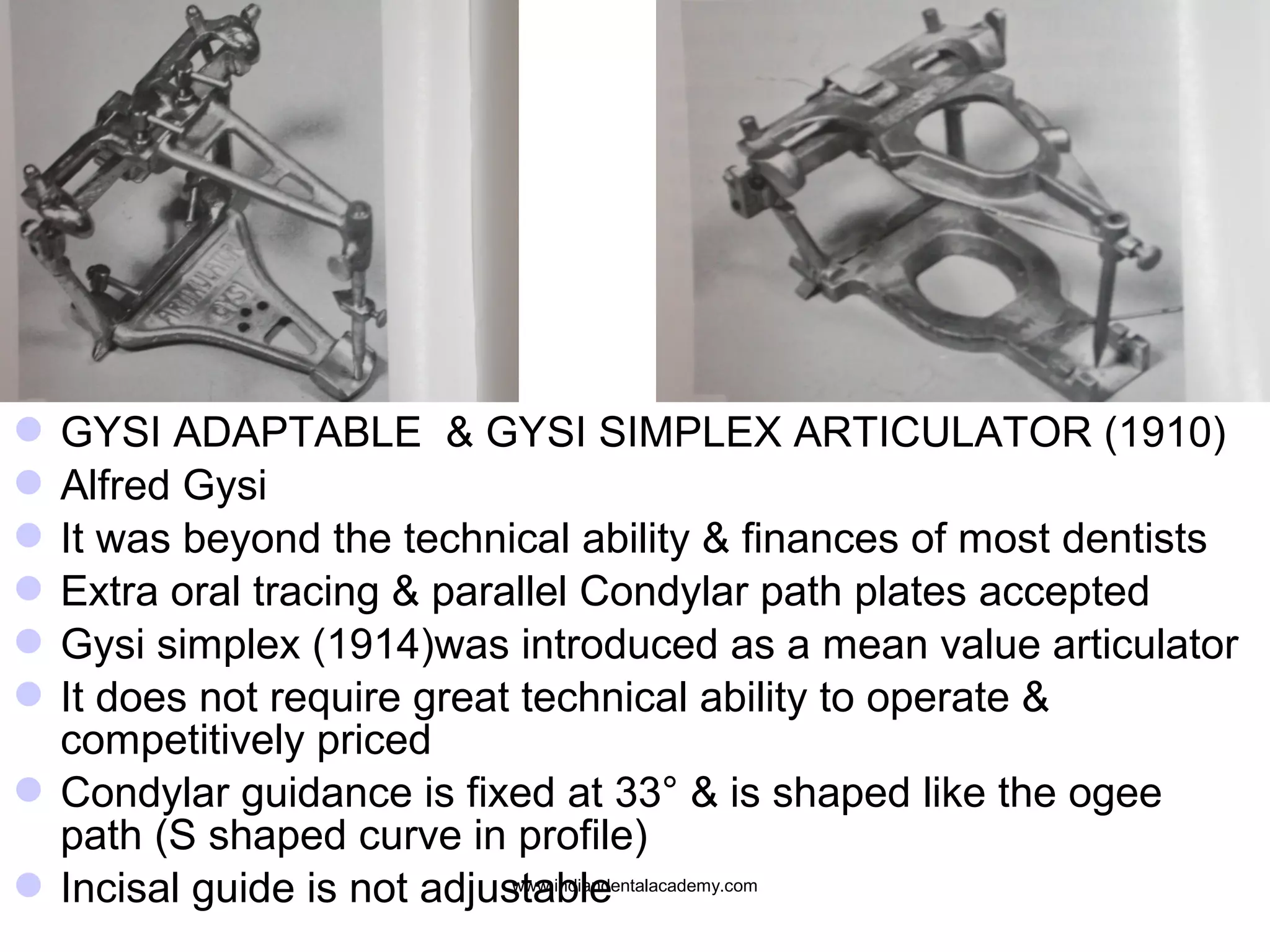
 GYSI ADAPTABLE & GYSI SIMPLEX ARTICULATOR (1910)
 Alfred Gysi
 It was beyond the technical ability & finances of most dentists
 Extra oral tracing & parallel Condylar path plates accepted
 Gysi simplex (1914)was introduced as a mean value articulator
 It does not require great technical ability to operate &
competitively priced
 Condylar guidance is fixed at 33° & is shaped like the ogee
path (S shaped curve in profile)
www.indiandentalacademy.com
 Incisal guide is not adjustable
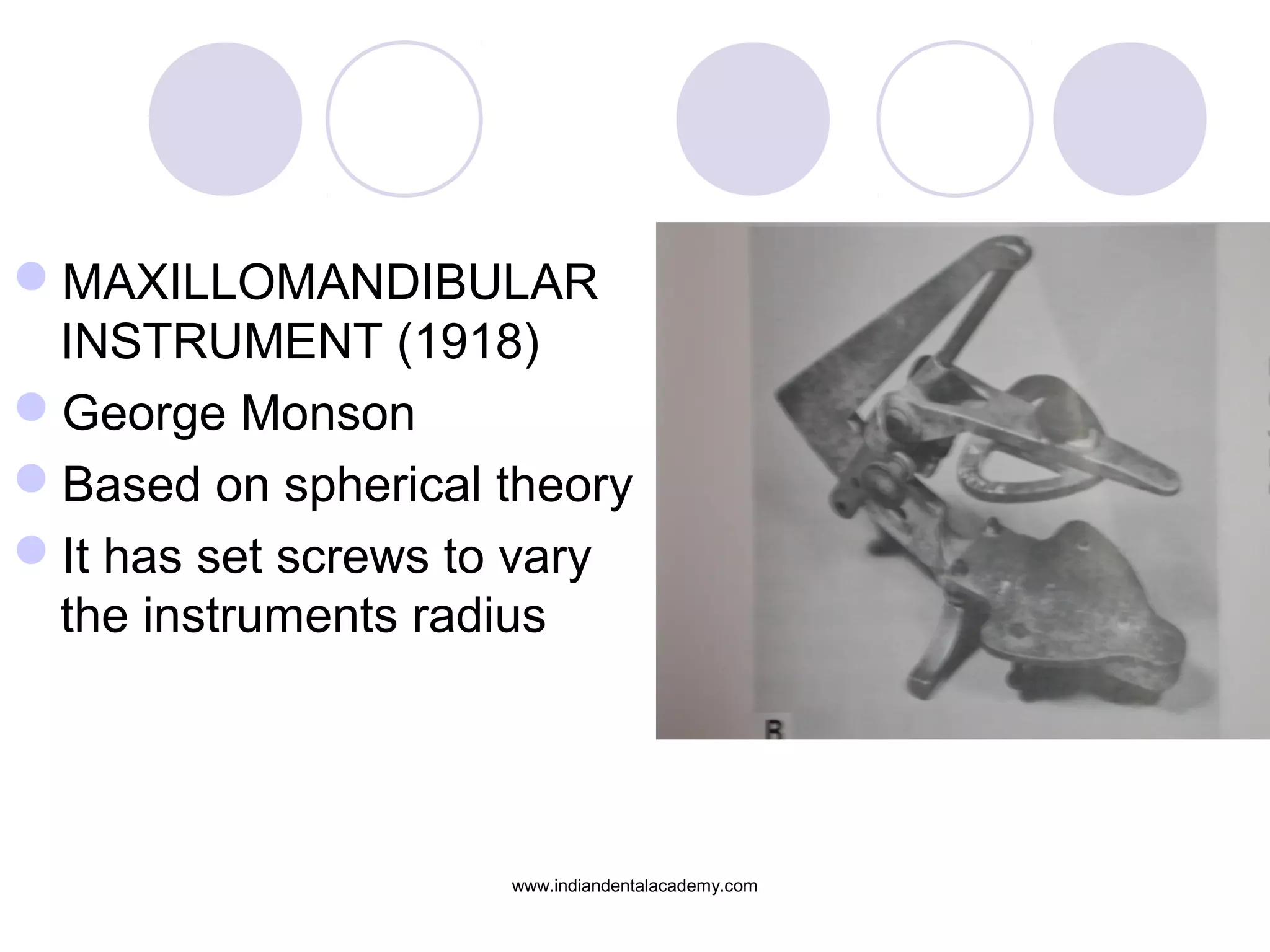
MAXILLOMANDIBULAR
INSTRUMENT (1918)
George Monson
Based on spherical theory
It has set screws to vary
the instruments radius

www.indiandentalacademy.com
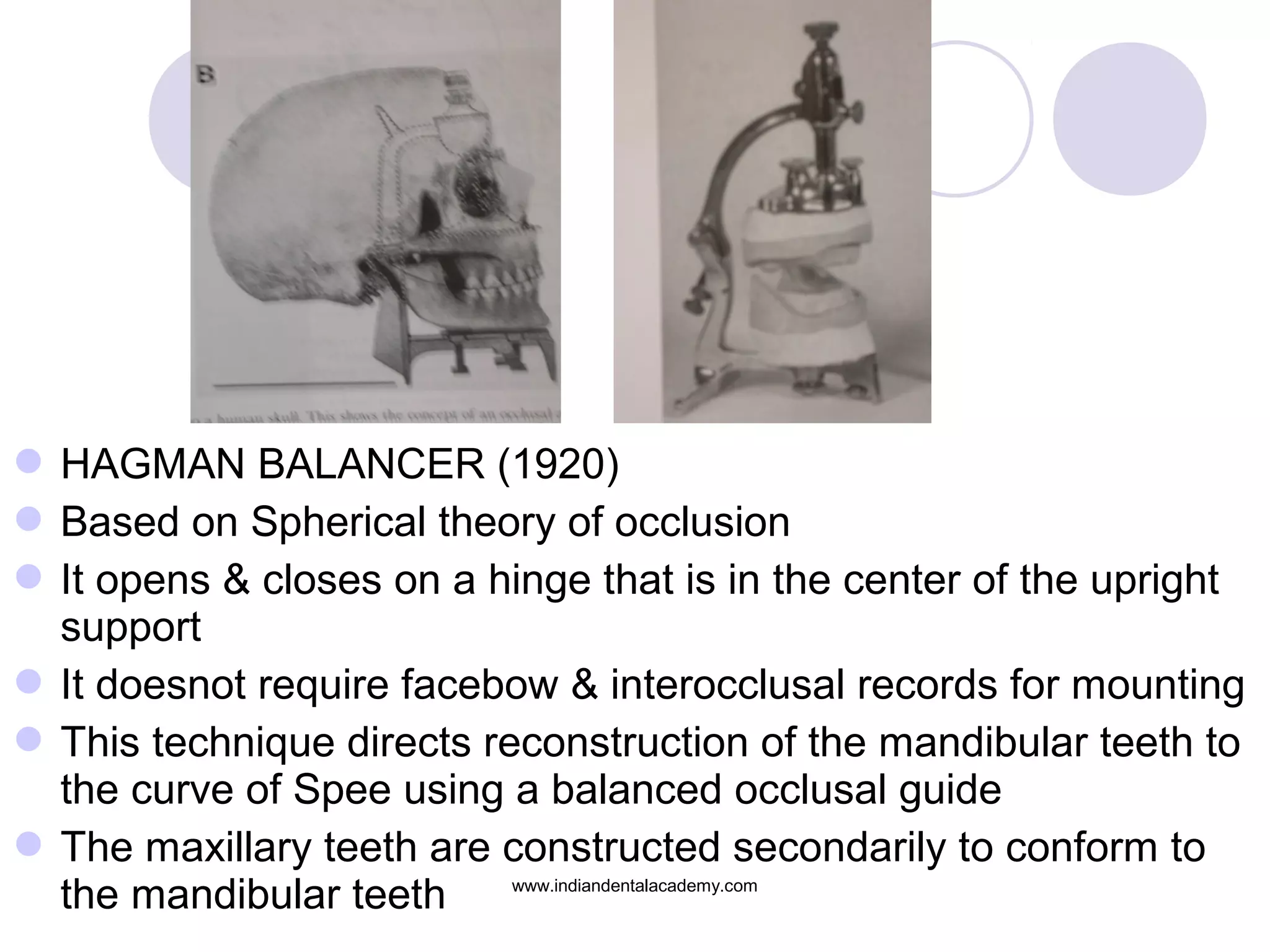
 HAGMAN BALANCER (1920)
 Based on Spherical theory of occlusion
 It opens & closes on a hinge that is in the center of the upright
support
 It doesnot require facebow & interocclusal records for mounting
 This technique directs reconstruction of the mandibular teeth to
the curve of Spee using a balanced occlusal guide
 The maxillary teeth are constructed secondarily to conform to
www.indiandentalacademy.com
the mandibular teeth
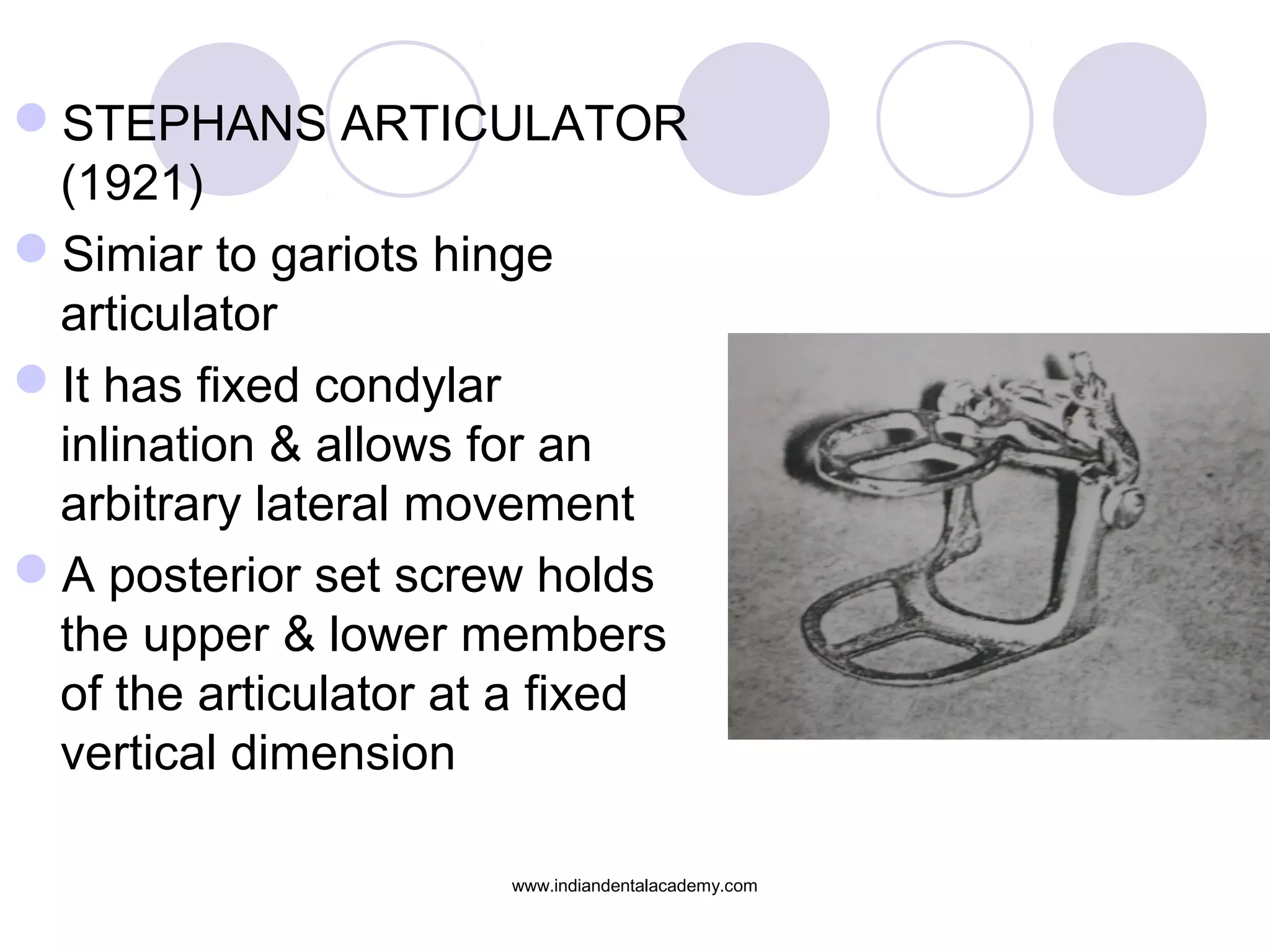
STEPHANS ARTICULATOR
(1921)
Simiar to gariots hinge
articulator
It has fixed condylar
inlination & allows for an
arbitrary lateral movement
A posterior set screw holds
the upper & lower members
of the articulator at a fixed
vertical dimension
www.indiandentalacademy.com
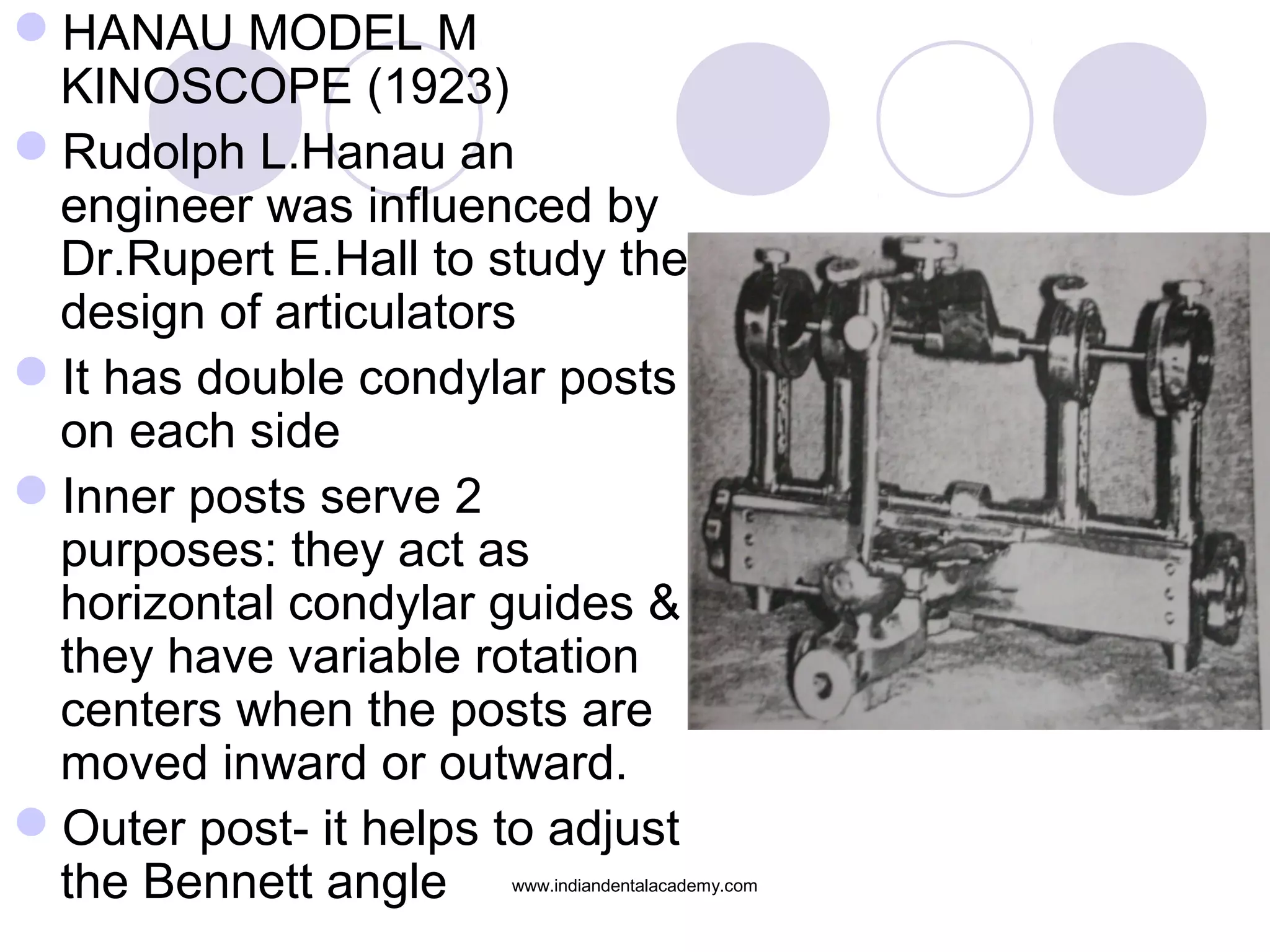
HANAU MODEL M
KINOSCOPE (1923)
Rudolph L.Hanau an
engineer was influenced by
Dr.Rupert E.Hall to study the
design of articulators
It has double condylar posts
on each side
Inner posts serve 2
purposes: they act as
horizontal condylar guides &
they have variable rotation
centers when the posts are
moved inward or outward.
Outer post- it helps to adjust
the Bennett angle

www.indiandentalacademy.com
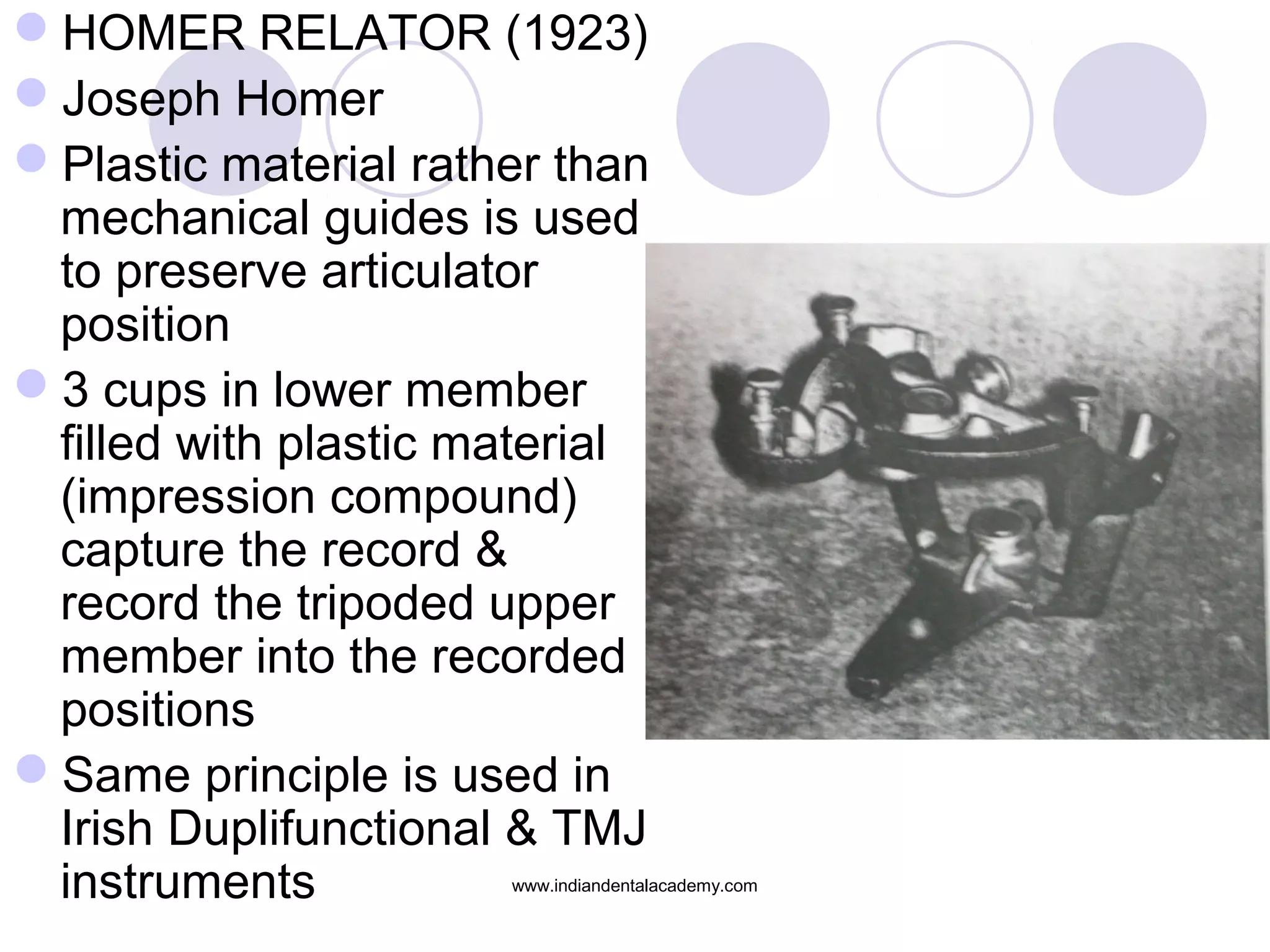
HOMER RELATOR (1923)
Joseph Homer
Plastic material rather than
mechanical guides is used
to preserve articulator
position
3 cups in lower member
filled with plastic material
(impression compound)
capture the record &
record the tripoded upper
member into the recorded
positions
Same principle is used in
Irish Duplifunctional & TMJ
instruments

www.indiandentalacademy.com
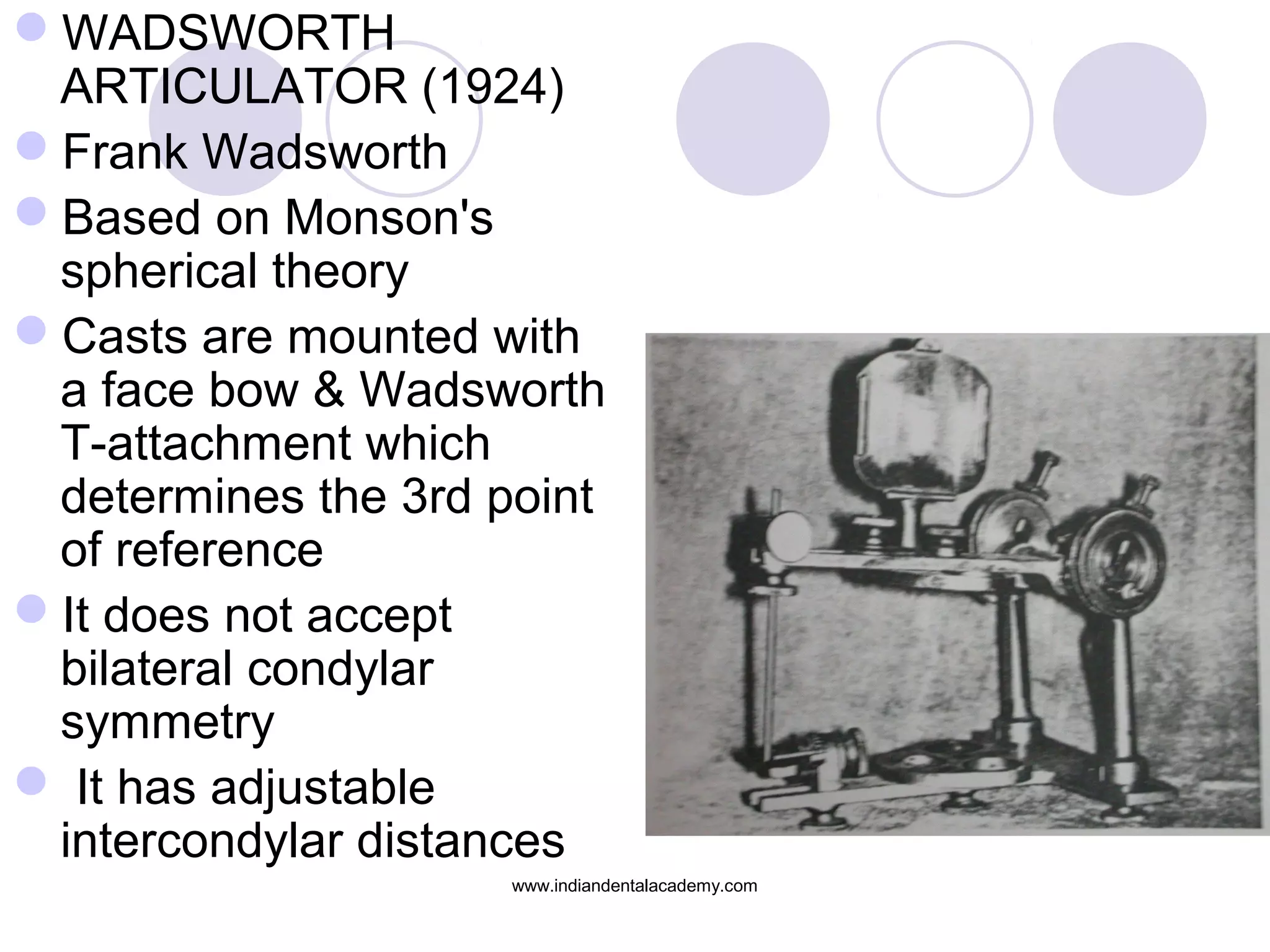
WADSWORTH
ARTICULATOR (1924)
Frank Wadsworth
Based on Monson's
spherical theory
Casts are mounted with
a face bow & Wadsworth
T-attachment which
determines the 3rd point
of reference
It does not accept
bilateral condylar
symmetry
 It has adjustable
intercondylar distances
www.indiandentalacademy.com
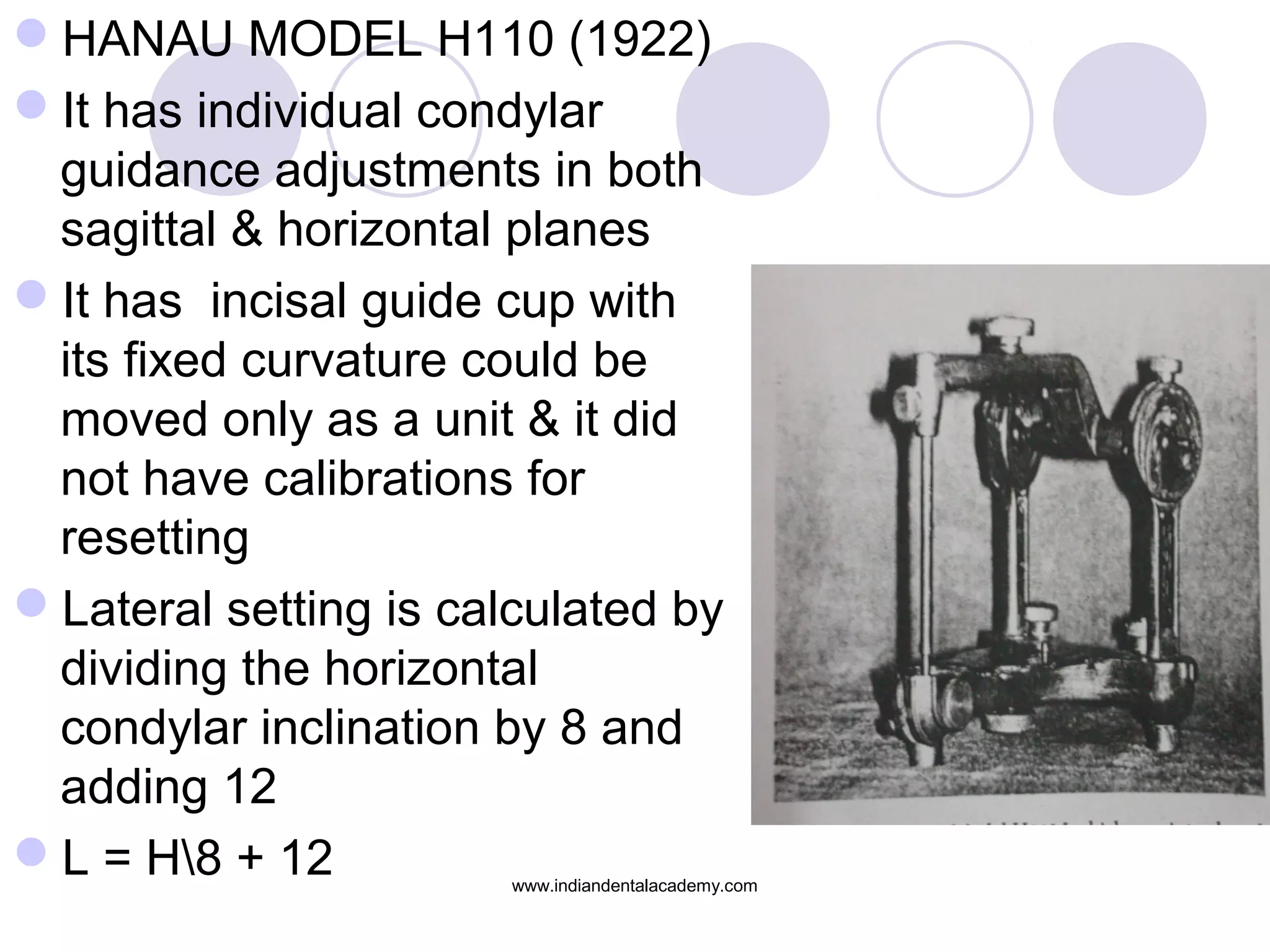
HANAU MODEL H110 (1922)
It has individual condylar
guidance adjustments in both
sagittal & horizontal planes
It has incisal guide cup with
its fixed curvature could be
moved only as a unit & it did
not have calibrations for
resetting
Lateral setting is calculated by
dividing the horizontal
condylar inclination by 8 and
adding 12
L = H8 + 12

www.indiandentalacademy.com
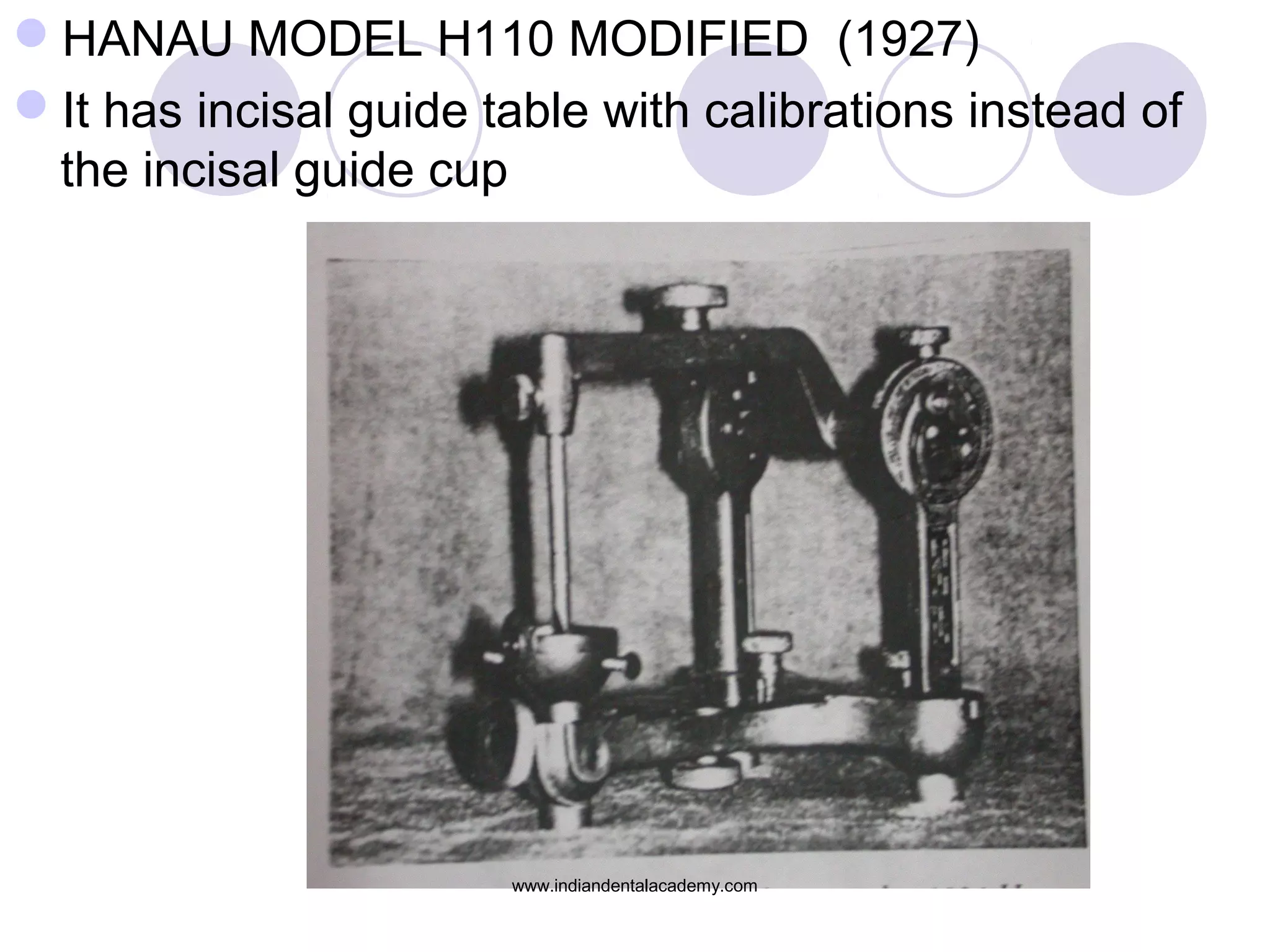
HANAU MODEL H110 MODIFIED (1927)
It has incisal guide table with calibrations instead of
the incisal guide cup

www.indiandentalacademy.com
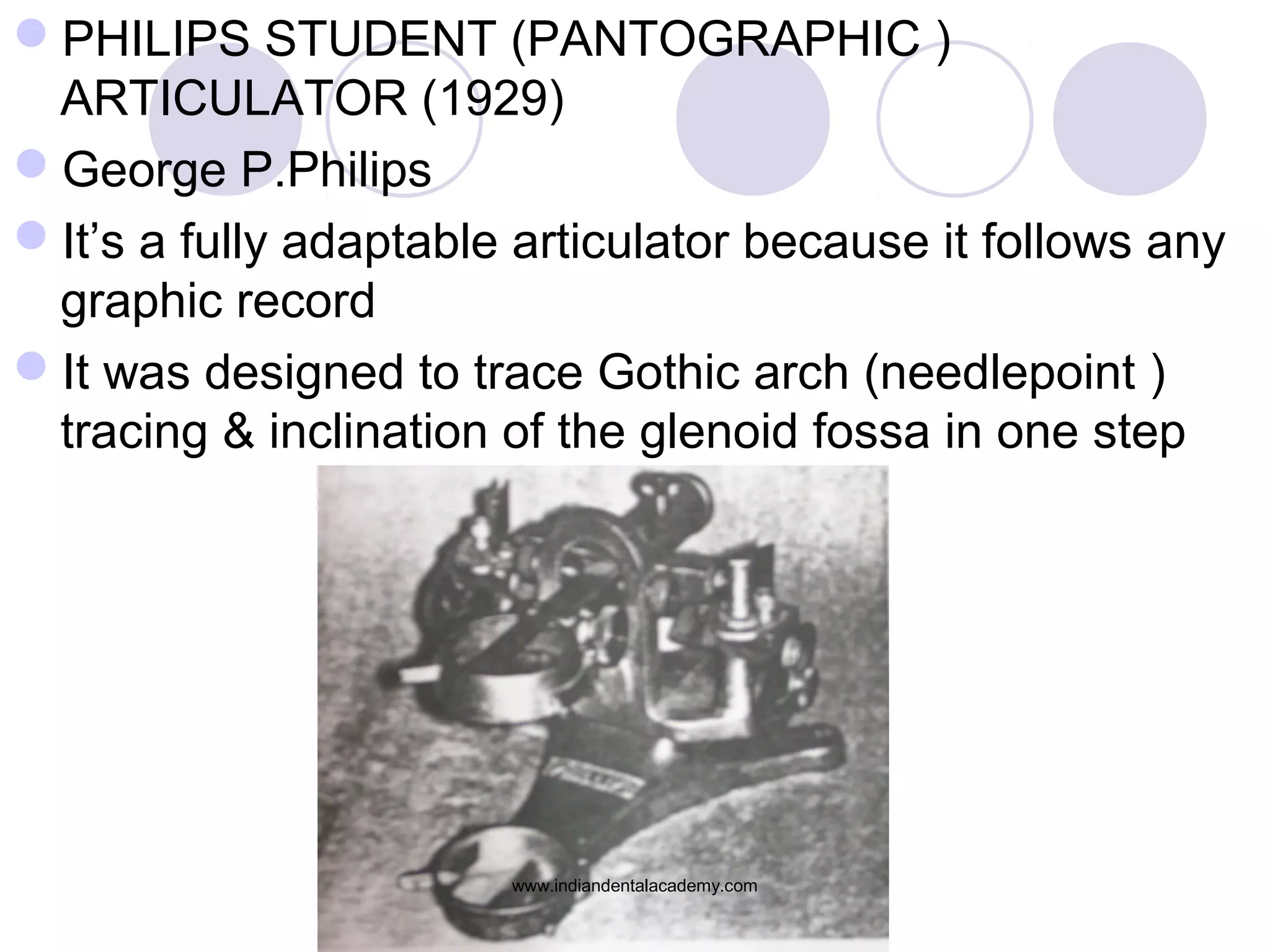
PHILIPS STUDENT (PANTOGRAPHIC )
ARTICULATOR (1929)
George P.Philips
It’s a fully adaptable articulator because it follows any
graphic record
It was designed to trace Gothic arch (needlepoint )
tracing & inclination of the glenoid fossa in one step

www.indiandentalacademy.com
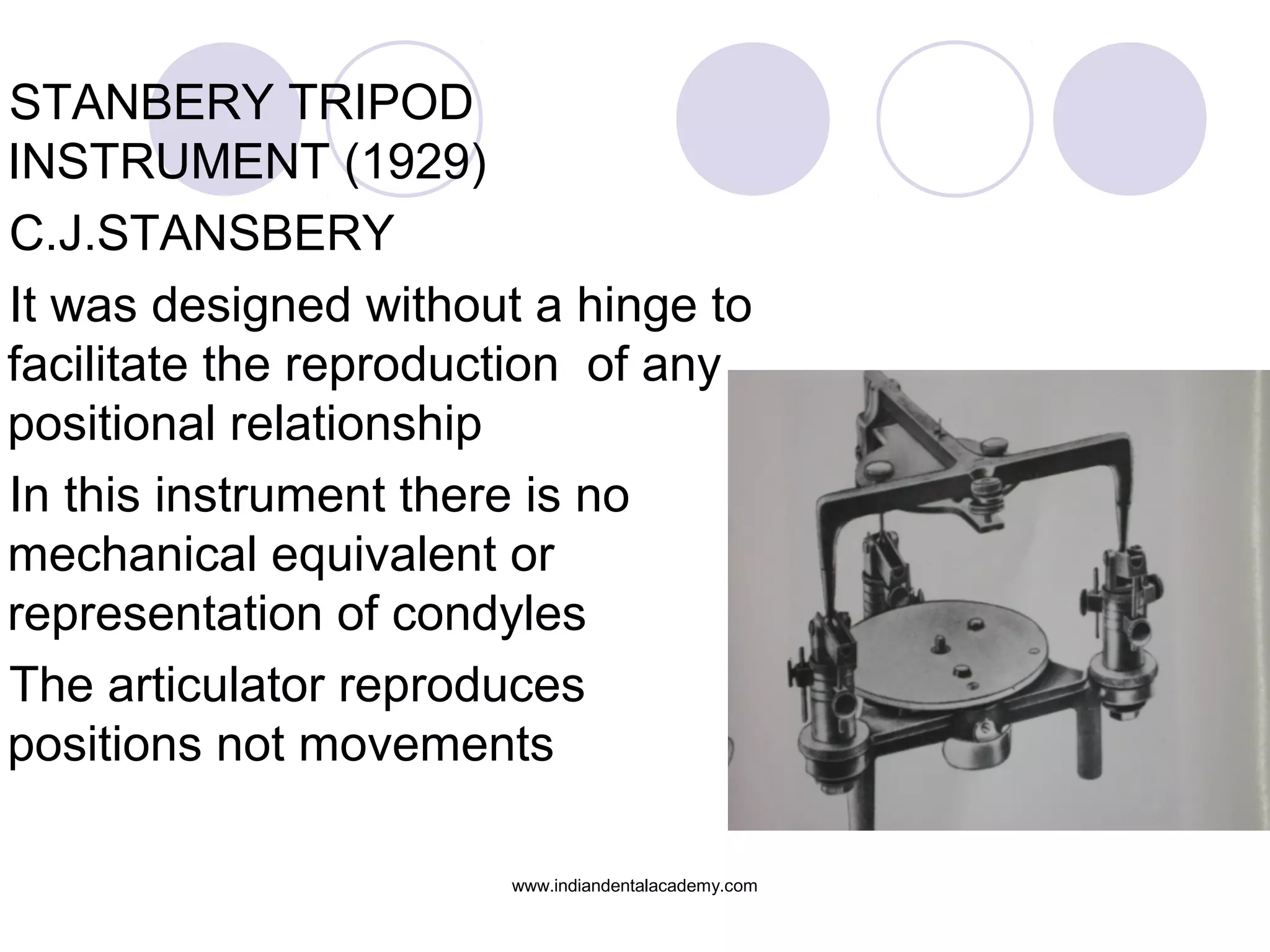
STANBERY TRIPOD
INSTRUMENT (1929)
C.J.STANSBERY
It was designed without a hinge to
facilitate the reproduction of any
positional relationship
In this instrument there is no
mechanical equivalent or
representation of condyles
The articulator reproduces
positions not movements
www.indiandentalacademy.com
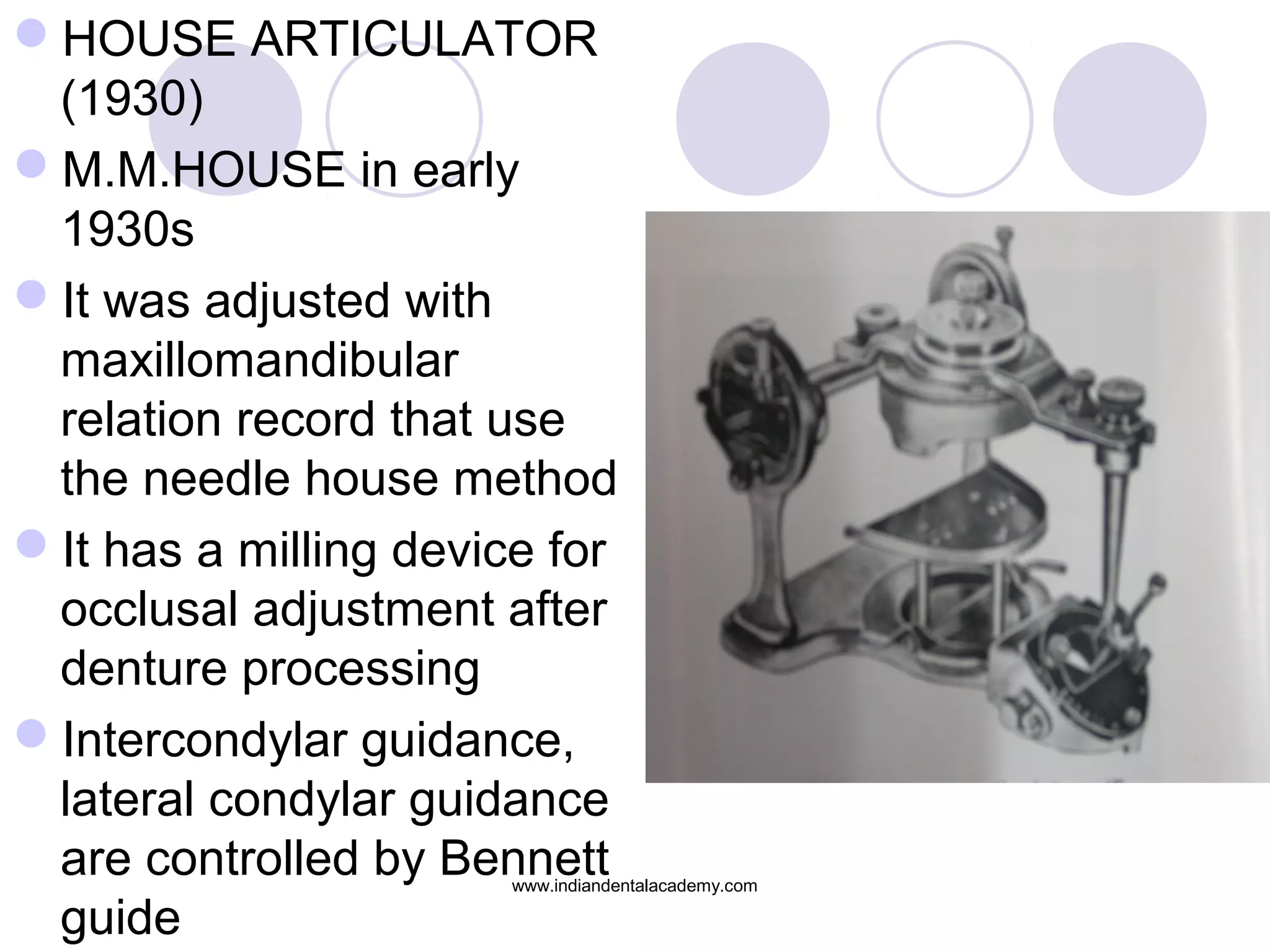
HOUSE ARTICULATOR
(1930)
M.M.HOUSE in early
1930s
It was adjusted with
maxillomandibular
relation record that use
the needle house method
It has a milling device for
occlusal adjustment after
denture processing
Intercondylar guidance,
lateral condylar guidance
are controlled by Bennett
guide

www.indiandentalacademy.com
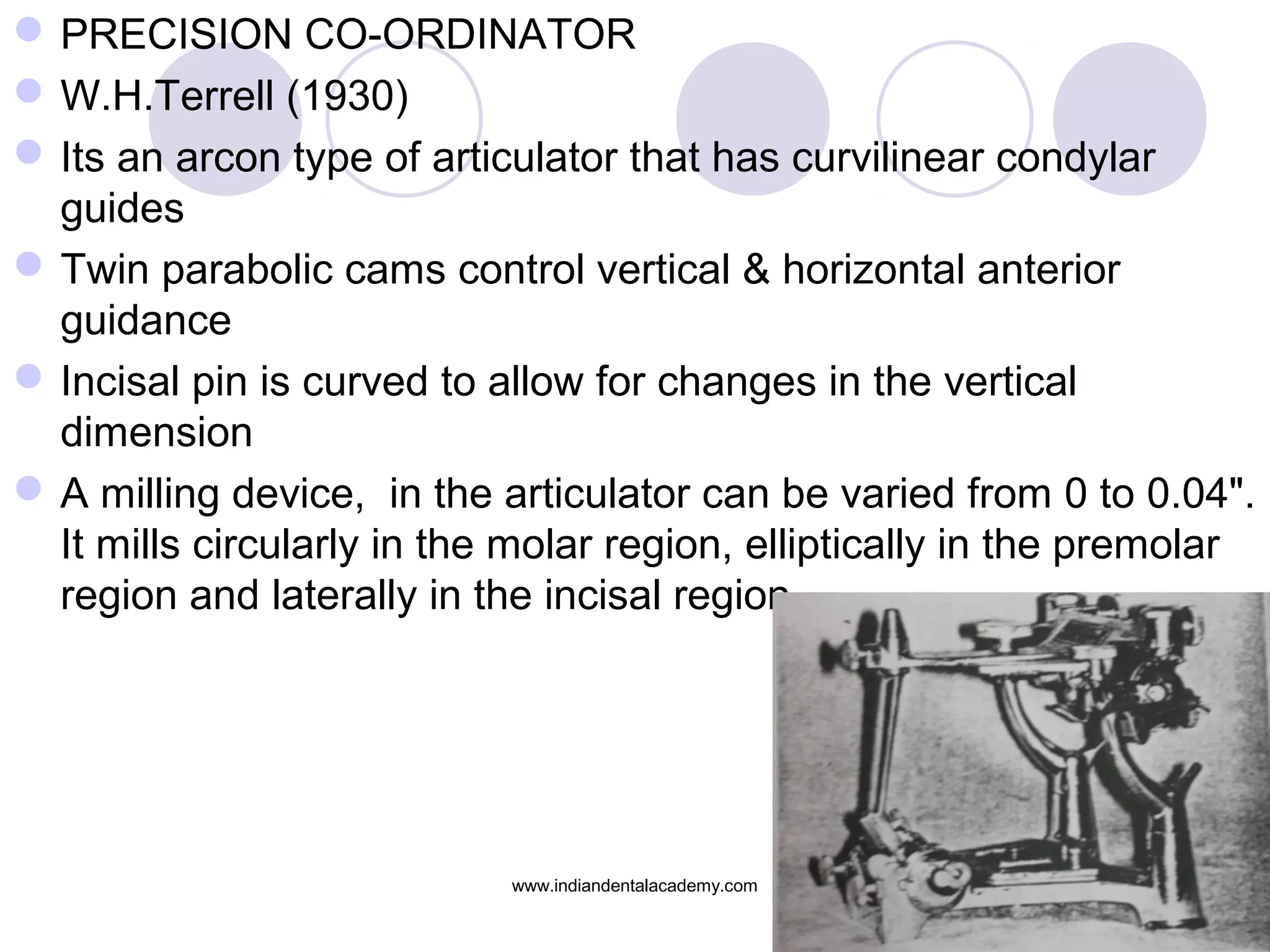
 PRECISION CO-ORDINATOR
 W.H.Terrell (1930)
 Its an arcon type of articulator that has curvilinear condylar
guides
 Twin parabolic cams control vertical & horizontal anterior
guidance
 Incisal pin is curved to allow for changes in the vertical
dimension
 A milling device, in the articulator can be varied from 0 to 0.04".
It mills circularly in the molar region, elliptically in the premolar
region and laterally in the incisal region

www.indiandentalacademy.com
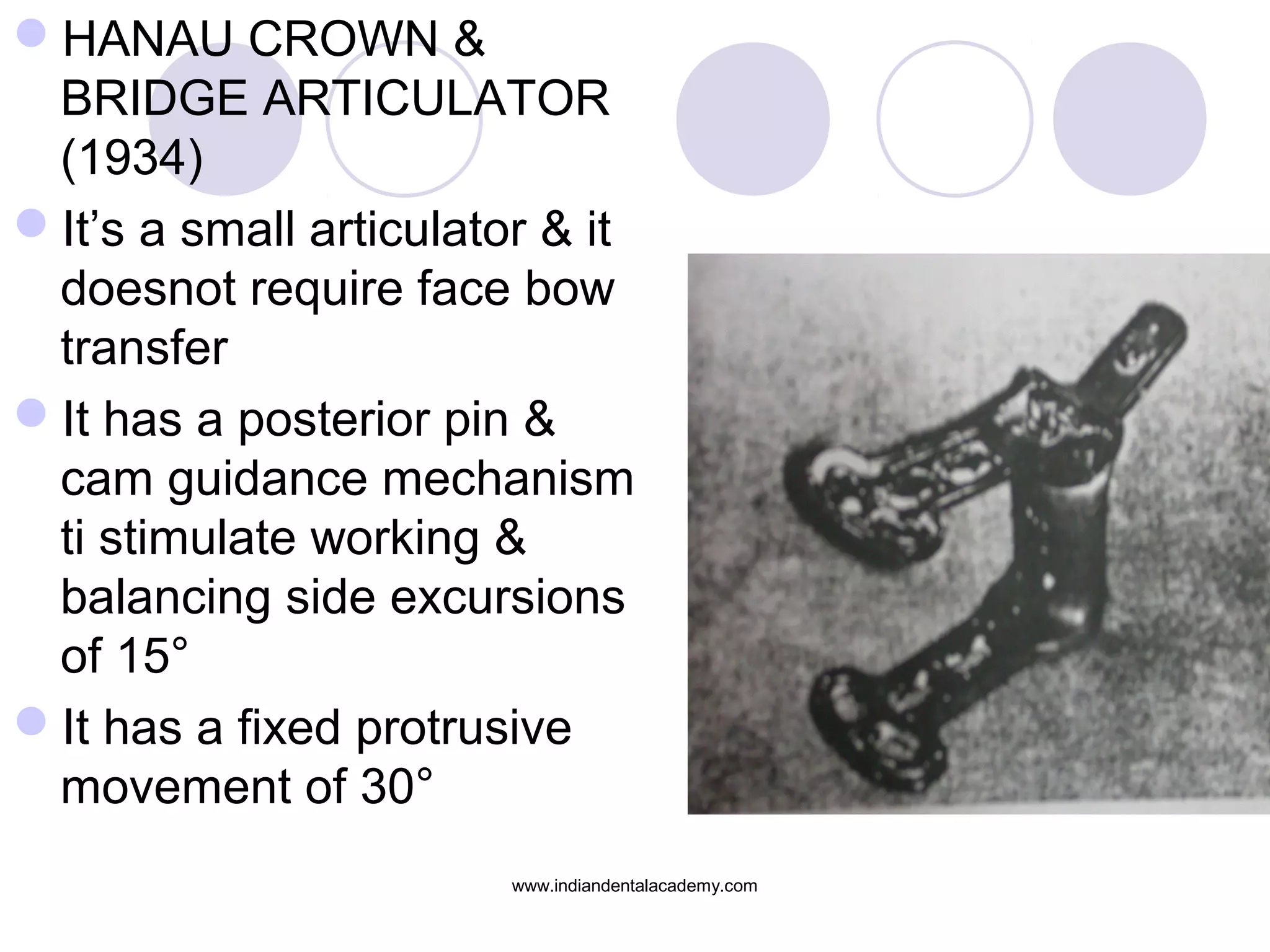
HANAU CROWN &
BRIDGE ARTICULATOR
(1934)
It’s a small articulator & it
doesnot require face bow
transfer
It has a posterior pin &
cam guidance mechanism
ti stimulate working &
balancing side excursions
of 15°
It has a fixed protrusive
movement of 30°
www.indiandentalacademy.com
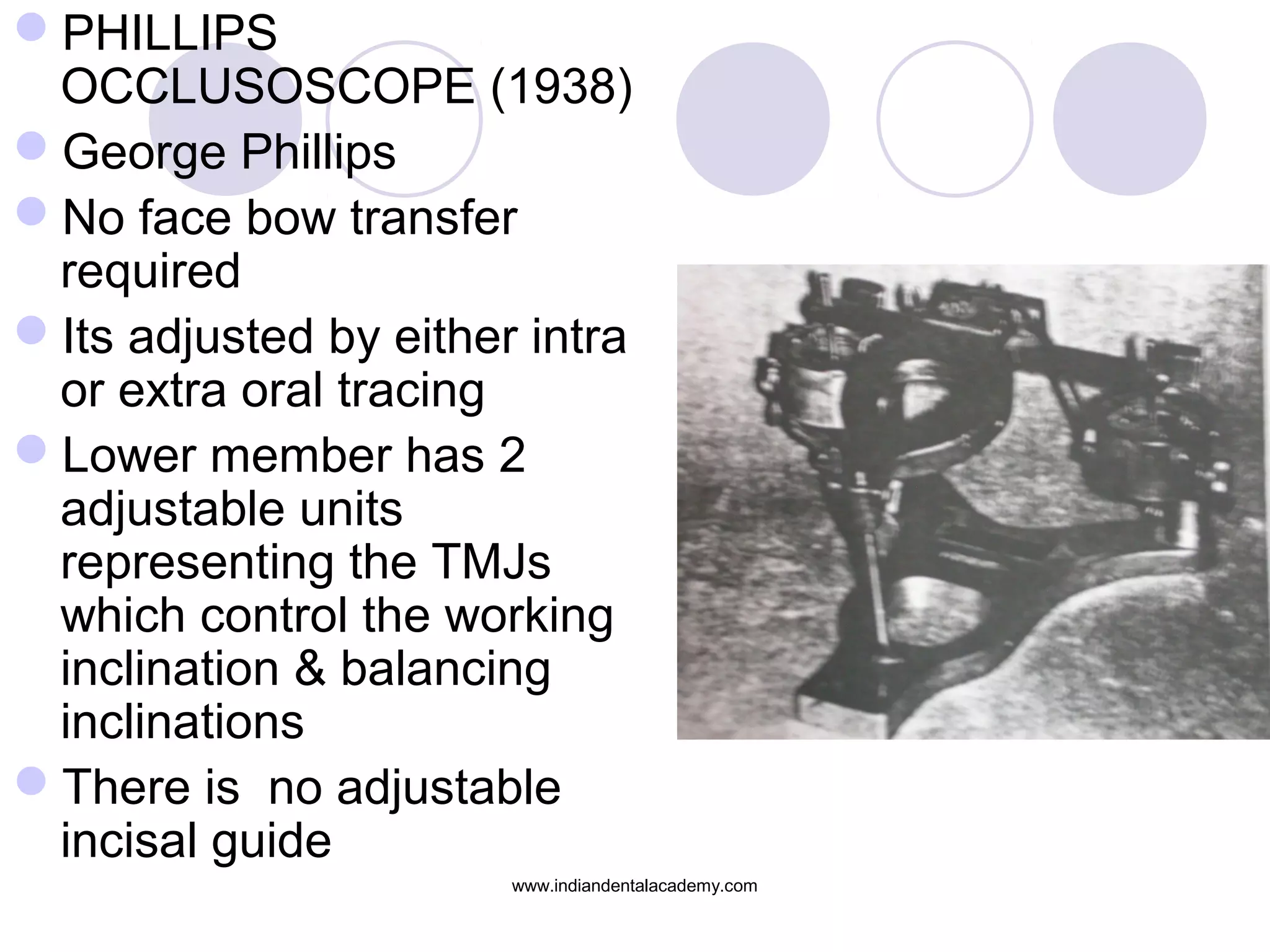
PHILLIPS
OCCLUSOSCOPE (1938)
George Phillips
No face bow transfer
required
Its adjusted by either intra
or extra oral tracing
Lower member has 2
adjustable units
representing the TMJs
which control the working
inclination & balancing
inclinations
There is no adjustable
incisal guide
www.indiandentalacademy.com
Thank you
For more details please visit
www.indiandentalacademy.com

www.indiandentalacademy.com

Articulatorpowerpoint /certified fixed orthodontic courses by Indian dental academy

  • 1.
    ART ICUL ORS AT INDIAN ACADEMY DENTAL Leader incontinuing dental education www.indiandentalacademy.com www.indiandentalacademy.com
  • 2.
    ART ICUL ORS AT Definition: Articulatormay be defined as a mechanical device that represents human Temporomandibular joint and jaw members to which maxillary ands mandibular cast are attached to simulate jaw movements. GPT www.indiandentalacademy.com
  • 3.
    FUNCTIONS The primary functionof the articulator is to act as a representative in patients It is used to simulate the patients Temporomandibular joint, muscles of mastication, mandibular ligaments, maxilla and mandible and the complex neuromuscular mechanism that programmes the mandibular movements. www.indiandentalacademy.com
  • 4.
    The articulator ismade to simulate the equivalent movements of the TMJ but does not duplicate or produce identical movements as in the human mouth It forms an important instrument to the dentist as it can be programmed with certain patients records allowing the operator and laboratory technician to fabricate a restoration that will be physiologically and psychologically acceptable. www.indiandentalacademy.com
  • 5.
    ADVANTAGES Properly mounted castallow the operated to better visualize the patient occlusion from the lingual side. Patient’ s co-operation is not required once the Interocclusal records are obtained from the patients Refinement of the complete dentures in the patient’ s mouth is extremely difficult because of shifting of denture bases and resiliency of the supporting tissues. This does not take place in the articulator. www.indiandentalacademy.com
  • 6.
    Chair side appointmentis reduced and more work can be designated to the auxiliary personnel. Patient’ s tongue saliva, check etc. are not a factors of hinderence under using the articulator www.indiandentalacademy.com
  • 7.
    LIMITATIONS An articulator isa mechanical device made by metal hence is subjected to error in tooling and there by resulting from fatigue and bear Articulator will not duplicate but simulates the condylar movements of TMJ www.indiandentalacademy.com
  • 8.
    REQUIREMENTS It should holdcasts in correct horizontal and vertical relationships i.e., centric relations. It should provide a positive anterior vertical stop. It should accept a face bow transfer record. It should open and close in a hinge movement. It should allow protrusive and lateral jaw motions Moving parts should move freely and accurately Moving parts should be often rigid construction Should be easy to fix and attach the maxillary and mandibular cast to the articulator and also to attach from the articulators www.indiandentalacademy.com
  • 9.
    Additional Requirements Adjustable horizontal,lateral condylar guide element & allow protrusive movements A mechanism to accept the 3rd point of reference from a face bow A terminal hinge locking positional device Removable mounting plates that can be positioned accurately An adjustable incisal guide table Adjustable intercondylar width of the condylar element www.indiandentalacademy.com
  • 10.
    Classification of Articulators An articulator classification was developedbased on the instruments function, instrument capability, intent, registration procedure and registration acceptance were considered. www.indiandentalacademy.com
  • 11.
    Classification based onTheories of Occlusion BONWILLS THEORY OF OCCLUSION CONICAL THEORY OF OCCLUSION  ( R.E.Hall ) SPHERICAL THEORY OF OCCLUSION (G.S.Monson 1918 ) www.indiandentalacademy.com
  • 12.
    BONWILLS THEORY OF OCCLUSION Alsoknow as THEORY OF EQUILATERAL TRIANGLE. It stated that a 4" (10 cm ) distance occurs between the condyles and between each condyle & the incisal point E.g. Bonwills articulator www.indiandentalacademy.com
  • 13.
    CONICAL THEORY OFOCCLUSION R.E.HALL proposed that the lower teeth move over the surface of the upper teeth as over the surface of a cone with an angle of 45° with the central axis of the cone tipped at 45° Angle to the occlusal plane E.g. Hall automatic articulator. teeth with 45° cusp are necessary to construct dentures on these articulators. www.indiandentalacademy.com
  • 14.
    SPHERICAL THEORY OF OCCLUSION(Monson 1918) Monson proposed that lower teeth moves over the surface of the upper teeth as over the surface of a sphere with a diameter of 8 " (20cm). the center of the sphere is located in the region of Glabella & the surfaces of the sphere passes through the Glenoid fossa along the articulating eminences. E.g. Maxillomandibular instrument. www.indiandentalacademy.com
  • 15.
    Drawbacks Articulators based ontheories of occlusion was that they made no provision for variation from the theoretical relationships that occurs in different people. www.indiandentalacademy.com
  • 16.
    CLASSIFICATION BASED ONTHE TYPES OF RECORDS USED FOR THEIR ADJUSTMENT  INTEROCCLUSAL RECORD ADJUSTMENT  GRAPHIC RECORD ADJUSTMENT  HINGE AXIS LOCATION FOR ADJUSTING ARTICULATORS www.indiandentalacademy.com
  • 17.
    INTEROCCLUSAL RECORD ADJUSTMENT These recordsmay be made in wax, dental plaster ZnOE paste or cold-cure acrylic resin. Each of these records are of only one positional relationship of the lower jaw to the upper jaw Either centric or to protrusive OR Centric or to lateral record E.g. Hanau articulators www.indiandentalacademy.com
  • 18.
    GRAPHIC RECORD ADJUSTMENT Thegraphic records consists of records of the extreme border positions of mandibular movement which are curved and the articulators must be capable of producing at least the equivalent of curved movements simple procedure if natural teeth exists in both jaws & it becomes difficult and unreliable in edentulous patients www.indiandentalacademy.com
  • 19.
    HINGE AXIS LOCATIONFOR ADJUSTING ARTICULATOR Correct location of the opening axis of mandibular hinge axis is essential for the correct adjustment of instrument www.indiandentalacademy.com
  • 20.
    CLASSIFICATION OF ARTICULATORS USINGNEW SYSTEMS FULLY ADJUSTABLE ARTICULATORS SEMI ADJUSTABLE ARTICULATORS NON ADJUSTABLE ARTICULATORS www.indiandentalacademy.com
  • 21.
    FULLY ADJUSTABLE ARTICULATORS Articulatorswhich can accept all the following 5 records 1).Face bow transfer 2) Centric jaw relation record 3) Protrusive record 4) Lateral records 5) Intercondylar distance record E.g.. Hanau kinescope(1923) Mc Collum Gnathoscope(1935) Granger Gnatholator (1950) Stuarticulator(1955) Ney-Depietro(1962) Hanau 130-21 (1953) Simulator (1968) Dentar D4-A (1968) www.indiandentalacademy.com
  • 22.
    SEMIADJUSTABLE ARTICULATORS Articulators whichcan accept the following 3 record 1).Face bow transfer 2) Centric jaw relation record 3) Protrusive record www.indiandentalacademy.com
  • 23.
    E.g. Snow Acme (1910) GysiAdaptable (1910) (does not accept lateral record ) Wadsworth (1924) Hanau H (1922) Gysi Trubyte (1926) (does not accept intercondylar records ) House(1927) (does not accept intercondylar records & satisfies Bonwills principle) Dentatus (1944) Bergstorm Arcon(1950) Hanau 130-28 (1963) Whip-mix (1968) www.indiandentalacademy.com
  • 24.
    NONADJUSTABLE ARTICULATORS Articulators whichcan accept 1 OR 2 of the following 3 records 1).Face bow transfer 2) Centric jaw relation record 3) Protrusive record Gariot (1805) Evans (1840) Barn door hinge (1858) Bonwill (1858) Walker (1896) Has adjustable condylar guidance but does not accept face bow record www.indiandentalacademy.com
  • 25.
    Gritman (1899) Snow (1906) Gysisimplex(1912 ) Monson (1918) Stansbery (1929)  Based on Tripod theory (no condylar control ) Phillips Occlusoscope (1931) (tripod theory & does not accept face bow record ) Kile Dentograph (1945 ) ( tripod principle ) Transograph (1952 ) ( contains 2 face bows & no condylar guidance ) Pankey-Mann (1955) (Based on spherical theory ) www.indiandentalacademy.com
  • 26.
    BASED ON INSTRUMENTFUNCTION International Prosthodontics workshop Class I – Simple holding instruments capable of accepting a single static registration. Vertical motion is possible, but only for convenience E.g.. Slab articulator, barn door hinge articulator www.indiandentalacademy.com
  • 27.
    Class II –Instrument that permit horizontal as well as vertical motion but do not orient the motion to the TMJ via, a face bow transfer. Class II AThese articulators permit eccentric motion based on average or arbitrary values. E.g.. – GYSI Simplex articulators. www.indiandentalacademy.com
  • 28.
    Class II B-Articulators permit only eccentric movements based on theories of arbitrary motion. E.g..-Monson Maxillomandibular articulators www.indiandentalacademy.com
  • 29.
    Class IIC Articulators permit eccentric motion determined by the patient using engravingmethods E.g..-House articulator www.indiandentalacademy.com
  • 30.
    Class III –Instrument can accept a face bow transfer. Class III A- Instrument that accept a static protrusive registration and use equivalents for the rest of the motion E.g.: Hanau Model-H Articulator www.indiandentalacademy.com
  • 31.
    Class III B-Instrument in this class accept a face bow transfer, protrusive Interocclusal records, and some lateral Interocclusal records E.g.: Trubyte articulator www.indiandentalacademy.com
  • 32.
    Class IV –Instruments that will accepts three dimensional dynamic registration Class IV A- Instruments in this class will accept three dimensional dynamic registrations and utilize a face bow transfer E.g.: TMJ articulators www.indiandentalacademy.com
  • 33.
    Class IV B– Instrument in this class will accept three dimensional dynamic registrations and utilize a face bow transfer E.g.:- Denar www.indiandentalacademy.com
  • 34.
    Posselt Classification Plane lineor simple hinge type Mean value type with fixed condylar part Adjustable type In the first two types no control mechanism exists. Only the Interocclusal centric relation can be recorded. They lack individualized information concerning spatial relationship and occlusal arrangement of artificial teeth. So may not resemble patient actual jaw movements www.indiandentalacademy.com
  • 35.
    Arcon and Non-Arconarticulators Arcon Type: Instruments with condyles in the lower member and condylar guides on the upper. i.e., lower member is movable. Non-Arcon type: Condyles are on the upper member and condylar guides on the lower member www.indiandentalacademy.com
  • 36.
    MEAN VALUE ARTICULATOROR FIXED ARTICULATOR OR THREE POINT ARTICULATOR It consists an upper and lower member representing the maxilla and mandible Opens and closes around a axis i.e., the condylar shaft Shaft is engaged in the condylar slot representing glenoid fossa Vertical Separation is done by vertical pin Vertical pin consists of a mid incisal pin Condylar slot is inclined at the angulation of 33 0 to the horizontal plane www.indiandentalacademy.com
  • 37.
  • 38.
    Distance between thetwo condyle slots is fixed and is 110 mm Vertical pin rests on incisal table Incisal table has an angulation of 50 into the horizontal plane The distance between the centre of the centre of the condyle shaft and mid incisive pin is again.110 mm. Based on Bonwill equilateral triangle www.indiandentalacademy.com
  • 39.
    HISTORY OF ARTICULATORS UPTO1940 www.indiandentalacademy.com
  • 40.
    PLASTER ARTICULATORS It was1st described by Phillips Pfaff (1756) A plaster extension on the distal portion of the mandibular cast was grooved to serve as a guide for a plaster extension of the maxillary cast. The extended casts together constituted the 1st articulator, commonly called a SLAB ARTICULATOR www.indiandentalacademy.com
  • 41.
    BARN DOOR HINGE Itshinge is modified by bending each arm 90°  FORM L-shaped upper & lower members. www.indiandentalacademy.com
  • 42.
    ADAPTABLE BARN DOORHINGE It is capable of opening & closing only in a hinge movement. It has an anterior vertical stop, which is usually a machine bolt. www.indiandentalacademy.com
  • 43.
    GARIOT HINGE JOINT ARTICULATOR (J.B.GARIOT(1805) It consists of 2 metal frames to which the casts are attached with a simple hinge & a set screw to hold the frames in fixed vertical position. www.indiandentalacademy.com
  • 44.
    BOWILLS ARTICULATOR(1858 ) It’s the 1starticulator developed to imitate the movements of the mandible in eccentric position. Based on Bonwills theory of equilateral triangle www.indiandentalacademy.com
  • 45.
    KERR ARTICULATOR (1902) It hasfixed protrusive & lateral movements Hinge is located on approximately the same plane as the occlusal plane of the mounted cast. www.indiandentalacademy.com
  • 46.
    NEW CENTURY ARTICULATOR(1906) George B.Snow It has a tension spring which allows a greater range of movement Rotation centers placed 4" apart in accordance with Bonwills theory Modified articulator has an incisal pin & post extension added to lower member to prevent tipping www.indiandentalacademy.com
  • 47.
    ACME ARTICULATOR (1910) GeorgeB.Snow Its an elaboration of New Century Instrument (1910) 3 models of different widths that accommodate 3 ranges of intercondylar distance Condylar paths are straight & adjustable condylar inclinations Provided Bennett movement Posterior adjustment is possible to increse the distance between upper & lower members Guiding mechanisms are on the upper member www.indiandentalacademy.com
  • 48.
     GYSI ADAPTABLE& GYSI SIMPLEX ARTICULATOR (1910)  Alfred Gysi  It was beyond the technical ability & finances of most dentists  Extra oral tracing & parallel Condylar path plates accepted  Gysi simplex (1914)was introduced as a mean value articulator  It does not require great technical ability to operate & competitively priced  Condylar guidance is fixed at 33° & is shaped like the ogee path (S shaped curve in profile) www.indiandentalacademy.com  Incisal guide is not adjustable
  • 49.
    MAXILLOMANDIBULAR INSTRUMENT (1918) George Monson Basedon spherical theory It has set screws to vary the instruments radius www.indiandentalacademy.com
  • 50.
     HAGMAN BALANCER(1920)  Based on Spherical theory of occlusion  It opens & closes on a hinge that is in the center of the upright support  It doesnot require facebow & interocclusal records for mounting  This technique directs reconstruction of the mandibular teeth to the curve of Spee using a balanced occlusal guide  The maxillary teeth are constructed secondarily to conform to www.indiandentalacademy.com the mandibular teeth
  • 51.
    STEPHANS ARTICULATOR (1921) Simiar togariots hinge articulator It has fixed condylar inlination & allows for an arbitrary lateral movement A posterior set screw holds the upper & lower members of the articulator at a fixed vertical dimension www.indiandentalacademy.com
  • 52.
    HANAU MODEL M KINOSCOPE(1923) Rudolph L.Hanau an engineer was influenced by Dr.Rupert E.Hall to study the design of articulators It has double condylar posts on each side Inner posts serve 2 purposes: they act as horizontal condylar guides & they have variable rotation centers when the posts are moved inward or outward. Outer post- it helps to adjust the Bennett angle www.indiandentalacademy.com
  • 53.
    HOMER RELATOR (1923) JosephHomer Plastic material rather than mechanical guides is used to preserve articulator position 3 cups in lower member filled with plastic material (impression compound) capture the record & record the tripoded upper member into the recorded positions Same principle is used in Irish Duplifunctional & TMJ instruments www.indiandentalacademy.com
  • 54.
    WADSWORTH ARTICULATOR (1924) Frank Wadsworth Basedon Monson's spherical theory Casts are mounted with a face bow & Wadsworth T-attachment which determines the 3rd point of reference It does not accept bilateral condylar symmetry  It has adjustable intercondylar distances www.indiandentalacademy.com
  • 55.
    HANAU MODEL H110(1922) It has individual condylar guidance adjustments in both sagittal & horizontal planes It has incisal guide cup with its fixed curvature could be moved only as a unit & it did not have calibrations for resetting Lateral setting is calculated by dividing the horizontal condylar inclination by 8 and adding 12 L = H8 + 12 www.indiandentalacademy.com
  • 56.
    HANAU MODEL H110MODIFIED (1927) It has incisal guide table with calibrations instead of the incisal guide cup www.indiandentalacademy.com
  • 57.
    PHILIPS STUDENT (PANTOGRAPHIC) ARTICULATOR (1929) George P.Philips It’s a fully adaptable articulator because it follows any graphic record It was designed to trace Gothic arch (needlepoint ) tracing & inclination of the glenoid fossa in one step www.indiandentalacademy.com
  • 58.
    STANBERY TRIPOD INSTRUMENT (1929) C.J.STANSBERY Itwas designed without a hinge to facilitate the reproduction of any positional relationship In this instrument there is no mechanical equivalent or representation of condyles The articulator reproduces positions not movements www.indiandentalacademy.com
  • 59.
    HOUSE ARTICULATOR (1930) M.M.HOUSE inearly 1930s It was adjusted with maxillomandibular relation record that use the needle house method It has a milling device for occlusal adjustment after denture processing Intercondylar guidance, lateral condylar guidance are controlled by Bennett guide www.indiandentalacademy.com
  • 60.
     PRECISION CO-ORDINATOR W.H.Terrell (1930)  Its an arcon type of articulator that has curvilinear condylar guides  Twin parabolic cams control vertical & horizontal anterior guidance  Incisal pin is curved to allow for changes in the vertical dimension  A milling device, in the articulator can be varied from 0 to 0.04". It mills circularly in the molar region, elliptically in the premolar region and laterally in the incisal region www.indiandentalacademy.com
  • 61.
    HANAU CROWN & BRIDGEARTICULATOR (1934) It’s a small articulator & it doesnot require face bow transfer It has a posterior pin & cam guidance mechanism ti stimulate working & balancing side excursions of 15° It has a fixed protrusive movement of 30° www.indiandentalacademy.com
  • 62.
    PHILLIPS OCCLUSOSCOPE (1938) George Phillips Noface bow transfer required Its adjusted by either intra or extra oral tracing Lower member has 2 adjustable units representing the TMJs which control the working inclination & balancing inclinations There is no adjustable incisal guide www.indiandentalacademy.com
  • 63.
    Thank you For moredetails please visit www.indiandentalacademy.com www.indiandentalacademy.com