Introduction
The development of students’ creativity, skills and
imagination progress are in a sequential process.
Teaching art will enhance students’ creativity,
imagination, and self-esteem, critical thinking, and
learning.
Learning progression map
5 Activities chosen to identify and apply one or more art elements
to create artworks
Activity 1:
Indicator:
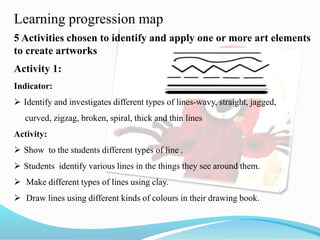
 Identify and investigates different types of lines-wavy, straight, jagged,
curved, zigzag, broken, spiral, thick and thin lines
Activity:
 Show to the students different types of line .
 Students identify various lines in the things they see around them.
 Make different types of lines using clay.
 Draw lines using different kinds of colours in their drawing book.
Activity 2:
Indicator:
 Recognizes basic shapes ( circle, square, etc.) and free-form organic shapes
( puddle, water drop, leaves, flowers, clouds etc. ) and use them to make works of
art.
Activity:
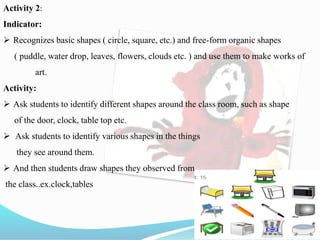
 Ask students to identify different shapes around the class room, such as shape
of the door, clock, table top etc.
 Ask students to identify various shapes in the things
they see around them.
 And then students draw shapes they observed from
the class..ex.clock,tables
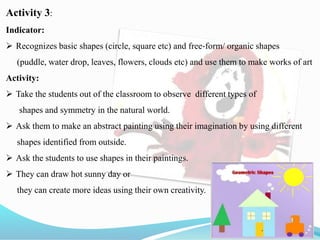
Activity 3:
Indicator:
 Recognizes basic shapes (circle, square etc) and free‐form/ organic shapes
(puddle, water drop, leaves, flowers, clouds etc) and use them to make works of art
Activity:
 Take the students out of the classroom to observe different types of
shapes and symmetry in the natural world.
 Ask them to make an abstract painting using their imagination by using different
shapes identified from outside.
 Ask the students to use shapes in their paintings.
 They can draw hot sunny day or
they can create more ideas using their own creativity.
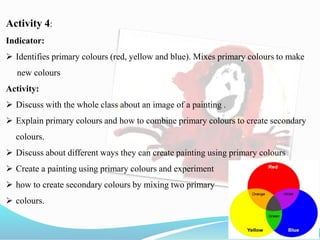
Activity 4:
Indicator:
 Identifies primary colours (red, yellow and blue). Mixes primary colours to make
new colours
Activity:
 Discuss with the whole class about an image of a painting .
 Explain primary colours and how to combine primary colours to create secondary
colours.
 Discuss about different ways they can create painting using primary colours
 Create a painting using primary colours and experiment
 how to create secondary colours by mixing two primary
 colours.
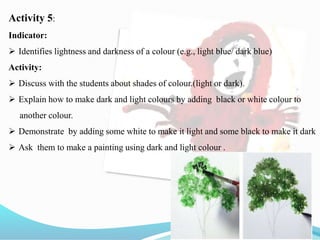
Activity 5:
Indicator:
 Identifies lightness and darkness of a colour (e.g., light blue/ dark blue)
Activity:
 Discuss with the students about shades of colour.(light or dark).
 Explain how to make dark and light colours by adding black or white colour to
another colour.
 Demonstrate by adding some white to make it light and some black to make it dark
 Ask them to make a painting using dark and light colour .
Student’s Artwork Description
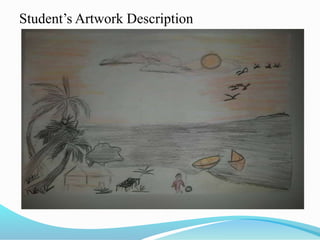
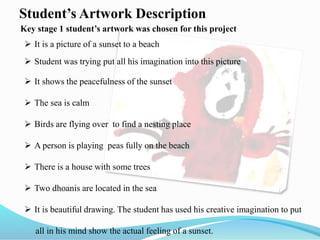
 It is a picture of a sunset to a beach
 Student was trying put all his imagination into this picture
 It shows the peacefulness of the sunset
 The sea is calm
 Birds are flying over to find a nesting place
 A person is playing peas fully on the beach
 There is a house with some trees
 Two dhoanis are located in the sea
 It is beautiful drawing. The student has used his creative imagination to put
all in his mind show the actual feeling of a sunset.
Key stage 1 student’s artwork was chosen for this project
Picture Analysis
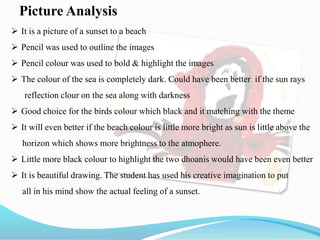
 It is a picture of a sunset to a beach
 Pencil was used to outline the images
 Pencil colour was used to bold & highlight the images
 The colour of the sea is completely dark. Could have been better if the sun rays
reflection clour on the sea along with darkness
 Good choice for the birds colour which black and it matching with the theme
 It will even better if the beach colour is little more bright as sun is little above the
horizon which shows more brightness to the atmophere.
 Little more black colour to highlight the two dhoanis would have been even better
 It is beautiful drawing. The student has used his creative imagination to put
all in his mind show the actual feeling of a sunset.
Discussion
Positive
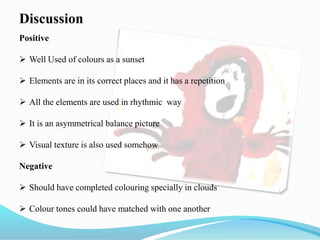
 Well Used of colours as a sunset
 Elements are in its correct places and it has a repetition
 All the elements are used in rhythmic way
 It is an asymmetrical balance picture
 Visual texture is also used somehow
Negative
 Should have completed colouring specially in clouds
 Colour tones could have matched with one another
Conclusion
In this assignment, I have realized that arts education
helps students to develop skills that are needed for most
jobs in later life, including creative thinking, problem
solving, exercise of individual responsibility, sociability
and self-esteem.
References
1. Shirumeen Ahmed & Mohamed Ashir (2015), Exploring Creative Arts, teacher’s
guide, A joint publication of National Institute of Education, Maldives and
Cambridge University Press, India.
2. Anna Reyner, (2008), Art Influences Learning, Articles, The Professional Resource
for Teachers & Parents , Excelligence Learning Corporation, Retrieved from:
http://www.earlychildhoodnews.com/earlychildhood/article_view.aspx?ArticleID=
509
Art ppt by jeeza

Art ppt by jeeza

  • 2.
    Introduction The development ofstudents’ creativity, skills and imagination progress are in a sequential process. Teaching art will enhance students’ creativity, imagination, and self-esteem, critical thinking, and learning.
  • 3.
    Learning progression map 5Activities chosen to identify and apply one or more art elements to create artworks Activity 1: Indicator:  Identify and investigates different types of lines-wavy, straight, jagged, curved, zigzag, broken, spiral, thick and thin lines Activity:  Show to the students different types of line .  Students identify various lines in the things they see around them.  Make different types of lines using clay.  Draw lines using different kinds of colours in their drawing book.
  • 4.
    Activity 2: Indicator:  Recognizesbasic shapes ( circle, square, etc.) and free-form organic shapes ( puddle, water drop, leaves, flowers, clouds etc. ) and use them to make works of art. Activity:  Ask students to identify different shapes around the class room, such as shape of the door, clock, table top etc.  Ask students to identify various shapes in the things they see around them.  And then students draw shapes they observed from the class..ex.clock,tables
  • 5.
    Activity 3: Indicator:  Recognizesbasic shapes (circle, square etc) and free‐form/ organic shapes (puddle, water drop, leaves, flowers, clouds etc) and use them to make works of art Activity:  Take the students out of the classroom to observe different types of shapes and symmetry in the natural world.  Ask them to make an abstract painting using their imagination by using different shapes identified from outside.  Ask the students to use shapes in their paintings.  They can draw hot sunny day or they can create more ideas using their own creativity.
  • 6.
    Activity 4: Indicator:  Identifiesprimary colours (red, yellow and blue). Mixes primary colours to make new colours Activity:  Discuss with the whole class about an image of a painting .  Explain primary colours and how to combine primary colours to create secondary colours.  Discuss about different ways they can create painting using primary colours  Create a painting using primary colours and experiment  how to create secondary colours by mixing two primary  colours.
  • 7.
    Activity 5: Indicator:  Identifieslightness and darkness of a colour (e.g., light blue/ dark blue) Activity:  Discuss with the students about shades of colour.(light or dark).  Explain how to make dark and light colours by adding black or white colour to another colour.  Demonstrate by adding some white to make it light and some black to make it dark  Ask them to make a painting using dark and light colour .
  • 8.
  • 9.
    Student’s Artwork Description It is a picture of a sunset to a beach  Student was trying put all his imagination into this picture  It shows the peacefulness of the sunset  The sea is calm  Birds are flying over to find a nesting place  A person is playing peas fully on the beach  There is a house with some trees  Two dhoanis are located in the sea  It is beautiful drawing. The student has used his creative imagination to put all in his mind show the actual feeling of a sunset. Key stage 1 student’s artwork was chosen for this project
  • 10.
    Picture Analysis  Itis a picture of a sunset to a beach  Pencil was used to outline the images  Pencil colour was used to bold & highlight the images  The colour of the sea is completely dark. Could have been better if the sun rays reflection clour on the sea along with darkness  Good choice for the birds colour which black and it matching with the theme  It will even better if the beach colour is little more bright as sun is little above the horizon which shows more brightness to the atmophere.  Little more black colour to highlight the two dhoanis would have been even better  It is beautiful drawing. The student has used his creative imagination to put all in his mind show the actual feeling of a sunset.
  • 11.
    Discussion Positive  Well Usedof colours as a sunset  Elements are in its correct places and it has a repetition  All the elements are used in rhythmic way  It is an asymmetrical balance picture  Visual texture is also used somehow Negative  Should have completed colouring specially in clouds  Colour tones could have matched with one another
  • 12.
    Conclusion In this assignment,I have realized that arts education helps students to develop skills that are needed for most jobs in later life, including creative thinking, problem solving, exercise of individual responsibility, sociability and self-esteem.
  • 13.
    References 1. Shirumeen Ahmed& Mohamed Ashir (2015), Exploring Creative Arts, teacher’s guide, A joint publication of National Institute of Education, Maldives and Cambridge University Press, India. 2. Anna Reyner, (2008), Art Influences Learning, Articles, The Professional Resource for Teachers & Parents , Excelligence Learning Corporation, Retrieved from: http://www.earlychildhoodnews.com/earlychildhood/article_view.aspx?ArticleID= 509