Drawing & Painting with Style and Confidence Presented by Anne Kullaf Anne Kullaf © 2008 Pastel   Fundamentals
Course premise… This course is designed to provide a basic primer for students new to painting with pastels. It will cover the technical aspects of working with the materials as well as general concepts of color, composition and design.
Course Overview… During this course we will explore the following topics: Methods & Materials: Overview of materials and options for surfaces to work on Layering Blending vs. not blending Color: Working with complementary colors Working with a limited palette Composition: Creating balance with shape, value and color
Pastels Pastel  is an art medium in the form of a stick, consisting of pure powdered pigment and a binder. The pigments used in pastels are the same as those used to produce all colored art media, including oil paints; the binder is of a neutral hue and low saturation.
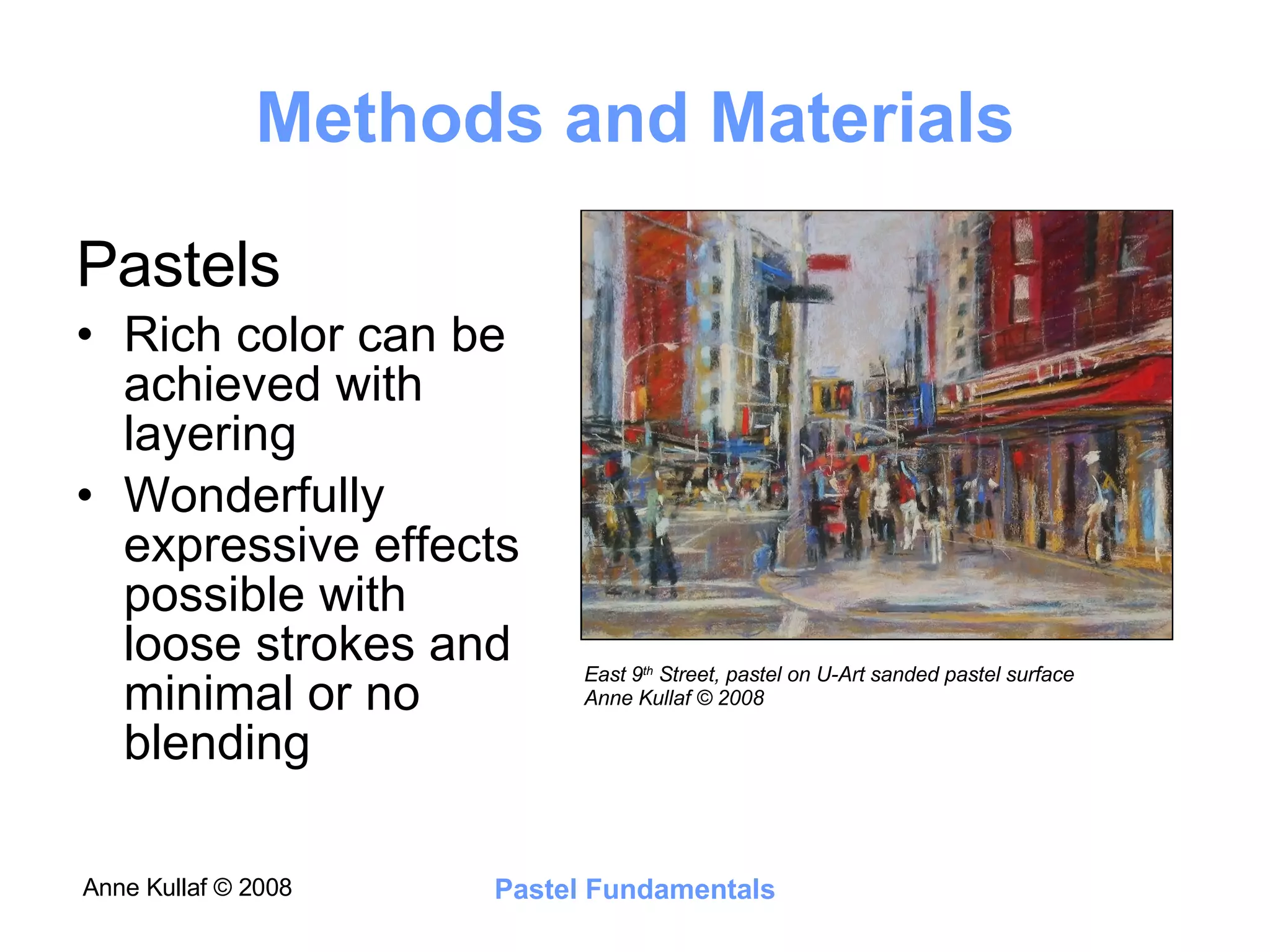
Methods and Materials Pastels Rich color can be achieved with layering Wonderfully expressive effects possible with loose strokes and minimal or no blending East 9 th  Street, pastel on U-Art sanded pastel surface Anne Kullaf  © 2008
Methods and Materials Support Surfaces Canson paper – good for quick sketching, but limits the amount of layering that can be done Art Spectrum sanded paper – a good economical brand of sanded paper that will take a good amount of layering Sennelier La Carte pastel card – excellent higher end paper that accepts layers beautifully, archival, comes in a variety of colors Wallis sanded paper – professional and museum grades available, excellent high end paper for maximum layering
Methods and Materials Pastels Hard pastels – NuPastels, Yarka Russian pastels, excellent for under layers Medium pastels – Rembrandt, Unison, Mount Vision are excellent medium hardness pastels, use these for layering on top of hard pastels Soft pastels – Sennelier, Schmienke pastels are ultra soft and best used for the upper most layers
Methods and Materials Working in layers Begin with a charcoal sketch to establish values Using hard pastels, layer on top of the charcoal sketch beginning with dark and medium values first Continue to layer, migrate to medium hardness pastels as you add lighter and brighter colors Finish with soft pastels for the highlights and lightest areas of the painting Fifth Ave, pastel on Wallis sanded pastel surface Anne Kullaf  © 2008
Color
Color Basics Colors that complement one another should be used to create shadows and darks, in other words, colors that appear opposite one another on the color wheel Example: if you need show a shaded area on a lemon (yellow, primary color) use violet (secondary color) Mix your secondary colors whenever possible instead of using them directly from the tube
The Limited Palette This is a little more complicated with pastel than it is with paint because you need to mix your colors optically on the surface rather than on a palette Try limiting yourself to about 6 colors of hard pastels as you begin your painting Add in more colors as you move from hard to medium pastels, choose brighter shades as you begin layering At the very end when you add in your highlights and brightest colors with soft pastels, add in a hint of unexpected color throughout the composition, choose a color that will work harmoniously with the colors present in the painting
Composition
Composition Basics Composition refers to the way you arrange the elements/objects contained in your painting in order to create and maintain: Balance Harmony Viewer interest Magnolia Tree,  pastel on Art Spectrum sanded pastel surface, Anne Kullaf  © 2008
Focal Point vs. Overall Movement There are many approaches to composition, all are a matter of personal preference and what you want to say with your painting For example, you may wish to have an overall sense of movement rather than a strong focal point—either one can work but each will convey a different mood and feeling in your finished work Times Square,  pastel sketch on Canson paper, Anne Kullaf  © 2008
Look for things that repeat to keep your composition cohesive and to engage your viewer: Shapes Colors Directional movement Motion Look for examples of  the items listed above  in the painting at right Composition Basics
Tying it all together…
Tying it all together… Painting with pastels provides rich color and a sense of expressiveness You can work on a variety of surfaces including paper and special surfaces designed specifically for pastel Layering is key to color depth and dimensionality Focus on shapes and values – sketch in charcoal first! Experiment with larger loose strokes and avoid over blending for a painterly feeling Use complementary colors for shading Try working with a limited palette Paint from life whenever you can, either outdoors or in your studio If you work from photos, try not to “copy” the photo, instead use it just for inspiration and reference

Pastel Fundamentals

  • 1.
    Drawing & Paintingwith Style and Confidence Presented by Anne Kullaf Anne Kullaf © 2008 Pastel Fundamentals
  • 2.
    Course premise… Thiscourse is designed to provide a basic primer for students new to painting with pastels. It will cover the technical aspects of working with the materials as well as general concepts of color, composition and design.
  • 3.
    Course Overview… Duringthis course we will explore the following topics: Methods & Materials: Overview of materials and options for surfaces to work on Layering Blending vs. not blending Color: Working with complementary colors Working with a limited palette Composition: Creating balance with shape, value and color
  • 4.
    Pastels Pastel is an art medium in the form of a stick, consisting of pure powdered pigment and a binder. The pigments used in pastels are the same as those used to produce all colored art media, including oil paints; the binder is of a neutral hue and low saturation.
  • 5.
    Methods and MaterialsPastels Rich color can be achieved with layering Wonderfully expressive effects possible with loose strokes and minimal or no blending East 9 th Street, pastel on U-Art sanded pastel surface Anne Kullaf © 2008
  • 6.
    Methods and MaterialsSupport Surfaces Canson paper – good for quick sketching, but limits the amount of layering that can be done Art Spectrum sanded paper – a good economical brand of sanded paper that will take a good amount of layering Sennelier La Carte pastel card – excellent higher end paper that accepts layers beautifully, archival, comes in a variety of colors Wallis sanded paper – professional and museum grades available, excellent high end paper for maximum layering
  • 7.
    Methods and MaterialsPastels Hard pastels – NuPastels, Yarka Russian pastels, excellent for under layers Medium pastels – Rembrandt, Unison, Mount Vision are excellent medium hardness pastels, use these for layering on top of hard pastels Soft pastels – Sennelier, Schmienke pastels are ultra soft and best used for the upper most layers
  • 8.
    Methods and MaterialsWorking in layers Begin with a charcoal sketch to establish values Using hard pastels, layer on top of the charcoal sketch beginning with dark and medium values first Continue to layer, migrate to medium hardness pastels as you add lighter and brighter colors Finish with soft pastels for the highlights and lightest areas of the painting Fifth Ave, pastel on Wallis sanded pastel surface Anne Kullaf © 2008
  • 9.
  • 10.
    Color Basics Colorsthat complement one another should be used to create shadows and darks, in other words, colors that appear opposite one another on the color wheel Example: if you need show a shaded area on a lemon (yellow, primary color) use violet (secondary color) Mix your secondary colors whenever possible instead of using them directly from the tube
  • 11.
    The Limited PaletteThis is a little more complicated with pastel than it is with paint because you need to mix your colors optically on the surface rather than on a palette Try limiting yourself to about 6 colors of hard pastels as you begin your painting Add in more colors as you move from hard to medium pastels, choose brighter shades as you begin layering At the very end when you add in your highlights and brightest colors with soft pastels, add in a hint of unexpected color throughout the composition, choose a color that will work harmoniously with the colors present in the painting
  • 12.
  • 13.
    Composition Basics Compositionrefers to the way you arrange the elements/objects contained in your painting in order to create and maintain: Balance Harmony Viewer interest Magnolia Tree, pastel on Art Spectrum sanded pastel surface, Anne Kullaf © 2008
  • 14.
    Focal Point vs.Overall Movement There are many approaches to composition, all are a matter of personal preference and what you want to say with your painting For example, you may wish to have an overall sense of movement rather than a strong focal point—either one can work but each will convey a different mood and feeling in your finished work Times Square, pastel sketch on Canson paper, Anne Kullaf © 2008
  • 15.
    Look for thingsthat repeat to keep your composition cohesive and to engage your viewer: Shapes Colors Directional movement Motion Look for examples of the items listed above in the painting at right Composition Basics
  • 16.
    Tying it alltogether…
  • 17.
    Tying it alltogether… Painting with pastels provides rich color and a sense of expressiveness You can work on a variety of surfaces including paper and special surfaces designed specifically for pastel Layering is key to color depth and dimensionality Focus on shapes and values – sketch in charcoal first! Experiment with larger loose strokes and avoid over blending for a painterly feeling Use complementary colors for shading Try working with a limited palette Paint from life whenever you can, either outdoors or in your studio If you work from photos, try not to “copy” the photo, instead use it just for inspiration and reference