ARIES
A Transaction Recovery Method Supporting
Fine-Granularity Locking and Partial Rollbacks
Using Write-Ahead Logging
C.Mohan et al. 1992
Fatima C. Faurillo February 21, 2017
OUTLINE
➤ Background and Motivation
➤ Recovery Methods
➤ Write-Ahead Logging
➤ Shadow Paging
➤ Aries
➤ Three Main Principles of Aries
➤ The Log
➤ Other Recovery Related Structures
➤ Recovering from System Crash
➤ Analysis Phase
➤ Redo Phase
➤ Undo Phase
➤ Other Features
➤ References
BACKGROUND AND MOTIVATION
Transaction Management is one of the most important
functionalities of Database Management System
Two most important aspects of Transaction Management
1. Concurrency Control
2. Recovery
BACKGROUND AND MOTIVATION
Recovery Manager of DBMS is responsible for ensuring two
important properties of transactions.
Atomicity - either all actions in the transaction occur or none
occur
Durability - if a transaction commits, then its effect must persist
BACKGROUND AND MOTIVATION
What happens when system crashes?
Recovery manager is given control and must bring the database
to a consistent state. It is also responsible for undoing the
actions of aborted transactions.
It ensures atomicity by undoing transactions that did not
commit and durability by making sure that all actions of
committed transactions survive.
RECOVERY METHODS
Write-Ahead Logging (WAL)
a log of all modifications in the database is written to “stable
storage” (i.e disks, tapes) before the change is made
Shadow Paging
when transaction makes changes to a data page, it creates a
copy called the shadow of a page
ARIES
ARIES (Algorithm for Recovery and Isolation Exploiting)
supports partial rollbacks of transactions, fine granularity locking
and recovery using write-ahead logging(WAL).
Three phases:
Analysis Phase
Redo Phase
Undo Phase
THREE MAIN PRINCIPLES OF ARIES
1. Write-Ahead Logging
all changes are recorded in logs that are written to stable storage before change in
database object is written to disk
2. Repeating History during Redo
retraces all actions made before the crash and brings the system back to the
exact state that it was in at the time of the crash
3. Logging changes during Undo
changes made during undo are logged to ensure such action is not repeated in
the event of repeated failures
THE LOG
Log, sometimes called trail or journal, is a history of actions executed by DBMS.
Every log record is given a unique id called the log sequence number (LSN) which is
assigned in increasing order.
Every page in the database contains the most recent log record that describe the
changes to the page, called PageLSN.
A log is written for each action:
Updating a Page, Commit, Abort, End, Undoing an update
Compensation Log Record (CLR) notes the rollback of a particular change to the
database.
Each corresponds with exactly one other Update Log Record and includes undoNextLSN(LSN
of the next log record that is to be undone)
9
Figure 1. Contents of Update Log Record
Ramakrishnan, Raghu and Gehrke, Johannes. Database Management Systems, 3rd Ed. McGraw-Hill (2003).
(http://pages.cs.wisc.edu/~dbbook/)
OTHER RECOVERY RELATED STRUCTURES
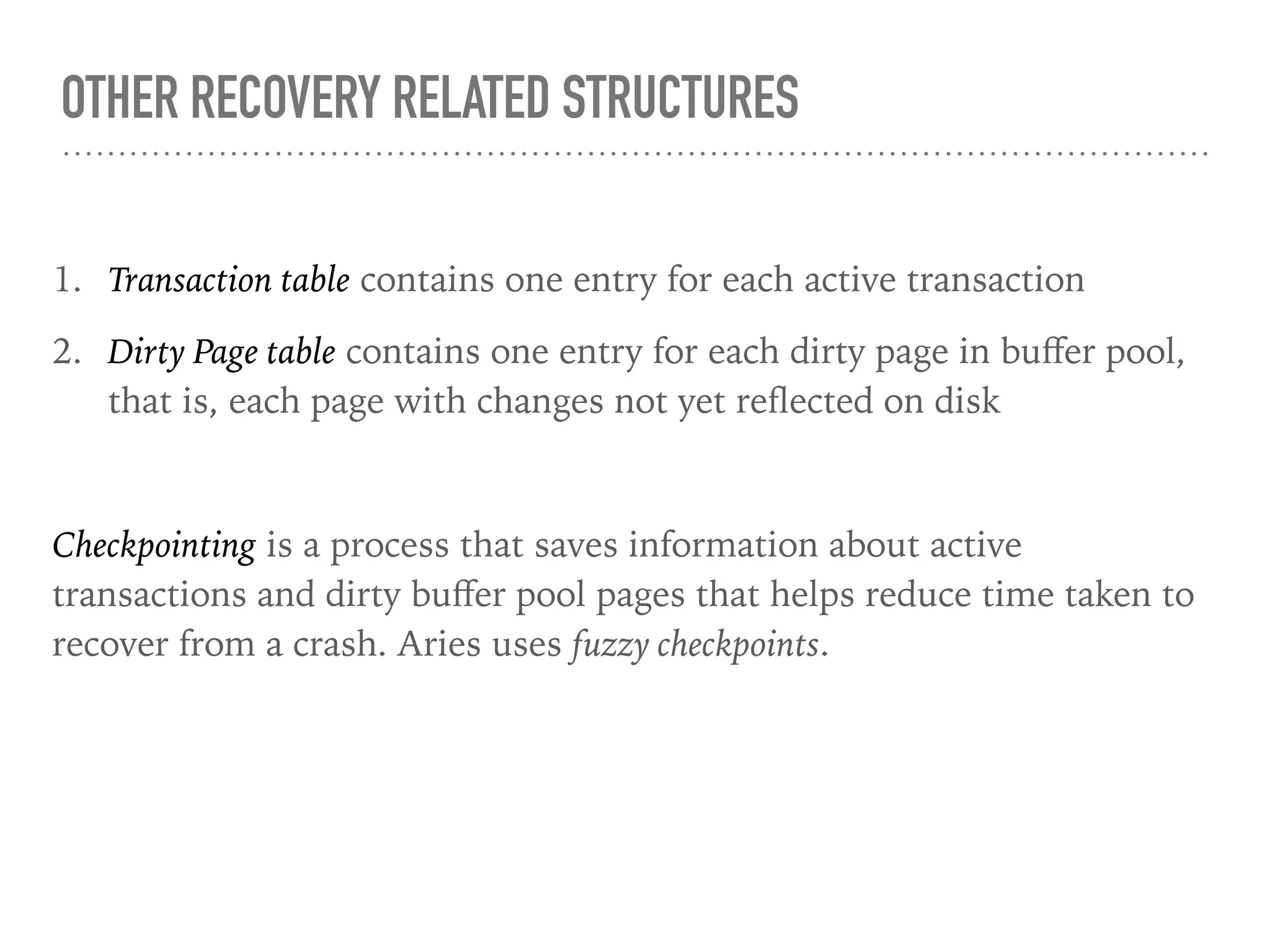
1. Transaction table contains one entry for each active transaction
2. Dirty Page table contains one entry for each dirty page in buffer pool,
that is, each page with changes not yet reflected on disk
Checkpointing is a process that saves information about active
transactions and dirty buffer pool pages that helps reduce time taken to
recover from a crash. Aries uses fuzzy checkpoints.
OTHER RECOVERY RELATED STRUCTURES
Ramakrishnan, Raghu and Gehrke, Johannes. Database Management Systems, 3rd Ed. McGraw-Hill (2003).
(http://pages.cs.wisc.edu/~dbbook/)
Figure 2. Instance of Log, Dirty Page table and Transaction table
RECOVERING FROM SYSTEM CRASH
Analysis Phase
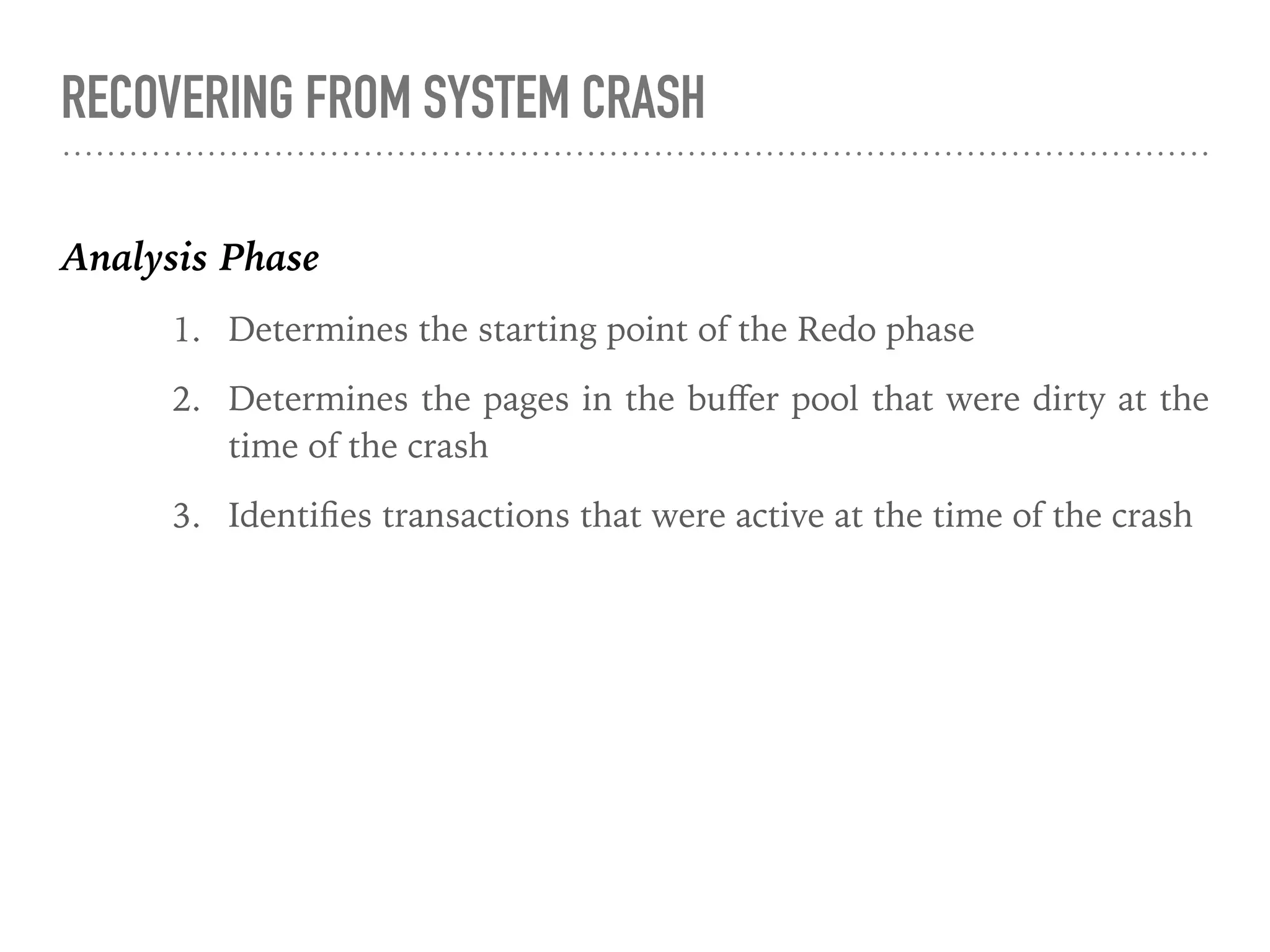
1. Determines the starting point of the Redo phase
2. Determines the pages in the buffer pool that were dirty at the
time of the crash
3. Identifies transactions that were active at the time of the crash
RECOVERING FROM SYSTEM CRASH
Analysis Phase Algorithm
1. Find the most recent begin_checkpoint log record.
2. Initialize the transaction table and dirty page table to the most
recent checkpoint.
3. Scan forward the records from begin checkpoint to the end of the
log. For each log record, update the transaction and dirty page
table as follows:
If there is an end log record for transaction T1, remove T1 from the transaction table.
If there is a log record T1 that is not in the transaction table, add T1 to the table. If
its in the transaction table, then update T1 lastLSN field.
If there is an update/CLR log record for page P1 and P1 is not in the dirty page table,
add P1 in dirty page table and set recLSN to P1’s LSN.
ANALYSIS PHASE EXAMPLE
After system crashes, both
transaction and dirty page tables
are lost.
No previous checkpointing,
initialize tables to empty.
ANALYSIS PHASE EXAMPLE
Scanning log 00:
Add T1000 to transaction
table.
Add P500 to dirty page table.
ANALYSIS PHASE EXAMPLE
Scanning log 10:
Add T2000 to transaction
table.
Add P600 to dirty page table.
ANALYSIS PHASE EXAMPLE
Scanning log 20:
Set T2000 lastLSN to 20.
ANALYSIS PHASE EXAMPLE
Scanning log 30:
Set T1000 lastLSN to 30.
Add P505 to dirty page table.
ANALYSIS PHASE EXAMPLE
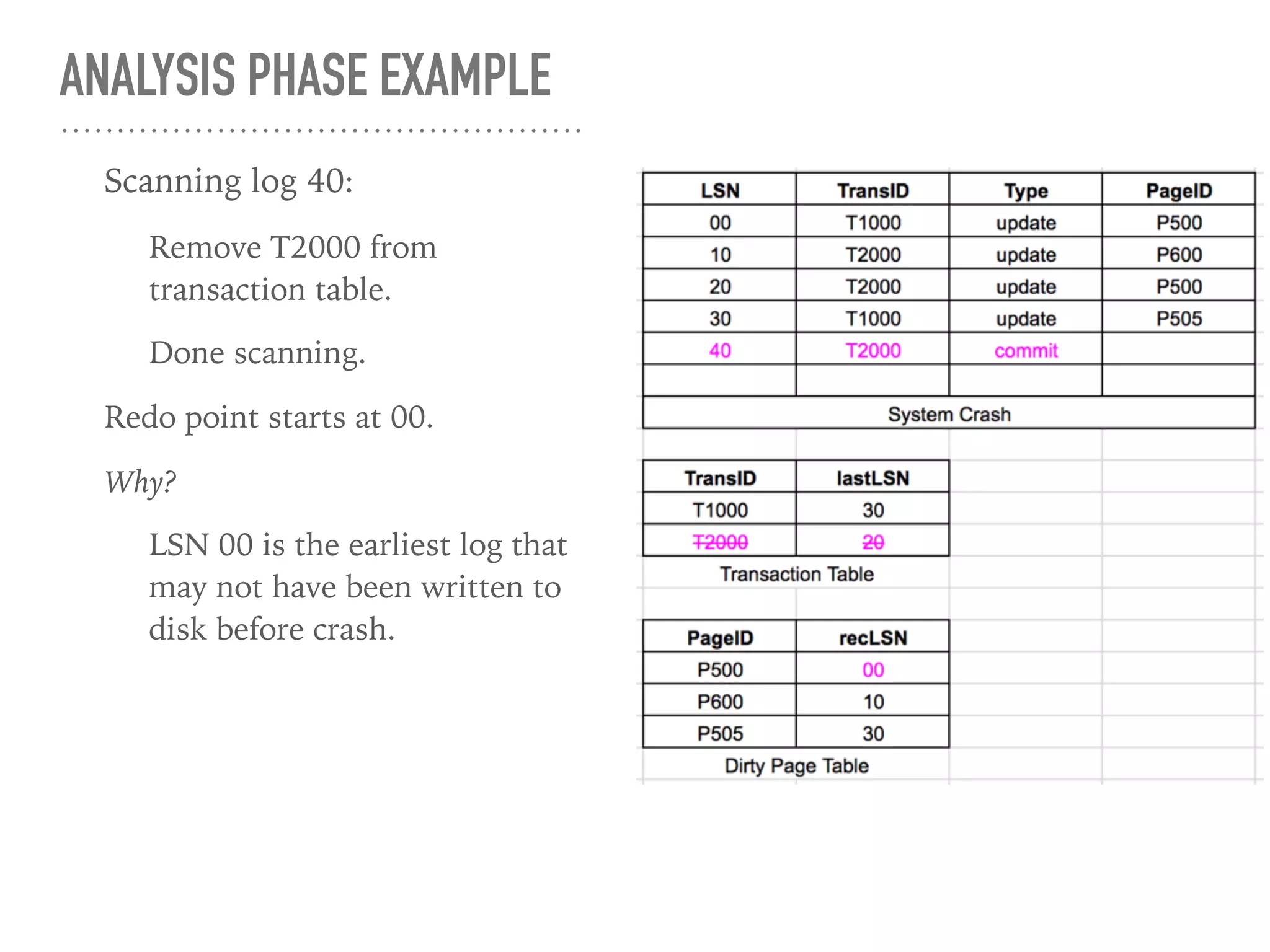
Scanning log 40:
Remove T2000 from
transaction table.
Done scanning.
Redo point starts at 00.
Why?
LSN 00 is the earliest log that
may not have been written to
disk before crash.
RECOVERING FROM SYSTEM CRASH
Redo Phase reapplies the update of all transactions, committed
or otherwise.
This repeating history paradigm distinguishes ARIES from other
proposed WAL-based recovery algorithms.
RECOVERING FROM SYSTEM CRASH
Actions must be redone unless:
1. Affected page is not in the dirty page table.
2. Affected page is in dirty page table but the recLSN for the entry
is greater than the LSN of the log record being checked.
3. PageLSN is greater than or equal to the LSN of the log record
being checked.
REDO PHASE EXAMPLE
Scan forward from the redo point
(LSN 00)
Assume that P600 has been written
to disk. (But it can still be in the
dirty page table.)
Scanning 00:
P500 is in the dirty page table.
recLSN(00)== LSN (00)
PageLSN(-10) < LSN(00)
Redo 00
Redo unless:
1. Affected page is not in the dirty page table.
2. Affected page is in dirty page table and recLSN > LSN of
the log record being checked.
3. PageLSN is >= to the LSN of the log record being checked
REDO PHASE EXAMPLE
Scanning 10:
P600 is in the dirty page
table.
recLSN(10)== LSN (10)
PageLSN(10) == LSN(10)
Do not redo 10
Redo unless:
1. Affected page is not in the dirty page table.
2. Affected page is in dirty page table and
recLSN > LSN of the log record being
checked.
3. PageLSN is >= to the LSN of the log record
being checked
RECOVERING FROM SYSTEM CRASH
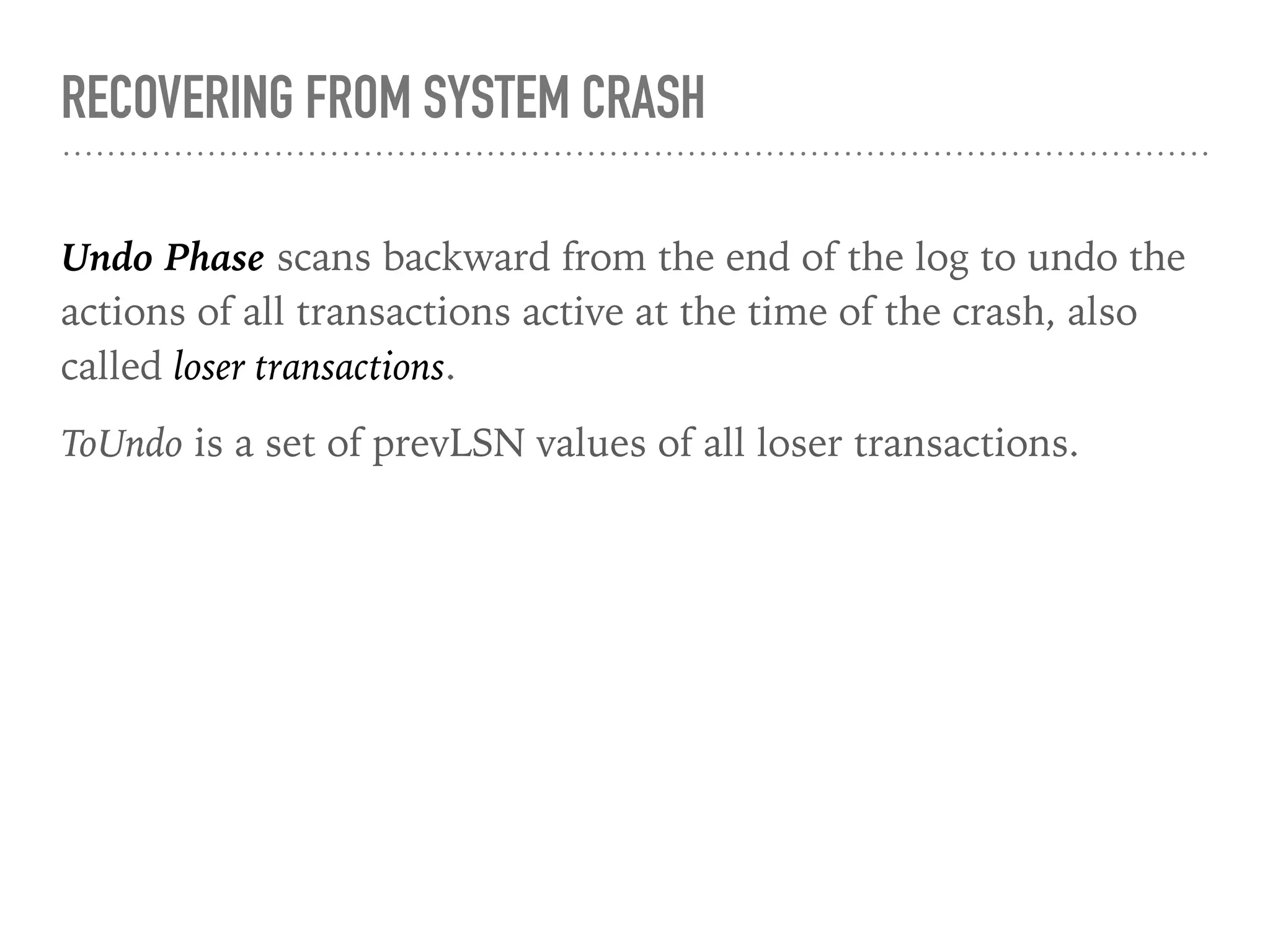
Undo Phase scans backward from the end of the log to undo the
actions of all transactions active at the time of the crash, also
called loser transactions.
ToUndo is a set of prevLSN values of all loser transactions.
RECOVERING FROM SYSTEM CRASH
Undo Phase Algorithm:
Repeatedly choose the record with the largest LSN value in the
ToUndo set and process it until ToUndo is empty.
If it is an update record, a CLR is written and restore the data record value
to beforeImage. Use prevLSN value in ToUndo.
If it is a CLR and the undoNextLSN value is not null, use undoNextLSN
value in ToUndo. If undoNextLSN is null, this transaction is completely
undone.
UNDO PHASE EXAMPLE
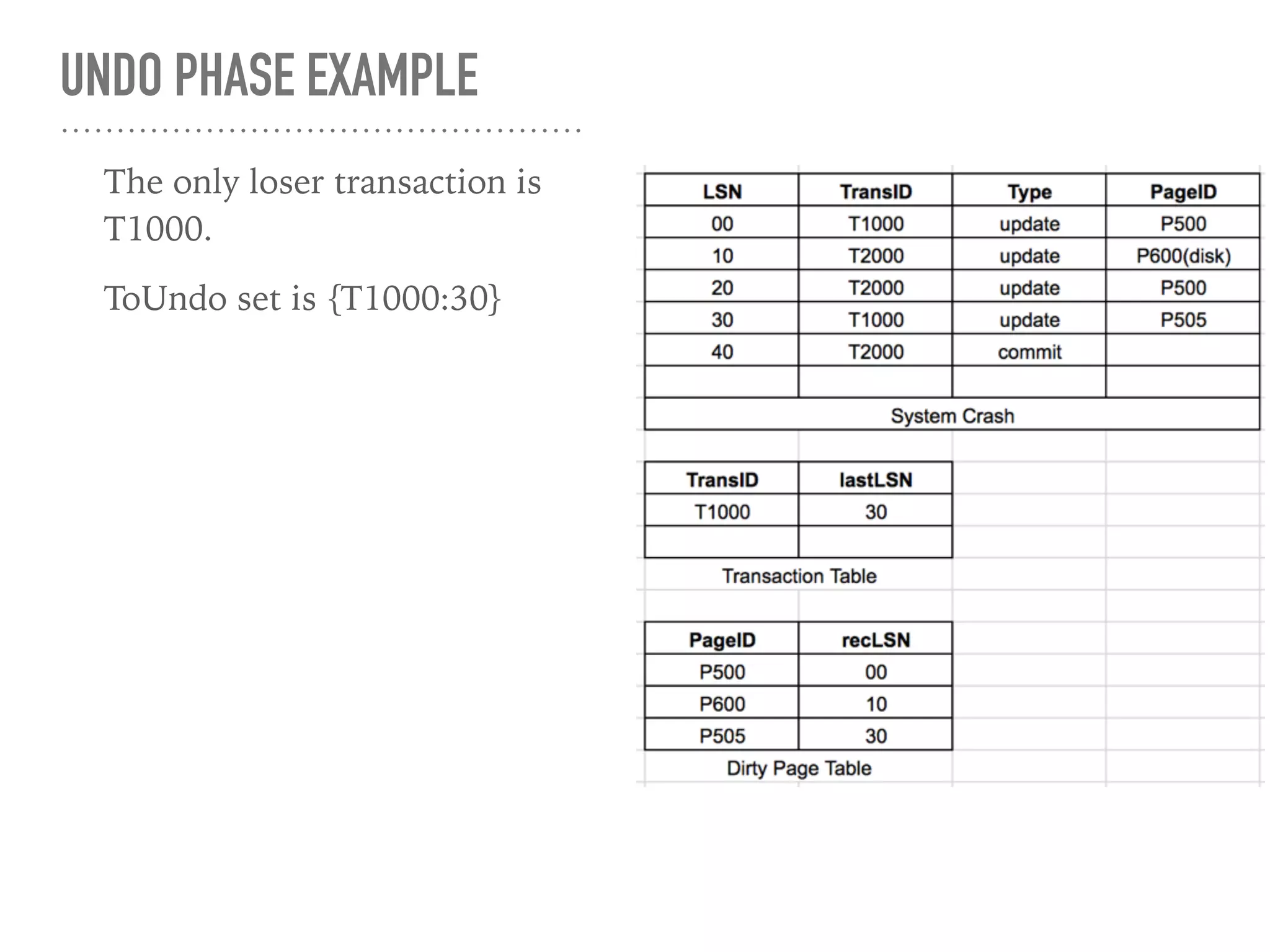
The only loser transaction is
T1000.
ToUndo set is {T1000:30}
UNDO PHASE EXAMPLE
The only loser transaction is
T1000.
ToUndo set is {T1000:30}
Undoing LSN:30
Write CLR:undo record log
ToUndo set becomes
{T1000:00}
Undoing LSN:00
Write CLR:undo record log
ToUndo becomes null
Done
OTHER FEATURES:
➤ Crashes During Restart
➤ Media Recovery
➤ Periodically making copy
of the database (fuzzy
object)
➤ Other approaches and
Interaction with Concurrency
Control
➤ Supports fine-
granularity locks (record
level locks) and logging
logical operations
Ramakrishnan, Raghu and Gehrke, Johannes. Database Management Systems, 3rd Ed. McGraw-Hill (2003).
(http://pages.cs.wisc.edu/~dbbook/)
Figure 3. Example of undo with Repeated Crashes
REFERENCES:
Ramakrishnan, Raghu and Gehrke, Johannes. Database Management Systems, 3rd Ed. McGraw-Hill (2003).
(http://pages.cs.wisc.edu/~dbbook/)

C. Mohan, et al., "ARIES: A Transaction Recovery Method Supporting Fine-Granularity Locking and Partial
Rollbacks Using Write-Ahead Logging", TODS 17(1), 1992.
https://blog.acolyer.org/2016/01/08/aries/
http://www.slideshare.net/PulasthiLankeshwara/aries-recovery-algorithms

Aries

  • 1.
    ARIES A Transaction RecoveryMethod Supporting Fine-Granularity Locking and Partial Rollbacks Using Write-Ahead Logging C.Mohan et al. 1992 Fatima C. Faurillo February 21, 2017
  • 2.
    OUTLINE ➤ Background andMotivation ➤ Recovery Methods ➤ Write-Ahead Logging ➤ Shadow Paging ➤ Aries ➤ Three Main Principles of Aries ➤ The Log ➤ Other Recovery Related Structures ➤ Recovering from System Crash ➤ Analysis Phase ➤ Redo Phase ➤ Undo Phase ➤ Other Features ➤ References
  • 3.
    BACKGROUND AND MOTIVATION TransactionManagement is one of the most important functionalities of Database Management System Two most important aspects of Transaction Management 1. Concurrency Control 2. Recovery
  • 4.
    BACKGROUND AND MOTIVATION RecoveryManager of DBMS is responsible for ensuring two important properties of transactions. Atomicity - either all actions in the transaction occur or none occur Durability - if a transaction commits, then its effect must persist
  • 5.
    BACKGROUND AND MOTIVATION Whathappens when system crashes? Recovery manager is given control and must bring the database to a consistent state. It is also responsible for undoing the actions of aborted transactions. It ensures atomicity by undoing transactions that did not commit and durability by making sure that all actions of committed transactions survive.
  • 6.
    RECOVERY METHODS Write-Ahead Logging(WAL) a log of all modifications in the database is written to “stable storage” (i.e disks, tapes) before the change is made Shadow Paging when transaction makes changes to a data page, it creates a copy called the shadow of a page
  • 7.
    ARIES ARIES (Algorithm forRecovery and Isolation Exploiting) supports partial rollbacks of transactions, fine granularity locking and recovery using write-ahead logging(WAL). Three phases: Analysis Phase Redo Phase Undo Phase
  • 8.
    THREE MAIN PRINCIPLESOF ARIES 1. Write-Ahead Logging all changes are recorded in logs that are written to stable storage before change in database object is written to disk 2. Repeating History during Redo retraces all actions made before the crash and brings the system back to the exact state that it was in at the time of the crash 3. Logging changes during Undo changes made during undo are logged to ensure such action is not repeated in the event of repeated failures
  • 9.
    THE LOG Log, sometimescalled trail or journal, is a history of actions executed by DBMS. Every log record is given a unique id called the log sequence number (LSN) which is assigned in increasing order. Every page in the database contains the most recent log record that describe the changes to the page, called PageLSN. A log is written for each action: Updating a Page, Commit, Abort, End, Undoing an update Compensation Log Record (CLR) notes the rollback of a particular change to the database. Each corresponds with exactly one other Update Log Record and includes undoNextLSN(LSN of the next log record that is to be undone) 9
  • 10.
    Figure 1. Contentsof Update Log Record Ramakrishnan, Raghu and Gehrke, Johannes. Database Management Systems, 3rd Ed. McGraw-Hill (2003). (http://pages.cs.wisc.edu/~dbbook/)
  • 11.
    OTHER RECOVERY RELATEDSTRUCTURES 1. Transaction table contains one entry for each active transaction 2. Dirty Page table contains one entry for each dirty page in buffer pool, that is, each page with changes not yet reflected on disk Checkpointing is a process that saves information about active transactions and dirty buffer pool pages that helps reduce time taken to recover from a crash. Aries uses fuzzy checkpoints.
  • 12.
    OTHER RECOVERY RELATEDSTRUCTURES Ramakrishnan, Raghu and Gehrke, Johannes. Database Management Systems, 3rd Ed. McGraw-Hill (2003). (http://pages.cs.wisc.edu/~dbbook/) Figure 2. Instance of Log, Dirty Page table and Transaction table
  • 13.
    RECOVERING FROM SYSTEMCRASH Analysis Phase 1. Determines the starting point of the Redo phase 2. Determines the pages in the buffer pool that were dirty at the time of the crash 3. Identifies transactions that were active at the time of the crash
  • 14.
    RECOVERING FROM SYSTEMCRASH Analysis Phase Algorithm 1. Find the most recent begin_checkpoint log record. 2. Initialize the transaction table and dirty page table to the most recent checkpoint. 3. Scan forward the records from begin checkpoint to the end of the log. For each log record, update the transaction and dirty page table as follows: If there is an end log record for transaction T1, remove T1 from the transaction table. If there is a log record T1 that is not in the transaction table, add T1 to the table. If its in the transaction table, then update T1 lastLSN field. If there is an update/CLR log record for page P1 and P1 is not in the dirty page table, add P1 in dirty page table and set recLSN to P1’s LSN.
  • 15.
    ANALYSIS PHASE EXAMPLE Aftersystem crashes, both transaction and dirty page tables are lost. No previous checkpointing, initialize tables to empty.
  • 16.
    ANALYSIS PHASE EXAMPLE Scanninglog 00: Add T1000 to transaction table. Add P500 to dirty page table.
  • 17.
    ANALYSIS PHASE EXAMPLE Scanninglog 10: Add T2000 to transaction table. Add P600 to dirty page table.
  • 18.
    ANALYSIS PHASE EXAMPLE Scanninglog 20: Set T2000 lastLSN to 20.
  • 19.
    ANALYSIS PHASE EXAMPLE Scanninglog 30: Set T1000 lastLSN to 30. Add P505 to dirty page table.
  • 20.
    ANALYSIS PHASE EXAMPLE Scanninglog 40: Remove T2000 from transaction table. Done scanning. Redo point starts at 00. Why? LSN 00 is the earliest log that may not have been written to disk before crash.
  • 21.
    RECOVERING FROM SYSTEMCRASH Redo Phase reapplies the update of all transactions, committed or otherwise. This repeating history paradigm distinguishes ARIES from other proposed WAL-based recovery algorithms.
  • 22.
    RECOVERING FROM SYSTEMCRASH Actions must be redone unless: 1. Affected page is not in the dirty page table. 2. Affected page is in dirty page table but the recLSN for the entry is greater than the LSN of the log record being checked. 3. PageLSN is greater than or equal to the LSN of the log record being checked.
  • 23.
    REDO PHASE EXAMPLE Scanforward from the redo point (LSN 00) Assume that P600 has been written to disk. (But it can still be in the dirty page table.) Scanning 00: P500 is in the dirty page table. recLSN(00)== LSN (00) PageLSN(-10) < LSN(00) Redo 00 Redo unless: 1. Affected page is not in the dirty page table. 2. Affected page is in dirty page table and recLSN > LSN of the log record being checked. 3. PageLSN is >= to the LSN of the log record being checked
  • 24.
    REDO PHASE EXAMPLE Scanning10: P600 is in the dirty page table. recLSN(10)== LSN (10) PageLSN(10) == LSN(10) Do not redo 10 Redo unless: 1. Affected page is not in the dirty page table. 2. Affected page is in dirty page table and recLSN > LSN of the log record being checked. 3. PageLSN is >= to the LSN of the log record being checked
  • 25.
    RECOVERING FROM SYSTEMCRASH Undo Phase scans backward from the end of the log to undo the actions of all transactions active at the time of the crash, also called loser transactions. ToUndo is a set of prevLSN values of all loser transactions.
  • 26.
    RECOVERING FROM SYSTEMCRASH Undo Phase Algorithm: Repeatedly choose the record with the largest LSN value in the ToUndo set and process it until ToUndo is empty. If it is an update record, a CLR is written and restore the data record value to beforeImage. Use prevLSN value in ToUndo. If it is a CLR and the undoNextLSN value is not null, use undoNextLSN value in ToUndo. If undoNextLSN is null, this transaction is completely undone.
  • 27.
    UNDO PHASE EXAMPLE Theonly loser transaction is T1000. ToUndo set is {T1000:30}
  • 28.
    UNDO PHASE EXAMPLE Theonly loser transaction is T1000. ToUndo set is {T1000:30} Undoing LSN:30 Write CLR:undo record log ToUndo set becomes {T1000:00} Undoing LSN:00 Write CLR:undo record log ToUndo becomes null Done
  • 29.
    OTHER FEATURES: ➤ CrashesDuring Restart ➤ Media Recovery ➤ Periodically making copy of the database (fuzzy object) ➤ Other approaches and Interaction with Concurrency Control ➤ Supports fine- granularity locks (record level locks) and logging logical operations Ramakrishnan, Raghu and Gehrke, Johannes. Database Management Systems, 3rd Ed. McGraw-Hill (2003). (http://pages.cs.wisc.edu/~dbbook/) Figure 3. Example of undo with Repeated Crashes
  • 30.
    REFERENCES: Ramakrishnan, Raghu andGehrke, Johannes. Database Management Systems, 3rd Ed. McGraw-Hill (2003). (http://pages.cs.wisc.edu/~dbbook/)
 C. Mohan, et al., "ARIES: A Transaction Recovery Method Supporting Fine-Granularity Locking and Partial Rollbacks Using Write-Ahead Logging", TODS 17(1), 1992. https://blog.acolyer.org/2016/01/08/aries/ http://www.slideshare.net/PulasthiLankeshwara/aries-recovery-algorithms