Types of    Three Phases/Steps in    Transactions Unit Paper IV Unit 1(Adv DBMS)
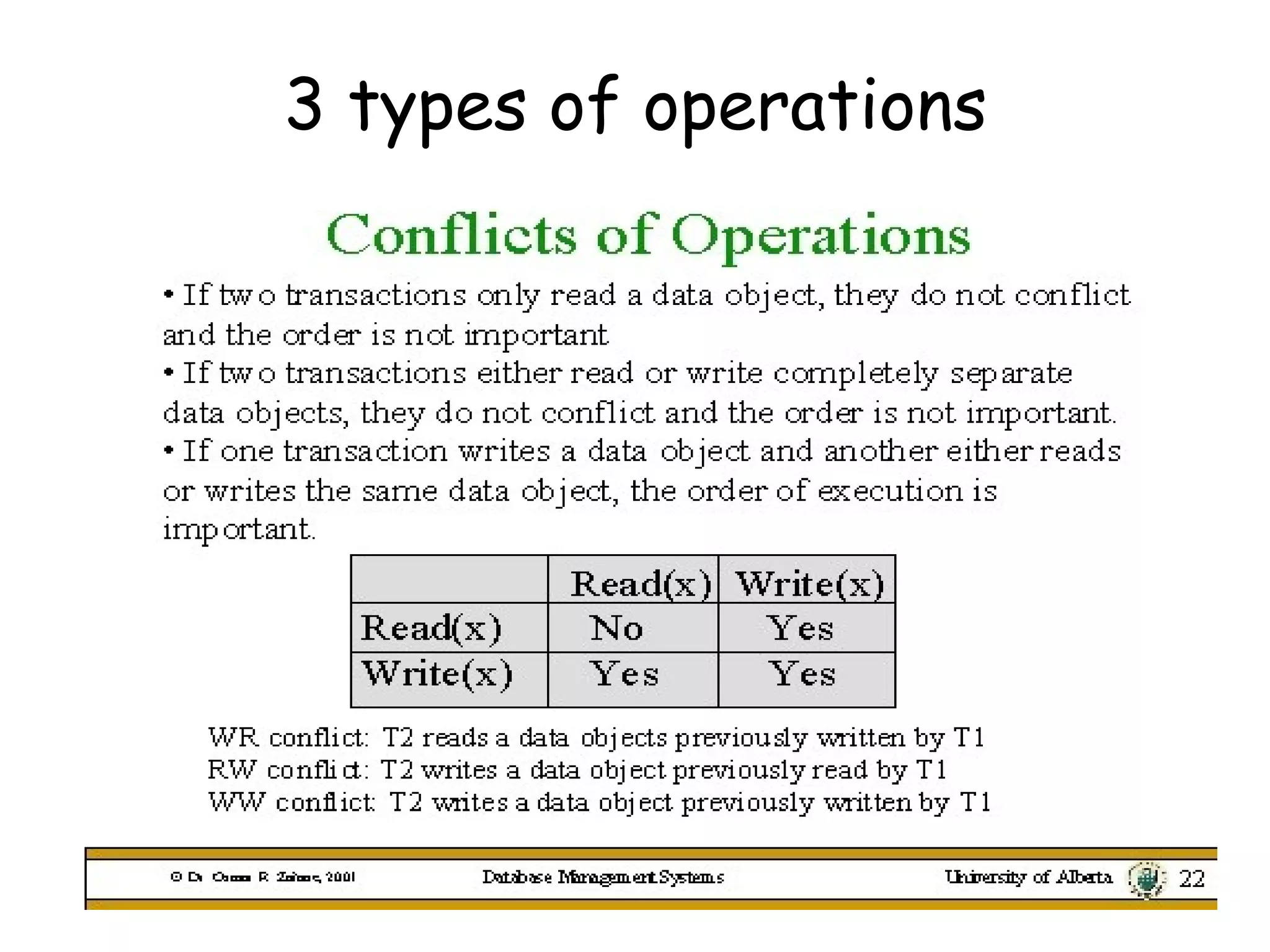
3 types of operations
3 Different Types of Locking 1.page locking 2. class/table  locking 3. instance/row locking Page locking  In this, all the data on a specific page are locked. A page is a common unit of storage in computer systems and is used by all types of DBMSs.  Class or table locking  means that all instances of either a class or table are locked,   It represents all instances of a class, regardless of the page where they are stored. Instance /row locking  locks a single relational tuple in an RDBMS or a single object in an ODBMS
Two Phase Commit – 3 phases It defines three types of operations :- DO performs the operation and records the  before  and  after  values in the transaction log UNDO reverses an operation ,using the log entries written by DO portion of the sequence REDO redoes an operation,using the log entries written by the DO portion of the sequence To ensure that DO,UNDO,REDO can survive a system crash while they are being executed,a write ahead log protocol is used.
Two PC two types of nodes :- co-ordinator and one or more subordinates Phase 1:Preparation(contains 3 steps) The coordinator sends a PREPARE to COMMIT mesg to all subordinates The subordinates receive the mesg,write the transaction log,using write ahead protocol and send an acknowledgement(YES/prepared to commit and NO/nor prepared)mesg to coordinator The coordinator makes sure that all nodes are ready to commit,or it aborts the action If all nodes are prepared to commit,the transaction goes to phase2. If one/more nodes reply NO, the co-ordinator broadcasts an ABORT mesg to all subordinates Phase 2: the Final Commit(contains 3 steps) The coordinator broadcasts a COMMIT mesg to all subordinates and waits for the replies Each subordinate receives the COMMIT mesg,then updates the db using DO protocol The subordinates reply with a COMMITTED or NOT COMMITTED mesg to the coordinator If one/more subordinates did not commit, the coordinator sends an ABORT mesg,thereby forcing them to UNDO all changes
Time Stamp Ordering In optimistic concurrency control,a  timestamp ordering  is imposed on transactions and validations checks that all conflicting actions occurred in the same order The  optimistic approach  does not  require locking or time stamping  techq. using an optimistic approach,each transaction moves thru two or three phases:-they are  read, validation and write Read phase:  reads the db,executes the needed computations,and makes the updates to private copy of db values. All update operations of the transaction are recorded in a temp.update file,which is not accessed by remaining transactions Validation phase :the transaction is validated to ensure that the changes made will not affect the integrity and consistency of the db.If validation test is +ve, the transaction goes to write phase else if it is –ve,then the transaction is restarted and changes are discarded During  write phase:  the changes are permanently applied to the database
Optimistic and pessimistic approach Locking protocols take a Pessimistic approach Optimistic approach’s basic idea is that most transactions do not conflict with other transactions Transactions proceed in 3 phases:- Read  – the transaction executes , reading values from db and writing to a private workspace Validation - if the transaction decides it wants to commit,the dbms checks with other transactions whether it has been conflicted. If it has, the transaction is aborted, the private workspace is cleared and it is restarted Write - if validation determines that there no possible conflicts,the changes to data objects made by the transaction in its private workspace are copied into the database.
ARIES – 3phases ARIES is a recovery algorithm designed to work with a steal, no-force approach  used(no-force approach  means that some of these changes may not have been written to disk at the time of subsequent crash), when recovery mgr. is invoked after a crash, restart & proceeds in 3 phases:- Analysis  :indentifies dirty pages in the buffer pool Redo : repeats all actions, starting from an appropriate point in the log & restores the db state to what it was at the time of crash Undo : undoes the actions of transactions that didn’t commit , so that db reflects only the actions of committed transactions
Checkpointing Checkpointing is like a snapshot of the DBMS state, DBMS can reduce the work to be done during restart in the event of a subsequent crash Checkpointing ARIES has 3 steps:- begin_checkpoint,end_checkpoint and fuzzy checkpoint Begin checkpoint  record is written to indicate  when the checkpoint starts End checkpoint  record is constructed, including in it the current contents of the transaction table & dirty page table and appended to the log 3 rd  step is executed after end_checkpoint record is written to stable storage
Recovery from System Crash When a system is restarted after a crash, the recovery mgr procceds in 3 phases:- Analysis  – examines the most recent begin_checkpoint record , whose LSN is denoted by C Redo - follows analysis and redoes all the changes to any page that might have been dirty at the time of crash;this set of pages and the starting pt.for Redo are determined during analysis Undo - undo phase follows Redo and undoes the changes of all transactions active at the time of crash. This set of transactions is identified at during the analysis phase
Analysis phase of System crash It performs 3 tasks:- It determines the point in the log at which to start the Redo pass It determines pages in the buffer pool that were dirty at the time of crash It identifies transactions that were active at the time of crash and must be undone

3 phases in transactions 3 units

  • 1.
    Types of Three Phases/Steps in Transactions Unit Paper IV Unit 1(Adv DBMS)
  • 2.
    3 types ofoperations
  • 3.
    3 Different Typesof Locking 1.page locking 2. class/table locking 3. instance/row locking Page locking In this, all the data on a specific page are locked. A page is a common unit of storage in computer systems and is used by all types of DBMSs. Class or table locking means that all instances of either a class or table are locked,   It represents all instances of a class, regardless of the page where they are stored. Instance /row locking locks a single relational tuple in an RDBMS or a single object in an ODBMS
  • 4.
    Two Phase Commit– 3 phases It defines three types of operations :- DO performs the operation and records the before and after values in the transaction log UNDO reverses an operation ,using the log entries written by DO portion of the sequence REDO redoes an operation,using the log entries written by the DO portion of the sequence To ensure that DO,UNDO,REDO can survive a system crash while they are being executed,a write ahead log protocol is used.
  • 5.
    Two PC twotypes of nodes :- co-ordinator and one or more subordinates Phase 1:Preparation(contains 3 steps) The coordinator sends a PREPARE to COMMIT mesg to all subordinates The subordinates receive the mesg,write the transaction log,using write ahead protocol and send an acknowledgement(YES/prepared to commit and NO/nor prepared)mesg to coordinator The coordinator makes sure that all nodes are ready to commit,or it aborts the action If all nodes are prepared to commit,the transaction goes to phase2. If one/more nodes reply NO, the co-ordinator broadcasts an ABORT mesg to all subordinates Phase 2: the Final Commit(contains 3 steps) The coordinator broadcasts a COMMIT mesg to all subordinates and waits for the replies Each subordinate receives the COMMIT mesg,then updates the db using DO protocol The subordinates reply with a COMMITTED or NOT COMMITTED mesg to the coordinator If one/more subordinates did not commit, the coordinator sends an ABORT mesg,thereby forcing them to UNDO all changes
  • 6.
    Time Stamp OrderingIn optimistic concurrency control,a timestamp ordering is imposed on transactions and validations checks that all conflicting actions occurred in the same order The optimistic approach does not require locking or time stamping techq. using an optimistic approach,each transaction moves thru two or three phases:-they are read, validation and write Read phase: reads the db,executes the needed computations,and makes the updates to private copy of db values. All update operations of the transaction are recorded in a temp.update file,which is not accessed by remaining transactions Validation phase :the transaction is validated to ensure that the changes made will not affect the integrity and consistency of the db.If validation test is +ve, the transaction goes to write phase else if it is –ve,then the transaction is restarted and changes are discarded During write phase: the changes are permanently applied to the database
  • 7.
    Optimistic and pessimisticapproach Locking protocols take a Pessimistic approach Optimistic approach’s basic idea is that most transactions do not conflict with other transactions Transactions proceed in 3 phases:- Read – the transaction executes , reading values from db and writing to a private workspace Validation - if the transaction decides it wants to commit,the dbms checks with other transactions whether it has been conflicted. If it has, the transaction is aborted, the private workspace is cleared and it is restarted Write - if validation determines that there no possible conflicts,the changes to data objects made by the transaction in its private workspace are copied into the database.
  • 8.
    ARIES – 3phasesARIES is a recovery algorithm designed to work with a steal, no-force approach used(no-force approach means that some of these changes may not have been written to disk at the time of subsequent crash), when recovery mgr. is invoked after a crash, restart & proceeds in 3 phases:- Analysis :indentifies dirty pages in the buffer pool Redo : repeats all actions, starting from an appropriate point in the log & restores the db state to what it was at the time of crash Undo : undoes the actions of transactions that didn’t commit , so that db reflects only the actions of committed transactions
  • 9.
    Checkpointing Checkpointing islike a snapshot of the DBMS state, DBMS can reduce the work to be done during restart in the event of a subsequent crash Checkpointing ARIES has 3 steps:- begin_checkpoint,end_checkpoint and fuzzy checkpoint Begin checkpoint record is written to indicate when the checkpoint starts End checkpoint record is constructed, including in it the current contents of the transaction table & dirty page table and appended to the log 3 rd step is executed after end_checkpoint record is written to stable storage
  • 10.
    Recovery from SystemCrash When a system is restarted after a crash, the recovery mgr procceds in 3 phases:- Analysis – examines the most recent begin_checkpoint record , whose LSN is denoted by C Redo - follows analysis and redoes all the changes to any page that might have been dirty at the time of crash;this set of pages and the starting pt.for Redo are determined during analysis Undo - undo phase follows Redo and undoes the changes of all transactions active at the time of crash. This set of transactions is identified at during the analysis phase
  • 11.
    Analysis phase ofSystem crash It performs 3 tasks:- It determines the point in the log at which to start the Redo pass It determines pages in the buffer pool that were dirty at the time of crash It identifies transactions that were active at the time of crash and must be undone