Class 13
EWRT 1B
Agenda
• Presentation: Terms list 3
• Discussion: Essay #3
• In-class writing: Essay #3
 • Directed Summary
 • Counter Argument
 • Conclusion
• Author Lecture: David Henry Hwang
Terms List #3
Exam June 4th
Terms

Androgeny (also androgynous, bi-gendered, no-
gendered): A person who identifies as both or neither
of the two culturally defined genders, or a person who
expresses merged culturally/stereotypically feminine
and masculine characteristics or neutral
characteristics.

Anti-Semitism: Hostility toward, or prejudice or
discrimination against Jews or Judaism.
Assigned (Biological) Sex: A social construct referring to the state of
being intersex, female, or male. A concept that relies on the
dichotomous division of various genitive, biological, chromosomal,
hormonal and physiological differences in human.

Bisexual: A person who is emotionally, physically, and/or sexually
attracted to both men and women. Some people avoid this term
because of its implications that there are only two sexes/genders to be
sexually attracted to and this reinforces the binary gender system.

Cross-Dresser: Someone who enjoys wearing clothing typically
assigned to a gender that the individual has not been socialized as, or
does not identify as. Cross-dressers are of all sexual orientations and
do not necessarily identify as transgender. “Cross-dresser” is
frequently used today in place of the term “transvestite.” This activity
seems more obvious when men as opposed to women engage in it
publicly, because of an inequity in societal norms concerning attire
and other components of appearance.
Cultural Humility: A lifelong commitment to self-
evaluation and critique, to redressing the power imbalances
in the [interpersonal relationship] dynamic[s], and to
developing mutually beneficial and non-paternalistic
partnerships with communities on behalf of individuals and
defined populations.

FtM (F2M)/MtF (M2F): Generally, abbreviations used to
refer to specific members of the trans community. FtM
stands for female-to-male, as in moving from a female pole
of the spectrum to the male. MtF stands for male-to-female
and refers to moving from the male pole of the spectrum tot
eh female. FtM is sometimes, not always, synonymous with
transman. Conversely, someone who identifies as MtF, may
identify as a transwoman.
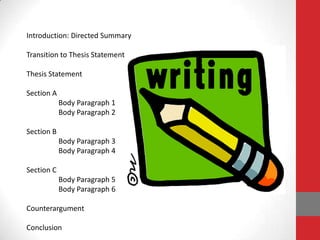
Essay #3
Introduction: Directed Summary

Transition to Thesis Statement

Thesis Statement

Section A
            Body Paragraph 1
            Body Paragraph 2

Section B
            Body Paragraph 3
            Body Paragraph 4

Section C
            Body Paragraph 5
            Body Paragraph 6

Counterargument

Conclusion
The Directed
Summary
How to write one!
Directed Summary
• A directed summary provides readers of your
  paper with the information they need to
  understand your argument and explanation.

• State the title and author of the literary work
  near the beginning of the first paragraph,
  perhaps in the first sentence. This is essential
  so that the reader knows which work you are
  discussing.
• Hook the reader. In the first sentences, write
  what is particularly interesting about the work.
  This thought-provoking information must also
  be relevant to the topic you will discuss in your
  essay.

• Assume that the reader is familiar with the
  work about which you are writing. Do not
  include too much plot summary in the
  introduction or in the rest of the essay. Do
  include a bit of the story that will support your
  thesis.
• Use transitions throughout the introduction. Because
  there are so many aspects of the work that have to be
  included, the introduction can end up fragmented
  and confusing. Make sure that it makes sense on its
  own as a paragraph. Clearly transition from your
  introduction into your thesis.

• State the thesis near the end of the introduction
  (your introduction might be more than one
  paragraph). The thesis should clearly state what the
  essay will analyze and should be very specific.
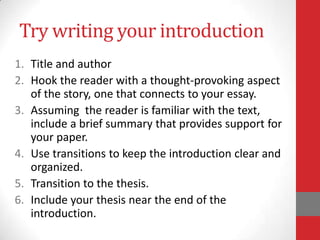
Try writing your introduction
1. Title and author
2. Hook the reader with a thought-provoking aspect
   of the story, one that connects to your essay.
3. Assuming the reader is familiar with the text,
   include a brief summary that provides support for
   your paper.
4. Use transitions to keep the introduction clear and
   organized.
5. Transition to the thesis.
6. Include your thesis near the end of the
   introduction.
The
Counterargument
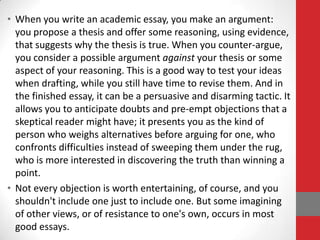
• When you write an academic essay, you make an argument:
  you propose a thesis and offer some reasoning, using evidence,
  that suggests why the thesis is true. When you counter-argue,
  you consider a possible argument against your thesis or some
  aspect of your reasoning. This is a good way to test your ideas
  when drafting, while you still have time to revise them. And in
  the finished essay, it can be a persuasive and disarming tactic. It
  allows you to anticipate doubts and pre-empt objections that a
  skeptical reader might have; it presents you as the kind of
  person who weighs alternatives before arguing for one, who
  confronts difficulties instead of sweeping them under the rug,
  who is more interested in discovering the truth than winning a
  point.
• Not every objection is worth entertaining, of course, and you
  shouldn't include one just to include one. But some imagining
  of other views, or of resistance to one's own, occurs in most
  good essays.
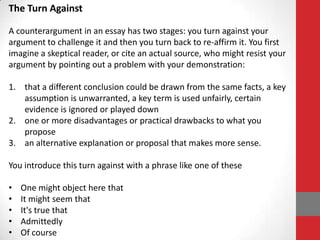
The Turn Against

A counterargument in an essay has two stages: you turn against your
argument to challenge it and then you turn back to re-affirm it. You first
imagine a skeptical reader, or cite an actual source, who might resist your
argument by pointing out a problem with your demonstration:

1. that a different conclusion could be drawn from the same facts, a key
   assumption is unwarranted, a key term is used unfairly, certain
   evidence is ignored or played down
2. one or more disadvantages or practical drawbacks to what you
   propose
3. an alternative explanation or proposal that makes more sense.

You introduce this turn against with a phrase like one of these

•   One might object here that
•   It might seem that
•   It's true that
•   Admittedly
•   Of course
Another approach is to use an anticipated
challenging question:

But how...?
But why...?
But isn't this just…?
But if this is so, what about…?

Then you state the case against yourself as briefly but as
clearly and forcefully as you can, pointing to evidence where
possible. You must answer your own question completely and
concisely or you risk undermining your own argument.

An obviously feeble or perfunctory counterargument does
more harm than good.
The Turn Back

Your return to your own argument—which you announce with a
but, yet, however, nevertheless or still—must likewise involve
careful reasoning, not a flippant (or nervous) dismissal. In
reasoning about the proposed counterargument, you may do one
of the following:

1. Refute it, showing why it is mistaken—an apparent but not
   real problem
2. Acknowledge its validity or plausibility, but suggest why on
   balance it's relatively less important or less likely than what
   you propose, and thus doesn't overturn it;
3. Concede its force and complicate your idea accordingly—
   restate your thesis in a more exact, qualified, or nuanced way
   that takes account of the objection, or start a new section in
   which you consider your topic in light of it.
Where to Put a Counter-Argument

Counter-argument can appear anywhere in the essay. Try it in several places
and see where it fits best:

1. as part of your introduction—before you propose your thesis—where the
   existence of a different view is the motive for your essay, the reason it
   needs writing;
2. as a section or paragraph just after your introduction, in which you lay out
   the expected reaction or standard position before turning away to develop
   your own.
3. as a quick move within a paragraph, where you imagine a
   counterargument not to your main idea but to the sub-idea that the
   paragraph is arguing or is about to argue.
4. as a section or paragraph just before the conclusion of your essay, in which
   you imagine what someone might object to what you have argued.

But watch that you don't overdo it. A turn into counterargument here and
there will sharpen and energize your essay, but too many such turns will have
the reverse effect by obscuring your main idea or suggesting that you're
ambivalent.
Thesis: This book shows that social pressure, oppression, and
violence do not act only as forces of conformity, but also as
powerful sources of agency; they can inspire people to challenge
injustice in pursuit of liberty.

Counterargument:

Of course, there are times when social pressure, oppression, and
violence push people to conform, but these examples generally fall into
one of three main categories: One, people bow to social pressure,
oppression, and violence when they do not have a significant reason to
resist; two, people bow to social pressure, oppression, and violence
when the consequences are life threatening; and three, people bow to
social pressure, oppression, and violence until they can strategize their
resistance. This final response is the one that Feinberg illustrates
through Jess Goldberg.
Conclusions
Strategies for Writing a Conclusion

Conclusions are often the most difficult part of an essay
to write, and many writers feel that they have nothing
left to say after having written the paper. A writer needs
to keep in mind that the conclusion is often what a
reader remembers best. Your conclusion should be the
best part of your paper.

A conclusion should
• stress the importance of the thesis statement,
• give the essay a sense of completeness, and
• leave a final impression on the reader.
Create a new meaning
 Demonstrating how your ideas work together can
create a new picture. Often the sum of the paper
is worth more than its parts.


Stone Butch Blues shows that social
pressures, oppression, and violence are
appropriate ways neither to create harmony
nor to manage cultural diversity
Answer the question "So What?”
Show your readers why this paper was
important.


Stone Butch Blues provides knowledge
that can liberate those people who suffer
social oppression by both providing
models of and encouraging successful
resistance.
Propose a course of action


Redirect your reader's thought process and help him or
her to apply your info and ideas to her own life or to
see the broader implications.

Finally, Stone Butch Blues inspires people to
challenge injustice in pursuit of liberty for all
people.
Let’s try writing a couple of conclusions
1. Answer the question "So What?”: Show your readers why this paper
   was important.
2. Synthesize information: Show how the points you made and the
   support and examples you used fit together.
3. Challenge the reader: Help readers redirect the information in the
   paper, so they may apply it to their own lives.
4. Create a new meaning: demonstrating how your ideas work together
   can create a new picture. Often the sum of the paper is worth more
   than its parts.
5. Propose a course of action, a solution to an issue, or questions for
   further study: Redirect your reader's thought process and help him
   or her to apply your info and ideas to her own life or to see the
   broader implications.
6. Echo the introduction: If you begin by describing a scenario, you can
   end with the same scenario as proof that your essay was helpful in
   creating a new understanding.
Henry David Hwang
• David Henry Hwang was born on August 11, 1957
  in Los Angeles, California.
• His parents immigrated from China
• He went to Stanford University
• As an undergraduate, he wrote his first play FOB,
  which explores the contrast in attitudes between
  recently arrived Chinese immigrants and two
  Chinese-American students who have long since
  assimilated.
• He went to graduate school at Yale, where he
  continued to write successful plays.
M Butterfly
•   Hwang returned to the stage with M. Butterfly, one of the
    most celebrated of recent American plays, and the first by
    an Asian-American to win universal acclaim.

•   It was first produced in 1988 and won numerous awards,
    including the Tony Award for Best Play of the Year, the
    New York Drama Desk Award, the Outer Critics Circle
    Award for Best Broadway play, and the John Gassner
    Award for the season's outstanding new playwright.

•   M. Butterfly enjoyed a popular run on Broadway and
    when it moved to London's Shaftsbury Theatre in 1989 it
    broke all box office records in the first week.
• Reading: M Butterfly
• Writing:
   • Introduction
   • Counterargument
   • Conclusion
• Finish your draft of Essay
  #3 and post it.
• Bring three complete
  copies of your draft to our
  next meeting.

Class 13 1 b

  • 1.
  • 2.
    Agenda • Presentation: Termslist 3 • Discussion: Essay #3 • In-class writing: Essay #3 • Directed Summary • Counter Argument • Conclusion • Author Lecture: David Henry Hwang
  • 3.
  • 4.
    Terms Androgeny (also androgynous,bi-gendered, no- gendered): A person who identifies as both or neither of the two culturally defined genders, or a person who expresses merged culturally/stereotypically feminine and masculine characteristics or neutral characteristics. Anti-Semitism: Hostility toward, or prejudice or discrimination against Jews or Judaism.
  • 5.
    Assigned (Biological) Sex:A social construct referring to the state of being intersex, female, or male. A concept that relies on the dichotomous division of various genitive, biological, chromosomal, hormonal and physiological differences in human. Bisexual: A person who is emotionally, physically, and/or sexually attracted to both men and women. Some people avoid this term because of its implications that there are only two sexes/genders to be sexually attracted to and this reinforces the binary gender system. Cross-Dresser: Someone who enjoys wearing clothing typically assigned to a gender that the individual has not been socialized as, or does not identify as. Cross-dressers are of all sexual orientations and do not necessarily identify as transgender. “Cross-dresser” is frequently used today in place of the term “transvestite.” This activity seems more obvious when men as opposed to women engage in it publicly, because of an inequity in societal norms concerning attire and other components of appearance.
  • 6.
    Cultural Humility: Alifelong commitment to self- evaluation and critique, to redressing the power imbalances in the [interpersonal relationship] dynamic[s], and to developing mutually beneficial and non-paternalistic partnerships with communities on behalf of individuals and defined populations. FtM (F2M)/MtF (M2F): Generally, abbreviations used to refer to specific members of the trans community. FtM stands for female-to-male, as in moving from a female pole of the spectrum to the male. MtF stands for male-to-female and refers to moving from the male pole of the spectrum tot eh female. FtM is sometimes, not always, synonymous with transman. Conversely, someone who identifies as MtF, may identify as a transwoman.
  • 7.
  • 8.
    Introduction: Directed Summary Transitionto Thesis Statement Thesis Statement Section A Body Paragraph 1 Body Paragraph 2 Section B Body Paragraph 3 Body Paragraph 4 Section C Body Paragraph 5 Body Paragraph 6 Counterargument Conclusion
  • 9.
  • 10.
    Directed Summary • Adirected summary provides readers of your paper with the information they need to understand your argument and explanation. • State the title and author of the literary work near the beginning of the first paragraph, perhaps in the first sentence. This is essential so that the reader knows which work you are discussing.
  • 11.
    • Hook thereader. In the first sentences, write what is particularly interesting about the work. This thought-provoking information must also be relevant to the topic you will discuss in your essay. • Assume that the reader is familiar with the work about which you are writing. Do not include too much plot summary in the introduction or in the rest of the essay. Do include a bit of the story that will support your thesis.
  • 12.
    • Use transitionsthroughout the introduction. Because there are so many aspects of the work that have to be included, the introduction can end up fragmented and confusing. Make sure that it makes sense on its own as a paragraph. Clearly transition from your introduction into your thesis. • State the thesis near the end of the introduction (your introduction might be more than one paragraph). The thesis should clearly state what the essay will analyze and should be very specific.
  • 13.
    Try writing yourintroduction 1. Title and author 2. Hook the reader with a thought-provoking aspect of the story, one that connects to your essay. 3. Assuming the reader is familiar with the text, include a brief summary that provides support for your paper. 4. Use transitions to keep the introduction clear and organized. 5. Transition to the thesis. 6. Include your thesis near the end of the introduction.
  • 14.
  • 15.
    • When youwrite an academic essay, you make an argument: you propose a thesis and offer some reasoning, using evidence, that suggests why the thesis is true. When you counter-argue, you consider a possible argument against your thesis or some aspect of your reasoning. This is a good way to test your ideas when drafting, while you still have time to revise them. And in the finished essay, it can be a persuasive and disarming tactic. It allows you to anticipate doubts and pre-empt objections that a skeptical reader might have; it presents you as the kind of person who weighs alternatives before arguing for one, who confronts difficulties instead of sweeping them under the rug, who is more interested in discovering the truth than winning a point. • Not every objection is worth entertaining, of course, and you shouldn't include one just to include one. But some imagining of other views, or of resistance to one's own, occurs in most good essays.
  • 16.
    The Turn Against Acounterargument in an essay has two stages: you turn against your argument to challenge it and then you turn back to re-affirm it. You first imagine a skeptical reader, or cite an actual source, who might resist your argument by pointing out a problem with your demonstration: 1. that a different conclusion could be drawn from the same facts, a key assumption is unwarranted, a key term is used unfairly, certain evidence is ignored or played down 2. one or more disadvantages or practical drawbacks to what you propose 3. an alternative explanation or proposal that makes more sense. You introduce this turn against with a phrase like one of these • One might object here that • It might seem that • It's true that • Admittedly • Of course
  • 17.
    Another approach isto use an anticipated challenging question: But how...? But why...? But isn't this just…? But if this is so, what about…? Then you state the case against yourself as briefly but as clearly and forcefully as you can, pointing to evidence where possible. You must answer your own question completely and concisely or you risk undermining your own argument. An obviously feeble or perfunctory counterargument does more harm than good.
  • 18.
    The Turn Back Yourreturn to your own argument—which you announce with a but, yet, however, nevertheless or still—must likewise involve careful reasoning, not a flippant (or nervous) dismissal. In reasoning about the proposed counterargument, you may do one of the following: 1. Refute it, showing why it is mistaken—an apparent but not real problem 2. Acknowledge its validity or plausibility, but suggest why on balance it's relatively less important or less likely than what you propose, and thus doesn't overturn it; 3. Concede its force and complicate your idea accordingly— restate your thesis in a more exact, qualified, or nuanced way that takes account of the objection, or start a new section in which you consider your topic in light of it.
  • 19.
    Where to Puta Counter-Argument Counter-argument can appear anywhere in the essay. Try it in several places and see where it fits best: 1. as part of your introduction—before you propose your thesis—where the existence of a different view is the motive for your essay, the reason it needs writing; 2. as a section or paragraph just after your introduction, in which you lay out the expected reaction or standard position before turning away to develop your own. 3. as a quick move within a paragraph, where you imagine a counterargument not to your main idea but to the sub-idea that the paragraph is arguing or is about to argue. 4. as a section or paragraph just before the conclusion of your essay, in which you imagine what someone might object to what you have argued. But watch that you don't overdo it. A turn into counterargument here and there will sharpen and energize your essay, but too many such turns will have the reverse effect by obscuring your main idea or suggesting that you're ambivalent.
  • 20.
    Thesis: This bookshows that social pressure, oppression, and violence do not act only as forces of conformity, but also as powerful sources of agency; they can inspire people to challenge injustice in pursuit of liberty. Counterargument: Of course, there are times when social pressure, oppression, and violence push people to conform, but these examples generally fall into one of three main categories: One, people bow to social pressure, oppression, and violence when they do not have a significant reason to resist; two, people bow to social pressure, oppression, and violence when the consequences are life threatening; and three, people bow to social pressure, oppression, and violence until they can strategize their resistance. This final response is the one that Feinberg illustrates through Jess Goldberg.
  • 21.
  • 22.
    Strategies for Writinga Conclusion Conclusions are often the most difficult part of an essay to write, and many writers feel that they have nothing left to say after having written the paper. A writer needs to keep in mind that the conclusion is often what a reader remembers best. Your conclusion should be the best part of your paper. A conclusion should • stress the importance of the thesis statement, • give the essay a sense of completeness, and • leave a final impression on the reader.
  • 23.
    Create a newmeaning Demonstrating how your ideas work together can create a new picture. Often the sum of the paper is worth more than its parts. Stone Butch Blues shows that social pressures, oppression, and violence are appropriate ways neither to create harmony nor to manage cultural diversity
  • 24.
    Answer the question"So What?” Show your readers why this paper was important. Stone Butch Blues provides knowledge that can liberate those people who suffer social oppression by both providing models of and encouraging successful resistance.
  • 25.
    Propose a courseof action Redirect your reader's thought process and help him or her to apply your info and ideas to her own life or to see the broader implications. Finally, Stone Butch Blues inspires people to challenge injustice in pursuit of liberty for all people.
  • 26.
    Let’s try writinga couple of conclusions 1. Answer the question "So What?”: Show your readers why this paper was important. 2. Synthesize information: Show how the points you made and the support and examples you used fit together. 3. Challenge the reader: Help readers redirect the information in the paper, so they may apply it to their own lives. 4. Create a new meaning: demonstrating how your ideas work together can create a new picture. Often the sum of the paper is worth more than its parts. 5. Propose a course of action, a solution to an issue, or questions for further study: Redirect your reader's thought process and help him or her to apply your info and ideas to her own life or to see the broader implications. 6. Echo the introduction: If you begin by describing a scenario, you can end with the same scenario as proof that your essay was helpful in creating a new understanding.
  • 27.
    Henry David Hwang •David Henry Hwang was born on August 11, 1957 in Los Angeles, California. • His parents immigrated from China • He went to Stanford University • As an undergraduate, he wrote his first play FOB, which explores the contrast in attitudes between recently arrived Chinese immigrants and two Chinese-American students who have long since assimilated. • He went to graduate school at Yale, where he continued to write successful plays.
  • 28.
    M Butterfly • Hwang returned to the stage with M. Butterfly, one of the most celebrated of recent American plays, and the first by an Asian-American to win universal acclaim. • It was first produced in 1988 and won numerous awards, including the Tony Award for Best Play of the Year, the New York Drama Desk Award, the Outer Critics Circle Award for Best Broadway play, and the John Gassner Award for the season's outstanding new playwright. • M. Butterfly enjoyed a popular run on Broadway and when it moved to London's Shaftsbury Theatre in 1989 it broke all box office records in the first week.
  • 29.
    • Reading: MButterfly • Writing: • Introduction • Counterargument • Conclusion • Finish your draft of Essay #3 and post it. • Bring three complete copies of your draft to our next meeting.