Arduino Radar System
Presented By:
Introduction
• In this project, we will see how to design a simple Radar Application
using Arduino and Processing.
• Radar is a long-range object detection system that uses radio waves
to establish certain parameters of an object like its range, speed and
position.
• Radar technology is used in aircrafts, missiles, marine, weather
predictions and automobiles.
Objective
The main goals of the project are:
• To design and develop a radar system using Arduino and ultrasonic technology.
• To detect objects and calculate their distance from the radar system.
• To visualize the scanned data in a radar-like format on a graphical display.
• To provide a low-cost alternative to commercial radar systems for small-scale
applications.
Components Used
• The Arduino Radar System consists of the following components:
• Arduino Microcontroller (Uno or Nano): Acts as the central processing unit for
data acquisition and control.
• Ultrasonic Sensor (HC-SR04): Sends ultrasonic waves and receives the reflected
waves to measure distance.
• Servo Motor: Rotates the ultrasonic sensor to enable a wide-angle scan.
• Processing Software: Creates the radar visualization on a computer.
• Power Supply: Powers the Arduino and the connected modules.
• Miscellaneous: Breadboard, jumper wires, and resistors.
Working Principle
The radar system is based on the ultrasonic sensing principle, where sound waves
are used to detect objects.
The working steps include:
• The ultrasonic sensor emits a high-frequency sound wave when triggered.
• If the wave hits an object, it reflects back to the sensor.
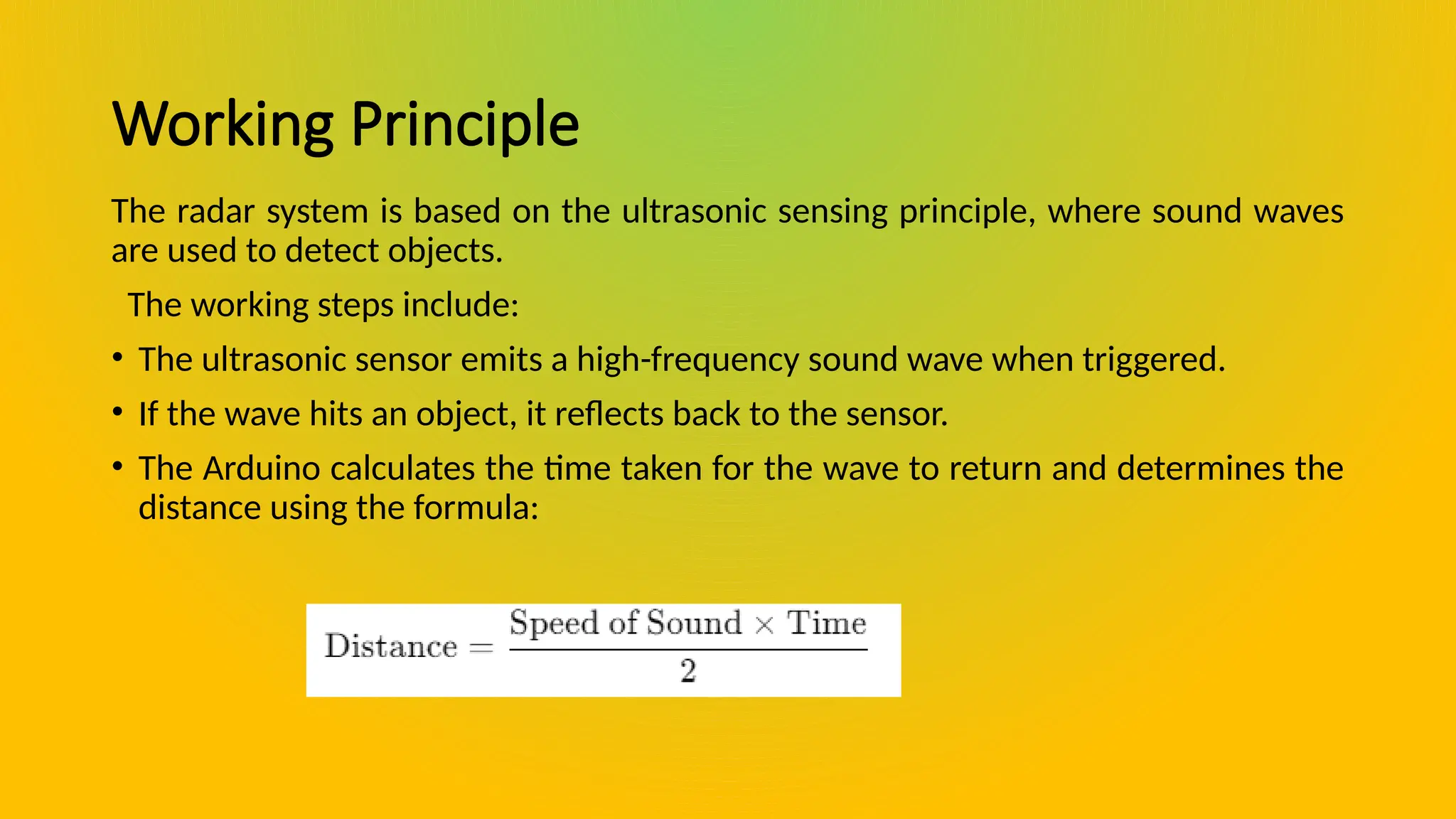
• The Arduino calculates the time taken for the wave to return and determines the
distance using the formula:
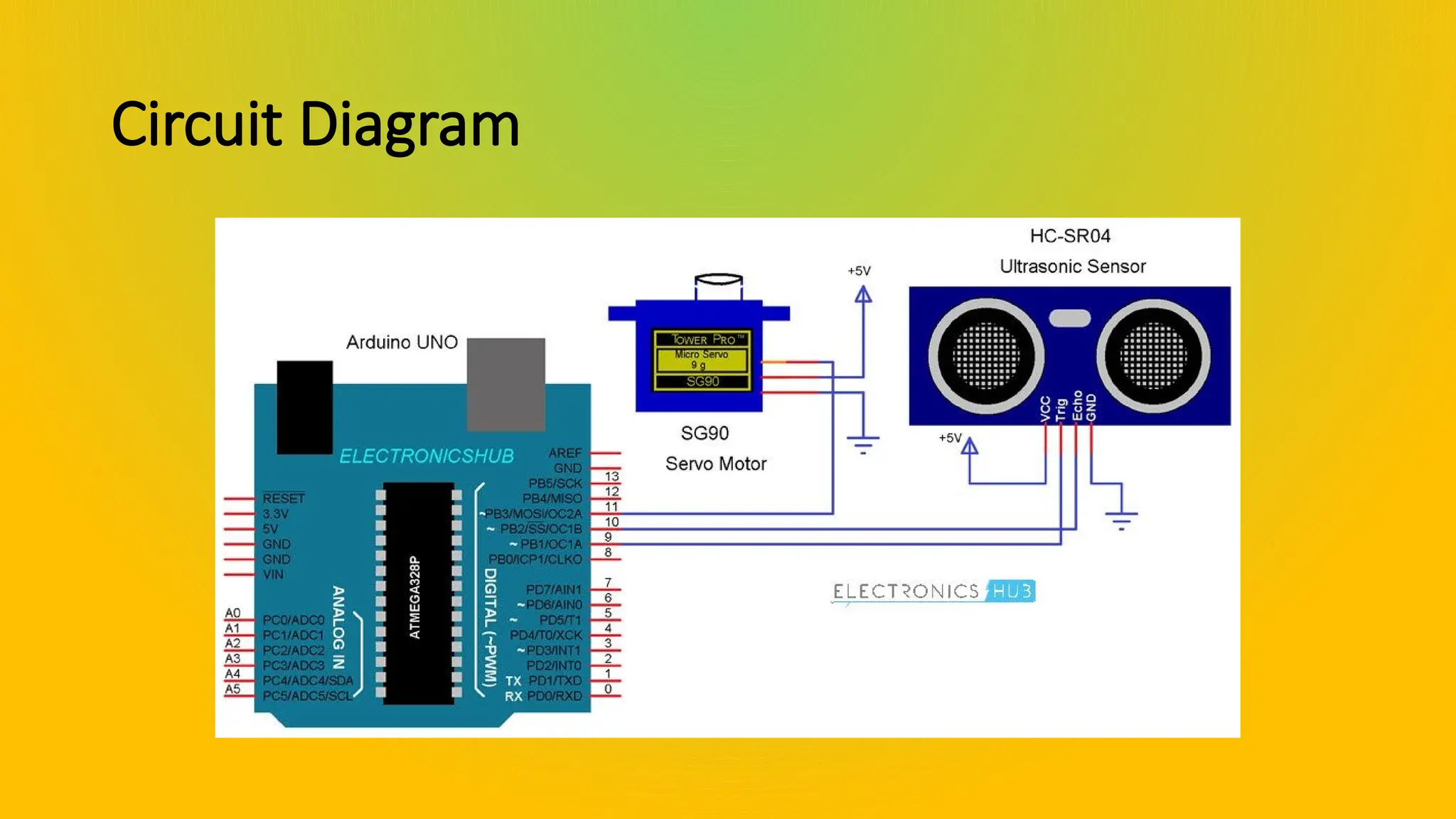
Circuit Diagram
Software Implementation
Arduino IDE:
The microcontroller is programmed to calculate distances, control the servo motor,
and send data to the computer.
Processing IDE:
Used to create a graphical radar-like interface, displaying object positions in real
time.
Applications
This radar system has a variety of applications, including:
• Obstacle detection in robotics.
• Security systems to detect intrusions.
• Monitoring objects in industrial environments.
• Educational projects to demonstrate radar principles.
Advantages
•Low-cost and easy-to-build system.
•Real-time object detection and visualization.
•Customizable for various applications.
•Compact and lightweight design.
Challenges Faced
• Synchronizing the servo motor with the sensor.
• Reducing noise in ultrasonic readings for better accuracy.
• Achieving smooth visualization in Processing.
Future Enhancements
• Integrate additional sensors for 360° object detection.
• Use advanced sensors like LiDAR for higher precision.
• Implement wireless communication for remote monitoring.
• Add a display screen to make the system standalone.
Conclusion
The Arduino Radar System is a simple yet powerful project that demonstrates the
potential of integrating microcontrollers and sensors. This scalable system can be
enhanced for advanced applications, serving as a valuable tool in education and
technology development.
Thank You !

Arduino Radar System using Arduino Uno board

  • 1.
  • 2.
    Introduction • In thisproject, we will see how to design a simple Radar Application using Arduino and Processing. • Radar is a long-range object detection system that uses radio waves to establish certain parameters of an object like its range, speed and position. • Radar technology is used in aircrafts, missiles, marine, weather predictions and automobiles.
  • 3.
    Objective The main goalsof the project are: • To design and develop a radar system using Arduino and ultrasonic technology. • To detect objects and calculate their distance from the radar system. • To visualize the scanned data in a radar-like format on a graphical display. • To provide a low-cost alternative to commercial radar systems for small-scale applications.
  • 4.
    Components Used • TheArduino Radar System consists of the following components: • Arduino Microcontroller (Uno or Nano): Acts as the central processing unit for data acquisition and control. • Ultrasonic Sensor (HC-SR04): Sends ultrasonic waves and receives the reflected waves to measure distance. • Servo Motor: Rotates the ultrasonic sensor to enable a wide-angle scan. • Processing Software: Creates the radar visualization on a computer. • Power Supply: Powers the Arduino and the connected modules. • Miscellaneous: Breadboard, jumper wires, and resistors.
  • 5.
    Working Principle The radarsystem is based on the ultrasonic sensing principle, where sound waves are used to detect objects. The working steps include: • The ultrasonic sensor emits a high-frequency sound wave when triggered. • If the wave hits an object, it reflects back to the sensor. • The Arduino calculates the time taken for the wave to return and determines the distance using the formula:
  • 6.
  • 7.
    Software Implementation Arduino IDE: Themicrocontroller is programmed to calculate distances, control the servo motor, and send data to the computer. Processing IDE: Used to create a graphical radar-like interface, displaying object positions in real time.
  • 8.
    Applications This radar systemhas a variety of applications, including: • Obstacle detection in robotics. • Security systems to detect intrusions. • Monitoring objects in industrial environments. • Educational projects to demonstrate radar principles.
  • 9.
    Advantages •Low-cost and easy-to-buildsystem. •Real-time object detection and visualization. •Customizable for various applications. •Compact and lightweight design.
  • 10.
    Challenges Faced • Synchronizingthe servo motor with the sensor. • Reducing noise in ultrasonic readings for better accuracy. • Achieving smooth visualization in Processing.
  • 11.
    Future Enhancements • Integrateadditional sensors for 360° object detection. • Use advanced sensors like LiDAR for higher precision. • Implement wireless communication for remote monitoring. • Add a display screen to make the system standalone.
  • 12.
    Conclusion The Arduino RadarSystem is a simple yet powerful project that demonstrates the potential of integrating microcontrollers and sensors. This scalable system can be enhanced for advanced applications, serving as a valuable tool in education and technology development.
  • 13.