ENRICO MANIAS
Portfolio
12
8
2
16
20
22
24
26
Table of Contents
Museum of Contemporary Art
Restoration of a rural church
Thesis: The school and the hamlet
Tramway station
Quartiere Mille
3D Studio Max Modeling and Rendering
High performance building
Autocad 3D Modeling and Rendering
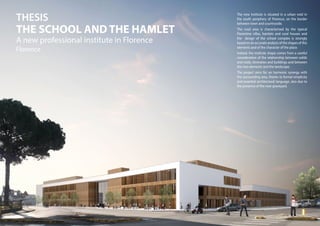
The new institute is situated in a urban void in
the south periphery of Florence, on the border
between town and countryside.
The rural area is characterised by the typical
Florentine villas, hamlets and rural houses and
the design of the school complex is strongly
based on an accurate analysis of the shapes of this
elements and of the character of the place.
Indeed, the institute shape comes from a careful
consideration of the relationship between solids
and voids, itineraries and buildings and between
this two elements and the landscape.
The project aims for an harmonic synergy with
the surrounding area, thanks to formal simplicity
and essential architectural language, also due to
the presence of the near graveyard.
THESIS
THE SCHOOL AND THE HAMLET
A new professional institute in Florence
Florence
3
ROOF OF THE AUDITORIUM
LIBRARY ON TWO LEVELS
AND ADMINISTRATION OFFICES
LIBRARY COURTYARD
MAIN HALL
GYM
RECREATION AREA
ON THREE LEVELS
MOTORBIKE PARKING
PUBLIC SQUARE
AND principal façade
LABORATORY
LABORATORY
INSULATED MOBILE WALL
CLASSROOM
SCHOOL GARDEN
GLAZED HALLWAY
MECHANICAL BUILDING
CAR PARKING
INNER COURTYARD
INFORMAL ACTIVITIES AREA
CLASSROOM
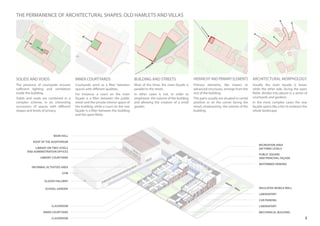
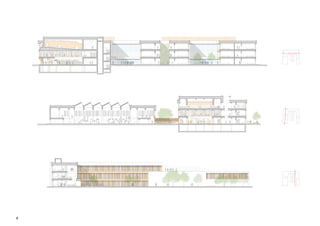
The presence of courtyards ensures
sufficient lighting and ventilation
inside the building.
Solids and voids are combined in a
complex scheme, in an interesting
succession of spaces with different
shapes and levels of privacy.
Courtyards work as a filter between
spaces with different qualities.
For instance, a court on the main
façade is a filter between the public
street and the private interior space of
the building, while a court on the rear
façade is a filter between the building
and the open fileds.
Most of the times the main façade is
parallel to the street.
In other cases is not, in order to
emphasize the volume of the building
and allowing the creation of a small
garden.
Usually the main façade is linear,
while the other side, facing the open
fields, divides into pieces in a series of
courtyards and gardens.
In the most complex cases the rear
façade opens like a fan to embrace the
whole landscape.
SOLIDS AND VOIDS INNER COURTYARDS BUILDING AND STREETS HIERARCHY AND PRIMARY ELEMENTS ARCHITECTURAL MORPHOLOGY
Primary elements, like towers or
advanced structures, emerge from the
rest of the building.
This parts usually are situated in cental
position or on the corner facing the
street, emphasizing the volume of the
building.
THE PERMANENCE OF ARCHITECTURAL SHAPES: OLD HAMLETS AND VILLAS
4
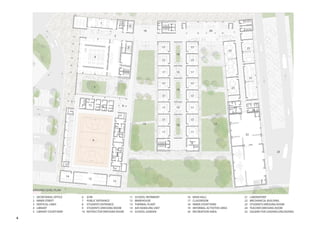
1 SECRETARIAL OFFICE
2 INNER STREET
3 VERTICAL LINKS
4 LIBRARY
5 library courtyard
6 gym
7 PUBLIC entrance
8 STUDENTS entrance
9 STUDENTS DRESSING ROOM
10 INSTRUCTOR DRESSING ROOM
11 school INFiRMaRy
12 WAREHOUSE
13 ThERMAl plant
14 air handling unit
15 school garden
16 MAIN HALL
17 CLASSROOM
18 INNER COURTYARD
19 INFORMAL ACTIVITIES AREA
20 RECREATION AREA
21 LABORATORY
22 MECHANICAL BUILDING
23 STUDENTS DRESSING ROOM
24 teacher dressing room
25 square for loading/unloading
1
16
2
3
3
11 10
9
9
6
12
13
14
7
8
15 15
3
18
18
18
19
19
20
21
21
21
21
23
24
22
25
1717
1717
1717
1717
1717
1717
1717
1717
4
5
GROUND LEVEL PLAN
5
6
7
The institute is composed of several
elements: a corner building that
characterize the crossroad on the northwest
part of the building site, the block that
contains classrooms, laboratories and the
mechanical building, the main hall that
connects this two blocks and a gym.
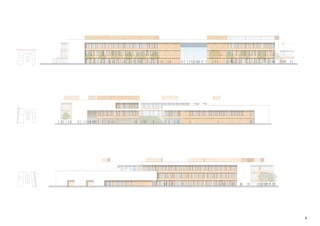
The main façade is compact and linear,
while the other side opens like a fan to
embrace the whole landscape.
Inside the building, parallel to the main
façade, runs an inner street that comprises a
succession of spaces with different qualities:
height,lightness,transparencyanddifferent
relationship with the landscape and the
urban context.
Two deep courtyards in the form of a
trapezium work as a filter between the main
connective spaces of the institute and the
open fields at the south border of the site.
The parts of the institute opposite to the
main façade’s side decrease in height and
divide into fragments, in a combination of
solids and voids.
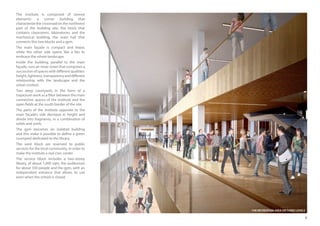
The gym becomes an isolated building
and this make it possible to define a green
courtyard dedicated to the library.
The west block are reserved to public
services for the local community, in order to
make the institute a real civic center.
The service block includes a two-storey
library, of about 1,000 sqm, the auditorium
for about 350 people and the gym, with an
independent entrance that allows its use
even when the school is closed.
THE RECREATION AREA ON THREE LEVELS
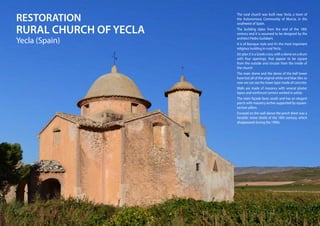
RESTORATION
RURAL CHURCH OF YECLA
Yecla (Spain)
The rural church was built near Yecla, a town of
the Autonomous Community of Murcia, in the
southwest of Spain.
The building dates from the end of the 18th
century and it is assumed to be designed by the
architect Pedro Guilabert.
It is of Baroque style and it’s the most important
religious building in ruralYecla.
On plan it is a Greek cross, with a dome on a drum
with four openings, that appear to be square
from the outside and circular from the inside of
the church.
The main dome and the dome of the bell tower
have lost all of the original white and blue tiles so
now we can see the lower layer made of concrete.
Walls are made of masonry with several plaster
layers and reinforced corners worked in ashlar.
The main façade faces south and has an elegant
porch with masonry arches supported by square-
section pillars.
Encased on the wall above the porch there was a
heraldic stone shield of the 18th century, which
disappeared during the 1990s.
9
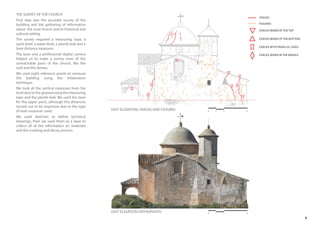
EAST ELEVATION ORTHOPHOTO
EAST ELEVATION: CRACKS AND FISSURES
crACKS
FiSSURes
CRacks WIDER AT THE TOP
CRacks WIDER AT THE BOTTOM
CRACKS WITH PARALLEL SIDES
CRACKS WIDER IN THE MIDDLE
0 1 2 5
0 1 2 5
THE SURVEY OF THE CHURCH
First step was the accurate survey of the
building and the gathering of information
about the rural church and its historical and
cultural setting.
The survey required a measuring tape, a
spirit level, a water level, a plumb bob and a
laser distance measurer.
The laser and a professional digital camera
helped us to make a survey even of the
unreachable parts of the church, like the
roof and the domes.
We used eight reference points to measure
the building using the trilateration
technique.
We took all the vertical measures from the
level zero to the ground using the measuring
tape and the plumb bob. We used the laser
for the upper parts, although this distances
turned out to be imprecise due to the type
of laser measurer used.
We used sketches to define technical
drawings, then we used them as a base to
collect all of the information on materials
and the cracking and decay process.
10
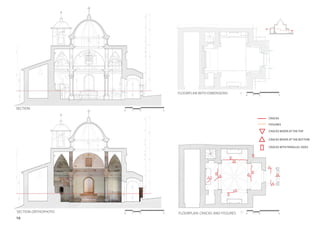
SECTION
SECTION ORTHOPHOTO 0 1 2 5
0 1 2 5
FLOORPLAN WITH DIMENSIONS 0 1 2 5
crACKS
FISSURES
CRacks WIDER AT THE TOP
CRacks WIDER AT THE BOTTOM
CRACKS WITH PARALLEL SIDES
FLOORPLAN: CRACKS AND FISSURES 0 1 2 5
11
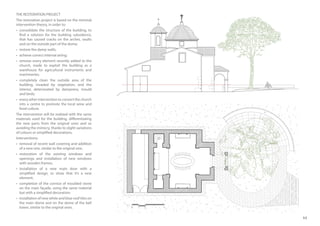
THE RESTORATION PROJECT
The restoration project is based on the minimal
intervention theory, in order to:
•	 consolidate the structure of the building, to
find a solution for the building subsidence,
that has caused cracks on the arches, vaults
and on the outside part of the dome;
•	 restore the damp walls;
•	 achieve correct internal airing;
•	 remove every element recently added to the
church, made to exploit the building as a
warehouse for agricultural instruments and
machineries;
•	 completely clean the outside area of the
building, invaded by vegetation, and the
interior, deteriorated by dampness, mould
and birds;
•	 every other intervention to convert the church
into a centre to promote the local wine and
food culture.
The intervention will be realized with the same
materials used for the building, differentiating
the new parts from the original ones and so
avoiding the mimicry, thanks to slight variations
of colours or simplified decorations.
Interventions:
•	 removal of recent wall covering and addition
of a new one, similar to the original one;
•	 restoration of the existing windows and
openings and installation of new windows
with wooden frames;
•	 installation of a new main door with a
simplified design, to show that it’s a new
element;
•	 completion of the cornice of moulded stone
on the main façade, using the same material
but with a simplified decoration;
•	 installation of new white and blue roof tiles on
the main dome and on the dome of the bell
tower, similar to the original ones. 0 1 2 5
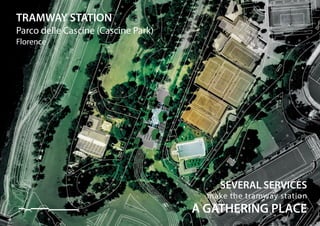
TRAMWAY STATION
Florence
0 10 20 50 100
Parco delle Cascine (Cascine Park)
make the tramway station
A GATHERING PLACE
SEVERAL SERVICES
13
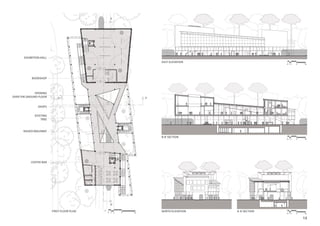
first FLOOR PLAN NORTH ELEVATION A-A’SECTION
b-b’SECTION
EAST ELEVATION
A’A
B’
B
0 1 2 5 10
0 1 2 5 10
0 1 2 5 10
0 1 2 5 10
exhibition hall
BOOKSHOP
SHOPS
OPENING
OVER THE GROUND FLOOR
RAISED WALKWAY
COFFEE BAR
EXISTING
TREE
14
VIEW TOWARDS THE MUSEUM
The station consists of a tramway stop,
two shops, a two-storey museum and a
two-storey coffee bar.
The museum and the coffee bar create
two poles of attraction in the complex.
They are connected by a glass roofing,
supported by space frames and concrete
pillars.
The glass covering allows users to enjoy
the view of the park and the Arno river,
as well as making possible to exploit the
natural light inside the station.
That’s why the coffee bar has large
windows and the museum a big skylight.
15
VIEW TOWARD THE COFFEE BAR
exhibition hall
glass roofing
STEEL STRUCTURE
coffee bar
coffee bar
exhibition hall
RAISED WALKWAY
TRAMWAY STOP
GROUND FLOOR
TOILETS
EQUIPMENT ROOM
INTERNAL VIEW OF THE MUSEUM
16
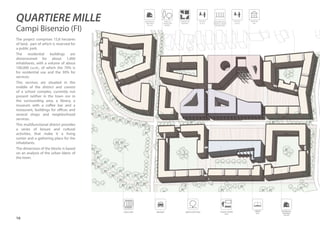
The project comprises 15,8 hectares
of land, part of which is reserved for
a public park.
The residential buildings are
dimensioned for about 1,000
inhabitants, with a volume of about
100,000 cu.m., of which the 70% is
for residential use and the 30% for
services.
This services are situated in the
middle of the district and consist
of a school complex, currently not
present neither in the town nor in
the surrounding area, a library, a
museum with a coffee bar and a
restaurant, buildings for offices and
several shops and neighborhood
services.
This multifunctional district provides
a series of leisure and cultural
activities, that make it a living
center and a gathering place for the
inhabitants.
The dimension of the blocks is based
on an analysis of the urban fabric of
the town.
SCHOOL CENTRE
(BLUE)
LIBRARY
(BLUE)
green courtyarddrivewayPUBLIC PARK
TREES AS
LANDSCAPE
MARKS
RESIDENTIAL
BUILDING
(YELLOW)
RESIDENTIAL
BUILDING
(YELLOW)
CONNECTED
SQUARES
OFFICES
(PURPLE)
OFFICES
(PURPLE)
NEIGHBORHOOD
SERVICES UNDER
THE ARCADES
MUSEUM
(RED)
QUARTIERE MILLE
Campi Bisenzio (FI)
17
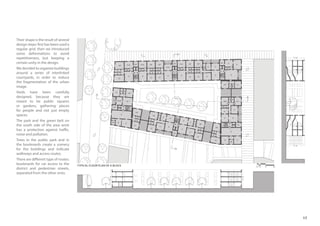
TYPICAL FLOOR PLAN OF A BLOCK
11m
11m
11 m
11 m
0 1 2 5 10
Their shape is the result of several
design steps: first has been used a
regular grid, then we introduced
some deformations to avoid
repetitiveness, but keeping a
certain unity in the design.
We decided to organize buildings
around a series of interlinked
courtyards, in order to reduce
the fragmentation of the urban
image.
Voids have been carefully
designed, because they are
meant to be public squares
or gardens, gathering places
for people and not just empty
spaces.
The park and the green belt on
the south side of the area work
has a protection against traffic,
noise and pollution.
Trees in the public park and in
the boulevards create a scenery
for the buildings and indicate
walkways and access routes.
There are different type of routes:
boulevards for car access to the
district and pedestrian streets,
separated from the other ones.
18
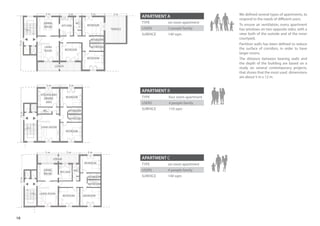
We defined several types of apartments, to
respond to the needs of different users.
To ensure air ventilation, every apartment
has windows on two opposite sides, with a
view both of the outside and of the inner
courtyard.
Partition walls has been defined to reduce
the surface of corridors, in order to have
larger rooms.
The distance between bearing walls and
the depth of the building are based on a
study on several contemporary projects,
that shows that the most used dimensions
are about 5 m x 12 m.
APARTMENT A
TYPE six room apartment
USERS 5 people family
SURFACE 140 sqm
APARTMENT B
TYPE four room apartment
USERS 4 people family
SURFACE 110 sqm
APARTMENT C
TYPE six room apartment
USERS 4 people family
SURFACE 140 sqm
WC
KITCHEN AND
DINING
AREA
LIVING ROOM
BEDROOM
BEDROOM
BATHROOM
BATHROOM
5 m5 m
12m
KITCHEN
WCDINING
ROOM
LIVING
ROOM BEDROOM
BEDROOM
BATHROOM
BATHROOM
BEDROOM
5 m 5 m 5 m 5 m
12m
TERRACE
LOGGIA
KITCHEN WCLIVING
ROOM
LIVING ROOM
BEDROOM BEDROOM
BATHROOM
BATHROOM
BEDROOM
5 m5 m
12m
5 m
LOGGIA
19
The two-storey villa included in the
residential building derives from a study of
the architectures of Richard Meier and Le
Corbusier.
The living area is in the lower level and
features a large double-height hall with a
staircase that leads to the second level.
Large French windows provide adequate
natural illumination for the hall and the
dining room and give access to a large
loggia.
The rest of the living area is occupied by a
smaller living, services and a kitchen.
Thesecondlevelcomprisesthreebedrooms
and the related services.
1st
LEVEL PLAN
LIVING
LIVING
KITCHENLOGGIA
5 m
12m
5 m 5 m
LOGGIA
DINING
ROOM
BATHROOM
BATHROOM
2nd
LEVEL PLAN
12m
5 m 5 m 5 m
BEDROOM
BEDROOM
BEDROOM
LOGGIABALCONY
BATH BATH
20
A-A’Section
EAST ELEVATION
2nd
LEVEL PLAN: INTERNAL BRIDGE AND LOWER LEVELS
OFFICES
STAIRCASE
WAREHOUSE
ELEVATORINFO
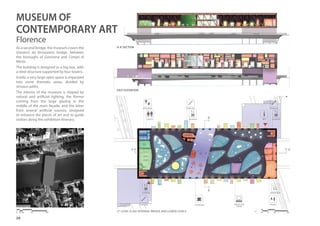
As a second bridge, the museum covers the
Giovanni da Verrazzano bridge, between
the boroughs of Gavinana and Campo di
Marte.
The building is designed as a big box, with
a steel structure supported by four towers.
Inside, a very large open space is organized
into some thematic areas, divided by
sinuous paths.
The interior of the museum is shaped by
natural and artificial lighting, the former
coming from the large glazing in the
middle of the main façade, and the latter
from several artificial sources, designed
to enhance the pieces of art and to guide
visitors along the exhibition itinerary.
A’A
B
B’
01 5 10 200 10 20 50 100
PROJECTION
ROOM
COFFEE BAR
ELEVATOR
ELEVATOR
BOOKSHOP
STAIRCASE
STAIRCASE
TOILETS
MUSEUM OF
CONTEMPORARY ART
Florence
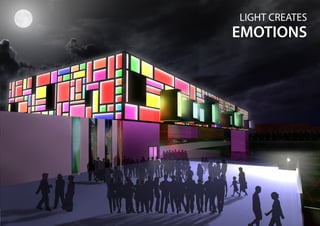
LIGHT CREATES
EMOTIONS
22
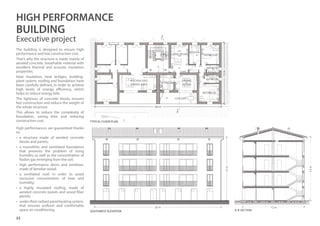
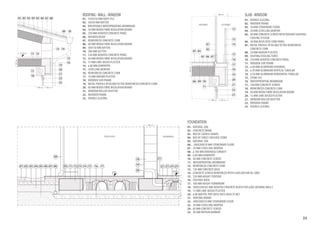
The building is designed to ensure high
performance and low construction cost.
That’s why the structure is made mainly of
aerated concrete, breathable material with
excellent thermal and acoustic insulation
properties.
Heat insulation, heat bridges, building-
plant system, roofing and foundation have
been carefully defined, in order to achieve
high levels of energy efficiency, which
helps to reduce energy bills.
The lightness of concrete blocks ensures
fast construction and reduce the weight of
the whole structure.
This allows to reduce the complexity of
foundation, saving time and reducing
construction cost.
High performances are guaranteed thanks
to:
•	 a structure made of aerated concrete
blocks and panels;
•	 a monolithic and ventilated foundation
that prevents the problem of rising
humidity as well as the concentration of
Radon gas emerging from the soil;
•	 high performance doors and windows,
made of lamellar wood;
•	 a ventilated roof, in order to avoid
excessive concentration of heat and
humidity;
•	 a highly insulated roofing, made of
aerated concrete panels and wood fiber
panels;
•	 under-floorradiantpanelheatingsystem,
that ensures uniform and comfortable
space air conditioning. SOUTHwest elevation
26 m
13m
A-A’section
12 m
13m
TYPICAL FLOOR PLAN
26 m
A’
A
12m
LIVING ROOM
KITCHEN
BATHROOM
BATHROOM
BEDROOM
BEDROOM
BEDROOM
DINING
ROOM
LOGGIA
KITCHEN AND
DINING AREA
HIGH PERFORMANCE
BUILDING
Executive project
23
SLAB-WINDOW
01.	 DOUBLE GLAZING
02.	 WOODEN FRAME
03.	 10 MM STONEWARE FLOOR
04.	 20 MM LEVELLING MORTAR
05.	 90 MM CONCRETE SCREEDWITH RADIANT HEATING/
COOLING SYSTEM
06.	 30 MM INSULATED CORK PANEL
07.	 METAL PROFILE ATTACHEDTOTHE REINFORCED
CONCRETE CURB
08.	 10 MM INDOOR PLASTER
09.	 HEATING/COOLINGTUBES
10.	 250 MM AERATED CONCRETE PANEL
11.	 WOODEN SUB FRAME
12.	 ø 60 MM ALUMINUM HANDRAIL
13.	 ø 50 MM ALUMINUMVERTICALTUBULAR
14.	 ø 30 MM ALUMINUM HORIZONTALTUBULAR
15.	 STONE SILL
16.	 WATERPROOFING MEMBRANE
17.	 100 MM CONCRETE SCREED
18.	 REINFORCED CONCRETE CURB
19.	 60 MMWOOD FIBRE INSULATION BOARD
20.	 15 MM LIME-BASED PLASTER
21.	 WINDOW ROLLER SHUTTER
22.	 WOODEN FRAME
23.	 DOUBLE GLAZING
25 cm30 cm
+ 12,20 m
32cm
01 02 03 04 05 06 07 08
09
14
15
16
19
20
21
22
23
17
11 12
18
13
10
FOUNDATION
01.	 NATURAL SOIL
02.	 CONCRETE DRAIN
03.	 BED OF COARSE GRAVEL
04.	 BED OF FINELY CRUSHED STONE
05.	 NATURAL SOIL
06.	 200X200X10 MM STONEWARE FLOOR
07.	 20 MM LEVELLING MORTAR
08.	 ø 100 MM DRAINAGE CONDUIT
09.	 ø 80 MM DOWNPIPE
10.	 40 MM CONCRETE SCREED
11.	 WATERPROOFING MEMBRANE
12.	 REINFORCED CONCRETE CURB
13.	 120 MM CONCRETE BASE
14.	 CONCRETE SCREED REINFORCEDWITH AWELDED METAL GRID
15.	 250 MM HEIGHT STOPEND
16.	 CRUSHED ROCK
17.	 300 MM HEIGHT FORMWORK
18.	 500X250X365 MM AERATED CONCRETE BLOCK FOR LOAD-BEARINGWALLS
19.	 15 MM LIME-BASED PLASTER
20.	 ø 80 MM PVC PIPEWITH ANTI-INSECTS NET
21.	 SKIRTING BOARD
22.	 200X200X10 MM STONEWARE FLOOR
23.	 20 MM LEVELLING MORTAR
24.	 60 MM CONCRETE SCREED
25.	 40 MMVAPOUR BARRIER
25 cm30 cm
38 cm
42cm
ESTERNOINTERNO
12
13
14
15
16
070605
10
11
0908
0403
02
01
17
18
19
20
21
22
23
44cm24cm
PORTICATO
0,00 +0,02 m
SGOMBERO
01 02 03 04 05 06 07 08
09
10 11 12 13 14 15 16 17
18
19
20
21
22 23 24 25
40 cm
ROOFING-WALL-WINDOW
01.	 410X250 MM ROOFTILE
02.	 50X30 MM BATTEN
03.	 BREATHABLEWATERPROOFING MEMBRANE
04.	 50 MMWOOD FIBRE INSULATION BOARD
05.	 250 MM AERATED CONCRETE PANEL
06.	 WOODEN BEAM
07.	 REINFORCED CONCRETE CURB
08.	 60 MMWOOD FIBRE INSULATION BOARD
09.	 30X150 MM BATTEN
10.	 200 MM GUTTER
11.	 250 MM AERATED CONCRETE PANEL
12.	 60 MMWOOD FIBRE INSULATION BOARD
13.	 15 MM LIME-BASED PLASTER
14.	 ø 80 MM DOWNPIPE
15.	 LEVELLING MORTAR
16.	 REINFORCED CONCRETE CURB
17.	 10 MM INDOOR PLASTER
18.	 WOODEN SUB FRAME
19.	 METAL PROFILE ATTACHEDTOTHE REINFORCED CONCRETE CURB
20.	 60 MMWOOD FIBRE INSULATION BOARD
21.	 WINDOW ROLLER SHUTTER
22.	 WOODEN FRAME
23.	 DOUBLE GLAZING
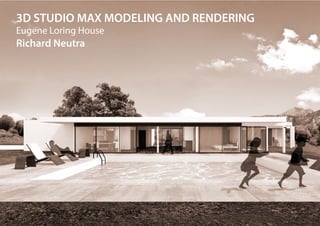
3D STUDIO MAX MODELING AND RENDERING
Eugene Loring House
Richard Neutra
25
The project consists in the 3D modeling of the villa designed by the Austrian architect
Richard Neutra in 1959, built near Los Angeles.
26
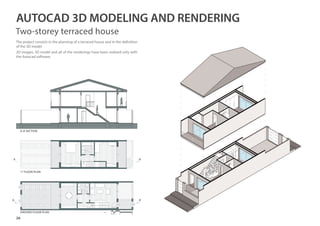
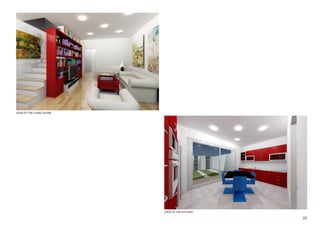
The project consists in the planning of a terraced house and in the definition
of the 3D model.
2D images, 3D model and all of the renderings have been realized only with
the Autocad software.
GROUND FLOOR PLAN
1st
FLOOR PLAN
A-A’SECTION
A’A
A’A
0 10,5 2 5
AUTOCAD 3D MODELING AND RENDERING
Two-storey terraced house
27
VIEW OF THE LIVING ROOM
VIEW OF THE KITCHEN
Enrico Manias
via Antonio Scano 12, 09129 Cagliari, Italy
+39 347 04 24 064
enricomanias@hotmail.it
skype: enricoark
Architecture portfolio_EN

Architecture portfolio_EN

  • 1.
  • 3.
    12 8 2 16 20 22 24 26 Table of Contents Museumof Contemporary Art Restoration of a rural church Thesis: The school and the hamlet Tramway station Quartiere Mille 3D Studio Max Modeling and Rendering High performance building Autocad 3D Modeling and Rendering
  • 4.
    The new instituteis situated in a urban void in the south periphery of Florence, on the border between town and countryside. The rural area is characterised by the typical Florentine villas, hamlets and rural houses and the design of the school complex is strongly based on an accurate analysis of the shapes of this elements and of the character of the place. Indeed, the institute shape comes from a careful consideration of the relationship between solids and voids, itineraries and buildings and between this two elements and the landscape. The project aims for an harmonic synergy with the surrounding area, thanks to formal simplicity and essential architectural language, also due to the presence of the near graveyard. THESIS THE SCHOOL AND THE HAMLET A new professional institute in Florence Florence
  • 5.
    3 ROOF OF THEAUDITORIUM LIBRARY ON TWO LEVELS AND ADMINISTRATION OFFICES LIBRARY COURTYARD MAIN HALL GYM RECREATION AREA ON THREE LEVELS MOTORBIKE PARKING PUBLIC SQUARE AND principal façade LABORATORY LABORATORY INSULATED MOBILE WALL CLASSROOM SCHOOL GARDEN GLAZED HALLWAY MECHANICAL BUILDING CAR PARKING INNER COURTYARD INFORMAL ACTIVITIES AREA CLASSROOM The presence of courtyards ensures sufficient lighting and ventilation inside the building. Solids and voids are combined in a complex scheme, in an interesting succession of spaces with different shapes and levels of privacy. Courtyards work as a filter between spaces with different qualities. For instance, a court on the main façade is a filter between the public street and the private interior space of the building, while a court on the rear façade is a filter between the building and the open fileds. Most of the times the main façade is parallel to the street. In other cases is not, in order to emphasize the volume of the building and allowing the creation of a small garden. Usually the main façade is linear, while the other side, facing the open fields, divides into pieces in a series of courtyards and gardens. In the most complex cases the rear façade opens like a fan to embrace the whole landscape. SOLIDS AND VOIDS INNER COURTYARDS BUILDING AND STREETS HIERARCHY AND PRIMARY ELEMENTS ARCHITECTURAL MORPHOLOGY Primary elements, like towers or advanced structures, emerge from the rest of the building. This parts usually are situated in cental position or on the corner facing the street, emphasizing the volume of the building. THE PERMANENCE OF ARCHITECTURAL SHAPES: OLD HAMLETS AND VILLAS
  • 6.
    4 1 SECRETARIAL OFFICE 2INNER STREET 3 VERTICAL LINKS 4 LIBRARY 5 library courtyard 6 gym 7 PUBLIC entrance 8 STUDENTS entrance 9 STUDENTS DRESSING ROOM 10 INSTRUCTOR DRESSING ROOM 11 school INFiRMaRy 12 WAREHOUSE 13 ThERMAl plant 14 air handling unit 15 school garden 16 MAIN HALL 17 CLASSROOM 18 INNER COURTYARD 19 INFORMAL ACTIVITIES AREA 20 RECREATION AREA 21 LABORATORY 22 MECHANICAL BUILDING 23 STUDENTS DRESSING ROOM 24 teacher dressing room 25 square for loading/unloading 1 16 2 3 3 11 10 9 9 6 12 13 14 7 8 15 15 3 18 18 18 19 19 20 21 21 21 21 23 24 22 25 1717 1717 1717 1717 1717 1717 1717 1717 4 5 GROUND LEVEL PLAN
  • 7.
  • 8.
  • 9.
    7 The institute iscomposed of several elements: a corner building that characterize the crossroad on the northwest part of the building site, the block that contains classrooms, laboratories and the mechanical building, the main hall that connects this two blocks and a gym. The main façade is compact and linear, while the other side opens like a fan to embrace the whole landscape. Inside the building, parallel to the main façade, runs an inner street that comprises a succession of spaces with different qualities: height,lightness,transparencyanddifferent relationship with the landscape and the urban context. Two deep courtyards in the form of a trapezium work as a filter between the main connective spaces of the institute and the open fields at the south border of the site. The parts of the institute opposite to the main façade’s side decrease in height and divide into fragments, in a combination of solids and voids. The gym becomes an isolated building and this make it possible to define a green courtyard dedicated to the library. The west block are reserved to public services for the local community, in order to make the institute a real civic center. The service block includes a two-storey library, of about 1,000 sqm, the auditorium for about 350 people and the gym, with an independent entrance that allows its use even when the school is closed. THE RECREATION AREA ON THREE LEVELS
  • 10.
    RESTORATION RURAL CHURCH OFYECLA Yecla (Spain) The rural church was built near Yecla, a town of the Autonomous Community of Murcia, in the southwest of Spain. The building dates from the end of the 18th century and it is assumed to be designed by the architect Pedro Guilabert. It is of Baroque style and it’s the most important religious building in ruralYecla. On plan it is a Greek cross, with a dome on a drum with four openings, that appear to be square from the outside and circular from the inside of the church. The main dome and the dome of the bell tower have lost all of the original white and blue tiles so now we can see the lower layer made of concrete. Walls are made of masonry with several plaster layers and reinforced corners worked in ashlar. The main façade faces south and has an elegant porch with masonry arches supported by square- section pillars. Encased on the wall above the porch there was a heraldic stone shield of the 18th century, which disappeared during the 1990s.
  • 11.
    9 EAST ELEVATION ORTHOPHOTO EASTELEVATION: CRACKS AND FISSURES crACKS FiSSURes CRacks WIDER AT THE TOP CRacks WIDER AT THE BOTTOM CRACKS WITH PARALLEL SIDES CRACKS WIDER IN THE MIDDLE 0 1 2 5 0 1 2 5 THE SURVEY OF THE CHURCH First step was the accurate survey of the building and the gathering of information about the rural church and its historical and cultural setting. The survey required a measuring tape, a spirit level, a water level, a plumb bob and a laser distance measurer. The laser and a professional digital camera helped us to make a survey even of the unreachable parts of the church, like the roof and the domes. We used eight reference points to measure the building using the trilateration technique. We took all the vertical measures from the level zero to the ground using the measuring tape and the plumb bob. We used the laser for the upper parts, although this distances turned out to be imprecise due to the type of laser measurer used. We used sketches to define technical drawings, then we used them as a base to collect all of the information on materials and the cracking and decay process.
  • 12.
    10 SECTION SECTION ORTHOPHOTO 01 2 5 0 1 2 5 FLOORPLAN WITH DIMENSIONS 0 1 2 5 crACKS FISSURES CRacks WIDER AT THE TOP CRacks WIDER AT THE BOTTOM CRACKS WITH PARALLEL SIDES FLOORPLAN: CRACKS AND FISSURES 0 1 2 5
  • 13.
    11 THE RESTORATION PROJECT Therestoration project is based on the minimal intervention theory, in order to: • consolidate the structure of the building, to find a solution for the building subsidence, that has caused cracks on the arches, vaults and on the outside part of the dome; • restore the damp walls; • achieve correct internal airing; • remove every element recently added to the church, made to exploit the building as a warehouse for agricultural instruments and machineries; • completely clean the outside area of the building, invaded by vegetation, and the interior, deteriorated by dampness, mould and birds; • every other intervention to convert the church into a centre to promote the local wine and food culture. The intervention will be realized with the same materials used for the building, differentiating the new parts from the original ones and so avoiding the mimicry, thanks to slight variations of colours or simplified decorations. Interventions: • removal of recent wall covering and addition of a new one, similar to the original one; • restoration of the existing windows and openings and installation of new windows with wooden frames; • installation of a new main door with a simplified design, to show that it’s a new element; • completion of the cornice of moulded stone on the main façade, using the same material but with a simplified decoration; • installation of new white and blue roof tiles on the main dome and on the dome of the bell tower, similar to the original ones. 0 1 2 5
  • 14.
    TRAMWAY STATION Florence 0 1020 50 100 Parco delle Cascine (Cascine Park) make the tramway station A GATHERING PLACE SEVERAL SERVICES
  • 15.
    13 first FLOOR PLANNORTH ELEVATION A-A’SECTION b-b’SECTION EAST ELEVATION A’A B’ B 0 1 2 5 10 0 1 2 5 10 0 1 2 5 10 0 1 2 5 10 exhibition hall BOOKSHOP SHOPS OPENING OVER THE GROUND FLOOR RAISED WALKWAY COFFEE BAR EXISTING TREE
  • 16.
    14 VIEW TOWARDS THEMUSEUM The station consists of a tramway stop, two shops, a two-storey museum and a two-storey coffee bar. The museum and the coffee bar create two poles of attraction in the complex. They are connected by a glass roofing, supported by space frames and concrete pillars. The glass covering allows users to enjoy the view of the park and the Arno river, as well as making possible to exploit the natural light inside the station. That’s why the coffee bar has large windows and the museum a big skylight.
  • 17.
    15 VIEW TOWARD THECOFFEE BAR exhibition hall glass roofing STEEL STRUCTURE coffee bar coffee bar exhibition hall RAISED WALKWAY TRAMWAY STOP GROUND FLOOR TOILETS EQUIPMENT ROOM INTERNAL VIEW OF THE MUSEUM
  • 18.
    16 The project comprises15,8 hectares of land, part of which is reserved for a public park. The residential buildings are dimensioned for about 1,000 inhabitants, with a volume of about 100,000 cu.m., of which the 70% is for residential use and the 30% for services. This services are situated in the middle of the district and consist of a school complex, currently not present neither in the town nor in the surrounding area, a library, a museum with a coffee bar and a restaurant, buildings for offices and several shops and neighborhood services. This multifunctional district provides a series of leisure and cultural activities, that make it a living center and a gathering place for the inhabitants. The dimension of the blocks is based on an analysis of the urban fabric of the town. SCHOOL CENTRE (BLUE) LIBRARY (BLUE) green courtyarddrivewayPUBLIC PARK TREES AS LANDSCAPE MARKS RESIDENTIAL BUILDING (YELLOW) RESIDENTIAL BUILDING (YELLOW) CONNECTED SQUARES OFFICES (PURPLE) OFFICES (PURPLE) NEIGHBORHOOD SERVICES UNDER THE ARCADES MUSEUM (RED) QUARTIERE MILLE Campi Bisenzio (FI)
  • 19.
    17 TYPICAL FLOOR PLANOF A BLOCK 11m 11m 11 m 11 m 0 1 2 5 10 Their shape is the result of several design steps: first has been used a regular grid, then we introduced some deformations to avoid repetitiveness, but keeping a certain unity in the design. We decided to organize buildings around a series of interlinked courtyards, in order to reduce the fragmentation of the urban image. Voids have been carefully designed, because they are meant to be public squares or gardens, gathering places for people and not just empty spaces. The park and the green belt on the south side of the area work has a protection against traffic, noise and pollution. Trees in the public park and in the boulevards create a scenery for the buildings and indicate walkways and access routes. There are different type of routes: boulevards for car access to the district and pedestrian streets, separated from the other ones.
  • 20.
    18 We defined severaltypes of apartments, to respond to the needs of different users. To ensure air ventilation, every apartment has windows on two opposite sides, with a view both of the outside and of the inner courtyard. Partition walls has been defined to reduce the surface of corridors, in order to have larger rooms. The distance between bearing walls and the depth of the building are based on a study on several contemporary projects, that shows that the most used dimensions are about 5 m x 12 m. APARTMENT A TYPE six room apartment USERS 5 people family SURFACE 140 sqm APARTMENT B TYPE four room apartment USERS 4 people family SURFACE 110 sqm APARTMENT C TYPE six room apartment USERS 4 people family SURFACE 140 sqm WC KITCHEN AND DINING AREA LIVING ROOM BEDROOM BEDROOM BATHROOM BATHROOM 5 m5 m 12m KITCHEN WCDINING ROOM LIVING ROOM BEDROOM BEDROOM BATHROOM BATHROOM BEDROOM 5 m 5 m 5 m 5 m 12m TERRACE LOGGIA KITCHEN WCLIVING ROOM LIVING ROOM BEDROOM BEDROOM BATHROOM BATHROOM BEDROOM 5 m5 m 12m 5 m LOGGIA
  • 21.
    19 The two-storey villaincluded in the residential building derives from a study of the architectures of Richard Meier and Le Corbusier. The living area is in the lower level and features a large double-height hall with a staircase that leads to the second level. Large French windows provide adequate natural illumination for the hall and the dining room and give access to a large loggia. The rest of the living area is occupied by a smaller living, services and a kitchen. Thesecondlevelcomprisesthreebedrooms and the related services. 1st LEVEL PLAN LIVING LIVING KITCHENLOGGIA 5 m 12m 5 m 5 m LOGGIA DINING ROOM BATHROOM BATHROOM 2nd LEVEL PLAN 12m 5 m 5 m 5 m BEDROOM BEDROOM BEDROOM LOGGIABALCONY BATH BATH
  • 22.
    20 A-A’Section EAST ELEVATION 2nd LEVEL PLAN:INTERNAL BRIDGE AND LOWER LEVELS OFFICES STAIRCASE WAREHOUSE ELEVATORINFO As a second bridge, the museum covers the Giovanni da Verrazzano bridge, between the boroughs of Gavinana and Campo di Marte. The building is designed as a big box, with a steel structure supported by four towers. Inside, a very large open space is organized into some thematic areas, divided by sinuous paths. The interior of the museum is shaped by natural and artificial lighting, the former coming from the large glazing in the middle of the main façade, and the latter from several artificial sources, designed to enhance the pieces of art and to guide visitors along the exhibition itinerary. A’A B B’ 01 5 10 200 10 20 50 100 PROJECTION ROOM COFFEE BAR ELEVATOR ELEVATOR BOOKSHOP STAIRCASE STAIRCASE TOILETS MUSEUM OF CONTEMPORARY ART Florence
  • 23.
  • 24.
    22 The building isdesigned to ensure high performance and low construction cost. That’s why the structure is made mainly of aerated concrete, breathable material with excellent thermal and acoustic insulation properties. Heat insulation, heat bridges, building- plant system, roofing and foundation have been carefully defined, in order to achieve high levels of energy efficiency, which helps to reduce energy bills. The lightness of concrete blocks ensures fast construction and reduce the weight of the whole structure. This allows to reduce the complexity of foundation, saving time and reducing construction cost. High performances are guaranteed thanks to: • a structure made of aerated concrete blocks and panels; • a monolithic and ventilated foundation that prevents the problem of rising humidity as well as the concentration of Radon gas emerging from the soil; • high performance doors and windows, made of lamellar wood; • a ventilated roof, in order to avoid excessive concentration of heat and humidity; • a highly insulated roofing, made of aerated concrete panels and wood fiber panels; • under-floorradiantpanelheatingsystem, that ensures uniform and comfortable space air conditioning. SOUTHwest elevation 26 m 13m A-A’section 12 m 13m TYPICAL FLOOR PLAN 26 m A’ A 12m LIVING ROOM KITCHEN BATHROOM BATHROOM BEDROOM BEDROOM BEDROOM DINING ROOM LOGGIA KITCHEN AND DINING AREA HIGH PERFORMANCE BUILDING Executive project
  • 25.
    23 SLAB-WINDOW 01. DOUBLE GLAZING 02. WOODEN FRAME 03. 10 MM STONEWARE FLOOR 04. 20 MM LEVELLING MORTAR 05. 90 MM CONCRETE SCREEDWITH RADIANT HEATING/ COOLING SYSTEM 06. 30 MM INSULATED CORK PANEL 07. METAL PROFILE ATTACHEDTOTHE REINFORCED CONCRETE CURB 08. 10 MM INDOOR PLASTER 09. HEATING/COOLINGTUBES 10. 250 MM AERATED CONCRETE PANEL 11. WOODEN SUB FRAME 12. ø 60 MM ALUMINUM HANDRAIL 13. ø 50 MM ALUMINUMVERTICALTUBULAR 14. ø 30 MM ALUMINUM HORIZONTALTUBULAR 15. STONE SILL 16. WATERPROOFING MEMBRANE 17. 100 MM CONCRETE SCREED 18. REINFORCED CONCRETE CURB 19. 60 MMWOOD FIBRE INSULATION BOARD 20. 15 MM LIME-BASED PLASTER 21. WINDOW ROLLER SHUTTER 22. WOODEN FRAME 23. DOUBLE GLAZING 25 cm30 cm + 12,20 m 32cm 01 02 03 04 05 06 07 08 09 14 15 16 19 20 21 22 23 17 11 12 18 13 10 FOUNDATION 01. NATURAL SOIL 02. CONCRETE DRAIN 03. BED OF COARSE GRAVEL 04. BED OF FINELY CRUSHED STONE 05. NATURAL SOIL 06. 200X200X10 MM STONEWARE FLOOR 07. 20 MM LEVELLING MORTAR 08. ø 100 MM DRAINAGE CONDUIT 09. ø 80 MM DOWNPIPE 10. 40 MM CONCRETE SCREED 11. WATERPROOFING MEMBRANE 12. REINFORCED CONCRETE CURB 13. 120 MM CONCRETE BASE 14. CONCRETE SCREED REINFORCEDWITH AWELDED METAL GRID 15. 250 MM HEIGHT STOPEND 16. CRUSHED ROCK 17. 300 MM HEIGHT FORMWORK 18. 500X250X365 MM AERATED CONCRETE BLOCK FOR LOAD-BEARINGWALLS 19. 15 MM LIME-BASED PLASTER 20. ø 80 MM PVC PIPEWITH ANTI-INSECTS NET 21. SKIRTING BOARD 22. 200X200X10 MM STONEWARE FLOOR 23. 20 MM LEVELLING MORTAR 24. 60 MM CONCRETE SCREED 25. 40 MMVAPOUR BARRIER 25 cm30 cm 38 cm 42cm ESTERNOINTERNO 12 13 14 15 16 070605 10 11 0908 0403 02 01 17 18 19 20 21 22 23 44cm24cm PORTICATO 0,00 +0,02 m SGOMBERO 01 02 03 04 05 06 07 08 09 10 11 12 13 14 15 16 17 18 19 20 21 22 23 24 25 40 cm ROOFING-WALL-WINDOW 01. 410X250 MM ROOFTILE 02. 50X30 MM BATTEN 03. BREATHABLEWATERPROOFING MEMBRANE 04. 50 MMWOOD FIBRE INSULATION BOARD 05. 250 MM AERATED CONCRETE PANEL 06. WOODEN BEAM 07. REINFORCED CONCRETE CURB 08. 60 MMWOOD FIBRE INSULATION BOARD 09. 30X150 MM BATTEN 10. 200 MM GUTTER 11. 250 MM AERATED CONCRETE PANEL 12. 60 MMWOOD FIBRE INSULATION BOARD 13. 15 MM LIME-BASED PLASTER 14. ø 80 MM DOWNPIPE 15. LEVELLING MORTAR 16. REINFORCED CONCRETE CURB 17. 10 MM INDOOR PLASTER 18. WOODEN SUB FRAME 19. METAL PROFILE ATTACHEDTOTHE REINFORCED CONCRETE CURB 20. 60 MMWOOD FIBRE INSULATION BOARD 21. WINDOW ROLLER SHUTTER 22. WOODEN FRAME 23. DOUBLE GLAZING
  • 26.
    3D STUDIO MAXMODELING AND RENDERING Eugene Loring House Richard Neutra
  • 27.
    25 The project consistsin the 3D modeling of the villa designed by the Austrian architect Richard Neutra in 1959, built near Los Angeles.
  • 28.
    26 The project consistsin the planning of a terraced house and in the definition of the 3D model. 2D images, 3D model and all of the renderings have been realized only with the Autocad software. GROUND FLOOR PLAN 1st FLOOR PLAN A-A’SECTION A’A A’A 0 10,5 2 5 AUTOCAD 3D MODELING AND RENDERING Two-storey terraced house
  • 29.
    27 VIEW OF THELIVING ROOM VIEW OF THE KITCHEN
  • 30.
    Enrico Manias via AntonioScano 12, 09129 Cagliari, Italy +39 347 04 24 064 enricomanias@hotmail.it skype: enricoark