URBAN FORM AS AN INSPIRATION FOR DESIGN
[ Angie Claeys ]
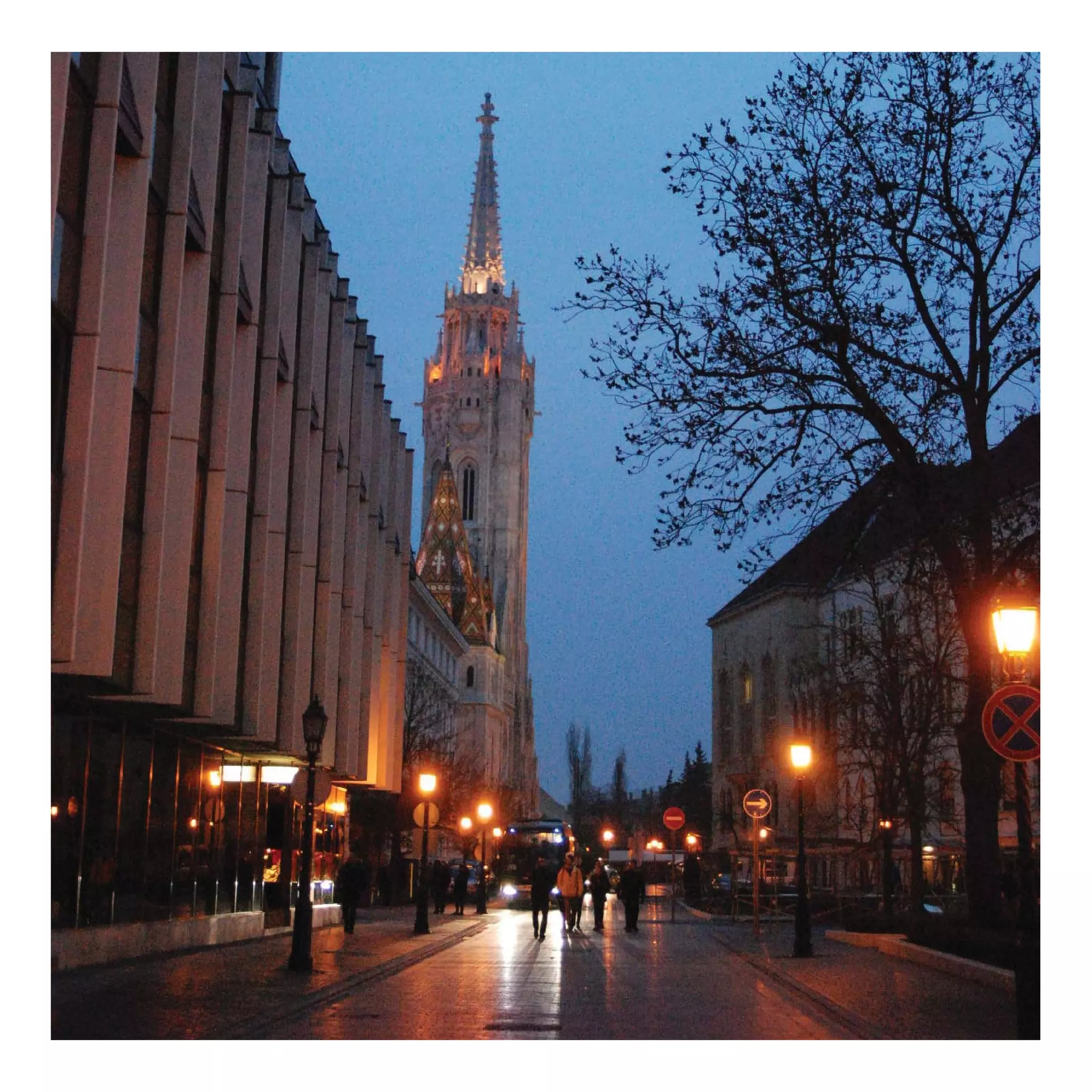
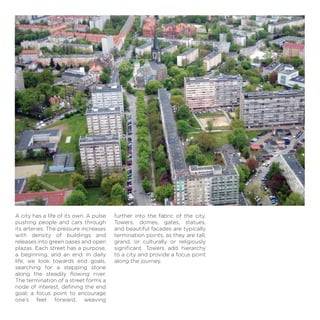
A city has a life of its own. A pulse
pushing people and cars through
its arteries. The pressure increases
with density of buildings and
releases into green oases and open
plazas. Each street has a purpose,
a beginning, and an end. In daily
life, we look towards end goals,
searching for a stepping stone
along the steadily flowing river.
The termination of a street forms a
node of interest, defining the end
goal; a focus point to encourage
one’s feet forward, weaving
further into the fabric of the city.
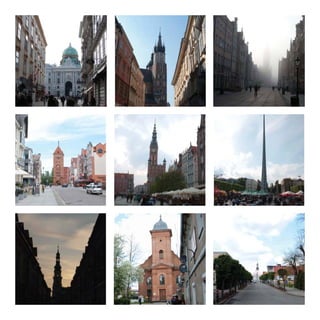
Towers, domes, gates, statues,
and beautiful facades are typically
termination points, as they are tall,
grand, or culturally or religiously
significant. Towers add hierarchy
to a city and provide a focus point
along the journey.
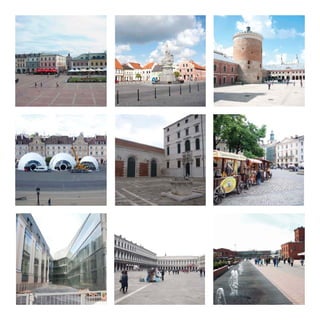
Sergels Torg in Stockholm, Sweden
is a recessed square defined
by the surroundings buildings,
stairs, and a tall scultpural tower
visible from afar. In addition, the
paving patterns continue from the
square through a shopping center
and to a subway station. Like a
welcoming carpet, the black and
white triangles are a marker of
location. Easily recognizable, one
knows when they are nearing the
main square and approaching a
main node of the city.
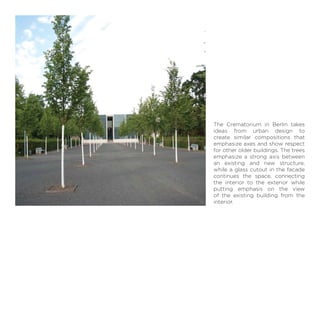
The Crematorium in Berlin takes
ideas from urban design to
create similar compositions that
emphasize axes and show respect
for other older buildings. The trees
emphasize a strong axis between
an existing and new structure,
while a glass cutout in the facade
continues the space, connecting
the interior to the exterior while
putting emphasis on the view
of the existing building from the
interior.
Urban design can also inform
interior spaces of newly designed
buildings. Public squares do not
onlyhavetobeoutside,butcanalso
be covered, lively interior spaces. It
is full of program and light, like a
street. The street becomes part of
the interior of the building, forming
a public square within. The Jewish
Museum in Warsaw, Poland has a
simple exterior volume with one
slice through the interior to form
a public passageway connected to
program such as a restaurant and
snack bar. The curvilinear, interior
forms contrast the orthogonal
exterior, giving importance and life
to the interior space. Multiple levels
with bridges and floor openings
create visual connections between
floors, making the space feel more
open while also encouraging
interaction between people. The
space is likened to a street and a
square because it is more than
just a passage, but a place for
businesses, a socializing hub, and
a meeting point.
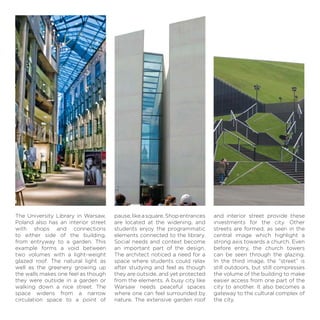
pause,likeasquare.Shopentrances
are located at the widening, and
students enjoy the programmatic
elements connected to the library.
Social needs and context become
an important part of the design.
The architect noticed a need for a
space where students could relax
after studying and feel as though
they are outside, and yet protected
from the elements. A busy city like
Warsaw needs peaceful spaces
where one can feel surrounded by
nature. The extensive garden roof
The University Library in Warsaw,
Poland also has an interior street
with shops and connections
to either side of the building,
from entryway to a garden. This
example forms a void between
two volumes with a light-weight
glazed roof. The natural light as
well as the greenery growing up
the walls makes one feel as though
they were outside in a garden or
walking down a nice street. The
space widens from a narrow
circulation space to a point of
and interior street provide these
investments for the city. Other
streets are formed, as seen in the
central image which highlight a
strong axis towards a church. Even
before entry, the church towers
can be seen through the glazing.
In the third image, the “street” is
still outdoors, but still compresses
the volume of the building to make
easier access from one part of the
city to another. It also becomes a
gateway to the cultural complex of
the city.
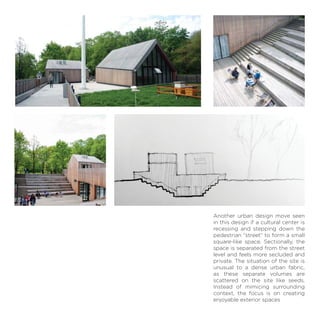
Another urban design move seen
in this design if a cultural center is
recessing and stepping down the
pedestrian “street” to form a small
square-like space. Sectionally, the
space is separated from the street
level and feels more secluded and
private. The situation of the site is
unusual to a dense urban fabric,
as these separate volumes are
scattered on the site like seeds.
Instead of mimicing surrounding
context, the focus is on creating
enjoyable exterior spaces
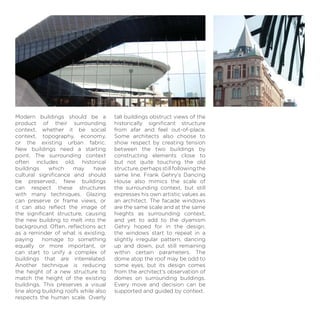
Modern buildings should be a
product of their surrounding
context, whether it be social
context, topography, economy,
or the existing urban fabric.
New buildings need a starting
point. The surrounding context
often includes old, historical
buildings which may have
cultural significance and should
be preserved.. New buildings
can respect these structures
with many techniques. Glazing
can preserve or frame views, or
it can also reflect the image of
the significant structure, causing
the new building to melt into the
background. Often, reflections act
as a reminder of what is existing,
paying homage to something
equally or more important, or
can start to unify a complex of
buildings that are interrelated.
Another technique is reducing
the height of a new structure to
match the height of the existing
buildings. This preserves a visual
line along building roofs while also
respects the human scale. Overly
tall buildings obstruct views of the
historically significant structure
from afar and feel out-of-place.
Some architects also choose to
show respect by creating tension
between the two buildings by
constructing elements close to
but not quite touching the old
structure,perhapsstillfollowingthe
same line. Frank Gehry’s Dancing
House also mimics the scale of
the surrounding context, but still
expresses his own artistic values as
an architect. The facade windows
are the same scale and at the same
hieghts as surrounding context,
and yet to add to the dyamism
Gehry hoped for in the design,
the windows start to repeat in a
slightly irregular pattern, dancing
up and down, put still remaining
within certain parameters. The
dome atop the roof may be odd to
some eyes, but its design comes
from the architect’s observation of
domes on surrounding buildings.
Every move and decision can be
supported and guided by context.
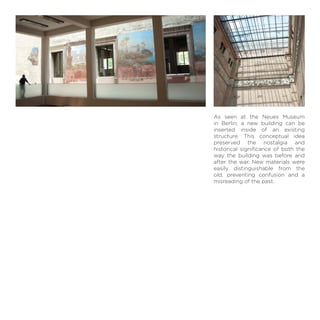
As seen at the Neues Museum
in Berlin, a new building can be
inserted inside of an existing
structure. This conceptual idea
preserved the nostalgia and
historical significance of both the
way the building was before and
after the war. New materials were
easily distinguishable from the
old, preventing confusion and a
misreading of the past.
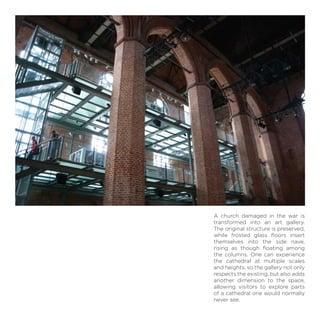
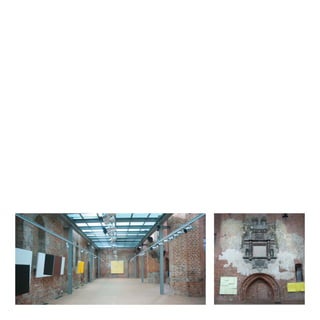
A church damaged in the war is
transformed into an art gallery.
The original structure is preserved,
while frosted glass floors insert
themselves into the side nave,
rising as though floating among
the columns. One can experience
the cathedral at multiple scales
and heights, so the gallery not only
respects the existing, but also adds
another dimension to the space,
allowing visitors to explore parts
of a cathedral one would normally
never see.
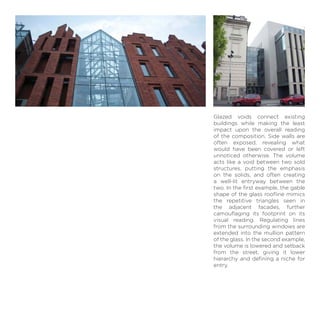
Glazed voids connect existing
buildings while making the least
impact upon the overall reading
of the composition. Side walls are
often exposed, revealing what
would have been covered or left
unnoticed otherwise. The volume
acts like a void between two sold
structures, putting the emphasis
on the solids, and often creating
a well-lit entryway between the
two. In the first example, the gable
shape of the glass roofline mimics
the repetitive triangles seen in
the adjacent facades, further
camouflaging its footprint on its
visual reading. Regulating lines
from the surrounding windows are
extended into the mullion pattern
of the glass. In the second example,
the volume is lowered and setback
from the street, giving it lower
hierarchy and defining a niche for
entry.
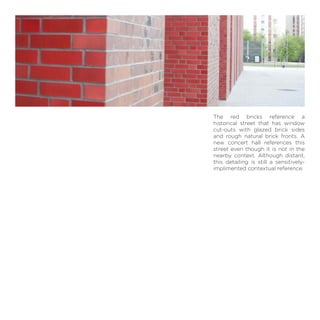
The red bricks reference a
historical street that has window
cut-outs with glazed brick sides
and rough natural brick fronts. A
new concert hall references this
street even though it is not in the
nearby context. Although distant,
this detailing is still a sensitively-
implimented contextual reference.
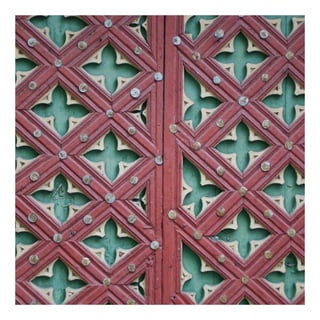
Urban composition informs design
through contextual references
such as social ideals of the city,
economics, hostory, and existing
design and styles. New design can
be a reinterpreted repetition of
a reference from afar or directly
nearby. Everything from the urban
scale to a colorful door detail can
be contextually based, and should
be, in order to design purposefully
for the betterment of inhabitants’
quality of life and a cities’ overall
character.
aclaeys_book

aclaeys_book

  • 2.
    URBAN FORM ASAN INSPIRATION FOR DESIGN [ Angie Claeys ]
  • 3.
    A city hasa life of its own. A pulse pushing people and cars through its arteries. The pressure increases with density of buildings and releases into green oases and open plazas. Each street has a purpose, a beginning, and an end. In daily life, we look towards end goals, searching for a stepping stone along the steadily flowing river. The termination of a street forms a node of interest, defining the end goal; a focus point to encourage one’s feet forward, weaving further into the fabric of the city. Towers, domes, gates, statues, and beautiful facades are typically termination points, as they are tall, grand, or culturally or religiously significant. Towers add hierarchy to a city and provide a focus point along the journey.
  • 5.
    Sergels Torg inStockholm, Sweden is a recessed square defined by the surroundings buildings, stairs, and a tall scultpural tower visible from afar. In addition, the paving patterns continue from the square through a shopping center and to a subway station. Like a welcoming carpet, the black and white triangles are a marker of location. Easily recognizable, one knows when they are nearing the main square and approaching a main node of the city.
  • 7.
    The Crematorium inBerlin takes ideas from urban design to create similar compositions that emphasize axes and show respect for other older buildings. The trees emphasize a strong axis between an existing and new structure, while a glass cutout in the facade continues the space, connecting the interior to the exterior while putting emphasis on the view of the existing building from the interior.
  • 8.
    Urban design canalso inform interior spaces of newly designed buildings. Public squares do not onlyhavetobeoutside,butcanalso be covered, lively interior spaces. It is full of program and light, like a street. The street becomes part of the interior of the building, forming a public square within. The Jewish Museum in Warsaw, Poland has a simple exterior volume with one slice through the interior to form a public passageway connected to program such as a restaurant and snack bar. The curvilinear, interior forms contrast the orthogonal exterior, giving importance and life to the interior space. Multiple levels with bridges and floor openings create visual connections between floors, making the space feel more open while also encouraging interaction between people. The space is likened to a street and a square because it is more than just a passage, but a place for businesses, a socializing hub, and a meeting point.
  • 9.
    pause,likeasquare.Shopentrances are located atthe widening, and students enjoy the programmatic elements connected to the library. Social needs and context become an important part of the design. The architect noticed a need for a space where students could relax after studying and feel as though they are outside, and yet protected from the elements. A busy city like Warsaw needs peaceful spaces where one can feel surrounded by nature. The extensive garden roof The University Library in Warsaw, Poland also has an interior street with shops and connections to either side of the building, from entryway to a garden. This example forms a void between two volumes with a light-weight glazed roof. The natural light as well as the greenery growing up the walls makes one feel as though they were outside in a garden or walking down a nice street. The space widens from a narrow circulation space to a point of and interior street provide these investments for the city. Other streets are formed, as seen in the central image which highlight a strong axis towards a church. Even before entry, the church towers can be seen through the glazing. In the third image, the “street” is still outdoors, but still compresses the volume of the building to make easier access from one part of the city to another. It also becomes a gateway to the cultural complex of the city.
  • 10.
    Another urban designmove seen in this design if a cultural center is recessing and stepping down the pedestrian “street” to form a small square-like space. Sectionally, the space is separated from the street level and feels more secluded and private. The situation of the site is unusual to a dense urban fabric, as these separate volumes are scattered on the site like seeds. Instead of mimicing surrounding context, the focus is on creating enjoyable exterior spaces
  • 11.
    Modern buildings shouldbe a product of their surrounding context, whether it be social context, topography, economy, or the existing urban fabric. New buildings need a starting point. The surrounding context often includes old, historical buildings which may have cultural significance and should be preserved.. New buildings can respect these structures with many techniques. Glazing can preserve or frame views, or it can also reflect the image of the significant structure, causing the new building to melt into the background. Often, reflections act as a reminder of what is existing, paying homage to something equally or more important, or can start to unify a complex of buildings that are interrelated. Another technique is reducing the height of a new structure to match the height of the existing buildings. This preserves a visual line along building roofs while also respects the human scale. Overly tall buildings obstruct views of the historically significant structure from afar and feel out-of-place. Some architects also choose to show respect by creating tension between the two buildings by constructing elements close to but not quite touching the old structure,perhapsstillfollowingthe same line. Frank Gehry’s Dancing House also mimics the scale of the surrounding context, but still expresses his own artistic values as an architect. The facade windows are the same scale and at the same hieghts as surrounding context, and yet to add to the dyamism Gehry hoped for in the design, the windows start to repeat in a slightly irregular pattern, dancing up and down, put still remaining within certain parameters. The dome atop the roof may be odd to some eyes, but its design comes from the architect’s observation of domes on surrounding buildings. Every move and decision can be supported and guided by context.
  • 12.
    As seen atthe Neues Museum in Berlin, a new building can be inserted inside of an existing structure. This conceptual idea preserved the nostalgia and historical significance of both the way the building was before and after the war. New materials were easily distinguishable from the old, preventing confusion and a misreading of the past.
  • 13.
    A church damagedin the war is transformed into an art gallery. The original structure is preserved, while frosted glass floors insert themselves into the side nave, rising as though floating among the columns. One can experience the cathedral at multiple scales and heights, so the gallery not only respects the existing, but also adds another dimension to the space, allowing visitors to explore parts of a cathedral one would normally never see.
  • 15.
    Glazed voids connectexisting buildings while making the least impact upon the overall reading of the composition. Side walls are often exposed, revealing what would have been covered or left unnoticed otherwise. The volume acts like a void between two sold structures, putting the emphasis on the solids, and often creating a well-lit entryway between the two. In the first example, the gable shape of the glass roofline mimics the repetitive triangles seen in the adjacent facades, further camouflaging its footprint on its visual reading. Regulating lines from the surrounding windows are extended into the mullion pattern of the glass. In the second example, the volume is lowered and setback from the street, giving it lower hierarchy and defining a niche for entry.
  • 16.
    The red bricksreference a historical street that has window cut-outs with glazed brick sides and rough natural brick fronts. A new concert hall references this street even though it is not in the nearby context. Although distant, this detailing is still a sensitively- implimented contextual reference.
  • 17.
    Urban composition informsdesign through contextual references such as social ideals of the city, economics, hostory, and existing design and styles. New design can be a reinterpreted repetition of a reference from afar or directly nearby. Everything from the urban scale to a colorful door detail can be contextually based, and should be, in order to design purposefully for the betterment of inhabitants’ quality of life and a cities’ overall character.