AMSTERDAMN CENTRAL LIBRARY
Central Public
Library of
Amsterdam
Architect :Jo Coenen
Year(s) of
construction:2007
Built-up Area :
28,500 m2
Location:
Prinsengracht 587,
Amsterdam,
Netherlands
Coordinates :
52° 22' 34" N, 4° 54'
28" E
INTRODUCTION
 The Amsterdam Central Public Library,
designed by German architect Jo Coenen, is
the head of a network of 27 libraries called
Openbare Bibliotheek Amsterdam (OBA,
Amsterdam Public Library).
 With approximately 28,500 meters square,
is the largest library in Europe.
 Its construction cost was 80 million Euros
and get an average of 7,000 visits per day.
 It is open 7 days a week from 10:00 to
22:00 hours, not only the library but also a
café, a restaurant, theater, terrace and
exhibition hall.
 The system of borrowing and returning
books, CD's, DVD's and games are fully
automated.
LOCATION
 Oosterdokseiland is located in a developing area of
the city being built on both sides of Central Station,
where there are also other important works such as
Renzo Piano's Nemo and ARCAM (Architecture
Center Amsterdam).
 The Library is one of three buildings forming part of
the master development plan for this area. From its
large windows you can see a panoramic view of Old
Amsterdam and the area Westerdokseiland
Oosterdokseiland and, on the opposite side of
Central Station.
CONCEPT
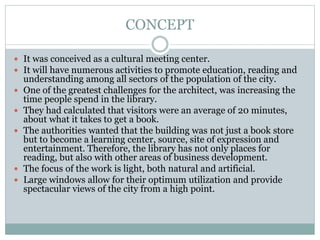
 It was conceived as a cultural meeting center.
 It will have numerous activities to promote education, reading and
understanding among all sectors of the population of the city.
 One of the greatest challenges for the architect, was increasing the
time people spend in the library.
 They had calculated that visitors were an average of 20 minutes,
about what it takes to get a book.
 The authorities wanted that the building was not just a book store
but to become a learning center, source, site of expression and
entertainment. Therefore, the library has not only places for
reading, but also with other areas of business development.
 The focus of the work is light, both natural and artificial.
 Large windows allow for their optimum utilization and provide
spectacular views of the city from a high point.
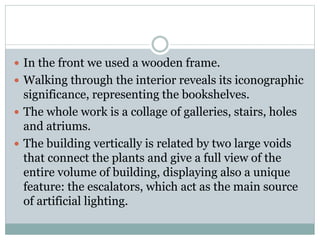
 In the front we used a wooden frame.
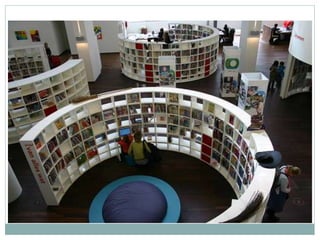
 Walking through the interior reveals its iconographic
significance, representing the bookshelves.
 The whole work is a collage of galleries, stairs, holes
and atriums.
 The building vertically is related by two large voids
that connect the plants and give a full view of the
entire volume of building, displaying also a unique
feature: the escalators, which act as the main source
of artificial lighting.
SPACES
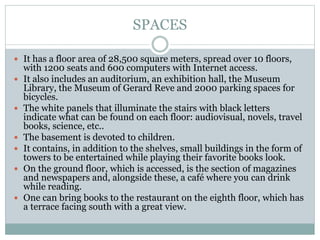
 It has a floor area of 28,500 square meters, spread over 10 floors,
with 1200 seats and 600 computers with Internet access.
 It also includes an auditorium, an exhibition hall, the Museum
Library, the Museum of Gerard Reve and 2000 parking spaces for
bicycles.
 The white panels that illuminate the stairs with black letters
indicate what can be found on each floor: audiovisual, novels, travel
books, science, etc..
 The basement is devoted to children.
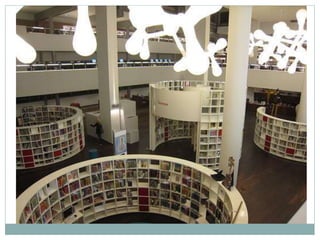
 It contains, in addition to the shelves, small buildings in the form of
towers to be entertained while playing their favorite books look.
 On the ground floor, which is accessed, is the section of magazines
and newspapers and, alongside these, a café where you can drink
while reading.
 One can bring books to the restaurant on the eighth floor, which has
a terrace facing south with a great view.
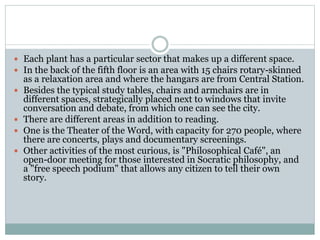
 Each plant has a particular sector that makes up a different space.
 In the back of the fifth floor is an area with 15 chairs rotary-skinned
as a relaxation area and where the hangars are from Central Station.
 Besides the typical study tables, chairs and armchairs are in
different spaces, strategically placed next to windows that invite
conversation and debate, from which one can see the city.
 There are different areas in addition to reading.
 One is the Theater of the Word, with capacity for 270 people, where
there are concerts, plays and documentary screenings.
 Other activities of the most curious, is "Philosophical Café", an
open-door meeting for those interested in Socratic philosophy, and
a "free speech podium" that allows any citizen to tell their own
story.
Lighting
 The glass surface is very important in this building, always
presenting huge windows allowing optimum use of natural light and
spectacular views of Amsterdam-Centrum.
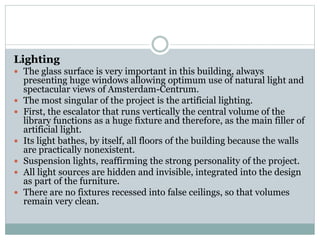
 The most singular of the project is the artificial lighting.
 First, the escalator that runs vertically the central volume of the
library functions as a huge fixture and therefore, as the main filler of
artificial light.
 Its light bathes, by itself, all floors of the building because the walls
are practically nonexistent.
 Suspension lights, reaffirming the strong personality of the project.
 All light sources are hidden and invisible, integrated into the design
as part of the furniture.
 There are no fixtures recessed into false ceilings, so that volumes
remain very clean.
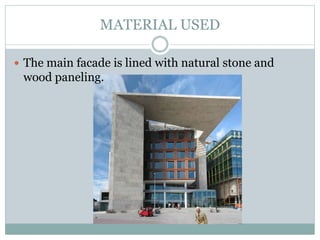
MATERIAL USED
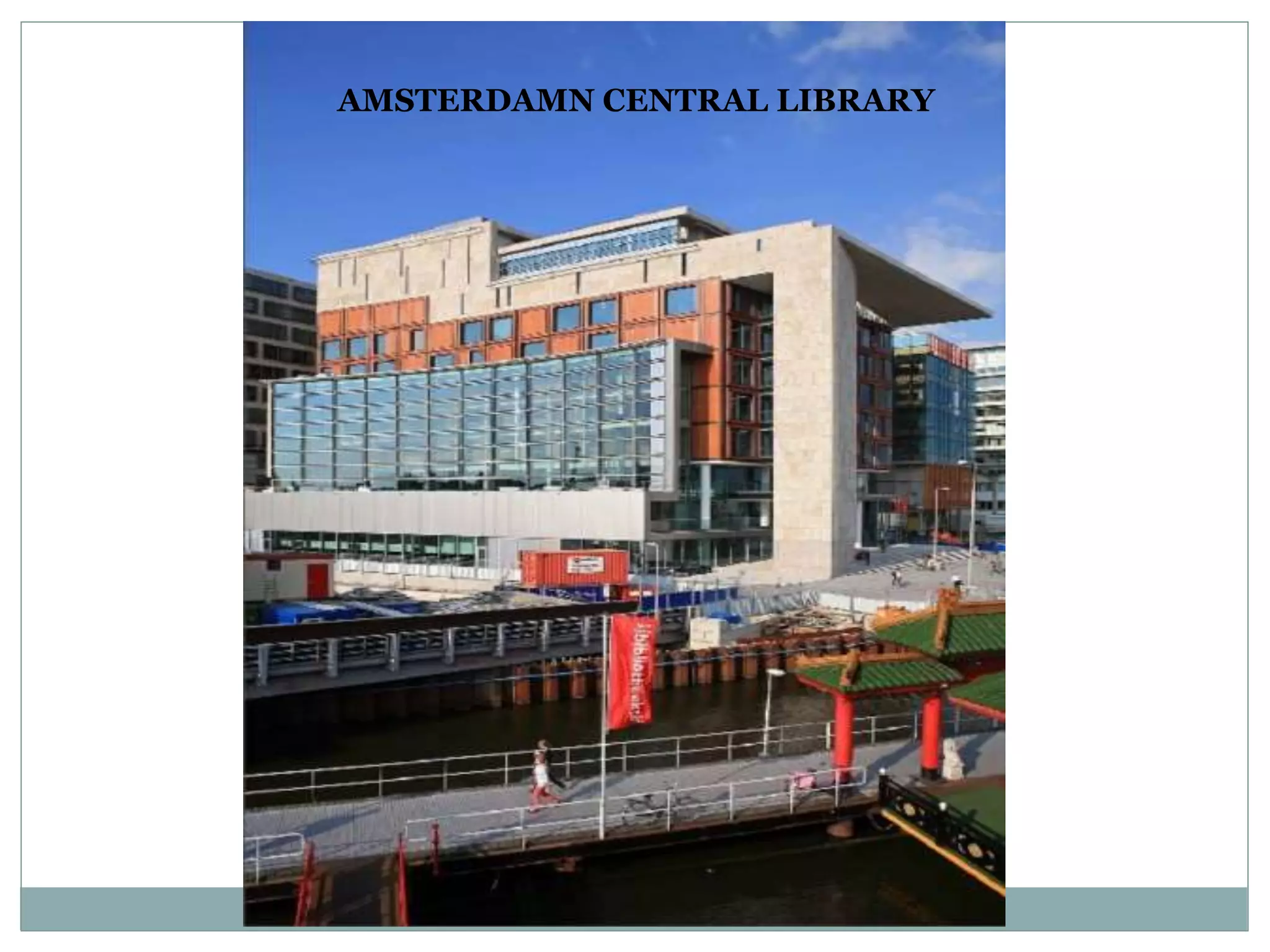
 The main facade is lined with natural stone and
wood paneling.
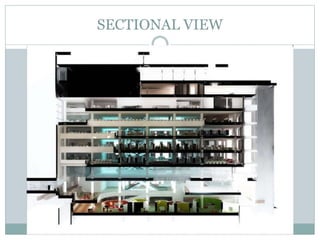
SECTIONAL VIEW
THANK YOU

Amsterdamn library

  • 1.
  • 2.
    Central Public Library of Amsterdam Architect:Jo Coenen Year(s) of construction:2007 Built-up Area : 28,500 m2 Location: Prinsengracht 587, Amsterdam, Netherlands Coordinates : 52° 22' 34" N, 4° 54' 28" E INTRODUCTION  The Amsterdam Central Public Library, designed by German architect Jo Coenen, is the head of a network of 27 libraries called Openbare Bibliotheek Amsterdam (OBA, Amsterdam Public Library).  With approximately 28,500 meters square, is the largest library in Europe.  Its construction cost was 80 million Euros and get an average of 7,000 visits per day.  It is open 7 days a week from 10:00 to 22:00 hours, not only the library but also a café, a restaurant, theater, terrace and exhibition hall.  The system of borrowing and returning books, CD's, DVD's and games are fully automated.
  • 3.
    LOCATION  Oosterdokseiland islocated in a developing area of the city being built on both sides of Central Station, where there are also other important works such as Renzo Piano's Nemo and ARCAM (Architecture Center Amsterdam).  The Library is one of three buildings forming part of the master development plan for this area. From its large windows you can see a panoramic view of Old Amsterdam and the area Westerdokseiland Oosterdokseiland and, on the opposite side of Central Station.
  • 5.
    CONCEPT  It wasconceived as a cultural meeting center.  It will have numerous activities to promote education, reading and understanding among all sectors of the population of the city.  One of the greatest challenges for the architect, was increasing the time people spend in the library.  They had calculated that visitors were an average of 20 minutes, about what it takes to get a book.  The authorities wanted that the building was not just a book store but to become a learning center, source, site of expression and entertainment. Therefore, the library has not only places for reading, but also with other areas of business development.  The focus of the work is light, both natural and artificial.  Large windows allow for their optimum utilization and provide spectacular views of the city from a high point.
  • 6.
     In thefront we used a wooden frame.  Walking through the interior reveals its iconographic significance, representing the bookshelves.  The whole work is a collage of galleries, stairs, holes and atriums.  The building vertically is related by two large voids that connect the plants and give a full view of the entire volume of building, displaying also a unique feature: the escalators, which act as the main source of artificial lighting.
  • 7.
    SPACES  It hasa floor area of 28,500 square meters, spread over 10 floors, with 1200 seats and 600 computers with Internet access.  It also includes an auditorium, an exhibition hall, the Museum Library, the Museum of Gerard Reve and 2000 parking spaces for bicycles.  The white panels that illuminate the stairs with black letters indicate what can be found on each floor: audiovisual, novels, travel books, science, etc..  The basement is devoted to children.  It contains, in addition to the shelves, small buildings in the form of towers to be entertained while playing their favorite books look.  On the ground floor, which is accessed, is the section of magazines and newspapers and, alongside these, a café where you can drink while reading.  One can bring books to the restaurant on the eighth floor, which has a terrace facing south with a great view.
  • 9.
     Each planthas a particular sector that makes up a different space.  In the back of the fifth floor is an area with 15 chairs rotary-skinned as a relaxation area and where the hangars are from Central Station.  Besides the typical study tables, chairs and armchairs are in different spaces, strategically placed next to windows that invite conversation and debate, from which one can see the city.  There are different areas in addition to reading.  One is the Theater of the Word, with capacity for 270 people, where there are concerts, plays and documentary screenings.  Other activities of the most curious, is "Philosophical Café", an open-door meeting for those interested in Socratic philosophy, and a "free speech podium" that allows any citizen to tell their own story.
  • 10.
    Lighting  The glasssurface is very important in this building, always presenting huge windows allowing optimum use of natural light and spectacular views of Amsterdam-Centrum.  The most singular of the project is the artificial lighting.  First, the escalator that runs vertically the central volume of the library functions as a huge fixture and therefore, as the main filler of artificial light.  Its light bathes, by itself, all floors of the building because the walls are practically nonexistent.  Suspension lights, reaffirming the strong personality of the project.  All light sources are hidden and invisible, integrated into the design as part of the furniture.  There are no fixtures recessed into false ceilings, so that volumes remain very clean.
  • 12.
    MATERIAL USED  Themain facade is lined with natural stone and wood paneling.
  • 13.
  • 14.