Archaeology
Digging Up the Past
Archaeology
Archaeology

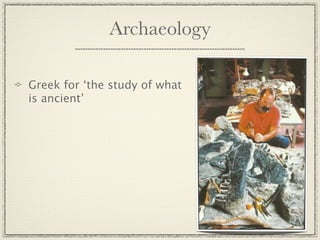
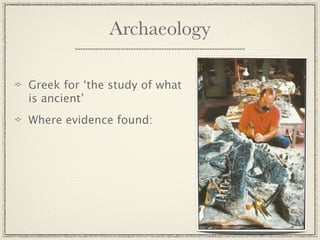
Greek for ‘the study of what
is ancient’
Archaeology

Greek for ‘the study of what
is ancient’
Where evidence found:
Archaeology

Greek for ‘the study of what
is ancient’
Where evidence found:
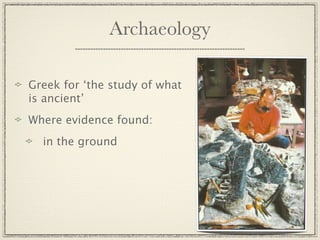
  in the ground
Archaeology

Greek for ‘the study of what
is ancient’
Where evidence found:
  in the ground
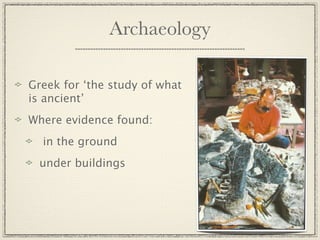
 under buildings
Archaeology

Greek for ‘the study of what
is ancient’
Where evidence found:
  in the ground
 under buildings
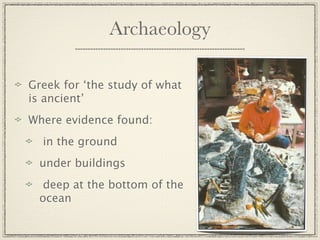
  deep at the bottom of the
 ocean
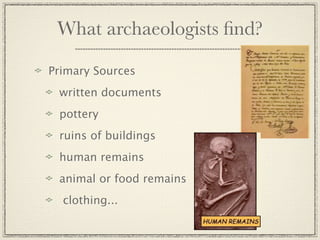
What archaeologists find?

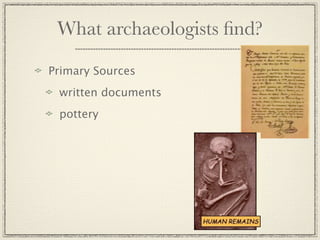
Primary Sources
What archaeologists find?

Primary Sources
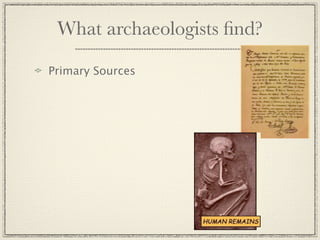
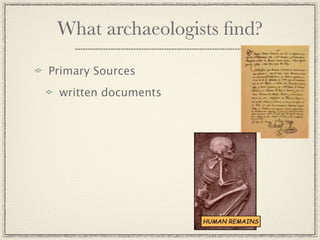
 written documents
What archaeologists find?

Primary Sources
 written documents
 pottery
What archaeologists find?

Primary Sources
 written documents
 pottery
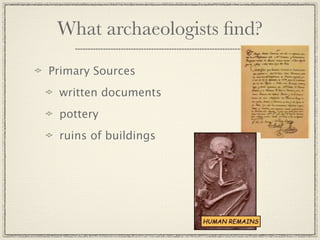
 ruins of buildings
What archaeologists find?

Primary Sources
 written documents
 pottery
 ruins of buildings
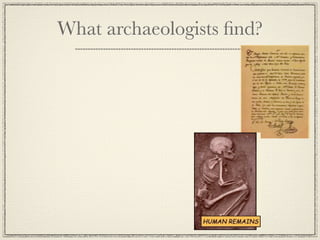
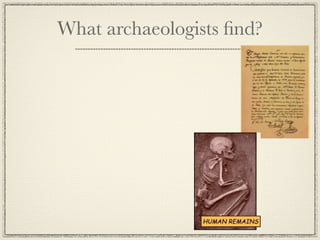
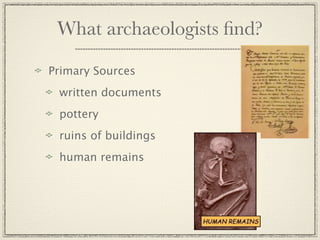
 human remains
What archaeologists find?

Primary Sources
 written documents
 pottery
 ruins of buildings
 human remains
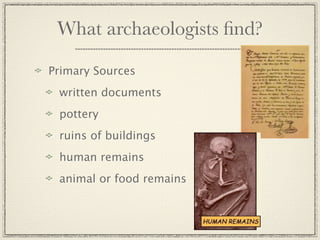
 animal or food remains
What archaeologists find?

Primary Sources
 written documents
 pottery
 ruins of buildings
 human remains
 animal or food remains
  clothing...
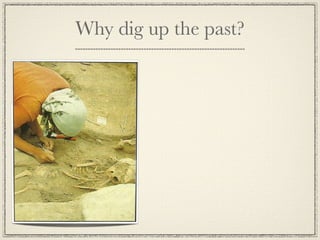
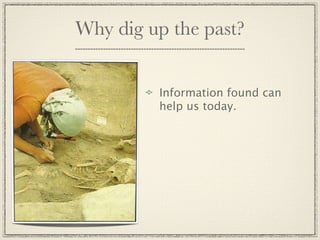
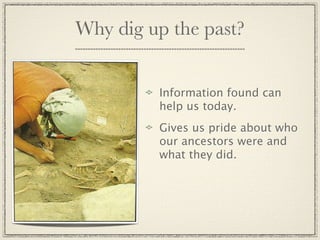
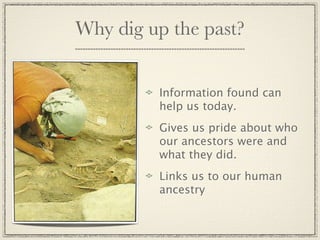
Why dig up the past?


         Information found can
         help us today.
Why dig up the past?


         Information found can
         help us today.
         Gives us pride about who
         our ancestors were and
         what they did.
Why dig up the past?


         Information found can
         help us today.
         Gives us pride about who
         our ancestors were and
         what they did.
         Links us to our human
         ancestry
Rising to the Challenge

          Today


      Roman Times
Rising to the Challenge
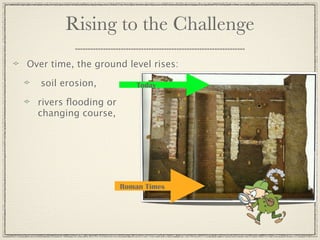
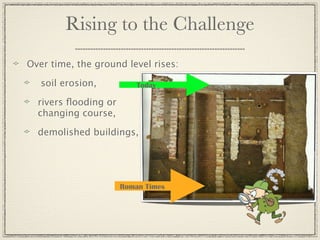
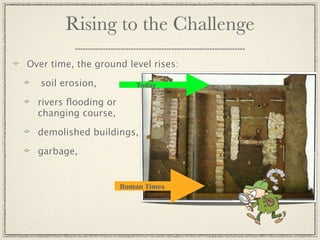
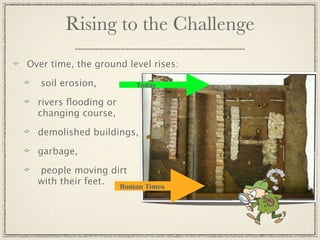
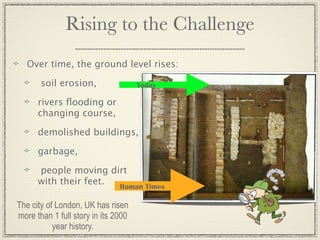
Over time, the ground level rises:

                        Today


                    Roman Times
Rising to the Challenge
Over time, the ground level rises:

   soil erosion,        Today


                    Roman Times
Rising to the Challenge
Over time, the ground level rises:

   soil erosion,          Today

  rivers flooding or
  changing course,


                      Roman Times
Rising to the Challenge
Over time, the ground level rises:

   soil erosion,          Today

  rivers flooding or
  changing course,

  demolished buildings,


                      Roman Times
Rising to the Challenge
Over time, the ground level rises:

   soil erosion,          Today

  rivers flooding or
  changing course,

  demolished buildings,

  garbage,


                      Roman Times
Rising to the Challenge
Over time, the ground level rises:

   soil erosion,        Today

  rivers flooding or
  changing course,

  demolished buildings,

  garbage,

  people moving dirt
  with their feet. Roman Times
Rising to the Challenge
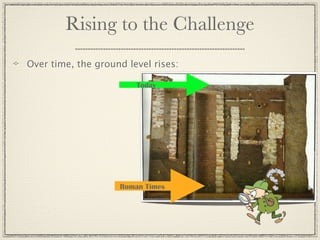
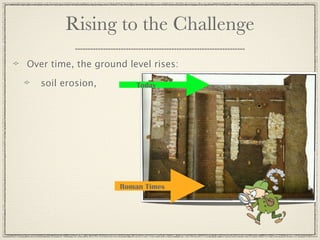
   Over time, the ground level rises:

       soil erosion,                 Today

      rivers flooding or
      changing course,

      demolished buildings,

      garbage,

      people moving dirt
      with their feet. Roman Times

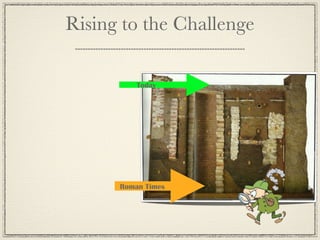
The city of London, UK has risen
more than 1 full story in its 2000
           year history.
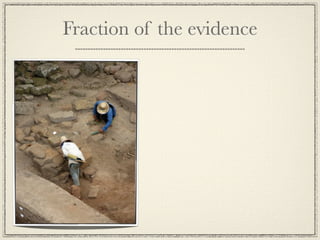
Fraction of the evidence


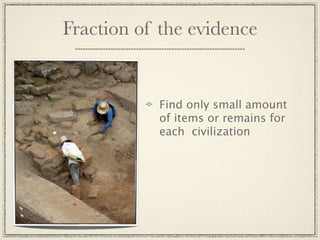
           Find only small amount
           of items or remains for
           each civilization
Fraction of the evidence


           Find only small amount
           of items or remains for
           each civilization
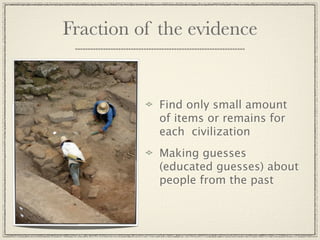
           Making guesses
           (educated guesses) about
           people from the past
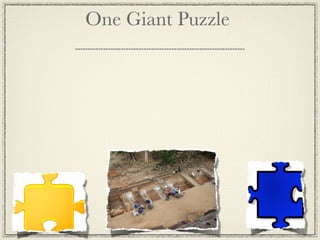
One Giant Puzzle
One Giant Puzzle

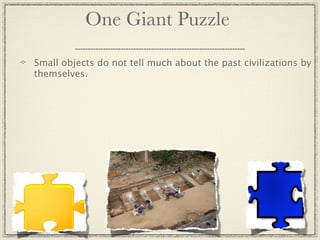
Small objects do not tell much about the past civilizations by
themselves.
One Giant Puzzle

Small objects do not tell much about the past civilizations by
themselves.

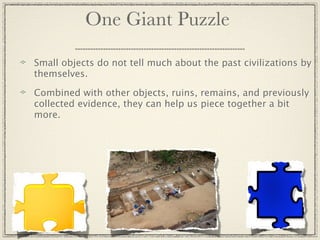
Combined with other objects, ruins, remains, and previously
collected evidence, they can help us piece together a bit
more.
One Giant Puzzle

Small objects do not tell much about the past civilizations by
themselves.

Combined with other objects, ruins, remains, and previously
collected evidence, they can help us piece together a bit
more.
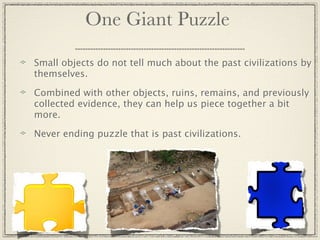
Never ending puzzle that is past civilizations.
Tools of the Trade
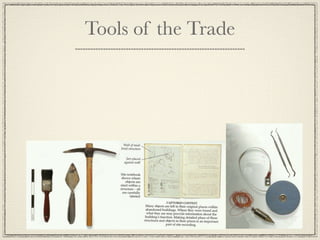
Tools of the Trade

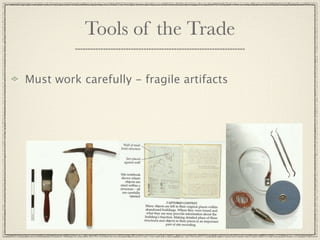
Must work carefully - fragile artifacts
Tools of the Trade

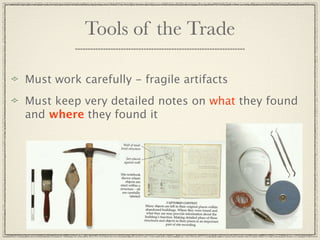
Must work carefully - fragile artifacts
Must keep very detailed notes on what they found
and where they found it
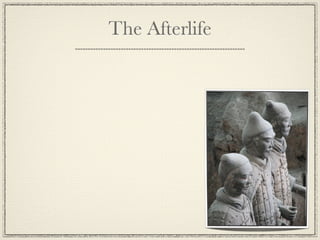
The Afterlife
The Afterlife

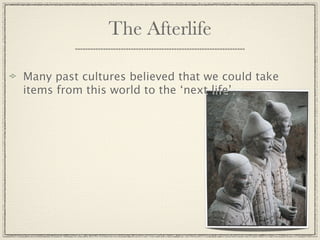
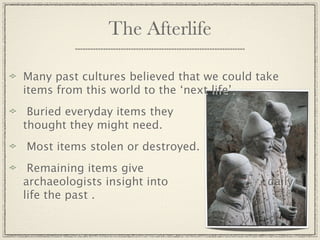
Many past cultures believed that we could take
items from this world to the ‘next life’.
The Afterlife

Many past cultures believed that we could take
items from this world to the ‘next life’.
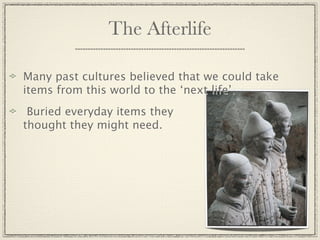
 Buried everyday items they
thought they might need.
The Afterlife

Many past cultures believed that we could take
items from this world to the ‘next life’.
 Buried everyday items they
thought they might need.
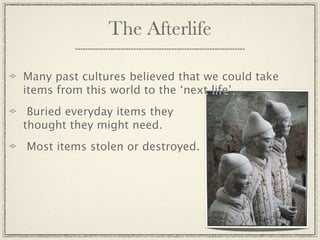
Most items stolen or destroyed.
The Afterlife

Many past cultures believed that we could take
items from this world to the ‘next life’.
 Buried everyday items they
thought they might need.
Most items stolen or destroyed.
 Remaining items give
archaeologists insight into                daily
life the past .
Just Garbage?
Just Garbage?


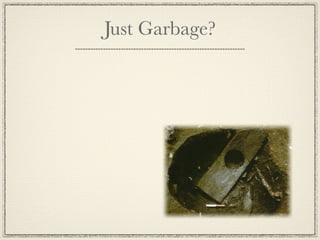
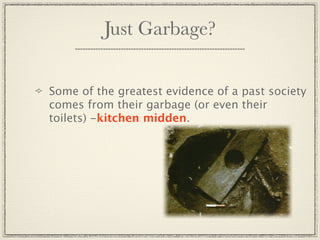
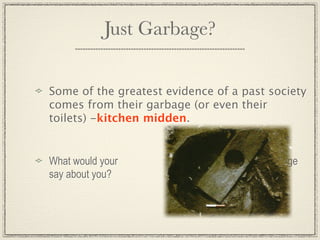
Some of the greatest evidence of a past society
comes from their garbage (or even their
toilets) -kitchen midden.
Just Garbage?


Some of the greatest evidence of a past society
comes from their garbage (or even their
toilets) -kitchen midden.
Just Garbage?


Some of the greatest evidence of a past society
comes from their garbage (or even their
toilets) -kitchen midden.


What would your                        garbage
say about you?
Past Problems
Past Problems

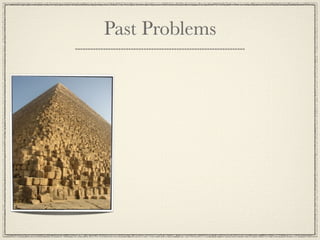
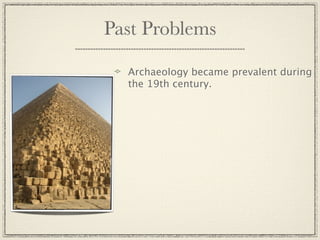
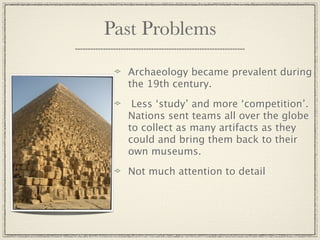
  Archaeology became prevalent during
  the 19th century.
Past Problems

  Archaeology became prevalent during
  the 19th century.

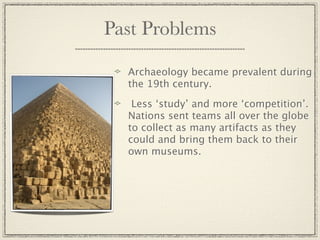
   Less ‘study’ and more ‘competition’.
  Nations sent teams all over the globe
  to collect as many artifacts as they
  could and bring them back to their
  own museums.
Past Problems

  Archaeology became prevalent during
  the 19th century.

   Less ‘study’ and more ‘competition’.
  Nations sent teams all over the globe
  to collect as many artifacts as they
  could and bring them back to their
  own museums.

  Not much attention to detail
Past Problems

  Archaeology became prevalent during
  the 19th century.

   Less ‘study’ and more ‘competition’.
  Nations sent teams all over the globe
  to collect as many artifacts as they
  could and bring them back to their
  own museums.

  Not much attention to detail

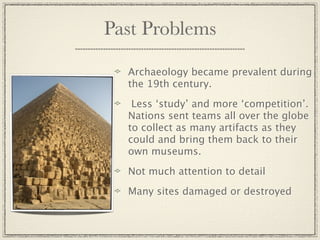
  Many sites damaged or destroyed
More Trouble Ahead?

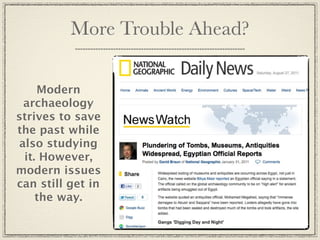
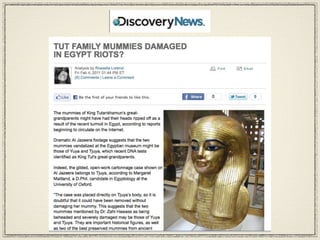
     Modern
  archaeology
strives to save
the past while
 also studying
  it. However,
modern issues
can still get in
     the way.
Archaeology keynote 2011 mine

Archaeology keynote 2011 mine

  • 1.
  • 2.
  • 3.
    Archaeology Greek for ‘thestudy of what is ancient’
  • 4.
    Archaeology Greek for ‘thestudy of what is ancient’ Where evidence found:
  • 5.
    Archaeology Greek for ‘thestudy of what is ancient’ Where evidence found: in the ground
  • 6.
    Archaeology Greek for ‘thestudy of what is ancient’ Where evidence found: in the ground under buildings
  • 7.
    Archaeology Greek for ‘thestudy of what is ancient’ Where evidence found: in the ground under buildings deep at the bottom of the ocean
  • 8.
  • 9.
  • 10.
  • 11.
    What archaeologists find? PrimarySources written documents
  • 12.
    What archaeologists find? PrimarySources written documents pottery
  • 13.
    What archaeologists find? PrimarySources written documents pottery ruins of buildings
  • 14.
    What archaeologists find? PrimarySources written documents pottery ruins of buildings human remains
  • 15.
    What archaeologists find? PrimarySources written documents pottery ruins of buildings human remains animal or food remains
  • 16.
    What archaeologists find? PrimarySources written documents pottery ruins of buildings human remains animal or food remains clothing...
  • 17.
    Why dig upthe past?
  • 18.
    Why dig upthe past? Information found can help us today.
  • 19.
    Why dig upthe past? Information found can help us today. Gives us pride about who our ancestors were and what they did.
  • 20.
    Why dig upthe past? Information found can help us today. Gives us pride about who our ancestors were and what they did. Links us to our human ancestry
  • 21.
    Rising to theChallenge Today Roman Times
  • 22.
    Rising to theChallenge Over time, the ground level rises: Today Roman Times
  • 23.
    Rising to theChallenge Over time, the ground level rises: soil erosion, Today Roman Times
  • 24.
    Rising to theChallenge Over time, the ground level rises: soil erosion, Today rivers flooding or changing course, Roman Times
  • 25.
    Rising to theChallenge Over time, the ground level rises: soil erosion, Today rivers flooding or changing course, demolished buildings, Roman Times
  • 26.
    Rising to theChallenge Over time, the ground level rises: soil erosion, Today rivers flooding or changing course, demolished buildings, garbage, Roman Times
  • 27.
    Rising to theChallenge Over time, the ground level rises: soil erosion, Today rivers flooding or changing course, demolished buildings, garbage, people moving dirt with their feet. Roman Times
  • 28.
    Rising to theChallenge Over time, the ground level rises: soil erosion, Today rivers flooding or changing course, demolished buildings, garbage, people moving dirt with their feet. Roman Times The city of London, UK has risen more than 1 full story in its 2000 year history.
  • 29.
  • 30.
    Fraction of theevidence Find only small amount of items or remains for each civilization
  • 31.
    Fraction of theevidence Find only small amount of items or remains for each civilization Making guesses (educated guesses) about people from the past
  • 32.
  • 33.
    One Giant Puzzle Smallobjects do not tell much about the past civilizations by themselves.
  • 34.
    One Giant Puzzle Smallobjects do not tell much about the past civilizations by themselves. Combined with other objects, ruins, remains, and previously collected evidence, they can help us piece together a bit more.
  • 35.
    One Giant Puzzle Smallobjects do not tell much about the past civilizations by themselves. Combined with other objects, ruins, remains, and previously collected evidence, they can help us piece together a bit more. Never ending puzzle that is past civilizations.
  • 36.
  • 37.
    Tools of theTrade Must work carefully - fragile artifacts
  • 38.
    Tools of theTrade Must work carefully - fragile artifacts Must keep very detailed notes on what they found and where they found it
  • 39.
  • 40.
    The Afterlife Many pastcultures believed that we could take items from this world to the ‘next life’.
  • 41.
    The Afterlife Many pastcultures believed that we could take items from this world to the ‘next life’. Buried everyday items they thought they might need.
  • 42.
    The Afterlife Many pastcultures believed that we could take items from this world to the ‘next life’. Buried everyday items they thought they might need. Most items stolen or destroyed.
  • 43.
    The Afterlife Many pastcultures believed that we could take items from this world to the ‘next life’. Buried everyday items they thought they might need. Most items stolen or destroyed. Remaining items give archaeologists insight into daily life the past .
  • 44.
  • 45.
    Just Garbage? Some ofthe greatest evidence of a past society comes from their garbage (or even their toilets) -kitchen midden.
  • 46.
    Just Garbage? Some ofthe greatest evidence of a past society comes from their garbage (or even their toilets) -kitchen midden.
  • 47.
    Just Garbage? Some ofthe greatest evidence of a past society comes from their garbage (or even their toilets) -kitchen midden. What would your garbage say about you?
  • 48.
  • 49.
    Past Problems Archaeology became prevalent during the 19th century.
  • 50.
    Past Problems Archaeology became prevalent during the 19th century. Less ‘study’ and more ‘competition’. Nations sent teams all over the globe to collect as many artifacts as they could and bring them back to their own museums.
  • 51.
    Past Problems Archaeology became prevalent during the 19th century. Less ‘study’ and more ‘competition’. Nations sent teams all over the globe to collect as many artifacts as they could and bring them back to their own museums. Not much attention to detail
  • 52.
    Past Problems Archaeology became prevalent during the 19th century. Less ‘study’ and more ‘competition’. Nations sent teams all over the globe to collect as many artifacts as they could and bring them back to their own museums. Not much attention to detail Many sites damaged or destroyed
  • 53.
    More Trouble Ahead? Modern archaeology strives to save the past while also studying it. However, modern issues can still get in the way.