BIODIVERSITY AND ITS CONSERVATION
CASE STUDIES OF NATIONAL AND INTERNATIONAL BIODIVERSITIES
NATIONAL ACSE STUDY :YAMUNA BIODIVERSITY PARK, DELHI
INTERNATIONAL CASE STUDY : DAINTREE NATIONAL PARK, QUEENSLAND,
AUSTRALIA
SUBMITTED BY : POOJA SHARMA
M.ARCH ( LANDSCAPE ) – 2ND SEM
INTRODUCTION
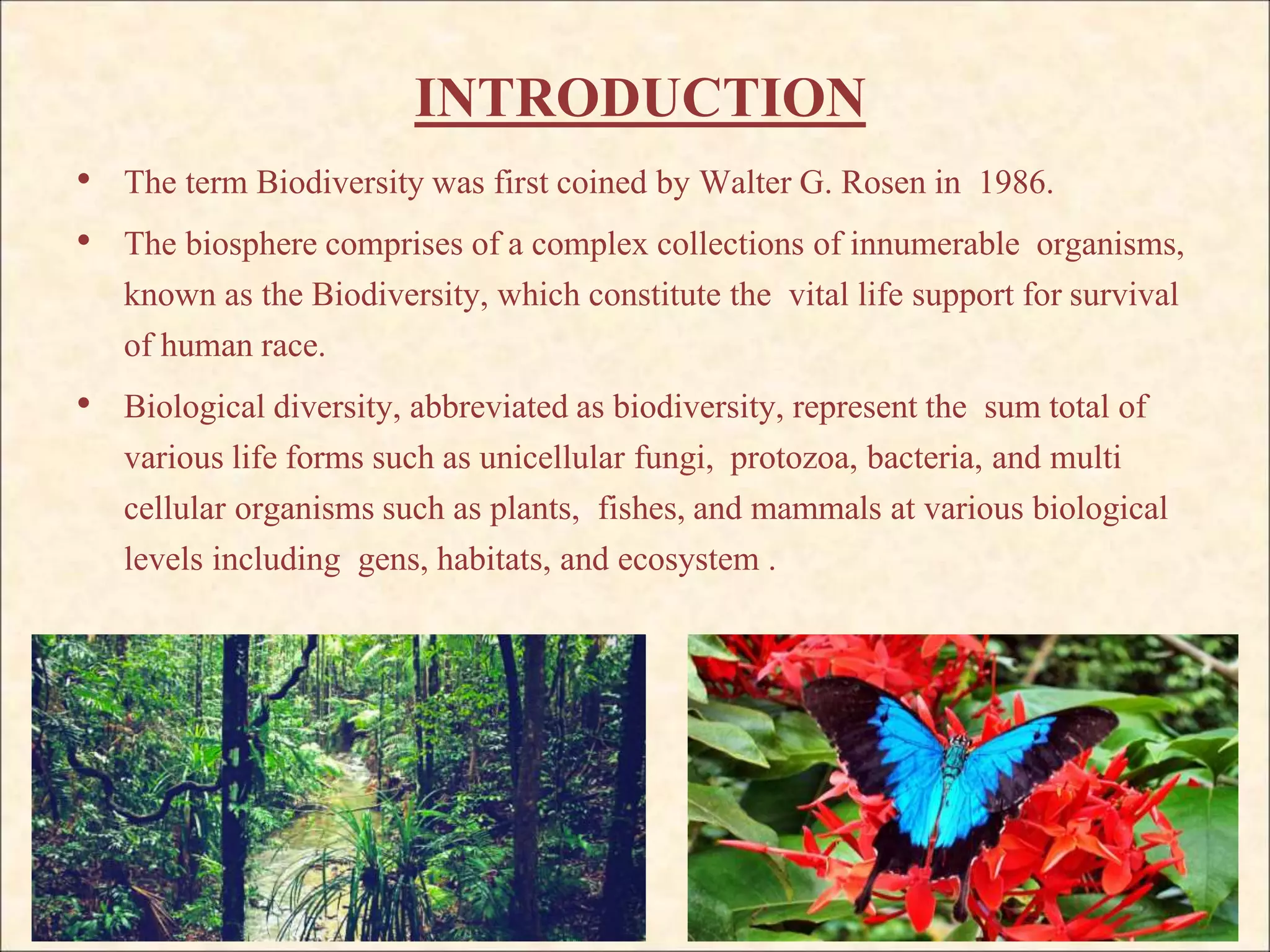
• The term Biodiversity was first coined by Walter G. Rosen in 1986.
• The biosphere comprises of a complex collections of innumerable organisms,
known as the Biodiversity, which constitute the vital life support for survival
of human race.
• Biological diversity, abbreviated as biodiversity, represent the sum total of
various life forms such as unicellular fungi, protozoa, bacteria, and multi
cellular organisms such as plants, fishes, and mammals at various biological
levels including gens, habitats, and ecosystem .
What is Biodiversity?
•The word Biodiversity originates from the Greek word BIOS = LIFE and Latin word
DIVERSITAS = VARIETY or DIFFERENCE.
•The whole word bio diversity generally therefore means: VARIETY OF LIFE.
•Biodiversity is the degree of variation of life. It is a measure of the variety of
organisms present in different ecosystems.
• The loss of biological diversity is at grave
threat.
• Tocounter global climate change.
• Sustainable physical and social
environment for improving quality of life.
• Conservation and Development of the
Natural features.
• Toprotect the ground water recharge
zones and enhance its capacity.
Why Biodiversity Park?
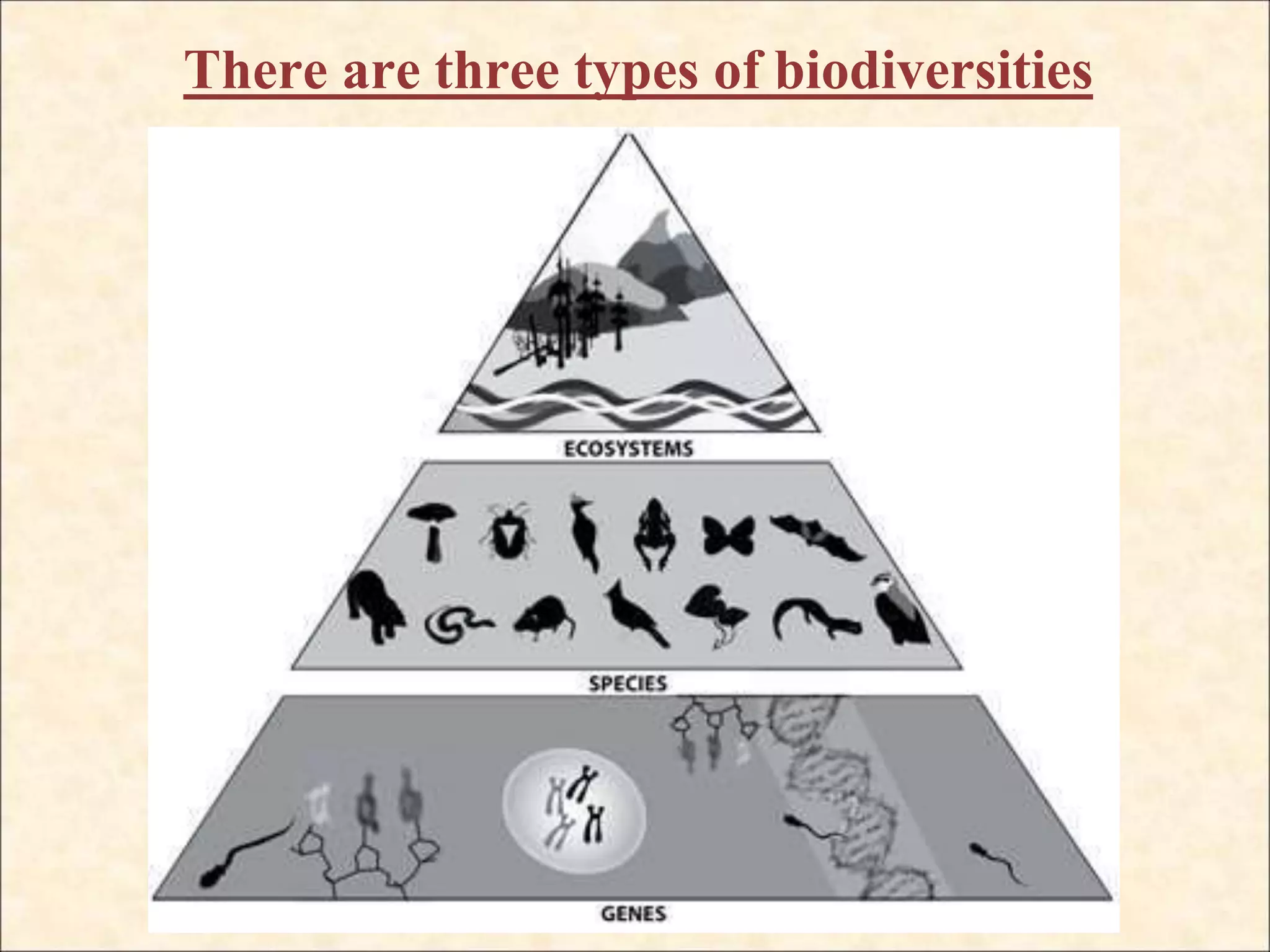
There are three types of biodiversities
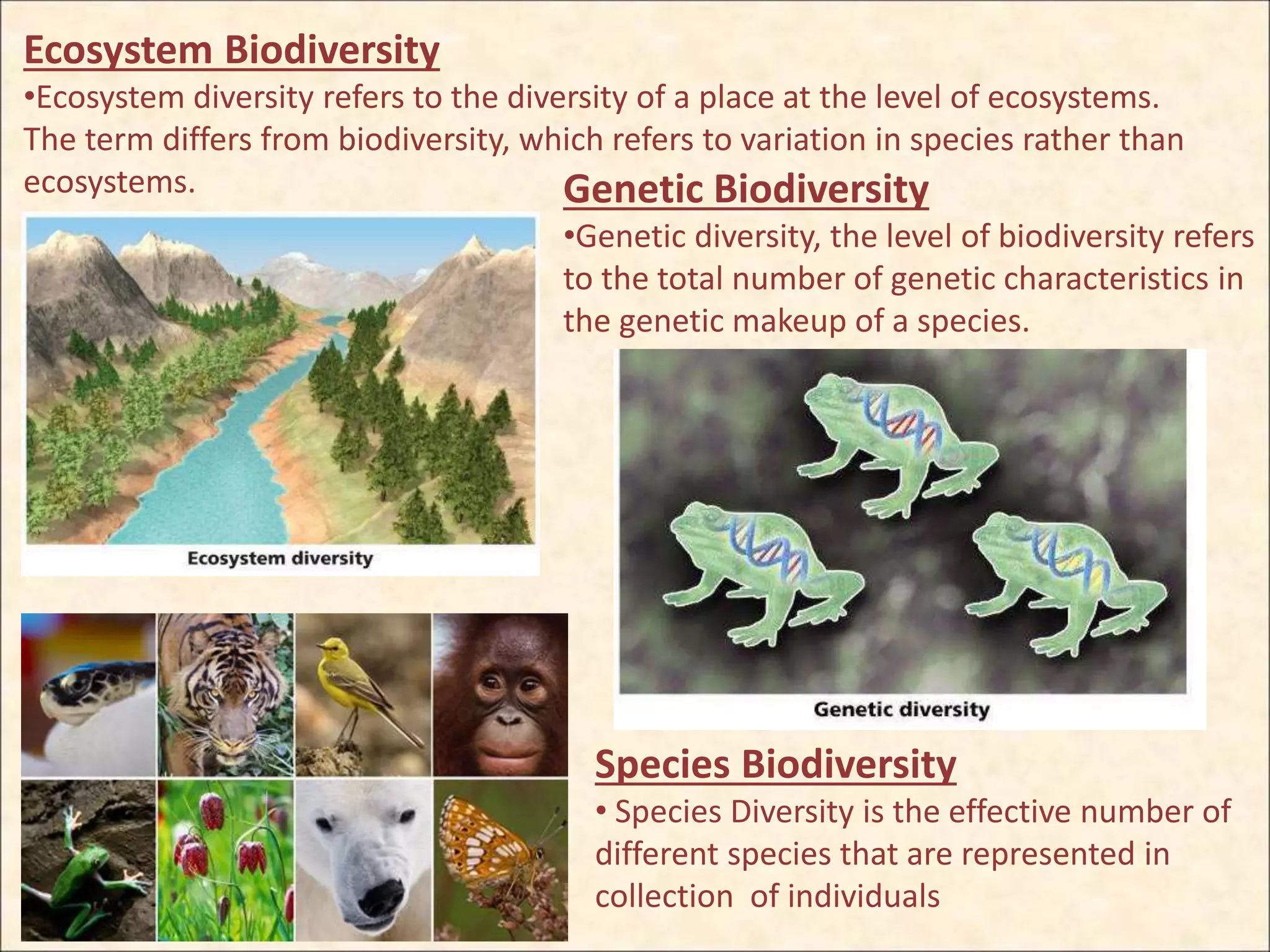
Species Biodiversity
• Species Diversity is the effective number of
different species that are represented in
collection of individuals
Genetic Biodiversity
•Genetic diversity, the level of biodiversity refers
to the total number of genetic characteristics in
the genetic makeup of a species.
Ecosystem Biodiversity
•Ecosystem diversity refers to the diversity of a place at the level of ecosystems.
The term differs from biodiversity, which refers to variation in species rather than
ecosystems.
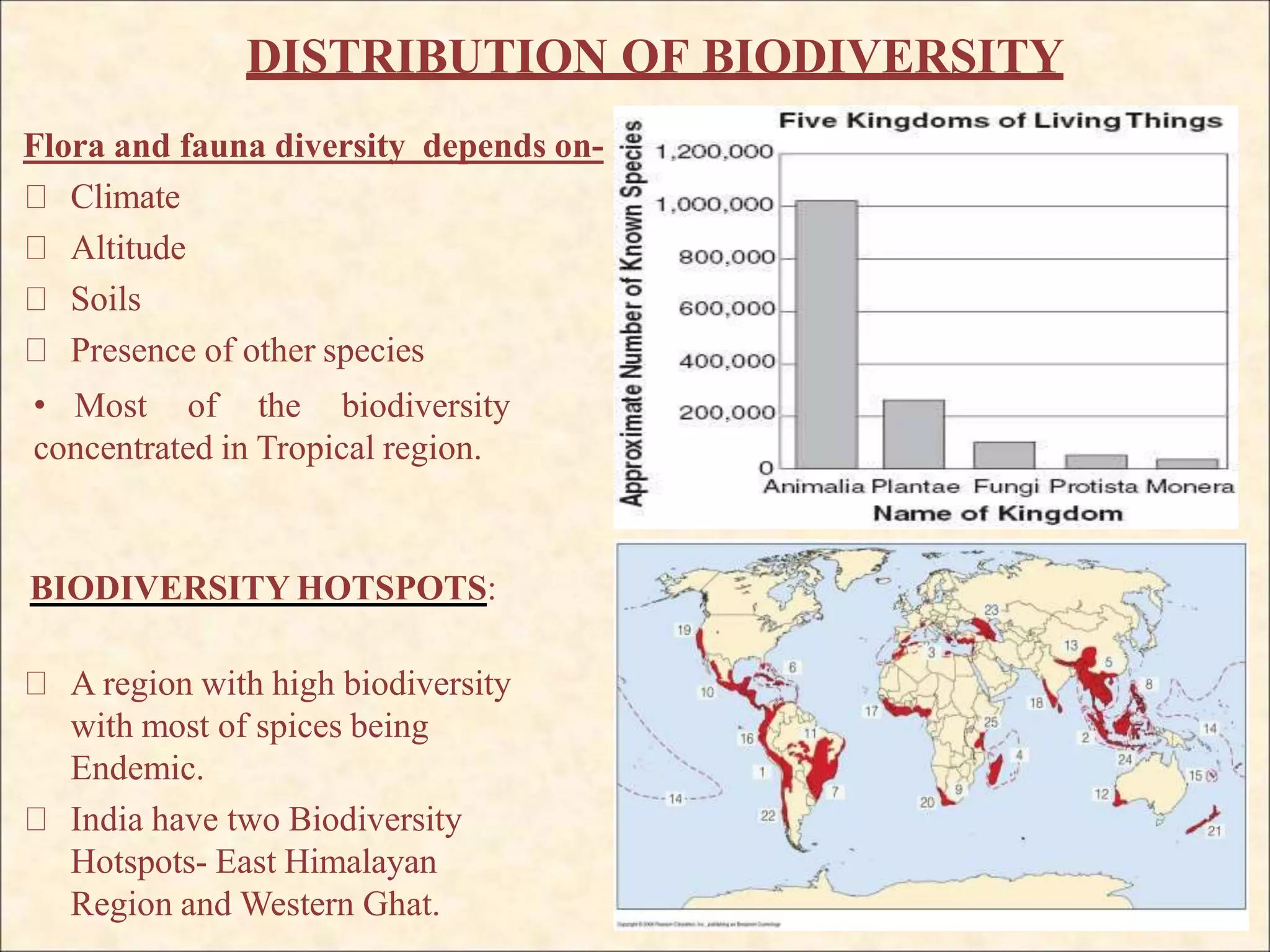
DISTRIBUTION OF BIODIVERSITY
Flora and fauna diversity depends on-
Climate
Altitude
Soils
Presence of other species
• Most of the biodiversity
concentrated in Tropical region.
BIODIVERSITY HOTSPOTS:
A region with high biodiversity
with most of spices being
Endemic.
India have two Biodiversity
Hotspots- East Himalayan
Region and Western Ghat.
BENEFITS OF BIODIVERSITY
Consumptive value:
Food/Drink
Fuel
Medicine
Better crop varieties
Industrial Material
Non-Consumptive Value:
Recreation
Education and Research
Traditional value
Ecological services:
Balance of nature
Biological productivity
Regulation of climate
Degradation of waste
Cleaning of air and water
Cycling of nutrients
Control of potential pest and disease causing species
Detoxification of soil and sediments
Stabilization of land against erosion
Carbon sequestration and global climate change
Maintenance of Soil fertility
THREATS TO BIODIVERSITY
Natural causes:
Narrow geographical area
Low population
Low breeding rate
Natural disasters
Anthropogenic causes:
Habitat modification
Overexploitation of selected
species
Innovation by exotic species
Pollution
Hunting
Global warming and climate change
Agriculture
Domino effect
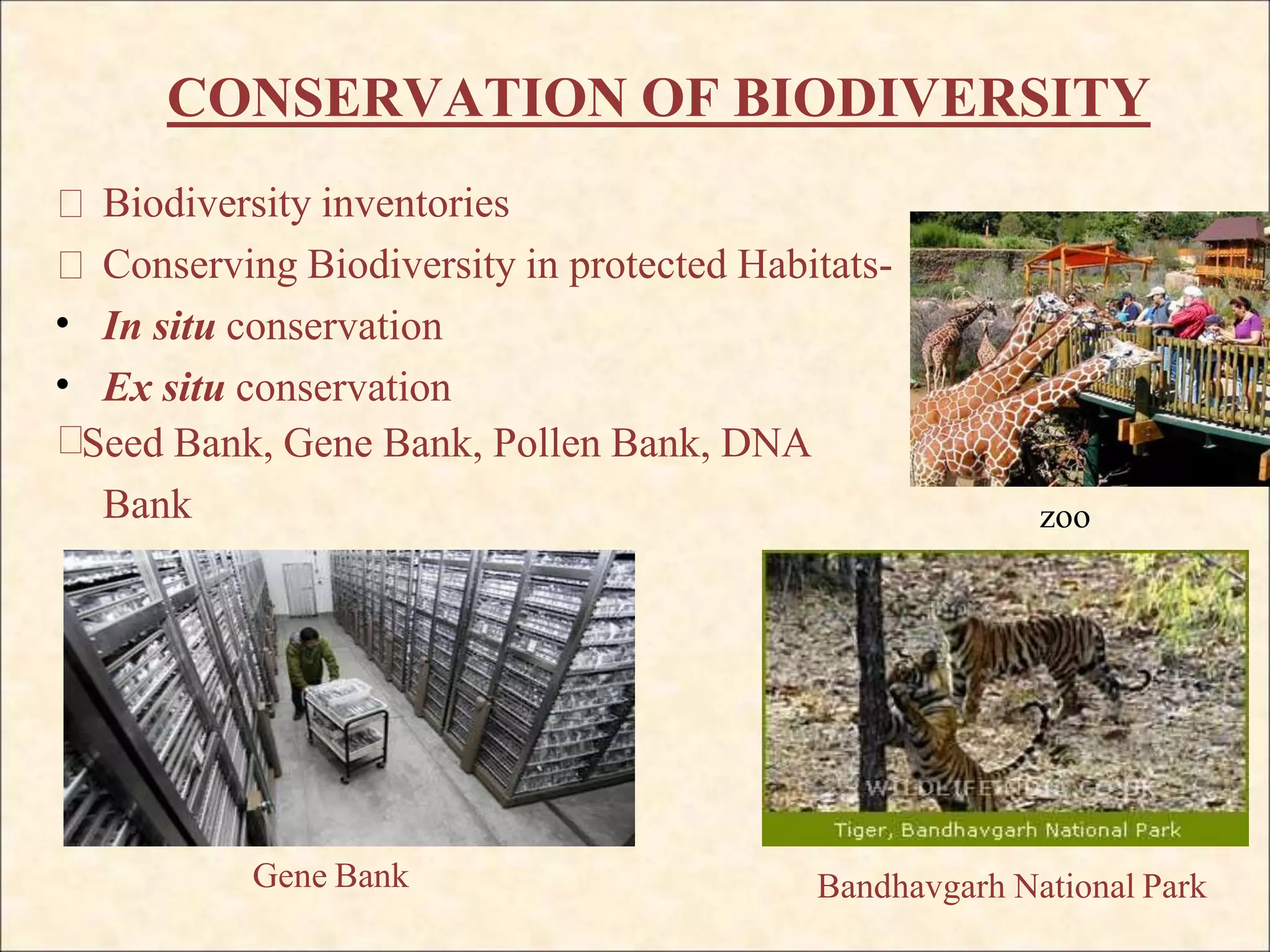
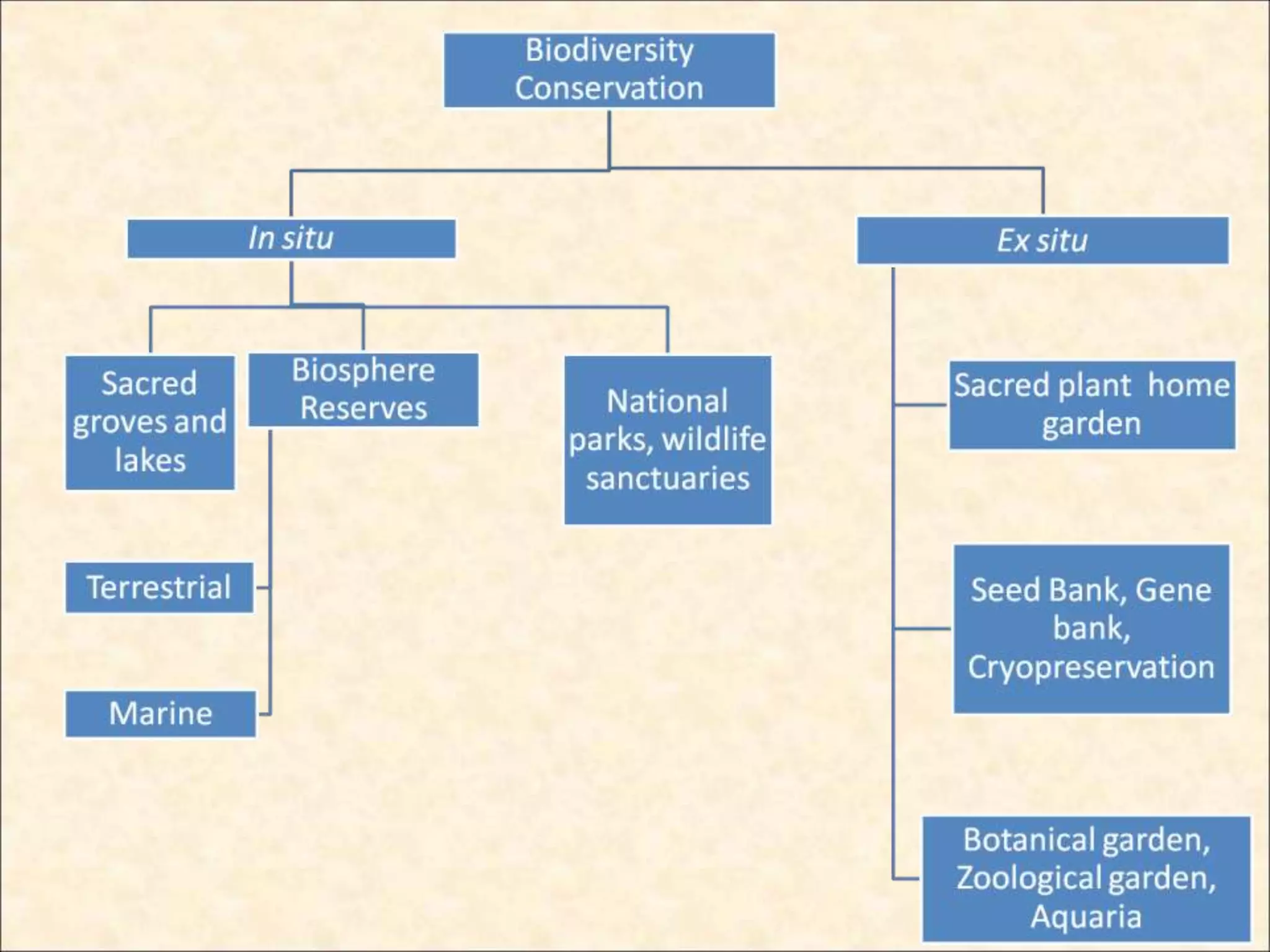
CONSERVATION OF BIODIVERSITY
Biodiversity inventories
Conserving Biodiversity in protected Habitats-
•
•
In situ conservation
Ex situ conservation
Seed Bank, Gene Bank, Pollen Bank, DNA
Bank
Gene Bank
zoo
Bandhavgarh National Park
Restoration of Biodiversity
Imparting Environmental Education
Enacting, strengthening and enforcing Environmental
Legislation
Population Control
Reviewing the agriculture practice
Controlling Urbanization
Conservation through Biotechnology
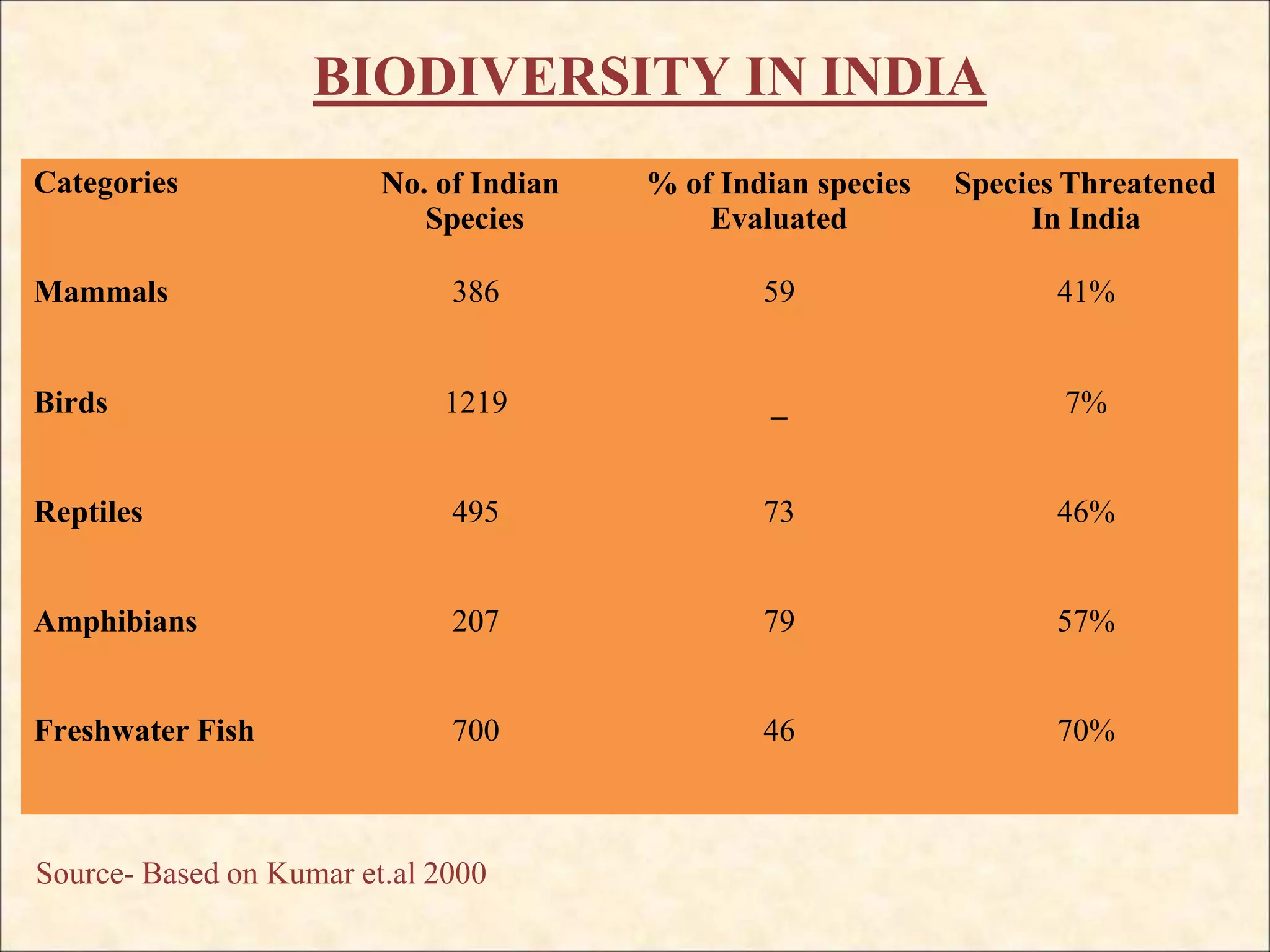
BIODIVERSITY IN INDIA
Categories No. of Indian
Species
% of Indian species
Evaluated
Species Threatened
In India
Mammals 386 59 41%
Birds 1219 _ 7%
Reptiles 495 73 46%
Amphibians 207 79 57%
Freshwater Fish 700 46 70%
Source- Based on Kumar et.al 2000
BIODIVERSITY CONVENSIONS
The first convention on biodiversity organized at Rio De
Janerio, capital of Brazil from June 5 to 16, 1992 named as
United Nation Conference On Environment and Development
(UNCED), batter known as Rio Summit to maintain ecological
balance and enrich biodiversity. The
signed by 150 countries
agreement on
including three
biodiversity
programmes-
To ensure conservation of biodiversity
Sustainable use of biodiversity
Rational and equitable share of profit to accrue from use of
genetic resources.
The second convention organized at Johannesburg in 2002
called World Summit On Sustainable Development (WSSD)
where the Biodiversity and Sustainable Ecosystem
Management was the issue.
The International Conference held on Biodiversity in
Relation to Food & Human Security in a warming planet
15-17 February, 2010 in Chennai.
International Conference on Wildlife & Biodiversity
Conservation held on 3 to 5 June, 2010 at Dal lake,
Srinagar, Kashmir.
Indian Biodiversity Congress (IBC) & Indian
Biodiversity Expo(IBE) will be held on 27-31 December
at Thriuvananthapuram, Kerala.
CONCLUSION
Biodiversity is our life. If the Biodiversity got lost at this rate then
in near future, the survival of human being will be threatened. So,
it is our moral duty to conserve Biodiversity as well our
Environment. Long- term maintenance of species and their
management requires co-operative efforts across entire landscapes.
Biodiversity should be dealt with at scale of habitats or ecosystems
rather than at species level.
NATIONAL CASE STUDY
YAMUNA BIODIVERSITY PARK
JAGATPUR KHADAR, YAMUNA DELHI
Yamuna Biodiversity Park
AERIAL VIEW OF YAMUNA BIODIVERSITYPARK,DELHI
LOCATION
Aim of Yamuna Biodiversity Park
• T
o protect and sustain the biodiversity.
• Toprotect the natural drainage of river Yamuna in Delhi.
• T
o provide regional level open and green spaces.
• T
o protect the ground recharge zones like river Yamuna
and Ridge
Origin and Salient features of the site
• This park is located close to river Yamuna, Jharoda, Wazirabad
• Actually 1km away from the main stream of Yamuna but still in its Basin
• It was a part of the flood plain during some 30-40 years back
• DDA acquired land in 2001-2002 and planned biodiversity park in 2003
• The area is low lying used to get seasonally flooded and long spell of standing
water has turned soil more saline(pH=8.9)
• For developing park two pronged strategies were adopted- physical and
biological interventions
Physical Intervention
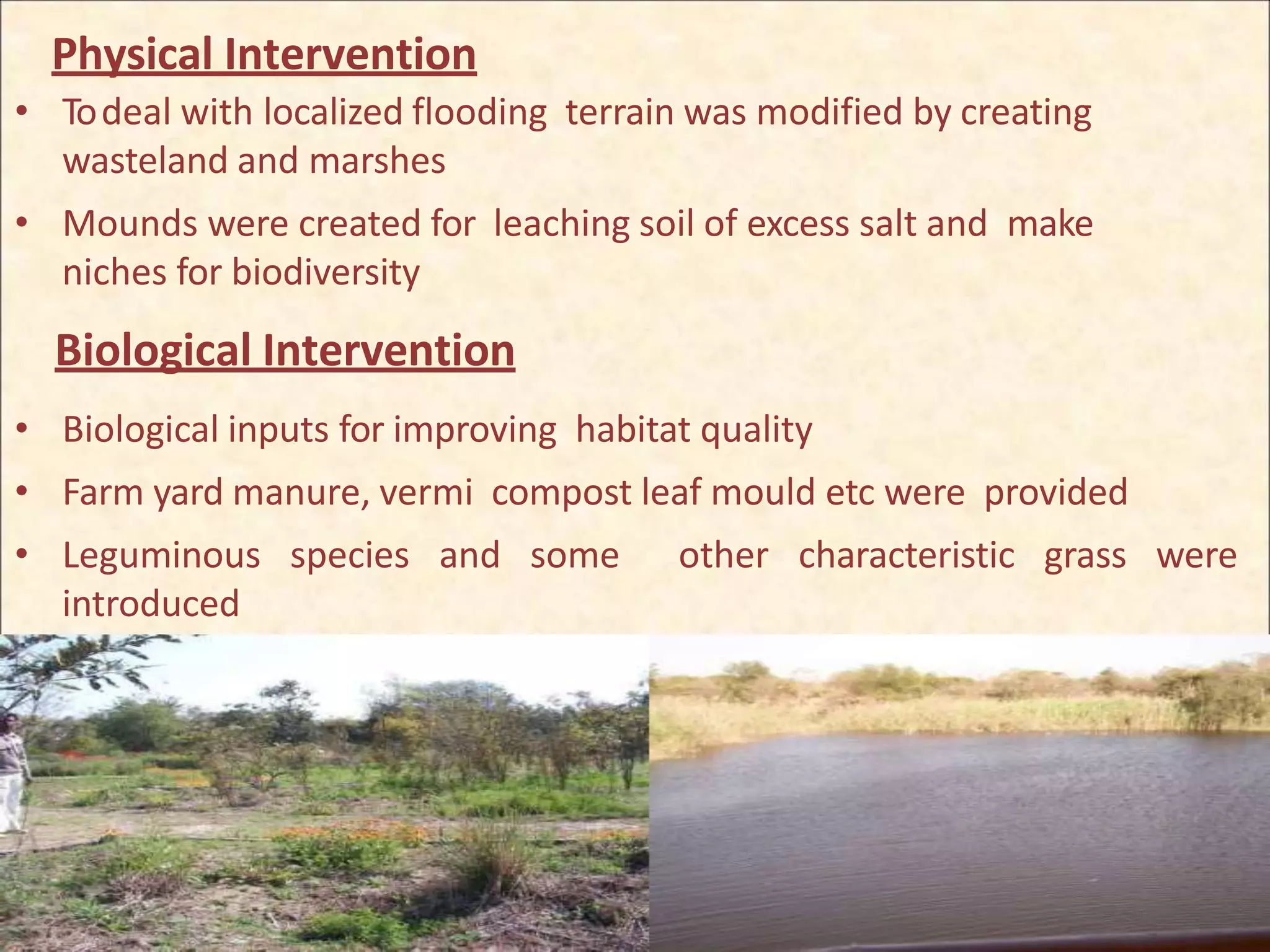
• Todeal with localized flooding terrain was modified by creating
wasteland and marshes
• Mounds were created for leaching soil of excess salt and make
niches for biodiversity
Biological Intervention
• Biological inputs for improving habitat quality
• Farm yard manure, vermi compost leaf mould etc were provided
• Leguminous species and some other characteristic grass were
introduced
Importance of Yamuna Biodiversity Park
• Emerging as the capital's most visited public place.
• Prominent centre for learning and understanding the
environment.
• Home for biologically rich wetlands, grassland communities,
• A wide variety of fruit yielding species and an abundance of
medicinal herbs.
• The Park also comprises a native flora and fauna which used to exist a 100
years ago and then became extinct locally.
Important Features of the site
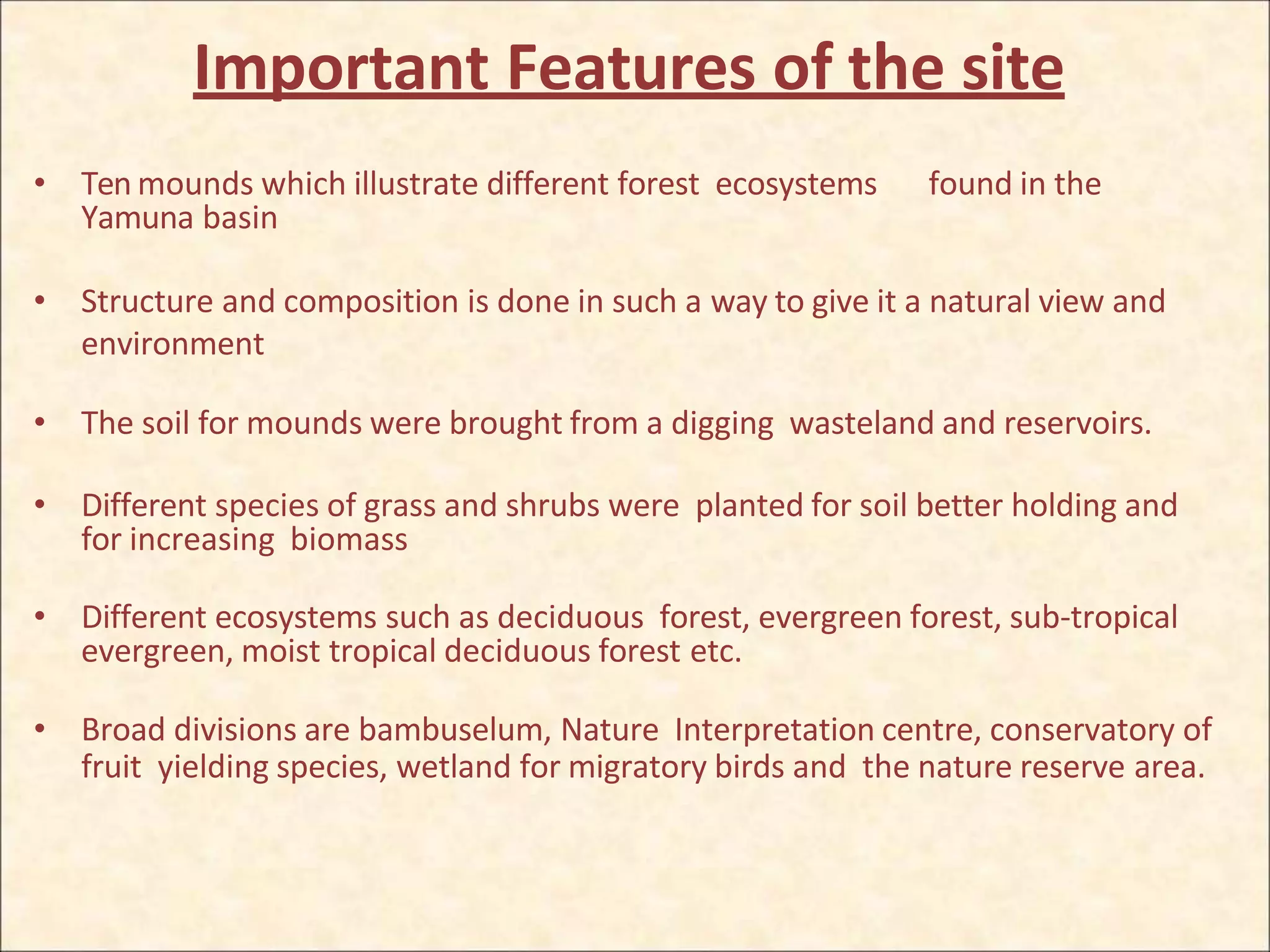
• Ten mounds which illustrate different forest ecosystems found in the
Yamuna basin
• Structure and composition is done in such a way to give it a natural view and
environment
• The soil for mounds were brought from a digging wasteland and reservoirs.
• Different species of grass and shrubs were planted for soil better holding and
for increasing biomass
• Different ecosystems such as deciduous forest, evergreen forest, sub-tropical
evergreen, moist tropical deciduous forest etc.
• Broad divisions are bambuselum, Nature Interpretation centre, conservatory of
fruit yielding species, wetland for migratory birds and the nature reserve area.
Zoning of Park
• The front portion of the Yamuna Biodiversity Park, a 220m southward and
140m northward stretch from the main entry gate with 20-30m width is
demarcated as
• Domesticated Biodiversity Zone. Enclosed by a hedge of poplar, it
features plants like Ailanthus Butea and Bauhinia
• The outer iron fencing is embraced by multi-coloured climbers
like Jasmine and QuisqualiS.
• The Conservatory of fruit yielding species
• The Migratory duck’swetland
• The Nature Reserve area.
• Nature Interpretation Centre
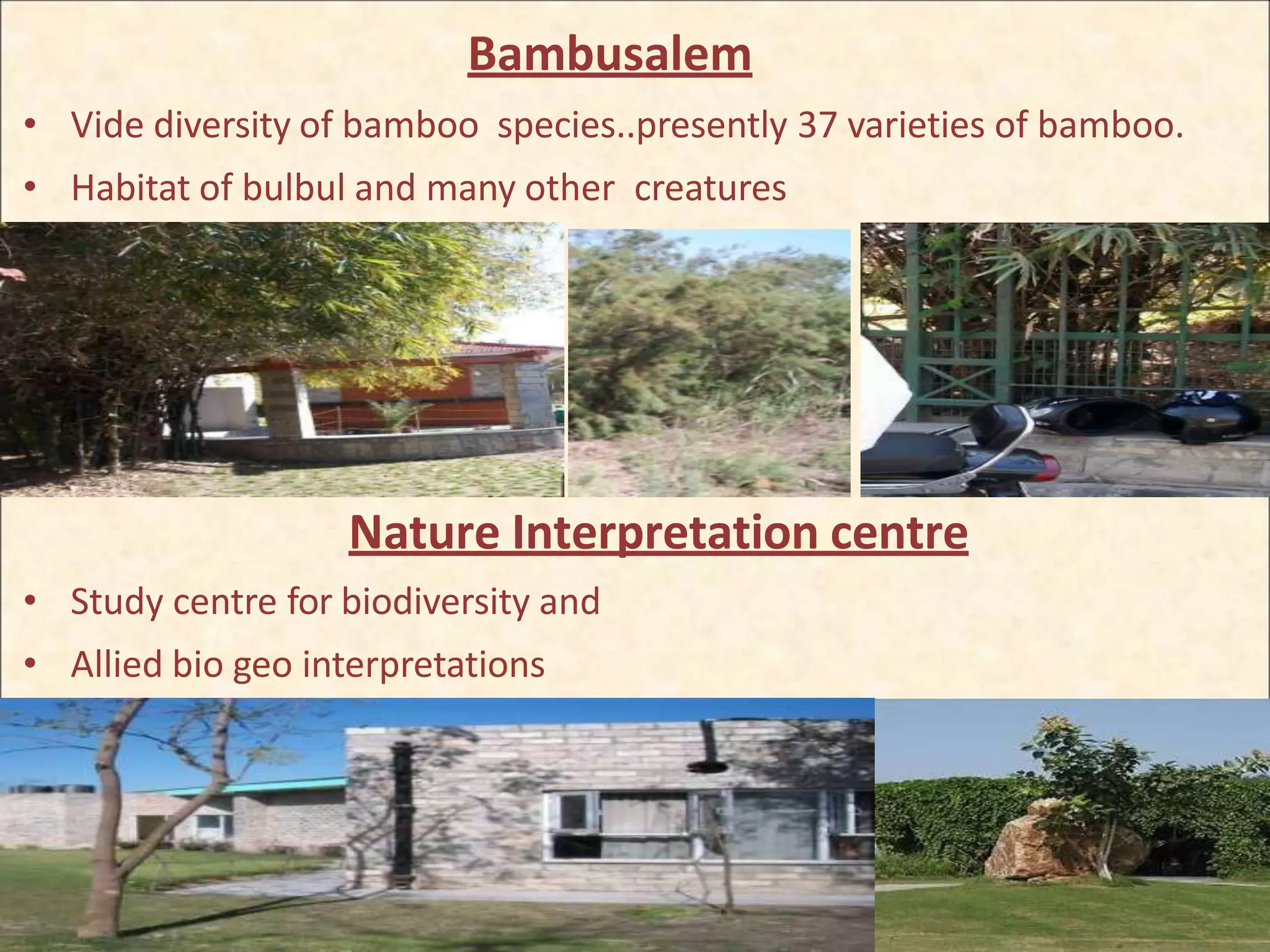
Bambusalem
• Vide diversity of bamboo species..presently 37 varieties of bamboo.
• Habitat of bulbul and many other creatures
Nature Interpretation centre
• Study centre for biodiversity and
• Allied bio geo interpretations
Flora
According to prof. C R Babu of Delhi University, initially only mongooses,
lizards and 31 species of birds were there in the park up until 2004. By 2014
the biodiversity park already had 900 species of native plants. The native
species reintroduced included Adina, Sal, teak and Hardwicke. As of 2019, it
has about 1,500 species of plants and animals, and 200 species of birds.
Fauna
By 2014, the wetlands was already attracting thousands of migratory
birds from Siberia, Central Asia and Europe. It had 200 species of birds, 75
species of butterflies, 10 species of snakes, and big mammals
like porcupine, small Indian civet and wild boars.
Wetlands
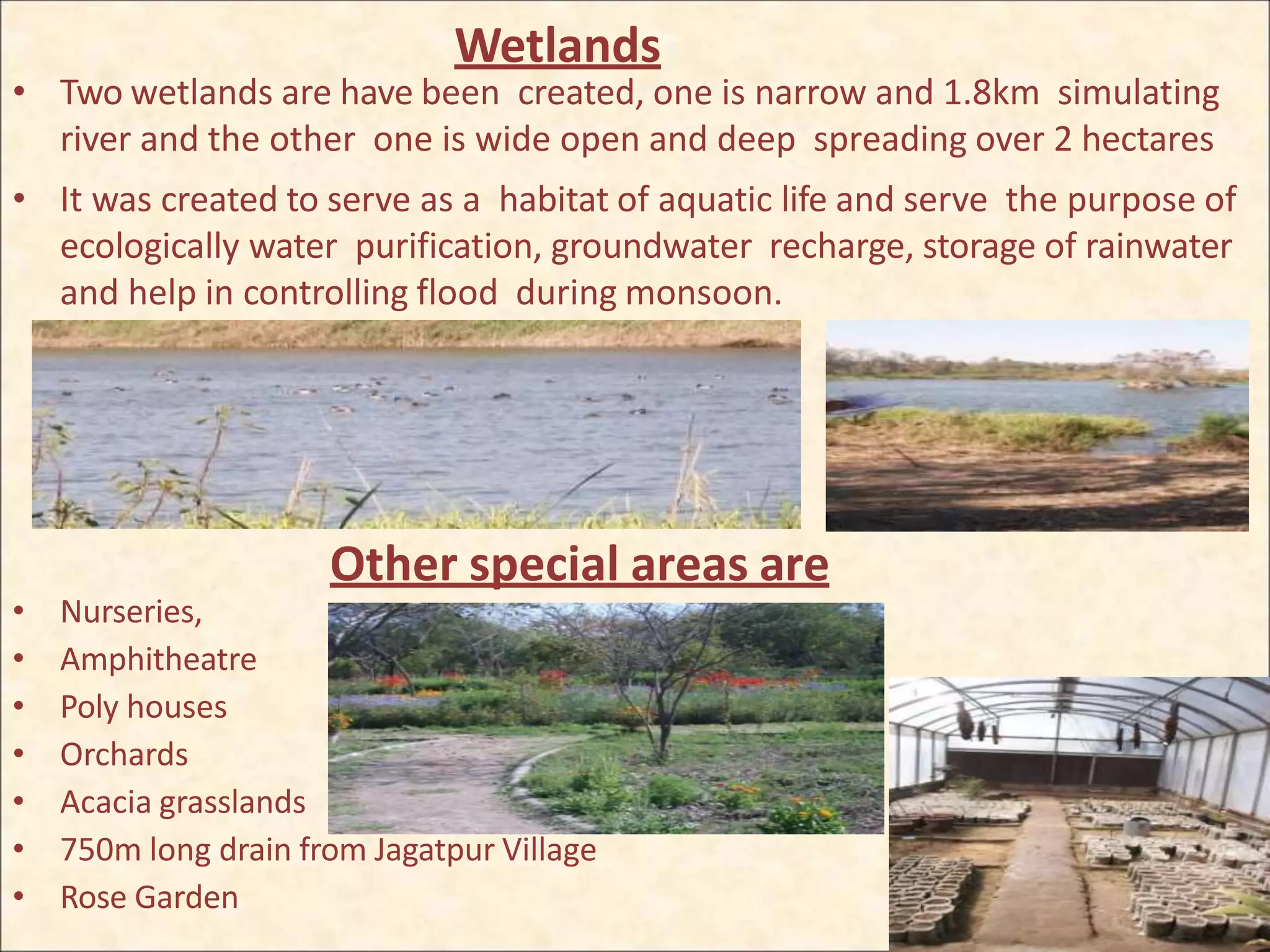
• Two wetlands are have been created, one is narrow and 1.8km simulating
river and the other one is wide open and deep spreading over 2 hectares
• It was created to serve as a habitat of aquatic life and serve the purpose of
ecologically water purification, groundwater recharge, storage of rainwater
and help in controlling flood during monsoon.
Other special areas are
• Nurseries,
• Amphitheatre
• Poly houses
• Orchards
• Acacia grasslands
• 750m long drain from Jagatpur Village
• Rose Garden
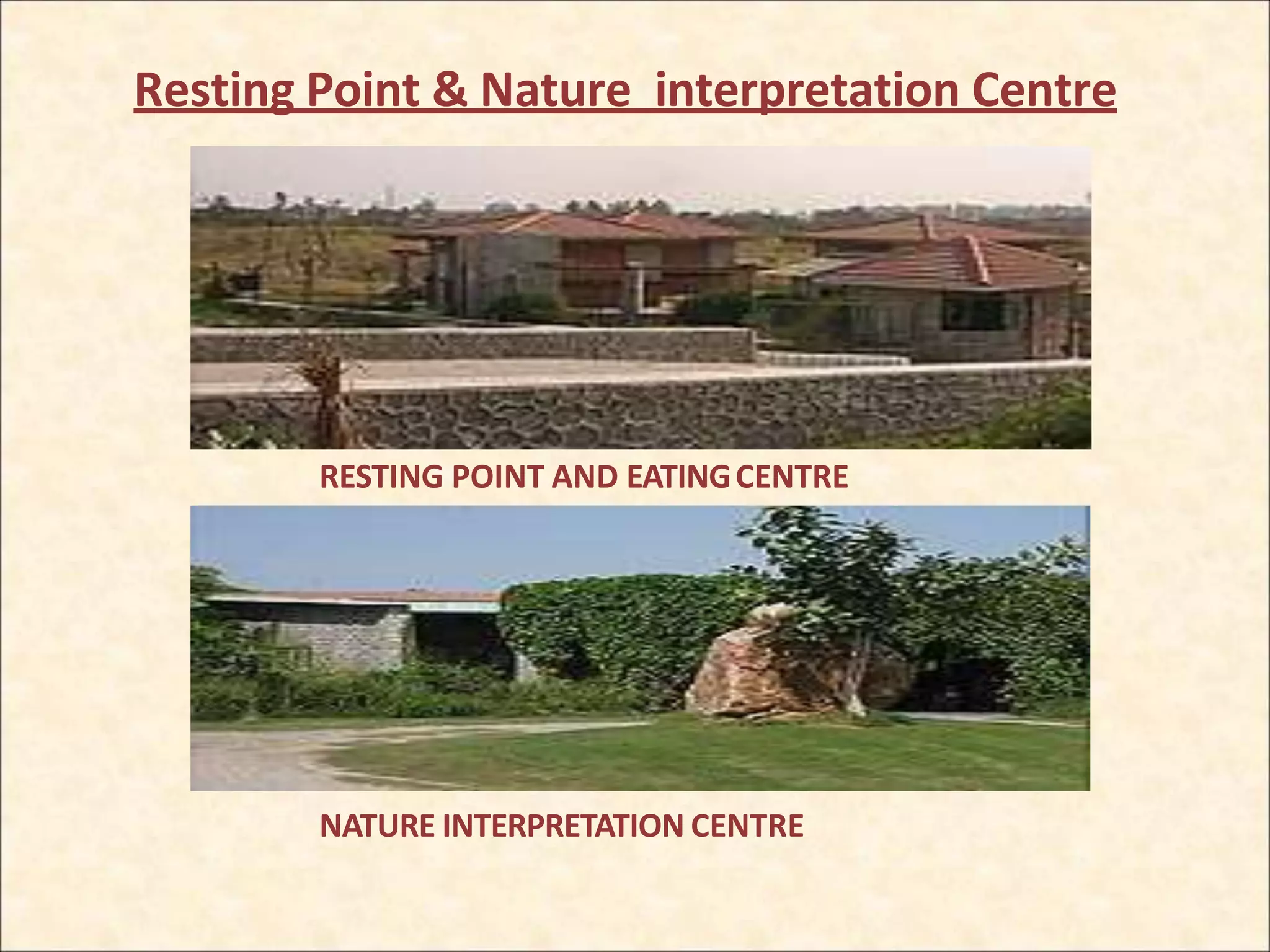
Resting Point & Nature interpretation Centre
RESTING POINT AND EATINGCENTRE
NATURE INTERPRETATION CENTRE
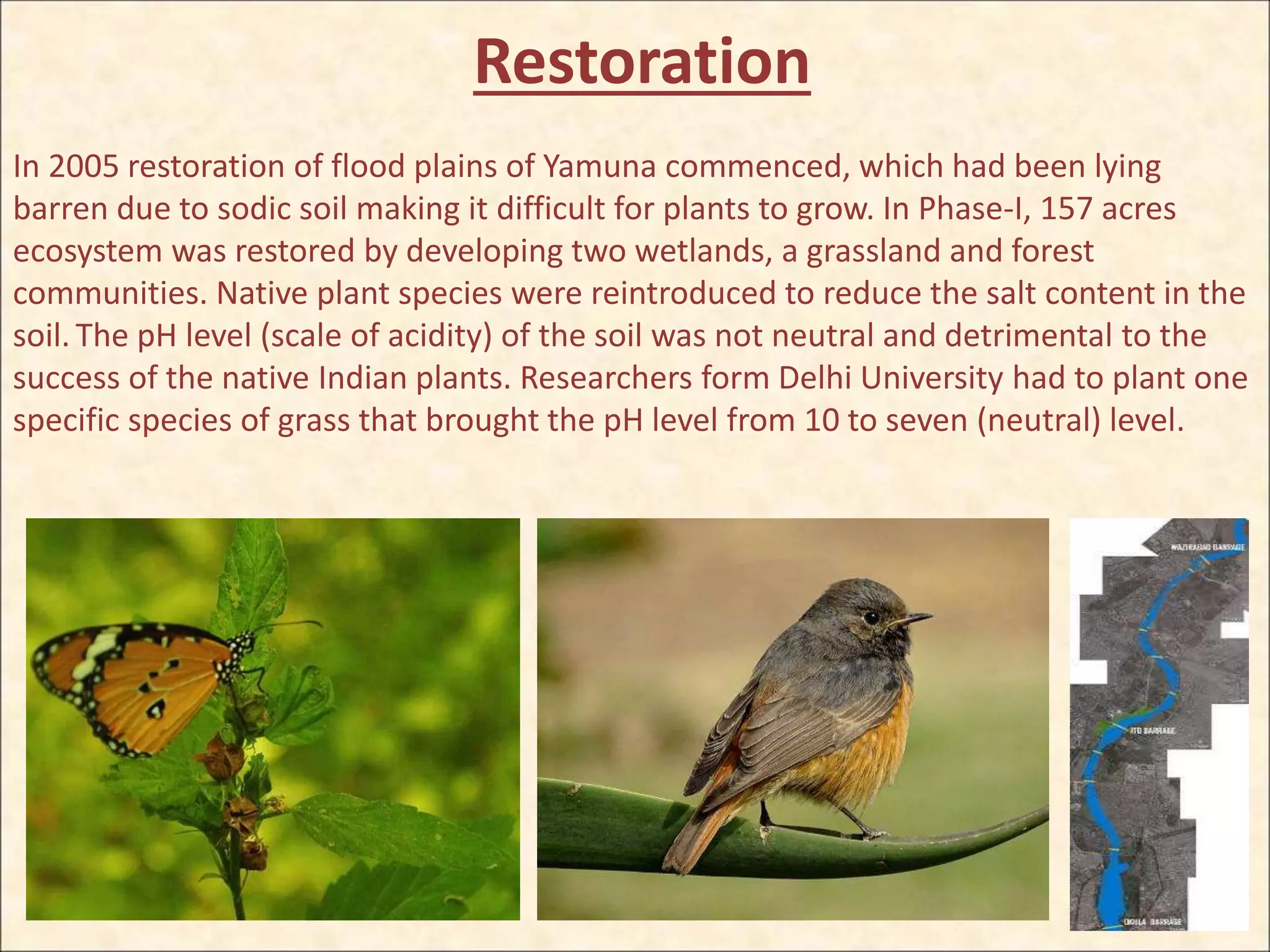
Restoration
In 2005 restoration of flood plains of Yamuna commenced, which had been lying
barren due to sodic soil making it difficult for plants to grow. In Phase-I, 157 acres
ecosystem was restored by developing two wetlands, a grassland and forest
communities. Native plant species were reintroduced to reduce the salt content in the
soil. The pH level (scale of acidity) of the soil was not neutral and detrimental to the
success of the native Indian plants. Researchers form Delhi University had to plant one
specific species of grass that brought the pH level from 10 to seven (neutral) level.
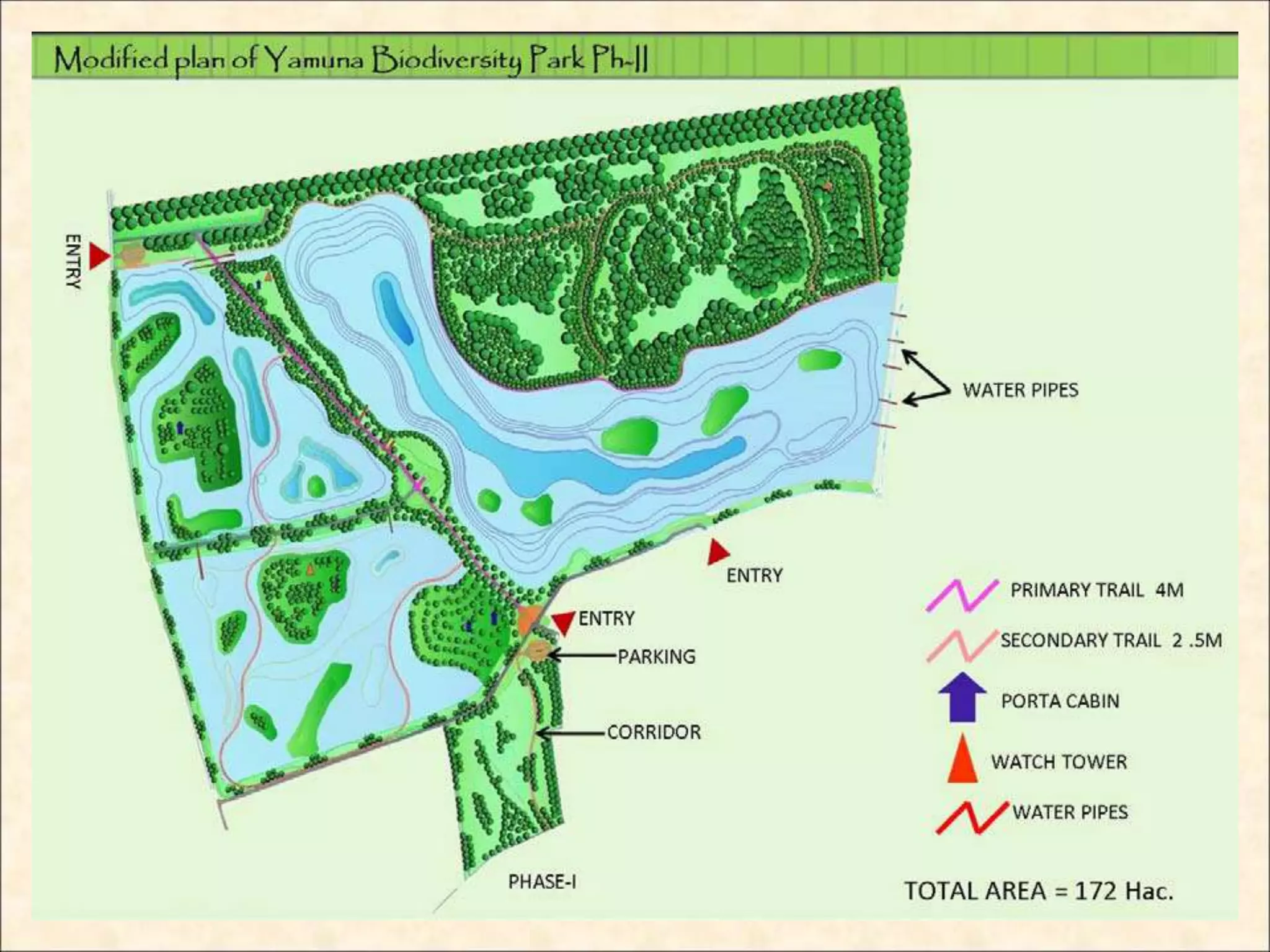
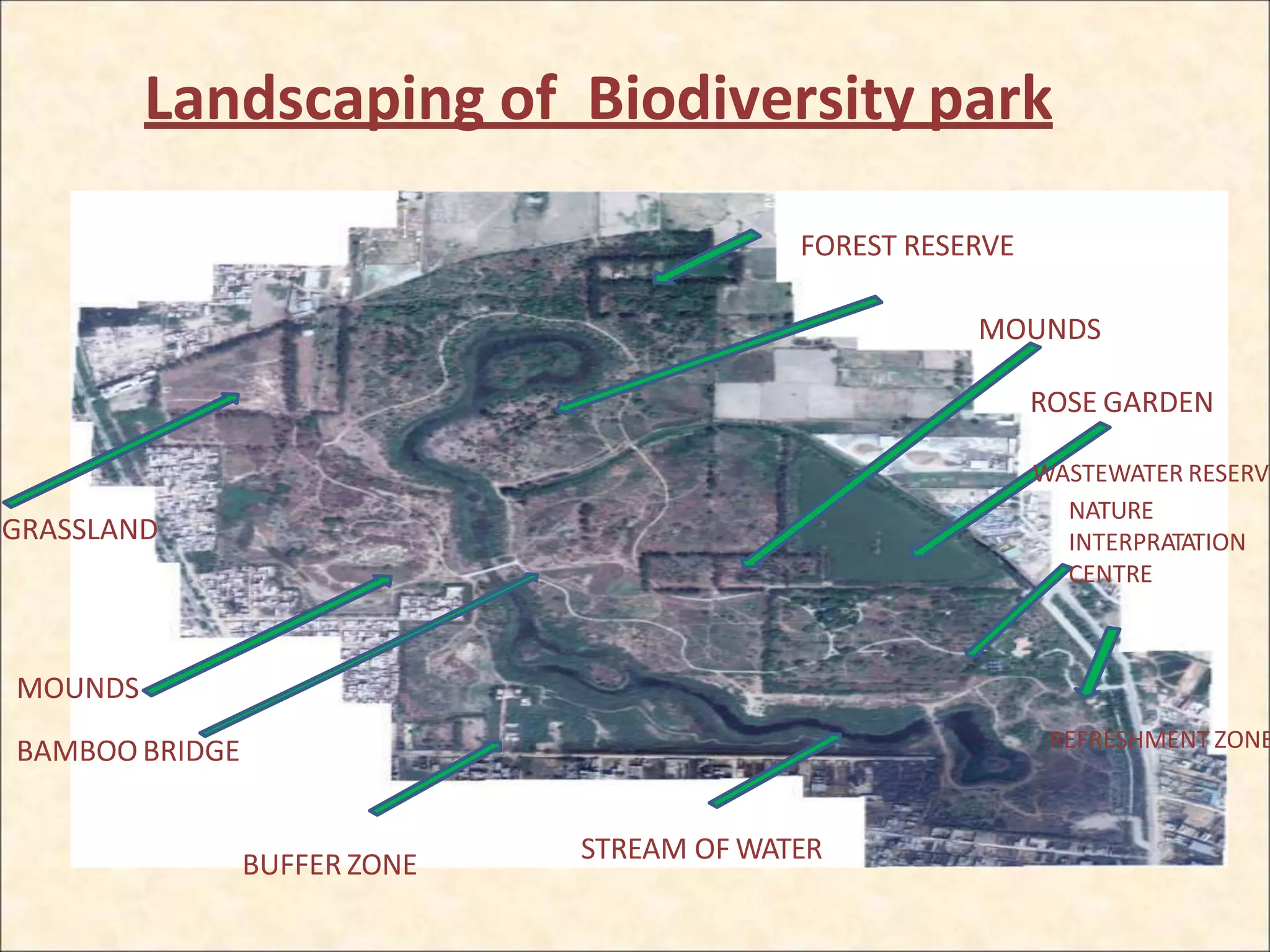
Landscaping of Biodiversity park
NATURE
INTERPRATATION
CENTRE
REFRESHMENT ZONE
FOREST RESERVE
MOUNDS
ROSE GARDEN
WASTEWATER RESERV
BUFFER ZONE
GRASSLAND
MOUNDS
BAMBOO BRIDGE
STREAM OF WATER
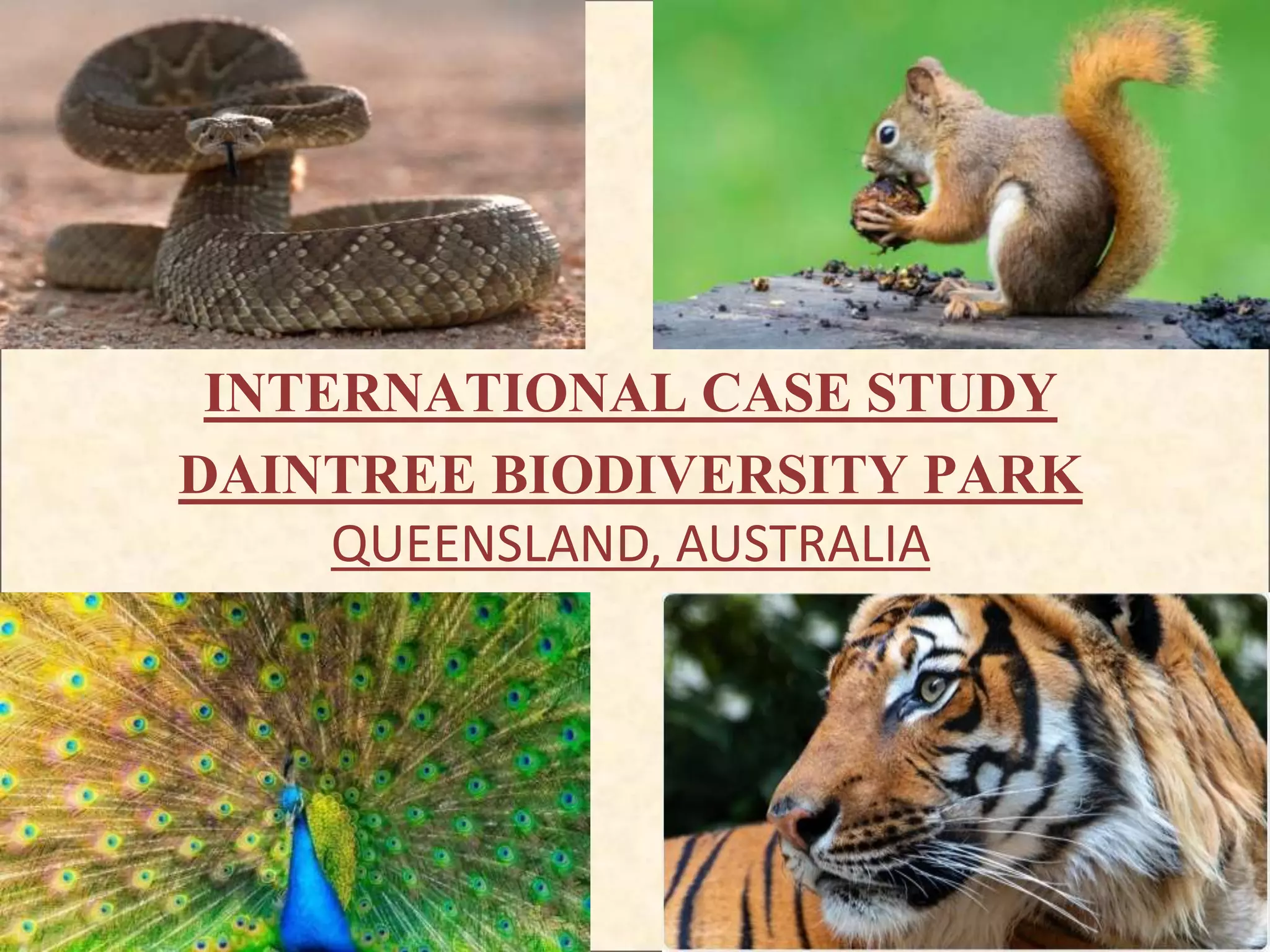
INTERNATIONAL CASE STUDY
DAINTREE BIODIVERSITY PARK
QUEENSLAND, AUSTRALIA
DAINTREE BIODIVERSITY PARK
Daintree Rainforest
•Daintree rainforest is the largest rainforest in Australia.
•It was named after Richard Daintree.
•The Daintree covers over 3000 square kilometers. That’s nearly the size of Adelaide!
It is packed with vegetation.
•People call this place the lungs of the earth. These lungs are being destructed by the
same token.
•We are losing this rainforest rapidly, and we need to make an action.
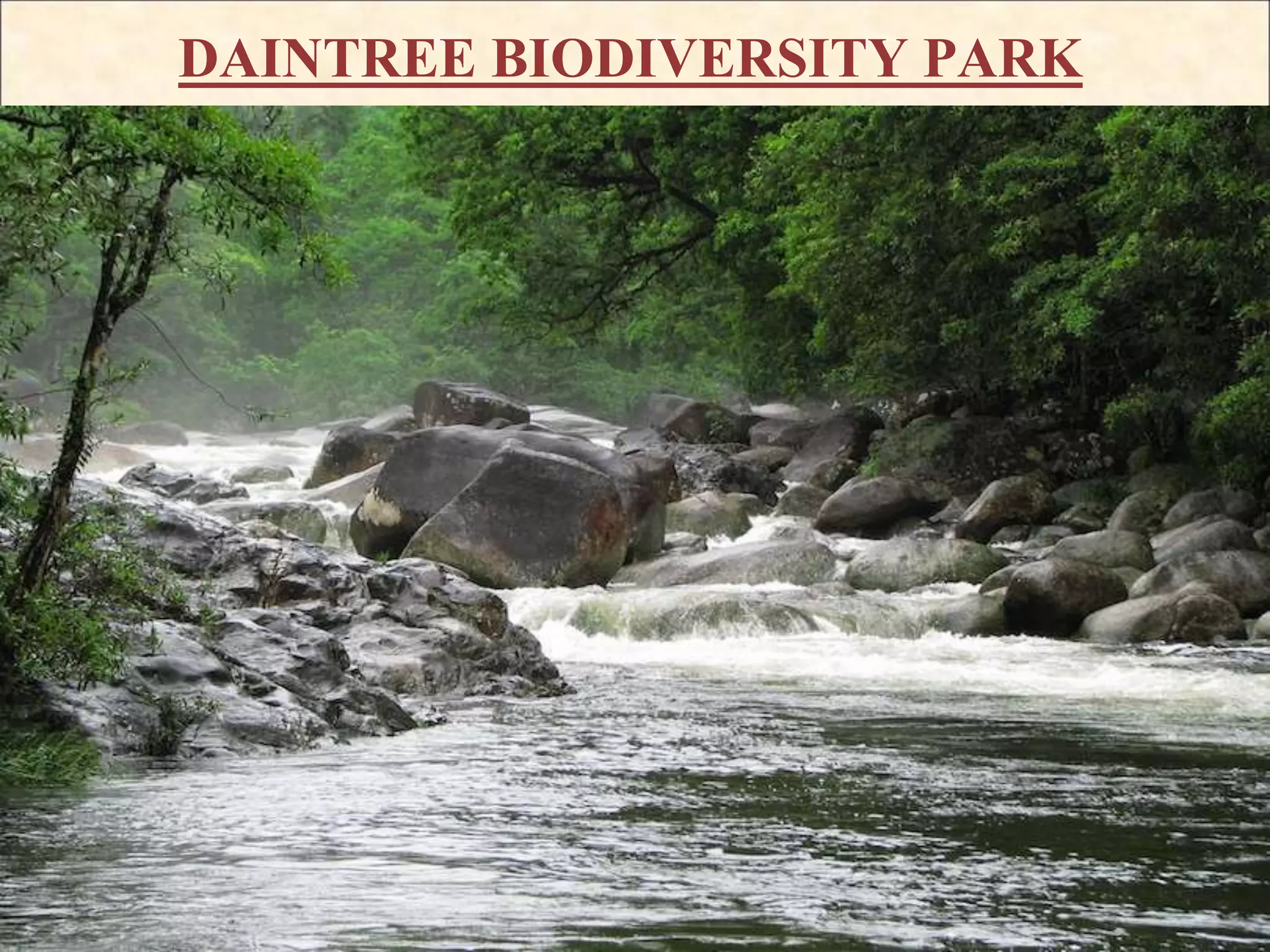
•The Daintree Rainforest is a landscape with striking diversity. From the
dense rainforest and mountain ranges to fast flowing streams, waterfalls and gorges.
With such a rich array of flora and fauna set amongst stunning scenery, there is a rich
and colorful world here waiting to be discovered.
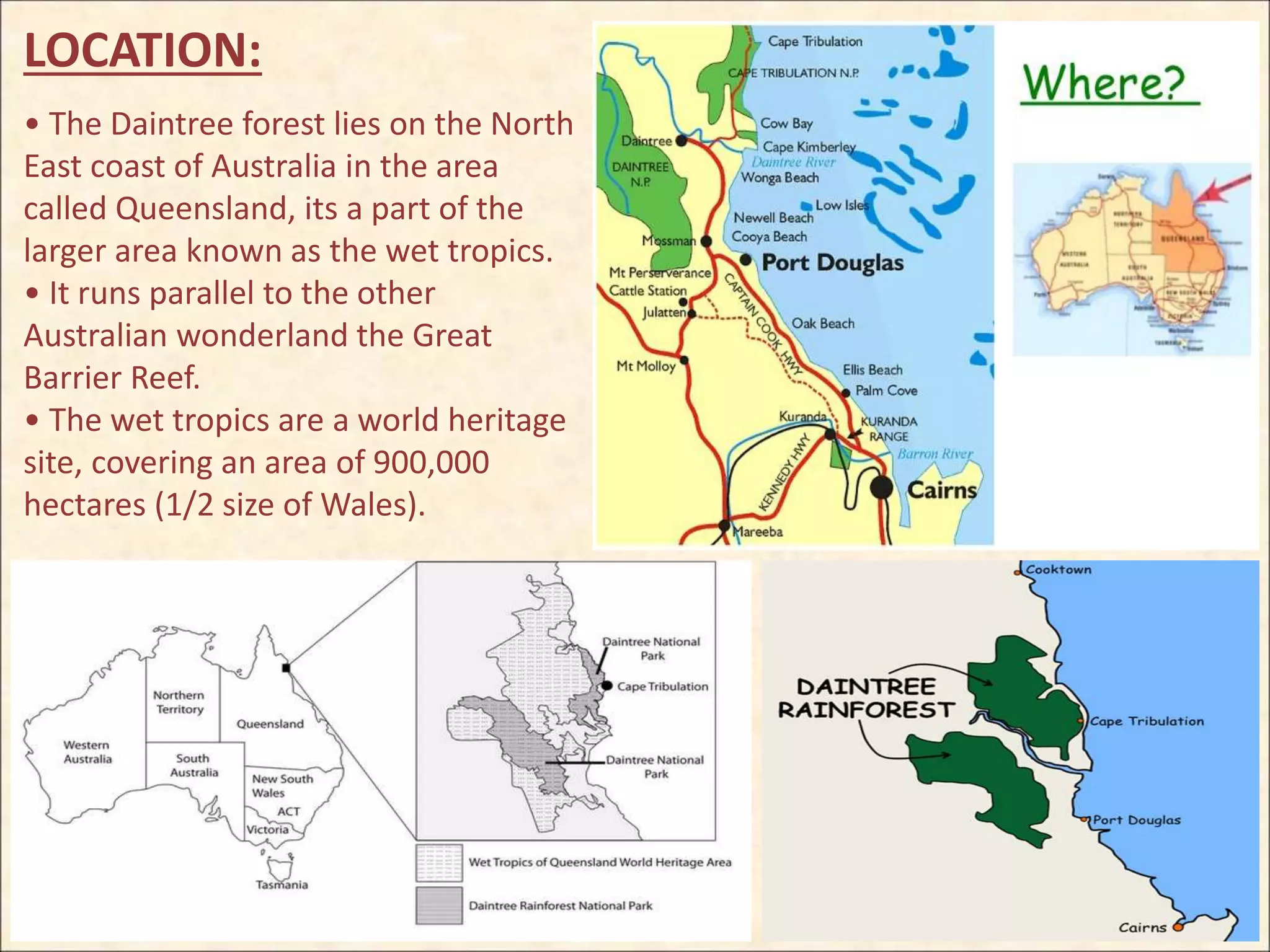
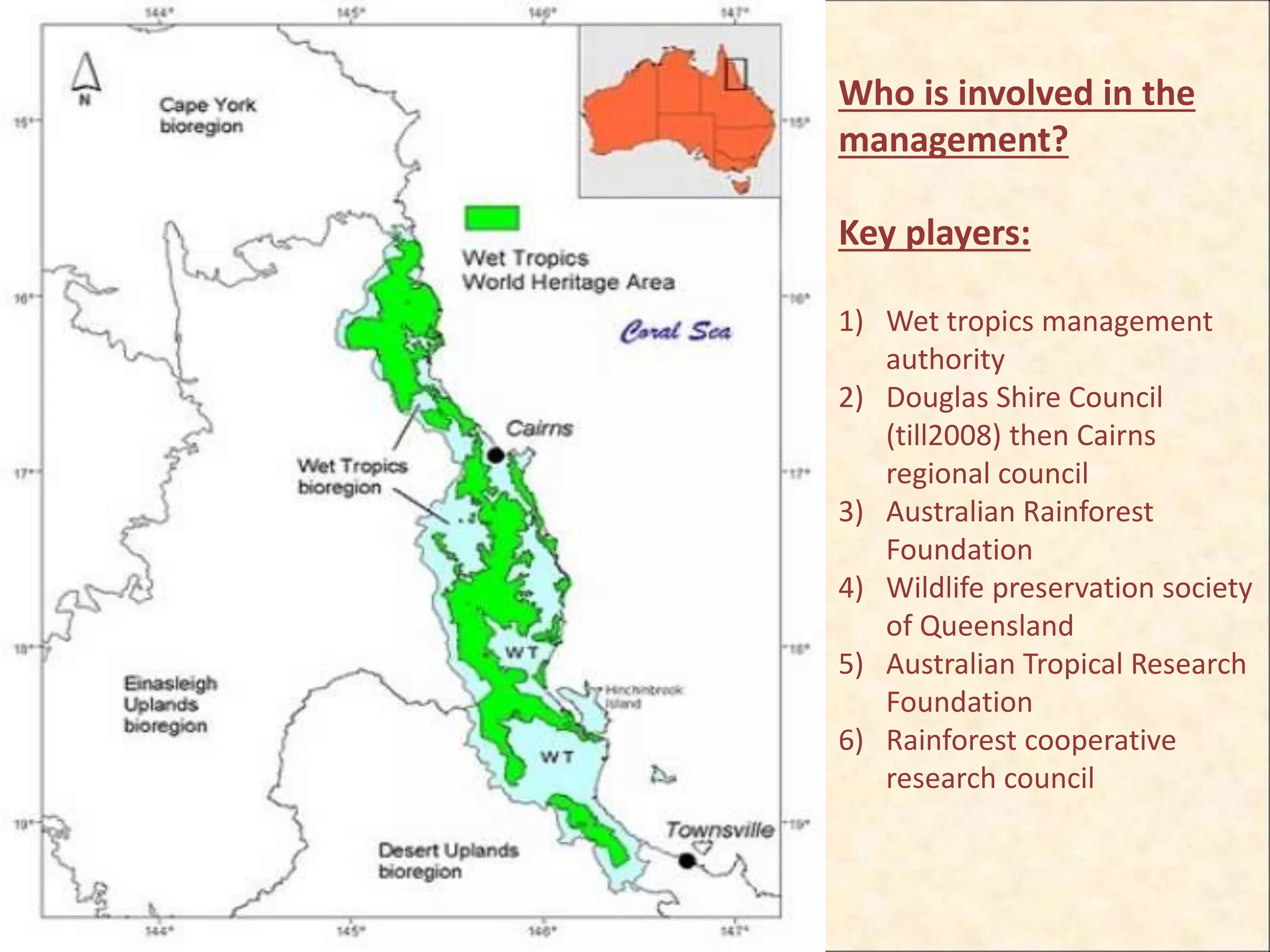
LOCATION:
• The Daintree forest lies on the North
East coast of Australia in the area
called Queensland, its a part of the
larger area known as the wet tropics.
• It runs parallel to the other
Australian wonderland the Great
Barrier Reef.
• The wet tropics are a world heritage
site, covering an area of 900,000
hectares (1/2 size of Wales).
Why is the Daintree so
special?
Its Size:
The jungle stretches across
approximately 1,200 square
kilometers of land. It is the third
largest tropical rainforest in the
world and is the largest within
Australia. It is also the only place
where two world heritage listed
sights stand side by side; where
the rainforest meets the reef.
The GREAT BARRIER REEF and
the Daintree Rainforest live
together peacefully and the
wildlife flourishes between the
two.
Its Age:
Dating back 180 million years, Daintree is one of the oldest vegetations in the world. It is older
than the even the famous Amazon Rainforest by about 10 million years.
It’s Wildlife:
The Daintree is one of the best biologically diverse rainforests in the world. Home to a huge
percentage of the entire country’s animal population. This includes 30% of Australia’s frog
population, 65% of butterfly and bats and around 12,000 different insect species. As well as
being diverse, the animals are unique. Some of these species aren’t found anywhere else on the
planet, including the Ulysses Butterfly, Boyd’s Forest Dragon, and the Southern Cassowary.
The plants are just as interesting, with over three thousand types of plant species existing in the
rainforest. The diversity, complexity, and age of the ecosystem’s plant species are one of the
greatest in the entire world. Out of the 19 primate plants families remaining on earth, 12 are
found in this rainforest. The ‘Idiot Fruit’ is one of the most ancient plants that litter the
rainforest, which thrived when dinosaurs wandered the earth.
It is a Gateway:
It acts as a gateway to one of the greatest tourist spots around; the Cape Tribulation. The Cape
Tribulation is a coastal area within the National park and is bursting with unspoiled beaches with
the beautiful reefs. It is a tropical heaven, untouched by urban development. The only way you
can see this spectacular site is by passing through the rainforest, which acts as a protective
border from the modern world.
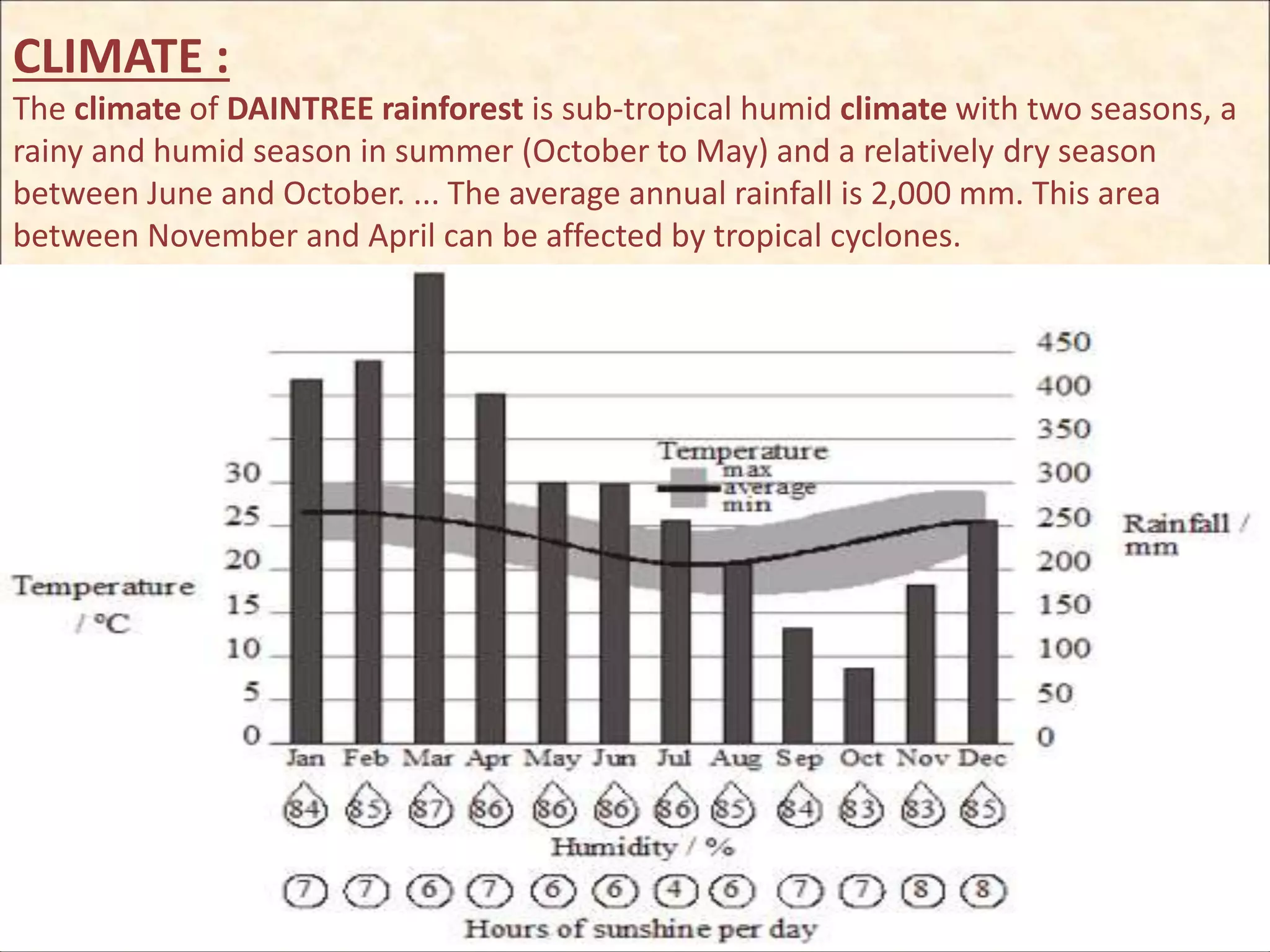
CLIMATE :
The climate of DAINTREE rainforest is sub-tropical humid climate with two seasons, a
rainy and humid season in summer (October to May) and a relatively dry season
between June and October. ... The average annual rainfall is 2,000 mm. This area
between November and April can be affected by tropical cyclones.
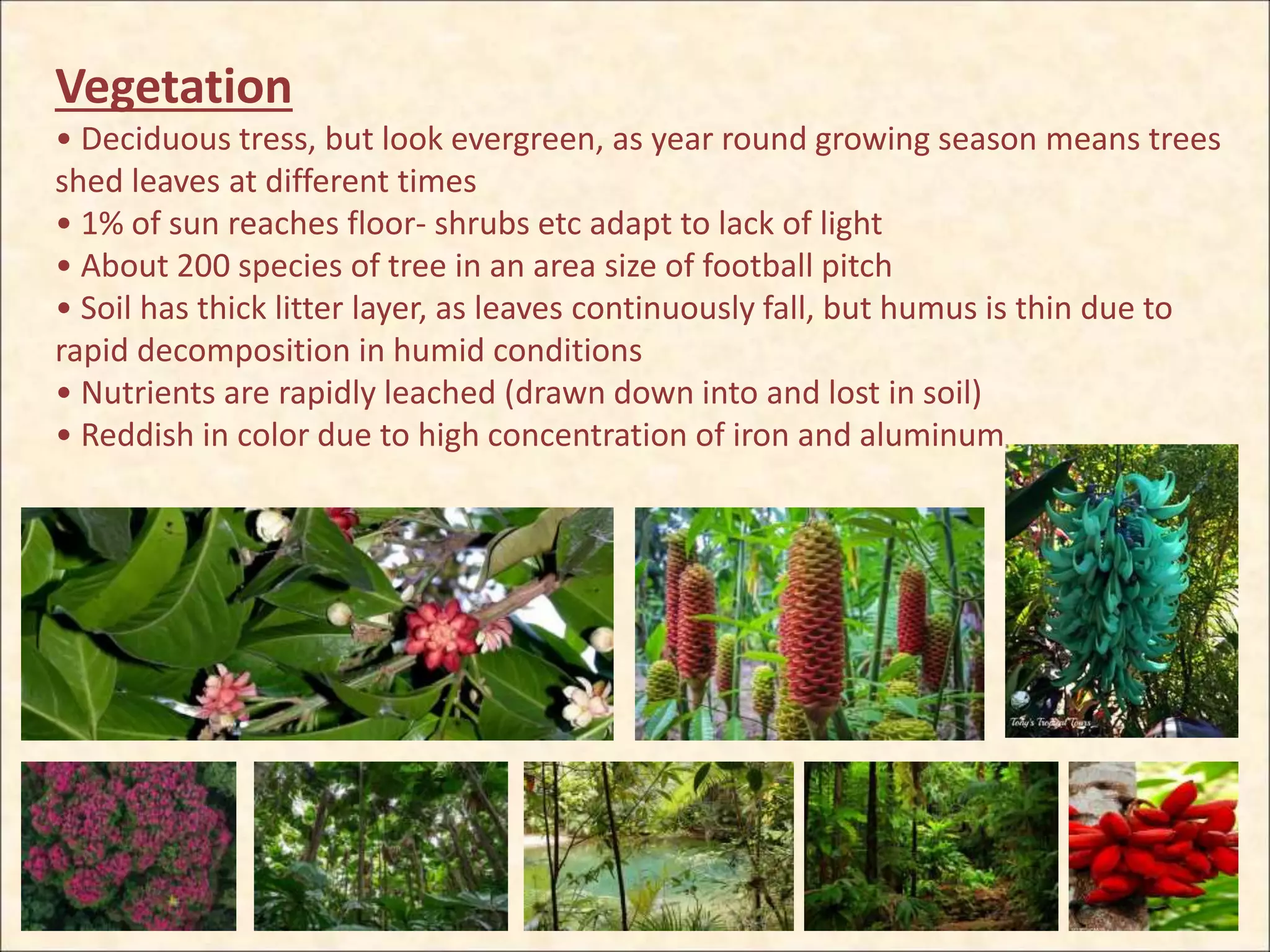
Vegetation
• Deciduous tress, but look evergreen, as year round growing season means trees
shed leaves at different times
• 1% of sun reaches floor- shrubs etc adapt to lack of light
• About 200 species of tree in an area size of football pitch
• Soil has thick litter layer, as leaves continuously fall, but humus is thin due to
rapid decomposition in humid conditions
• Nutrients are rapidly leached (drawn down into and lost in soil)
• Reddish in color due to high concentration of iron and aluminum
It’s the oldest intact tropical lowland
rainforest in the world.
It has the greatest diversity of plants and
animals found anywhere in Australia.
It is host to 12 of the world’s 19 primitive
flowering plant species.
It is home to 28% of frogs, 65% of ferns,
40% of birds and 34% of mammals in
Australia.
FLORA
TYPES OF FLORA IN DAINTREE FOREST:
IDIOT FRUIT (Idiospermum australiense)
EPIPHYTES
KING FERNS (Angiopteris evecta)
NOAH’S SATINASH (Syzygium maraca)
NATIVE GINGERS (Family: Zingiberaceae)
FAN PALM (Licuala ramsayi)
PANDANUS
YELLOW MAHOGANY (Dysoxylum parasiticum)
•The park supports more than 430 bird species.
•The wompoo fruit-dove is one of six species of pigeon
that live in the park as well as significant populations of
the endangered cassowary, a flightless bird of
substantial size.
•The buff-breasted paradise kingfisher is a seasonal
visitor. Mammals include the striped possum, Daintree
River ringtail possum, brown bandicoot, long-nosed
bandicoot, musky rat-kangaroo, Bennett’s tree
kangaroo, swamp wallaby, platypus and short-beaked
echidna.
•At least 23 species of reptile and 13 species of
amphibian can be found in the park.
•Among the reptiles present are Boyd's forest
dragon, eastern water dragon, chameleon gecko,
northern leaf-tailed gecko, the scrub or amethystine
python, keel back, and the green and northern tree
snakes.
•Frogs found in the park include the Australian
lacelid, white-lipped tree frog, colorful-eyed tree frog
and common mist frog.
•The introduced cane toad is also present in the park.
FAUNA
Mangrove Nurseries
•The mangrove system of forests that ring the mouths of creeks and rivers in the
Daintree is a wonderful fish nursery that plays a particular importance in the
ecology of the area.
•Mangroves are vital for many young fish species that migrate to the Great Barrier
Reef later in life.
•They also hold the highest species diversity for this type of habitat anywhere in
Australia.
What are the threats to the Daintree?
Humans make a huge impact on ecosystems, here are some of the many things we do that are
slowing destroying the Daintree.
Logging:
Logging affects the Daintree Rainforest because if the loggers go and cut down all the trees and
sell the timber for money there will be no rainforest left.
Farming:
Farming affects the Daintree Rainforest because farmers burn the rainforest in order to clear
land for more farming.
Development:
Development is affecting the Daintree Rainforest because people are destroying the rainforest
to build houses, roads and infrastructure.
Mining:
Mining is a problem because miners clear the rainforest and dig up the ground to extract
minerals.
Tourism:
Tourism is a problem because as interest in the Daintree Rainforest grows, more buses and
transport is needed to keep up with demand and that increases the carbon dioxide and impacts
on climate change.
As a consequence of human impact over 120 local animal and plant species are threatened.
Example, the Cassowary is a threatened species and there are only 2,000 left.
Services provided by the Daintree
• Carbon Sequestration- Daintree plants and trees store carbon in leaves which reduces
pollution and regulates climate
• Medicine- 25% of drugs are from rainforests, including chemicals to treat diabetes, heart
disease, malaria, arthritis and traditional headache tablets. Many Daintree plants are identified
as containing cancer fighting properties
• People of the rainforest- rainforest aborigine people are the original owners of the forest-
the natural rainforest and its processes are integral to these people and the way they live
• Tourism- ½ million tourist visits a year from home and abroad, come for scenery- unique
combo of forest, coast and mountains and the GBR all together- nowhere else like this on Earth
• Logging- began in 1930s in the 80s arguments ensued between conservationists and timber
industry- decided continued logging at then rate UNSUSTAINABLE.
Save the Daintree Rainforest for Future Generations
It is so important for us to preserve this one of a kind natural wonder. You are welcome
to visit this stunningly diverse natural habitat, but please ensure that you leave this
pristine environment as it was when you arrived. Take any rubbish with you when
leaving the forest, don’t pollute the water and don’t feed the wildlife. Protecting this
natural environment starts with you. As they say, ‘Leave nothing but footsteps and
take nothing but photographs’.
It is also vital to do what we can to protect the cassowary and boost their numbers in
the Daintree. The best way to achieve this is with rainforest re-vegetation.
Rainforest Rescue is a fantastic organization who undertakes in the necessary re-
vegetation that is needed to support the cassowary population. Every donation helps
to save this magnificent creature and help sustain the wonderful natural diversity of
the Daintree Rainforest.
Who is involved in the
management?
Key players:
1) Wet tropics management
authority
2) Douglas Shire Council
(till2008) then Cairns
regional council
3) Australian Rainforest
Foundation
4) Wildlife preservation society
of Queensland
5) Australian Tropical Research
Foundation
6) Rainforest cooperative
research council
Biodiversity parks and case studies

Biodiversity parks and case studies

  • 1.
    BIODIVERSITY AND ITSCONSERVATION CASE STUDIES OF NATIONAL AND INTERNATIONAL BIODIVERSITIES NATIONAL ACSE STUDY :YAMUNA BIODIVERSITY PARK, DELHI INTERNATIONAL CASE STUDY : DAINTREE NATIONAL PARK, QUEENSLAND, AUSTRALIA SUBMITTED BY : POOJA SHARMA M.ARCH ( LANDSCAPE ) – 2ND SEM
  • 2.
    INTRODUCTION • The termBiodiversity was first coined by Walter G. Rosen in 1986. • The biosphere comprises of a complex collections of innumerable organisms, known as the Biodiversity, which constitute the vital life support for survival of human race. • Biological diversity, abbreviated as biodiversity, represent the sum total of various life forms such as unicellular fungi, protozoa, bacteria, and multi cellular organisms such as plants, fishes, and mammals at various biological levels including gens, habitats, and ecosystem .
  • 3.
    What is Biodiversity? •Theword Biodiversity originates from the Greek word BIOS = LIFE and Latin word DIVERSITAS = VARIETY or DIFFERENCE. •The whole word bio diversity generally therefore means: VARIETY OF LIFE. •Biodiversity is the degree of variation of life. It is a measure of the variety of organisms present in different ecosystems. • The loss of biological diversity is at grave threat. • Tocounter global climate change. • Sustainable physical and social environment for improving quality of life. • Conservation and Development of the Natural features. • Toprotect the ground water recharge zones and enhance its capacity. Why Biodiversity Park?
  • 4.
    There are threetypes of biodiversities
  • 5.
    Species Biodiversity • SpeciesDiversity is the effective number of different species that are represented in collection of individuals Genetic Biodiversity •Genetic diversity, the level of biodiversity refers to the total number of genetic characteristics in the genetic makeup of a species. Ecosystem Biodiversity •Ecosystem diversity refers to the diversity of a place at the level of ecosystems. The term differs from biodiversity, which refers to variation in species rather than ecosystems.
  • 6.
    DISTRIBUTION OF BIODIVERSITY Floraand fauna diversity depends on- Climate Altitude Soils Presence of other species • Most of the biodiversity concentrated in Tropical region. BIODIVERSITY HOTSPOTS: A region with high biodiversity with most of spices being Endemic. India have two Biodiversity Hotspots- East Himalayan Region and Western Ghat.
  • 7.
    BENEFITS OF BIODIVERSITY Consumptivevalue: Food/Drink Fuel Medicine Better crop varieties Industrial Material Non-Consumptive Value: Recreation Education and Research Traditional value
  • 8.
    Ecological services: Balance ofnature Biological productivity Regulation of climate Degradation of waste Cleaning of air and water Cycling of nutrients Control of potential pest and disease causing species Detoxification of soil and sediments Stabilization of land against erosion Carbon sequestration and global climate change Maintenance of Soil fertility
  • 9.
    THREATS TO BIODIVERSITY Naturalcauses: Narrow geographical area Low population Low breeding rate Natural disasters Anthropogenic causes: Habitat modification Overexploitation of selected species Innovation by exotic species
  • 10.
    Pollution Hunting Global warming andclimate change Agriculture Domino effect
  • 11.
    CONSERVATION OF BIODIVERSITY Biodiversityinventories Conserving Biodiversity in protected Habitats- • • In situ conservation Ex situ conservation Seed Bank, Gene Bank, Pollen Bank, DNA Bank Gene Bank zoo Bandhavgarh National Park
  • 12.
    Restoration of Biodiversity ImpartingEnvironmental Education Enacting, strengthening and enforcing Environmental Legislation Population Control Reviewing the agriculture practice Controlling Urbanization Conservation through Biotechnology
  • 14.
    BIODIVERSITY IN INDIA CategoriesNo. of Indian Species % of Indian species Evaluated Species Threatened In India Mammals 386 59 41% Birds 1219 _ 7% Reptiles 495 73 46% Amphibians 207 79 57% Freshwater Fish 700 46 70% Source- Based on Kumar et.al 2000
  • 15.
    BIODIVERSITY CONVENSIONS The firstconvention on biodiversity organized at Rio De Janerio, capital of Brazil from June 5 to 16, 1992 named as United Nation Conference On Environment and Development (UNCED), batter known as Rio Summit to maintain ecological balance and enrich biodiversity. The signed by 150 countries agreement on including three biodiversity programmes- To ensure conservation of biodiversity Sustainable use of biodiversity Rational and equitable share of profit to accrue from use of genetic resources. The second convention organized at Johannesburg in 2002 called World Summit On Sustainable Development (WSSD) where the Biodiversity and Sustainable Ecosystem Management was the issue.
  • 16.
    The International Conferenceheld on Biodiversity in Relation to Food & Human Security in a warming planet 15-17 February, 2010 in Chennai. International Conference on Wildlife & Biodiversity Conservation held on 3 to 5 June, 2010 at Dal lake, Srinagar, Kashmir. Indian Biodiversity Congress (IBC) & Indian Biodiversity Expo(IBE) will be held on 27-31 December at Thriuvananthapuram, Kerala.
  • 17.
    CONCLUSION Biodiversity is ourlife. If the Biodiversity got lost at this rate then in near future, the survival of human being will be threatened. So, it is our moral duty to conserve Biodiversity as well our Environment. Long- term maintenance of species and their management requires co-operative efforts across entire landscapes. Biodiversity should be dealt with at scale of habitats or ecosystems rather than at species level.
  • 18.
    NATIONAL CASE STUDY YAMUNABIODIVERSITY PARK JAGATPUR KHADAR, YAMUNA DELHI
  • 19.
    Yamuna Biodiversity Park AERIALVIEW OF YAMUNA BIODIVERSITYPARK,DELHI
  • 20.
  • 22.
    Aim of YamunaBiodiversity Park • T o protect and sustain the biodiversity. • Toprotect the natural drainage of river Yamuna in Delhi. • T o provide regional level open and green spaces. • T o protect the ground recharge zones like river Yamuna and Ridge
  • 23.
    Origin and Salientfeatures of the site • This park is located close to river Yamuna, Jharoda, Wazirabad • Actually 1km away from the main stream of Yamuna but still in its Basin • It was a part of the flood plain during some 30-40 years back • DDA acquired land in 2001-2002 and planned biodiversity park in 2003 • The area is low lying used to get seasonally flooded and long spell of standing water has turned soil more saline(pH=8.9) • For developing park two pronged strategies were adopted- physical and biological interventions
  • 24.
    Physical Intervention • Todealwith localized flooding terrain was modified by creating wasteland and marshes • Mounds were created for leaching soil of excess salt and make niches for biodiversity Biological Intervention • Biological inputs for improving habitat quality • Farm yard manure, vermi compost leaf mould etc were provided • Leguminous species and some other characteristic grass were introduced
  • 25.
    Importance of YamunaBiodiversity Park • Emerging as the capital's most visited public place. • Prominent centre for learning and understanding the environment. • Home for biologically rich wetlands, grassland communities, • A wide variety of fruit yielding species and an abundance of medicinal herbs. • The Park also comprises a native flora and fauna which used to exist a 100 years ago and then became extinct locally.
  • 26.
    Important Features ofthe site • Ten mounds which illustrate different forest ecosystems found in the Yamuna basin • Structure and composition is done in such a way to give it a natural view and environment • The soil for mounds were brought from a digging wasteland and reservoirs. • Different species of grass and shrubs were planted for soil better holding and for increasing biomass • Different ecosystems such as deciduous forest, evergreen forest, sub-tropical evergreen, moist tropical deciduous forest etc. • Broad divisions are bambuselum, Nature Interpretation centre, conservatory of fruit yielding species, wetland for migratory birds and the nature reserve area.
  • 27.
    Zoning of Park •The front portion of the Yamuna Biodiversity Park, a 220m southward and 140m northward stretch from the main entry gate with 20-30m width is demarcated as • Domesticated Biodiversity Zone. Enclosed by a hedge of poplar, it features plants like Ailanthus Butea and Bauhinia • The outer iron fencing is embraced by multi-coloured climbers like Jasmine and QuisqualiS. • The Conservatory of fruit yielding species • The Migratory duck’swetland • The Nature Reserve area. • Nature Interpretation Centre
  • 28.
    Bambusalem • Vide diversityof bamboo species..presently 37 varieties of bamboo. • Habitat of bulbul and many other creatures Nature Interpretation centre • Study centre for biodiversity and • Allied bio geo interpretations
  • 29.
    Flora According to prof.C R Babu of Delhi University, initially only mongooses, lizards and 31 species of birds were there in the park up until 2004. By 2014 the biodiversity park already had 900 species of native plants. The native species reintroduced included Adina, Sal, teak and Hardwicke. As of 2019, it has about 1,500 species of plants and animals, and 200 species of birds.
  • 30.
    Fauna By 2014, thewetlands was already attracting thousands of migratory birds from Siberia, Central Asia and Europe. It had 200 species of birds, 75 species of butterflies, 10 species of snakes, and big mammals like porcupine, small Indian civet and wild boars.
  • 31.
    Wetlands • Two wetlandsare have been created, one is narrow and 1.8km simulating river and the other one is wide open and deep spreading over 2 hectares • It was created to serve as a habitat of aquatic life and serve the purpose of ecologically water purification, groundwater recharge, storage of rainwater and help in controlling flood during monsoon. Other special areas are • Nurseries, • Amphitheatre • Poly houses • Orchards • Acacia grasslands • 750m long drain from Jagatpur Village • Rose Garden
  • 32.
    Resting Point &Nature interpretation Centre RESTING POINT AND EATINGCENTRE NATURE INTERPRETATION CENTRE
  • 33.
    Restoration In 2005 restorationof flood plains of Yamuna commenced, which had been lying barren due to sodic soil making it difficult for plants to grow. In Phase-I, 157 acres ecosystem was restored by developing two wetlands, a grassland and forest communities. Native plant species were reintroduced to reduce the salt content in the soil. The pH level (scale of acidity) of the soil was not neutral and detrimental to the success of the native Indian plants. Researchers form Delhi University had to plant one specific species of grass that brought the pH level from 10 to seven (neutral) level.
  • 34.
    Landscaping of Biodiversitypark NATURE INTERPRATATION CENTRE REFRESHMENT ZONE FOREST RESERVE MOUNDS ROSE GARDEN WASTEWATER RESERV BUFFER ZONE GRASSLAND MOUNDS BAMBOO BRIDGE STREAM OF WATER
  • 35.
    INTERNATIONAL CASE STUDY DAINTREEBIODIVERSITY PARK QUEENSLAND, AUSTRALIA
  • 36.
  • 37.
    Daintree Rainforest •Daintree rainforestis the largest rainforest in Australia. •It was named after Richard Daintree. •The Daintree covers over 3000 square kilometers. That’s nearly the size of Adelaide! It is packed with vegetation. •People call this place the lungs of the earth. These lungs are being destructed by the same token. •We are losing this rainforest rapidly, and we need to make an action. •The Daintree Rainforest is a landscape with striking diversity. From the dense rainforest and mountain ranges to fast flowing streams, waterfalls and gorges. With such a rich array of flora and fauna set amongst stunning scenery, there is a rich and colorful world here waiting to be discovered.
  • 38.
    LOCATION: • The Daintreeforest lies on the North East coast of Australia in the area called Queensland, its a part of the larger area known as the wet tropics. • It runs parallel to the other Australian wonderland the Great Barrier Reef. • The wet tropics are a world heritage site, covering an area of 900,000 hectares (1/2 size of Wales).
  • 39.
    Why is theDaintree so special? Its Size: The jungle stretches across approximately 1,200 square kilometers of land. It is the third largest tropical rainforest in the world and is the largest within Australia. It is also the only place where two world heritage listed sights stand side by side; where the rainforest meets the reef. The GREAT BARRIER REEF and the Daintree Rainforest live together peacefully and the wildlife flourishes between the two.
  • 40.
    Its Age: Dating back180 million years, Daintree is one of the oldest vegetations in the world. It is older than the even the famous Amazon Rainforest by about 10 million years. It’s Wildlife: The Daintree is one of the best biologically diverse rainforests in the world. Home to a huge percentage of the entire country’s animal population. This includes 30% of Australia’s frog population, 65% of butterfly and bats and around 12,000 different insect species. As well as being diverse, the animals are unique. Some of these species aren’t found anywhere else on the planet, including the Ulysses Butterfly, Boyd’s Forest Dragon, and the Southern Cassowary. The plants are just as interesting, with over three thousand types of plant species existing in the rainforest. The diversity, complexity, and age of the ecosystem’s plant species are one of the greatest in the entire world. Out of the 19 primate plants families remaining on earth, 12 are found in this rainforest. The ‘Idiot Fruit’ is one of the most ancient plants that litter the rainforest, which thrived when dinosaurs wandered the earth. It is a Gateway: It acts as a gateway to one of the greatest tourist spots around; the Cape Tribulation. The Cape Tribulation is a coastal area within the National park and is bursting with unspoiled beaches with the beautiful reefs. It is a tropical heaven, untouched by urban development. The only way you can see this spectacular site is by passing through the rainforest, which acts as a protective border from the modern world.
  • 41.
    CLIMATE : The climateof DAINTREE rainforest is sub-tropical humid climate with two seasons, a rainy and humid season in summer (October to May) and a relatively dry season between June and October. ... The average annual rainfall is 2,000 mm. This area between November and April can be affected by tropical cyclones.
  • 42.
    Vegetation • Deciduous tress,but look evergreen, as year round growing season means trees shed leaves at different times • 1% of sun reaches floor- shrubs etc adapt to lack of light • About 200 species of tree in an area size of football pitch • Soil has thick litter layer, as leaves continuously fall, but humus is thin due to rapid decomposition in humid conditions • Nutrients are rapidly leached (drawn down into and lost in soil) • Reddish in color due to high concentration of iron and aluminum
  • 43.
    It’s the oldestintact tropical lowland rainforest in the world. It has the greatest diversity of plants and animals found anywhere in Australia. It is host to 12 of the world’s 19 primitive flowering plant species. It is home to 28% of frogs, 65% of ferns, 40% of birds and 34% of mammals in Australia. FLORA TYPES OF FLORA IN DAINTREE FOREST: IDIOT FRUIT (Idiospermum australiense) EPIPHYTES KING FERNS (Angiopteris evecta) NOAH’S SATINASH (Syzygium maraca) NATIVE GINGERS (Family: Zingiberaceae) FAN PALM (Licuala ramsayi) PANDANUS YELLOW MAHOGANY (Dysoxylum parasiticum)
  • 44.
    •The park supportsmore than 430 bird species. •The wompoo fruit-dove is one of six species of pigeon that live in the park as well as significant populations of the endangered cassowary, a flightless bird of substantial size. •The buff-breasted paradise kingfisher is a seasonal visitor. Mammals include the striped possum, Daintree River ringtail possum, brown bandicoot, long-nosed bandicoot, musky rat-kangaroo, Bennett’s tree kangaroo, swamp wallaby, platypus and short-beaked echidna. •At least 23 species of reptile and 13 species of amphibian can be found in the park. •Among the reptiles present are Boyd's forest dragon, eastern water dragon, chameleon gecko, northern leaf-tailed gecko, the scrub or amethystine python, keel back, and the green and northern tree snakes. •Frogs found in the park include the Australian lacelid, white-lipped tree frog, colorful-eyed tree frog and common mist frog. •The introduced cane toad is also present in the park. FAUNA
  • 45.
    Mangrove Nurseries •The mangrovesystem of forests that ring the mouths of creeks and rivers in the Daintree is a wonderful fish nursery that plays a particular importance in the ecology of the area. •Mangroves are vital for many young fish species that migrate to the Great Barrier Reef later in life. •They also hold the highest species diversity for this type of habitat anywhere in Australia.
  • 46.
    What are thethreats to the Daintree? Humans make a huge impact on ecosystems, here are some of the many things we do that are slowing destroying the Daintree. Logging: Logging affects the Daintree Rainforest because if the loggers go and cut down all the trees and sell the timber for money there will be no rainforest left. Farming: Farming affects the Daintree Rainforest because farmers burn the rainforest in order to clear land for more farming. Development: Development is affecting the Daintree Rainforest because people are destroying the rainforest to build houses, roads and infrastructure. Mining: Mining is a problem because miners clear the rainforest and dig up the ground to extract minerals. Tourism: Tourism is a problem because as interest in the Daintree Rainforest grows, more buses and transport is needed to keep up with demand and that increases the carbon dioxide and impacts on climate change. As a consequence of human impact over 120 local animal and plant species are threatened. Example, the Cassowary is a threatened species and there are only 2,000 left.
  • 47.
    Services provided bythe Daintree • Carbon Sequestration- Daintree plants and trees store carbon in leaves which reduces pollution and regulates climate • Medicine- 25% of drugs are from rainforests, including chemicals to treat diabetes, heart disease, malaria, arthritis and traditional headache tablets. Many Daintree plants are identified as containing cancer fighting properties • People of the rainforest- rainforest aborigine people are the original owners of the forest- the natural rainforest and its processes are integral to these people and the way they live • Tourism- ½ million tourist visits a year from home and abroad, come for scenery- unique combo of forest, coast and mountains and the GBR all together- nowhere else like this on Earth • Logging- began in 1930s in the 80s arguments ensued between conservationists and timber industry- decided continued logging at then rate UNSUSTAINABLE.
  • 48.
    Save the DaintreeRainforest for Future Generations It is so important for us to preserve this one of a kind natural wonder. You are welcome to visit this stunningly diverse natural habitat, but please ensure that you leave this pristine environment as it was when you arrived. Take any rubbish with you when leaving the forest, don’t pollute the water and don’t feed the wildlife. Protecting this natural environment starts with you. As they say, ‘Leave nothing but footsteps and take nothing but photographs’. It is also vital to do what we can to protect the cassowary and boost their numbers in the Daintree. The best way to achieve this is with rainforest re-vegetation. Rainforest Rescue is a fantastic organization who undertakes in the necessary re- vegetation that is needed to support the cassowary population. Every donation helps to save this magnificent creature and help sustain the wonderful natural diversity of the Daintree Rainforest.
  • 49.
    Who is involvedin the management? Key players: 1) Wet tropics management authority 2) Douglas Shire Council (till2008) then Cairns regional council 3) Australian Rainforest Foundation 4) Wildlife preservation society of Queensland 5) Australian Tropical Research Foundation 6) Rainforest cooperative research council