P a g e | 1
19BCH067
1
TITLE PAGE
FOCUS AREA: CULTURE AND TOURISM
THEME TO WORK ON: ECOTOURISM
UTTAR PRADESH ECOTOURISM POLICY 2014
(A CASE STUDY OF UTTARPRADESH STATE)
BY
VISHWA PATEL (19BCH067), DEPARTMENT OF CHEMICAL
ENGINEERING, SCHOOL OF TECHNOLOGY
PANDIT DEENDAYAL PETROLEUM UNIVERSITY,
GANDHINAGAR, GUJARAT, INDIA
A CASE STUDY PRESENTED TO CSSI 2020 OFFICE
CIVIC AND SOCIAL SERVICE INTERNSHIP
3rd
AUGUST 2020
P a g e | 2
19BCH067
2
EXECUTIVE SUMMARY:
State of Uttar Pradesh has 14,349 sq. kilometer area under forest is home to some beautiful
landscapes, forest sights, rivers, waterfalls, many endangered birds and animals. The distinct cultural
traditions, historical heritage provide amazing and rich experience to the visiting tourists in the state.
Due to increasing biotic pressure,unplanned exploitation, the natural wealth and resources are
depleting fast but the consequent negative effects on the environment have made public more conscious
towards the importance of natural resources and their conservation. Ecotourism is developing as a remarkable
tool for ‘inclusive growth’ giving advantages to the local communities amalgamating sections of wildlife,
environment conservation, education, refreshment and cultural awareness.
Uttar Pradesh Ecotourism Policy 2014 involves specific guidelines for delivering high-quality
experience to visitors, the involvement of local communities, employment generation ensuring nature
protection and conservation at the same time. This policy will have a significant contribution in raising
awareness for nature preservation and empowerment of local people in the state economically.
The program seeks to provide funds for the protection of the environment, to educate visitors about it,
contributing directly to the economic growth of local communities and areas,and to promote respect for
different cultures. This report aims to better understanding of ecotourism and its various aspects,to know the
scenario of ecotourism in India and Uttar Pradesh,amount of work done in the field of ecotourism by Central
and State government, exploring the understanding and working strategies of state government under the
Uttar Pradesh Ecotourism policy, to examine the output of this policy, to scout opportunities and challenges
of ecotourism and recommendations for improvement in the sector of ecotourism in Uttar Pradesh.
The policy resulted in promoting and supporting ecotourism in the state with the development of local
communities economically and nature conservation. The statistics from the year 2015 to 2019 of the number
of tourists visited in total and at ecotourism sites such as Pilibhat, Dhudhwa, etc. after the implementation of
policy in 2014 has significantly increased in Uttar Pradesh. International and domestic tourist arrivals in India
increased considerably from 2000 onwards, and Uttar Pradesh received a significant number of tourists. Uttar
Pradesh was ranked 2nd in terms of domestic tourism visits and 3rd in aspects of foreign tourist visits to India
in 2018. The glamorous figures on tourism in Uttar Pradesh indicate that it is possible to build jobs for both
skilled and non - skilled employees, both directly and indirectly. Simultaneously it arises a lot of future
obstacles and problems viz. shortfall of high-quality tourism infrastructure, global concerns with for health
and safety of tourists and visitors etc.
The challenges can be removed if the government focuses on some of the major issues in the
ecotourism sector such as employment, by encouraging local people to take active participation in ecotourist
activities, improvement in various areas such as building good infrastructure, hygienic public places,
providing high-quality food, increasing the safety of tourist etc.
P a g e | 3
19BCH067
3
Table of Contents
1. INTRODUCTION.................................................................................................................................4
1.1 ECOTOURISM .............................................................................................................................4
1.2 MAIN FEATURES OF ECOTOURISM........................................................................................5
1.3 ECOTOURISM IN UTTAR PRADESH........................................................................................6
1.4 WHAT IS UTTAR PRADESH ECOTOURISM POLICY? ...........................................................6
2. OBJECTIVES OF THE CASE STUDY: ...............................................................................................7
3. APPROACH FOR THE RESEARCH...................................................................................................7
4. UTTAR PRADESH ECOTOURISM POLICY: ....................................................................................7
4.1 PROSPECTS.................................................................................................................................7
4.2 OBJECTIVES OF THE POLICY..................................................................................................7
4.3 FOUNDATION..............................................................................................................................7
4.4 WORKING STRATEGY:..............................................................................................................8
4.5 CHALLENGES...........................................................................................................................10
5. RESULTS AND DISCUSSION ...........................................................................................................10
6. RECOMMENDATIONS.....................................................................................................................12
REFERENCES...........................................................................................................................................14
P a g e | 4
19BCH067
4
1. INTRODUCTION
The urge to travel has been an important human pursuit since the beginning of human history; man
has valued the need to explore unfamiliar locations, to pursue environmental changes and to encounter new
experiences. Unlike traditional tourism, ecotourism has emerged as a form of tourism in the last two decades
to support both the environment and the society.
1.1 ECOTOURISM
The first definition of ecotourism made by Mexican architect Hector Ceballos-Lascurain in 1983 is as
follows:
“That form of environmentally responsible tourism that involves travel and visitation to relatively undisturbed
natural areas with the object of enjoying, admiring and studying the nature(the scenery,wild plants and
animals), as well as any cultural aspect(both past and present) found in these areas,through a process which
promotes conservation, has a low impact on the environment and culture and favors the active and socio-
economically beneficial involvement of local communities.”
Eco-tourism is much more than a catchword for nature-loving travel and leisure. This is committed to
preserving the richness of the natural and cultural ecosystems of the earth. This accommodates tourists in a
manner that is minimally disruptive to the ecosystem and respects native cultures in the areas in which it
works.
Most definitions of ecotourism meet three criteria which contribute a positive nature for environment
conservation:
1) it provides for environmental conservation
2) it includes meaningful community participation
3) it is profitable and can be self-sustaining
P a g e | 5
19BCH067
5
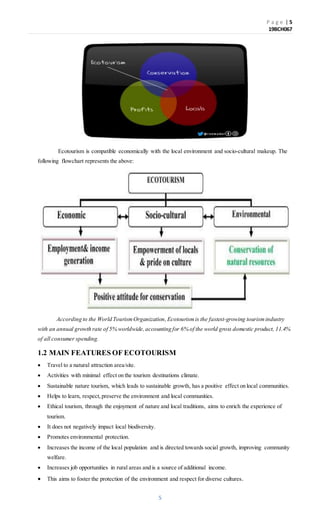
Ecotourism is compatible economically with the local environment and socio-cultural makeup. The
following flowchart represents the above:
According to the World TourismOrganization, Ecotourism is the fastest-growing tourismindustry
with an annual growth rate of 5% worldwide,accounting for 6% of the world gross domestic product, 11.4%
of all consumer spending.
1.2 MAIN FEATURES OF ECOTOURISM
 Travel to a natural attraction area/site.
 Activities with minimal effect on the tourism destinations climate.
 Sustainable nature tourism, which leads to sustainable growth, has a positive effect on local communities.
 Helps to learn, respect,preserve the environment and local communities.
 Ethical tourism, through the enjoyment of nature and local traditions, aims to enrich the experience of
tourism.
 It does not negatively impact local biodiversity.
 Promotes environmental protection.
 Increases the income of the local population and is directed towards social growth, improving community
welfare.
 Increases job opportunities in rural areas and is a source of additional income.
 This aims to foster the protection of the environment and respect for diverse cultures.
P a g e | 6
19BCH067
6
1.3 ECOTOURISMIN UTTAR PRADESH
Uttar Pradesh is a state established in northern India on 1 April 1937. As of 2011, it is the fifth-largest
Indian state with 6.88% of the land area and the most populated state with a population of around 16.51% of
the Indian population. Lucknow is the capital of Uttar Pradesh,and Kanpur is the center of commerce. The
contribution of tourism to the generation of jobs is of utmost importance to the state.
In 2018, the state attracted the second-largest domestic tourist arrival with 285 million tourists to the
state and the third-largest international tourist arrival in the nation, with more than 3.78 million.
Definition ofecotourism adopted by the state ofUttar Pradesh is as follows:
“Ecotourism is responsible travel to natural areas and seeks to promote and support the understanding,
appreciation and conservation of the environment and culture, raising awareness for biodiversity and for local
cultures emphasizing on preserving their indigenous features. It also promotes employment as well as
economic and social development, acting as an alternative income source for economically and socially
marginalized people living in hard economic situations.”
Uttar Pradesh,with its rich natural attractions, a huge cultural and religious heritage, has enormous
potential for growth in the ecotourism market. The State consists of 1 National Park and 24 Wildlife
Sanctuaries as Protected Areas.
Circuits ofEcotourism: Ecotourism spots in Uttar Pradesh are divided into 09 circuits.
1. Western Wildlife Circuit
2. Lion Safari and Riverine Circuit
3. TeraiTiger Circuit
4. Bundelkhand Adventure Circuit
5. Vindhya Mountain Circuit
6. Western Bird/Wetland Circuit
7. Central Bird/Wetland Circuit
8. Ganges Basin Circuit
9. Eastern Wildlife Circuit
In an attempt to display these natural wonders to tourists with the active involvement of indigenous
communities, so that visitors can admire the grandeur and kindness of nature, recognize the value of recycling
and constraining use, and imbibe the culture of nature and the conservation of resources,the Uttar Pradesh
Government, with its clear commitment to promoting ecotourism, has made a significant contribution. The
case study will brief on that.
1.4 WHAT IS UTTAR PRADESHECOTOURISMPOLICY?
An Ecotourism Policy that envisages new interventions to make tourism the cornerstone in job
creation, environmental transformation, the development of remote areas and the growth of women and other
marginalized groups in the world, is therefore vital to our economy in addition to fostering social inclusion.
This will contribute to the upliftment of more gained local communities and create opportunities for further
investment in these regions.
P a g e | 7
19BCH067
7
2. OBJECTIVESOF THE CASE STUDY:
1. To understand the working strategy of Uttar Pradesh Government under Uttar Pradesh
Ecotourism Policy.
2. To find out the challenges of ecotourism in Uttar Pradesh.
3. To know the amount of work done through Ecotourism Policy in Uttar Pradesh.
4. To know the results of work done via Uttar Pradesh Ecotourism Policy.
3. APPROACHFOR THE RESEARCH
For the present study, the required data has been collected from various old research papers,journals,
books internet, some of the governmental data etc. The data has also been taken from various documents such
as books, newsletters, reports, magazines, journals, newspaper,internet, as well as from existing literature to
understand challenges of ecotourism in Uttar Pradesh. Thereafter,appropriate statistical tools were used to
figure out the necessary results.
4. UTTAR PRADESHECOTOURISM POLICY:
This policy was made by Uttar Pradesh government in 2014 to raise awareness for culture and nature
conservation, promoting and supporting ecotourism and for economic empowerment of local people in the
state.
4.1 PROSPECTS
To exhibit Uttar Pradesh as a national leader in ecotourism sector through meaningful and distinct
learning experience of nature and culture by its conservation with the empowerment and meaningful
involvement of local communities.
4.2 OBJECTIVES OF THE POLICY
 Upliftment of sustainable ecotourism in nature-rich areas based on community.
 Development of eco-friendly infrastructure at ecotourism destinations.
 To build the capacity of local communities in hospitality, exhibiting culture and natural heritage
interpretation and communication skills for tourists.
 To build coordination among stakeholders to develop and promote ecotourism destinations.
 To advocate entrepreneurship and more employment opportunities in areas of ecotourism destinations.
 Provide good quality learning experience to tourists and appreciate nature-based activities.
4.3 FOUNDATION
1. Legal framework:
All ecotourism activities are to confirm with the spirit of the existing environmental laws of the country,
including
 the Wild Life Act 1972
 the Forest Act 1980
 the Environment Act 1986
 the Environment Rules 1986
and notifications under it for Eco-sensitive zones and guidelines of
 National Tiger Conservation Authority
P a g e | 8
19BCH067
8
 Ministry of Environment and Forests
 Management Plan prescriptions
and guidelines issued by the Central and State government.
2. Ecotourism as a conservation centric activity:
Ecotourism destinations will be conservation centric according to the ecotourism plan and will be a
part of the working plan of the division. Ecotourism plan for Protected area will be prepared according to the
guidelines issued by the National Tiger Conservation Authority.
3. Community-based Ecotourism:
It involves the active participation of local communities and uplifting them economically via
ecotourism activities which will be compatible with the environment and socio-cultural characteristic of the
local communities leading to the sustainable development of the area.
4. Capacity Building:
For the development of responsible and sustainable tourism, the capacity of the local communities
and government will be strengthened.
5. Development ofInfrastructure:
Ecofriendly infrastructure will be adopted at ecotourism destinations having the least impact on
natural resource and local culture.
6. Consciousness:
Consciousness for the environment and its conservation will be done by creating environmental
awareness among all sections and age groups a major activity for each ecotourism destination.
7. Collaboration:
Collaboration of stakeholders will be encouraged in developing operating facilities and activities
which will be undertaken either by a government agency or in collaboration with private enterprises and local
people.
8. Marketing:
On the basis of market analysis and survey through wide of electronic print and cyber media,
marketing strategies will be developed for marketing Uttar Pradesh ecotourism as multifarious ecotourism
destinations.
4.4 WORKING STRATEGY:
1. Organizational setup:
The Forest Department,Government of Uttar Pradesh shall be the nodal department and the Uttar
Pradesh Forest Corporation will act as the nodal agency to promote ecotourism in the state.
2. Necessary methods and standards for the purpose should be developed by UPFC provided that
Corporation will provide required technical and financial resources.
3. The Wildlife Management Plan of Protected Areas and Working Plan of Forests is considered to be an
integral part of Ecotourism plan and in case of any conflict, the management of Protected Areas,
Wildlife and Biodiversity interests shall take precedence over ecotourism.
4. Identification ofecotourism destinations will be carried out based on the features.Some ofthe
features are mentioned below:
P a g e | 9
19BCH067
9
 Should be good chances of sighting animals, birds, waterfalls, streams,mountains near destinations.
 Has some historical and cultural relevance.
 Local communities and forest staff around the destination should be sensitive to nature.
 Good transport facility should be available to a destination
 Ease of access for medical facilities close to the destination.
5. Infrastructure and Facilities at Ecotourism Destination:
The facilities and infrastructure at ecotourism destinations should be eco-friendly. UPFC will provide
private guesthouses and tourist lodges on way to ecotourism destination outside the Protected Area/Forest
limits. Concept of Homestays will be promoted and Nodal agency with the help of the Department of Tourism
will regulate such entities.
6. Feasible activitiesat Ecotourism Destination:
The feasible activities that may be undertaken for promoting an area as an ecotourism destination are as
follows:
 Nature Camps
 Eco-friendly Accommodation
 Trekking routes and Nature walks
 Wildlife Viewing and River Cruise
 Adventure Sports
 Herbal Ecotourism
 Interpretation Centers
 Conservation Education
7. Capacity building:
Capacity of local communities and the government will be developed for responsible tourism
professionally. Study tours will be conducted and training will be given by reputed institutions or NGOs with
good track in ecotourism fields along with training in areas like cooking, bakery, tour guide etc.
8. Setting standards and quality Benchmarks:
Standards, models, accreditation schemes,guidelines and codes will be made and promoted for
setting standards and quality benchmarks related to different aspects of ecotourism.
9. Extension and Publicity:
Promotion of ecotourism can be done through a circuit approach, website, brochures,souvenir
shops, linkages with state and national tourism departments, selecting a brand ambassador and logo for
UP ecotourism, technical cooperation between national and international agencies and networking with all
stakeholders.
10. Destination outputs:
 Increase in the use of renewable energy and biodegradable resources.
 Ecotourism facilities are managed by Eco-Development Committees/Joint forest Management
Committees.
 For a better understanding of the ecosystem’s importance and conservation, activities are more of
experiential nature enabling the visitor to learn and see from ‘doing’.
 Methods adopted for waste disposal should be ecofriendly.
11. Financial Management:
P a g e | 10
19BCH067
10
Financial resources can be made available from ongoing schemes of the centralgovernment, an
outlay of the administrative department of the state budget. partnership of private organizations and Forest
Corporation etc.
4.5 CHALLENGES
1. Inadequate cleanliness:
In a densely populated state like Uttar Pradesh,inadequate cleanliness at tourist destinations and
surroundings involving lack of clean public toilets are the major factor which turns off foreign tourists and the
government needs to work on it.
2. Unbalance in interest ofecotourism industry and locals:
There is always a probability of unbalance between the use of resources for ecotourism and livelihood
of residents until the role of local people and their interest is recognized in the planning and development of
ecotourism destination.
3. Limited availability of tourist guides:
The profession of tourist guide is hereditary in nature and youth adopt it from their parents due to
which increased monopoly is seen in this profession. Lack of trained and certified tourist guides increases the
risk of exploitation of tourists.
4. Lack ofgood infrastructure:
Inadequate road, insufficient availability of hotel rooms, limited availability of hygienic food,
restaurant's at destinations rail and air connectivity to various ecotourism destinations are major hurdles which
affects tourist arrival figures.
5. Lack ofconservation of ecotourism sites:
Due to poor policy, corruption in the implementation of policies for ecotourism causes environmental
degradation and affects negatively to the future possibilities of foreign tourists leading to the lack of proper
conservation of ecotourism sites.
6. Tourist safety:
Safety of tourist and harassment especially foreign tourist is a major concern as safety and security of
tourists is of severe importance which majorly impacts the flow of tourists in the country. In states and tourist
locations where tourists consider a threat to their safety and security, Domestic tourist movements take place
which holds special significance for India as it has been ranked at a low level of 74 amongst 140 global
economies on safety and security parameters as per the World Economic Forum’s Travel and Tourism
Competitiveness Report 2013.
5. RESULTS AND DISCUSSION
The present case study is acting as a tool to spread knowledge and awareness regarding eco-tourism,
the working of Uttar Pradesh government in promoting ecotourism through Ecotourism Policy, their adapted
strategies, work done and improvement needed in the ecotourism sector.
Uttar Pradesh is the fourth largest state in India with an approximate area of 2,40,928 sq. km and the
most populous state in the country with a population of 199.8 million (2011) and is considered to be an
ecotourist paradise. State Government is implementing various strategies with a vision of conservation of
nature, development of local communities, promoting eco-tourism via Uttar Pradesh Ecotourism Policy.
P a g e | 11
19BCH067
11
Uttar Pradesh has emerged among the top frontrunner states in attracting foreign and domestic
tourists from all over the world. State witnessed second-highest domestic tourist arrivals in 2018 with 285
million visiting the state while it occupies the third position in international tourist arrivals with more than
3.78 million visiting India. The following tables show the Indian and foreign tourist visits in important
tourist places ofUttar Pradesh in the year 2015 to 2019.
Above graphs shows that Uttar Pradesh is one of India’s most iconic states which attract approx. 500
million domestic and just over 4 million international visitors out of 1.1 billion domestic and nearly 7 million
international tourists visiting India and the number goes by increasing significantly in case of domestic as
well as foreign tourists.
P a g e | 12
19BCH067
12
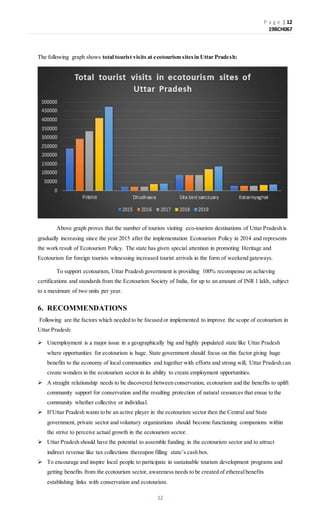
The following graph shows total tourist visits at ecotourism sitesin Uttar Pradesh:
Above graph proves that the number of tourists visiting eco-tourism destinations of Uttar Pradesh is
gradually increasing since the year 2015 after the implementation Ecotourism Policy in 2014 and represents
the work result of Ecotourism Policy. The state has given special attention in promoting Heritage and
Ecotourism for foreign tourists witnessing increased tourist arrivals in the form of weekend gateways.
To support ecotourism, Uttar Pradesh government is providing 100% recompense on achieving
certifications and standards from the Ecotourism Society of India, for up to an amount of INR 1 lakh, subject
to a maximum of two units per year.
6. RECOMMENDATIONS
Following are the factors which needed to be focused or implemented to improve the scope of ecotourism in
Uttar Pradesh:
 Unemployment is a major issue in a geographically big and highly populated state like Uttar Pradesh
where opportunities for ecotourism is huge. State government should focus on this factor giving huge
benefits to the economy of local communities and together with efforts and strong will, Uttar Pradesh can
create wonders in the ecotourism sector in its ability to create employment opportunities.
 A straight relationship needs to be discovered between conservation, ecotourism and the benefits to uplift
community support for conservation and the resulting protection of natural resources that ensue to the
community whether collective or individual.
 If Uttar Pradesh wants to be an active player in the ecotourism sector then the Central and State
government, private sector and voluntary organizations should become functioning companions within
the strive to perceive actual growth in the ecotourism sector.
 Uttar Pradesh should have the potential to assemble funding in the ecotourism sector and to attract
indirect revenue like tax collections thereupon filling state’s cash box.
 To encourage and inspire local people to participate in sustainable tourism development programs and
getting benefits from the ecotourism sector, awareness needs to be created of etherealbenefits
establishing links with conservation and ecotourism.
P a g e | 13
19BCH067
13
 Other factors which can make a way for Uttar Pradesh to be the best Ecotourism place:
1. Build great roads and access points
2. Skill up-gradation
3. Safety and Security of travelers
4. Maintenance of heritage buildings
5. Appointing Brand Ambassador for endorsement
6. Create experiences,not just tourist spots
7. Launching new initiatives in the sector of ecotourism
8. Hygienics public places (toilets, restaurants etc.)
9. Good quality food
P a g e | 14
19BCH067
14
REFERENCES
MRSS India, (February, 2016). Uttar Pradesh: Changing Perspectives. Uttar Pradesh,Published by MRSS
India, PP 9-34. Retrieved from http://www.mrssindia.in/uploads/reports/pdf/uttar-pradesh-tourism-
report-1.pdf
Upendra Nabh Tripathi & Amit Kumar Jain, (November-December 2017). Opportunities and challenges of
Ecotourismwith reference to its employability potential: Uttar Pradesh,India. Scholarly Research
Journal for Interdisciplinary Studies, Vol-4/37, PP 8872-8881. Retrieved from
http://oaji.net/articles/2017/1174-1522065418.pdf
Government of Uttar Pradesh,(24th
September 2016). Uttar Pradesh EcotourismPolicy. Department of
Tourism, Government of Uttar Pradesh. PP 1-20. Retrieved from
http://uptourism.gov.in/site/writereaddata/siteContent/Upecotourism%20PolicyEnglish.pdf
Government of Uttar Pradesh,(2018). Uttar Pradesh TourismPolicy 2018. Department of Tourism,
Government of Uttar Pradesh. PP 43-49. Retrieved from
http://www.uptourism.gov.in/site/writereaddata/siteContent/201804081222143668Tourism-Policy-
2018-1.pdf
Megha Aggarwal, (8th
March 2018). Assignment on Ecotourism. SlideShare, Education. PP 4-5. Retrieved
from https://www.slideshare.net/Meghaaaaaaaaaa/ecotourism-17028715?qid=24d9e200-b44c-41fd-
ac26-32be461fe07d&v=&b=&from_search=1
Ron Mader, (4th
May 2020). Exploring Ecotourism. Planeta.com. Retrieved from
https://www.planeta.com/ecotourism/
Government of India, (12th
February 2020). The Indian and Foreign tourist visits in important tourist places
of Uttar Pradesh in year2015 to 2019,Ministry of Tourism, New Delhi. Retrieved from
http://www.uptourism.gov.in/site/writereaddata/siteContent/202003131118073276Year-wise-
statistics2020.pdf
Tourismin Uttar Pradesh (India): Evolution and Present Situation. UttarPradesh,India, Shodhganga. PP 71-
86. Retrieved from https://shodhganga.inflibnet.ac.in/bitstream/10603/19757/14/14_chapter3.pdf
Importance of Ecotourismin India. India, Shodhganga. PP 106-118. Retrieved from
https://shodhganga.inflibnet.ac.in/bitstream/10603/19757/14/14_chapter3.pdf
About Uttar Pradesh: Tourism, Agriculture,Industries,Economy & Geography. (June 2020). Uttar Pradesh,
Indian Brand Equity Foundation. Retrieved from https://www.ibef.org/states/uttar-pradesh.aspx
Linda McCormick, (18th
January 2011). Eco Travel and EcotourismDefinition. Verdemode. Retrieved from
https://www.verdemode.com/wp-content/uploads/2011/01/ecotourism.jpg
Madhumita Das & Bani Chatterjee, (2015). Ecotourism: A panacea or a predicament? Elsevier. Retrieved
from https://sci-hub.tw/https://www.sciencedirect.com/science/article/abs/pii/S2211973615000185
https://en.wikipedia.org/wiki/List_of_states_and_union_territories_of_India_by_population
P a g e | 15
19BCH067
15
Literature Review
Focus area: Culture and Tourism
Theme to work on: Ecotourism
by
Vishwa Gopalbhai Patel (19BCH067), Department of Chemical Engineering,
School of Technology
Pandit Deendayal Petroleum University
Submitted to CSSI 2020 office
Civic and Social Service Internship
3rd August, 2020
P a g e | 16
19BCH067
16
(1) Article by: Guy Castley, Clare Moriisom, Ralf Bubkley
Place Article is about: New Zealand
Title ofthe Article: Going on Safari? Research shows ecotourism can help endangered species
Published on: The Conversation (Academic rigour, journalistic flair)
 The work focused on whether the ecotourism is positive or poor for endangered species identified in the
Red List of Nature Conservation International Union. To forecast the probability of extinction, the
methodology for this study uses population viability modelling that forecasts potential demographic
dynamics and time. The techniques they use are well established and commonly employed in the realistic
conservation of wildlife. Researcherslooked at nine separate species in the reported study, and concluded
that generally, ecotourism is beneficial for biodiversity and offers net survival benefits.
 It is noticed that existing rates of tourism are not enough to help orangutans in Sumatra, and as a matter
of reality are poor for sea lions in New Zealand, small-scale ecotourism cannot repress the negative
effects of deforestation. Larger-scale ecotourism by enabling ecosystem conservation and the resurrection
of individuals from confined conditions provides a net positive impact. Ecotourism simply incorporates
the impact of concentrated fishing as it increases the amount of sea lion pups dying in New Zealand as a
result of pure activity at haul-out locations.
 The study emphasizes three main points:
1. To predict how ecotourism affects biodiversity, we need to learn details about it; ecotourism requires both
biologists and social scientists.
2. The effects of ecotourism are not universal: it depends on the organisms and local conditions whether
ecotourism is successfulor poor.
3. Ecotourism will help to save threatened organisms from destruction at appropriate rates.
(2) Article by: Neha Jain
Place Article is about: Bandhavgarh and Kanha Tiger Reserves in Madhya Pradesh
Title ofthe Article: Soaring ecotourism is causing stress among tigers in central Indian reserves,reveals a
new case study
Published on: Scroll.in, First appeared on Mongabay
 A case study investigating stress hormones in tigers was performed by a team of researchers from two
famous centralIndian tiger reserves namely the Bandhavgarh Tiger Reserve and Kanha Tiger Reserves in
Madhya Pradesh due to wildlife tourism and a growing number of vehicles entering the parks.
Reproductive efficiency, immunity, growth may be adversely affected by high glucocorticoid rates in
tigers, stated Govindaswamy Umapathy, a leading scientist and project leader at the Endangered Species
Conservation Laboratory at the CSIR Centre for Cellular and Molecular Biology in Hyderabad.
P a g e | 17
19BCH067
17
 In 2015, the Researchers obtained 206 tiger fresh scat samples from which they extracted glucocorticoid
metabolites – steroid hormones produced while the animals are anxious and their amounts are determined
along. The team gathered forest department data on the number of cars accessing the parks and the degree
of disruption to visitor footfall. A substantial increase in stress was reported in tigers exhibiting higher
concentrations of glucocorticoid metabolite in both reserves during the tourism era relative to the non-
tourism era and increased in the Bandhavgarh Tiger Reserve as the amount of disruption and number of
vehicles increased.
 Findings of the case study carried out by the research team showed that beguiling cats are more depressed
as a consequence of the release of stress hormones during the tourist season compared to the non-tourism
period of tiger scat samples in Bandhavgarh and Kanha Tiger Reserves in Madhya Pradesh. It was
observed that both reserves approved on average much higher amount of vehicles per day as noted by the
research team while the National Tiger Conservation Authority (NTCA) stipulates that in tiger reserves a
limit of 40 vehicles per day should be permitted. The research authors proposed more strict vehicle traffic
control, amount of tourist vehicles entering the reserve,move of waterholes away from tourist roads along
with displacement of villagers from the centraltiger reserve district.
(3) Article By: Anshu Pragyan Das
Place Article is about: BadmulVillage, Satkosia Tiger Reserve,Nayagarh district, Odisha
Title ofthe Article: Nayagarh'sBadmulcommunity based eco-tourism is a conservation success story with
livelihood creation for locals
Published on: The Samikhsya
 An eco-tourism project named 'Satkosia Sands Resort and Nature Camp', commenced by the forest
department of Odisha in 2016 at Badmul Village in the heart of Satkosia Tiger Reserve on the bank of
the Mahanadi in the Nayagarh district as a community-based nature tourism destination which started
with nine tents on the shoal of the Mahanadi and seven cottages on the mountain slope overlooking the
mighty Satkosia Gorge handled by 28 villagers of Badmul, turned out to be a huge success right from the
beginning till the date providing livelihood to approximately six villages adjacent to the area.
 Satkosia Sands Resort and Nature Camp serves as a livelihood option by employing on monthly income
to the forest-dependent communities making them engaged in the project which minimise their
dependence on forest and aids them to understand the importance of wild habitat resulting in the ceasing
of poaching. Formation of EDCs in poacher villagers by carrying out programmes like 'Poachers turned
Protectors of Satkosia', erection of new anti-poaching camps with VHF in poaching prone areas,closure
of illegal fishing in Satkosia gorge in the core,enrolling women in protection squads and various such
initiatives to create an inviolate area for wildlife and protect the core of the tiger reserve is supported and
maintained by all the local villagers. All the villages adjoining the Mahanadi river of Mahanadi division
supports the initiatives and are benefitted by the eco-tourism project. The Authority is providing
electricity by cabled wires along with better road connectivity in order to enrol public support.
P a g e | 18
19BCH067
18
 The numbers proving the success achieved by Badmul community in this project are as follows:
1. From Rs.27 lakh in 2016-17, the revenue rose to Rs.60 Lakh in 2017-18 and touched Rs.1.30 crore in
2018-19 along with 3000 odd visitors in 2018 from which 20% were from Germany, France and Britain.
2. Each family managing the project have earned around Rs.1.5-2 lakh this year against Rs.20,000 yearly
income prior to the project.
3. Till the date 40 community oversee nature camps and in 2019 Odisha eco-tourism projects have earned a
total revenue of Rs.5.6 crore from which 90% of the revenue goes to the local community (stakeholders
of the project) and providing employment to more than 1,000 forest dependent villagers.
(4) Article by: Paromita Ghosh and Sumit Rai
Place Article is about: Indian Himalayan Region
Title ofthe Article: Agro-ecotourism: A Potential & Sustainable Livelihood Option in the Indian Himalayan
Region
Published on: Krishi Jagran
 In their paper, Paromita Ghosh and Sumit Rai describe how agro-ecotourism can be a means of poverty
mitigation by providing a healthy livelihood for local indigenous peoples in both rural and remote areas
and environmental conservation in the Indian Himalayan Region (IHR). They also stated that tourism can
be the main growth activities in the area,addressing the hurdles of unemployment, revenue generation
and IHR communities' ability to absorb fair benefits from tourism footprints in a sustainable manner via
agro-ecotourism. Often recognised as a common 17-goal course of action for citizens, the world and
development of all nations, Sustainable Development Goals ( SDGs) contain two goals i.e. Goals 8 and
12 specifically addressing mountain-specific tourism and writers describe how agro-ecotourism promotes
global growth and meets the Millennium Development Goal of poverty alleviation by following the
requirements laid out in objectives 8 and 12 of the SDGs.
 The last few years data for tourist arrivals indicate phenomenal development with a total of 494 million
tourist arrivals (8.42 per cent of the total national arrival) from 2011-2015 and predicted to rise in
numbers (estimated at 240 million) by 2025, demonstrating the reach of both tourism and agro-
ecotourism in IHR. Agro-ecotourism, an aspect of sustainable agriculture, is a joint collaboration between
tourism and agriculture integrating the key values and practices of ecotourism, eco-farming and
permaculture, through which farmers and farms become an essential part of growth, providing incentives
for consumer niches to expand and allowing families to utilize their land in an economical manner. This is
effective in places of high deprivation that support vulnerable people through job programs, engage them
in business planning and promotion, educate local communities who are not financially or informed about
markets and attract tourists through modern technologies, encourage local history, the arts and crafts,
improve the local food supply chain resulting in all-round conservation and mutual benefits.
 Experiencing authentic local preferences and local people's cultural heritage, witnessing the common
farming practices of the indigenous communities and numerous other typical neighbourhood events are
P a g e | 19
19BCH067
19
included in agro-ecotourism that keeps tourists interested in engaging in common agricultural activities
that render their eco-holiday unforgettable. The local community must preserve its traditional culture and
community existence which lets tourists see and encounter the community in their original form of life
which is the model of agro-ecotourism. To unlock the ability of well-controlled ecotourism as a crucial
economic force for biodiversity protection, agro-ecotourism should be publicized.
(5) Article by: Chadamas Chinmaneevong
Place Article is about: Bo Hin Farmstay, located at Ban Bo Hin in Si Khao district, Trang province, Thailand
Title ofthe Article: Ecotourism success story
Published on: Bangkok Post
 Ban Bo Hin community operates a popular homestay in Bo Hin farm at Ban Bo Hin in Si Khao District,
Trang Province, Thailand, established by Ban Pru Jud community enterprise and was an ecotourism
model for other villages and became the first group to launch homestay in Trang. The concept of opening
a homestay came to Banjong Naruepornmethee (the president of the Association of Trang Tourism and
Hotels) after finding the curiosity of his friends in their traditional lifestyle and livelihood whenever they
visited Trang. He and his team sweat blood to educate the group on the project's intent and render the
homestay more efficient together with promoting the farm stay on social networking sites like Facebook
by public relations practices.
 For 10 years, Ban Pru Jud Community Enterprise has been offering monthly revenue of up to 40,000 baht
(Thailand Currency) to families supporting homestay and demonstrating the importance of homestay in
accordance with self-sufficient philosophy. The beginning visitors were friends when the farm stay was
opened but then it got the speed of popularity as the word of mouth started to progress and as a result, the
tourists are now making advance bookings because the farm stay can handle just 700 guests a month with
650 baht a head for 2 days, one night. The group prefers to do their usual work and chose to be tour
guides teach urban tourists about their modern way of living and provide additional service through
homestay.
 In 2015, the farm stay was awarded with the Kinnaree ecotourism award from Tourism Authority of
Thailand led by Mr Banjong. The farmstay 's performance have improvised the lives of local citizens and
society by offering livelihoods along with preserving the conventional way of lifestyle. According to Mr
Banjong 's opinion, the secret to success for this group ecotourism farm stay is the collective cooperation
of community as they are the first to understand the idea of ecotourism.
P a g e | 20
19BCH067
20
References
[1] https://theconversation.com/going-on-safari-research-shows-ecotourism-can-help-
save-threatened-species-54746
[2] https://scroll.in/article/941987/soaring-ecotourism-is-causing-stress-among-tigers-in-
central-indian-reserves-finds-a-new-
study#:~:text=Now%2C%20a%20study%20examining%20stress,of%20vehicles%20ente
ring%20the%20parks.
[3] https://thesamikhsya.com/exclusive/satkosia-sands-resorts-a-template-of-success-of-
what-community-can-do-from-a-festering-sore-to-soothing-smile#:~:text=Special-
,Nayagarh's%20Badmul%20community%20based%20eco%2Dtourism%20is%20a%20c
onservation%20success,with%20livelihood%20creation%20for%20locals&text=Earlier
%20Nayagarh%20district%20was%20only,the%20Mahanadi%20in%20the%20district.
[4] https://krishijagran.com/featured/agro-ecotourism-a-potential-sustainable-livelihood-
option-in-the-indian-himalayan-region/
[5] https://www.bangkokpost.com/business/683480/ecotourism-success-story#:~:text=1-
,Ecotourism%20success%20story,intact%20its%20way%20of%20life.&text=Bo%20Hin
%20Farmstay%20visitors%20get,of%20the%20community's%20conservation%20projec
t.

A Case Study on Ecotourism.

  • 1.
    P a ge | 1 19BCH067 1 TITLE PAGE FOCUS AREA: CULTURE AND TOURISM THEME TO WORK ON: ECOTOURISM UTTAR PRADESH ECOTOURISM POLICY 2014 (A CASE STUDY OF UTTARPRADESH STATE) BY VISHWA PATEL (19BCH067), DEPARTMENT OF CHEMICAL ENGINEERING, SCHOOL OF TECHNOLOGY PANDIT DEENDAYAL PETROLEUM UNIVERSITY, GANDHINAGAR, GUJARAT, INDIA A CASE STUDY PRESENTED TO CSSI 2020 OFFICE CIVIC AND SOCIAL SERVICE INTERNSHIP 3rd AUGUST 2020
  • 2.
    P a ge | 2 19BCH067 2 EXECUTIVE SUMMARY: State of Uttar Pradesh has 14,349 sq. kilometer area under forest is home to some beautiful landscapes, forest sights, rivers, waterfalls, many endangered birds and animals. The distinct cultural traditions, historical heritage provide amazing and rich experience to the visiting tourists in the state. Due to increasing biotic pressure,unplanned exploitation, the natural wealth and resources are depleting fast but the consequent negative effects on the environment have made public more conscious towards the importance of natural resources and their conservation. Ecotourism is developing as a remarkable tool for ‘inclusive growth’ giving advantages to the local communities amalgamating sections of wildlife, environment conservation, education, refreshment and cultural awareness. Uttar Pradesh Ecotourism Policy 2014 involves specific guidelines for delivering high-quality experience to visitors, the involvement of local communities, employment generation ensuring nature protection and conservation at the same time. This policy will have a significant contribution in raising awareness for nature preservation and empowerment of local people in the state economically. The program seeks to provide funds for the protection of the environment, to educate visitors about it, contributing directly to the economic growth of local communities and areas,and to promote respect for different cultures. This report aims to better understanding of ecotourism and its various aspects,to know the scenario of ecotourism in India and Uttar Pradesh,amount of work done in the field of ecotourism by Central and State government, exploring the understanding and working strategies of state government under the Uttar Pradesh Ecotourism policy, to examine the output of this policy, to scout opportunities and challenges of ecotourism and recommendations for improvement in the sector of ecotourism in Uttar Pradesh. The policy resulted in promoting and supporting ecotourism in the state with the development of local communities economically and nature conservation. The statistics from the year 2015 to 2019 of the number of tourists visited in total and at ecotourism sites such as Pilibhat, Dhudhwa, etc. after the implementation of policy in 2014 has significantly increased in Uttar Pradesh. International and domestic tourist arrivals in India increased considerably from 2000 onwards, and Uttar Pradesh received a significant number of tourists. Uttar Pradesh was ranked 2nd in terms of domestic tourism visits and 3rd in aspects of foreign tourist visits to India in 2018. The glamorous figures on tourism in Uttar Pradesh indicate that it is possible to build jobs for both skilled and non - skilled employees, both directly and indirectly. Simultaneously it arises a lot of future obstacles and problems viz. shortfall of high-quality tourism infrastructure, global concerns with for health and safety of tourists and visitors etc. The challenges can be removed if the government focuses on some of the major issues in the ecotourism sector such as employment, by encouraging local people to take active participation in ecotourist activities, improvement in various areas such as building good infrastructure, hygienic public places, providing high-quality food, increasing the safety of tourist etc.
  • 3.
    P a ge | 3 19BCH067 3 Table of Contents 1. INTRODUCTION.................................................................................................................................4 1.1 ECOTOURISM .............................................................................................................................4 1.2 MAIN FEATURES OF ECOTOURISM........................................................................................5 1.3 ECOTOURISM IN UTTAR PRADESH........................................................................................6 1.4 WHAT IS UTTAR PRADESH ECOTOURISM POLICY? ...........................................................6 2. OBJECTIVES OF THE CASE STUDY: ...............................................................................................7 3. APPROACH FOR THE RESEARCH...................................................................................................7 4. UTTAR PRADESH ECOTOURISM POLICY: ....................................................................................7 4.1 PROSPECTS.................................................................................................................................7 4.2 OBJECTIVES OF THE POLICY..................................................................................................7 4.3 FOUNDATION..............................................................................................................................7 4.4 WORKING STRATEGY:..............................................................................................................8 4.5 CHALLENGES...........................................................................................................................10 5. RESULTS AND DISCUSSION ...........................................................................................................10 6. RECOMMENDATIONS.....................................................................................................................12 REFERENCES...........................................................................................................................................14
  • 4.
    P a ge | 4 19BCH067 4 1. INTRODUCTION The urge to travel has been an important human pursuit since the beginning of human history; man has valued the need to explore unfamiliar locations, to pursue environmental changes and to encounter new experiences. Unlike traditional tourism, ecotourism has emerged as a form of tourism in the last two decades to support both the environment and the society. 1.1 ECOTOURISM The first definition of ecotourism made by Mexican architect Hector Ceballos-Lascurain in 1983 is as follows: “That form of environmentally responsible tourism that involves travel and visitation to relatively undisturbed natural areas with the object of enjoying, admiring and studying the nature(the scenery,wild plants and animals), as well as any cultural aspect(both past and present) found in these areas,through a process which promotes conservation, has a low impact on the environment and culture and favors the active and socio- economically beneficial involvement of local communities.” Eco-tourism is much more than a catchword for nature-loving travel and leisure. This is committed to preserving the richness of the natural and cultural ecosystems of the earth. This accommodates tourists in a manner that is minimally disruptive to the ecosystem and respects native cultures in the areas in which it works. Most definitions of ecotourism meet three criteria which contribute a positive nature for environment conservation: 1) it provides for environmental conservation 2) it includes meaningful community participation 3) it is profitable and can be self-sustaining
  • 5.
    P a ge | 5 19BCH067 5 Ecotourism is compatible economically with the local environment and socio-cultural makeup. The following flowchart represents the above: According to the World TourismOrganization, Ecotourism is the fastest-growing tourismindustry with an annual growth rate of 5% worldwide,accounting for 6% of the world gross domestic product, 11.4% of all consumer spending. 1.2 MAIN FEATURES OF ECOTOURISM  Travel to a natural attraction area/site.  Activities with minimal effect on the tourism destinations climate.  Sustainable nature tourism, which leads to sustainable growth, has a positive effect on local communities.  Helps to learn, respect,preserve the environment and local communities.  Ethical tourism, through the enjoyment of nature and local traditions, aims to enrich the experience of tourism.  It does not negatively impact local biodiversity.  Promotes environmental protection.  Increases the income of the local population and is directed towards social growth, improving community welfare.  Increases job opportunities in rural areas and is a source of additional income.  This aims to foster the protection of the environment and respect for diverse cultures.
  • 6.
    P a ge | 6 19BCH067 6 1.3 ECOTOURISMIN UTTAR PRADESH Uttar Pradesh is a state established in northern India on 1 April 1937. As of 2011, it is the fifth-largest Indian state with 6.88% of the land area and the most populated state with a population of around 16.51% of the Indian population. Lucknow is the capital of Uttar Pradesh,and Kanpur is the center of commerce. The contribution of tourism to the generation of jobs is of utmost importance to the state. In 2018, the state attracted the second-largest domestic tourist arrival with 285 million tourists to the state and the third-largest international tourist arrival in the nation, with more than 3.78 million. Definition ofecotourism adopted by the state ofUttar Pradesh is as follows: “Ecotourism is responsible travel to natural areas and seeks to promote and support the understanding, appreciation and conservation of the environment and culture, raising awareness for biodiversity and for local cultures emphasizing on preserving their indigenous features. It also promotes employment as well as economic and social development, acting as an alternative income source for economically and socially marginalized people living in hard economic situations.” Uttar Pradesh,with its rich natural attractions, a huge cultural and religious heritage, has enormous potential for growth in the ecotourism market. The State consists of 1 National Park and 24 Wildlife Sanctuaries as Protected Areas. Circuits ofEcotourism: Ecotourism spots in Uttar Pradesh are divided into 09 circuits. 1. Western Wildlife Circuit 2. Lion Safari and Riverine Circuit 3. TeraiTiger Circuit 4. Bundelkhand Adventure Circuit 5. Vindhya Mountain Circuit 6. Western Bird/Wetland Circuit 7. Central Bird/Wetland Circuit 8. Ganges Basin Circuit 9. Eastern Wildlife Circuit In an attempt to display these natural wonders to tourists with the active involvement of indigenous communities, so that visitors can admire the grandeur and kindness of nature, recognize the value of recycling and constraining use, and imbibe the culture of nature and the conservation of resources,the Uttar Pradesh Government, with its clear commitment to promoting ecotourism, has made a significant contribution. The case study will brief on that. 1.4 WHAT IS UTTAR PRADESHECOTOURISMPOLICY? An Ecotourism Policy that envisages new interventions to make tourism the cornerstone in job creation, environmental transformation, the development of remote areas and the growth of women and other marginalized groups in the world, is therefore vital to our economy in addition to fostering social inclusion. This will contribute to the upliftment of more gained local communities and create opportunities for further investment in these regions.
  • 7.
    P a ge | 7 19BCH067 7 2. OBJECTIVESOF THE CASE STUDY: 1. To understand the working strategy of Uttar Pradesh Government under Uttar Pradesh Ecotourism Policy. 2. To find out the challenges of ecotourism in Uttar Pradesh. 3. To know the amount of work done through Ecotourism Policy in Uttar Pradesh. 4. To know the results of work done via Uttar Pradesh Ecotourism Policy. 3. APPROACHFOR THE RESEARCH For the present study, the required data has been collected from various old research papers,journals, books internet, some of the governmental data etc. The data has also been taken from various documents such as books, newsletters, reports, magazines, journals, newspaper,internet, as well as from existing literature to understand challenges of ecotourism in Uttar Pradesh. Thereafter,appropriate statistical tools were used to figure out the necessary results. 4. UTTAR PRADESHECOTOURISM POLICY: This policy was made by Uttar Pradesh government in 2014 to raise awareness for culture and nature conservation, promoting and supporting ecotourism and for economic empowerment of local people in the state. 4.1 PROSPECTS To exhibit Uttar Pradesh as a national leader in ecotourism sector through meaningful and distinct learning experience of nature and culture by its conservation with the empowerment and meaningful involvement of local communities. 4.2 OBJECTIVES OF THE POLICY  Upliftment of sustainable ecotourism in nature-rich areas based on community.  Development of eco-friendly infrastructure at ecotourism destinations.  To build the capacity of local communities in hospitality, exhibiting culture and natural heritage interpretation and communication skills for tourists.  To build coordination among stakeholders to develop and promote ecotourism destinations.  To advocate entrepreneurship and more employment opportunities in areas of ecotourism destinations.  Provide good quality learning experience to tourists and appreciate nature-based activities. 4.3 FOUNDATION 1. Legal framework: All ecotourism activities are to confirm with the spirit of the existing environmental laws of the country, including  the Wild Life Act 1972  the Forest Act 1980  the Environment Act 1986  the Environment Rules 1986 and notifications under it for Eco-sensitive zones and guidelines of  National Tiger Conservation Authority
  • 8.
    P a ge | 8 19BCH067 8  Ministry of Environment and Forests  Management Plan prescriptions and guidelines issued by the Central and State government. 2. Ecotourism as a conservation centric activity: Ecotourism destinations will be conservation centric according to the ecotourism plan and will be a part of the working plan of the division. Ecotourism plan for Protected area will be prepared according to the guidelines issued by the National Tiger Conservation Authority. 3. Community-based Ecotourism: It involves the active participation of local communities and uplifting them economically via ecotourism activities which will be compatible with the environment and socio-cultural characteristic of the local communities leading to the sustainable development of the area. 4. Capacity Building: For the development of responsible and sustainable tourism, the capacity of the local communities and government will be strengthened. 5. Development ofInfrastructure: Ecofriendly infrastructure will be adopted at ecotourism destinations having the least impact on natural resource and local culture. 6. Consciousness: Consciousness for the environment and its conservation will be done by creating environmental awareness among all sections and age groups a major activity for each ecotourism destination. 7. Collaboration: Collaboration of stakeholders will be encouraged in developing operating facilities and activities which will be undertaken either by a government agency or in collaboration with private enterprises and local people. 8. Marketing: On the basis of market analysis and survey through wide of electronic print and cyber media, marketing strategies will be developed for marketing Uttar Pradesh ecotourism as multifarious ecotourism destinations. 4.4 WORKING STRATEGY: 1. Organizational setup: The Forest Department,Government of Uttar Pradesh shall be the nodal department and the Uttar Pradesh Forest Corporation will act as the nodal agency to promote ecotourism in the state. 2. Necessary methods and standards for the purpose should be developed by UPFC provided that Corporation will provide required technical and financial resources. 3. The Wildlife Management Plan of Protected Areas and Working Plan of Forests is considered to be an integral part of Ecotourism plan and in case of any conflict, the management of Protected Areas, Wildlife and Biodiversity interests shall take precedence over ecotourism. 4. Identification ofecotourism destinations will be carried out based on the features.Some ofthe features are mentioned below:
  • 9.
    P a ge | 9 19BCH067 9  Should be good chances of sighting animals, birds, waterfalls, streams,mountains near destinations.  Has some historical and cultural relevance.  Local communities and forest staff around the destination should be sensitive to nature.  Good transport facility should be available to a destination  Ease of access for medical facilities close to the destination. 5. Infrastructure and Facilities at Ecotourism Destination: The facilities and infrastructure at ecotourism destinations should be eco-friendly. UPFC will provide private guesthouses and tourist lodges on way to ecotourism destination outside the Protected Area/Forest limits. Concept of Homestays will be promoted and Nodal agency with the help of the Department of Tourism will regulate such entities. 6. Feasible activitiesat Ecotourism Destination: The feasible activities that may be undertaken for promoting an area as an ecotourism destination are as follows:  Nature Camps  Eco-friendly Accommodation  Trekking routes and Nature walks  Wildlife Viewing and River Cruise  Adventure Sports  Herbal Ecotourism  Interpretation Centers  Conservation Education 7. Capacity building: Capacity of local communities and the government will be developed for responsible tourism professionally. Study tours will be conducted and training will be given by reputed institutions or NGOs with good track in ecotourism fields along with training in areas like cooking, bakery, tour guide etc. 8. Setting standards and quality Benchmarks: Standards, models, accreditation schemes,guidelines and codes will be made and promoted for setting standards and quality benchmarks related to different aspects of ecotourism. 9. Extension and Publicity: Promotion of ecotourism can be done through a circuit approach, website, brochures,souvenir shops, linkages with state and national tourism departments, selecting a brand ambassador and logo for UP ecotourism, technical cooperation between national and international agencies and networking with all stakeholders. 10. Destination outputs:  Increase in the use of renewable energy and biodegradable resources.  Ecotourism facilities are managed by Eco-Development Committees/Joint forest Management Committees.  For a better understanding of the ecosystem’s importance and conservation, activities are more of experiential nature enabling the visitor to learn and see from ‘doing’.  Methods adopted for waste disposal should be ecofriendly. 11. Financial Management:
  • 10.
    P a ge | 10 19BCH067 10 Financial resources can be made available from ongoing schemes of the centralgovernment, an outlay of the administrative department of the state budget. partnership of private organizations and Forest Corporation etc. 4.5 CHALLENGES 1. Inadequate cleanliness: In a densely populated state like Uttar Pradesh,inadequate cleanliness at tourist destinations and surroundings involving lack of clean public toilets are the major factor which turns off foreign tourists and the government needs to work on it. 2. Unbalance in interest ofecotourism industry and locals: There is always a probability of unbalance between the use of resources for ecotourism and livelihood of residents until the role of local people and their interest is recognized in the planning and development of ecotourism destination. 3. Limited availability of tourist guides: The profession of tourist guide is hereditary in nature and youth adopt it from their parents due to which increased monopoly is seen in this profession. Lack of trained and certified tourist guides increases the risk of exploitation of tourists. 4. Lack ofgood infrastructure: Inadequate road, insufficient availability of hotel rooms, limited availability of hygienic food, restaurant's at destinations rail and air connectivity to various ecotourism destinations are major hurdles which affects tourist arrival figures. 5. Lack ofconservation of ecotourism sites: Due to poor policy, corruption in the implementation of policies for ecotourism causes environmental degradation and affects negatively to the future possibilities of foreign tourists leading to the lack of proper conservation of ecotourism sites. 6. Tourist safety: Safety of tourist and harassment especially foreign tourist is a major concern as safety and security of tourists is of severe importance which majorly impacts the flow of tourists in the country. In states and tourist locations where tourists consider a threat to their safety and security, Domestic tourist movements take place which holds special significance for India as it has been ranked at a low level of 74 amongst 140 global economies on safety and security parameters as per the World Economic Forum’s Travel and Tourism Competitiveness Report 2013. 5. RESULTS AND DISCUSSION The present case study is acting as a tool to spread knowledge and awareness regarding eco-tourism, the working of Uttar Pradesh government in promoting ecotourism through Ecotourism Policy, their adapted strategies, work done and improvement needed in the ecotourism sector. Uttar Pradesh is the fourth largest state in India with an approximate area of 2,40,928 sq. km and the most populous state in the country with a population of 199.8 million (2011) and is considered to be an ecotourist paradise. State Government is implementing various strategies with a vision of conservation of nature, development of local communities, promoting eco-tourism via Uttar Pradesh Ecotourism Policy.
  • 11.
    P a ge | 11 19BCH067 11 Uttar Pradesh has emerged among the top frontrunner states in attracting foreign and domestic tourists from all over the world. State witnessed second-highest domestic tourist arrivals in 2018 with 285 million visiting the state while it occupies the third position in international tourist arrivals with more than 3.78 million visiting India. The following tables show the Indian and foreign tourist visits in important tourist places ofUttar Pradesh in the year 2015 to 2019. Above graphs shows that Uttar Pradesh is one of India’s most iconic states which attract approx. 500 million domestic and just over 4 million international visitors out of 1.1 billion domestic and nearly 7 million international tourists visiting India and the number goes by increasing significantly in case of domestic as well as foreign tourists.
  • 12.
    P a ge | 12 19BCH067 12 The following graph shows total tourist visits at ecotourism sitesin Uttar Pradesh: Above graph proves that the number of tourists visiting eco-tourism destinations of Uttar Pradesh is gradually increasing since the year 2015 after the implementation Ecotourism Policy in 2014 and represents the work result of Ecotourism Policy. The state has given special attention in promoting Heritage and Ecotourism for foreign tourists witnessing increased tourist arrivals in the form of weekend gateways. To support ecotourism, Uttar Pradesh government is providing 100% recompense on achieving certifications and standards from the Ecotourism Society of India, for up to an amount of INR 1 lakh, subject to a maximum of two units per year. 6. RECOMMENDATIONS Following are the factors which needed to be focused or implemented to improve the scope of ecotourism in Uttar Pradesh:  Unemployment is a major issue in a geographically big and highly populated state like Uttar Pradesh where opportunities for ecotourism is huge. State government should focus on this factor giving huge benefits to the economy of local communities and together with efforts and strong will, Uttar Pradesh can create wonders in the ecotourism sector in its ability to create employment opportunities.  A straight relationship needs to be discovered between conservation, ecotourism and the benefits to uplift community support for conservation and the resulting protection of natural resources that ensue to the community whether collective or individual.  If Uttar Pradesh wants to be an active player in the ecotourism sector then the Central and State government, private sector and voluntary organizations should become functioning companions within the strive to perceive actual growth in the ecotourism sector.  Uttar Pradesh should have the potential to assemble funding in the ecotourism sector and to attract indirect revenue like tax collections thereupon filling state’s cash box.  To encourage and inspire local people to participate in sustainable tourism development programs and getting benefits from the ecotourism sector, awareness needs to be created of etherealbenefits establishing links with conservation and ecotourism.
  • 13.
    P a ge | 13 19BCH067 13  Other factors which can make a way for Uttar Pradesh to be the best Ecotourism place: 1. Build great roads and access points 2. Skill up-gradation 3. Safety and Security of travelers 4. Maintenance of heritage buildings 5. Appointing Brand Ambassador for endorsement 6. Create experiences,not just tourist spots 7. Launching new initiatives in the sector of ecotourism 8. Hygienics public places (toilets, restaurants etc.) 9. Good quality food
  • 14.
    P a ge | 14 19BCH067 14 REFERENCES MRSS India, (February, 2016). Uttar Pradesh: Changing Perspectives. Uttar Pradesh,Published by MRSS India, PP 9-34. Retrieved from http://www.mrssindia.in/uploads/reports/pdf/uttar-pradesh-tourism- report-1.pdf Upendra Nabh Tripathi & Amit Kumar Jain, (November-December 2017). Opportunities and challenges of Ecotourismwith reference to its employability potential: Uttar Pradesh,India. Scholarly Research Journal for Interdisciplinary Studies, Vol-4/37, PP 8872-8881. Retrieved from http://oaji.net/articles/2017/1174-1522065418.pdf Government of Uttar Pradesh,(24th September 2016). Uttar Pradesh EcotourismPolicy. Department of Tourism, Government of Uttar Pradesh. PP 1-20. Retrieved from http://uptourism.gov.in/site/writereaddata/siteContent/Upecotourism%20PolicyEnglish.pdf Government of Uttar Pradesh,(2018). Uttar Pradesh TourismPolicy 2018. Department of Tourism, Government of Uttar Pradesh. PP 43-49. Retrieved from http://www.uptourism.gov.in/site/writereaddata/siteContent/201804081222143668Tourism-Policy- 2018-1.pdf Megha Aggarwal, (8th March 2018). Assignment on Ecotourism. SlideShare, Education. PP 4-5. Retrieved from https://www.slideshare.net/Meghaaaaaaaaaa/ecotourism-17028715?qid=24d9e200-b44c-41fd- ac26-32be461fe07d&v=&b=&from_search=1 Ron Mader, (4th May 2020). Exploring Ecotourism. Planeta.com. Retrieved from https://www.planeta.com/ecotourism/ Government of India, (12th February 2020). The Indian and Foreign tourist visits in important tourist places of Uttar Pradesh in year2015 to 2019,Ministry of Tourism, New Delhi. Retrieved from http://www.uptourism.gov.in/site/writereaddata/siteContent/202003131118073276Year-wise- statistics2020.pdf Tourismin Uttar Pradesh (India): Evolution and Present Situation. UttarPradesh,India, Shodhganga. PP 71- 86. Retrieved from https://shodhganga.inflibnet.ac.in/bitstream/10603/19757/14/14_chapter3.pdf Importance of Ecotourismin India. India, Shodhganga. PP 106-118. Retrieved from https://shodhganga.inflibnet.ac.in/bitstream/10603/19757/14/14_chapter3.pdf About Uttar Pradesh: Tourism, Agriculture,Industries,Economy & Geography. (June 2020). Uttar Pradesh, Indian Brand Equity Foundation. Retrieved from https://www.ibef.org/states/uttar-pradesh.aspx Linda McCormick, (18th January 2011). Eco Travel and EcotourismDefinition. Verdemode. Retrieved from https://www.verdemode.com/wp-content/uploads/2011/01/ecotourism.jpg Madhumita Das & Bani Chatterjee, (2015). Ecotourism: A panacea or a predicament? Elsevier. Retrieved from https://sci-hub.tw/https://www.sciencedirect.com/science/article/abs/pii/S2211973615000185 https://en.wikipedia.org/wiki/List_of_states_and_union_territories_of_India_by_population
  • 15.
    P a ge | 15 19BCH067 15 Literature Review Focus area: Culture and Tourism Theme to work on: Ecotourism by Vishwa Gopalbhai Patel (19BCH067), Department of Chemical Engineering, School of Technology Pandit Deendayal Petroleum University Submitted to CSSI 2020 office Civic and Social Service Internship 3rd August, 2020
  • 16.
    P a ge | 16 19BCH067 16 (1) Article by: Guy Castley, Clare Moriisom, Ralf Bubkley Place Article is about: New Zealand Title ofthe Article: Going on Safari? Research shows ecotourism can help endangered species Published on: The Conversation (Academic rigour, journalistic flair)  The work focused on whether the ecotourism is positive or poor for endangered species identified in the Red List of Nature Conservation International Union. To forecast the probability of extinction, the methodology for this study uses population viability modelling that forecasts potential demographic dynamics and time. The techniques they use are well established and commonly employed in the realistic conservation of wildlife. Researcherslooked at nine separate species in the reported study, and concluded that generally, ecotourism is beneficial for biodiversity and offers net survival benefits.  It is noticed that existing rates of tourism are not enough to help orangutans in Sumatra, and as a matter of reality are poor for sea lions in New Zealand, small-scale ecotourism cannot repress the negative effects of deforestation. Larger-scale ecotourism by enabling ecosystem conservation and the resurrection of individuals from confined conditions provides a net positive impact. Ecotourism simply incorporates the impact of concentrated fishing as it increases the amount of sea lion pups dying in New Zealand as a result of pure activity at haul-out locations.  The study emphasizes three main points: 1. To predict how ecotourism affects biodiversity, we need to learn details about it; ecotourism requires both biologists and social scientists. 2. The effects of ecotourism are not universal: it depends on the organisms and local conditions whether ecotourism is successfulor poor. 3. Ecotourism will help to save threatened organisms from destruction at appropriate rates. (2) Article by: Neha Jain Place Article is about: Bandhavgarh and Kanha Tiger Reserves in Madhya Pradesh Title ofthe Article: Soaring ecotourism is causing stress among tigers in central Indian reserves,reveals a new case study Published on: Scroll.in, First appeared on Mongabay  A case study investigating stress hormones in tigers was performed by a team of researchers from two famous centralIndian tiger reserves namely the Bandhavgarh Tiger Reserve and Kanha Tiger Reserves in Madhya Pradesh due to wildlife tourism and a growing number of vehicles entering the parks. Reproductive efficiency, immunity, growth may be adversely affected by high glucocorticoid rates in tigers, stated Govindaswamy Umapathy, a leading scientist and project leader at the Endangered Species Conservation Laboratory at the CSIR Centre for Cellular and Molecular Biology in Hyderabad.
  • 17.
    P a ge | 17 19BCH067 17  In 2015, the Researchers obtained 206 tiger fresh scat samples from which they extracted glucocorticoid metabolites – steroid hormones produced while the animals are anxious and their amounts are determined along. The team gathered forest department data on the number of cars accessing the parks and the degree of disruption to visitor footfall. A substantial increase in stress was reported in tigers exhibiting higher concentrations of glucocorticoid metabolite in both reserves during the tourism era relative to the non- tourism era and increased in the Bandhavgarh Tiger Reserve as the amount of disruption and number of vehicles increased.  Findings of the case study carried out by the research team showed that beguiling cats are more depressed as a consequence of the release of stress hormones during the tourist season compared to the non-tourism period of tiger scat samples in Bandhavgarh and Kanha Tiger Reserves in Madhya Pradesh. It was observed that both reserves approved on average much higher amount of vehicles per day as noted by the research team while the National Tiger Conservation Authority (NTCA) stipulates that in tiger reserves a limit of 40 vehicles per day should be permitted. The research authors proposed more strict vehicle traffic control, amount of tourist vehicles entering the reserve,move of waterholes away from tourist roads along with displacement of villagers from the centraltiger reserve district. (3) Article By: Anshu Pragyan Das Place Article is about: BadmulVillage, Satkosia Tiger Reserve,Nayagarh district, Odisha Title ofthe Article: Nayagarh'sBadmulcommunity based eco-tourism is a conservation success story with livelihood creation for locals Published on: The Samikhsya  An eco-tourism project named 'Satkosia Sands Resort and Nature Camp', commenced by the forest department of Odisha in 2016 at Badmul Village in the heart of Satkosia Tiger Reserve on the bank of the Mahanadi in the Nayagarh district as a community-based nature tourism destination which started with nine tents on the shoal of the Mahanadi and seven cottages on the mountain slope overlooking the mighty Satkosia Gorge handled by 28 villagers of Badmul, turned out to be a huge success right from the beginning till the date providing livelihood to approximately six villages adjacent to the area.  Satkosia Sands Resort and Nature Camp serves as a livelihood option by employing on monthly income to the forest-dependent communities making them engaged in the project which minimise their dependence on forest and aids them to understand the importance of wild habitat resulting in the ceasing of poaching. Formation of EDCs in poacher villagers by carrying out programmes like 'Poachers turned Protectors of Satkosia', erection of new anti-poaching camps with VHF in poaching prone areas,closure of illegal fishing in Satkosia gorge in the core,enrolling women in protection squads and various such initiatives to create an inviolate area for wildlife and protect the core of the tiger reserve is supported and maintained by all the local villagers. All the villages adjoining the Mahanadi river of Mahanadi division supports the initiatives and are benefitted by the eco-tourism project. The Authority is providing electricity by cabled wires along with better road connectivity in order to enrol public support.
  • 18.
    P a ge | 18 19BCH067 18  The numbers proving the success achieved by Badmul community in this project are as follows: 1. From Rs.27 lakh in 2016-17, the revenue rose to Rs.60 Lakh in 2017-18 and touched Rs.1.30 crore in 2018-19 along with 3000 odd visitors in 2018 from which 20% were from Germany, France and Britain. 2. Each family managing the project have earned around Rs.1.5-2 lakh this year against Rs.20,000 yearly income prior to the project. 3. Till the date 40 community oversee nature camps and in 2019 Odisha eco-tourism projects have earned a total revenue of Rs.5.6 crore from which 90% of the revenue goes to the local community (stakeholders of the project) and providing employment to more than 1,000 forest dependent villagers. (4) Article by: Paromita Ghosh and Sumit Rai Place Article is about: Indian Himalayan Region Title ofthe Article: Agro-ecotourism: A Potential & Sustainable Livelihood Option in the Indian Himalayan Region Published on: Krishi Jagran  In their paper, Paromita Ghosh and Sumit Rai describe how agro-ecotourism can be a means of poverty mitigation by providing a healthy livelihood for local indigenous peoples in both rural and remote areas and environmental conservation in the Indian Himalayan Region (IHR). They also stated that tourism can be the main growth activities in the area,addressing the hurdles of unemployment, revenue generation and IHR communities' ability to absorb fair benefits from tourism footprints in a sustainable manner via agro-ecotourism. Often recognised as a common 17-goal course of action for citizens, the world and development of all nations, Sustainable Development Goals ( SDGs) contain two goals i.e. Goals 8 and 12 specifically addressing mountain-specific tourism and writers describe how agro-ecotourism promotes global growth and meets the Millennium Development Goal of poverty alleviation by following the requirements laid out in objectives 8 and 12 of the SDGs.  The last few years data for tourist arrivals indicate phenomenal development with a total of 494 million tourist arrivals (8.42 per cent of the total national arrival) from 2011-2015 and predicted to rise in numbers (estimated at 240 million) by 2025, demonstrating the reach of both tourism and agro- ecotourism in IHR. Agro-ecotourism, an aspect of sustainable agriculture, is a joint collaboration between tourism and agriculture integrating the key values and practices of ecotourism, eco-farming and permaculture, through which farmers and farms become an essential part of growth, providing incentives for consumer niches to expand and allowing families to utilize their land in an economical manner. This is effective in places of high deprivation that support vulnerable people through job programs, engage them in business planning and promotion, educate local communities who are not financially or informed about markets and attract tourists through modern technologies, encourage local history, the arts and crafts, improve the local food supply chain resulting in all-round conservation and mutual benefits.  Experiencing authentic local preferences and local people's cultural heritage, witnessing the common farming practices of the indigenous communities and numerous other typical neighbourhood events are
  • 19.
    P a ge | 19 19BCH067 19 included in agro-ecotourism that keeps tourists interested in engaging in common agricultural activities that render their eco-holiday unforgettable. The local community must preserve its traditional culture and community existence which lets tourists see and encounter the community in their original form of life which is the model of agro-ecotourism. To unlock the ability of well-controlled ecotourism as a crucial economic force for biodiversity protection, agro-ecotourism should be publicized. (5) Article by: Chadamas Chinmaneevong Place Article is about: Bo Hin Farmstay, located at Ban Bo Hin in Si Khao district, Trang province, Thailand Title ofthe Article: Ecotourism success story Published on: Bangkok Post  Ban Bo Hin community operates a popular homestay in Bo Hin farm at Ban Bo Hin in Si Khao District, Trang Province, Thailand, established by Ban Pru Jud community enterprise and was an ecotourism model for other villages and became the first group to launch homestay in Trang. The concept of opening a homestay came to Banjong Naruepornmethee (the president of the Association of Trang Tourism and Hotels) after finding the curiosity of his friends in their traditional lifestyle and livelihood whenever they visited Trang. He and his team sweat blood to educate the group on the project's intent and render the homestay more efficient together with promoting the farm stay on social networking sites like Facebook by public relations practices.  For 10 years, Ban Pru Jud Community Enterprise has been offering monthly revenue of up to 40,000 baht (Thailand Currency) to families supporting homestay and demonstrating the importance of homestay in accordance with self-sufficient philosophy. The beginning visitors were friends when the farm stay was opened but then it got the speed of popularity as the word of mouth started to progress and as a result, the tourists are now making advance bookings because the farm stay can handle just 700 guests a month with 650 baht a head for 2 days, one night. The group prefers to do their usual work and chose to be tour guides teach urban tourists about their modern way of living and provide additional service through homestay.  In 2015, the farm stay was awarded with the Kinnaree ecotourism award from Tourism Authority of Thailand led by Mr Banjong. The farmstay 's performance have improvised the lives of local citizens and society by offering livelihoods along with preserving the conventional way of lifestyle. According to Mr Banjong 's opinion, the secret to success for this group ecotourism farm stay is the collective cooperation of community as they are the first to understand the idea of ecotourism.
  • 20.
    P a ge | 20 19BCH067 20 References [1] https://theconversation.com/going-on-safari-research-shows-ecotourism-can-help- save-threatened-species-54746 [2] https://scroll.in/article/941987/soaring-ecotourism-is-causing-stress-among-tigers-in- central-indian-reserves-finds-a-new- study#:~:text=Now%2C%20a%20study%20examining%20stress,of%20vehicles%20ente ring%20the%20parks. [3] https://thesamikhsya.com/exclusive/satkosia-sands-resorts-a-template-of-success-of- what-community-can-do-from-a-festering-sore-to-soothing-smile#:~:text=Special- ,Nayagarh's%20Badmul%20community%20based%20eco%2Dtourism%20is%20a%20c onservation%20success,with%20livelihood%20creation%20for%20locals&text=Earlier %20Nayagarh%20district%20was%20only,the%20Mahanadi%20in%20the%20district. [4] https://krishijagran.com/featured/agro-ecotourism-a-potential-sustainable-livelihood- option-in-the-indian-himalayan-region/ [5] https://www.bangkokpost.com/business/683480/ecotourism-success-story#:~:text=1- ,Ecotourism%20success%20story,intact%20its%20way%20of%20life.&text=Bo%20Hin %20Farmstay%20visitors%20get,of%20the%20community's%20conservation%20projec t.