Reporton theFieldStudyTourto AdjoiningAreasofGorumaraNational park
and Sillery Gaon (Part of Neora Valley National Park), West Bengal
Worksubmittedfor thepartial fulfillment fortheMasters ofScience in Zoology,West
Bengal StateUniversity, Barasat
Department of Zoology
Registration No.: 2014003158 of 2014
“Nothing in Biology Makes Sense, Except In
The Light of Evolution”
- T. Dobzhansky
CONTENTS
Topic Page no.
Acknowledgement.............................................................. 1
Album................................................................................. 2
Introduction........................................................................ 3
Purpose of the field study................................................... 4
Journey Schedule................................................................ 5
Accompanying tour members............................................. 6
General description of the areas visited.............................. 7
Tables.................................................................................. 9
Bibliography....................................................................... 15
Acknowledgement: I wish to express my sincere gratitude and heartfelt respect
to the Honourable Vice Chancellor, West Bengal State University, Barasat for
kindly granting us permission to expedite this field study tour. I further like to
express my sincere thanks to Professor Narayan Ghorai, Head of the
Department of Zoology, West Bengal State University and Dr. Chiranjib Paul,
Professor Kamal Kumar Banerjree for their active guidance, help and technical
assistance extended to us throughout the course of work. My sincere regards
are also due to all my other teachers of the department for providing us with
all necessary support during the pre journey period.
My friends of the Department deserve special mention for helping me to
prepare the field report and also thanks to Mr. Tapas Bhowmick of Hammock
Huts Holidays for his kind help. Finally I wish to express my sincere regards to
my parents for their moral support & blessing.
.............................................. ............................................
Prof. Narayan Ghorai Dr. Chiranjib Paul
(Head of the Deparment) (Assistant Professor)
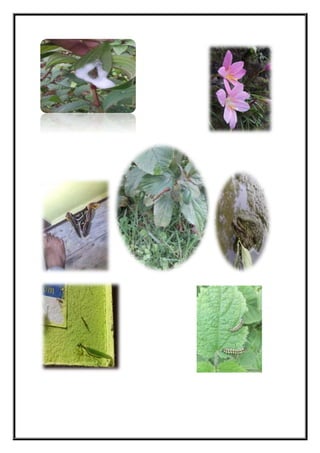
Album
Introduction: Biology is the study of life, endow with mosaic patterns of
diversity and uniformity with all kinds of life exists on earth and also to get
ideas about processes thatmight cause such patterns. Proper biological studies
involve observations of living organisms especially in their habitats. The field
study encompassing various ecosystem patches in different landscapes
including the behaviour, home range, nich and nich width, and the
interrelationship between the organisms and their environment including
temperature, moisture, rainfall and various organic and inorganic edaphic
components- all these factors invariably linked with their habitats as well as
ecologically efficient food web, foraging patterns and influences of various
anthropogenic pressures to maintain a stable relation for the very existence of
entire surrounding biotic & abiotic paradigm. All these factors together with
different interlinked parameters are associated with the study of biodiversity.
Biodiversity is the variety of species whose distribution influences the
development of communities and eventually configures the community
structures and patterns. These are some natural areas where protected
either by legislation or by communities where maximum natural diversity of
flora and fauna can be observed at their most natural state, are designated
as forest.
Ecological importance of forest for the maintenance of quality
environment has been advocated by number of ecologists. Globally the
forested region occupies more than 4 lakh hectors of land in which 70% are
located in the tropics. Tropical forests are characterised by highly complex
ecosystem which encores an uninterrupted evolution over a million of years-
have achieved a remarkable balance within the plants & animals along with
their surroundings. This typical situation attributes a high level of species
diversity in tropical forests. The tropical forests further posses’ high level of
biological productivity due to their enhanced rates of carbon and nutrient run
over in the soil. All recent authors strongly suggested that Indian sub climates
are well suited for all kinds of forests having specific endemic flora and fauna
and thereby has been considered the one of major mega diversity countries in
the world which has at least two important hotspot areas.
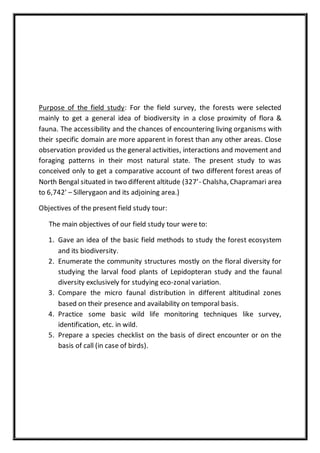
Purpose of the field study: For the field survey, the forests were selected
mainly to get a general idea of biodiversity in a close proximity of flora &
fauna. The accessibility and the chances of encountering living organisms with
their specific domain are more apparent in forest than any other areas. Close
observation provided us the general activities, interactions and movement and
foraging patterns in their most natural state. The present study to was
conceived only to get a comparative account of two different forest areas of
North Bengal situated in two different altitude (327’- Chalsha, Chapramari area
to 6,742' – Sillerygaon and its adjoining area.)
Objectives of the present field study tour:
The main objectives of our field study tour were to:
1. Gave an idea of the basic field methods to study the forest ecosystem
and its biodiversity.
2. Enumerate the community structures mostly on the floral diversity for
studying the larval food plants of Lepidopteran study and the faunal
diversity exclusively for studying eco-zonal variation.
3. Compare the micro faunal distribution in different altitudinal zones
based on their presence and availability on temporal basis.
4. Practice some basic wild life monitoring techniques like survey,
identification, etc. in wild.
5. Prepare a species checklist on the basis of direct encounter or on the
basis of call (in case of birds).
JourneySchedule :
DATE DAY TIME PROGAMME
04-06-
2015
Thursday 08.30 pm Boarded Kanchankanya Express from Sealdah
Station
05-06-
2015
Friday 10.30 am Reached New Mal Junction
11.45 am Reached Chalsa~ Tiya Bon Resort
02.00 pm Field study nearby
06-06-
2015
Saturday 09.00 am Started for Sillery Gaon
1.00 pm Reached Sillery Gaon
03.00pm Field Study at Sillery Gaon
07-06-
2015
Sunday 07.00 am Nature trail till Ramitey Point
10.30 am Short Trek in the forest
03.00 pm Field study nearby
08-06-
2015
Monday 9.00 am Started from Sillery Gaon
12.30 pm Reached Chalsa
05.30 pm Boarded Kanchankanya Express from New
Mal Junction
09-06-
2015
Tuesday 09.30 am Reached Sealdah Station
Accompanying tour members:
Students :-
1. Aiswarya V Nair
2. Ananya Sarkar
3. Ankhi Sarkar
4. FerdousiRahaman
5. Maitryee Hazra
6. Monalisa Chakraborty
7. Pramita Roy
8. Pratiksha Gain
9. Puja Kundu
10.Sarada Bhattacharyya
11.Abhinandan Ghosh
12.Indrajit Das
13.Mohammad Ali
14.Nemai Prodhan
15.Shuvam Das
16.Sourabh Biswas
17.Supriya Nath
Teachers :-
1. ProfessorNarayan Gorai
2. Dr. Chiranjib Pal
3. Dr. Kamal Kumar Banerjee*
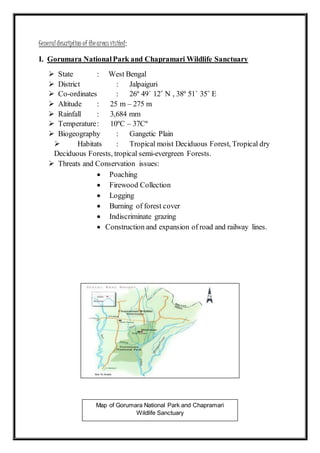
Map of Gorumara National Park and Chapramari
Wildlife Sanctuary
Generaldescription of theareasvisited:
I. Gorumara NationalPark and Chapramari Wildlife Sanctuary
 State : West Bengal
 District : Jalpaiguri
 Co-ordinates : 26º 49´ 12˝ N , 38º 51´ 35˝ E
 Altitude : 25 m – 275 m
 Rainfall : 3,684 mm
 Temperature: 10ºC – 37Cº
 Biogeography : Gangetic Plain
 Habitats : Tropical moist Deciduous Forest, Tropical dry
Deciduous Forests, tropical semi-evergreen Forests.
 Threats and Conservation issues:
 Poaching
 Firewood Collection
 Logging
 Burning of forest cover
 Indiscriminate grazing
 Construction and expansion of road and railway lines.
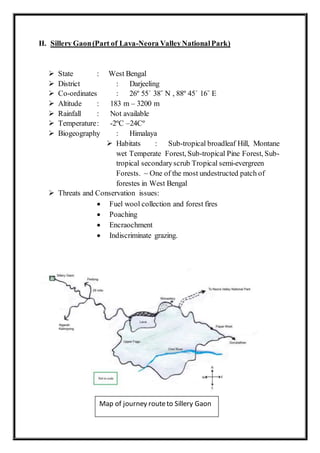
II. Sillery Gaon(Part of Lava-Neora ValleyNationalPark)
 State : West Bengal
 District : Darjeeling
 Co-ordinates : 26º 55´ 38˝ N , 88º 45´ 16˝ E
 Altitude : 183 m – 3200 m
 Rainfall : Not available
 Temperature: -2ºC –24Cº
 Biogeography : Himalaya
 Habitats : Sub-tropical broadleaf Hill, Montane
wet Temperate Forest, Sub-tropical Pine Forest, Sub-
tropical secondaryscrub Tropical semi-evergreen
Forests. ~ One of the most undestructed patch of
forestes in West Bengal
 Threats and Conservation issues:
 Fuel wool collection and forest fires
 Poaching
 Encraochment
 Indiscriminate grazing.
Map of journey routeto Sillery Gaon
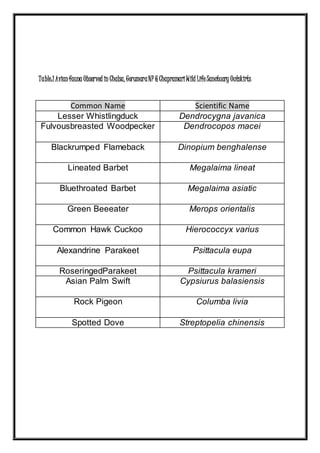
Table:1Avianfauna Observed in Chalsa, GorumaraNP &ChapramariWild LifeSanctuary Outskirts
Common Name Scientific Name
Lesser Whistlingduck Dendrocygna javanica
Fulvousbreasted Woodpecker Dendrocopos macei
Blackrumped Flameback Dinopium benghalense
Lineated Barbet Megalaima lineat
Bluethroated Barbet Megalaima asiatic
Green Beeeater Merops orientalis
Common Hawk Cuckoo Hierococcyx varius
Alexandrine Parakeet Psittacula eupa
RoseringedParakeet Psittacula krameri
Asian Palm Swift Cypsiurus balasiensis
Rock Pigeon Columba livia
Spotted Dove Streptopelia chinensis
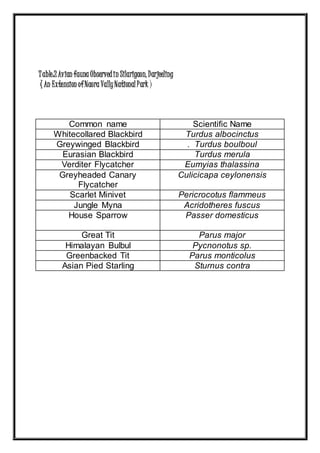
Table:2 Avian fauna Observedin Silarigaon, Darjeeling
( An Extension ofNaora VallyNational Park )
Common name Scientific Name
Whitecollared Blackbird Turdus albocinctus
Greywinged Blackbird . Turdus boulboul
Eurasian Blackbird Turdus merula
Verditer Flycatcher Eumyias thalassina
Greyheaded Canary
Flycatcher
Culicicapa ceylonensis
Scarlet Minivet Pericrocotus flammeus
Jungle Myna Acridotheres fuscus
House Sparrow Passer domesticus
Great Tit Parus major
Himalayan Bulbul Pycnonotus sp.
Greenbacked Tit Parus monticolus
Asian Pied Starling Sturnus contra
Table 3:
Checklist of flora found:
Flowers:
1. Cobra Lily
2. Hydrangea
3. Fuschia
4. Impatiens
5. Carnatian
6. Angel’s Trumpet
7. Indian Rhododendron
Fungus
1. Amanita
2. Auracularia sp.
3. Dictyophora sp.
4. Fragile dapperling
5. OrangePeel Fungus
6. Parasola sp.
Lichens
1. Crustose
2. Foliose
3. Fruticose
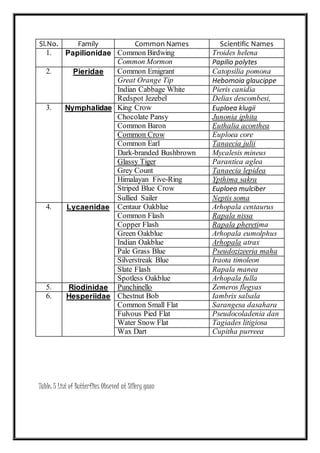
Table: 4 List of Butterflies Obseved at Dooars
Checklistof Butterflies observed (Species count-32)
Sl.No. Family Common Names Scientific Names
1. Papilionidae Common Birdwing Troides helena
Common Mormon Papilio polytes
2. Pieridae Common Emigrant Catopsilia pomona
Great Orange Tip Hebomoia glaucippe
Indian Cabbage White Pieris canidia
Redspot Jezebel Delias descombesi,
3. Nymphalidae King Crow Euploea klugii
Chocolate Pansy Junonia iphita
Common Baron Euthalia aconthea
Common Crow Euploea core
Common Earl Tanaecia julii
Dark-branded Bushbrown Mycalesis mineus
Glassy Tiger Parantica aglea
Grey Count Tanaecia lepidea
Himalayan Five-Ring Ypthima sakra
Striped Blue Crow Euploea mulciber
Sullied Sailer Neptis soma
4. Lycaenidae Centaur Oakblue Arhopala centaurus
Common Flash Rapala nissa
Copper Flash Rapala pheretima
Green Oakblue Arhopala eumolphus
Indian Oakblue Arhopala atrax
Pale Grass Blue Pseudozizeeria maha
Silverstreak Blue Iraota timoleon
Slate Flash Rapala manea
Spotless Oakblue Arhopala fulla
5. Riodinidae Punchinello Zemeros flegyas
6. Hesperiidae Chestnut Bob Iambrix salsala
Common Small Flat Sarangesa dasahara
Fulvous Pied Flat Pseudocoladenia dan
Water Snow Flat Tagiades litigiosa
Wax Dart Cupitha purreea
Table: 5 List of Butterflies Obseved at Sillery gaon
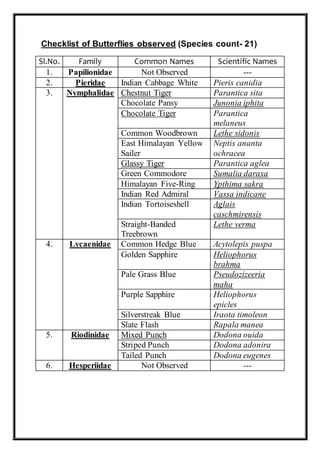
Checklist of Butterflies observed (Species count- 21)
Sl.No. Family Common Names Scientific Names
1. Papilionidae Not Observed ---
2. Pieridae Indian Cabbage White Pieris canidia
3. Nymphalidae Chestnut Tiger Parantica sita
Chocolate Pansy Junonia iphita
Chocolate Tiger Parantica
melaneus
Common Woodbrown Lethe sidonis
East Himalayan Yellow
Sailer
Neptis ananta
ochracea
Glassy Tiger Parantica aglea
Green Commodore Sumalia daraxa
Himalayan Five-Ring Ypthima sakra
Indian Red Admiral Vassa indicane
Indian Tortoiseshell Aglais
caschmirensis
Straight-Banded
Treebrown
Lethe verma
4. Lycaenidae Common Hedge Blue Acytolepis puspa
Golden Sapphire Heliophorus
brahma
Pale Grass Blue Pseudozizeeria
maha
Purple Sapphire Heliophorus
epicles
Silverstreak Blue Iraota timoleon
Slate Flash Rapala manea
5. Riodinidae Mixed Punch Dodona ouida
Striped Punch Dodona adonira
Tailed Punch Dodona eugenes
6. Hesperiidae Not Observed ---
Table: 6
List of moth observed in Sillery gaon
 Atlas moth
 Adrapsa sp.
 Callabraxas sp.
 Eri silk moth
 False tiger moth
 Callidula sp.
 Cyana belissama
 Palirisa lineosa
 Vamuna remelana
 Oak moth
 Llema sp
 Nyctemera adverata
Bibliography:
1. Grimmett. R., Inskipp. C., Inskipp. T., Pocket Guide to the Birds of the
Indian Subcontinent
2. Kazmierezak. K., A Field Guide To the Birds of Indian Subcontinent
3. Menon. V., A Field Guide to Indian Mammals
4. Menon. V., Daniel. J.C., A Field Guide to Indian Mammals
5. Kazmierezak. K., Singh. R.,A Birdwatcher’s Guide to India

project

  • 1.
    Reporton theFieldStudyTourto AdjoiningAreasofGorumaraNationalpark and Sillery Gaon (Part of Neora Valley National Park), West Bengal Worksubmittedfor thepartial fulfillment fortheMasters ofScience in Zoology,West Bengal StateUniversity, Barasat Department of Zoology Registration No.: 2014003158 of 2014
  • 2.
    “Nothing in BiologyMakes Sense, Except In The Light of Evolution” - T. Dobzhansky CONTENTS Topic Page no.
  • 3.
    Acknowledgement.............................................................. 1 Album................................................................................. 2 Introduction........................................................................3 Purpose of the field study................................................... 4 Journey Schedule................................................................ 5 Accompanying tour members............................................. 6 General description of the areas visited.............................. 7 Tables.................................................................................. 9 Bibliography....................................................................... 15 Acknowledgement: I wish to express my sincere gratitude and heartfelt respect to the Honourable Vice Chancellor, West Bengal State University, Barasat for
  • 4.
    kindly granting uspermission to expedite this field study tour. I further like to express my sincere thanks to Professor Narayan Ghorai, Head of the Department of Zoology, West Bengal State University and Dr. Chiranjib Paul, Professor Kamal Kumar Banerjree for their active guidance, help and technical assistance extended to us throughout the course of work. My sincere regards are also due to all my other teachers of the department for providing us with all necessary support during the pre journey period. My friends of the Department deserve special mention for helping me to prepare the field report and also thanks to Mr. Tapas Bhowmick of Hammock Huts Holidays for his kind help. Finally I wish to express my sincere regards to my parents for their moral support & blessing. .............................................. ............................................ Prof. Narayan Ghorai Dr. Chiranjib Paul (Head of the Deparment) (Assistant Professor)
  • 5.
  • 7.
    Introduction: Biology isthe study of life, endow with mosaic patterns of diversity and uniformity with all kinds of life exists on earth and also to get ideas about processes thatmight cause such patterns. Proper biological studies involve observations of living organisms especially in their habitats. The field study encompassing various ecosystem patches in different landscapes including the behaviour, home range, nich and nich width, and the interrelationship between the organisms and their environment including temperature, moisture, rainfall and various organic and inorganic edaphic components- all these factors invariably linked with their habitats as well as ecologically efficient food web, foraging patterns and influences of various anthropogenic pressures to maintain a stable relation for the very existence of entire surrounding biotic & abiotic paradigm. All these factors together with different interlinked parameters are associated with the study of biodiversity. Biodiversity is the variety of species whose distribution influences the development of communities and eventually configures the community structures and patterns. These are some natural areas where protected either by legislation or by communities where maximum natural diversity of flora and fauna can be observed at their most natural state, are designated as forest. Ecological importance of forest for the maintenance of quality environment has been advocated by number of ecologists. Globally the forested region occupies more than 4 lakh hectors of land in which 70% are located in the tropics. Tropical forests are characterised by highly complex ecosystem which encores an uninterrupted evolution over a million of years- have achieved a remarkable balance within the plants & animals along with their surroundings. This typical situation attributes a high level of species diversity in tropical forests. The tropical forests further posses’ high level of biological productivity due to their enhanced rates of carbon and nutrient run over in the soil. All recent authors strongly suggested that Indian sub climates are well suited for all kinds of forests having specific endemic flora and fauna and thereby has been considered the one of major mega diversity countries in the world which has at least two important hotspot areas.
  • 8.
    Purpose of thefield study: For the field survey, the forests were selected mainly to get a general idea of biodiversity in a close proximity of flora & fauna. The accessibility and the chances of encountering living organisms with their specific domain are more apparent in forest than any other areas. Close observation provided us the general activities, interactions and movement and foraging patterns in their most natural state. The present study to was conceived only to get a comparative account of two different forest areas of North Bengal situated in two different altitude (327’- Chalsha, Chapramari area to 6,742' – Sillerygaon and its adjoining area.) Objectives of the present field study tour: The main objectives of our field study tour were to: 1. Gave an idea of the basic field methods to study the forest ecosystem and its biodiversity. 2. Enumerate the community structures mostly on the floral diversity for studying the larval food plants of Lepidopteran study and the faunal diversity exclusively for studying eco-zonal variation. 3. Compare the micro faunal distribution in different altitudinal zones based on their presence and availability on temporal basis. 4. Practice some basic wild life monitoring techniques like survey, identification, etc. in wild. 5. Prepare a species checklist on the basis of direct encounter or on the basis of call (in case of birds).
  • 9.
    JourneySchedule : DATE DAYTIME PROGAMME 04-06- 2015 Thursday 08.30 pm Boarded Kanchankanya Express from Sealdah Station 05-06- 2015 Friday 10.30 am Reached New Mal Junction 11.45 am Reached Chalsa~ Tiya Bon Resort 02.00 pm Field study nearby 06-06- 2015 Saturday 09.00 am Started for Sillery Gaon 1.00 pm Reached Sillery Gaon 03.00pm Field Study at Sillery Gaon 07-06- 2015 Sunday 07.00 am Nature trail till Ramitey Point 10.30 am Short Trek in the forest 03.00 pm Field study nearby 08-06- 2015 Monday 9.00 am Started from Sillery Gaon 12.30 pm Reached Chalsa 05.30 pm Boarded Kanchankanya Express from New Mal Junction 09-06- 2015 Tuesday 09.30 am Reached Sealdah Station
  • 10.
    Accompanying tour members: Students:- 1. Aiswarya V Nair 2. Ananya Sarkar 3. Ankhi Sarkar 4. FerdousiRahaman 5. Maitryee Hazra 6. Monalisa Chakraborty 7. Pramita Roy 8. Pratiksha Gain 9. Puja Kundu 10.Sarada Bhattacharyya 11.Abhinandan Ghosh 12.Indrajit Das 13.Mohammad Ali 14.Nemai Prodhan 15.Shuvam Das 16.Sourabh Biswas 17.Supriya Nath Teachers :- 1. ProfessorNarayan Gorai 2. Dr. Chiranjib Pal 3. Dr. Kamal Kumar Banerjee*
  • 11.
    Map of GorumaraNational Park and Chapramari Wildlife Sanctuary Generaldescription of theareasvisited: I. Gorumara NationalPark and Chapramari Wildlife Sanctuary  State : West Bengal  District : Jalpaiguri  Co-ordinates : 26º 49´ 12˝ N , 38º 51´ 35˝ E  Altitude : 25 m – 275 m  Rainfall : 3,684 mm  Temperature: 10ºC – 37Cº  Biogeography : Gangetic Plain  Habitats : Tropical moist Deciduous Forest, Tropical dry Deciduous Forests, tropical semi-evergreen Forests.  Threats and Conservation issues:  Poaching  Firewood Collection  Logging  Burning of forest cover  Indiscriminate grazing  Construction and expansion of road and railway lines.
  • 12.
    II. Sillery Gaon(Partof Lava-Neora ValleyNationalPark)  State : West Bengal  District : Darjeeling  Co-ordinates : 26º 55´ 38˝ N , 88º 45´ 16˝ E  Altitude : 183 m – 3200 m  Rainfall : Not available  Temperature: -2ºC –24Cº  Biogeography : Himalaya  Habitats : Sub-tropical broadleaf Hill, Montane wet Temperate Forest, Sub-tropical Pine Forest, Sub- tropical secondaryscrub Tropical semi-evergreen Forests. ~ One of the most undestructed patch of forestes in West Bengal  Threats and Conservation issues:  Fuel wool collection and forest fires  Poaching  Encraochment  Indiscriminate grazing. Map of journey routeto Sillery Gaon
  • 13.
    Table:1Avianfauna Observed inChalsa, GorumaraNP &ChapramariWild LifeSanctuary Outskirts Common Name Scientific Name Lesser Whistlingduck Dendrocygna javanica Fulvousbreasted Woodpecker Dendrocopos macei Blackrumped Flameback Dinopium benghalense Lineated Barbet Megalaima lineat Bluethroated Barbet Megalaima asiatic Green Beeeater Merops orientalis Common Hawk Cuckoo Hierococcyx varius Alexandrine Parakeet Psittacula eupa RoseringedParakeet Psittacula krameri Asian Palm Swift Cypsiurus balasiensis Rock Pigeon Columba livia Spotted Dove Streptopelia chinensis
  • 14.
    Table:2 Avian faunaObservedin Silarigaon, Darjeeling ( An Extension ofNaora VallyNational Park ) Common name Scientific Name Whitecollared Blackbird Turdus albocinctus Greywinged Blackbird . Turdus boulboul Eurasian Blackbird Turdus merula Verditer Flycatcher Eumyias thalassina Greyheaded Canary Flycatcher Culicicapa ceylonensis Scarlet Minivet Pericrocotus flammeus Jungle Myna Acridotheres fuscus House Sparrow Passer domesticus Great Tit Parus major Himalayan Bulbul Pycnonotus sp. Greenbacked Tit Parus monticolus Asian Pied Starling Sturnus contra
  • 15.
    Table 3: Checklist offlora found: Flowers: 1. Cobra Lily 2. Hydrangea 3. Fuschia 4. Impatiens 5. Carnatian 6. Angel’s Trumpet 7. Indian Rhododendron Fungus 1. Amanita 2. Auracularia sp. 3. Dictyophora sp. 4. Fragile dapperling 5. OrangePeel Fungus 6. Parasola sp. Lichens 1. Crustose 2. Foliose 3. Fruticose Table: 4 List of Butterflies Obseved at Dooars Checklistof Butterflies observed (Species count-32)
  • 16.
    Sl.No. Family CommonNames Scientific Names 1. Papilionidae Common Birdwing Troides helena Common Mormon Papilio polytes 2. Pieridae Common Emigrant Catopsilia pomona Great Orange Tip Hebomoia glaucippe Indian Cabbage White Pieris canidia Redspot Jezebel Delias descombesi, 3. Nymphalidae King Crow Euploea klugii Chocolate Pansy Junonia iphita Common Baron Euthalia aconthea Common Crow Euploea core Common Earl Tanaecia julii Dark-branded Bushbrown Mycalesis mineus Glassy Tiger Parantica aglea Grey Count Tanaecia lepidea Himalayan Five-Ring Ypthima sakra Striped Blue Crow Euploea mulciber Sullied Sailer Neptis soma 4. Lycaenidae Centaur Oakblue Arhopala centaurus Common Flash Rapala nissa Copper Flash Rapala pheretima Green Oakblue Arhopala eumolphus Indian Oakblue Arhopala atrax Pale Grass Blue Pseudozizeeria maha Silverstreak Blue Iraota timoleon Slate Flash Rapala manea Spotless Oakblue Arhopala fulla 5. Riodinidae Punchinello Zemeros flegyas 6. Hesperiidae Chestnut Bob Iambrix salsala Common Small Flat Sarangesa dasahara Fulvous Pied Flat Pseudocoladenia dan Water Snow Flat Tagiades litigiosa Wax Dart Cupitha purreea Table: 5 List of Butterflies Obseved at Sillery gaon
  • 17.
    Checklist of Butterfliesobserved (Species count- 21) Sl.No. Family Common Names Scientific Names 1. Papilionidae Not Observed --- 2. Pieridae Indian Cabbage White Pieris canidia 3. Nymphalidae Chestnut Tiger Parantica sita Chocolate Pansy Junonia iphita Chocolate Tiger Parantica melaneus Common Woodbrown Lethe sidonis East Himalayan Yellow Sailer Neptis ananta ochracea Glassy Tiger Parantica aglea Green Commodore Sumalia daraxa Himalayan Five-Ring Ypthima sakra Indian Red Admiral Vassa indicane Indian Tortoiseshell Aglais caschmirensis Straight-Banded Treebrown Lethe verma 4. Lycaenidae Common Hedge Blue Acytolepis puspa Golden Sapphire Heliophorus brahma Pale Grass Blue Pseudozizeeria maha Purple Sapphire Heliophorus epicles Silverstreak Blue Iraota timoleon Slate Flash Rapala manea 5. Riodinidae Mixed Punch Dodona ouida Striped Punch Dodona adonira Tailed Punch Dodona eugenes 6. Hesperiidae Not Observed ---
  • 18.
    Table: 6 List ofmoth observed in Sillery gaon  Atlas moth  Adrapsa sp.  Callabraxas sp.  Eri silk moth  False tiger moth  Callidula sp.  Cyana belissama  Palirisa lineosa  Vamuna remelana  Oak moth  Llema sp  Nyctemera adverata
  • 19.
    Bibliography: 1. Grimmett. R.,Inskipp. C., Inskipp. T., Pocket Guide to the Birds of the Indian Subcontinent 2. Kazmierezak. K., A Field Guide To the Birds of Indian Subcontinent 3. Menon. V., A Field Guide to Indian Mammals 4. Menon. V., Daniel. J.C., A Field Guide to Indian Mammals 5. Kazmierezak. K., Singh. R.,A Birdwatcher’s Guide to India