Arachidonic Acid Pathway
The arachidonic acid pathway, also known as
the arachidonic acid cascade or the eicosanoid
pathway, is a biochemical pathway involved in
the production of various signaling molecules
called eicosanoids. Arachidonic acid is a
polyunsaturated fatty acid that serves as the
precursor for these eicosanoids.
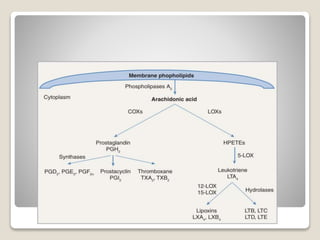
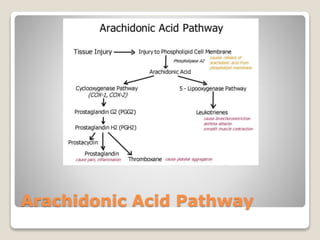
The pathway begins with the release
of arachidonic acid from the
phospholipids of the cell membrane,
usually in response to a stimulus
such as inflammation or cellular
activation. This release is mediated
by the enzyme phospholipase A2.
Once arachidonic acid is released, it
can be metabolized by two major
enzymatic pathways: the
cyclooxygenase (COX) pathway and
the lipoxygenase (LOX) pathway.
The arachidonic acid pathway
describes the biosynthesis of
eicosanoids from arachidonic acid
(AA) including its formation from
omega-6 polyunsaturated fatty acids
(PUFAs) and the synthesis of
eicosanoids from eicosapentaenoic
acid (EPA) including its formation
from omega-3 PUFAs.
Cyclooxygenase (COX) pathway:
Arachidonic acid can be converted by
the enzyme cyclooxygenase into
various prostaglandins and
thromboxanes. There are two
isoforms of cyclooxygenase: COX-1
and COX-2. COX-1 is constitutively
expressed in many tissues and
involved in physiological functions,
while COX-2 is induced during
inflammation and plays a role in pain,
fever, and inflammation.
Prostaglandins and thromboxanes are
involved in various biological
processes, including regulation of
inflammation, blood clotting, and
gastrointestinal protection.
Lipoxygenase (LOX) pathway:
Arachidonic acid can also be
metabolized by the enzyme
lipoxygenase into leukotrienes and
lipoxins. Leukotrienes are involved in
inflammatory and allergic reactions,
while lipoxins are thought to have
anti-inflammatory effects and play a
role in resolving inflammation.
The products of the arachidonic acid
pathway, including prostaglandins,
thromboxanes, leukotrienes, and
lipoxins, act as local hormones or
signaling molecules, exerting a wide
range of effects on various tissues
and physiological processes. They can
modulate inflammation, vascular
tone, platelet aggregation,
bronchoconstriction, and other
important functions in the body.
The arachidonic acid pathway is
tightly regulated, and its
dysregulation can contribute to
various diseases and conditions, such
as inflammation, asthma,
cardiovascular diseases, and cancer.
Consequently, drugs that target
specific enzymes in this pathway,
such as COX inhibitors (e.g.,
nonsteroidal anti-inflammatory drugs
or NSAIDs), are widely used to treat
pain, inflammation, and other related
conditions.
Arachidonic Acid Pathway

Arachidonic Acid Pathway.ppt.pptx

  • 1.
  • 2.
    The arachidonic acidpathway, also known as the arachidonic acid cascade or the eicosanoid pathway, is a biochemical pathway involved in the production of various signaling molecules called eicosanoids. Arachidonic acid is a polyunsaturated fatty acid that serves as the precursor for these eicosanoids.
  • 3.
    The pathway beginswith the release of arachidonic acid from the phospholipids of the cell membrane, usually in response to a stimulus such as inflammation or cellular activation. This release is mediated by the enzyme phospholipase A2. Once arachidonic acid is released, it can be metabolized by two major enzymatic pathways: the cyclooxygenase (COX) pathway and the lipoxygenase (LOX) pathway.
  • 4.
    The arachidonic acidpathway describes the biosynthesis of eicosanoids from arachidonic acid (AA) including its formation from omega-6 polyunsaturated fatty acids (PUFAs) and the synthesis of eicosanoids from eicosapentaenoic acid (EPA) including its formation from omega-3 PUFAs.
  • 6.
    Cyclooxygenase (COX) pathway: Arachidonicacid can be converted by the enzyme cyclooxygenase into various prostaglandins and thromboxanes. There are two isoforms of cyclooxygenase: COX-1 and COX-2. COX-1 is constitutively expressed in many tissues and involved in physiological functions, while COX-2 is induced during inflammation and plays a role in pain, fever, and inflammation. Prostaglandins and thromboxanes are involved in various biological processes, including regulation of inflammation, blood clotting, and gastrointestinal protection.
  • 7.
    Lipoxygenase (LOX) pathway: Arachidonicacid can also be metabolized by the enzyme lipoxygenase into leukotrienes and lipoxins. Leukotrienes are involved in inflammatory and allergic reactions, while lipoxins are thought to have anti-inflammatory effects and play a role in resolving inflammation.
  • 8.
    The products ofthe arachidonic acid pathway, including prostaglandins, thromboxanes, leukotrienes, and lipoxins, act as local hormones or signaling molecules, exerting a wide range of effects on various tissues and physiological processes. They can modulate inflammation, vascular tone, platelet aggregation, bronchoconstriction, and other important functions in the body.
  • 9.
    The arachidonic acidpathway is tightly regulated, and its dysregulation can contribute to various diseases and conditions, such as inflammation, asthma, cardiovascular diseases, and cancer. Consequently, drugs that target specific enzymes in this pathway, such as COX inhibitors (e.g., nonsteroidal anti-inflammatory drugs or NSAIDs), are widely used to treat pain, inflammation, and other related conditions.
  • 10.