Africa RISING in the Ethiopian
Highlands
Kindu Mekonnen and Peter Thorne
International Livestock Research Institute
US Embassy, Addis Ababa
8 November 2017
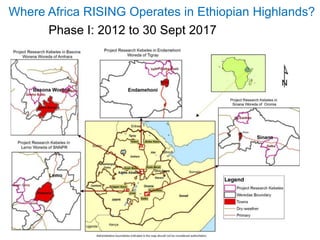
Where Africa RISING Operates in Ethiopian Highlands?
Phase I: 2012 to 30 Sept 2017
Phase II: Oct 2016-2021- Progressive
Phase I: 2012- Sept 2016
o An action research project;
o Focus on technology identification, testing and
validation; and
o Resource intensive and focused more on quality
than quantity.
Phase II: Oct 2016- 2021
o Primarily research to backstop scaling initiatives
with development partners (DPs); and
o Systematic horizontal and vertical scaling of
phase I innovations with DPs.
What We Do?
Irrigated/rain-fed forages
Post-harvest feed management
and utilizationFodder and fertilizer trees/shrubs
Feed and food crop (Sweet lupin)
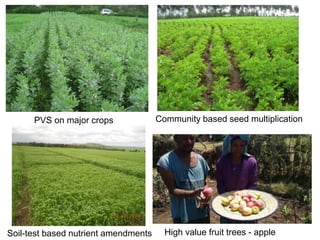
Africa RISING’s Phase I interventions: Examples
Soil-test based nutrient amendments High value fruit trees - apple
Community based seed multiplicationPVS on major crops
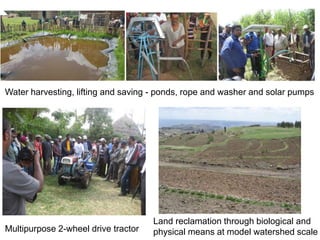
Multipurpose 2-wheel drive tractor
Water harvesting, lifting and saving - ponds, rope and washer and solar pumps
Land reclamation through biological and
physical means at model watershed scale
o Preliminary targets: 0.7 million direct beneficiary hhs
with the potential to scale to a further 3.4 million hhs.
Africa RISING Phase II Targets and Achievements
Table 1. Africa RISING -Scaling and R4D initiatives in 2017 cropping season
Region Zone Woreda Technology type Male
HHs
Female
HHs
Total
HHs
Areas
(ha)
Tigray 2 5 Crop, livestock, NRM 6769 1636 8405 1361
Amhara 1 10 Crop, livestock, NRM 22338 2099 24438 8154
Oromia 1 7 Crop, livestock, NRM 21911 3182 25093 10774
SNNPR 3 6 Crop, livestock, NRM 2210 246 2456 108
Total 7 28 Crop, livestock, NRM 53228 7163 60392 20397
o Reached to more than 60392 hhs and covered 20397
ha of land in 2017 with less than 12 month; and
o DPs convinced by the research evidences and co-
invested in the scaling initiatives.
Challenges and Opportunities
Opportunities:
o Increasing demand for the Africa RISING validated
technologies/innovations;
o Most of Africa RISING validated
technologies/innovations are in alignment with the
Ethiopian government development priorities; and
o Strong partnership with CGIAR centers, local
Universities, research institutions, extension, NGOs,
communities and some private entrepreneurs.
Challenges:
o Funding uncertainties: More can be done if
there was no resource limitation; and
o Funding uncertainties create less trust with
CGIAR and local partners.
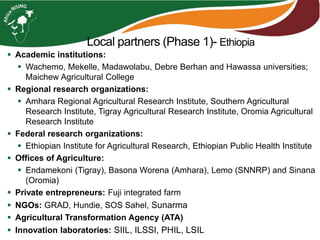
Africa RISING CGIAR partners in Ethiopia
 Academic institutions:
 Wachemo, Mekelle, Madawolabu, Debre Berhan and Hawassa universities;
Maichew Agricultural College
 Regional research organizations:
 Amhara Regional Agricultural Research Institute, Southern Agricultural
Research Institute, Tigray Agricultural Research Institute, Oromia Agricultural
Research Institute
 Federal research organizations:
 Ethiopian Institute for Agricultural Research, Ethiopian Public Health Institute
 Offices of Agriculture:
 Endamekoni (Tigray), Basona Worena (Amhara), Lemo (SNNRP) and Sinana
(Oromia)
 Private entrepreneurs: Fuji integrated farm
 NGOs: GRAD, Hundie, SOS Sahel, Sunarma
 Agricultural Transformation Agency (ATA)
 Innovation laboratories: SIIL, ILSSI, PHIL, LSIL
Local partners (Phase 1)- Ethiopia
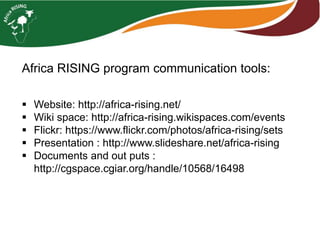
 Website: http://africa-rising.net/
 Wiki space: http://africa-rising.wikispaces.com/events
 Flickr: https://www.flickr.com/photos/africa-rising/sets
 Presentation : http://www.slideshare.net/africa-rising
 Documents and out puts :
http://cgspace.cgiar.org/handle/10568/16498
Africa RISING program communication tools:
Africa Research in Sustainable Intensification for the Next Generation
africa-rising.net
This presentation is licensed for use under the Creative Commons Attribution 4.0 International Licence.

Africa RISING in the Ethiopian Highlands

  • 1.
    Africa RISING inthe Ethiopian Highlands Kindu Mekonnen and Peter Thorne International Livestock Research Institute US Embassy, Addis Ababa 8 November 2017
  • 2.
    Where Africa RISINGOperates in Ethiopian Highlands? Phase I: 2012 to 30 Sept 2017
  • 3.
    Phase II: Oct2016-2021- Progressive
  • 4.
    Phase I: 2012-Sept 2016 o An action research project; o Focus on technology identification, testing and validation; and o Resource intensive and focused more on quality than quantity. Phase II: Oct 2016- 2021 o Primarily research to backstop scaling initiatives with development partners (DPs); and o Systematic horizontal and vertical scaling of phase I innovations with DPs. What We Do?
  • 5.
    Irrigated/rain-fed forages Post-harvest feedmanagement and utilizationFodder and fertilizer trees/shrubs Feed and food crop (Sweet lupin) Africa RISING’s Phase I interventions: Examples
  • 6.
    Soil-test based nutrientamendments High value fruit trees - apple Community based seed multiplicationPVS on major crops
  • 7.
    Multipurpose 2-wheel drivetractor Water harvesting, lifting and saving - ponds, rope and washer and solar pumps Land reclamation through biological and physical means at model watershed scale
  • 8.
    o Preliminary targets:0.7 million direct beneficiary hhs with the potential to scale to a further 3.4 million hhs. Africa RISING Phase II Targets and Achievements Table 1. Africa RISING -Scaling and R4D initiatives in 2017 cropping season Region Zone Woreda Technology type Male HHs Female HHs Total HHs Areas (ha) Tigray 2 5 Crop, livestock, NRM 6769 1636 8405 1361 Amhara 1 10 Crop, livestock, NRM 22338 2099 24438 8154 Oromia 1 7 Crop, livestock, NRM 21911 3182 25093 10774 SNNPR 3 6 Crop, livestock, NRM 2210 246 2456 108 Total 7 28 Crop, livestock, NRM 53228 7163 60392 20397 o Reached to more than 60392 hhs and covered 20397 ha of land in 2017 with less than 12 month; and o DPs convinced by the research evidences and co- invested in the scaling initiatives.
  • 9.
    Challenges and Opportunities Opportunities: oIncreasing demand for the Africa RISING validated technologies/innovations; o Most of Africa RISING validated technologies/innovations are in alignment with the Ethiopian government development priorities; and o Strong partnership with CGIAR centers, local Universities, research institutions, extension, NGOs, communities and some private entrepreneurs.
  • 10.
    Challenges: o Funding uncertainties:More can be done if there was no resource limitation; and o Funding uncertainties create less trust with CGIAR and local partners.
  • 11.
    Africa RISING CGIARpartners in Ethiopia
  • 12.
     Academic institutions: Wachemo, Mekelle, Madawolabu, Debre Berhan and Hawassa universities; Maichew Agricultural College  Regional research organizations:  Amhara Regional Agricultural Research Institute, Southern Agricultural Research Institute, Tigray Agricultural Research Institute, Oromia Agricultural Research Institute  Federal research organizations:  Ethiopian Institute for Agricultural Research, Ethiopian Public Health Institute  Offices of Agriculture:  Endamekoni (Tigray), Basona Worena (Amhara), Lemo (SNNRP) and Sinana (Oromia)  Private entrepreneurs: Fuji integrated farm  NGOs: GRAD, Hundie, SOS Sahel, Sunarma  Agricultural Transformation Agency (ATA)  Innovation laboratories: SIIL, ILSSI, PHIL, LSIL Local partners (Phase 1)- Ethiopia
  • 13.
     Website: http://africa-rising.net/ Wiki space: http://africa-rising.wikispaces.com/events  Flickr: https://www.flickr.com/photos/africa-rising/sets  Presentation : http://www.slideshare.net/africa-rising  Documents and out puts : http://cgspace.cgiar.org/handle/10568/16498 Africa RISING program communication tools:
  • 14.
    Africa Research inSustainable Intensification for the Next Generation africa-rising.net This presentation is licensed for use under the Creative Commons Attribution 4.0 International Licence.

Editor's Notes