GLOBAL RIVER FLOOD RISKS
Tianyi Luo, Research Analyst, and Charles Iceland, Aqueduct Director
www.wri.org/floods
Why Do River Floods Matter?
1. SCALE Floods affect more people than
any other natural disaster
2. DAMAGE Floods from rivers cause as
much or more damage in some countries
as rising seas, storm surges.
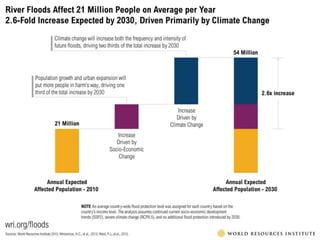
3. RISKS RISING 21 million people at risk
now – 54 million expected in 2030.
Key Findings
1. POPULATION: 21 million people
worldwide currently at risk – 54 million
projected in 2030
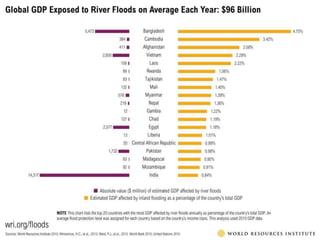
2. GDP: $96 billion at risk currently -- $521
billion projected by 2030
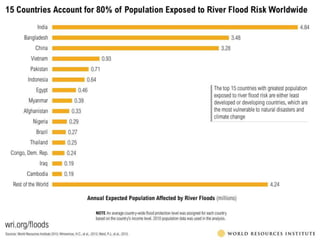
3. TOP COUNTRIES: India, Bangladesh,
China, Vietnam, Pakistan.
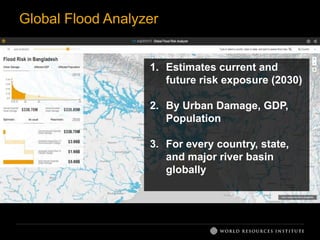
Global Flood Analyzer
1. Estimates current and
future risk exposure (2030)
2. By Urban Damage, GDP,
Population
3. For every country, state,
and major river basin
globally
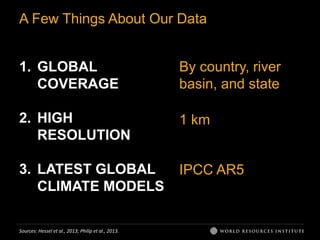
A Few Things About Our Data
1. GLOBAL
COVERAGE
2. HIGH
RESOLUTION
3. LATEST GLOBAL
CLIMATE MODELS
By country, river
basin, and state
1 km
IPCC AR5
Sources: Hessel et al., 2013; Philip et al., 2013.
Aqueduct Flood Analyzer Partners
What’s Next?
1. Coastal storm surge risk
2. Estimates of actual levels of protection
worldwide
3. Estimates of viability, cost, and benefits of
protection measures
What’s Next?
1. Coastal storm surge risk
2. Estimates of actual levels of protection
worldwide
3. Estimates of viability, cost, and benefits of
protection measures
Questions or comments?
Contact: Tianyi Luo, tluo@wri.org
Find us on Twitter: @WRIAqueduct
www.wri.org/floods

Global River Flood Risks

  • 1.
    GLOBAL RIVER FLOODRISKS Tianyi Luo, Research Analyst, and Charles Iceland, Aqueduct Director www.wri.org/floods
  • 2.
    Why Do RiverFloods Matter? 1. SCALE Floods affect more people than any other natural disaster 2. DAMAGE Floods from rivers cause as much or more damage in some countries as rising seas, storm surges. 3. RISKS RISING 21 million people at risk now – 54 million expected in 2030.
  • 3.
    Key Findings 1. POPULATION:21 million people worldwide currently at risk – 54 million projected in 2030 2. GDP: $96 billion at risk currently -- $521 billion projected by 2030 3. TOP COUNTRIES: India, Bangladesh, China, Vietnam, Pakistan.
  • 7.
    Global Flood Analyzer 1.Estimates current and future risk exposure (2030) 2. By Urban Damage, GDP, Population 3. For every country, state, and major river basin globally
  • 8.
    A Few ThingsAbout Our Data 1. GLOBAL COVERAGE 2. HIGH RESOLUTION 3. LATEST GLOBAL CLIMATE MODELS By country, river basin, and state 1 km IPCC AR5 Sources: Hessel et al., 2013; Philip et al., 2013.
  • 9.
  • 10.
    What’s Next? 1. Coastalstorm surge risk 2. Estimates of actual levels of protection worldwide 3. Estimates of viability, cost, and benefits of protection measures
  • 11.
    What’s Next? 1. Coastalstorm surge risk 2. Estimates of actual levels of protection worldwide 3. Estimates of viability, cost, and benefits of protection measures
  • 12.
    Questions or comments? Contact:Tianyi Luo, tluo@wri.org Find us on Twitter: @WRIAqueduct www.wri.org/floods

Editor's Notes

  • #3 PCR – GLOB for hydrological modelling. Daily river runoff and flood volumes (50km x 50km) for the period 1960 – 1999 were simulated. GLOFRIS for inundation modelling. 1km flood hazard maps were generated for 8 return periods, 2, 5, 10, 25, 50, 100, 250, 500, and 1000-year. Impact modelling. 2010 GDP and population data (1km x 1km) were used. Model urban damage estimates ($1.1 Billion) validated with local studies ($1 Billion) in the Rhine river basin.
  • #4 PCR – GLOB for hydrological modelling. Daily river runoff and flood volumes (50km x 50km) for the period 1960 – 1999 were simulated. GLOFRIS for inundation modelling. 1km flood hazard maps were generated for 8 return periods, 2, 5, 10, 25, 50, 100, 250, 500, and 1000-year. Impact modelling. 2010 GDP and population data (1km x 1km) were used. Model urban damage estimates ($1.1 Billion) validated with local studies ($1 Billion) in the Rhine river basin.
  • #10 The Aqueduct Flood Analyzer project is a partnership forged between WRI, the Netherlands Ministry of Infrastructure and Environment, and four Dutch research organizations (Declares, VU University Amsterdam, Utrecht University, and PBL Netherlands Environmental Assessment Agency).