Apremilast
Dr Shinde Viraj Ashok
Junior Resident – 2
Department of Pharmacology
GMC Nagpur
Overview
Introduction
Pharmacodynamics
Pharmacokinetics
Therapeutic efficacy
Current status
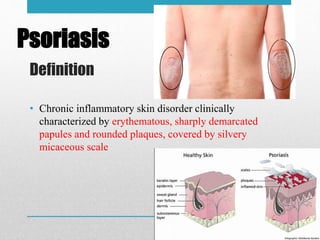
Definition
• Chronic inflammatory skin disorder clinically
characterized by erythematous, sharply demarcated
papules and rounded plaques, covered by silvery
micaceous scale
Psoriasis
Standard treatment of
psoriasis
• Type, location & extent of disease
• Localized , plaque type psoriasis - Midpotency topical
glucocorticoids
• Long-term use is often accompanied by
• Loss of effectiveness
• Atrophy of the skin
• Topical vitamin D analogue (calcipotriene) & retinoid
(tazarotene) - Efficacious
• Associated with ↑ incidence of non melanoma &
melanoma skin cancer
• Methotrexate
 Severe or refractory plaque type of psoriasis
 Effective agent in patients with psoriatic arthritis
• Synthetic retinoid - acitretin
 Drug of choice in psoriasis with AIDS
 Teratogenicity limits its use
• Oral glucocorticoids –
 Should not be used for treatment of psoriasis due to potential
for developing life-threatening pustular psoriasis when
therapy is discontinued
• Cyclosporine - Very effective in the treatment of
psoriasis
• Psoriasis - T cell–mediated disorder - has directed
therapeutic efforts to immunoregulation
• Attention is currently directed towards development of
biologic agents with more selective immunosuppressive
properties and better safety profiles
Apremilast
• Small molecule inhibitor of
phosphodiesterase(PDE)- 4 (main PDE in
inflammatory cells)
• Results in down regulation of immune mediators
Pharmacodynamics
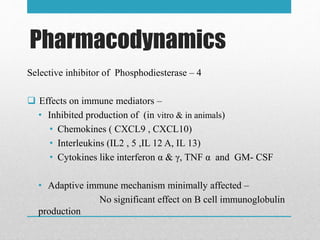
Selective inhibitor of Phosphodiesterase – 4
 Effects on immune mediators –
• Inhibited production of (in vitro & in animals)
• Chemokines ( CXCL9 , CXCL10)
• Interleukins (IL2 , 5 ,IL 12 A, IL 13)
• Cytokines like interferon α & γ, TNF α and GM- CSF
• Adaptive immune mechanism minimally affected –
No significant effect on B cell immunoglobulin
production
 Effects on immune mediators
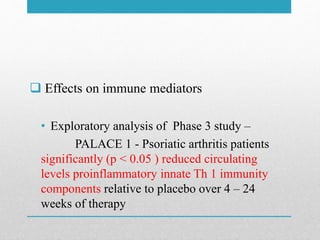
• Exploratory analysis of Phase 3 study –
PALACE 1 - Psoriatic arthritis patients
significantly (p < 0.05 ) reduced circulating
levels proinflammatory innate Th 1 immunity
components relative to placebo over 4 – 24
weeks of therapy
Pharmacodynamics
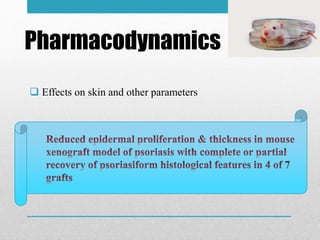
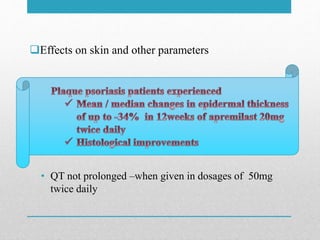
 Effects on skin and other parameters
Effects on skin and other parameters
• QT not prolonged –when given in dosages of 50mg
twice daily
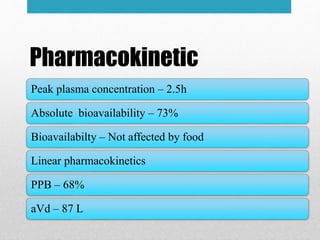
Pharmacokinetic
Peak plasma concentration – 2.5h
Absolute bioavailability – 73%
Bioavailabilty – Not affected by food
Linear pharmacokinetics
PPB – 68%
aVd – 87 L
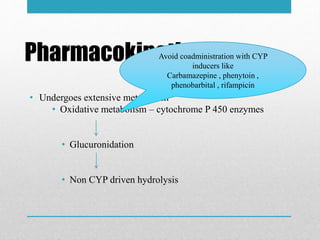
Pharmacokinetic
• Undergoes extensive metabolism
• Oxidative metabolism – cytochrome P 450 enzymes
• Glucuronidation
• Non CYP driven hydrolysis
Avoid coadministration with CYP
inducers like
Carbamazepine , phenytoin ,
phenobarbital , rifampicin
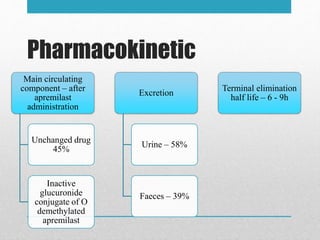
Pharmacokinetic
Main circulating
component – after
apremilast
administration
Unchanged drug
45%
Inactive
glucuronide
conjugate of O
demethylated
apremilast
Excretion
Urine – 58%
Faeces – 39%
Terminal elimination
half life – 6 - 9h
Pharmacokinetic
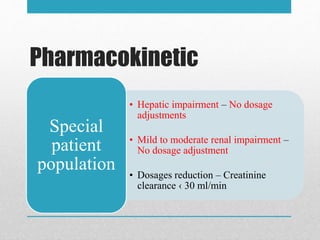
• Hepatic impairment – No dosage
adjustments
• Mild to moderate renal impairment –
No dosage adjustment
• Dosages reduction – Creatinine
clearance ‹ 30 ml/min
Special
patient
population
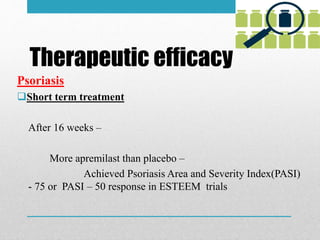
Therapeutic efficacy
Psoriasis
Short term treatment
After 16 weeks –
More apremilast than placebo –
Achieved Psoriasis Area and Severity Index(PASI)
- 75 or PASI – 50 response in ESTEEM trials
• Long term treatment
After 32 weeks –
Apremilast responders re-randomised to apremilast
maintained PASI response at 52 week
Less than quarter of apremilast responders re-
randomised to placebo maintained PASI response
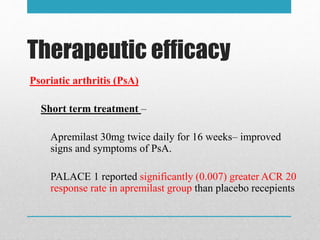
Therapeutic efficacy
Psoriatic arthritis (PsA)
Short term treatment –
Apremilast 30mg twice daily for 16 weeks– improved
signs and symptoms of PsA.
PALACE 1 reported significantly (0.007) greater ACR 20
response rate in apremilast group than placebo recepients
Therapeutic efficacy
Long term treatment –
 PALACE 1, 2 &3 –
 At 52 weeks- Improvements in enthesitis & dactylitis
 At 104 weeks - Benefits of apremilast therapy on PsA in
signs & symptoms, disease activity & physical function
Adverse effects
• Most common adverse effects 30mg twice daily
 Diarrhoea ,URTI &Nausea up to 52weeks
 URTI & nasopharyngitis >52 – 104 weeks
• Apremilast recipients – Experience weight loss
Underweight patients initiating apremilast - Regular bodyweight
monitoring
Discontinuation if clinically significant weight loss occurs
Current status
Oral apremilast 30mg twice daily – Approved in Europe &
USA for treatment of
Moderate to severe chronic plaque psoriasis
 Non responders
or
 Contraindication + to systemic therapies
or
 Intolerannce +
Current status
Active psoriatic arthritis with
 Inadequate response
or to DMARDs
 Intolerance
References
• Drugs (2015) 75; Apremilast : A review in psoriasis and
psoriatic arthritis
• Harrison's Principles of Internal Medicine, 18e
Apremilast
Apremilast
Apremilast
Apremilast
Apremilast
Apremilast
Apremilast
Apremilast
Apremilast
Apremilast

Apremilast

  • 1.
    Apremilast Dr Shinde VirajAshok Junior Resident – 2 Department of Pharmacology GMC Nagpur
  • 2.
  • 3.
    Definition • Chronic inflammatoryskin disorder clinically characterized by erythematous, sharply demarcated papules and rounded plaques, covered by silvery micaceous scale Psoriasis
  • 4.
    Standard treatment of psoriasis •Type, location & extent of disease • Localized , plaque type psoriasis - Midpotency topical glucocorticoids • Long-term use is often accompanied by • Loss of effectiveness • Atrophy of the skin • Topical vitamin D analogue (calcipotriene) & retinoid (tazarotene) - Efficacious
  • 5.
    • Associated with↑ incidence of non melanoma & melanoma skin cancer
  • 6.
    • Methotrexate  Severeor refractory plaque type of psoriasis  Effective agent in patients with psoriatic arthritis • Synthetic retinoid - acitretin  Drug of choice in psoriasis with AIDS  Teratogenicity limits its use • Oral glucocorticoids –  Should not be used for treatment of psoriasis due to potential for developing life-threatening pustular psoriasis when therapy is discontinued
  • 7.
    • Cyclosporine -Very effective in the treatment of psoriasis • Psoriasis - T cell–mediated disorder - has directed therapeutic efforts to immunoregulation • Attention is currently directed towards development of biologic agents with more selective immunosuppressive properties and better safety profiles
  • 8.
    Apremilast • Small moleculeinhibitor of phosphodiesterase(PDE)- 4 (main PDE in inflammatory cells) • Results in down regulation of immune mediators
  • 9.
    Pharmacodynamics Selective inhibitor ofPhosphodiesterase – 4  Effects on immune mediators – • Inhibited production of (in vitro & in animals) • Chemokines ( CXCL9 , CXCL10) • Interleukins (IL2 , 5 ,IL 12 A, IL 13) • Cytokines like interferon α & γ, TNF α and GM- CSF • Adaptive immune mechanism minimally affected – No significant effect on B cell immunoglobulin production
  • 10.
     Effects onimmune mediators • Exploratory analysis of Phase 3 study – PALACE 1 - Psoriatic arthritis patients significantly (p < 0.05 ) reduced circulating levels proinflammatory innate Th 1 immunity components relative to placebo over 4 – 24 weeks of therapy
  • 11.
    Pharmacodynamics  Effects onskin and other parameters
  • 12.
    Effects on skinand other parameters • QT not prolonged –when given in dosages of 50mg twice daily
  • 13.
    Pharmacokinetic Peak plasma concentration– 2.5h Absolute bioavailability – 73% Bioavailabilty – Not affected by food Linear pharmacokinetics PPB – 68% aVd – 87 L
  • 14.
    Pharmacokinetic • Undergoes extensivemetabolism • Oxidative metabolism – cytochrome P 450 enzymes • Glucuronidation • Non CYP driven hydrolysis Avoid coadministration with CYP inducers like Carbamazepine , phenytoin , phenobarbital , rifampicin
  • 15.
    Pharmacokinetic Main circulating component –after apremilast administration Unchanged drug 45% Inactive glucuronide conjugate of O demethylated apremilast Excretion Urine – 58% Faeces – 39% Terminal elimination half life – 6 - 9h
  • 16.
    Pharmacokinetic • Hepatic impairment– No dosage adjustments • Mild to moderate renal impairment – No dosage adjustment • Dosages reduction – Creatinine clearance ‹ 30 ml/min Special patient population
  • 17.
    Therapeutic efficacy Psoriasis Short termtreatment After 16 weeks – More apremilast than placebo – Achieved Psoriasis Area and Severity Index(PASI) - 75 or PASI – 50 response in ESTEEM trials
  • 18.
    • Long termtreatment After 32 weeks – Apremilast responders re-randomised to apremilast maintained PASI response at 52 week Less than quarter of apremilast responders re- randomised to placebo maintained PASI response
  • 19.
    Therapeutic efficacy Psoriatic arthritis(PsA) Short term treatment – Apremilast 30mg twice daily for 16 weeks– improved signs and symptoms of PsA. PALACE 1 reported significantly (0.007) greater ACR 20 response rate in apremilast group than placebo recepients
  • 20.
    Therapeutic efficacy Long termtreatment –  PALACE 1, 2 &3 –  At 52 weeks- Improvements in enthesitis & dactylitis  At 104 weeks - Benefits of apremilast therapy on PsA in signs & symptoms, disease activity & physical function
  • 21.
    Adverse effects • Mostcommon adverse effects 30mg twice daily  Diarrhoea ,URTI &Nausea up to 52weeks  URTI & nasopharyngitis >52 – 104 weeks • Apremilast recipients – Experience weight loss Underweight patients initiating apremilast - Regular bodyweight monitoring Discontinuation if clinically significant weight loss occurs
  • 22.
    Current status Oral apremilast30mg twice daily – Approved in Europe & USA for treatment of Moderate to severe chronic plaque psoriasis  Non responders or  Contraindication + to systemic therapies or  Intolerannce +
  • 23.
    Current status Active psoriaticarthritis with  Inadequate response or to DMARDs  Intolerance
  • 24.
    References • Drugs (2015)75; Apremilast : A review in psoriasis and psoriatic arthritis • Harrison's Principles of Internal Medicine, 18e

Editor's Notes

  • #5 and have largely replaced other topical agents such as coal tar, salicylic acid, and anthralin
  • #6 Ultraviolet light, natural or artificial - effective therapy for widespread psoriasis.
  • #9 PDE4 hydrolyzes cyclic adenosine monophosphate (cAMP) to inactive adenosine monophosphate (AMP). Inhibition of PDE4 blocks hydrolysis of cAMP, thereby increasing levels of cAMP within cell
  • #23  to systemic therapies including cyclosporine, methotrexate or phototherapy with psoralen plus ultraviolet A