Approach For Ptosis
Waqar Qabba’a ,MD
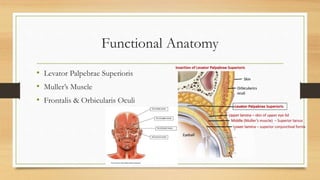
Functional Anatomy
• Levator Palpebrae Superioris
• Muller’s Muscle
• Frontalis & Orbicularis Oculi
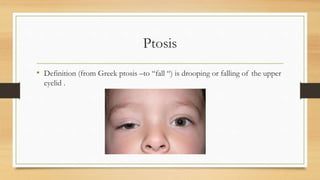
Ptosis
• Definition (from Greek ptosis –to “fall “) is drooping or falling of the upper
eyelid .
Classification
• Congenital
• Acquired
1. myogenic
2.neurogenic
3.mechanical
4.aponeurotic
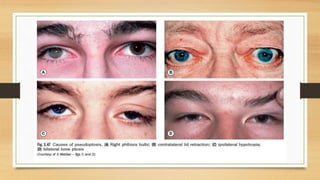
• Pseudoptosis
Pseudoptosis
• Lack of support of the lids by the globe
• Contralateral lid retraction
• Ipsilateral hypotropia
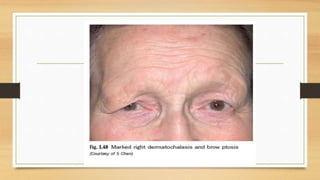
• Brow ptosis
• Dermatochalasis
Clinical Evaluation
• History : age of onset
duration , old photographs
one/both eyes
diurnal variability
• Associated symptoms :
diplopia
dysphagia
muscle weakness
• Vision
• Previous history of :
trauma or surgery
steroid eye drops
• Family history of ptosis or muscle weakness
Ocular Examination
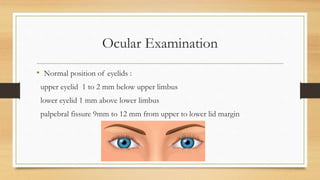
• Normal position of eyelids :
upper eyelid 1 to 2 mm below upper limbus
lower eyelid 1 mm above lower limbus
palpebral fissure 9mm to 12 mm from upper to lower lid margin
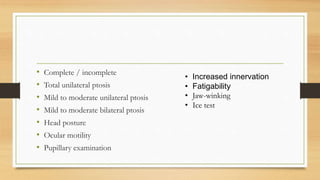
• Complete / incomplete
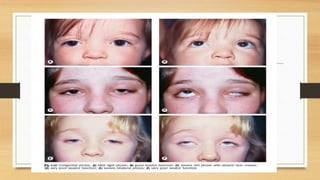
• Total unilateral ptosis
• Mild to moderate unilateral ptosis
• Mild to moderate bilateral ptosis
• Head posture
• Ocular motility
• Pupillary examination
• Increased innervation
• Fatigability
• Jaw-winking
• Ice test
Measurements
• Margin–reflex distance MRD
- distance between the upper lid margin and the
corneal reflection of a pentorch held by the
examiner on which the patient fixates
- the normal measurement is 4–5 mm
- mild (up to 2 mm)., moderate (3 mm)
,severe (4 mm or more).
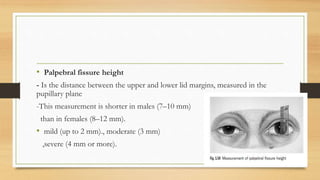
• Palpebral fissure height
- Is the distance between the upper and lower lid margins, measured in the
pupillary plane
-This measurement is shorter in males (7–10 mm)
than in females (8–12 mm).
• mild (up to 2 mm)., moderate (3 mm)
,severe (4 mm or more).
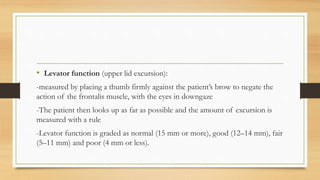
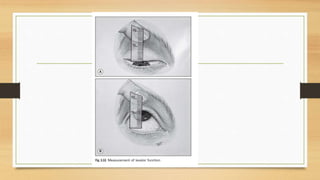
• Levator function (upper lid excursion):
-measured by placing a thumb firmly against the patient’s brow to negate the
action of the frontalis muscle, with the eyes in downgaze
-The patient then looks up as far as possible and the amount of excursion is
measured with a rule
-Levator function is graded as normal (15 mm or more), good (12–14 mm), fair
(5–11 mm) and poor (4 mm or less).
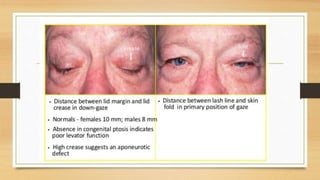
• Upper lid crease
• is taken as the vertical distance between the lid margin and the lid crease in downgaze.
• In females it measures about 10 mm and in males 8 mm.
• Absence of the crease in a patient with congenital ptosis is evidence of poor levator
function, whereas a high crease suggests an aponeurotic defect (usually involutional).
• The skin crease is also used as a guide to the initial incision in some surgical procedures.
• Pretarsal show :
• is the distance between the lid margin and the skin fold with the eyes in the primary
position.
Simple congenital ptosis
• failure of neuronal migration or development with muscular sequelae
secondary to this.
• minority of patients have a family history
Signs
• Unilateral or bilateral ptosis of variable severity.
• Absent upper lid crease and poor levator function.
• In downgaze the ptotic lid is higher than the normal because of poor
relaxation of the levator muscle.
• This is in contrast to acquired ptosis, in which the affected lid is either level
with or lower than the normal lid on downgaze.
• Following surgical correction the lid lag in downgaze may worsen.
Associations
• Superior rectus weakness may be present because of its close embryological
association with the levator
• Compensatory chin elevation in severe bilateral cases.
• Refractive errors are common and more frequently responsible for
amblyopia than the ptosis itself.
Treatment
• Treatment should be carried out during the preschool years once accurate
measurements can be obtained, but may be considered earlier in severe cases
to prevent amblyopia.
• Levator resection is usually required.
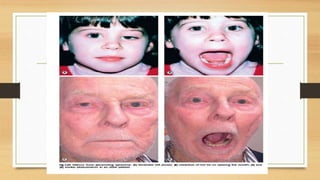
Marcus Gunn jaw-winking syndrome
• 5% of all cases of congenital ptosis are associated with the Marcus Gunn
jaw-winking phenomenon
• The vast majority are unilateral
• the exact aetiology is unclear, it has been postulated that a branch of the
mandibular division of the fifth cranial nerve is misdirected to the levator
muscle
Signs
• Retraction of the ptotic lid in conjunction with stimulation of the ipsilateral
pterygoid muscles by chewing, sucking, opening the mouth or contralateral
jaw movement.
• Less common stimuli to winking include jaw protrusion, smiling, swallowing
and clenching of teeth.
• Jaw-winking does not improve with age , although patients may learn to
mask it.
Treatment
• Surgery should be considered if jaw-winking or ptosis represents a significant
functional or cosmetic problem.
• Mild cases with reasonable levator function of 5 mm or better, and little
synkinetic movement may be treated with unilateral levator advancement.
• Moderate cases. Unilateral levator disinsertion can be performed to address the
synkinetic winking component, with ipsilateral brow (frontalis) suspension so that
lid elevation is due solely to frontalis muscle elevation.
• Bilateral surgery. Bilateral levator disinsertion with bilateral brow suspension may
be carried out to produce a symmetrical result.
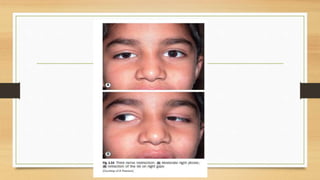
Third nerve misdirection syndromes
• congenital, but more frequently follow acquired third nerve palsy
• Bizarre movements of the upper lid accompany various eye movements
• Ptosis may also occur following aberrant facial nerve regeneration.
• Treatment is by levator disinsertion and brow suspension
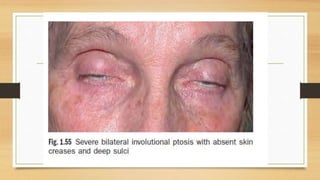
Involutional ptosis
• Involutional (aponeurotic) ptosis is an age-related condition caused by dehiscence,
disinsertion or stretching of the levator aponeurosis.
• Due to fatigue of the Müller muscle it frequently worsens towards the end of the day, so
that it can sometimes be confused with myasthenic ptosis.
• There is a variable, usually bilateral, ptosis with a high upper lid crease and good levator
function.
• In severe cases the upper lid crease may be absent, the eyelid above the tarsal plate very thin
and the upper sulcus deep.
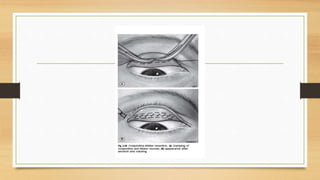
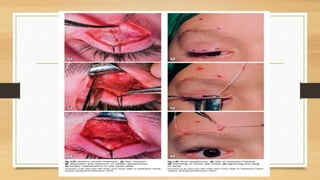
• Treatment options include levator resection, advancement with reinsertion or anterior
levator repair.
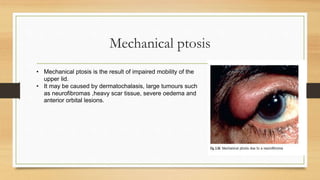
Mechanical ptosis
• Mechanical ptosis is the result of impaired mobility of the
upper lid.
• It may be caused by dermatochalasis, large tumours such
as neurofibromas ,heavy scar tissue, severe oedema and
anterior orbital lesions.
Surgery
• Conjunctiva–Müller resection
The maximal elevation achievable is 2–3 mm (mild ptosis 10mm levator f.)
HORNER AND CONGENITAL PTOSIS
• Levator advancement (resection)
levator complex is shortened through either an anterior – skin – or posterior – conjunctival –
approach
residual levator function is at least 5 mm.
• Brow (frontalis) suspension
severe ptosis (>4 mm)and poor levator function (<4 mm)
• Thank you 

Approach for ptosis

  • 1.
  • 2.
    Functional Anatomy • LevatorPalpebrae Superioris • Muller’s Muscle • Frontalis & Orbicularis Oculi
  • 3.
    Ptosis • Definition (fromGreek ptosis –to “fall “) is drooping or falling of the upper eyelid .
  • 4.
    Classification • Congenital • Acquired 1.myogenic 2.neurogenic 3.mechanical 4.aponeurotic • Pseudoptosis
  • 5.
    Pseudoptosis • Lack ofsupport of the lids by the globe • Contralateral lid retraction • Ipsilateral hypotropia • Brow ptosis • Dermatochalasis
  • 8.
    Clinical Evaluation • History: age of onset duration , old photographs one/both eyes diurnal variability • Associated symptoms : diplopia dysphagia muscle weakness • Vision • Previous history of : trauma or surgery steroid eye drops • Family history of ptosis or muscle weakness
  • 9.
    Ocular Examination • Normalposition of eyelids : upper eyelid 1 to 2 mm below upper limbus lower eyelid 1 mm above lower limbus palpebral fissure 9mm to 12 mm from upper to lower lid margin
  • 10.
    • Complete /incomplete • Total unilateral ptosis • Mild to moderate unilateral ptosis • Mild to moderate bilateral ptosis • Head posture • Ocular motility • Pupillary examination • Increased innervation • Fatigability • Jaw-winking • Ice test
  • 11.
    Measurements • Margin–reflex distanceMRD - distance between the upper lid margin and the corneal reflection of a pentorch held by the examiner on which the patient fixates - the normal measurement is 4–5 mm - mild (up to 2 mm)., moderate (3 mm) ,severe (4 mm or more).
  • 12.
    • Palpebral fissureheight - Is the distance between the upper and lower lid margins, measured in the pupillary plane -This measurement is shorter in males (7–10 mm) than in females (8–12 mm). • mild (up to 2 mm)., moderate (3 mm) ,severe (4 mm or more).
  • 13.
    • Levator function(upper lid excursion): -measured by placing a thumb firmly against the patient’s brow to negate the action of the frontalis muscle, with the eyes in downgaze -The patient then looks up as far as possible and the amount of excursion is measured with a rule -Levator function is graded as normal (15 mm or more), good (12–14 mm), fair (5–11 mm) and poor (4 mm or less).
  • 15.
    • Upper lidcrease • is taken as the vertical distance between the lid margin and the lid crease in downgaze. • In females it measures about 10 mm and in males 8 mm. • Absence of the crease in a patient with congenital ptosis is evidence of poor levator function, whereas a high crease suggests an aponeurotic defect (usually involutional). • The skin crease is also used as a guide to the initial incision in some surgical procedures. • Pretarsal show : • is the distance between the lid margin and the skin fold with the eyes in the primary position.
  • 17.
    Simple congenital ptosis •failure of neuronal migration or development with muscular sequelae secondary to this. • minority of patients have a family history
  • 18.
    Signs • Unilateral orbilateral ptosis of variable severity. • Absent upper lid crease and poor levator function. • In downgaze the ptotic lid is higher than the normal because of poor relaxation of the levator muscle. • This is in contrast to acquired ptosis, in which the affected lid is either level with or lower than the normal lid on downgaze. • Following surgical correction the lid lag in downgaze may worsen.
  • 19.
    Associations • Superior rectusweakness may be present because of its close embryological association with the levator • Compensatory chin elevation in severe bilateral cases. • Refractive errors are common and more frequently responsible for amblyopia than the ptosis itself.
  • 21.
    Treatment • Treatment shouldbe carried out during the preschool years once accurate measurements can be obtained, but may be considered earlier in severe cases to prevent amblyopia. • Levator resection is usually required.
  • 22.
    Marcus Gunn jaw-winkingsyndrome • 5% of all cases of congenital ptosis are associated with the Marcus Gunn jaw-winking phenomenon • The vast majority are unilateral • the exact aetiology is unclear, it has been postulated that a branch of the mandibular division of the fifth cranial nerve is misdirected to the levator muscle
  • 23.
    Signs • Retraction ofthe ptotic lid in conjunction with stimulation of the ipsilateral pterygoid muscles by chewing, sucking, opening the mouth or contralateral jaw movement. • Less common stimuli to winking include jaw protrusion, smiling, swallowing and clenching of teeth. • Jaw-winking does not improve with age , although patients may learn to mask it.
  • 25.
    Treatment • Surgery shouldbe considered if jaw-winking or ptosis represents a significant functional or cosmetic problem. • Mild cases with reasonable levator function of 5 mm or better, and little synkinetic movement may be treated with unilateral levator advancement. • Moderate cases. Unilateral levator disinsertion can be performed to address the synkinetic winking component, with ipsilateral brow (frontalis) suspension so that lid elevation is due solely to frontalis muscle elevation. • Bilateral surgery. Bilateral levator disinsertion with bilateral brow suspension may be carried out to produce a symmetrical result.
  • 26.
    Third nerve misdirectionsyndromes • congenital, but more frequently follow acquired third nerve palsy • Bizarre movements of the upper lid accompany various eye movements • Ptosis may also occur following aberrant facial nerve regeneration. • Treatment is by levator disinsertion and brow suspension
  • 28.
    Involutional ptosis • Involutional(aponeurotic) ptosis is an age-related condition caused by dehiscence, disinsertion or stretching of the levator aponeurosis. • Due to fatigue of the Müller muscle it frequently worsens towards the end of the day, so that it can sometimes be confused with myasthenic ptosis. • There is a variable, usually bilateral, ptosis with a high upper lid crease and good levator function. • In severe cases the upper lid crease may be absent, the eyelid above the tarsal plate very thin and the upper sulcus deep. • Treatment options include levator resection, advancement with reinsertion or anterior levator repair.
  • 30.
    Mechanical ptosis • Mechanicalptosis is the result of impaired mobility of the upper lid. • It may be caused by dermatochalasis, large tumours such as neurofibromas ,heavy scar tissue, severe oedema and anterior orbital lesions.
  • 31.
    Surgery • Conjunctiva–Müller resection Themaximal elevation achievable is 2–3 mm (mild ptosis 10mm levator f.) HORNER AND CONGENITAL PTOSIS • Levator advancement (resection) levator complex is shortened through either an anterior – skin – or posterior – conjunctival – approach residual levator function is at least 5 mm. • Brow (frontalis) suspension severe ptosis (>4 mm)and poor levator function (<4 mm)
  • 34.

Editor's Notes

  • #3 The levator aponeurosis fuses with the orbital septum about 4 mm above the superior border of the tarsal plate (Fig. 1.57). Its posterior fibres insert into the lower third of the anterior surface of the tarsal plate. The medial and lateral horns are expansions that act as check ligaments. Surgically, the aponeurosis can be approached through the skin or conjunctiva. The levator palpebrae superioris originates on the lesser wing of the sphenoid bone, just above the optic foramen. • Müller muscle is inserted into the upper border of the tarsal plate and can be approached transconjunctivally. • The inferior tarsal aponeurosis consists of the capsulopalpebral expansion of the inferior rectus muscle and is analogous to the levator aponeurosis. • The inferior tarsal muscle is analogous to Müller muscle
  • #5 Neurogenic ptosis is caused by an innervational defect such as third nerve paresis and Horner syndrome (see Ch. 19). • Myogenic ptosis is caused by a myopathy of the levator muscle itself, or by impairment of transmission of impulses at the neuromuscular junction (neuromyopathic). Acquired myogenic ptosis occurs in myasthenia gravis, myotonic dystrophy and progressive external ophthalmoplegia (see Ch. 19). • Aponeurotic or involutional ptosis is caused by a defect in the levator aponeurosis. • Mechanical ptosis is caused by the gravitational effect of a mass or by scarring.
  • #6 False impression of ptosis orbital volume deficit associated with an artificial eye, microphthalmos, phthisis bulbi comparing the levels of the upper lids, remembering that the margin of the upper lid normally covers the superior 2 mm of the cornea causes pseudoptosis because the upper lid follows the globe downwards. It disappears when the hypotropic eye assumes fixation on covering the normal eye. excessive skin on the brow, or seventh nerve palsy, which is diagnosed by manually elevating the eyebrow
  • #11 Muscle dystrophy ,mg
  • #14 BURKES METHOD
  • #18 SIMPLE WITH SUP RECTUS WEAKNENING BLEPHAROPHIMOSIS SYNDROME (TELECANTHUS EPI CANTHUS CONGENITAL SYNKINESIS
  • #23 TRIGEMINAL PETYRGOID M WITH OCCULOMOTR
  • #29 POST TRAUMA OR OP
  • #32 Phenylephrine test Brow (frontalis) suspension Brow (frontalis) suspension is used for severe ptosis (>4 mm) with very poor levator function (<4 mm) from a variety of causes, typical indications being ptosis associated with third nerve palsy, blepharophimosis syndrome and following an unsatisfactory result from previous levator resection. The tarsal plate is suspended from the frontalis muscle with a sling consisting of autologous fascia lata (Fig. 1.60) or non-absorbable material such as prolene or silicone.