HELP WANTED: BRIDGING THE SKILLS GAP


Kip Hollister
Founder and CEO, Hollister
Co-Chair, Alliance for Business Leadership
Economic Development Initiative
THE SKILLS GAP – WHAT IS IT?

United States
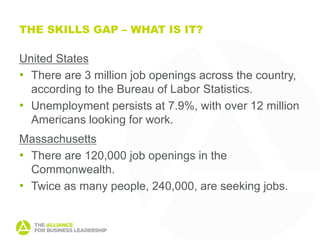
• There are 3 million job openings across the country,
  according to the Bureau of Labor Statistics.
• Unemployment persists at 7.9%, with over 12 million
  Americans looking for work.
Massachusetts
• There are 120,000 job openings in the
  Commonwealth.
• Twice as many people, 240,000, are seeking jobs.
THE SKILLS GAP – WHAT CAUSED IT?

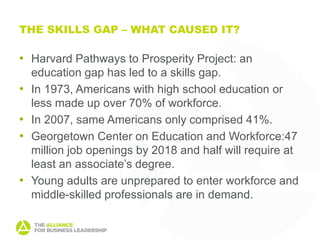
• Harvard Pathways to Prosperity Project: an
    education gap has led to a skills gap.
•   In 1973, Americans with high school education or
    less made up over 70% of workforce.
•   In 2007, same Americans only comprised 41%.
•   Georgetown Center on Education and Workforce:47
    million job openings by 2018 and half will require at
    least an associate’s degree.
•   Young adults are unprepared to enter workforce and
    middle-skilled professionals are in demand.
WHAT CAN GOVERNMENT DO? – FEDERAL LEVEL


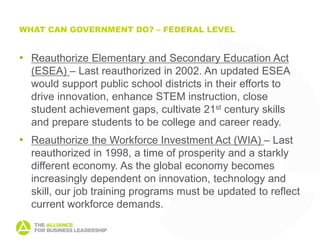
• Reauthorize Elementary and Secondary Education Act
  (ESEA) – Last reauthorized in 2002. An updated ESEA
  would support public school districts in their efforts to
  drive innovation, enhance STEM instruction, close
  student achievement gaps, cultivate 21st century skills
  and prepare students to be college and career ready.
• Reauthorize the Workforce Investment Act (WIA) – Last
  reauthorized in 1998, a time of prosperity and a starkly
  different economy. As the global economy becomes
  increasingly dependent on innovation, technology and
  skill, our job training programs must be updated to reflect
  current workforce demands.
WHAT CAN GOVERNMENT DO? – STATE LEVEL


• Community College Reform – MA Legislature passed
  changes to better align community college instruction
  with prevailing workforce demands. 3 Alliance Members
  were placed on community college boards to provide
  business input.
• Workforce Development Funds – RFP recently issued by
  the Commonwealth Corporation for “Middle Skills Gap
  Grants.” Businesses are eligible to apply. Letters of
  intent must be filed by 11/17. RFP can be accessed via:
  www.commoncorp.org
WHAT CAN BUSINESS DO?


• Companies can provide on-the-job training to workers –
  and there’s even a state grant for training to support
  companies investing in these programs.
• Companies can provide internships to students, which
  can lead to some of the best employees.
• Building leaders within companies and providing
  professional development can also be a powerful way to
  attract and retain top talent, and contribute to a
  sustainable workforce.
• Companies can partner with local community colleges to
  build curriculum. Critical, especially for vocational
  education.
WHAT’S THE BIG IDEA?


High School Innovation Labs
• A platform for educators, students, business and the
  community to develop and pilot initiatives to link learning
  to the 21st century workplace and the social, economic
  and environmental challenges that matter

P-Tech, “9 to 14 Schools”
• P-TECH is a STEM Pathway grade 9 through 14 school
  that confers both the high school diploma and a no-cost
  Associate's degree in technology
QUESTIONS FOR
BREAKOUT SESSION


1. With respect to on-the-job training, internships,
   mentorships or partnerships with academia:
   A. What are the keys to success?
   B. What are the barriers to implementation?

2. What big idea in education reform should the Alliance
   pursue?
   A. Innovation Labs
   B. P-Tech, 9 to 14 Schools
   C. Other: ______
CONTACT INFORMATION


Kip Hollister, Co-Chair
The Alliance Economic Development Initiative
Kip@Hollisterstaff.com

Kelly Bovio, Senior Policy Advisor
 The Alliance for Business Leadership
kbovio@allianceBL.org

The Alliance for Business Leadership
www.AllianceforBusinessLeadership.org

Economic development deck nov summit 2012

  • 1.
    HELP WANTED: BRIDGINGTHE SKILLS GAP Kip Hollister Founder and CEO, Hollister Co-Chair, Alliance for Business Leadership Economic Development Initiative
  • 2.
    THE SKILLS GAP– WHAT IS IT? United States • There are 3 million job openings across the country, according to the Bureau of Labor Statistics. • Unemployment persists at 7.9%, with over 12 million Americans looking for work. Massachusetts • There are 120,000 job openings in the Commonwealth. • Twice as many people, 240,000, are seeking jobs.
  • 3.
    THE SKILLS GAP– WHAT CAUSED IT? • Harvard Pathways to Prosperity Project: an education gap has led to a skills gap. • In 1973, Americans with high school education or less made up over 70% of workforce. • In 2007, same Americans only comprised 41%. • Georgetown Center on Education and Workforce:47 million job openings by 2018 and half will require at least an associate’s degree. • Young adults are unprepared to enter workforce and middle-skilled professionals are in demand.
  • 4.
    WHAT CAN GOVERNMENTDO? – FEDERAL LEVEL • Reauthorize Elementary and Secondary Education Act (ESEA) – Last reauthorized in 2002. An updated ESEA would support public school districts in their efforts to drive innovation, enhance STEM instruction, close student achievement gaps, cultivate 21st century skills and prepare students to be college and career ready. • Reauthorize the Workforce Investment Act (WIA) – Last reauthorized in 1998, a time of prosperity and a starkly different economy. As the global economy becomes increasingly dependent on innovation, technology and skill, our job training programs must be updated to reflect current workforce demands.
  • 5.
    WHAT CAN GOVERNMENTDO? – STATE LEVEL • Community College Reform – MA Legislature passed changes to better align community college instruction with prevailing workforce demands. 3 Alliance Members were placed on community college boards to provide business input. • Workforce Development Funds – RFP recently issued by the Commonwealth Corporation for “Middle Skills Gap Grants.” Businesses are eligible to apply. Letters of intent must be filed by 11/17. RFP can be accessed via: www.commoncorp.org
  • 6.
    WHAT CAN BUSINESSDO? • Companies can provide on-the-job training to workers – and there’s even a state grant for training to support companies investing in these programs. • Companies can provide internships to students, which can lead to some of the best employees. • Building leaders within companies and providing professional development can also be a powerful way to attract and retain top talent, and contribute to a sustainable workforce. • Companies can partner with local community colleges to build curriculum. Critical, especially for vocational education.
  • 7.
    WHAT’S THE BIGIDEA? High School Innovation Labs • A platform for educators, students, business and the community to develop and pilot initiatives to link learning to the 21st century workplace and the social, economic and environmental challenges that matter P-Tech, “9 to 14 Schools” • P-TECH is a STEM Pathway grade 9 through 14 school that confers both the high school diploma and a no-cost Associate's degree in technology
  • 8.
    QUESTIONS FOR BREAKOUT SESSION 1.With respect to on-the-job training, internships, mentorships or partnerships with academia: A. What are the keys to success? B. What are the barriers to implementation? 2. What big idea in education reform should the Alliance pursue? A. Innovation Labs B. P-Tech, 9 to 14 Schools C. Other: ______
  • 9.
    CONTACT INFORMATION Kip Hollister,Co-Chair The Alliance Economic Development Initiative Kip@Hollisterstaff.com Kelly Bovio, Senior Policy Advisor The Alliance for Business Leadership kbovio@allianceBL.org The Alliance for Business Leadership www.AllianceforBusinessLeadership.org