{Appreciative Listening
By: Chester Dave D. Cañedo
What Is Appreciative Listening?
What are the main information to be
included in this topic?
What are the teaching tips in this topic?
What is the function of appreciative
listening?
What are the elements of poetry?
Focus of the Lesson
It is demonstrated through the positive
reaction of a person to the things that he/she
hear.
Wolvin and Coakley (1992)
 It is the listening to obtain sensory
stimulation or enjoyment through “aural
stimuli”. Examples are Jazz Chants, Music,
Poetry, Storytelling, Jokes and others.
Machlis (1996)
Listening resides in dates, face or sound
itself.
Appreciative Listening
Appreciative listening is a type of listening
behavior where the listener seeks certain
information which they will appreciate, for
example that which helps meet his/her needs
and goals. One uses appreciative listening when
listening to good music, poetry or maybe even
the stirring words of a great leader.
Appreciative Listening
Tempo
It is the feature of poetry and music that
makes listening enjoyable.
It refers to the rate or face of movement
of lines in poems.
Tempo could be fast or slow.
Elements of Poetry
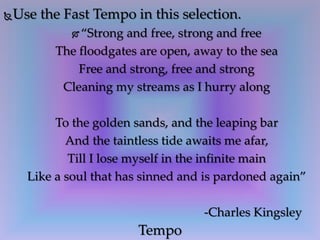
Use the Fast Tempo in this selection.
 “Strong and free, strong and free
The floodgates are open, away to the sea
Free and strong, free and strong
Cleaning my streams as I hurry along
To the golden sands, and the leaping bar
And the taintless tide awaits me afar,
Till I lose myself in the infinite main
Like a soul that has sinned and is pardoned again”
-Charles Kingsley
Tempo
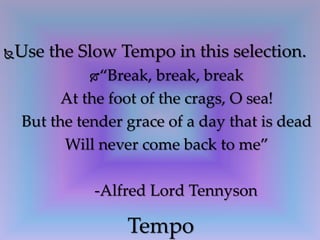
Use the Slow Tempo in this selection.
“Break, break, break
At the foot of the crags, O sea!
But the tender grace of a day that is dead
Will never come back to me”
-Alfred Lord Tennyson
Tempo
Rhythm
It is the total quality of lines motion.
This is the product of regular repetition
of several elements.
One of the highlight of this element is
the Jazz Chants.
Elements of Poetry
Honor your Corner, now’s your chance.
Honor your partner, ready to dance.
Gents to the center and form a star
Round you go, to where your partners are.
Keep on going your almost back,
Now pick her up you’re on the right track.
- Short Stanza from The House that Jack Built
Rhythm
Rhyme
It contributes for interesting and
significant effects usually as “end
– rhyme”.
This is the repetition of sounds
of the last word in two or more
lines
Elements of Poetry
Kreuzen (1966) created 4 Types of
Rhyme
MASCULINE RHYME
A rhyme in which the final and stressed
syllables correspond.
 EXAMPLES:
 Book – Look
 Decline – Design
 Pursue – Review
 Confess - Redress
Rhyme
FEMININE RHYME
A rhyme in which the stressed
sounds are followed by identical
unstressed sounds.
EXAMPLES
Daily – Gaily
Flatter – Matter
Deserving - Swerving
Rhyme
 SLANT RHYME/ HALF RHYME/ OFF RHYME
 Refers to the words that merely approximate
rhymes.
 EXAMPLES:
 “Labor is blossoming or dancing where
The body is not bruised to pleasure soul,
Nor beauty born out of its own despair,
Nor bleau – eyed wisdom of midnight oil.
- William Butler Yeats
“Among Schoolchildren”
Other Examples of Slant Rhymes
 Moonshine – Nine
 Content – Compliment
 Wind - Behind
Rhyme
INTERNAL RHYME
It refers to two or more words that rhyme in
the same line.
 EXAMPLE:
“And a good south wind sprung up behind;
The Albatross did follow,
And everyday, for food or play
Came to the mariner’s hollo!
In mist or cloud, on mast or shroud,
It perched for vespers nine;
Whiles all the night, through fog smoke white,
Glimmered the while moonshine.”
Functions of Rhyme
It is used to emphasize
significant words in a passage
of poetry.
It is sometimes used for
humorous effect.
TONE COLOR
It refers to the predominant and
repeated sounds of letters and words
in a poetry and prose.
Elements of Poetry
Alliteration
 Repetition of initial consonant sounds.
 “Full fathom five my father lies!” – William Shakespeare
Assonance
 Repetition of vowel sounds for effect.
 “Once upon a midnight dreary
As I pondered weak and weary.” – Edgar Allan Poe
Repetition of a word
 “ Pipe a song about a lamb!”
So I piped with merry cheer.
“Piper, pipe that song again.”
So I piped, he wept to hear”
Examples
 Jazz chants are characterized by their beat and tempo
which make them ideal texts to develop appreciative
learning. Carolyn Graham, an ESL teacher and author
of jazz chants suggests steps in teaching this chants.
Jazz Chants
1. Present the situational context of the chant.
2. Clarify vocabulary items and cultural load
inherent in the text.
3. Say the lines of the chant once or twice, as
needed, and have the students repeat the
lines in unison.
4. Establish the beat snapping the fingers,
tapping on a table top, clapping your hands,
etc.
5. Say the lines again and have the student say
them after you.
6. Divide the class into two groups and have
them say the lines alternately.
According to Wolvin and Coakley
(1992)
Appreciative learning is a highly
individualized process. What is
appreciated by one may not necessarily
be appreciated by another. Some
scholars believe that appreciation needs
specific training.
In short, “What some listeners may
appreciate, others may not.”
Enrichment
Farnsworth (1996) suggests that
the appreciative listener’s level of
appreciation depends on the
following:
1. Tonal configuration of the piece
2. Listener’s Personality
3. Listener’s mood prior to the
listening experience
4. Listener’s prior attitude held about
appreciative listening.
Appreciative listening also includes the speech
style ability of an individual in order to make
the sound pleasing to the ears. Here are some
characteristics of effective speech style:
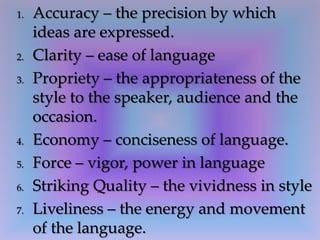
1. Accuracy – the precision by which
ideas are expressed.
2. Clarity – ease of language
3. Propriety – the appropriateness of the
style to the speaker, audience and the
occasion.
4. Economy – conciseness of language.
5. Force – vigor, power in language
6. Striking Quality – the vividness in style
7. Liveliness – the energy and movement
of the language.

Appreciative learning

  • 1.
  • 2.
    What Is AppreciativeListening? What are the main information to be included in this topic? What are the teaching tips in this topic? What is the function of appreciative listening? What are the elements of poetry? Focus of the Lesson
  • 3.
    It is demonstratedthrough the positive reaction of a person to the things that he/she hear. Wolvin and Coakley (1992)  It is the listening to obtain sensory stimulation or enjoyment through “aural stimuli”. Examples are Jazz Chants, Music, Poetry, Storytelling, Jokes and others. Machlis (1996) Listening resides in dates, face or sound itself. Appreciative Listening
  • 4.
    Appreciative listening isa type of listening behavior where the listener seeks certain information which they will appreciate, for example that which helps meet his/her needs and goals. One uses appreciative listening when listening to good music, poetry or maybe even the stirring words of a great leader. Appreciative Listening
  • 5.
    Tempo It is thefeature of poetry and music that makes listening enjoyable. It refers to the rate or face of movement of lines in poems. Tempo could be fast or slow. Elements of Poetry
  • 6.
    Use the FastTempo in this selection.  “Strong and free, strong and free The floodgates are open, away to the sea Free and strong, free and strong Cleaning my streams as I hurry along To the golden sands, and the leaping bar And the taintless tide awaits me afar, Till I lose myself in the infinite main Like a soul that has sinned and is pardoned again” -Charles Kingsley Tempo
  • 7.
    Use the SlowTempo in this selection. “Break, break, break At the foot of the crags, O sea! But the tender grace of a day that is dead Will never come back to me” -Alfred Lord Tennyson Tempo
  • 8.
    Rhythm It is thetotal quality of lines motion. This is the product of regular repetition of several elements. One of the highlight of this element is the Jazz Chants. Elements of Poetry
  • 9.
    Honor your Corner,now’s your chance. Honor your partner, ready to dance. Gents to the center and form a star Round you go, to where your partners are. Keep on going your almost back, Now pick her up you’re on the right track. - Short Stanza from The House that Jack Built Rhythm
  • 10.
    Rhyme It contributes forinteresting and significant effects usually as “end – rhyme”. This is the repetition of sounds of the last word in two or more lines Elements of Poetry
  • 11.
    Kreuzen (1966) created4 Types of Rhyme MASCULINE RHYME A rhyme in which the final and stressed syllables correspond.  EXAMPLES:  Book – Look  Decline – Design  Pursue – Review  Confess - Redress Rhyme
  • 12.
    FEMININE RHYME A rhymein which the stressed sounds are followed by identical unstressed sounds. EXAMPLES Daily – Gaily Flatter – Matter Deserving - Swerving Rhyme
  • 13.
     SLANT RHYME/HALF RHYME/ OFF RHYME  Refers to the words that merely approximate rhymes.  EXAMPLES:  “Labor is blossoming or dancing where The body is not bruised to pleasure soul, Nor beauty born out of its own despair, Nor bleau – eyed wisdom of midnight oil. - William Butler Yeats “Among Schoolchildren”
  • 14.
    Other Examples ofSlant Rhymes  Moonshine – Nine  Content – Compliment  Wind - Behind Rhyme
  • 15.
    INTERNAL RHYME It refersto two or more words that rhyme in the same line.  EXAMPLE: “And a good south wind sprung up behind; The Albatross did follow, And everyday, for food or play Came to the mariner’s hollo! In mist or cloud, on mast or shroud, It perched for vespers nine; Whiles all the night, through fog smoke white, Glimmered the while moonshine.”
  • 16.
    Functions of Rhyme Itis used to emphasize significant words in a passage of poetry. It is sometimes used for humorous effect.
  • 17.
    TONE COLOR It refersto the predominant and repeated sounds of letters and words in a poetry and prose. Elements of Poetry
  • 18.
    Alliteration  Repetition ofinitial consonant sounds.  “Full fathom five my father lies!” – William Shakespeare Assonance  Repetition of vowel sounds for effect.  “Once upon a midnight dreary As I pondered weak and weary.” – Edgar Allan Poe Repetition of a word  “ Pipe a song about a lamb!” So I piped with merry cheer. “Piper, pipe that song again.” So I piped, he wept to hear” Examples
  • 19.
     Jazz chantsare characterized by their beat and tempo which make them ideal texts to develop appreciative learning. Carolyn Graham, an ESL teacher and author of jazz chants suggests steps in teaching this chants. Jazz Chants
  • 20.
    1. Present thesituational context of the chant. 2. Clarify vocabulary items and cultural load inherent in the text. 3. Say the lines of the chant once or twice, as needed, and have the students repeat the lines in unison. 4. Establish the beat snapping the fingers, tapping on a table top, clapping your hands, etc. 5. Say the lines again and have the student say them after you. 6. Divide the class into two groups and have them say the lines alternately.
  • 21.
    According to Wolvinand Coakley (1992) Appreciative learning is a highly individualized process. What is appreciated by one may not necessarily be appreciated by another. Some scholars believe that appreciation needs specific training. In short, “What some listeners may appreciate, others may not.” Enrichment
  • 22.
    Farnsworth (1996) suggeststhat the appreciative listener’s level of appreciation depends on the following: 1. Tonal configuration of the piece 2. Listener’s Personality 3. Listener’s mood prior to the listening experience 4. Listener’s prior attitude held about appreciative listening.
  • 23.
    Appreciative listening alsoincludes the speech style ability of an individual in order to make the sound pleasing to the ears. Here are some characteristics of effective speech style:
  • 24.
    1. Accuracy –the precision by which ideas are expressed. 2. Clarity – ease of language 3. Propriety – the appropriateness of the style to the speaker, audience and the occasion. 4. Economy – conciseness of language. 5. Force – vigor, power in language 6. Striking Quality – the vividness in style 7. Liveliness – the energy and movement of the language.