GLOBAL INTERNAL AUDIT
STANDARDS MASTERCLASS 2024
AGUMA MPAIRWE BA,MBA,CIA,CISA,FCCA.
RUBAVU, RWANDA, JUNE 2024.
DOMAIN 4 - MANAGING THE INTERNAL AUDIT FUNCTION
The chief audit executive is responsible for managing the internal audit function
in accordance with the internal audit charter and Global Internal Audit Standards.
This responsibility includes strategic planning, obtaining and deploying resources,
building relationships, communicating with stakeholders, and
ensuring and enhancing the performance of the function
DOMAIN 4 - MANAGING THE INTERNAL AUDIT FUNCTION
The individual responsible for managing the internal audit function is expected to
conform with the Standards
whether the individual is directly employed by the organization or contracted
through an external service provider.
The specific job title and responsibilities may vary across organizations.
The chief audit executive may delegate appropriate responsibilities to other
qualified professionals in the internal audit function but retains ultimate
accountability
DOMAIN 4 - MANAGING THE INTERNAL AUDIT FUNCTION
The direct reporting relationship between the board and the chief audit
executive enables the internal audit function to fulfill its mandate.
In addition, the chief audit executive typically has an administrative
reporting line to the highest-ranking person in senior management, such as
the chief executive officer,
This supports day-to-day activities and establish the status and authority
necessary to ensure the results of the internal audit services are given due
consideration
PRINCIPLE 9- PLAN STRATEGICALLY
The chief audit executive plans strategically
to position the internal audit function to fulfill its mandate and
achieve long-term success.
PRINCIPLE 9- PLAN STRATEGICALLY
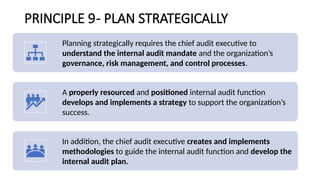
Planning strategically requires the chief audit executive to
understand the internal audit mandate and the organization’s
governance, risk management, and control processes.
A properly resourced and positioned internal audit function
develops and implements a strategy to support the organization’s
success.
In addition, the chief audit executive creates and implements
methodologies to guide the internal audit function and develop the
internal audit plan.
STANDARD 9.1 UNDERSTANDING GOVERNANCE, RISK MANAGEMENT,
AND CONTROL PROCESSES
To develop an effective internal audit strategy and plan, the chief audit executive
must understand
The organization’s governance,
Risk management, and
Control processes.
STANDARD 9.1 UNDERSTANDING GOVERNANCE, RISK MANAGEMENT,
& CONTROL PROCESSES
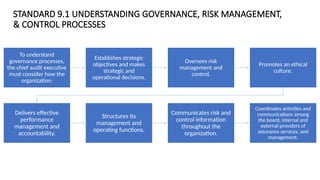
To understand
governance processes,
the chief audit executive
must consider how the
organization:
Establishes strategic
objectives and makes
strategic and
operational decisions.
Oversees risk
management and
control.
Promotes an ethical
culture.
Delivers effective
performance
management and
accountability.
Structures its
management and
operating functions.
Communicates risk and
control information
throughout the
organization.
Coordinates activities and
communications among
the board, internal and
external providers of
assurance services, and
management.
STANDARD 9.1 UNDERSTANDING GOVERNANCE, RISK MANAGEMENT,
& CONTROL PROCESSES
To understand risk management and control processes, the chief audit
executive must consider
how the organization identifies and assesses significant risks and selects
appropriate control processes
STANDARD 9.1 UNDERSTANDING GOVERNANCE, RISK MANAGEMENT,
& CONTROL PROCESSES
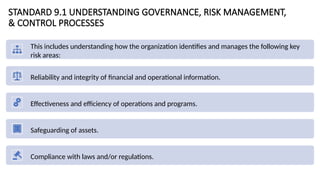
This includes understanding how the organization identifies and manages the following key
risk areas:
Reliability and integrity of financial and operational information.
Effectiveness and efficiency of operations and programs.
Safeguarding of assets.
Compliance with laws and/or regulations.
STANDARD 9.2 INTERNAL AUDIT STRATEGY
The chief audit executive must develop and implement a strategy for the
internal audit function
that supports the strategic objectives and success of the organization and
aligns with expectations of
expectations of the board, senior management, and other key
stakeholders.
STANDARD 9.2 INTERNAL AUDIT STRATEGY
An internal audit strategy is a plan of action designed to achieve a long-
term or overall objective.
The internal audit strategy must include a vision, strategic objectives,
and supporting initiatives for the internal audit function.
An internal audit strategy helps guide the internal audit function
toward the fulfillment of the internal audit mandate.
STANDARD 9.2
INTERNAL AUDIT
STRATEGY
The chief audit executive
must review the internal
audit strategy with the
board and senior
management periodically.
STANDARD 9.3 METHODOLOGIES
The chief audit executive must establish methodologies
to guide the internal audit function in a systematic and disciplined manner
to implement the internal audit strategy,
develop the internal audit plan, and
conform with the Standards.
STANDARD 9.3 METHODOLOGIES
The chief audit executive must evaluate the effectiveness of the
methodologies and
update them as necessary to improve the internal audit function
and respond to significant changes that affect the function.
The chief audit executive must provide internal auditors with
training on the methodologies.
STANDARD 9.4 INTERNAL
AUDIT PLAN
“The chief audit executive must
create an internal audit plan that
supports the achievement of the
organization’s objectives”.
STANDARD 9.4 INTERNAL AUDIT PLAN
The chief audit executive must base the internal audit plan on a documented
assessment of the organization’s strategies, objectives, and risks.
This assessment must be informed by input from the board and senior management as
well as
the chief audit executive’s understanding of the organization’s governance, risk
management, and control processes.
The assessment must be performed at least annually
STANDARD 9.4 INTERNAL AUDIT PLAN
Must consider the internal audit mandate and the full range of agreed-to internal audit services.
Specify internal audit services that support the evaluation and improvement of the
organization’s governance, risk management, and control processes.
Consider coverage of information technology governance, fraud risk, the effectiveness of the
organization’s compliance and ethics programs, and other high-risk areas.
Identify the necessary human, financial, and technological resources necessary to complete the
plan.
Be dynamic and updated timely in response to changes in the organization’s business, risks
operations, programs, systems, controls, and organizational culture
STANDARD 9.4 INTERNAL AUDIT PLAN
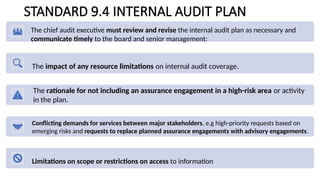
The chief audit executive must review and revise the internal audit plan as necessary and
communicate timely to the board and senior management:
The impact of any resource limitations on internal audit coverage.
The rationale for not including an assurance engagement in a high-risk area or activity
in the plan.
Conflicting demands for services between major stakeholders, e.g high-priority requests based on
emerging risks and requests to replace planned assurance engagements with advisory engagements.
Limitations on scope or restrictions on access to information
STANDARD 9.4 INTERNAL AUDIT PLAN
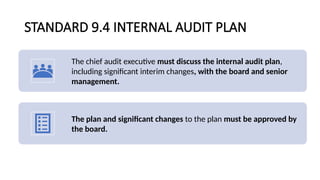
The chief audit executive must discuss the internal audit plan,
including significant interim changes, with the board and senior
management.
The plan and significant changes to the plan must be approved by
the board.
STANDARD 9.5 COORDINATION AND RELIANCE
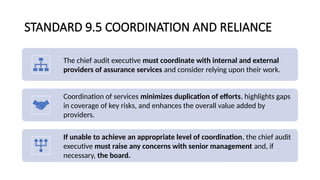
The chief audit executive must coordinate with internal and external
providers of assurance services and consider relying upon their work.
Coordination of services minimizes duplication of efforts, highlights gaps
in coverage of key risks, and enhances the overall value added by
providers.
If unable to achieve an appropriate level of coordination, the chief audit
executive must raise any concerns with senior management and, if
necessary, the board.
STANDARD 9.5 COORDINATION AND
RELIANCE
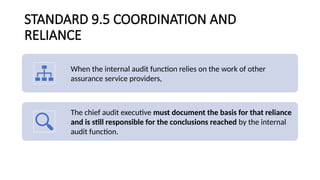
When the internal audit function relies on the work of other
assurance service providers,
The chief audit executive must document the basis for that reliance
and is still responsible for the conclusions reached by the internal
audit function.
PRINCIPLE 10 MANAGE
RESOURCES
• “The chief audit executive
manages resources to
implement the internal audit
function’s strategy and achieve
its plan and mandate”.
PRINCIPLE 10 MANAGE RESOURCES
Managing resources requires obtaining and deploying financial,
human, and technological resources effectively.
The chief audit executive needs to obtain the resources required to
perform internal audit responsibilities and
deploy the resources according to the methodologies established
for the internal audit function.
STANDARD 10.1 FINANCIAL RESOURCE MANAGEMENT
The chief audit executive must manage the internal audit function’s financial
resources.
The chief audit executive must develop a budget that enables the successful
implementation of the internal audit strategy and achievement of the plan.
The budget includes the resources necessary for the function’s operation, including
training and acquisition of technology and tools.
The chief audit executive must manage the day-to-day activities of the internal audit
function effectively and efficiently, in alignment with the budget.
STANDARD 10.1 FINANCIAL RESOURCE MANAGEMENT
The chief audit executive must seek budget approval from the board.
The chief audit executive must communicate promptly the impact of
insufficient financial resources to the board and senior management.
STANDARD 10.2 HUMAN RESOURCES MANAGEMENT
The chief audit executive must establish an approach to recruit,
develop, and retain internal auditors
These should be qualified to successfully implement the
internal audit strategy and achieve the internal audit plan.
STANDARD 10.2 HUMAN RESOURCES
MANAGEMENT
The chief audit executive must strive to ensure that human
resources are appropriate, sufficient, and effectively deployed to
achieve the approved internal audit plan.
Appropriate refers to the mix of knowledge, skills, and abilities;
sufficient refers to the quantity of resources; and
Effective deployment refers to assigning resources in a way that
optimizes the achievement of the internal audit plan.
STANDARD 10.2 HUMAN RESOURCES MANAGEMENT
The chief audit executive must communicate with the board and senior management
regarding the appropriateness and sufficiency of the internal audit function’s human
resources.
If the function lacks appropriate and sufficient human resources to achieve the internal
audit plan, the chief audit executive must
determine how to obtain the resources
or communicate timely to the board and senior management the impact of the
limitations.
STANDARD 10.2 HUMAN RESOURCES
MANAGEMENT
The chief audit executive must evaluate the competencies of individual
internal auditors within the internal audit function and encourage
professional development.
The chief audit executive must collaborate with internal auditors to
help them develop their individual competencies through training,
supervisory feedback, and/or mentoring.
STANDARD 10.3 TECHNOLOGICAL RESOURCES
The chief audit executive must strive to ensure that the internal audit
function has technology to support the internal audit process.
The chief audit executive must regularly evaluate the technology used
by the internal audit function and pursue opportunities to improve
effectiveness and efficiency.
STANDARD 10.3 TECHNOLOGICAL RESOURCES
When implementing new technology, the chief audit executive must
implement appropriate training for internal auditors in the effective use
of technological resources.
The chief audit executive must collaborate with the organization’s
information technology and information security functions to
implement technological resources properly.
The chief audit executive must communicate the impact of technology
limitations on the effectiveness or efficiency of the internal audit
function to the board and senior management.
PRINCIPLE 11- COMMUNICATE
EFFECTIVELY
“The chief audit executive
guides the internal audit
function to communicate
effectively with its
stakeholders”.
PRINCIPLE 11- COMMUNICATE EFFECTIVELY
Effective communication requires building relationships, establishing trust,
and enabling stakeholders to benefit from the results of internal audit
services.
The chief audit executive is responsible for helping the internal audit
function establish ongoing communication with stakeholders to build trust
and foster relationships.
Additionally, the chief audit executive oversees the internal audit function’s
formal communications with the board and senior management to enable
quality and provide insights based on the results of internal audit services.
STANDARD 11.1 BUILDING RELATIONSHIPS & COMMUNICATING
WITH STAKEHOLDERS
The chief audit executive must develop an approach for the internal audit function to build
relationships and trust with key stakeholders, including the
Board,
Senior management,
Operational management,
Regulators, and
Internal and external assurance providers and other consultants.
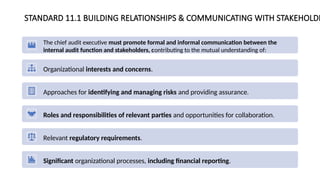
STANDARD 11.1 BUILDING RELATIONSHIPS & COMMUNICATING WITH STAKEHOLDE
The chief audit executive must promote formal and informal communication between the
internal audit function and stakeholders, contributing to the mutual understanding of:
Organizational interests and concerns.
Approaches for identifying and managing risks and providing assurance.
Roles and responsibilities of relevant parties and opportunities for collaboration.
Relevant regulatory requirements.
Significant organizational processes, including financial reporting.
STANDARD 11.2 EFFECTIVE COMMUNICATION
The chief audit executive must establish and implement methodologies to promote
Accurate,
Objective,
Clear,
Concise,
Constructive,
Complete, and
Timely internal audit communications.
STANDARD 11.3 COMMUNICATING RESULTS
The chief audit executive must communicate the results of internal
audit services to the board and senior management periodically and
for each engagement as appropriate.
The chief audit executive must understand the expectations of the
board and senior management regarding the nature and timing of
communications.
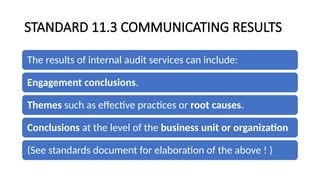
STANDARD 11.3 COMMUNICATING RESULTS
The results of internal audit services can include:
Engagement conclusions.
Themes such as effective practices or root causes.
Conclusions at the level of the business unit or organization
(See standards document for elaboration of the above ! )
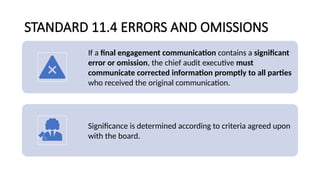
STANDARD 11.4 ERRORS AND OMISSIONS
If a final engagement communication contains a significant
error or omission, the chief audit executive must
communicate corrected information promptly to all parties
who received the original communication.
Significance is determined according to criteria agreed upon
with the board.
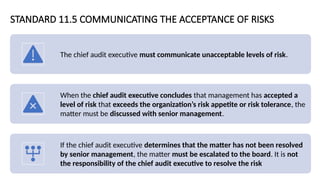
STANDARD 11.5 COMMUNICATING THE ACCEPTANCE OF RISKS
The chief audit executive must communicate unacceptable levels of risk.
When the chief audit executive concludes that management has accepted a
level of risk that exceeds the organization’s risk appetite or risk tolerance, the
matter must be discussed with senior management.
If the chief audit executive determines that the matter has not been resolved
by senior management, the matter must be escalated to the board. It is not
the responsibility of the chief audit executive to resolve the risk
PRINCIPLE 12- ENHANCE QUALITY
“The chief audit executive is responsible
for the internal audit function’s
conformance with the Global Internal
Audit Standards and continuous
performance improvement”.
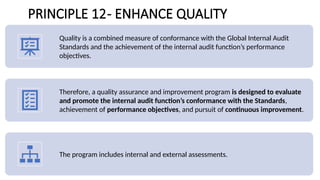
PRINCIPLE 12- ENHANCE QUALITY
Quality is a combined measure of conformance with the Global Internal Audit
Standards and the achievement of the internal audit function’s performance
objectives.
Therefore, a quality assurance and improvement program is designed to evaluate
and promote the internal audit function’s conformance with the Standards,
achievement of performance objectives, and pursuit of continuous improvement.
The program includes internal and external assessments.
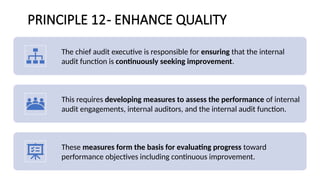
PRINCIPLE 12- ENHANCE QUALITY
The chief audit executive is responsible for ensuring that the internal
audit function is continuously seeking improvement.
This requires developing measures to assess the performance of internal
audit engagements, internal auditors, and the internal audit function.
These measures form the basis for evaluating progress toward
performance objectives including continuous improvement.
STANDARD 12.1 INTERNAL QUALITY ASSESSMENT
The chief audit executive must develop and conduct internal
assessments of the internal audit function’s conformance with the
Global Internal Audit Standards and
Progress toward performance objectives.
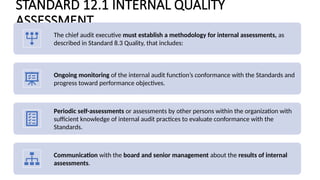
STANDARD 12.1 INTERNAL QUALITY
ASSESSMENT
The chief audit executive must establish a methodology for internal assessments, as
described in Standard 8.3 Quality, that includes:
Ongoing monitoring of the internal audit function’s conformance with the Standards and
progress toward performance objectives.
Periodic self-assessments or assessments by other persons within the organization with
sufficient knowledge of internal audit practices to evaluate conformance with the
Standards.
Communication with the board and senior management about the results of internal
assessments.
STANDARD 12.1 INTERNAL QUALITY
ASSESSMENT
Based on the results of periodic self-assessments, the chief audit
executive must develop action plans to address instances of
nonconformance with the Standards and opportunities for
improvement, including a proposed timeline for actions.
The chief audit executive must communicate the results of periodic
self-assessments and action plans to the board and senior
management.
STANDARD 12.1 INTERNAL QUALITY
ASSESSMENT
Internal assessments must be documented and included in the
evaluation conducted by an independent third party as part of the
organization’s external quality assessment.
If nonconformance with the Standards affects the overall scope or
operation of the internal audit function, the chief audit executive must
disclose to the board and senior management the nonconformance and
its impact.
STANDARD 12.2 PERFORMANCE MEASUREMENT
The chief audit executive must develop objectives to evaluate the internal
audit function’s performance.
The chief audit executive must consider the input and expectations of the
board and senior management when developing the performance objectives.
The chief audit executive must develop a performance measurement
methodology to assess progress toward achieving the function’s objectives
and to promote the continuous improvement of the internal audit function.
STANDARD 12.2 PERFORMANCE
MEASUREMENT
When assessing the internal audit function’s performance, the
chief audit executive must solicit feedback from the board and
senior management as appropriate.
The chief audit executive must develop an action plan to address
issues and opportunities for improvement
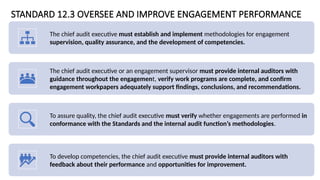
STANDARD 12.3 OVERSEE AND IMPROVE ENGAGEMENT PERFORMANCE
The chief audit executive must establish and implement methodologies for engagement
supervision, quality assurance, and the development of competencies.
The chief audit executive or an engagement supervisor must provide internal auditors with
guidance throughout the engagement, verify work programs are complete, and confirm
engagement workpapers adequately support findings, conclusions, and recommendations.
To assure quality, the chief audit executive must verify whether engagements are performed in
conformance with the Standards and the internal audit function’s methodologies.
To develop competencies, the chief audit executive must provide internal auditors with
feedback about their performance and opportunities for improvement.
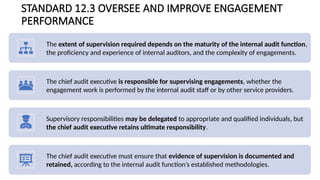
STANDARD 12.3 OVERSEE AND IMPROVE ENGAGEMENT
PERFORMANCE
The extent of supervision required depends on the maturity of the internal audit function,
the proficiency and experience of internal auditors, and the complexity of engagements.
The chief audit executive is responsible for supervising engagements, whether the
engagement work is performed by the internal audit staff or by other service providers.
Supervisory responsibilities may be delegated to appropriate and qualified individuals, but
the chief audit executive retains ultimate responsibility.
The chief audit executive must ensure that evidence of supervision is documented and
retained, according to the internal audit function’s established methodologies.
.
QUESTION TIME

RAINING SLIDES DOMAIN 1 - MANAGING THE INTERNAL AUDIT FUNCTIONs.pptx

  • 1.
    GLOBAL INTERNAL AUDIT STANDARDSMASTERCLASS 2024 AGUMA MPAIRWE BA,MBA,CIA,CISA,FCCA. RUBAVU, RWANDA, JUNE 2024.
  • 2.
    DOMAIN 4 -MANAGING THE INTERNAL AUDIT FUNCTION The chief audit executive is responsible for managing the internal audit function in accordance with the internal audit charter and Global Internal Audit Standards. This responsibility includes strategic planning, obtaining and deploying resources, building relationships, communicating with stakeholders, and ensuring and enhancing the performance of the function
  • 3.
    DOMAIN 4 -MANAGING THE INTERNAL AUDIT FUNCTION The individual responsible for managing the internal audit function is expected to conform with the Standards whether the individual is directly employed by the organization or contracted through an external service provider. The specific job title and responsibilities may vary across organizations. The chief audit executive may delegate appropriate responsibilities to other qualified professionals in the internal audit function but retains ultimate accountability
  • 4.
    DOMAIN 4 -MANAGING THE INTERNAL AUDIT FUNCTION The direct reporting relationship between the board and the chief audit executive enables the internal audit function to fulfill its mandate. In addition, the chief audit executive typically has an administrative reporting line to the highest-ranking person in senior management, such as the chief executive officer, This supports day-to-day activities and establish the status and authority necessary to ensure the results of the internal audit services are given due consideration
  • 5.
    PRINCIPLE 9- PLANSTRATEGICALLY The chief audit executive plans strategically to position the internal audit function to fulfill its mandate and achieve long-term success.
  • 6.
    PRINCIPLE 9- PLANSTRATEGICALLY Planning strategically requires the chief audit executive to understand the internal audit mandate and the organization’s governance, risk management, and control processes. A properly resourced and positioned internal audit function develops and implements a strategy to support the organization’s success. In addition, the chief audit executive creates and implements methodologies to guide the internal audit function and develop the internal audit plan.
  • 7.
    STANDARD 9.1 UNDERSTANDINGGOVERNANCE, RISK MANAGEMENT, AND CONTROL PROCESSES To develop an effective internal audit strategy and plan, the chief audit executive must understand The organization’s governance, Risk management, and Control processes.
  • 8.
    STANDARD 9.1 UNDERSTANDINGGOVERNANCE, RISK MANAGEMENT, & CONTROL PROCESSES To understand governance processes, the chief audit executive must consider how the organization: Establishes strategic objectives and makes strategic and operational decisions. Oversees risk management and control. Promotes an ethical culture. Delivers effective performance management and accountability. Structures its management and operating functions. Communicates risk and control information throughout the organization. Coordinates activities and communications among the board, internal and external providers of assurance services, and management.
  • 9.
    STANDARD 9.1 UNDERSTANDINGGOVERNANCE, RISK MANAGEMENT, & CONTROL PROCESSES To understand risk management and control processes, the chief audit executive must consider how the organization identifies and assesses significant risks and selects appropriate control processes
  • 10.
    STANDARD 9.1 UNDERSTANDINGGOVERNANCE, RISK MANAGEMENT, & CONTROL PROCESSES This includes understanding how the organization identifies and manages the following key risk areas: Reliability and integrity of financial and operational information. Effectiveness and efficiency of operations and programs. Safeguarding of assets. Compliance with laws and/or regulations.
  • 11.
    STANDARD 9.2 INTERNALAUDIT STRATEGY The chief audit executive must develop and implement a strategy for the internal audit function that supports the strategic objectives and success of the organization and aligns with expectations of expectations of the board, senior management, and other key stakeholders.
  • 12.
    STANDARD 9.2 INTERNALAUDIT STRATEGY An internal audit strategy is a plan of action designed to achieve a long- term or overall objective. The internal audit strategy must include a vision, strategic objectives, and supporting initiatives for the internal audit function. An internal audit strategy helps guide the internal audit function toward the fulfillment of the internal audit mandate.
  • 13.
    STANDARD 9.2 INTERNAL AUDIT STRATEGY Thechief audit executive must review the internal audit strategy with the board and senior management periodically.
  • 14.
    STANDARD 9.3 METHODOLOGIES Thechief audit executive must establish methodologies to guide the internal audit function in a systematic and disciplined manner to implement the internal audit strategy, develop the internal audit plan, and conform with the Standards.
  • 15.
    STANDARD 9.3 METHODOLOGIES Thechief audit executive must evaluate the effectiveness of the methodologies and update them as necessary to improve the internal audit function and respond to significant changes that affect the function. The chief audit executive must provide internal auditors with training on the methodologies.
  • 16.
    STANDARD 9.4 INTERNAL AUDITPLAN “The chief audit executive must create an internal audit plan that supports the achievement of the organization’s objectives”.
  • 17.
    STANDARD 9.4 INTERNALAUDIT PLAN The chief audit executive must base the internal audit plan on a documented assessment of the organization’s strategies, objectives, and risks. This assessment must be informed by input from the board and senior management as well as the chief audit executive’s understanding of the organization’s governance, risk management, and control processes. The assessment must be performed at least annually
  • 18.
    STANDARD 9.4 INTERNALAUDIT PLAN Must consider the internal audit mandate and the full range of agreed-to internal audit services. Specify internal audit services that support the evaluation and improvement of the organization’s governance, risk management, and control processes. Consider coverage of information technology governance, fraud risk, the effectiveness of the organization’s compliance and ethics programs, and other high-risk areas. Identify the necessary human, financial, and technological resources necessary to complete the plan. Be dynamic and updated timely in response to changes in the organization’s business, risks operations, programs, systems, controls, and organizational culture
  • 19.
    STANDARD 9.4 INTERNALAUDIT PLAN The chief audit executive must review and revise the internal audit plan as necessary and communicate timely to the board and senior management: The impact of any resource limitations on internal audit coverage. The rationale for not including an assurance engagement in a high-risk area or activity in the plan. Conflicting demands for services between major stakeholders, e.g high-priority requests based on emerging risks and requests to replace planned assurance engagements with advisory engagements. Limitations on scope or restrictions on access to information
  • 20.
    STANDARD 9.4 INTERNALAUDIT PLAN The chief audit executive must discuss the internal audit plan, including significant interim changes, with the board and senior management. The plan and significant changes to the plan must be approved by the board.
  • 21.
    STANDARD 9.5 COORDINATIONAND RELIANCE The chief audit executive must coordinate with internal and external providers of assurance services and consider relying upon their work. Coordination of services minimizes duplication of efforts, highlights gaps in coverage of key risks, and enhances the overall value added by providers. If unable to achieve an appropriate level of coordination, the chief audit executive must raise any concerns with senior management and, if necessary, the board.
  • 22.
    STANDARD 9.5 COORDINATIONAND RELIANCE When the internal audit function relies on the work of other assurance service providers, The chief audit executive must document the basis for that reliance and is still responsible for the conclusions reached by the internal audit function.
  • 23.
    PRINCIPLE 10 MANAGE RESOURCES •“The chief audit executive manages resources to implement the internal audit function’s strategy and achieve its plan and mandate”.
  • 24.
    PRINCIPLE 10 MANAGERESOURCES Managing resources requires obtaining and deploying financial, human, and technological resources effectively. The chief audit executive needs to obtain the resources required to perform internal audit responsibilities and deploy the resources according to the methodologies established for the internal audit function.
  • 25.
    STANDARD 10.1 FINANCIALRESOURCE MANAGEMENT The chief audit executive must manage the internal audit function’s financial resources. The chief audit executive must develop a budget that enables the successful implementation of the internal audit strategy and achievement of the plan. The budget includes the resources necessary for the function’s operation, including training and acquisition of technology and tools. The chief audit executive must manage the day-to-day activities of the internal audit function effectively and efficiently, in alignment with the budget.
  • 26.
    STANDARD 10.1 FINANCIALRESOURCE MANAGEMENT The chief audit executive must seek budget approval from the board. The chief audit executive must communicate promptly the impact of insufficient financial resources to the board and senior management.
  • 27.
    STANDARD 10.2 HUMANRESOURCES MANAGEMENT The chief audit executive must establish an approach to recruit, develop, and retain internal auditors These should be qualified to successfully implement the internal audit strategy and achieve the internal audit plan.
  • 28.
    STANDARD 10.2 HUMANRESOURCES MANAGEMENT The chief audit executive must strive to ensure that human resources are appropriate, sufficient, and effectively deployed to achieve the approved internal audit plan. Appropriate refers to the mix of knowledge, skills, and abilities; sufficient refers to the quantity of resources; and Effective deployment refers to assigning resources in a way that optimizes the achievement of the internal audit plan.
  • 29.
    STANDARD 10.2 HUMANRESOURCES MANAGEMENT The chief audit executive must communicate with the board and senior management regarding the appropriateness and sufficiency of the internal audit function’s human resources. If the function lacks appropriate and sufficient human resources to achieve the internal audit plan, the chief audit executive must determine how to obtain the resources or communicate timely to the board and senior management the impact of the limitations.
  • 30.
    STANDARD 10.2 HUMANRESOURCES MANAGEMENT The chief audit executive must evaluate the competencies of individual internal auditors within the internal audit function and encourage professional development. The chief audit executive must collaborate with internal auditors to help them develop their individual competencies through training, supervisory feedback, and/or mentoring.
  • 31.
    STANDARD 10.3 TECHNOLOGICALRESOURCES The chief audit executive must strive to ensure that the internal audit function has technology to support the internal audit process. The chief audit executive must regularly evaluate the technology used by the internal audit function and pursue opportunities to improve effectiveness and efficiency.
  • 32.
    STANDARD 10.3 TECHNOLOGICALRESOURCES When implementing new technology, the chief audit executive must implement appropriate training for internal auditors in the effective use of technological resources. The chief audit executive must collaborate with the organization’s information technology and information security functions to implement technological resources properly. The chief audit executive must communicate the impact of technology limitations on the effectiveness or efficiency of the internal audit function to the board and senior management.
  • 33.
    PRINCIPLE 11- COMMUNICATE EFFECTIVELY “Thechief audit executive guides the internal audit function to communicate effectively with its stakeholders”.
  • 34.
    PRINCIPLE 11- COMMUNICATEEFFECTIVELY Effective communication requires building relationships, establishing trust, and enabling stakeholders to benefit from the results of internal audit services. The chief audit executive is responsible for helping the internal audit function establish ongoing communication with stakeholders to build trust and foster relationships. Additionally, the chief audit executive oversees the internal audit function’s formal communications with the board and senior management to enable quality and provide insights based on the results of internal audit services.
  • 35.
    STANDARD 11.1 BUILDINGRELATIONSHIPS & COMMUNICATING WITH STAKEHOLDERS The chief audit executive must develop an approach for the internal audit function to build relationships and trust with key stakeholders, including the Board, Senior management, Operational management, Regulators, and Internal and external assurance providers and other consultants.
  • 36.
    STANDARD 11.1 BUILDINGRELATIONSHIPS & COMMUNICATING WITH STAKEHOLDE The chief audit executive must promote formal and informal communication between the internal audit function and stakeholders, contributing to the mutual understanding of: Organizational interests and concerns. Approaches for identifying and managing risks and providing assurance. Roles and responsibilities of relevant parties and opportunities for collaboration. Relevant regulatory requirements. Significant organizational processes, including financial reporting.
  • 37.
    STANDARD 11.2 EFFECTIVECOMMUNICATION The chief audit executive must establish and implement methodologies to promote Accurate, Objective, Clear, Concise, Constructive, Complete, and Timely internal audit communications.
  • 38.
    STANDARD 11.3 COMMUNICATINGRESULTS The chief audit executive must communicate the results of internal audit services to the board and senior management periodically and for each engagement as appropriate. The chief audit executive must understand the expectations of the board and senior management regarding the nature and timing of communications.
  • 39.
    STANDARD 11.3 COMMUNICATINGRESULTS The results of internal audit services can include: Engagement conclusions. Themes such as effective practices or root causes. Conclusions at the level of the business unit or organization (See standards document for elaboration of the above ! )
  • 40.
    STANDARD 11.4 ERRORSAND OMISSIONS If a final engagement communication contains a significant error or omission, the chief audit executive must communicate corrected information promptly to all parties who received the original communication. Significance is determined according to criteria agreed upon with the board.
  • 41.
    STANDARD 11.5 COMMUNICATINGTHE ACCEPTANCE OF RISKS The chief audit executive must communicate unacceptable levels of risk. When the chief audit executive concludes that management has accepted a level of risk that exceeds the organization’s risk appetite or risk tolerance, the matter must be discussed with senior management. If the chief audit executive determines that the matter has not been resolved by senior management, the matter must be escalated to the board. It is not the responsibility of the chief audit executive to resolve the risk
  • 42.
    PRINCIPLE 12- ENHANCEQUALITY “The chief audit executive is responsible for the internal audit function’s conformance with the Global Internal Audit Standards and continuous performance improvement”.
  • 43.
    PRINCIPLE 12- ENHANCEQUALITY Quality is a combined measure of conformance with the Global Internal Audit Standards and the achievement of the internal audit function’s performance objectives. Therefore, a quality assurance and improvement program is designed to evaluate and promote the internal audit function’s conformance with the Standards, achievement of performance objectives, and pursuit of continuous improvement. The program includes internal and external assessments.
  • 44.
    PRINCIPLE 12- ENHANCEQUALITY The chief audit executive is responsible for ensuring that the internal audit function is continuously seeking improvement. This requires developing measures to assess the performance of internal audit engagements, internal auditors, and the internal audit function. These measures form the basis for evaluating progress toward performance objectives including continuous improvement.
  • 45.
    STANDARD 12.1 INTERNALQUALITY ASSESSMENT The chief audit executive must develop and conduct internal assessments of the internal audit function’s conformance with the Global Internal Audit Standards and Progress toward performance objectives.
  • 46.
    STANDARD 12.1 INTERNALQUALITY ASSESSMENT The chief audit executive must establish a methodology for internal assessments, as described in Standard 8.3 Quality, that includes: Ongoing monitoring of the internal audit function’s conformance with the Standards and progress toward performance objectives. Periodic self-assessments or assessments by other persons within the organization with sufficient knowledge of internal audit practices to evaluate conformance with the Standards. Communication with the board and senior management about the results of internal assessments.
  • 47.
    STANDARD 12.1 INTERNALQUALITY ASSESSMENT Based on the results of periodic self-assessments, the chief audit executive must develop action plans to address instances of nonconformance with the Standards and opportunities for improvement, including a proposed timeline for actions. The chief audit executive must communicate the results of periodic self-assessments and action plans to the board and senior management.
  • 48.
    STANDARD 12.1 INTERNALQUALITY ASSESSMENT Internal assessments must be documented and included in the evaluation conducted by an independent third party as part of the organization’s external quality assessment. If nonconformance with the Standards affects the overall scope or operation of the internal audit function, the chief audit executive must disclose to the board and senior management the nonconformance and its impact.
  • 49.
    STANDARD 12.2 PERFORMANCEMEASUREMENT The chief audit executive must develop objectives to evaluate the internal audit function’s performance. The chief audit executive must consider the input and expectations of the board and senior management when developing the performance objectives. The chief audit executive must develop a performance measurement methodology to assess progress toward achieving the function’s objectives and to promote the continuous improvement of the internal audit function.
  • 50.
    STANDARD 12.2 PERFORMANCE MEASUREMENT Whenassessing the internal audit function’s performance, the chief audit executive must solicit feedback from the board and senior management as appropriate. The chief audit executive must develop an action plan to address issues and opportunities for improvement
  • 51.
    STANDARD 12.3 OVERSEEAND IMPROVE ENGAGEMENT PERFORMANCE The chief audit executive must establish and implement methodologies for engagement supervision, quality assurance, and the development of competencies. The chief audit executive or an engagement supervisor must provide internal auditors with guidance throughout the engagement, verify work programs are complete, and confirm engagement workpapers adequately support findings, conclusions, and recommendations. To assure quality, the chief audit executive must verify whether engagements are performed in conformance with the Standards and the internal audit function’s methodologies. To develop competencies, the chief audit executive must provide internal auditors with feedback about their performance and opportunities for improvement.
  • 52.
    STANDARD 12.3 OVERSEEAND IMPROVE ENGAGEMENT PERFORMANCE The extent of supervision required depends on the maturity of the internal audit function, the proficiency and experience of internal auditors, and the complexity of engagements. The chief audit executive is responsible for supervising engagements, whether the engagement work is performed by the internal audit staff or by other service providers. Supervisory responsibilities may be delegated to appropriate and qualified individuals, but the chief audit executive retains ultimate responsibility. The chief audit executive must ensure that evidence of supervision is documented and retained, according to the internal audit function’s established methodologies.
  • 53.