Andreas Deuter, Hans-Jürgen Koch IWSM-Mensura 2015
Applying manufacturing performance figures to
measure software development excellence
Andreas Deuter, Hans-Jürgen Koch IWSM-Mensura 2015
Ø  Challenges
Ø  Related Work
Ø  Proposed approach
Ø  Application of the approach
Ø  Conclusion and future work
Content
2
Andreas Deuter, Hans-Jürgen Koch IWSM-Mensura 2015
Challenges
Ø  Huge changes in traditional manufacturing driven by IT-
technology (Internet-of-Things, Cyber-physical systems)
Ø  Products integrated in new flexible plants increase their
innovations by software
Ø  Today, product manufacturing is one of the most important
business process in manufacturing companies
Ø  It is monitored with manufacturing performance figures
ensuring manufacturing excellence
Ø  New focus on manufacturing process as software is not
“assembled” in production lines
What is the problem?
3
Software development needs to be monitored in
manufacturing companies.
Andreas Deuter, Hans-Jürgen Koch IWSM-Mensura 2015
Challenges
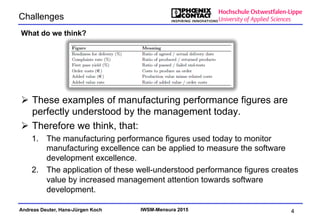
Ø  These examples of manufacturing performance figures are
perfectly understood by the management today.
Ø  Therefore we think, that:
1.  The manufacturing performance figures used today to monitor
manufacturing excellence can be applied to measure the software
development excellence.
2.  The application of these well-understood performance figures creates
value by increased management attention towards software
development.
What do we think?
4
Andreas Deuter, Hans-Jürgen Koch IWSM-Mensura 2015
Related Work
Ø  Agility extension of
traditional V-model
Ø  Reduces Work in
Progress (WiP)
Ø  Documents are
container of Work Items
Ø  Links between Work
Items to form “V”
Sliced V-model [1]
5
[1] A. Deuter, “Slicing the V-model - Reduced effort, higher flexibility” in Proceedings of 8th International Conference on Global Software Engineering,
ICGSE’13, 2013, pp. 1–10.
Andreas Deuter, Hans-Jürgen Koch IWSM-Mensura 2015
Related Work
Ø  Productivity increases in manufacturing motivates to
investigate applicable methods for software
Ø  Prominent example is Kanban[5], which has been transferred
to software[6]
Ø  Mixed picture, if manufacturing methods are applicable to
software – no’s[7] and yes’s[8]
Ø  Research topic with little focus
Transfer from manufacturing to software
6
[5] Liker, J.: The Toyota Way. 1st edn. McGraw-Hill (2004)
[6] Hiranabe, K.: Kanban applied to software development: from agile to lean. http://www.infoq.com/articles/hiranabe-lean-agile-kanban (2008) [2015-04-24].
[7] Binder, R.: Can a manufacturing quality model work for software? Software, IEEE 14(5) (Sep 1997) 101
[8] Schneidewind, N.: What can software engineers learn from manufacturing to improve software process and product? In: Intelligent Information Management.
Volume 1. (2009)
Andreas Deuter, Hans-Jürgen Koch IWSM-Mensura 2015
Related Work
Ø  Numerous articles, books and studies [2][3][4]
Ø  Question to managers: “Do you understand the meaning of
these performance figures?“
•  Answer: “Rather no”
Ø  Option A:
•  Explain managers software performance figures
Ø  Option B:
•  Use known manufacturing performance figures and apply them to
software
•  We chose this option
Software Performance Figures
7
[2] Fenton, N., Pfleeger, S.L.: Software metrics (2nd ed.): a rigorous and practical approach. PWS Publishing Co., Boston, MA, USA (1997)
[3] Kasunic, M.: A data specifcation for software project performance measures: Results of a collaboration on performance measurement. Technical Report CMU/SEI-
2008-TR-012, Software Engineering Institute, Carnegie Mellon University, Pittsburgh,Pennsylvania (2008)
[4] Hartmann, D., Dymond, R.: Appropriate agile measurement: using metrics and diagnostics to deliver business value. In: Agile Conference, 2006. (July 2006) 6
Andreas Deuter, Hans-Jürgen Koch IWSM-Mensura 2015
Proposed Approach
Ø  Software documentation
size Docr
•  Number of Work Items
Software performance figures: Quantity and Quality
8
Ø  Requirements churn[5] Chr
•  Size of code changes [KB] to
implement requirement
Ø  Internal defect churn Chdi
•  Size of code changes to fix
internally reported defects
Ø  External defect churn Chdx
•  Size of code changes to fix
externally reported defects
[5] Sjoberg, D.I., Johnsen, A., Solberg, J.: Quantifying the effect of using Kanban versus scrum: A case study. IEEE Software 29 (2012) 47{53
Andreas Deuter, Hans-Jürgen Koch IWSM-Mensura 2015
Proposed Approach
Ø  Following more figures defined in the paper:
•  Number of defect founds in internal testing activities
•  Number of defect report externally
•  Total number of defects
•  Development duration
•  Development effort
•  Productivity
•  Velocity
•  Defect Density
Software performance figures: all others
9
Andreas Deuter, Hans-Jürgen Koch IWSM-Mensura 2015
Proposed Approach
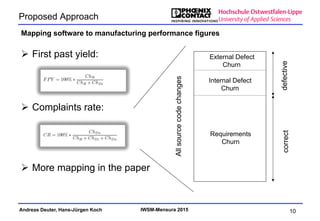
Ø  First past yield:
Mapping software to manufacturing performance figures
10
Requirements
Churn
Internal Defect
Churn
External Defect
Churn
Allsourcecodechanges
correctdefective
Ø  Complaints rate:
Ø  More mapping in the paper
Andreas Deuter, Hans-Jürgen Koch IWSM-Mensura 2015
Evaluation of the approach
Ø  Phoenix Contact supplier of electrical and electronic
components for industrial applications.
•  >14,000 employees (2014), 51 owned sales companies and more than
30 sales partners worldwide.
•  Software activities are carried out in three locations Bad Pyrmont,
Lemgo (Germany), Ann Arbor (USA).
Ø  Sliced V-Model implemented
using Polarion ALM [6]
Ø  Prototype implementing
our approach above concept
Who is the industrial partner?
11
[6] Polarion. http://www.polarion.com, 2015.
Andreas Deuter, Hans-Jürgen Koch IWSM-Mensura 2015
Evaluation of the approach
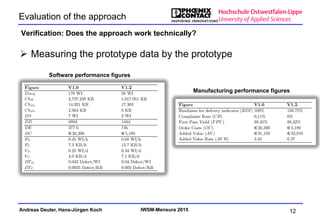
Ø  Measuring the prototype data by the prototype
Verification: Does the approach work technically?
12
Software performance figures
Manufacturing performance figures
Andreas Deuter, Hans-Jürgen Koch IWSM-Mensura 2015
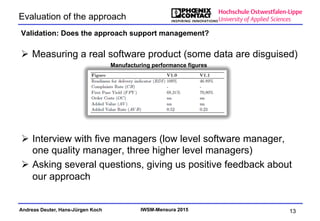
Ø  Measuring a real software product (some data are disguised)
Evaluation of the approach
Validation: Does the approach support management?
13
Manufacturing performance figures
Ø  Interview with five managers (low level software manager,
one quality manager, three higher level managers)
Ø  Asking several questions, giving us positive feedback about
our approach
Andreas Deuter, Hans-Jürgen Koch IWSM-Mensura 2015
Conclusion
Ø  Limited validation on one real project asking just five persons
•  Our joined project is ongoing
Ø  Approach limited to specific process model (Sliced V-model)
and tool chain (Polarion/Subversion)
•  Ok for this environment, but effort needed to generalize the approach
Ø  Some manufacturing data could not be mapped yet
Ø  However, a first step in the right direction !
Much more to do…
14
Andreas Deuter, Hans-Jürgen Koch IWSM-Mensura 2015
Questions and Discussion
15

Applying manufacturing performance figures to measure software development excellence andreas deuter

  • 1.
    Andreas Deuter, Hans-JürgenKoch IWSM-Mensura 2015 Applying manufacturing performance figures to measure software development excellence
  • 2.
    Andreas Deuter, Hans-JürgenKoch IWSM-Mensura 2015 Ø  Challenges Ø  Related Work Ø  Proposed approach Ø  Application of the approach Ø  Conclusion and future work Content 2
  • 3.
    Andreas Deuter, Hans-JürgenKoch IWSM-Mensura 2015 Challenges Ø  Huge changes in traditional manufacturing driven by IT- technology (Internet-of-Things, Cyber-physical systems) Ø  Products integrated in new flexible plants increase their innovations by software Ø  Today, product manufacturing is one of the most important business process in manufacturing companies Ø  It is monitored with manufacturing performance figures ensuring manufacturing excellence Ø  New focus on manufacturing process as software is not “assembled” in production lines What is the problem? 3 Software development needs to be monitored in manufacturing companies.
  • 4.
    Andreas Deuter, Hans-JürgenKoch IWSM-Mensura 2015 Challenges Ø  These examples of manufacturing performance figures are perfectly understood by the management today. Ø  Therefore we think, that: 1.  The manufacturing performance figures used today to monitor manufacturing excellence can be applied to measure the software development excellence. 2.  The application of these well-understood performance figures creates value by increased management attention towards software development. What do we think? 4
  • 5.
    Andreas Deuter, Hans-JürgenKoch IWSM-Mensura 2015 Related Work Ø  Agility extension of traditional V-model Ø  Reduces Work in Progress (WiP) Ø  Documents are container of Work Items Ø  Links between Work Items to form “V” Sliced V-model [1] 5 [1] A. Deuter, “Slicing the V-model - Reduced effort, higher flexibility” in Proceedings of 8th International Conference on Global Software Engineering, ICGSE’13, 2013, pp. 1–10.
  • 6.
    Andreas Deuter, Hans-JürgenKoch IWSM-Mensura 2015 Related Work Ø  Productivity increases in manufacturing motivates to investigate applicable methods for software Ø  Prominent example is Kanban[5], which has been transferred to software[6] Ø  Mixed picture, if manufacturing methods are applicable to software – no’s[7] and yes’s[8] Ø  Research topic with little focus Transfer from manufacturing to software 6 [5] Liker, J.: The Toyota Way. 1st edn. McGraw-Hill (2004) [6] Hiranabe, K.: Kanban applied to software development: from agile to lean. http://www.infoq.com/articles/hiranabe-lean-agile-kanban (2008) [2015-04-24]. [7] Binder, R.: Can a manufacturing quality model work for software? Software, IEEE 14(5) (Sep 1997) 101 [8] Schneidewind, N.: What can software engineers learn from manufacturing to improve software process and product? In: Intelligent Information Management. Volume 1. (2009)
  • 7.
    Andreas Deuter, Hans-JürgenKoch IWSM-Mensura 2015 Related Work Ø  Numerous articles, books and studies [2][3][4] Ø  Question to managers: “Do you understand the meaning of these performance figures?“ •  Answer: “Rather no” Ø  Option A: •  Explain managers software performance figures Ø  Option B: •  Use known manufacturing performance figures and apply them to software •  We chose this option Software Performance Figures 7 [2] Fenton, N., Pfleeger, S.L.: Software metrics (2nd ed.): a rigorous and practical approach. PWS Publishing Co., Boston, MA, USA (1997) [3] Kasunic, M.: A data specifcation for software project performance measures: Results of a collaboration on performance measurement. Technical Report CMU/SEI- 2008-TR-012, Software Engineering Institute, Carnegie Mellon University, Pittsburgh,Pennsylvania (2008) [4] Hartmann, D., Dymond, R.: Appropriate agile measurement: using metrics and diagnostics to deliver business value. In: Agile Conference, 2006. (July 2006) 6
  • 8.
    Andreas Deuter, Hans-JürgenKoch IWSM-Mensura 2015 Proposed Approach Ø  Software documentation size Docr •  Number of Work Items Software performance figures: Quantity and Quality 8 Ø  Requirements churn[5] Chr •  Size of code changes [KB] to implement requirement Ø  Internal defect churn Chdi •  Size of code changes to fix internally reported defects Ø  External defect churn Chdx •  Size of code changes to fix externally reported defects [5] Sjoberg, D.I., Johnsen, A., Solberg, J.: Quantifying the effect of using Kanban versus scrum: A case study. IEEE Software 29 (2012) 47{53
  • 9.
    Andreas Deuter, Hans-JürgenKoch IWSM-Mensura 2015 Proposed Approach Ø  Following more figures defined in the paper: •  Number of defect founds in internal testing activities •  Number of defect report externally •  Total number of defects •  Development duration •  Development effort •  Productivity •  Velocity •  Defect Density Software performance figures: all others 9
  • 10.
    Andreas Deuter, Hans-JürgenKoch IWSM-Mensura 2015 Proposed Approach Ø  First past yield: Mapping software to manufacturing performance figures 10 Requirements Churn Internal Defect Churn External Defect Churn Allsourcecodechanges correctdefective Ø  Complaints rate: Ø  More mapping in the paper
  • 11.
    Andreas Deuter, Hans-JürgenKoch IWSM-Mensura 2015 Evaluation of the approach Ø  Phoenix Contact supplier of electrical and electronic components for industrial applications. •  >14,000 employees (2014), 51 owned sales companies and more than 30 sales partners worldwide. •  Software activities are carried out in three locations Bad Pyrmont, Lemgo (Germany), Ann Arbor (USA). Ø  Sliced V-Model implemented using Polarion ALM [6] Ø  Prototype implementing our approach above concept Who is the industrial partner? 11 [6] Polarion. http://www.polarion.com, 2015.
  • 12.
    Andreas Deuter, Hans-JürgenKoch IWSM-Mensura 2015 Evaluation of the approach Ø  Measuring the prototype data by the prototype Verification: Does the approach work technically? 12 Software performance figures Manufacturing performance figures
  • 13.
    Andreas Deuter, Hans-JürgenKoch IWSM-Mensura 2015 Ø  Measuring a real software product (some data are disguised) Evaluation of the approach Validation: Does the approach support management? 13 Manufacturing performance figures Ø  Interview with five managers (low level software manager, one quality manager, three higher level managers) Ø  Asking several questions, giving us positive feedback about our approach
  • 14.
    Andreas Deuter, Hans-JürgenKoch IWSM-Mensura 2015 Conclusion Ø  Limited validation on one real project asking just five persons •  Our joined project is ongoing Ø  Approach limited to specific process model (Sliced V-model) and tool chain (Polarion/Subversion) •  Ok for this environment, but effort needed to generalize the approach Ø  Some manufacturing data could not be mapped yet Ø  However, a first step in the right direction ! Much more to do… 14
  • 15.
    Andreas Deuter, Hans-JürgenKoch IWSM-Mensura 2015 Questions and Discussion 15