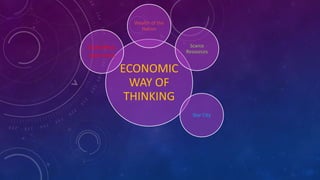
ECONOMIC
WAY OF
THINKING
Wealth of the
Nation
Scarce
Resources
Star City
ECONOMICS;
Adam Smith
SCARCITY
• The basic and central economic problem
confronting every society
• The heart of the study of economics and the
reason behind its establishment.
SCARCITY
• A commodity of service being in short supply, relative to
its demand which implies a constant availability of a
commodity or economic resource relative to the demand
for them.
• It is said that scarcity exist when at a zero price there is a
unit of demand which exceeds the available supply.
• Pertains to the limited availability of economic resources
relative to society’s demand for goods and services.
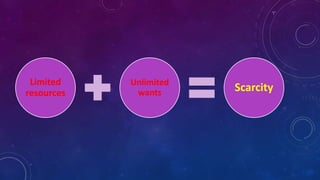
HUMAN WANTS AND NEEDS ARE
UNLIMITED AND THE AVAILABLE
RESOURCES ARE FINITE, SCARCITY
NATURALLY RESULTS LEAVING THE
SOCIETY WITH THE PROBLEM OF
RESOURCE ALLOCATION.
Limited
resources
Unlimited
wants Scarcity
ECONOMICS
• A science that deals with the management of scarce resources.
• A scientific study on how individuals and society generally make
choices.
• The study of the problem of using available economic resources
as efficiently as possible to attain the maximum fulfillment of
society’s unlimited demands for goods and service.
• It simply means scarcity and choice.
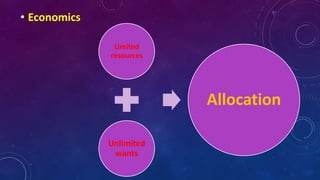
• Economics
Limited
resources
Unlimited
wants
Allocation
RELATIONSHIP BETWEEN
ECONOMICS AND SCARCITY
• The problem of scarcity gave birth to the study of
economics. Their relationship is such that if there
is no scarcity, there is no need for economics. The
study of economics was essentially founded in
order to address the issue of resource allocation
and distribution in response to scarcity.
ORIGIN OF THE TERM ECONOMICS
• Greek roots of the word economics are OIKOS-
household and NOMUS- system or
management
• OIKONOMIA or OIKONOMUS- the
management of household
-
CETERIS PARIBUS ASSUMPTION
• The assumption of ceteris paribus is important in studying economics.
• All other things held constant or all else equal- this assumption is used as
devise to analyze the relationship between two variables. For instance,
with the question; what is the impact of the change in the price of rice on
consumption behavior. If the price of rice increases 20%, how much
consumption will there be, assuming no simultaneous change in variable-
that is, assuming that income, number of family members, population, laws
and so on will remain constant.
HISTORY OF ECONOMICS
• Classical Economics
• Neo- Classical Economics (1870s)
• Keyne’s General Theory of Employment, Interest and Money
• Non- Walrasian Economics (1939)
• Post Keynesian Economics (1940-1950s)
• New Classical Economics
• Positive and Normative Economics

Advanced Economics.pptx

  • 1.
    ECONOMIC WAY OF THINKING Wealth ofthe Nation Scarce Resources Star City ECONOMICS; Adam Smith
  • 2.
    SCARCITY • The basicand central economic problem confronting every society • The heart of the study of economics and the reason behind its establishment.
  • 3.
    SCARCITY • A commodityof service being in short supply, relative to its demand which implies a constant availability of a commodity or economic resource relative to the demand for them. • It is said that scarcity exist when at a zero price there is a unit of demand which exceeds the available supply. • Pertains to the limited availability of economic resources relative to society’s demand for goods and services.
  • 4.
    HUMAN WANTS ANDNEEDS ARE UNLIMITED AND THE AVAILABLE RESOURCES ARE FINITE, SCARCITY NATURALLY RESULTS LEAVING THE SOCIETY WITH THE PROBLEM OF RESOURCE ALLOCATION.
  • 5.
  • 6.
    ECONOMICS • A sciencethat deals with the management of scarce resources. • A scientific study on how individuals and society generally make choices. • The study of the problem of using available economic resources as efficiently as possible to attain the maximum fulfillment of society’s unlimited demands for goods and service. • It simply means scarcity and choice.
  • 7.
  • 8.
    RELATIONSHIP BETWEEN ECONOMICS ANDSCARCITY • The problem of scarcity gave birth to the study of economics. Their relationship is such that if there is no scarcity, there is no need for economics. The study of economics was essentially founded in order to address the issue of resource allocation and distribution in response to scarcity.
  • 9.
    ORIGIN OF THETERM ECONOMICS • Greek roots of the word economics are OIKOS- household and NOMUS- system or management • OIKONOMIA or OIKONOMUS- the management of household -
  • 10.
    CETERIS PARIBUS ASSUMPTION •The assumption of ceteris paribus is important in studying economics. • All other things held constant or all else equal- this assumption is used as devise to analyze the relationship between two variables. For instance, with the question; what is the impact of the change in the price of rice on consumption behavior. If the price of rice increases 20%, how much consumption will there be, assuming no simultaneous change in variable- that is, assuming that income, number of family members, population, laws and so on will remain constant.
  • 11.
    HISTORY OF ECONOMICS •Classical Economics • Neo- Classical Economics (1870s) • Keyne’s General Theory of Employment, Interest and Money • Non- Walrasian Economics (1939) • Post Keynesian Economics (1940-1950s) • New Classical Economics • Positive and Normative Economics