
APPLICATION OF YOGICAPPLICATION OF YOGIC
CONCEPTS IN THECONCEPTS IN THE
PROMOTIONPROMOTION
OF POSITIVE HEALTHOF POSITIVE HEALTH
Yogacharya
Dr. ANANDA BALAYOGI BHAVANANIDr. ANANDA BALAYOGI BHAVANANI
MBBS, ADY, DPC, DSM, PGDFH, PGDY, FIAY
Chairman : International Centre for Yoga Education &
Research ( ICYER ) & Yoganjali Natyalayam
Programme Coordinator: ACYTER, JIPMER, Puducherry
INTRODUCTION
 Yoga is a spiritual science for the integrated
and holistic development of our physical,
mental and moral-spiritual aspects of being.
 The philosophy of Yoga is practical and
applicable in our day-to-day living.
 Yoga has been documented to normalise
physiological function and recent advances
in the field of research have shown that it
has sound scientific basis.
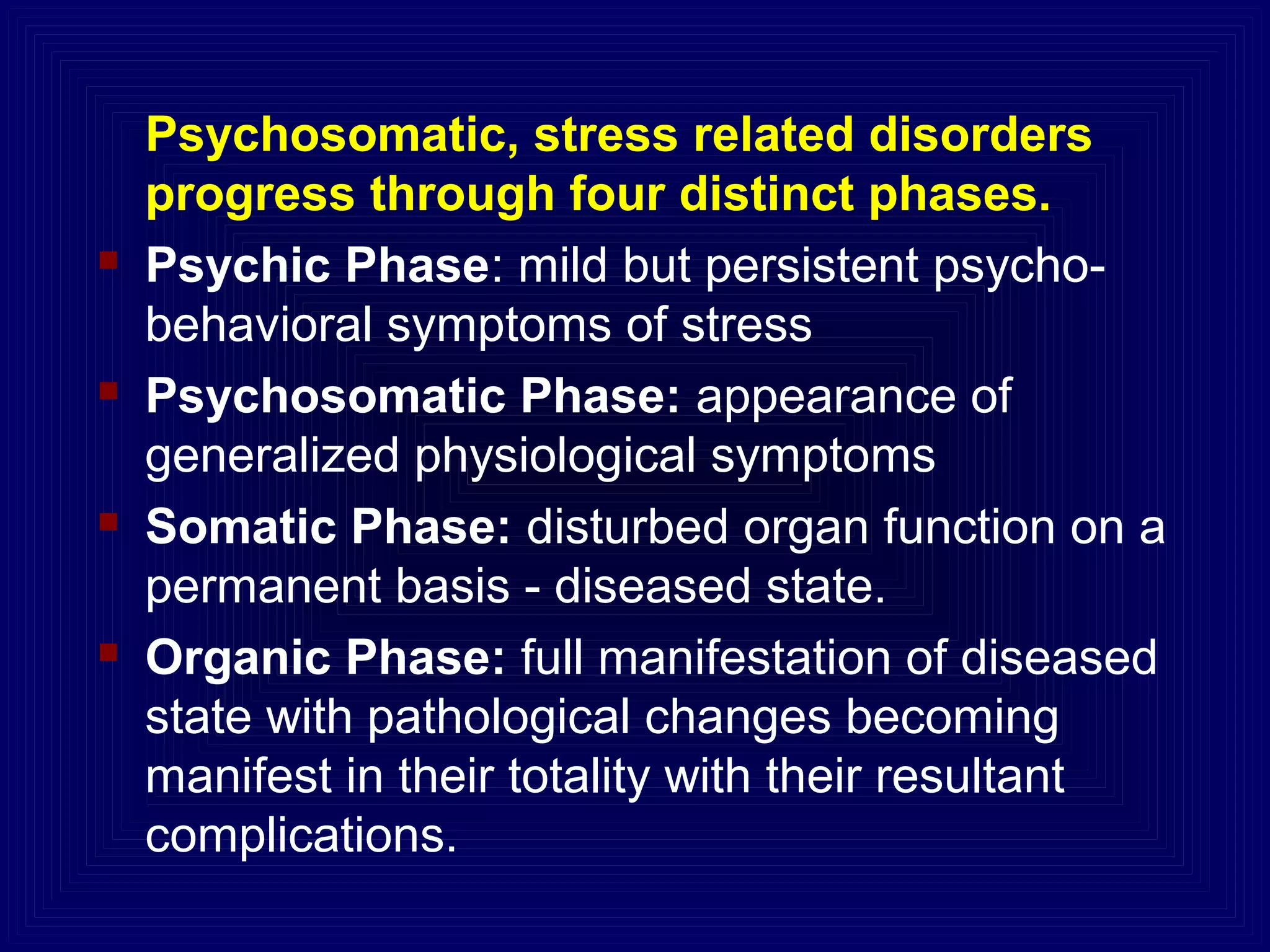
Psychosomatic, stress related disorders
progress through four distinct phases.
 Psychic Phase: mild but persistent psycho-
behavioral symptoms of stress
 Psychosomatic Phase: appearance of
generalized physiological symptoms
 Somatic Phase: disturbed organ function on a
permanent basis - diseased state.
 Organic Phase: full manifestation of diseased
state with pathological changes becoming
manifest in their totality with their resultant
complications.
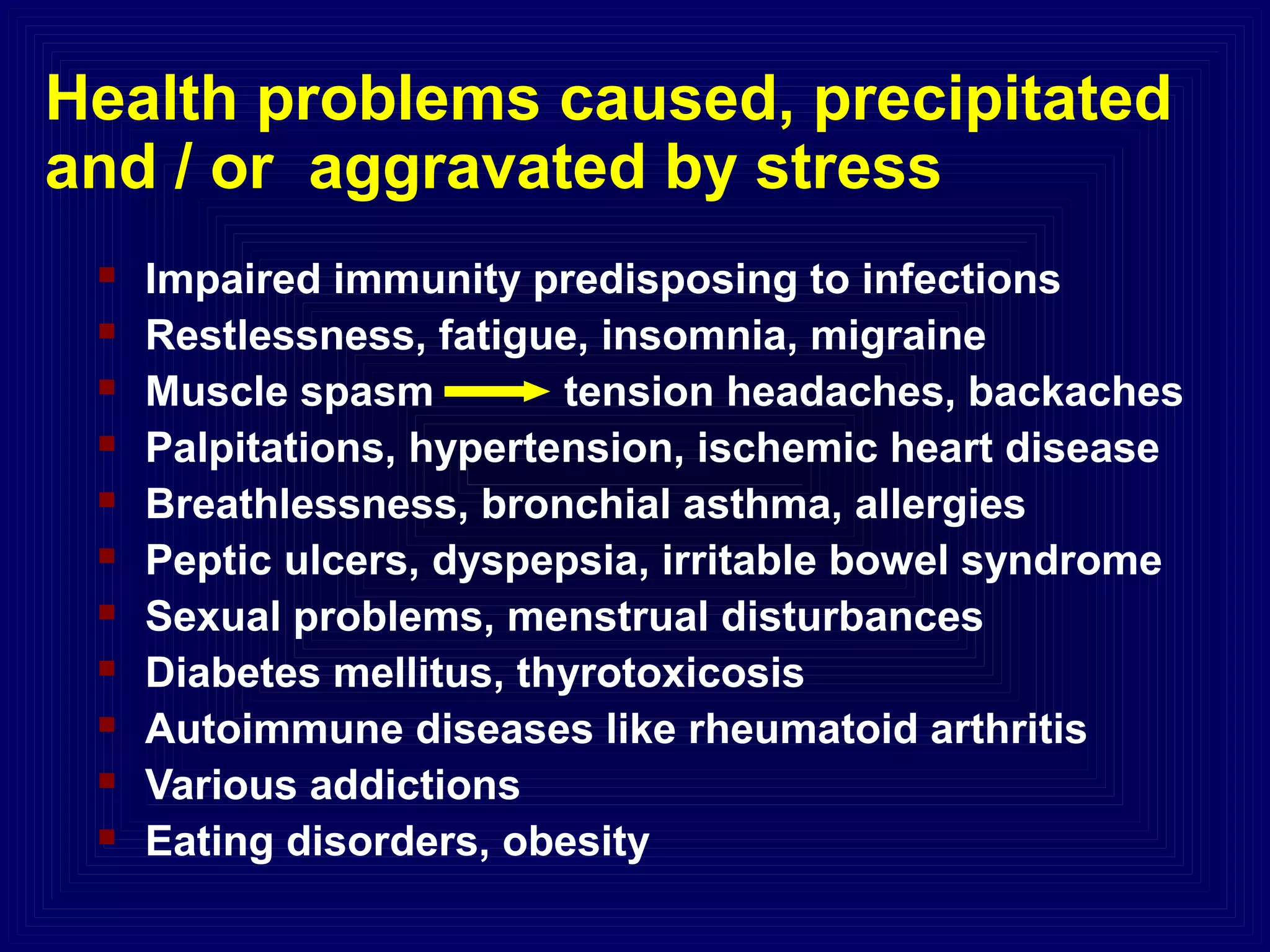
Health problems caused, precipitated
and / or aggravated by stress
 Impaired immunity predisposing to infections
 Restlessness, fatigue, insomnia, migraine
 Muscle spasm tension headaches, backaches
 Palpitations, hypertension, ischemic heart disease
 Breathlessness, bronchial asthma, allergies
 Peptic ulcers, dyspepsia, irritable bowel syndrome
 Sexual problems, menstrual disturbances
 Diabetes mellitus, thyrotoxicosis
 Autoimmune diseases like rheumatoid arthritis
 Various addictions
 Eating disorders, obesity
To create an environment
conducive to the development of
positive health and prevent and
manage lifestyle disorders that
are threatening humankind, Yoga
offers us many practical ‘day-to-
day’ methods of action.
Some of these tools for positive
health are as follows.
1. Become aware of your body, emotions and
mind:
 Without awareness there cannot be health or
healing. Awareness of body implies conscious
body work that needs to be synchronized with
breath to qualify as a psychosomatic
technique of health and healing.
 Psychosomatic disorders that are the bane of
the modern world cannot be tackled without
awareness.
2. Improve your dietary habits:
 Most disorders are directly or indirectly
linked to improper dietary patterns that
need to be addressed in order to find a
permanent solution to health challenges.
 One of the most important lifestyle
changes that needs be implemented in
management of any lifestyle disorder is
adoption of a helthy diet.
3. Relax your whole body:
 Relaxation is most often all that most
patients need to improve their physical
condition.
 Stress may be the causative, aggravating, or
precipitating factor psychosomatic disorders.
 Doctors are often found telling their patients
to relax, but never tell them how to do it!
 The relaxation part of every Yoga session is
most important for it is during it that benefit of
practices done in the session seep into each
and every cell producing rest, rejuvenation,
reinvigoration and reintegration.
4. Slow down the breath making it quiet and
deep:
 Rapid, uncontrolled, irregular breathing is a
sign of ill health - slow, deep and regular
controlled breathing is a sign of good health.
 Breath is the link between body and mind and
is the agent of physical, physiological and
mental unification.
 When breath is slowed, anabolic activities
stimulate process of healing and rebuilding.
 If breath is calm, mind is calm and life is long!
5. Calm down your mind and focus it
inwardly:
 The mind is as disturbed as a drunken monkey
bitten by a scorpion say our scriptures.
 Mind control is fundamental in finding a way
out of the ‘disease maze’ where we are
entangled like a fly in the spider’s web.
 Breath work and sensory control are the base
on which mind training can occur. It is only later
that concentration leading to meditation can
have any use.
 Just sitting and thinking about something is not
meditation!
6. Improve the flow of healing ‘Pranic Life
Energy’:
 Prana is life and without it there cannot be
healing.
 Different prana and upa prana vayu energies
driving different physiological functions need to
be understood and applied.
 In digestive disorders, focus must be on the
samana vayu whereas in pelvic conditions it
needs to be on apana vayu.
 5th
chapter of Hatha Pradipika deals with
various vayu malfunctions and their correction.
7. Fortify yourself against omnipresent
stressors:
 Decrease your stress level by fortifying yourself
against the various omnipresent stressors in
your life.
 Choosing the right attitude can change
everything and bring about a resolution of the
problem by healing the core.
 Stress is more about how you react to the
stressor than about the stressor itself!
8. Increase your self reliance and self
confidence:
 Challenges should be understood as
opportunities for change and must be faced
with confidence.
 We have the inner power to overcome each
and every challenge that is thrown at us by life.
 The Divine is not a sadist to give us challenges
that are beyond our capacity!
9. Facilitate natural emanation of wastes:
 Facilitate natural emanation of waste from the
body by practicing shuddi kriyas like dhauti,
basti and neti.
 Accumulation and stagnation of waste materials
either in inner or outer environment always
causes problems.
 Yogic cleaning practices help wash out
impurities (mala shodhana) thus helping the
process of regeneration and facilitating healing.
10. Take responsibility for your own health:
 Yoga fixes responsibility for our health squarely
upon our own shoulders.
 If we do healthy things we are healthy and if we
do unhealthy things we become sick.
 No use complaining that we are not well when
we have been the cause of our problem.
 As Swamiji Gitananda Giri would say, “You
don’t have problems-you are the problem!”
11. Health and happiness are your birthright:
 Health and happiness are our birthright! Claim
them and develop them to maximum potential.
 The goal of human existence is not health and
happiness but moksha (liberation).
 Most people today are so busy trying to find
health and happiness that they forget why they
are here in the first place.
 Yoga helps us regain our birthrights and attain
the goal of human life.
The dedicated practice of
Yoga as a way of life is no
doubt a panacea for problems
related to psychosomatic,
stress related disorders
helping us regain our
birthright of health and
happiness.
THANKTHANK
YOUYOU
www.icyer.com

Application of yogic concepts in the promotion of positive health

  • 1.
    APPLICATION OF YOGICAPPLICATIONOF YOGIC CONCEPTS IN THECONCEPTS IN THE PROMOTIONPROMOTION OF POSITIVE HEALTHOF POSITIVE HEALTH Yogacharya Dr. ANANDA BALAYOGI BHAVANANIDr. ANANDA BALAYOGI BHAVANANI MBBS, ADY, DPC, DSM, PGDFH, PGDY, FIAY Chairman : International Centre for Yoga Education & Research ( ICYER ) & Yoganjali Natyalayam Programme Coordinator: ACYTER, JIPMER, Puducherry
  • 2.
    INTRODUCTION  Yoga isa spiritual science for the integrated and holistic development of our physical, mental and moral-spiritual aspects of being.  The philosophy of Yoga is practical and applicable in our day-to-day living.  Yoga has been documented to normalise physiological function and recent advances in the field of research have shown that it has sound scientific basis.
  • 3.
    Psychosomatic, stress relateddisorders progress through four distinct phases.  Psychic Phase: mild but persistent psycho- behavioral symptoms of stress  Psychosomatic Phase: appearance of generalized physiological symptoms  Somatic Phase: disturbed organ function on a permanent basis - diseased state.  Organic Phase: full manifestation of diseased state with pathological changes becoming manifest in their totality with their resultant complications.
  • 4.
    Health problems caused,precipitated and / or aggravated by stress  Impaired immunity predisposing to infections  Restlessness, fatigue, insomnia, migraine  Muscle spasm tension headaches, backaches  Palpitations, hypertension, ischemic heart disease  Breathlessness, bronchial asthma, allergies  Peptic ulcers, dyspepsia, irritable bowel syndrome  Sexual problems, menstrual disturbances  Diabetes mellitus, thyrotoxicosis  Autoimmune diseases like rheumatoid arthritis  Various addictions  Eating disorders, obesity
  • 5.
    To create anenvironment conducive to the development of positive health and prevent and manage lifestyle disorders that are threatening humankind, Yoga offers us many practical ‘day-to- day’ methods of action. Some of these tools for positive health are as follows.
  • 6.
    1. Become awareof your body, emotions and mind:  Without awareness there cannot be health or healing. Awareness of body implies conscious body work that needs to be synchronized with breath to qualify as a psychosomatic technique of health and healing.  Psychosomatic disorders that are the bane of the modern world cannot be tackled without awareness.
  • 7.
    2. Improve yourdietary habits:  Most disorders are directly or indirectly linked to improper dietary patterns that need to be addressed in order to find a permanent solution to health challenges.  One of the most important lifestyle changes that needs be implemented in management of any lifestyle disorder is adoption of a helthy diet.
  • 8.
    3. Relax yourwhole body:  Relaxation is most often all that most patients need to improve their physical condition.  Stress may be the causative, aggravating, or precipitating factor psychosomatic disorders.  Doctors are often found telling their patients to relax, but never tell them how to do it!  The relaxation part of every Yoga session is most important for it is during it that benefit of practices done in the session seep into each and every cell producing rest, rejuvenation, reinvigoration and reintegration.
  • 9.
    4. Slow downthe breath making it quiet and deep:  Rapid, uncontrolled, irregular breathing is a sign of ill health - slow, deep and regular controlled breathing is a sign of good health.  Breath is the link between body and mind and is the agent of physical, physiological and mental unification.  When breath is slowed, anabolic activities stimulate process of healing and rebuilding.  If breath is calm, mind is calm and life is long!
  • 10.
    5. Calm downyour mind and focus it inwardly:  The mind is as disturbed as a drunken monkey bitten by a scorpion say our scriptures.  Mind control is fundamental in finding a way out of the ‘disease maze’ where we are entangled like a fly in the spider’s web.  Breath work and sensory control are the base on which mind training can occur. It is only later that concentration leading to meditation can have any use.  Just sitting and thinking about something is not meditation!
  • 11.
    6. Improve theflow of healing ‘Pranic Life Energy’:  Prana is life and without it there cannot be healing.  Different prana and upa prana vayu energies driving different physiological functions need to be understood and applied.  In digestive disorders, focus must be on the samana vayu whereas in pelvic conditions it needs to be on apana vayu.  5th chapter of Hatha Pradipika deals with various vayu malfunctions and their correction.
  • 12.
    7. Fortify yourselfagainst omnipresent stressors:  Decrease your stress level by fortifying yourself against the various omnipresent stressors in your life.  Choosing the right attitude can change everything and bring about a resolution of the problem by healing the core.  Stress is more about how you react to the stressor than about the stressor itself!
  • 13.
    8. Increase yourself reliance and self confidence:  Challenges should be understood as opportunities for change and must be faced with confidence.  We have the inner power to overcome each and every challenge that is thrown at us by life.  The Divine is not a sadist to give us challenges that are beyond our capacity!
  • 14.
    9. Facilitate naturalemanation of wastes:  Facilitate natural emanation of waste from the body by practicing shuddi kriyas like dhauti, basti and neti.  Accumulation and stagnation of waste materials either in inner or outer environment always causes problems.  Yogic cleaning practices help wash out impurities (mala shodhana) thus helping the process of regeneration and facilitating healing.
  • 15.
    10. Take responsibilityfor your own health:  Yoga fixes responsibility for our health squarely upon our own shoulders.  If we do healthy things we are healthy and if we do unhealthy things we become sick.  No use complaining that we are not well when we have been the cause of our problem.  As Swamiji Gitananda Giri would say, “You don’t have problems-you are the problem!”
  • 16.
    11. Health andhappiness are your birthright:  Health and happiness are our birthright! Claim them and develop them to maximum potential.  The goal of human existence is not health and happiness but moksha (liberation).  Most people today are so busy trying to find health and happiness that they forget why they are here in the first place.  Yoga helps us regain our birthrights and attain the goal of human life.
  • 17.
    The dedicated practiceof Yoga as a way of life is no doubt a panacea for problems related to psychosomatic, stress related disorders helping us regain our birthright of health and happiness.
  • 18.