Yoga for Diabetes and
Obesity
Guide By:
Dr. PRABHU C NAGALAPUR
M.D (AYU)
Presenter:
Dr. SAGAR SHARMA
Major killers
Before 1950’s Communicable
diseases-Plague, Cholera.
After 1950-Non
communicable diseases like
Diabetes,Obesity
Diabetes
• Diabetes is a disorder in which the body cells fail to take
up glucose from the blood.
• Wasting of tissues is seen as glucose-starved cells are
forced to consume their own proteins.
• Individuals with diabetes lack the ability to use the
hormone insulin
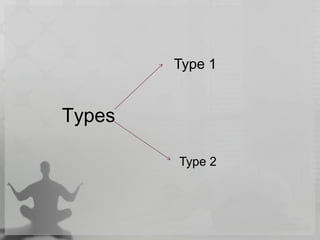
Types
Type 1
Type 2
• In type 1 diabetes body stops making insulin because
the body's immune system destroys the insulin
producing cells (called beta cells) in the pancreas.
• People with type 1 diabetes need to take insulin
injections every day.
• Although it can occur at any age, this type of diabetes
occurs more often in children and young adults
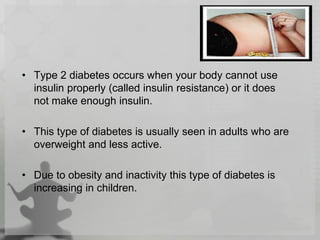
• Type 2 diabetes occurs when your body cannot use
insulin properly (called insulin resistance) or it does
not make enough insulin.
• This type of diabetes is usually seen in adults who are
overweight and less active.
• Due to obesity and inactivity this type of diabetes is
increasing in children.
Recommendations
• Dietary therapy
• Physical activity
• Pharmacotherapy
• Weight Loss
• Many controlled clinical trials had been carried out to
determine the effect of weight loss on fasting blood
glucose.
They found:
 Weight loss produced by lifestyle modification declines
blood glucose levels and HbA1c in type 2 diabetics.
 Glucose tolerance can be improved in overweight
individuals by decreasing abdominal fat.
 Glucose tolerance can also be improved in overweight
individuals with increased cardio respiratory fitness.
Yoga for Diabetes
• Yoga has considered all aspects of Diabetes (physical,
emotional and mental)
• Regular practice of Yoga and controlled life style
reduces Diabetes
• Yoga helps achieve control over mind and behavior (one
can easily control food habits and change life style to
reduce the Diabetes.)
• Yoga has an important role to play in the treatment of
Diabetes
• Yoga techniques affect body, internal organs, endocrine
glands, brain, mind and other factors concerning Body –
Mind complex.
• Various Yoga techniques can be practiced effectively to
reduce the weight and achieve normal healthy condition
of Body and Mind
Asanas
• Yoga positions or postures are especially useful to
reduce the fats in various parts, especially forward
bending, twisting and backward bending asana help
reduce the fats near abdomen, hips and other areas.
• Also the practice of asana improves functioning of
internal organs, strengthening heart, lungs, kidneys,
excretory & reproductive organs.
• Regular practice builds strength in muscles.
• Asana can be practiced with fast speed like exercise
with good effects, the practitioner may increase
repetitions instead of maintaining the asana for long.
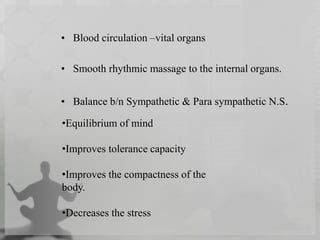
• Blood circulation –vital organs
• Smooth rhythmic massage to the internal organs.
• Balance b/n Sympathetic & Para sympathetic N.S.
•Equilibrium of mind
•Improves tolerance capacity
•Improves the compactness of the
body.
•Decreases the stress
• Equilibrium of mind
• Improves tolerance capacity
• Improves the compactness of the body.
• Decreases the stress
Sitting posture
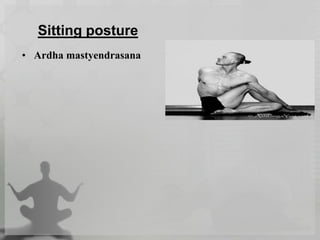
• Ardha mastyendrasana
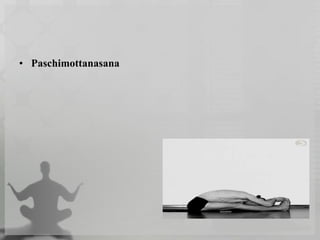
• Paschimottanasana
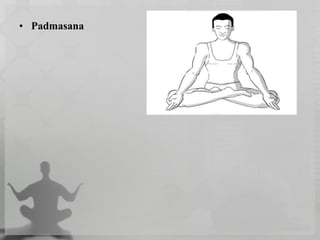
• Padmasana
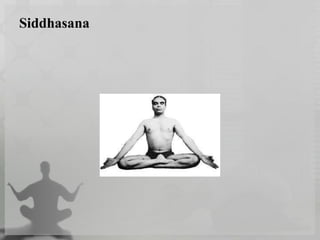
Siddhasana
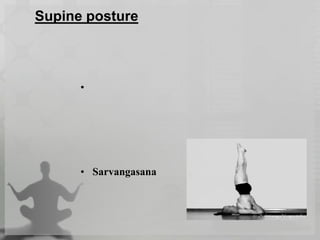
Supine posture
•
• Sarvangasana
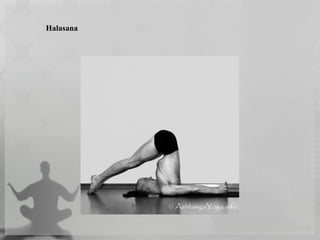
Halasana
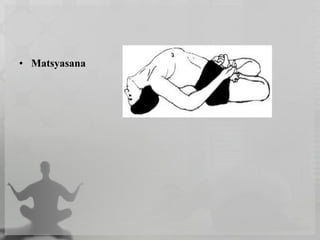
• Matsyasana
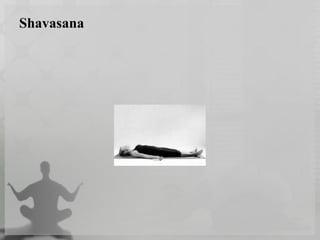
Shavasana
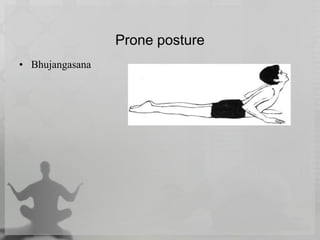
Prone posture
• Bhujangasana
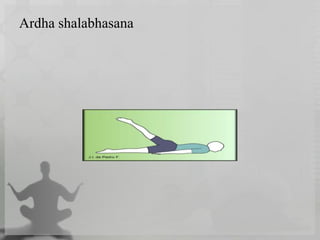
Ardha shalabhasana
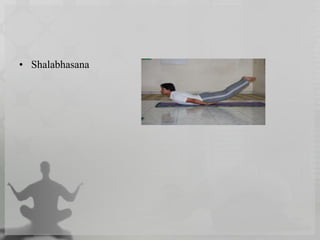
• Shalabhasana
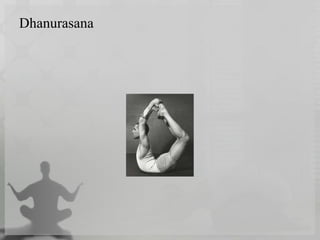
Dhanurasana
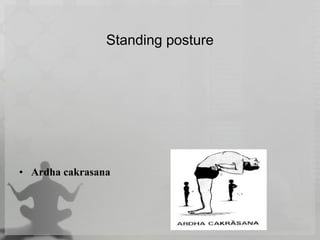
Standing posture
• Ardha cakrasana
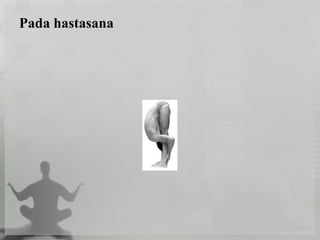
Pada hastasana
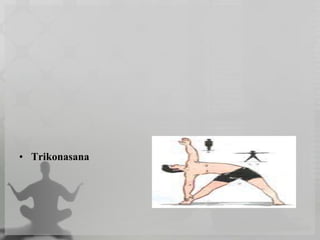
• Trikonasana
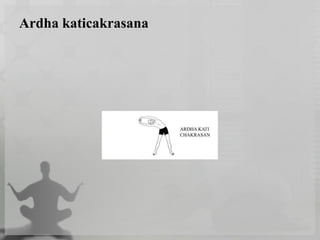
Ardha katicakrasana
Other postures
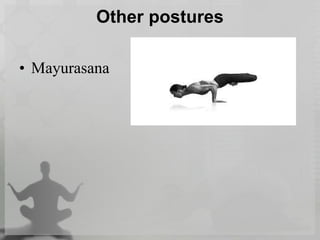
• Mayurasana
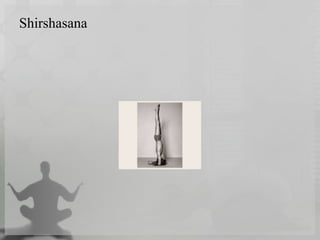
Shirshasana
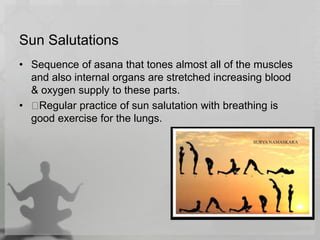
Sun Salutations
• Sequence of asana that tones almost all of the muscles
and also internal organs are stretched increasing blood
& oxygen supply to these parts.
• Regular practice of sun salutation with breathing is
good exercise for the lungs.
• Right nostril breathing- stimulates blood glucose (30 min)
• Left nostril breathing- stimulates right cerebral hemisphere
O2 consumption, carrying capacity
• Bastrica Stimulates Pancreases
• Suryanulomanavilomana stimulates Pancreases
• Nadishudhi Pranayama balances hormonal regulation and nervous sys.
Bhramari
• Bhramari: the bee breath soothes the nerves and calms
the mindInhale through both nostrils, taking a slow deep
breath in. Exhale through both nostrils using the throat to
make a soft "eeee" sound, like the buzzing of a bee. Do
5-10 rounds, making the buzzing bee noise louder as
you progress, but do not strain.
SitKari (Sit Cari)
• The hissing breathcools the bodycurl the tongue
touching the roof of the mouth as far back as you can to
the soft pallet. As you inhale clench the teeth together
and slightly part the lips making a hissing "ssss" sound
Exhale through both nostrils. Repeat 5-10 times
Shitali
• The cooling breathcools the bodyroll the tongue into a
tube (as best as you can) and stick the tip of the tongue
out of the mouth. Inhale through the tongue and hold the
breath in for 4-5 seconds with the chin pressed against
the chest. Exhale using ujjayi pranayama through the
nose. Repeat 5-10 times.
Kapalabhati
• The breath of fire or the skull shining breath invigorating,
energizing, and purifyingkapalabhati is a very active,
forced exhalation with a passive inhalation. To exhale,
the belly quickly pumps into the spine forcing the air out
of the nose (like trying to blow out a candle through you
nose). Place a hand on your belly to feel the belly
actively pumping. Play with the tempo (45-60
exhalations/30 seconds), but keep a steady rhythm. Start
with 2-3 rounds of 30 exhalations, and gradually
increase the exhalations if comfortable.
Bhastrika
• Keep the body, neck and head erect. Close the mouth.
Next, inhale and exhale quickly ten times like the bellows
of the blacksmith. Constantly dilate and contract. When
you practice this Pranayama a hissing sound is
produced. The practitioner should start with rapid
expulsions of breath following one another in rapid
succession.
Dhyana
• Relaxation to body & mind
• Reduction in blood lactate level-reduction in blood sugar level
• Develops deep internal awareness
• Overcome stressful situation- EEG- alpha wave pattern in brain
• Rejuvenation
Journal
Discussion
• Strong evidence that weight loss produced by lifestyle modification
reduces blood glucose levels and HbA1c in some patients with type
2 diabetes.
• Suggestive evidence that decrease in abdominal fat will improve
glucose tolerance in overweight individuals with impaired glucose
tolerance, although not independent of weight loss.
• Limited evidence that increased cardio respiratory fitness improves
glucose tolerance in overweight individuals with impaired glucose
tolerance or diabetes, although not independent of weight loss.
• Suggestive evidence that weight loss induced by weight loss
medications does not appear to improve blood glucose levels any
better than weight loss through lifestyle therapy in overweight
people with or without type 2 diabetes.
Conclusion
• Studies have shown that yoga can be Helpful in
Controlling Diabetes
.
• Practicing a lot of asana and Pranayama. They enhance
your memory, eyesight, and concentration and also bring
down your excessive weight.
• It makes the digestive tract function smoothly and allows
quick digestion of foods.
yoga in diabetes

yoga in diabetes

  • 1.
    Yoga for Diabetesand Obesity Guide By: Dr. PRABHU C NAGALAPUR M.D (AYU) Presenter: Dr. SAGAR SHARMA
  • 2.
    Major killers Before 1950’sCommunicable diseases-Plague, Cholera. After 1950-Non communicable diseases like Diabetes,Obesity
  • 3.
    Diabetes • Diabetes isa disorder in which the body cells fail to take up glucose from the blood. • Wasting of tissues is seen as glucose-starved cells are forced to consume their own proteins. • Individuals with diabetes lack the ability to use the hormone insulin
  • 5.
  • 6.
    • In type1 diabetes body stops making insulin because the body's immune system destroys the insulin producing cells (called beta cells) in the pancreas. • People with type 1 diabetes need to take insulin injections every day. • Although it can occur at any age, this type of diabetes occurs more often in children and young adults
  • 7.
    • Type 2diabetes occurs when your body cannot use insulin properly (called insulin resistance) or it does not make enough insulin. • This type of diabetes is usually seen in adults who are overweight and less active. • Due to obesity and inactivity this type of diabetes is increasing in children.
  • 8.
    Recommendations • Dietary therapy •Physical activity • Pharmacotherapy
  • 9.
    • Weight Loss •Many controlled clinical trials had been carried out to determine the effect of weight loss on fasting blood glucose. They found:  Weight loss produced by lifestyle modification declines blood glucose levels and HbA1c in type 2 diabetics.  Glucose tolerance can be improved in overweight individuals by decreasing abdominal fat.  Glucose tolerance can also be improved in overweight individuals with increased cardio respiratory fitness.
  • 10.
    Yoga for Diabetes •Yoga has considered all aspects of Diabetes (physical, emotional and mental) • Regular practice of Yoga and controlled life style reduces Diabetes • Yoga helps achieve control over mind and behavior (one can easily control food habits and change life style to reduce the Diabetes.)
  • 11.
    • Yoga hasan important role to play in the treatment of Diabetes • Yoga techniques affect body, internal organs, endocrine glands, brain, mind and other factors concerning Body – Mind complex. • Various Yoga techniques can be practiced effectively to reduce the weight and achieve normal healthy condition of Body and Mind
  • 12.
    Asanas • Yoga positionsor postures are especially useful to reduce the fats in various parts, especially forward bending, twisting and backward bending asana help reduce the fats near abdomen, hips and other areas. • Also the practice of asana improves functioning of internal organs, strengthening heart, lungs, kidneys, excretory & reproductive organs. • Regular practice builds strength in muscles. • Asana can be practiced with fast speed like exercise with good effects, the practitioner may increase repetitions instead of maintaining the asana for long.
  • 13.
    • Blood circulation–vital organs • Smooth rhythmic massage to the internal organs. • Balance b/n Sympathetic & Para sympathetic N.S. •Equilibrium of mind •Improves tolerance capacity •Improves the compactness of the body. •Decreases the stress
  • 14.
    • Equilibrium ofmind • Improves tolerance capacity • Improves the compactness of the body. • Decreases the stress
  • 15.
  • 16.
  • 17.
  • 18.
  • 19.
  • 20.
  • 21.
  • 22.
  • 23.
  • 24.
  • 25.
  • 26.
  • 27.
  • 28.
  • 29.
  • 30.
  • 31.
  • 32.
  • 33.
    Sun Salutations • Sequenceof asana that tones almost all of the muscles and also internal organs are stretched increasing blood & oxygen supply to these parts. • Regular practice of sun salutation with breathing is good exercise for the lungs.
  • 34.
    • Right nostrilbreathing- stimulates blood glucose (30 min) • Left nostril breathing- stimulates right cerebral hemisphere O2 consumption, carrying capacity • Bastrica Stimulates Pancreases • Suryanulomanavilomana stimulates Pancreases • Nadishudhi Pranayama balances hormonal regulation and nervous sys.
  • 35.
    Bhramari • Bhramari: thebee breath soothes the nerves and calms the mindInhale through both nostrils, taking a slow deep breath in. Exhale through both nostrils using the throat to make a soft "eeee" sound, like the buzzing of a bee. Do 5-10 rounds, making the buzzing bee noise louder as you progress, but do not strain.
  • 36.
    SitKari (Sit Cari) •The hissing breathcools the bodycurl the tongue touching the roof of the mouth as far back as you can to the soft pallet. As you inhale clench the teeth together and slightly part the lips making a hissing "ssss" sound Exhale through both nostrils. Repeat 5-10 times
  • 37.
    Shitali • The coolingbreathcools the bodyroll the tongue into a tube (as best as you can) and stick the tip of the tongue out of the mouth. Inhale through the tongue and hold the breath in for 4-5 seconds with the chin pressed against the chest. Exhale using ujjayi pranayama through the nose. Repeat 5-10 times.
  • 38.
    Kapalabhati • The breathof fire or the skull shining breath invigorating, energizing, and purifyingkapalabhati is a very active, forced exhalation with a passive inhalation. To exhale, the belly quickly pumps into the spine forcing the air out of the nose (like trying to blow out a candle through you nose). Place a hand on your belly to feel the belly actively pumping. Play with the tempo (45-60 exhalations/30 seconds), but keep a steady rhythm. Start with 2-3 rounds of 30 exhalations, and gradually increase the exhalations if comfortable.
  • 39.
    Bhastrika • Keep thebody, neck and head erect. Close the mouth. Next, inhale and exhale quickly ten times like the bellows of the blacksmith. Constantly dilate and contract. When you practice this Pranayama a hissing sound is produced. The practitioner should start with rapid expulsions of breath following one another in rapid succession.
  • 40.
    Dhyana • Relaxation tobody & mind • Reduction in blood lactate level-reduction in blood sugar level • Develops deep internal awareness • Overcome stressful situation- EEG- alpha wave pattern in brain • Rejuvenation
  • 41.
  • 42.
    Discussion • Strong evidencethat weight loss produced by lifestyle modification reduces blood glucose levels and HbA1c in some patients with type 2 diabetes. • Suggestive evidence that decrease in abdominal fat will improve glucose tolerance in overweight individuals with impaired glucose tolerance, although not independent of weight loss. • Limited evidence that increased cardio respiratory fitness improves glucose tolerance in overweight individuals with impaired glucose tolerance or diabetes, although not independent of weight loss. • Suggestive evidence that weight loss induced by weight loss medications does not appear to improve blood glucose levels any better than weight loss through lifestyle therapy in overweight people with or without type 2 diabetes.
  • 43.
    Conclusion • Studies haveshown that yoga can be Helpful in Controlling Diabetes . • Practicing a lot of asana and Pranayama. They enhance your memory, eyesight, and concentration and also bring down your excessive weight. • It makes the digestive tract function smoothly and allows quick digestion of foods.