Case Study
By : Mr.P.Pathmaraj
History of Toyota
• The history of Toyota started in 1933 with the company being a division of Toyoda
Automatic Loom Works devoted to the production of automobiles under the
direction of the founder's son, Kiichiro Toyoda.
• Kiichiro Toyoda had traveled to Europe and the United States in 1929 to investigate
automobile production and had begun researching gasoline-powered engines in
1930.
• Toyoda Automatic Loom Works was encouraged to develop automobile production
by the Japanese government, which needed domestic vehicle production, due to
the war with China.
• In 1934, the division produced its first Type A Engine, which was used in the first
Model A1 passenger car in May 1935 and the G1 truck in August 1935. Production
of the Model AA passenger car started in 1936.
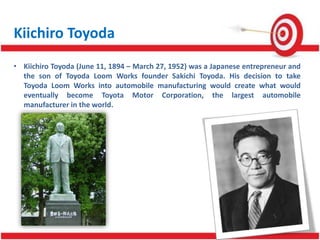
Kiichiro Toyoda
• Kiichiro Toyoda (June 11, 1894 – March 27, 1952) was a Japanese entrepreneur and
the son of Toyoda Loom Works founder Sakichi Toyoda. His decision to take
Toyoda Loom Works into automobile manufacturing would create what would
eventually become Toyota Motor Corporation, the largest automobile
manufacturer in the world.
2009–11 Toyota vehicle recalls
• Three separate but related recalls of automobiles by Toyota Motor
Corporation occurred at the end of 2009 and start of 2010.
• Toyota initiated the recalls, the first two with the assistance of the U.S. National
Highway Traffic Safety Administration (NHTSA), after reports that several vehicles
experienced unintended acceleration.
• The first recall, on November 2, 2009, was to correct a possible incursion of an
incorrect or out-of-place front driver's side floor mat into the foot pedal well, which
can cause pedal entrapment.
• The second recall, on January 21, 2010, was begun after some crashes were shown
not to have been caused by floor mat incursion. This latter defect was identified as
a possible mechanical sticking of the accelerator pedal causing unintended
acceleration, referred to as Sticking Accelerator Pedal by Toyota.
2009–11 Toyota vehicle recalls
• The original action was initiated by Toyota in their Defect Information Report,
dated October 5, 2009, amended January 27, 2010. Following the floor mat and
accelerator pedal recalls, Toyota also issued a separate recall for hybrid anti-lock
brake software in February 2010.
• As of January 28, 2010, Toyota had announced recalls of approximately 5.2 million
vehicles for the pedal entrapment/floor mat problem, and an additional 2.3 million
vehicles for the accelerator pedal problem. Approximately 1.7 million vehicles are
subject to both.
• The worldwide total number of cars recalled by Toyota stood at 9 million.
2009–11 Toyota vehicle recalls
• The original action was initiated by Toyota in their Defect Information Report,
dated October 5, 2009, amended January 27, 2010. Following the floor mat and
accelerator pedal recalls, Toyota also issued a separate recall for hybrid anti-lock
brake software in February 2010.
• As of January 28, 2010, Toyota had announced recalls of approximately 5.2 million
vehicles for the pedal entrapment/floor mat problem, and an additional 2.3 million
vehicles for the accelerator pedal problem. Approximately 1.7 million vehicles are
subject to both.
• The worldwide total number of cars recalled by Toyota stood at 9 million.
Question No: 01
If Toyota is not the cause of unintended
acceleration, why was it blamed for it?
• The Toyota Company was blamed for its unintended acceleration mainly because of
the failure of the Public relations. The reason was that the company’s public
relations response to recall the problems very slow, therefore many Americans
started to believe the Toyota Company was trying to hide something and cover
their laws. The CEO of the Toyota Company – Akio Toyoda also didn’t make any
statement about this crisis until February 5th. American Medias also blamed that
the companies lack of transparency and their actions in this regards.
Question No: 01
• Another prime problem was the cultural difference between Japanese and
Americans in the way of communication. In Japanese Management, when a
company face a problem first they tries to sort out and solve the problem after that
they inform to the media. But in American Style first they prefer answer, first then
after action. Therefore when Toyota keeps silent the American consider that they
are ignore them and unprofessionalism.
Question No: 02
Investigations have shown that after
stories of unintended acceleration are
publicized, report of incidents increase for
all automobiles. Why is the case?
• Now days according the new technology the automobiles also become more
technology based. The problem isn’t happen in Toyota Vehicles; similar problem
happed in Audi 5000 also. According to the “pedal misapplication” the unintended
acceleration happened in Audi. The drivers pressing the gas when they meant to
push the break. But not all Audi brand was thoroughly trashed and the sales didn’t
recover.
Question No: 02
• Due to the growing modern technology the automobiles become very
sophisticated. As a result the drivers become passive, reactive and insulated by
technology from any sense of control. Now this responsibility has shifted from the
drivers to vehicle manufactures, therefore the automobile manufactures facing
pressure to make automobiles with safe and reliable and also completely idiot –
proof.
• These kind of problems nowadays become common and regular incidents in
sophisticated automobiles and it is becomes as a regular problems for automakers.
Perhaps it is due to driver’s error or not.
Question No: 03
Is it possible to have a strong – even
arrogant – culture and still produce safe
and high quality vehicles?
• According to this case, we can realize the Toyota Company most likely suffers from
its arrogant culture. “Success can build a culture of arrogance that will destroy a
company”. If a company goes with arrogance culture in future it may crate negative
publicity according to this people may lose their trust.
• In this case the Toyota’s management never took the blame for unintended
acceleration first. There were several incidents happened about this unintended
acceleration, but the management didn’t spoke to the public. They stand still on
their method.
• As this arrogant culture people thought that Toyota Company trying to hide
Question No: 03
Is it possible to have a strong – even
arrogant – culture and still produce safe
and high quality vehicles?
• According to this case, we can realize the Toyota Company most likely suffers from
its arrogant culture. “Success can build a culture of arrogance that will destroy a
company”. If a company goes with arrogance culture in future it may crate negative
publicity according to this people may lose their trust.
• In this case the Toyota’s management never took the blame for unintended
acceleration first. There were several incidents happened about this unintended
acceleration, but the management didn’t spoke to the public. They stand still on
their method.
Question No: 03
• As this arrogant culture people thought that Toyota Company trying to hide
something about their fault. This arrogant culture creates negative publicity all
over and create tumultuous situation for the company.
• In here finally the Toyota Company realize the problem and try to apologize to
public but unfortunately to its arrogant culture it already gain huge negative
publicity.
• Therefore without good and proper public communication, it is impossible for a
company to produce safe and high quality vehicles in arrogant culture.
Question No: 04
If you were the CEO of Toyota when the
story was first publicized, how would you
have reacted?
Conclusion
In 2010 the Toyota Company advertising campaign reasserting Toyota’s commitment
to quality and safety. Due to Its arrogant culture it fails. After that the Toyota tries to
recover the issue. So they made modifications, they create the message to consumers
shows that to the Toyota Motor Corporation consider safety is priority.
After the incident the Toyota Company has developed a new “Communication Across
Cultures” for their public relation executives to prevent future discord. This program
will be implement each and every year and different selected representative will
participate from each Toyota headquarters. This helps them to understand different
culture and help them to make the business success in any different cultural situation.
Sources
How Toyota lost its Way (Alex Tailor, Senior Editor)
Fortune, July 12,2010
http://archive.fortune.com/2010/07/12/news/international/toyota_recall_c
risis_full_version.fortune/index.htm
Anatomy of Toyota’s Problem Pedal: Mechanic’s diary (Mike Allen)
Popular Mechanics, March 3, 2010
http://www.popularmechanics.com/cars/a5016/4347704/
Behind the Troubles at Toyota (By Bill Saporito, Joseph R. Szczesny / Detroit and with
Michael Schuman/Toyota City)
Time Magazine, February 11, 2010
http://content.time.com/time/magazine/article/0,9171,1963744,00.html
Sources
Lahood Voices Concerns Over Toyota Culture (By Bernard Simon in Washington)
Financial times, February 24,2010
http://www.ft.com/cms/s/0/11708d7c-20d7-11df-b920-
00144feab49a.html#axzz4GvOooOet
Toyota Will Fix Or Replace 4 Million Gas Pedals (By Bill Vlasic And Nick Bunkley)
The New York Times November 25th , 2009
http://www.nytimes.com/2009/11/26/business/26toyota.html?_r=0
Has Toyota’s Image Recovered From The Brand's Recall Crisis (Anne Marie
Kelly , Contributor)
Forbes Magazine, May 3, 2012
http://www.forbes.com/sites/annemariekelly/2012/03/05/has-toyotas-
image-recovered-from-the-brands-recall-crisis/#70de718a43ae

Toyata case study

  • 1.
    Case Study By :Mr.P.Pathmaraj
  • 2.
    History of Toyota •The history of Toyota started in 1933 with the company being a division of Toyoda Automatic Loom Works devoted to the production of automobiles under the direction of the founder's son, Kiichiro Toyoda. • Kiichiro Toyoda had traveled to Europe and the United States in 1929 to investigate automobile production and had begun researching gasoline-powered engines in 1930. • Toyoda Automatic Loom Works was encouraged to develop automobile production by the Japanese government, which needed domestic vehicle production, due to the war with China. • In 1934, the division produced its first Type A Engine, which was used in the first Model A1 passenger car in May 1935 and the G1 truck in August 1935. Production of the Model AA passenger car started in 1936.
  • 3.
    Kiichiro Toyoda • KiichiroToyoda (June 11, 1894 – March 27, 1952) was a Japanese entrepreneur and the son of Toyoda Loom Works founder Sakichi Toyoda. His decision to take Toyoda Loom Works into automobile manufacturing would create what would eventually become Toyota Motor Corporation, the largest automobile manufacturer in the world.
  • 4.
    2009–11 Toyota vehiclerecalls • Three separate but related recalls of automobiles by Toyota Motor Corporation occurred at the end of 2009 and start of 2010. • Toyota initiated the recalls, the first two with the assistance of the U.S. National Highway Traffic Safety Administration (NHTSA), after reports that several vehicles experienced unintended acceleration. • The first recall, on November 2, 2009, was to correct a possible incursion of an incorrect or out-of-place front driver's side floor mat into the foot pedal well, which can cause pedal entrapment. • The second recall, on January 21, 2010, was begun after some crashes were shown not to have been caused by floor mat incursion. This latter defect was identified as a possible mechanical sticking of the accelerator pedal causing unintended acceleration, referred to as Sticking Accelerator Pedal by Toyota.
  • 5.
    2009–11 Toyota vehiclerecalls • The original action was initiated by Toyota in their Defect Information Report, dated October 5, 2009, amended January 27, 2010. Following the floor mat and accelerator pedal recalls, Toyota also issued a separate recall for hybrid anti-lock brake software in February 2010. • As of January 28, 2010, Toyota had announced recalls of approximately 5.2 million vehicles for the pedal entrapment/floor mat problem, and an additional 2.3 million vehicles for the accelerator pedal problem. Approximately 1.7 million vehicles are subject to both. • The worldwide total number of cars recalled by Toyota stood at 9 million.
  • 6.
    2009–11 Toyota vehiclerecalls • The original action was initiated by Toyota in their Defect Information Report, dated October 5, 2009, amended January 27, 2010. Following the floor mat and accelerator pedal recalls, Toyota also issued a separate recall for hybrid anti-lock brake software in February 2010. • As of January 28, 2010, Toyota had announced recalls of approximately 5.2 million vehicles for the pedal entrapment/floor mat problem, and an additional 2.3 million vehicles for the accelerator pedal problem. Approximately 1.7 million vehicles are subject to both. • The worldwide total number of cars recalled by Toyota stood at 9 million.
  • 7.
    Question No: 01 IfToyota is not the cause of unintended acceleration, why was it blamed for it? • The Toyota Company was blamed for its unintended acceleration mainly because of the failure of the Public relations. The reason was that the company’s public relations response to recall the problems very slow, therefore many Americans started to believe the Toyota Company was trying to hide something and cover their laws. The CEO of the Toyota Company – Akio Toyoda also didn’t make any statement about this crisis until February 5th. American Medias also blamed that the companies lack of transparency and their actions in this regards.
  • 8.
    Question No: 01 •Another prime problem was the cultural difference between Japanese and Americans in the way of communication. In Japanese Management, when a company face a problem first they tries to sort out and solve the problem after that they inform to the media. But in American Style first they prefer answer, first then after action. Therefore when Toyota keeps silent the American consider that they are ignore them and unprofessionalism.
  • 9.
    Question No: 02 Investigationshave shown that after stories of unintended acceleration are publicized, report of incidents increase for all automobiles. Why is the case? • Now days according the new technology the automobiles also become more technology based. The problem isn’t happen in Toyota Vehicles; similar problem happed in Audi 5000 also. According to the “pedal misapplication” the unintended acceleration happened in Audi. The drivers pressing the gas when they meant to push the break. But not all Audi brand was thoroughly trashed and the sales didn’t recover.
  • 10.
    Question No: 02 •Due to the growing modern technology the automobiles become very sophisticated. As a result the drivers become passive, reactive and insulated by technology from any sense of control. Now this responsibility has shifted from the drivers to vehicle manufactures, therefore the automobile manufactures facing pressure to make automobiles with safe and reliable and also completely idiot – proof. • These kind of problems nowadays become common and regular incidents in sophisticated automobiles and it is becomes as a regular problems for automakers. Perhaps it is due to driver’s error or not.
  • 11.
    Question No: 03 Isit possible to have a strong – even arrogant – culture and still produce safe and high quality vehicles? • According to this case, we can realize the Toyota Company most likely suffers from its arrogant culture. “Success can build a culture of arrogance that will destroy a company”. If a company goes with arrogance culture in future it may crate negative publicity according to this people may lose their trust. • In this case the Toyota’s management never took the blame for unintended acceleration first. There were several incidents happened about this unintended acceleration, but the management didn’t spoke to the public. They stand still on their method. • As this arrogant culture people thought that Toyota Company trying to hide
  • 12.
    Question No: 03 Isit possible to have a strong – even arrogant – culture and still produce safe and high quality vehicles? • According to this case, we can realize the Toyota Company most likely suffers from its arrogant culture. “Success can build a culture of arrogance that will destroy a company”. If a company goes with arrogance culture in future it may crate negative publicity according to this people may lose their trust. • In this case the Toyota’s management never took the blame for unintended acceleration first. There were several incidents happened about this unintended acceleration, but the management didn’t spoke to the public. They stand still on their method.
  • 13.
    Question No: 03 •As this arrogant culture people thought that Toyota Company trying to hide something about their fault. This arrogant culture creates negative publicity all over and create tumultuous situation for the company. • In here finally the Toyota Company realize the problem and try to apologize to public but unfortunately to its arrogant culture it already gain huge negative publicity. • Therefore without good and proper public communication, it is impossible for a company to produce safe and high quality vehicles in arrogant culture.
  • 14.
    Question No: 04 Ifyou were the CEO of Toyota when the story was first publicized, how would you have reacted?
  • 15.
    Conclusion In 2010 theToyota Company advertising campaign reasserting Toyota’s commitment to quality and safety. Due to Its arrogant culture it fails. After that the Toyota tries to recover the issue. So they made modifications, they create the message to consumers shows that to the Toyota Motor Corporation consider safety is priority. After the incident the Toyota Company has developed a new “Communication Across Cultures” for their public relation executives to prevent future discord. This program will be implement each and every year and different selected representative will participate from each Toyota headquarters. This helps them to understand different culture and help them to make the business success in any different cultural situation.
  • 16.
    Sources How Toyota lostits Way (Alex Tailor, Senior Editor) Fortune, July 12,2010 http://archive.fortune.com/2010/07/12/news/international/toyota_recall_c risis_full_version.fortune/index.htm Anatomy of Toyota’s Problem Pedal: Mechanic’s diary (Mike Allen) Popular Mechanics, March 3, 2010 http://www.popularmechanics.com/cars/a5016/4347704/ Behind the Troubles at Toyota (By Bill Saporito, Joseph R. Szczesny / Detroit and with Michael Schuman/Toyota City) Time Magazine, February 11, 2010 http://content.time.com/time/magazine/article/0,9171,1963744,00.html
  • 17.
    Sources Lahood Voices ConcernsOver Toyota Culture (By Bernard Simon in Washington) Financial times, February 24,2010 http://www.ft.com/cms/s/0/11708d7c-20d7-11df-b920- 00144feab49a.html#axzz4GvOooOet Toyota Will Fix Or Replace 4 Million Gas Pedals (By Bill Vlasic And Nick Bunkley) The New York Times November 25th , 2009 http://www.nytimes.com/2009/11/26/business/26toyota.html?_r=0 Has Toyota’s Image Recovered From The Brand's Recall Crisis (Anne Marie Kelly , Contributor) Forbes Magazine, May 3, 2012 http://www.forbes.com/sites/annemariekelly/2012/03/05/has-toyotas- image-recovered-from-the-brands-recall-crisis/#70de718a43ae