The value of being seen
A Guide to Digital Advertising Viewability
Smart Market: Vol. 5
Data-Driven Marketing, Demystified
Smart Market: Vol. 5 | The value of being seen
A Closer Look at Viewability
Digital advertisers have long held that they
shouldn’t pay for ads no one actually sees.
Viewability is the new industry standard for
measuring that. This issue of Smart Market
takes a look at what viewability actually is,
how it works, and the smartest strategies for
putting it to work for you.
Viewability from the Top
Who decides what’s viewable?
The Smart Marketer’s Approach to Viewability
Balancing viewability and reach
Viewability in Action
What are the real trade-offs of added viewability?
The Bottom Line
Everything in moderation
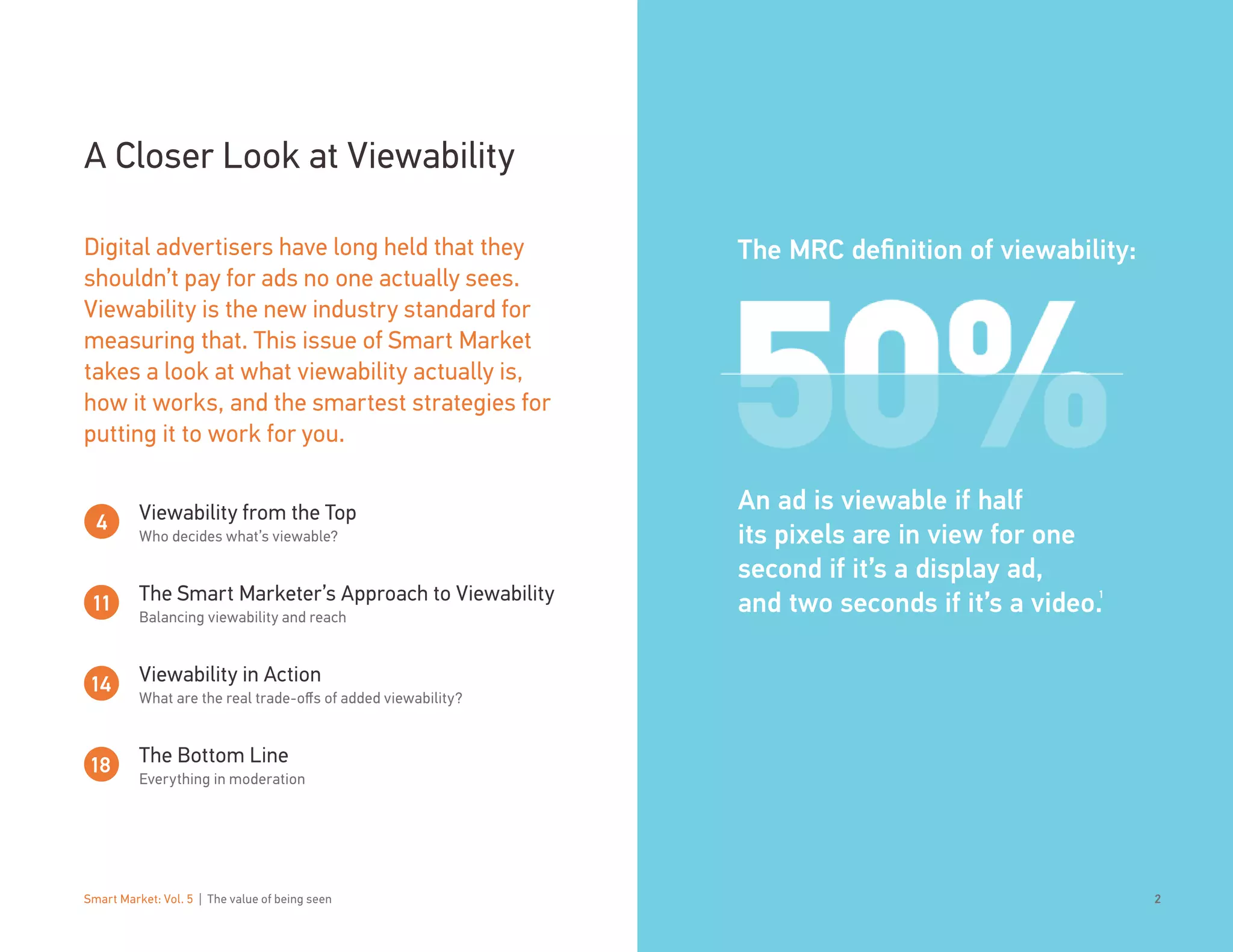
The MRC definition of viewability:
An ad is viewable if half
its pixels are in view for one
second if it’s a display ad,
and two seconds if it’s a video.1
4
11
14
18
2
Smart Market: Vol. 5 | The value of being seen 3
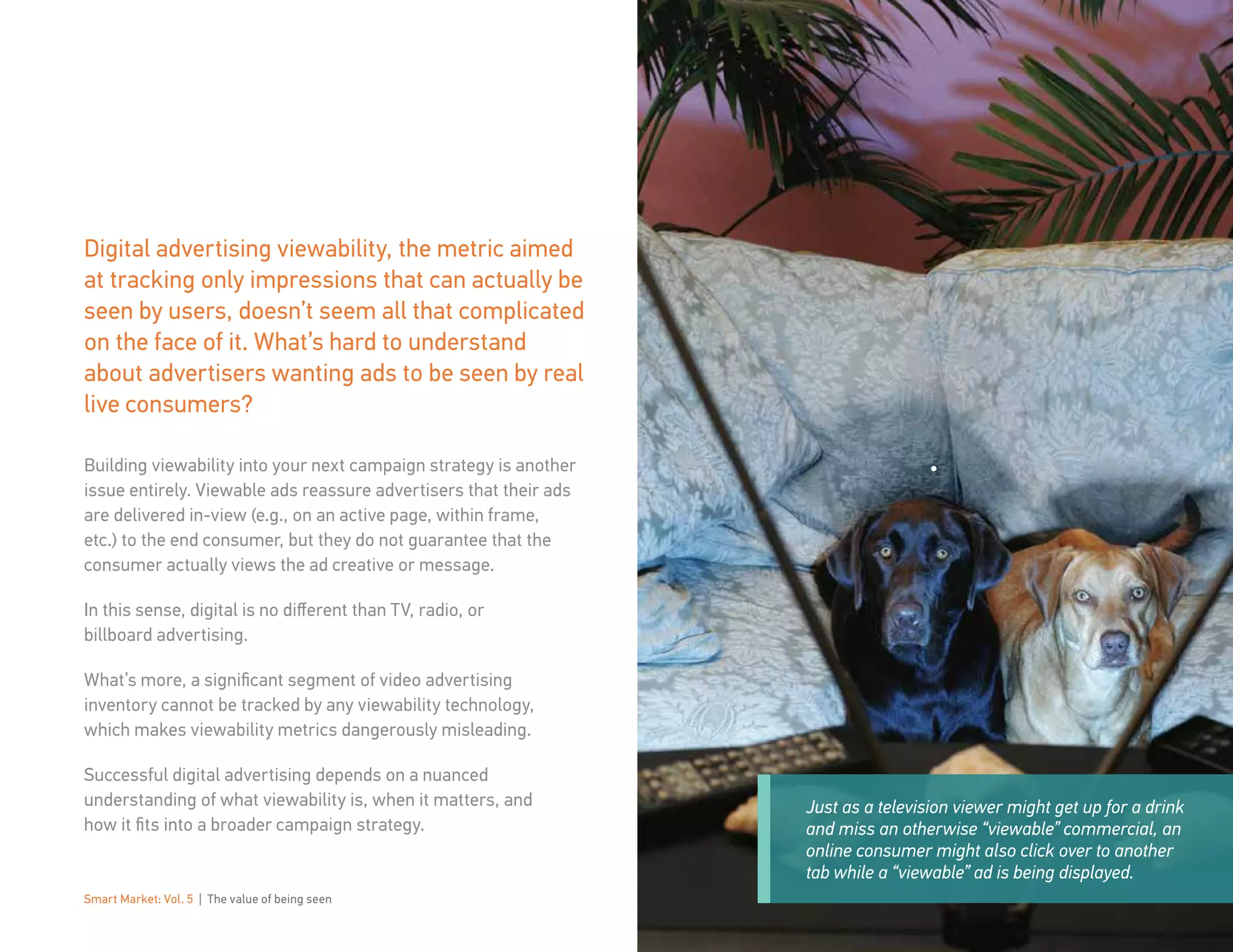
Just as a television viewer might get up for a drink
and miss an otherwise “viewable” commercial, an
online consumer might also click over to another
tab while a “viewable” ad is being displayed.
Digital advertising viewability, the metric aimed
at tracking only impressions that can actually be
seen by users, doesn’t seem all that complicated
on the face of it. What’s hard to understand
about advertisers wanting ads to be seen by real
live consumers?
Building viewability into your next campaign strategy is another
issue entirely. Viewable ads reassure advertisers that their ads
are delivered in-view (e.g., on an active page, within frame,
etc.) to the end consumer, but they do not guarantee that the
consumer actually views the ad creative or message.
In this sense, digital is no different than TV, radio, or
billboard advertising.
What’s more, a significant segment of video advertising
inventory cannot be tracked by any viewability technology,
which makes viewability metrics dangerously misleading.
Successful digital advertising depends on a nuanced
understanding of what viewability is, when it matters, and
how it fits into a broader campaign strategy.
Viewability from the Top
Who decides what’s viewable? How do you put viewability to work?
Smart Market: Vol. 5 | The value of being seen 5
VIEWABILITY FROM THE TOP
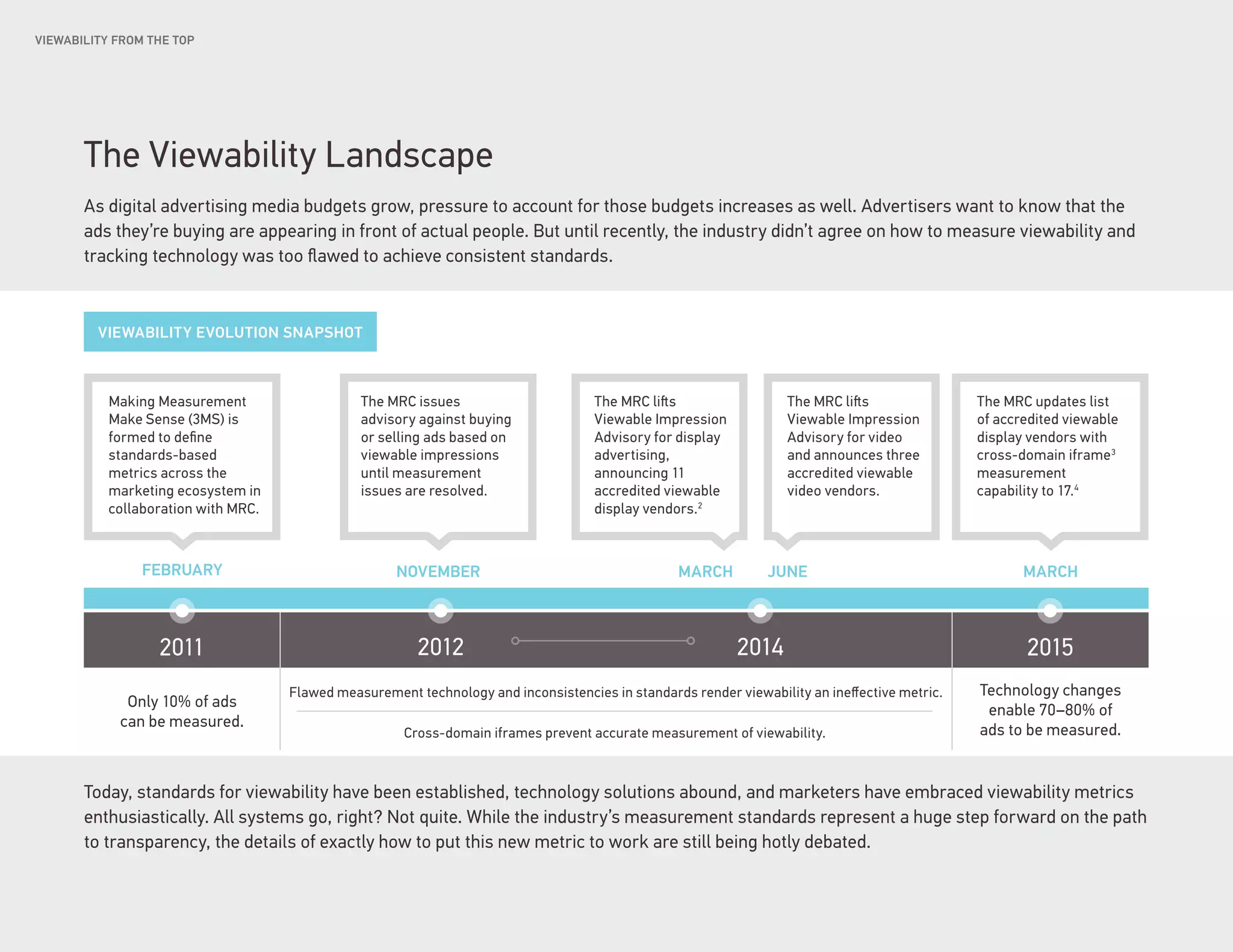
FEBRUARY NOVEMBER MARCH MARCHJUNE
2011 2015
Making Measurement
Make Sense (3MS) is
formed to define
standards-based
metrics across the
marketing ecosystem in
collaboration with MRC.
The MRC issues
advisory against buying
or selling ads based on
viewable impressions
until measurement
issues are resolved.
The MRC li s
Viewable Impression
Advisory for video
and announces three
accredited viewable
video vendors.
The MRC updates list
of accredited viewable
display vendors with
cross-domain iframe3
measurement
capability to 17.4
Technology changes
enable 70–80% of
ads to be measured.
Only 10% of ads
can be measured.
Flawed measurement technology and inconsistencies in standards render viewability an ineffective metric.
Cross-domain iframes prevent accurate measurement of viewability.
2012 2014
The MRC li s
Viewable Impression
Advisory for display
advertising,
announcing 11
accredited viewable
display vendors.2
Today, standards for viewability have been established, technology solutions abound, and marketers have embraced viewability metrics
enthusiastically. All systems go, right? Not quite. While the industry’s measurement standards represent a huge step forward on the path
to transparency, the details of exactly how to put this new metric to work are still being hotly debated.
The Viewability Landscape
As digital advertising media budgets grow, pressure to account for those budgets increases as well. Advertisers want to know that the
ads they’re buying are appearing in front of actual people. But until recently, the industry didn’t agree on how to measure viewability and
tracking technology was too flawed to achieve consistent standards.
VIEWABILITY EVOLUTION SNAPSHOT
Smart Market: Vol. 5 | The value of being seen 6
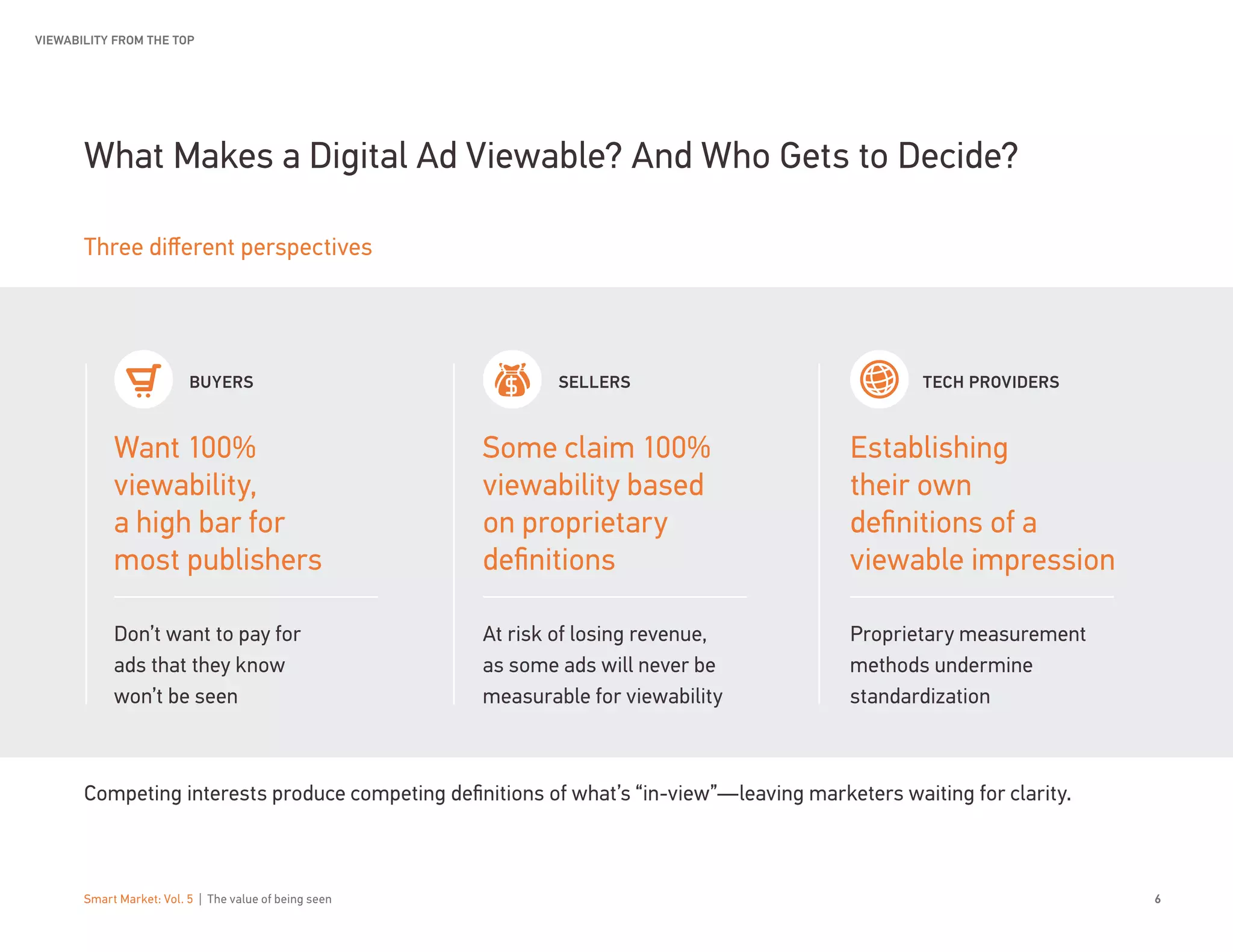
What Makes a Digital Ad Viewable? And Who Gets to Decide?
Three different perspectives
Competing interests produce competing definitions of what’s “in-view”—leaving marketers waiting for clarity.
Want 100%
viewability,
a high bar for
most publishers
Some claim 100%
viewability based
on proprietary
definitions
Establishing
their own
definitions of a
viewable impression
Don’t want to pay for
ads that they know
won’t be seen
At risk of losing revenue,
as some ads will never be
measurable for viewability
Proprietary measurement
methods undermine
standardization
BUYERS SELLERS TECH PROVIDERS
VIEWABILITY FROM THE TOP
Smart Market: Vol. 5 | The value of being seen 7
Despite advances in technology,
measuring viewability remains challenging.
Thanks to wide variability in browsers, screen sizes, and other
aspects of ad delivery, the industry’s move toward takeover
and other large-format ads in recent years also means that lots
of so-called “premium inventory” actually ranks very poorly
in terms of viewability.5
Video ads bring a separate suite of
viewability issues related to VPAID compliance (Video Player
Ad-Serving Interface definition, the only video ad delivery
standard that allows viewability to be measured), completion
rates, and audio muting.
Of course, viewability isn’t the only game in town. Today’s
advertisers have a whole spectrum of brand metrics at their
disposal, from attribution and engagement to brand lift.
Viewability is just the latest addition to this list, one more way to
understand what’s working in a campaign, what’s not, and why.
VIEWABILITY FROM THE TOP
Smart Market: Vol. 5 | The value of being seen 8
Who Owns Viewability
There are different viewpoints about which industry
players are accountable for viewability; that is, who
is responsible for making sure ads are seen. Is it the
marketer (buyer), agency, the media execution platform,
the supply-side platform, or the publisher (seller)?
Turn takes a practical approach here: We do everything
in our power to provide our customers only with
best-in-class inventory, while holding our inventory
providers to the highest possible standards.6
Efforts to maintain inventory
quality control must be two-
pronged: manual and algorithmic.
Turn leverages first- and third-party reporting and
insights to understand which properties have a
consistently poor quality rating and block them from
our inventory pool. We block known bots that can create
fraudulent (and therefore non-viewable) impressions and
by doing so increase the viewability of the supply we do
bid on. And we also support clients who want to purchase
only guaranteed viewable inventory by restricting bidding
to impressions that meet the MRC standard for viewability
and deliver ads only to intended (viewable) media.
TURN PERSPECTIVE
VIEWABILITY FROM THE TOP
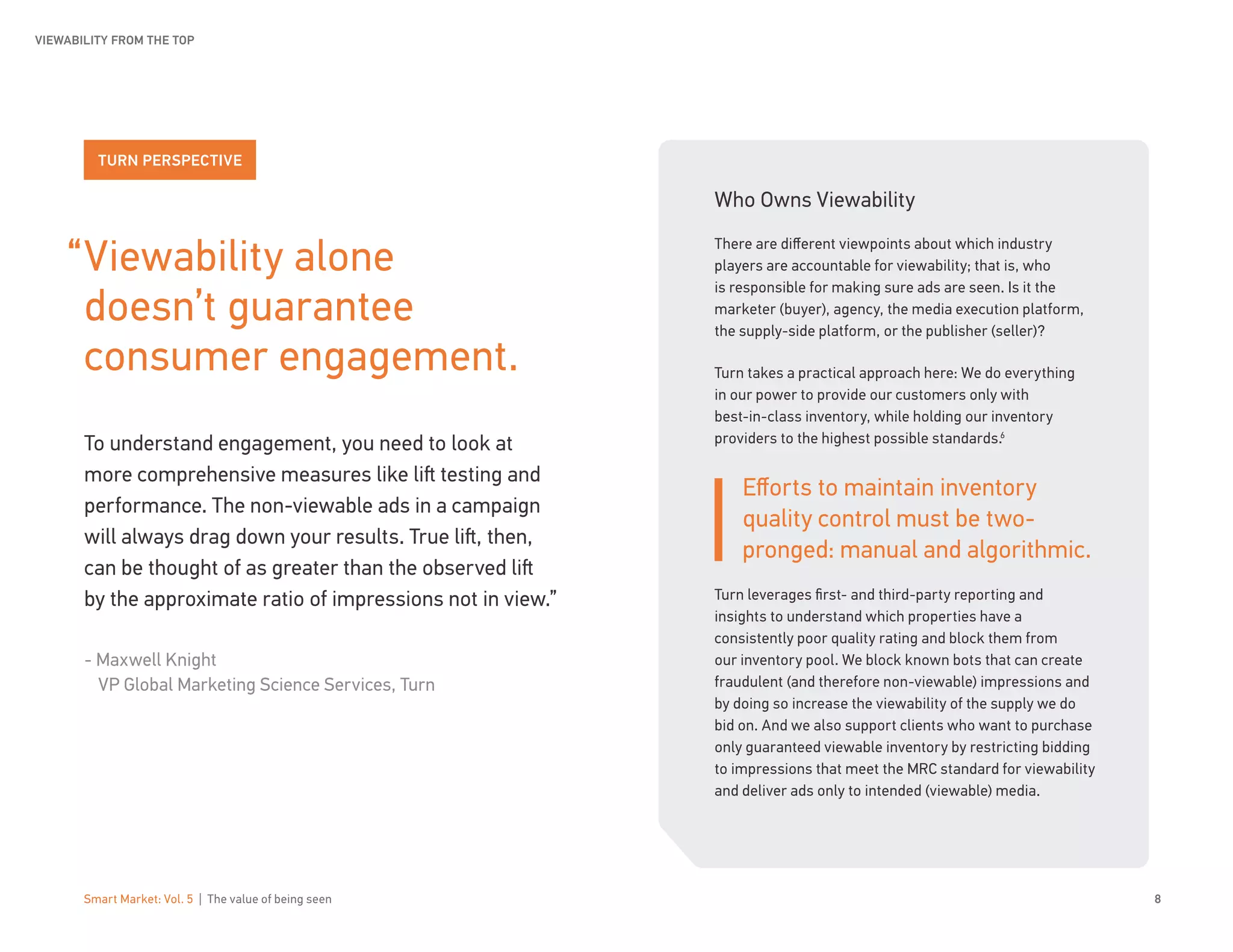
Viewability alone
doesn’t guarantee
consumer engagement.
To understand engagement, you need to look at
more comprehensive measures like lift testing and
performance. The non-viewable ads in a campaign
will always drag down your results. True lift, then,
can be thought of as greater than the observed lift
by the approximate ratio of impressions not in view.”
- Maxwell Knight
VP Global Marketing Science Services, Turn
“
Smart Market: Vol. 5 | The value of being seen 9
Viewability & Ad Effectiveness
An ad’s value and ultimate effectiveness cannot rely exclusively on the viewability of its placement.
This stands true whether a campaign’s key performance indicator (KPI) is high viewability as an end
in itself or viewability layered with other campaign metrics.
In some ways, viewability is doing for marketers the same thing
attribution modeling did when it released them from the known
pitfalls of last-touch attribution. Both viewability and multi-touch
attribution (MTA) are emerging measurement frameworks that
advertisers can use to better evaluate their campaigns, and
they’re even more powerful when applied in tandem.
Don’t fall victim to putting too much stock in viewability as a
standalone metric. Not all publishers measure the viewability of
their inventory, and yet a marketer’s desired audience might still
be drawn to those unmeasurable sites. For instance, since Google
doesn’t currently support VPAID ads, all YouTube traffic is not
measurable under the viewability industry standard.
Though its ads can’t be
measured as viewable under the
industry standard, YouTube may
well deliver the premium content
and KPIs that a marketer wants.
So the most effective campaign
for a given marketer might not
achieve 100% viewablility.
VIEWABILITY FROM THE TOP
Smart Market: Vol. 5 | The value of being seen 10
Marketers are just beginning to understand
the impact of applying viewability standards to
their campaigns.
Focusing primarily on viewability can reduce your inventory—
and your overall marketing reach—quickly. So how do you make
sure you’re not preventing yourself from meeting other campaign
goals in the interest of making sure your ads are viewable? If
you’re running a brand campaign, for example, you want to cast
a wide net so that you’ll gain insight into which creative, which
sites, and which offers work best and most effectively for you.
For every (viewability) action, there will be a reaction.
Advertisers who demand 100% viewability
won’t achieve the same reach as those who
don’t, at least until it’s possible to measure
viewability across media.
But their smaller, possibly more expensive audience might deliver
a higher rate of conversion, resulting in an uptick in performance
and ROI. The key is to do everything you can to ensure the most
favorable reaction possible.
VIEWABILITY FROM THE TOP
Smart Market: Vol. 5 | The value of being seen 11
The Smart Marketer’s Approach to Viewability
Viewability is important, but so is reach. How best to balance them both?
Smart Market: Vol. 5 | The value of being seen 12
All transactions between buyers
and sellers should use
MRC-accredited vendors only.
Given current technology, and the
publisher-observed variances in
measurement of 30–40%, it is
recommended that in this year of
transition (2015), measured
impressions be held to a 70%
viewability threshold.
Agree on a single measurement
vendor ahead of time. The industry
aspires to variances of no more than
10% between viewability measures
provided by different vendors.
Avoid costly, error-prone manual
processes of reconciling different
viewability numbers.
For large-format ads, defined as
242,500 pixels or over, a viewable
impression is counted if 30% of
the ad pixels are viewable for a
minimum of one continuous second.1
Look at how your exchange defines
viewability so you understand how
you’re being charged.
When Is a Digital Ad Viewable?
Viewability should always be one part of a broader conversation
about a campaign’s goals and measurement strategy.
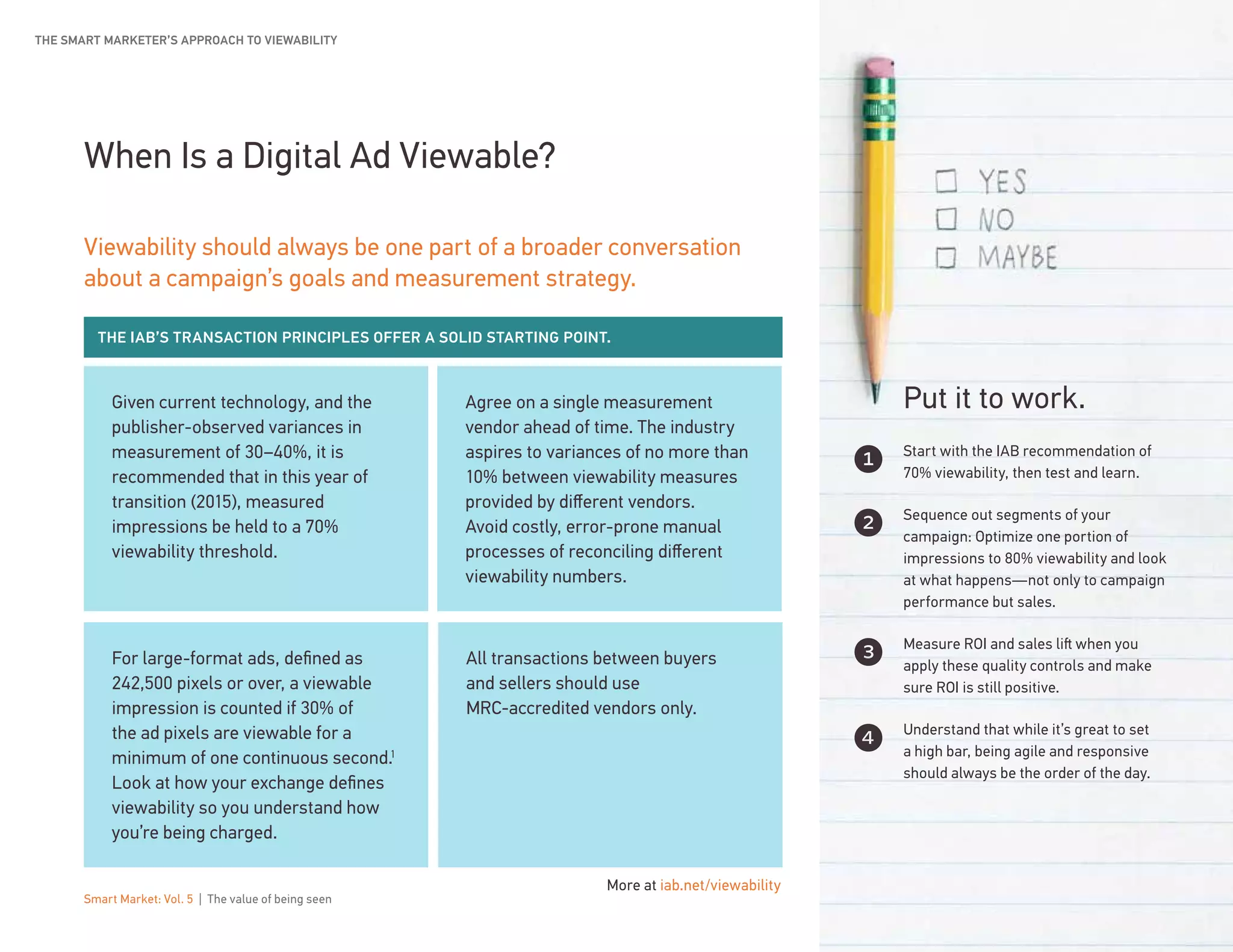
Start with the IAB recommendation of
70% viewability, then test and learn.
Sequence out segments of your
campaign: Optimize one portion of
impressions to 80% viewability and look
at what happens—not only to campaign
performance but sales.
Measure ROI and sales lift when you
apply these quality controls and make
sure ROI is still positive.
Understand that while it’s great to set
a high bar, being agile and responsive
should always be the order of the day.
Put it to work.
1
2
3
4
THE SMART MARKETER’S APPROACH TO VIEWABILITY
THE IAB’S TRANSACTION PRINCIPLES OFFER A SOLID STARTING POINT.
More at iab.net/viewability
Smart Market: Vol. 5 | The value of being seen 13
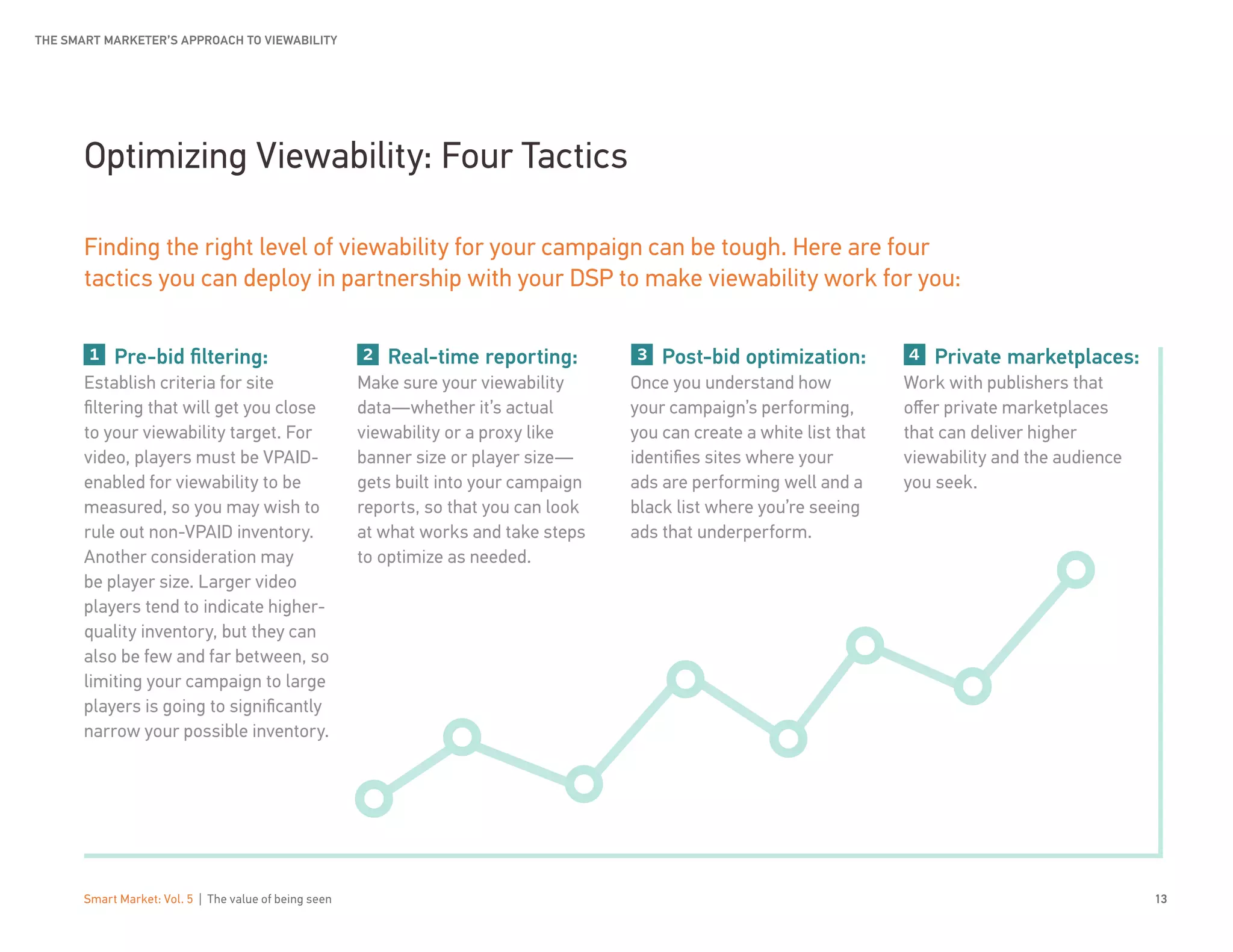
Pre-bid filtering:
Establish criteria for site
filtering that will get you close
to your viewability target. For
video, players must be VPAID-
enabled for viewability to be
measured, so you may wish to
rule out non-VPAID inventory.
Another consideration may
be player size. Larger video
players tend to indicate higher-
quality inventory, but they can
also be few and far between, so
limiting your campaign to large
players is going to significantly
narrow your possible inventory.
Real-time reporting:
Make sure your viewability
data—whether it’s actual
viewability or a proxy like
banner size or player size—
gets built into your campaign
reports, so that you can look
at what works and take steps
to optimize as needed.
Post-bid optimization:
Once you understand how
your campaign’s performing,
you can create a white list that
identifies sites where your
ads are performing well and a
black list where you’re seeing
ads that underperform.
Private marketplaces:
Work with publishers that
offer private marketplaces
that can deliver higher
viewability and the audience
you seek.
Optimizing Viewability: Four Tactics
Finding the right level of viewability for your campaign can be tough. Here are four
tactics you can deploy in partnership with your DSP to make viewability work for you:
1 2 3 4
THE SMART MARKETER’S APPROACH TO VIEWABILITY
Smart Market: Vol. 5 | The value of being seen 14
Viewability in Action
What are the real trade-offs of added viewability?
Smart Market: Vol. 5 | The value of being seen 15
Viewability in Action
It’s going to take a lot of trial and error to realize the full implications of adding viewability as a
requirement of inventory: Any targeting or filtering you apply will have some trickle-down effect.
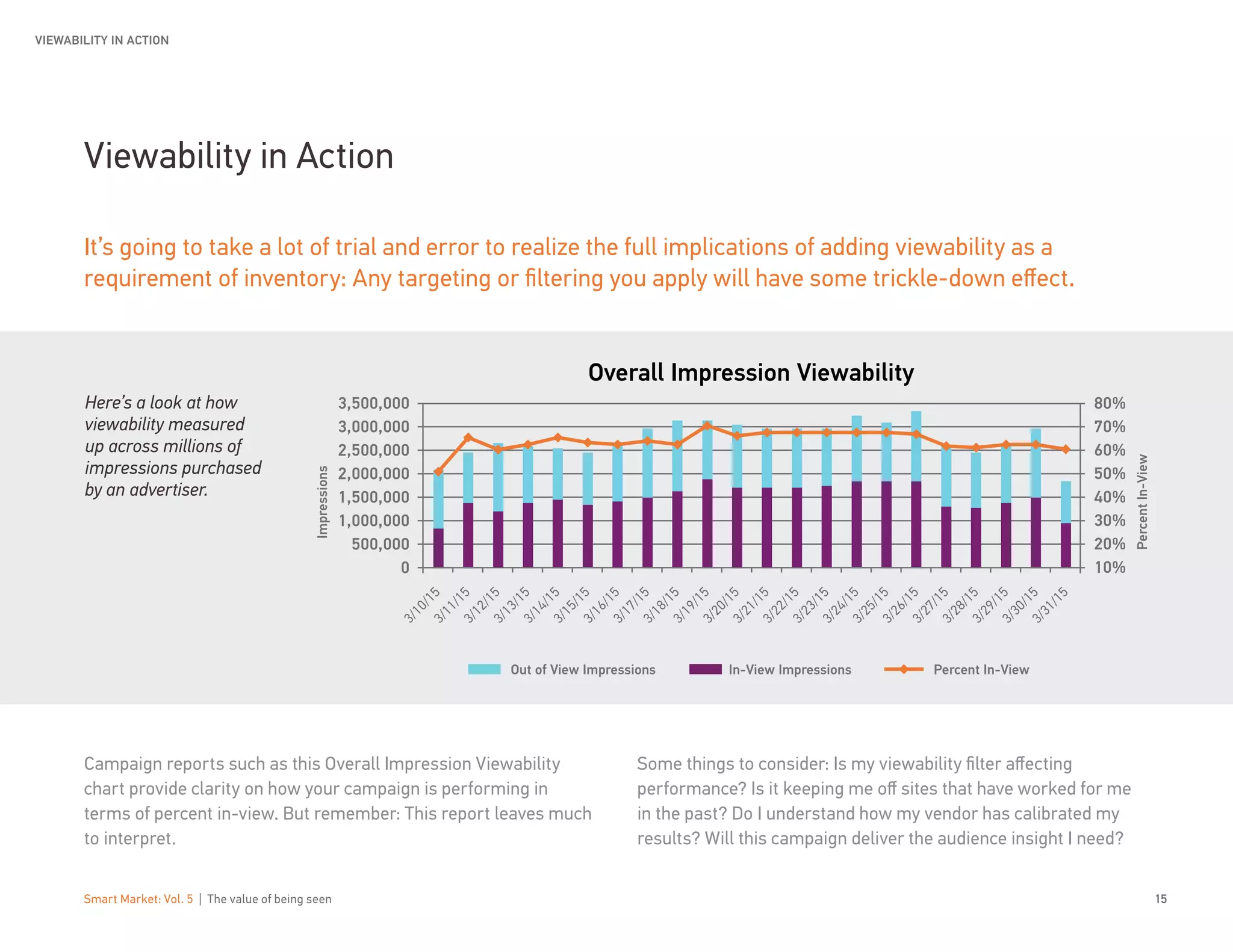
Here’s a look at how
viewability measured
up across millions of
impressions purchased
by an advertiser.
Campaign reports such as this Overall Impression Viewability
chart provide clarity on how your campaign is performing in
terms of percent in-view. But remember: This report leaves much
to interpret.
Some things to consider: Is my viewability filter affecting
performance? Is it keeping me off sites that have worked for me
in the past? Do I understand how my vendor has calibrated my
results? Will this campaign deliver the audience insight I need?
VIEWABILITY IN ACTION
3,500,000
3,000,000
2,500,000
2,000,000
1,500,000
1,000,000
500,000
0
80%
70%
60%
50%
40%
30%
20%
10%
3/10/153/11/153/12/153/13/153/14/153/15/153/16/153/17/153/18/153/19/153/20/153/21/153/22/153/23/153/24/153/25/153/26/153/27/153/28/153/29/153/30/153/31/15
Impressions
PercentIn-View
Out of View Impressions In-View Impressions Percent In-View
Overall Impression Viewability
Smart Market: Vol. 5 | The value of being seen 16
What Should You Do About Viewability?
If you’re an advertiser and want your campaigns to have the biggest possible impact,
you face a serious dilemma.
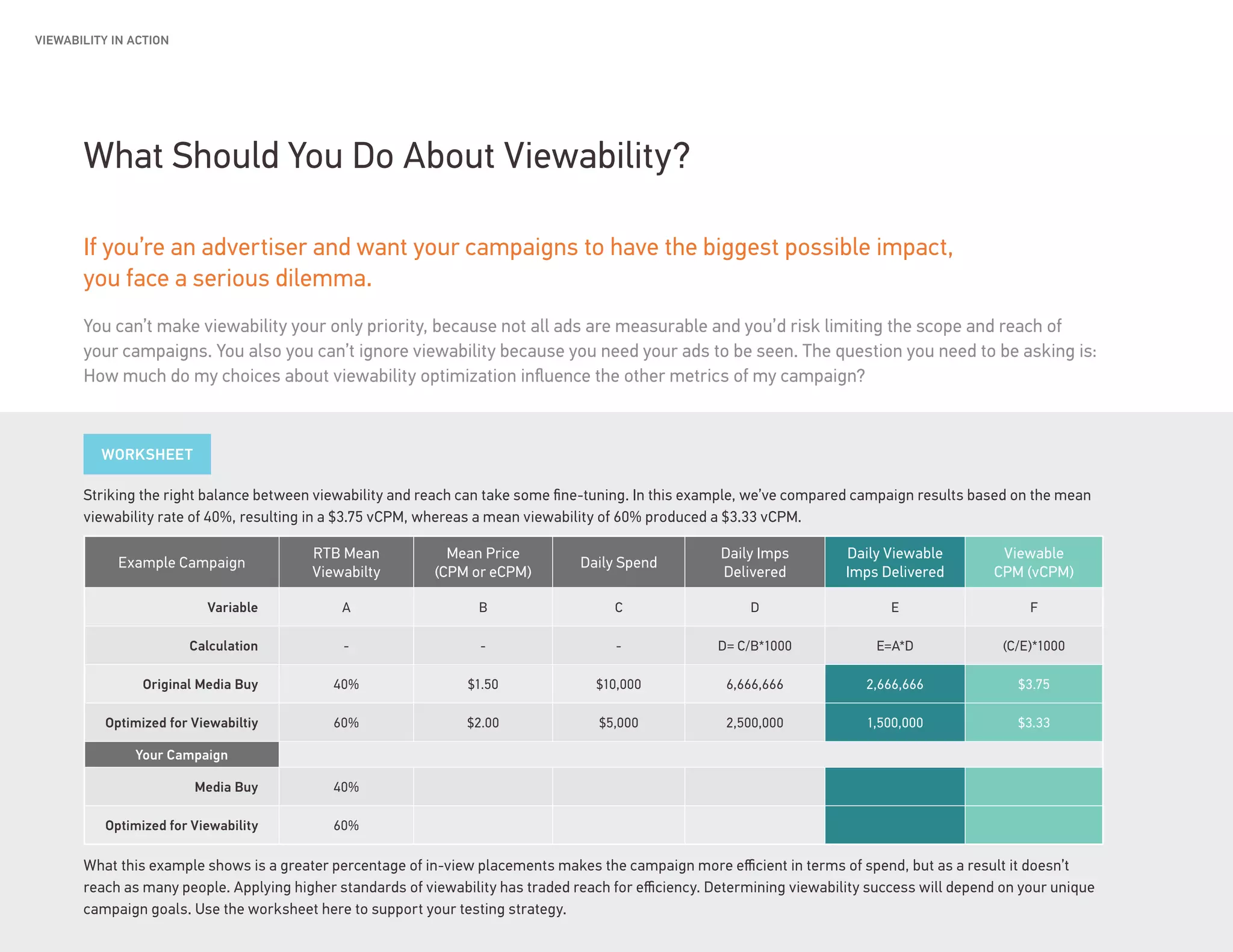
Striking the right balance between viewability and reach can take some fine-tuning. In this example, we’ve compared campaign results based on the mean
viewability rate of 40%, resulting in a $3.75 vCPM, whereas a mean viewability of 60% produced a $3.33 vCPM.
What this example shows is a greater percentage of in-view placements makes the campaign more efficient in terms of spend, but as a result it doesn’t
reach as many people. Applying higher standards of viewability has traded reach for efficiency. Determining viewability success will depend on your unique
campaign goals. Use the worksheet here to support your testing strategy.
VIEWABILITY IN ACTION
Example Campaign
RTB Mean
Viewabilty
Mean Price
(CPM or eCPM)
Daily Spend
Daily Imps
Delivered
Daily Viewable
Imps Delivered
Viewable
CPM (vCPM)
Variable A B C D E F
Calculation - - - D= C/B*1000 E=A*D (C/E)*1000
Original Media Buy 40% $1.50 $10,000 6,666,666 2,666,666 $3.75
Optimized for Viewabiltiy 60% $2.00 $5,000 2,500,000 1,500,000 $3.33
Your Campaign
Media Buy 40%
Optimized for Viewability 60%
You can’t make viewability your only priority, because not all ads are measurable and you’d risk limiting the scope and reach of
your campaigns. You also you can’t ignore viewability because you need your ads to be seen. The question you need to be asking is:
How much do my choices about viewability optimization influence the other metrics of my campaign?
WORKSHEET
Smart Market: Vol. 5 | The value of being seen 17
Are you measuring the impact of viewability
efforts on your marketing? Ask yourself
these questions:
Remember to measure the overall impact of your viewability
efforts on your marketing, so you won’t be stuck with unspent
budget and unmet targets.
What’s my vCPM (don’t forget to include
your ad serving fees, even on ads that
aren’t viewable)?
How does shifting my vCPM affect my
achievable level of viewable impressions?
What’s the trade-off between reach and
viewable efficiency?
What’s my real lift once I account for the
“drag” that non-viewable impressions had
on my treatment group (if you are, in fact,
measuring lift)?
VIEWABILITY IN ACTION
Smart Market: Vol. 5 | The value of being seen 18
The Bottom Line
Everything in moderation
Smart Market: Vol. 5 | The value of being seen 19
The Bottom Line
Whatever your approach to viewability, the
important thing is to keep an open mind, and
be ready to evolve with the industry.
Keep having transparent conversations with your agency
and technology partners. Stay on top of best practices. Most
important, make sure your approach to viewability supports,
rather than hinders, the success of your marketing. Use every
brand metric you can to measure your effectiveness. Make
sure you’re making all of them work, and not leaning too hard
on viewability. Viewability should never be an end in itself. It
should be a way of optimizing your marketing to support your
ultimate business objective, whether you’re in it for the clicks,
leads, or sales.
THE BOTTOM LINE
Viewability at a Glance
Viewability, an online ad’s ability to be seen, and the shift from
served to viewable impressions continue to move the industry
toward greater accountability.
Guaranteeing the ‘opportunity to see’ lays the groundwork
for comparability across media types, paving the way for
cross-media measurement.
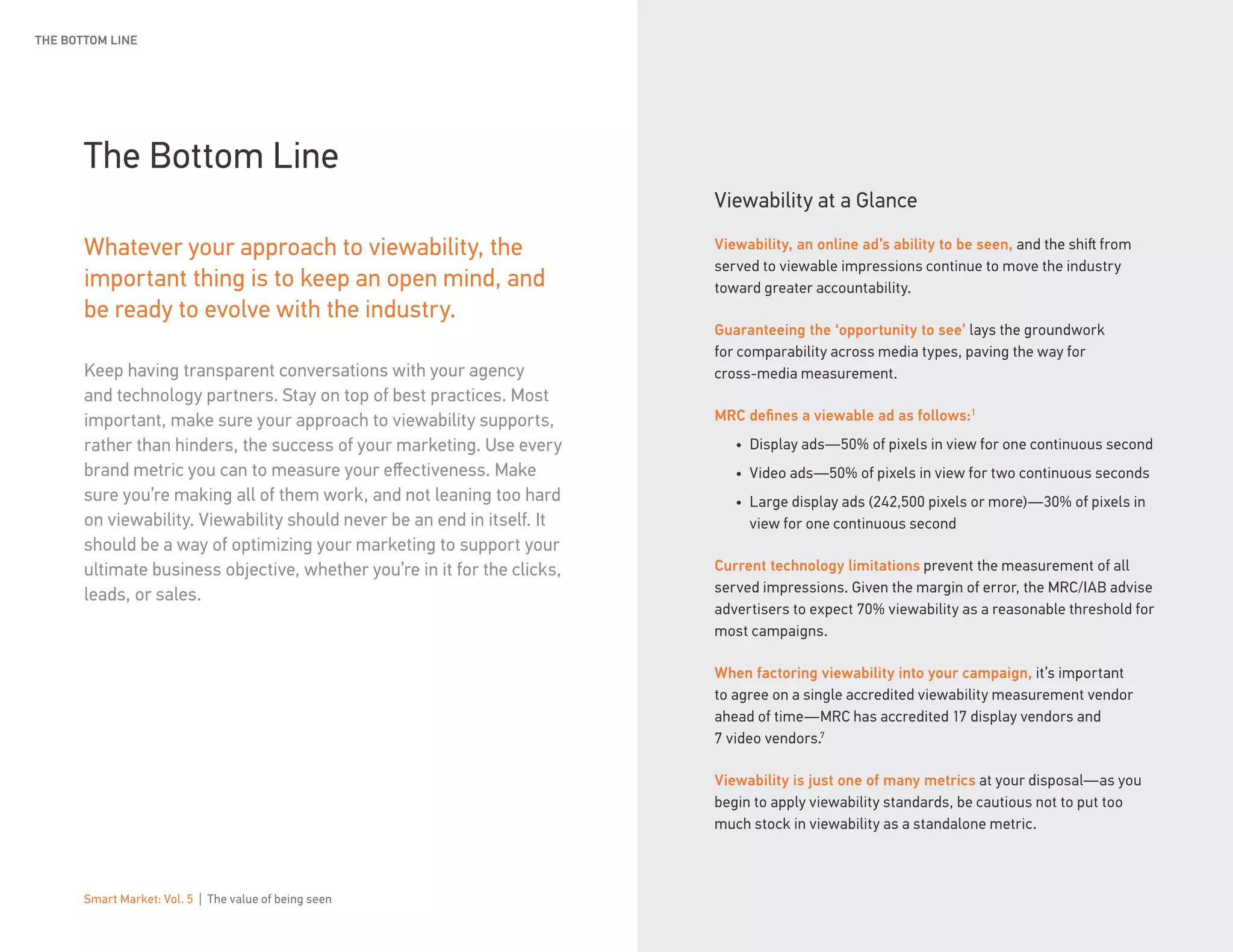
MRC defines a viewable ad as follows:1
•	 Display ads—50% of pixels in view for one continuous second
•	 Video ads—50% of pixels in view for two continuous seconds
•	 Large display ads (242,500 pixels or more)—30% of pixels in
view for one continuous second
Current technology limitations prevent the measurement of all
served impressions. Given the margin of error, the MRC/IAB advise
advertisers to expect 70% viewability as a reasonable threshold for
most campaigns.
When factoring viewability into your campaign, it’s important
to agree on a single accredited viewability measurement vendor
ahead of time—MRC has accredited 17 display vendors and
7 video vendors.7
Viewability is just one of many metrics at your disposal—as you
begin to apply viewability standards, be cautious not to put too
much stock in viewability as a standalone metric.
Smart Market: Vol. 5 | The value of being seen 20
About Turn
Turn delivers real-time insights that transform the way leading media agencies
and enterprises make marketing decisions. Our Digital Hub for Marketers enables
anonymous audience planning, data centralization, cross-device advertising, and
advanced analytics, along with point-and-click access to more than 150 integrated
technology partners. Turn is headquartered in Silicon Valley and provides its
products and services worldwide.
Sources:
1	 Media Rating Council. (2014, June 30). MRC Viewable Ad Impression Measurement Guidelines. Retrieved from http://www.mediaratingcouncil.org/063014%20
Viewable%20Ad%20Impression%20Guideline_Final.pdf
2	 Aquino, J. (2014, March 31). MRC Gives Its Blessing To Viewability Vendors. Retrieved from http://adexchanger.com/online-advertising/mrc-gives-its-blessing-to-
viewability-vendors/
3	 A cross-domain inline frame (or iframe) enables content from one web page to be displayed within another, separately hosted and loaded page.
4	 Media Rating Council. (2015, March 2). MRC Accredited Viewable Display Impression and/or Ad Verification Vendors: Enhanced Description. Retrieved from http://
mediaratingcouncil.org/030215_AdVerification%20disclosures%20PostReconciliation.pdf
5	 Shields, M. (2015, January 27). The Push For Web Ad Viewability Proving To Be Nightmare For Publishers Early On. The Wall Street Journal. Retrieved from http://blogs.
wsj.com/cmo/2015/01/27/the-push-for-web-ad-viewability-proving-to-be-nightmare-for-publishers-early-on/
6	 Turn Privacy Guidelines. (2015, April 3). Retrieved from www.turn.com/trust/inventory-guidelines.
7	 Media Rating Council. (2015, March 16). Digital Metrics, Companies Accredited by MRC. Retreived from http://mediaratingcouncil.org/Digital%20Landscape.pdf
© 2015 Turn Inc. All rights reserved. Turn is a registered trademark of Turn Inc. All services are subject to change or discontinuation without notice. April 2015.
For more information:
Americas
Quynh Cline
quynh.cline@turn.com
+1.650.362.6891
Europe
Helen Miall
helen.miall@turn.com
+44.20.7255.5665
Asia-Pacific
Rita Vannithone
rita.vannithone@turn.com
+852.6087.4576
For press inquiries:
Leslie Lee
leslie.lee@turn.com
+1.646.213.9734
Turn Turn Inc.@turnplatform
Visit www.turn.com

The value of being seen : a guide to digital advertising viewability - Turn - 2015

  • 1.
    The value ofbeing seen A Guide to Digital Advertising Viewability Smart Market: Vol. 5 Data-Driven Marketing, Demystified
  • 2.
    Smart Market: Vol.5 | The value of being seen A Closer Look at Viewability Digital advertisers have long held that they shouldn’t pay for ads no one actually sees. Viewability is the new industry standard for measuring that. This issue of Smart Market takes a look at what viewability actually is, how it works, and the smartest strategies for putting it to work for you. Viewability from the Top Who decides what’s viewable? The Smart Marketer’s Approach to Viewability Balancing viewability and reach Viewability in Action What are the real trade-offs of added viewability? The Bottom Line Everything in moderation The MRC definition of viewability: An ad is viewable if half its pixels are in view for one second if it’s a display ad, and two seconds if it’s a video.1 4 11 14 18 2
  • 3.
    Smart Market: Vol.5 | The value of being seen 3 Just as a television viewer might get up for a drink and miss an otherwise “viewable” commercial, an online consumer might also click over to another tab while a “viewable” ad is being displayed. Digital advertising viewability, the metric aimed at tracking only impressions that can actually be seen by users, doesn’t seem all that complicated on the face of it. What’s hard to understand about advertisers wanting ads to be seen by real live consumers? Building viewability into your next campaign strategy is another issue entirely. Viewable ads reassure advertisers that their ads are delivered in-view (e.g., on an active page, within frame, etc.) to the end consumer, but they do not guarantee that the consumer actually views the ad creative or message. In this sense, digital is no different than TV, radio, or billboard advertising. What’s more, a significant segment of video advertising inventory cannot be tracked by any viewability technology, which makes viewability metrics dangerously misleading. Successful digital advertising depends on a nuanced understanding of what viewability is, when it matters, and how it fits into a broader campaign strategy.
  • 4.
    Viewability from theTop Who decides what’s viewable? How do you put viewability to work?
  • 5.
    Smart Market: Vol.5 | The value of being seen 5 VIEWABILITY FROM THE TOP FEBRUARY NOVEMBER MARCH MARCHJUNE 2011 2015 Making Measurement Make Sense (3MS) is formed to define standards-based metrics across the marketing ecosystem in collaboration with MRC. The MRC issues advisory against buying or selling ads based on viewable impressions until measurement issues are resolved. The MRC li s Viewable Impression Advisory for video and announces three accredited viewable video vendors. The MRC updates list of accredited viewable display vendors with cross-domain iframe3 measurement capability to 17.4 Technology changes enable 70–80% of ads to be measured. Only 10% of ads can be measured. Flawed measurement technology and inconsistencies in standards render viewability an ineffective metric. Cross-domain iframes prevent accurate measurement of viewability. 2012 2014 The MRC li s Viewable Impression Advisory for display advertising, announcing 11 accredited viewable display vendors.2 Today, standards for viewability have been established, technology solutions abound, and marketers have embraced viewability metrics enthusiastically. All systems go, right? Not quite. While the industry’s measurement standards represent a huge step forward on the path to transparency, the details of exactly how to put this new metric to work are still being hotly debated. The Viewability Landscape As digital advertising media budgets grow, pressure to account for those budgets increases as well. Advertisers want to know that the ads they’re buying are appearing in front of actual people. But until recently, the industry didn’t agree on how to measure viewability and tracking technology was too flawed to achieve consistent standards. VIEWABILITY EVOLUTION SNAPSHOT
  • 6.
    Smart Market: Vol.5 | The value of being seen 6 What Makes a Digital Ad Viewable? And Who Gets to Decide? Three different perspectives Competing interests produce competing definitions of what’s “in-view”—leaving marketers waiting for clarity. Want 100% viewability, a high bar for most publishers Some claim 100% viewability based on proprietary definitions Establishing their own definitions of a viewable impression Don’t want to pay for ads that they know won’t be seen At risk of losing revenue, as some ads will never be measurable for viewability Proprietary measurement methods undermine standardization BUYERS SELLERS TECH PROVIDERS VIEWABILITY FROM THE TOP
  • 7.
    Smart Market: Vol.5 | The value of being seen 7 Despite advances in technology, measuring viewability remains challenging. Thanks to wide variability in browsers, screen sizes, and other aspects of ad delivery, the industry’s move toward takeover and other large-format ads in recent years also means that lots of so-called “premium inventory” actually ranks very poorly in terms of viewability.5 Video ads bring a separate suite of viewability issues related to VPAID compliance (Video Player Ad-Serving Interface definition, the only video ad delivery standard that allows viewability to be measured), completion rates, and audio muting. Of course, viewability isn’t the only game in town. Today’s advertisers have a whole spectrum of brand metrics at their disposal, from attribution and engagement to brand lift. Viewability is just the latest addition to this list, one more way to understand what’s working in a campaign, what’s not, and why. VIEWABILITY FROM THE TOP
  • 8.
    Smart Market: Vol.5 | The value of being seen 8 Who Owns Viewability There are different viewpoints about which industry players are accountable for viewability; that is, who is responsible for making sure ads are seen. Is it the marketer (buyer), agency, the media execution platform, the supply-side platform, or the publisher (seller)? Turn takes a practical approach here: We do everything in our power to provide our customers only with best-in-class inventory, while holding our inventory providers to the highest possible standards.6 Efforts to maintain inventory quality control must be two- pronged: manual and algorithmic. Turn leverages first- and third-party reporting and insights to understand which properties have a consistently poor quality rating and block them from our inventory pool. We block known bots that can create fraudulent (and therefore non-viewable) impressions and by doing so increase the viewability of the supply we do bid on. And we also support clients who want to purchase only guaranteed viewable inventory by restricting bidding to impressions that meet the MRC standard for viewability and deliver ads only to intended (viewable) media. TURN PERSPECTIVE VIEWABILITY FROM THE TOP Viewability alone doesn’t guarantee consumer engagement. To understand engagement, you need to look at more comprehensive measures like lift testing and performance. The non-viewable ads in a campaign will always drag down your results. True lift, then, can be thought of as greater than the observed lift by the approximate ratio of impressions not in view.” - Maxwell Knight VP Global Marketing Science Services, Turn “
  • 9.
    Smart Market: Vol.5 | The value of being seen 9 Viewability & Ad Effectiveness An ad’s value and ultimate effectiveness cannot rely exclusively on the viewability of its placement. This stands true whether a campaign’s key performance indicator (KPI) is high viewability as an end in itself or viewability layered with other campaign metrics. In some ways, viewability is doing for marketers the same thing attribution modeling did when it released them from the known pitfalls of last-touch attribution. Both viewability and multi-touch attribution (MTA) are emerging measurement frameworks that advertisers can use to better evaluate their campaigns, and they’re even more powerful when applied in tandem. Don’t fall victim to putting too much stock in viewability as a standalone metric. Not all publishers measure the viewability of their inventory, and yet a marketer’s desired audience might still be drawn to those unmeasurable sites. For instance, since Google doesn’t currently support VPAID ads, all YouTube traffic is not measurable under the viewability industry standard. Though its ads can’t be measured as viewable under the industry standard, YouTube may well deliver the premium content and KPIs that a marketer wants. So the most effective campaign for a given marketer might not achieve 100% viewablility. VIEWABILITY FROM THE TOP
  • 10.
    Smart Market: Vol.5 | The value of being seen 10 Marketers are just beginning to understand the impact of applying viewability standards to their campaigns. Focusing primarily on viewability can reduce your inventory— and your overall marketing reach—quickly. So how do you make sure you’re not preventing yourself from meeting other campaign goals in the interest of making sure your ads are viewable? If you’re running a brand campaign, for example, you want to cast a wide net so that you’ll gain insight into which creative, which sites, and which offers work best and most effectively for you. For every (viewability) action, there will be a reaction. Advertisers who demand 100% viewability won’t achieve the same reach as those who don’t, at least until it’s possible to measure viewability across media. But their smaller, possibly more expensive audience might deliver a higher rate of conversion, resulting in an uptick in performance and ROI. The key is to do everything you can to ensure the most favorable reaction possible. VIEWABILITY FROM THE TOP
  • 11.
    Smart Market: Vol.5 | The value of being seen 11 The Smart Marketer’s Approach to Viewability Viewability is important, but so is reach. How best to balance them both?
  • 12.
    Smart Market: Vol.5 | The value of being seen 12 All transactions between buyers and sellers should use MRC-accredited vendors only. Given current technology, and the publisher-observed variances in measurement of 30–40%, it is recommended that in this year of transition (2015), measured impressions be held to a 70% viewability threshold. Agree on a single measurement vendor ahead of time. The industry aspires to variances of no more than 10% between viewability measures provided by different vendors. Avoid costly, error-prone manual processes of reconciling different viewability numbers. For large-format ads, defined as 242,500 pixels or over, a viewable impression is counted if 30% of the ad pixels are viewable for a minimum of one continuous second.1 Look at how your exchange defines viewability so you understand how you’re being charged. When Is a Digital Ad Viewable? Viewability should always be one part of a broader conversation about a campaign’s goals and measurement strategy. Start with the IAB recommendation of 70% viewability, then test and learn. Sequence out segments of your campaign: Optimize one portion of impressions to 80% viewability and look at what happens—not only to campaign performance but sales. Measure ROI and sales lift when you apply these quality controls and make sure ROI is still positive. Understand that while it’s great to set a high bar, being agile and responsive should always be the order of the day. Put it to work. 1 2 3 4 THE SMART MARKETER’S APPROACH TO VIEWABILITY THE IAB’S TRANSACTION PRINCIPLES OFFER A SOLID STARTING POINT. More at iab.net/viewability
  • 13.
    Smart Market: Vol.5 | The value of being seen 13 Pre-bid filtering: Establish criteria for site filtering that will get you close to your viewability target. For video, players must be VPAID- enabled for viewability to be measured, so you may wish to rule out non-VPAID inventory. Another consideration may be player size. Larger video players tend to indicate higher- quality inventory, but they can also be few and far between, so limiting your campaign to large players is going to significantly narrow your possible inventory. Real-time reporting: Make sure your viewability data—whether it’s actual viewability or a proxy like banner size or player size— gets built into your campaign reports, so that you can look at what works and take steps to optimize as needed. Post-bid optimization: Once you understand how your campaign’s performing, you can create a white list that identifies sites where your ads are performing well and a black list where you’re seeing ads that underperform. Private marketplaces: Work with publishers that offer private marketplaces that can deliver higher viewability and the audience you seek. Optimizing Viewability: Four Tactics Finding the right level of viewability for your campaign can be tough. Here are four tactics you can deploy in partnership with your DSP to make viewability work for you: 1 2 3 4 THE SMART MARKETER’S APPROACH TO VIEWABILITY
  • 14.
    Smart Market: Vol.5 | The value of being seen 14 Viewability in Action What are the real trade-offs of added viewability?
  • 15.
    Smart Market: Vol.5 | The value of being seen 15 Viewability in Action It’s going to take a lot of trial and error to realize the full implications of adding viewability as a requirement of inventory: Any targeting or filtering you apply will have some trickle-down effect. Here’s a look at how viewability measured up across millions of impressions purchased by an advertiser. Campaign reports such as this Overall Impression Viewability chart provide clarity on how your campaign is performing in terms of percent in-view. But remember: This report leaves much to interpret. Some things to consider: Is my viewability filter affecting performance? Is it keeping me off sites that have worked for me in the past? Do I understand how my vendor has calibrated my results? Will this campaign deliver the audience insight I need? VIEWABILITY IN ACTION 3,500,000 3,000,000 2,500,000 2,000,000 1,500,000 1,000,000 500,000 0 80% 70% 60% 50% 40% 30% 20% 10% 3/10/153/11/153/12/153/13/153/14/153/15/153/16/153/17/153/18/153/19/153/20/153/21/153/22/153/23/153/24/153/25/153/26/153/27/153/28/153/29/153/30/153/31/15 Impressions PercentIn-View Out of View Impressions In-View Impressions Percent In-View Overall Impression Viewability
  • 16.
    Smart Market: Vol.5 | The value of being seen 16 What Should You Do About Viewability? If you’re an advertiser and want your campaigns to have the biggest possible impact, you face a serious dilemma. Striking the right balance between viewability and reach can take some fine-tuning. In this example, we’ve compared campaign results based on the mean viewability rate of 40%, resulting in a $3.75 vCPM, whereas a mean viewability of 60% produced a $3.33 vCPM. What this example shows is a greater percentage of in-view placements makes the campaign more efficient in terms of spend, but as a result it doesn’t reach as many people. Applying higher standards of viewability has traded reach for efficiency. Determining viewability success will depend on your unique campaign goals. Use the worksheet here to support your testing strategy. VIEWABILITY IN ACTION Example Campaign RTB Mean Viewabilty Mean Price (CPM or eCPM) Daily Spend Daily Imps Delivered Daily Viewable Imps Delivered Viewable CPM (vCPM) Variable A B C D E F Calculation - - - D= C/B*1000 E=A*D (C/E)*1000 Original Media Buy 40% $1.50 $10,000 6,666,666 2,666,666 $3.75 Optimized for Viewabiltiy 60% $2.00 $5,000 2,500,000 1,500,000 $3.33 Your Campaign Media Buy 40% Optimized for Viewability 60% You can’t make viewability your only priority, because not all ads are measurable and you’d risk limiting the scope and reach of your campaigns. You also you can’t ignore viewability because you need your ads to be seen. The question you need to be asking is: How much do my choices about viewability optimization influence the other metrics of my campaign? WORKSHEET
  • 17.
    Smart Market: Vol.5 | The value of being seen 17 Are you measuring the impact of viewability efforts on your marketing? Ask yourself these questions: Remember to measure the overall impact of your viewability efforts on your marketing, so you won’t be stuck with unspent budget and unmet targets. What’s my vCPM (don’t forget to include your ad serving fees, even on ads that aren’t viewable)? How does shifting my vCPM affect my achievable level of viewable impressions? What’s the trade-off between reach and viewable efficiency? What’s my real lift once I account for the “drag” that non-viewable impressions had on my treatment group (if you are, in fact, measuring lift)? VIEWABILITY IN ACTION
  • 18.
    Smart Market: Vol.5 | The value of being seen 18 The Bottom Line Everything in moderation
  • 19.
    Smart Market: Vol.5 | The value of being seen 19 The Bottom Line Whatever your approach to viewability, the important thing is to keep an open mind, and be ready to evolve with the industry. Keep having transparent conversations with your agency and technology partners. Stay on top of best practices. Most important, make sure your approach to viewability supports, rather than hinders, the success of your marketing. Use every brand metric you can to measure your effectiveness. Make sure you’re making all of them work, and not leaning too hard on viewability. Viewability should never be an end in itself. It should be a way of optimizing your marketing to support your ultimate business objective, whether you’re in it for the clicks, leads, or sales. THE BOTTOM LINE Viewability at a Glance Viewability, an online ad’s ability to be seen, and the shift from served to viewable impressions continue to move the industry toward greater accountability. Guaranteeing the ‘opportunity to see’ lays the groundwork for comparability across media types, paving the way for cross-media measurement. MRC defines a viewable ad as follows:1 • Display ads—50% of pixels in view for one continuous second • Video ads—50% of pixels in view for two continuous seconds • Large display ads (242,500 pixels or more)—30% of pixels in view for one continuous second Current technology limitations prevent the measurement of all served impressions. Given the margin of error, the MRC/IAB advise advertisers to expect 70% viewability as a reasonable threshold for most campaigns. When factoring viewability into your campaign, it’s important to agree on a single accredited viewability measurement vendor ahead of time—MRC has accredited 17 display vendors and 7 video vendors.7 Viewability is just one of many metrics at your disposal—as you begin to apply viewability standards, be cautious not to put too much stock in viewability as a standalone metric.
  • 20.
    Smart Market: Vol.5 | The value of being seen 20 About Turn Turn delivers real-time insights that transform the way leading media agencies and enterprises make marketing decisions. Our Digital Hub for Marketers enables anonymous audience planning, data centralization, cross-device advertising, and advanced analytics, along with point-and-click access to more than 150 integrated technology partners. Turn is headquartered in Silicon Valley and provides its products and services worldwide. Sources: 1 Media Rating Council. (2014, June 30). MRC Viewable Ad Impression Measurement Guidelines. Retrieved from http://www.mediaratingcouncil.org/063014%20 Viewable%20Ad%20Impression%20Guideline_Final.pdf 2 Aquino, J. (2014, March 31). MRC Gives Its Blessing To Viewability Vendors. Retrieved from http://adexchanger.com/online-advertising/mrc-gives-its-blessing-to- viewability-vendors/ 3 A cross-domain inline frame (or iframe) enables content from one web page to be displayed within another, separately hosted and loaded page. 4 Media Rating Council. (2015, March 2). MRC Accredited Viewable Display Impression and/or Ad Verification Vendors: Enhanced Description. Retrieved from http:// mediaratingcouncil.org/030215_AdVerification%20disclosures%20PostReconciliation.pdf 5 Shields, M. (2015, January 27). The Push For Web Ad Viewability Proving To Be Nightmare For Publishers Early On. The Wall Street Journal. Retrieved from http://blogs. wsj.com/cmo/2015/01/27/the-push-for-web-ad-viewability-proving-to-be-nightmare-for-publishers-early-on/ 6 Turn Privacy Guidelines. (2015, April 3). Retrieved from www.turn.com/trust/inventory-guidelines. 7 Media Rating Council. (2015, March 16). Digital Metrics, Companies Accredited by MRC. Retreived from http://mediaratingcouncil.org/Digital%20Landscape.pdf © 2015 Turn Inc. All rights reserved. Turn is a registered trademark of Turn Inc. All services are subject to change or discontinuation without notice. April 2015. For more information: Americas Quynh Cline quynh.cline@turn.com +1.650.362.6891 Europe Helen Miall helen.miall@turn.com +44.20.7255.5665 Asia-Pacific Rita Vannithone rita.vannithone@turn.com +852.6087.4576 For press inquiries: Leslie Lee leslie.lee@turn.com +1.646.213.9734 Turn Turn Inc.@turnplatform Visit www.turn.com