November 2014 
The Importance 
of Being Seen 
Viewability Insights for Digital 
Marketers and Publishers
thinkwithgoogle.com 
WHAT WE WANTED TO KNOW 
We conducted research using our Active View technology to 
learn about the current state of viewable impressions on the web. 
There is increased interest in viewability among brand 
advertisers and publishers now that the Media Rating Council 
has lifted the viewable transaction advisory. Brand advertisers 
want to ensure that their ads can be seen and are seeking 
enhanced ROI. Publishers want to enhance site viewability 
and to use viewable impressions as a currency to do so. 
Here we highlight the trends we discovered in analyzing the 
research data to help advertisers and publishers formulate 
their viewability strategy. 
2
thinkwithgoogle.com 
WHAT WE DID 
3 
Google conducted a study of our display advertising platforms, 
including Google and DoubleClick, to better understand ad 
viewability. According to the Media Rating Council and IAB 
standards, a viewable impression occurs when 50% of an ad’s 
pixels are on screen for one second. The data used in this study 
are based on display ads in browsers (desktop and mobile) and 
does not include mobile in-app or video ads.
thinkwithgoogle.com 
WWHHAATT WWEE FFOOUUNNDD 
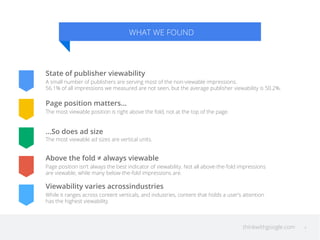
State of publisher viewability 
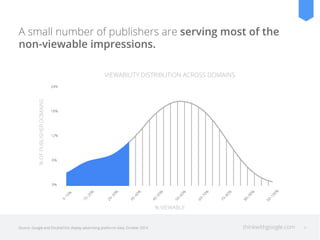
A small number of publishers are serving most of the non-viewable impressions. 
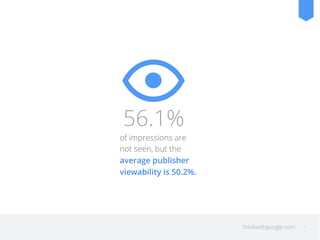
56.1% of all impressions we measured are not seen, but the average publisher viewability is 50.2%. 
Page position matters... 
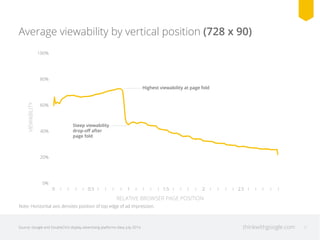
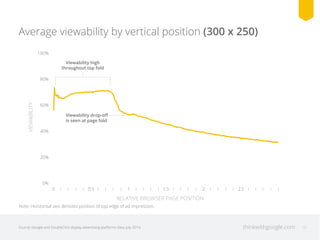
The most viewable position is right above the fold, not at the top of the page. 
...So does ad size 
The most viewable ad sizes are vertical units. 
Above the fold ≠ always viewable 
Page position isn’t always the best indicator of viewability. Not all above-the-fold impressions 
are viewable, while many below-the-fold impressions are. 
Viewability varies acrossindustries 
While it ranges across content verticals, and industries, content that holds a user’s attention 
has the highest viewability. 
4
State of Publisher Viewability
A small number of publishers are serving most of the 
non-viewable impressions. 
thinkwithgoogle.com 6 
VIEWABILITY DISTRIBUTION ACROSS DOMAINS 
Source: Google and DoubleClick display advertising platforms data, October 2014. 
% VIEWABLE 
% OF PUBLISHER DOMAINS
thinkwithgoogle.com 7 
56.1% 
of impressions are 
not seen, but the 
average publisher 
viewability is 50.2%.
Page Position Matters…
Average viewability by vertical position (728 x 90) 
100% 
80% 
60% 
40% 
20% 
0% 
Highest viewability at page fold 
Steep viewability 
drop-off after 
page fold 
0 0.5 1 1.5 2 2.5 
VIEWABILITY 
RELATIVE BROWSER PAGE POSITION 
Note: Horizontal axis denotes position of top edge of ad impression. 
Source: Google and DoubleClick display advertising platforms data, July 2014. thinkwithgoogle.com 9
Average viewability by vertical position (300 x 250) 
100% 
80% 
60% 
40% 
20% 
0% 
Viewability high 
throughout top fold 
Viewability drop-off 
is seen at page fold 
0 0.5 1 1.5 2 2.5 
VIEWABILITY 
RELATIVE BROWSER PAGE POSITION 
Note: Horizontal axis denotes position of top edge of ad impression. 
Source: Google and DoubleClick display advertising platforms data, July 2014. thinkwithgoogle.com 10
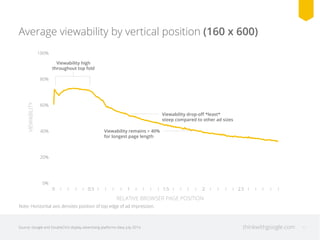
Average viewability by vertical position (160 x 600) 
100% 
80% 
60% 
40% 
20% 
0% 
Viewability high 
throughout top fold 
Viewability drop-off *least* 
steep compared to other ad sizes 
Viewability remains > 40% 
for longest page length 
0 0.5 1 1.5 2 2.5 
VIEWABILITY 
RELATIVE BROWSER PAGE POSITION 
Note: Horizontal axis denotes position of top edge of ad impression. 
Source: Google and DoubleClick display advertising platforms data, July 2014. thinkwithgoogle.com 11
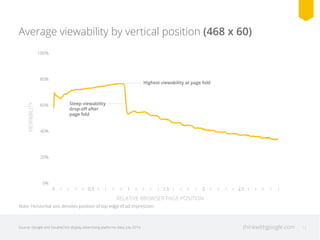
Average viewability by vertical position (468 x 60) 
100% 
80% 
60% 
40% 
20% 
0% 
Highest viewability at page fold 
Steep viewability 
drop-off after 
page fold 
0 0.5 1 1.5 2 2.5 
VIEWABILITY 
RELATIVE BROWSER PAGE POSITION 
Note: Horizontal axis denotes position of top edge of ad impression. 
Source: Google and DoubleClick display advertising platforms data, July 2014. thinkwithgoogle.com 12
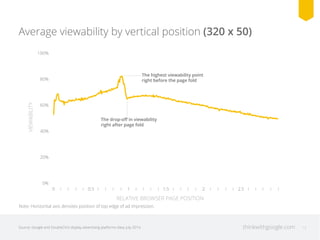
Average viewability by vertical position (320 x 50) 
100% 
80% 
60% 
40% 
20% 
0% 
The highest viewability point 
right before the page fold 
The drop-off in viewability 
right after page fold 
0 0.5 1 1.5 2 2.5 
VIEWABILITY 
RELATIVE BROWSER PAGE POSITION 
Note: Horizontal axis denotes position of top edge of ad impression. 
Source: Google and DoubleClick display advertising platforms data, July 2014. thinkwithgoogle.com 13
… So Does Ad Size
thinkwithgoogle.com 15 
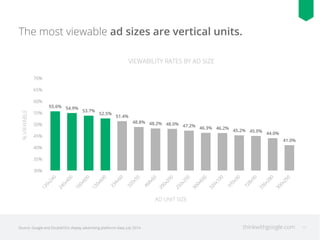
The most viewable ad sizes are vertical units. 
VIEWABILITY RATES BY AD SIZE 
55.6% 54.9% 53.7% 52.5% 51.4% 
48.8% 48.2% 48.0% 47.2% 46.3% 46.2% 45.2% 45.0% 44.0% 
41.0% 
70% 
65% 
60% 
55% 
50% 
45% 
40% 
35% 
30% 
% VIEWABLE 
Source: Google and DoubleClick display advertising platforms data, July 2014. 
AD UNIT SIZE
Above the Fold ≠ 
Always Viewable
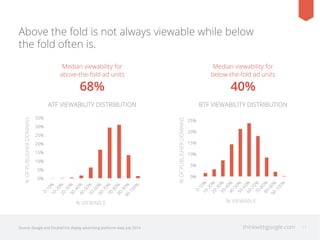
Above the fold is not always viewable while below 
the fold often is. 
thinkwithgoogle.com 17 
25% 
20% 
15% 
10% 
5% 
0% 
% OF PUBLISHER DOMAINS 
% VIEWABLE 
35% 
30% 
25% 
20% 
15% 
10% 
5% 
0% 
% OF PUBLISHER DOMAINS 
Median viewability for 
above-the-fold ad units 
68% 
ATF VIEWABILITY DISTRIBUTION 
% VIEWABLE 
Source: Google and DoubleClick display advertising platforms data, July 2014. 
Median viewability for 
below-the-fold ad units 
40% 
BTF VIEWABILITY DISTRIBUTION
Viewability Varies 
Across Industries
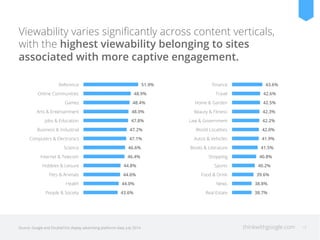
Viewability varies significantly across content verticals, 
with the highest viewability belonging to sites 
associated with more captive engagement. 
43.6% 
42.6% 
42.5% 
42.3% 
42.2% 
42.0% 
41.9% 
41.5% 
40.8% 
40.2% 
39.6% 
38.8% 
thinkwithgoogle.com 19 
48.9% 
48.4% 
48.0% 
47.8% 
47.2% 
47.1% 
46.6% 
46.4% 
44.8% 
44.6% 
44.0% 
43.6% 
Reference 
Online Communities 
Games 
Arts & Entertainment 
Jobs & Education 
Business & Industrial 
Computers & Electronics 
Science 
Internet & Telecom 
Hobbies & Leisure 
Pets & Animals 
Health 
Source: Google and DoubleClick display advertising platforms data, July 2014. 
51.9% 
People & Society 
38.7% 
Finance 
Travel 
Home & Garden 
Beauty & Fitness 
Law & Government 
World Localities 
Autos & Vehicles 
Books & Literature 
Shopping 
Sports 
Food & Drink 
News 
Real Estate
WHAT THIS MEANS FOR ADVERTISERS 
Viewability data enables advertisers to identify both high- and low-value 
inventory and then shift budgets and targets accordingly to 
maximize reach and ROI. 
By understanding trends about what inventory has the highest 
viewability, advertisers can better formulate their media strategies. 
thinkwithgoogle.com 20
WHAT THIS MEANS FOR ADVERTISERS 
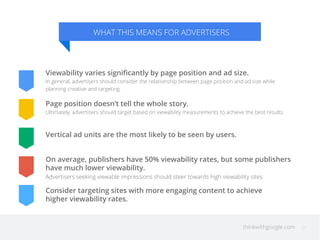
Viewability varies significantly by page position and ad size. 
In general, advertisers should consider the relationship between page position and ad size while 
planning creative and targeting. 
Page position doesn’t tell the whole story. 
Ultimately, advertisers should target based on viewability measurements to achieve the best results. 
On average, publishers have 50% viewability rates, but some publishers 
have much lower viewability. 
Advertisers seeking viewable impressions should steer towards high viewability sites. 
Consider targeting sites with more engaging content to achieve 
higher viewability rates. 
thinkwithgoogle.com 21 
Vertical ad units are the most likely to be seen by users.
WHAT THIS MEANS FOR PUBLISHERS 
Viewability data can help publishers increase the long-term value of 
their display inventory. 
By understanding the factors that affect viewability, publishers can 
enhance their sites to maximize viewable impressions. 
thinkwithgoogle.com 22
WHAT THIS MEANS FOR PUBLISHERS 
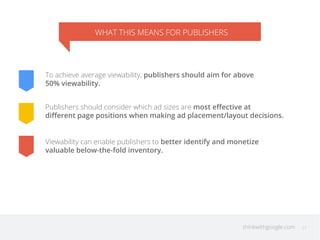
To achieve average viewability, publishers should aim for above 
50% viewability. 
Publishers should consider which ad sizes are most effective at 
different page positions when making ad placement/layout decisions. 
Viewability can enable publishers to better identify and monetize 
valuable below-the-fold inventory. 
thinkwithgoogle.com 23
thinkwithgoogle.com 
WHAT WE DID 
24 
Google conducted a study of our display advertising platforms, 
including Google and DoubleClick, to better understand ad 
viewability. According to the Media Rating Council and IAB 
standard, a viewable impression occurs when 50% of an ad’s 
pixels are on screen for one second. The data used in this 
study is based on display ads in browsers (desktop and mobile) 
and does not include mobile in-app and video ads. The data 
was collected in two months: October 2014 for the average 
viewability of impressions and domains, and July 2014 for 
the rest of our findings.
thinkwithgoogle.com 
WHAT WE DID 
25 
Minimum measurable counts: 
Domains with less than 1,000 measurable 
ads over the period of a week were 
removed. This filtering ensures sufficient 
data points for each domain to be 
confident in the statistics and removes 
unmeasurable domains. Unmeasurable 
domains were removed to better represent 
true viewability numbers instead of 
presenting numbers artificially lowered by 
non-measurable sites. 
Minimum measurable counts 
(vertical position graphs): 
The vertical position graphs use a 
minimum measurable count of 
ten ads over one day due to the 
data sets’ small granularity.
thinkwithgoogle.com 
WHAT WE DID 
26 
Minimum received rate: 
Active View ads send data pings 
regardless of whether they are viewed. 
Domains where we received pings from 
fewer than 50% of enabled ads are 
removed. Again, this is done to eliminate 
issues caused by non-measurable sites. 
With this filtering in place, we created 
a data set with over one week of data 
from impressions on DoubleClick for 
Publishers, DoubleClick Ad Exchange 
and the Google Display Network.

Google viewability study dec 2014

  • 1.
    November 2014 TheImportance of Being Seen Viewability Insights for Digital Marketers and Publishers
  • 2.
    thinkwithgoogle.com WHAT WEWANTED TO KNOW We conducted research using our Active View technology to learn about the current state of viewable impressions on the web. There is increased interest in viewability among brand advertisers and publishers now that the Media Rating Council has lifted the viewable transaction advisory. Brand advertisers want to ensure that their ads can be seen and are seeking enhanced ROI. Publishers want to enhance site viewability and to use viewable impressions as a currency to do so. Here we highlight the trends we discovered in analyzing the research data to help advertisers and publishers formulate their viewability strategy. 2
  • 3.
    thinkwithgoogle.com WHAT WEDID 3 Google conducted a study of our display advertising platforms, including Google and DoubleClick, to better understand ad viewability. According to the Media Rating Council and IAB standards, a viewable impression occurs when 50% of an ad’s pixels are on screen for one second. The data used in this study are based on display ads in browsers (desktop and mobile) and does not include mobile in-app or video ads.
  • 4.
    thinkwithgoogle.com WWHHAATT WWEEFFOOUUNNDD State of publisher viewability A small number of publishers are serving most of the non-viewable impressions. 56.1% of all impressions we measured are not seen, but the average publisher viewability is 50.2%. Page position matters... The most viewable position is right above the fold, not at the top of the page. ...So does ad size The most viewable ad sizes are vertical units. Above the fold ≠ always viewable Page position isn’t always the best indicator of viewability. Not all above-the-fold impressions are viewable, while many below-the-fold impressions are. Viewability varies acrossindustries While it ranges across content verticals, and industries, content that holds a user’s attention has the highest viewability. 4
  • 5.
    State of PublisherViewability
  • 6.
    A small numberof publishers are serving most of the non-viewable impressions. thinkwithgoogle.com 6 VIEWABILITY DISTRIBUTION ACROSS DOMAINS Source: Google and DoubleClick display advertising platforms data, October 2014. % VIEWABLE % OF PUBLISHER DOMAINS
  • 7.
    thinkwithgoogle.com 7 56.1% of impressions are not seen, but the average publisher viewability is 50.2%.
  • 8.
  • 9.
    Average viewability byvertical position (728 x 90) 100% 80% 60% 40% 20% 0% Highest viewability at page fold Steep viewability drop-off after page fold 0 0.5 1 1.5 2 2.5 VIEWABILITY RELATIVE BROWSER PAGE POSITION Note: Horizontal axis denotes position of top edge of ad impression. Source: Google and DoubleClick display advertising platforms data, July 2014. thinkwithgoogle.com 9
  • 10.
    Average viewability byvertical position (300 x 250) 100% 80% 60% 40% 20% 0% Viewability high throughout top fold Viewability drop-off is seen at page fold 0 0.5 1 1.5 2 2.5 VIEWABILITY RELATIVE BROWSER PAGE POSITION Note: Horizontal axis denotes position of top edge of ad impression. Source: Google and DoubleClick display advertising platforms data, July 2014. thinkwithgoogle.com 10
  • 11.
    Average viewability byvertical position (160 x 600) 100% 80% 60% 40% 20% 0% Viewability high throughout top fold Viewability drop-off *least* steep compared to other ad sizes Viewability remains > 40% for longest page length 0 0.5 1 1.5 2 2.5 VIEWABILITY RELATIVE BROWSER PAGE POSITION Note: Horizontal axis denotes position of top edge of ad impression. Source: Google and DoubleClick display advertising platforms data, July 2014. thinkwithgoogle.com 11
  • 12.
    Average viewability byvertical position (468 x 60) 100% 80% 60% 40% 20% 0% Highest viewability at page fold Steep viewability drop-off after page fold 0 0.5 1 1.5 2 2.5 VIEWABILITY RELATIVE BROWSER PAGE POSITION Note: Horizontal axis denotes position of top edge of ad impression. Source: Google and DoubleClick display advertising platforms data, July 2014. thinkwithgoogle.com 12
  • 13.
    Average viewability byvertical position (320 x 50) 100% 80% 60% 40% 20% 0% The highest viewability point right before the page fold The drop-off in viewability right after page fold 0 0.5 1 1.5 2 2.5 VIEWABILITY RELATIVE BROWSER PAGE POSITION Note: Horizontal axis denotes position of top edge of ad impression. Source: Google and DoubleClick display advertising platforms data, July 2014. thinkwithgoogle.com 13
  • 14.
    … So DoesAd Size
  • 15.
    thinkwithgoogle.com 15 Themost viewable ad sizes are vertical units. VIEWABILITY RATES BY AD SIZE 55.6% 54.9% 53.7% 52.5% 51.4% 48.8% 48.2% 48.0% 47.2% 46.3% 46.2% 45.2% 45.0% 44.0% 41.0% 70% 65% 60% 55% 50% 45% 40% 35% 30% % VIEWABLE Source: Google and DoubleClick display advertising platforms data, July 2014. AD UNIT SIZE
  • 16.
    Above the Fold≠ Always Viewable
  • 17.
    Above the foldis not always viewable while below the fold often is. thinkwithgoogle.com 17 25% 20% 15% 10% 5% 0% % OF PUBLISHER DOMAINS % VIEWABLE 35% 30% 25% 20% 15% 10% 5% 0% % OF PUBLISHER DOMAINS Median viewability for above-the-fold ad units 68% ATF VIEWABILITY DISTRIBUTION % VIEWABLE Source: Google and DoubleClick display advertising platforms data, July 2014. Median viewability for below-the-fold ad units 40% BTF VIEWABILITY DISTRIBUTION
  • 18.
  • 19.
    Viewability varies significantlyacross content verticals, with the highest viewability belonging to sites associated with more captive engagement. 43.6% 42.6% 42.5% 42.3% 42.2% 42.0% 41.9% 41.5% 40.8% 40.2% 39.6% 38.8% thinkwithgoogle.com 19 48.9% 48.4% 48.0% 47.8% 47.2% 47.1% 46.6% 46.4% 44.8% 44.6% 44.0% 43.6% Reference Online Communities Games Arts & Entertainment Jobs & Education Business & Industrial Computers & Electronics Science Internet & Telecom Hobbies & Leisure Pets & Animals Health Source: Google and DoubleClick display advertising platforms data, July 2014. 51.9% People & Society 38.7% Finance Travel Home & Garden Beauty & Fitness Law & Government World Localities Autos & Vehicles Books & Literature Shopping Sports Food & Drink News Real Estate
  • 20.
    WHAT THIS MEANSFOR ADVERTISERS Viewability data enables advertisers to identify both high- and low-value inventory and then shift budgets and targets accordingly to maximize reach and ROI. By understanding trends about what inventory has the highest viewability, advertisers can better formulate their media strategies. thinkwithgoogle.com 20
  • 21.
    WHAT THIS MEANSFOR ADVERTISERS Viewability varies significantly by page position and ad size. In general, advertisers should consider the relationship between page position and ad size while planning creative and targeting. Page position doesn’t tell the whole story. Ultimately, advertisers should target based on viewability measurements to achieve the best results. On average, publishers have 50% viewability rates, but some publishers have much lower viewability. Advertisers seeking viewable impressions should steer towards high viewability sites. Consider targeting sites with more engaging content to achieve higher viewability rates. thinkwithgoogle.com 21 Vertical ad units are the most likely to be seen by users.
  • 22.
    WHAT THIS MEANSFOR PUBLISHERS Viewability data can help publishers increase the long-term value of their display inventory. By understanding the factors that affect viewability, publishers can enhance their sites to maximize viewable impressions. thinkwithgoogle.com 22
  • 23.
    WHAT THIS MEANSFOR PUBLISHERS To achieve average viewability, publishers should aim for above 50% viewability. Publishers should consider which ad sizes are most effective at different page positions when making ad placement/layout decisions. Viewability can enable publishers to better identify and monetize valuable below-the-fold inventory. thinkwithgoogle.com 23
  • 24.
    thinkwithgoogle.com WHAT WEDID 24 Google conducted a study of our display advertising platforms, including Google and DoubleClick, to better understand ad viewability. According to the Media Rating Council and IAB standard, a viewable impression occurs when 50% of an ad’s pixels are on screen for one second. The data used in this study is based on display ads in browsers (desktop and mobile) and does not include mobile in-app and video ads. The data was collected in two months: October 2014 for the average viewability of impressions and domains, and July 2014 for the rest of our findings.
  • 25.
    thinkwithgoogle.com WHAT WEDID 25 Minimum measurable counts: Domains with less than 1,000 measurable ads over the period of a week were removed. This filtering ensures sufficient data points for each domain to be confident in the statistics and removes unmeasurable domains. Unmeasurable domains were removed to better represent true viewability numbers instead of presenting numbers artificially lowered by non-measurable sites. Minimum measurable counts (vertical position graphs): The vertical position graphs use a minimum measurable count of ten ads over one day due to the data sets’ small granularity.
  • 26.
    thinkwithgoogle.com WHAT WEDID 26 Minimum received rate: Active View ads send data pings regardless of whether they are viewed. Domains where we received pings from fewer than 50% of enabled ads are removed. Again, this is done to eliminate issues caused by non-measurable sites. With this filtering in place, we created a data set with over one week of data from impressions on DoubleClick for Publishers, DoubleClick Ad Exchange and the Google Display Network.