Short fixation followed by
Specific Physiotherapy Program
ApiFix®
New minimal invasive method to treat
Adolescent Idiopathic Scoliosis
Nikos Karavidas, MSc, PT
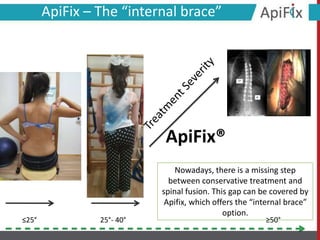
Nowadays, there is a missing step
between conservative treatment and
spinal fusion. This gap can be covered by
Apifix, which offers the “internal brace”
option.
25°- 40°≤25° ≥50°
ApiFix – The “internal brace”
ApiFix®
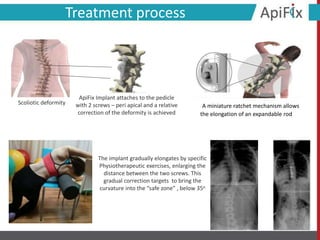
Treatment process
Scoliotic deformity
ApiFix Implant attaches to the pedicle
with 2 screws – peri apical and a relative
correction of the deformity is achieved
A miniature ratchet mechanism allows
the elongation of an expandable rod
The implant gradually elongates by specific
Physiotherapeutic exercises, enlarging the
distance between the two screws. This
gradual correction targets to bring the
curvature into the “safe zone” , below 35ο
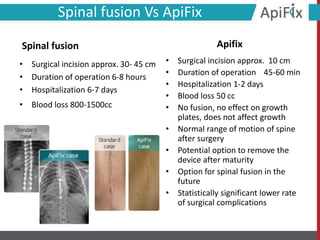
Spinal fusion Vs ApiFix
Spinal fusion
• Surgical incision approx. 30- 45 cm
• Duration of operation 6-8 hours
• Hospitalization 6-7 days
• Blood loss 800-1500cc
Apifix
• Surgical incision approx. 10 cm
• Duration of operation 45-60 min
• Hospitalization 1-2 days
• Blood loss 50 cc
• No fusion, no effect on growth
plates, does not affect growth
• Normal range of motion of spine
after surgery
• Potential option to remove the
device after maturity
• Option for spinal fusion in the
future
• Statistically significant lower rate
of surgical complications
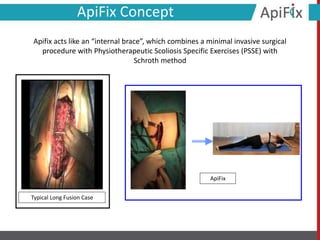
ApiFix
Typical Long Fusion Case
ApiFix Concept
Apifix acts like an “internal brace”, which combines a minimal invasive surgical
procedure with Physiotherapeutic Scoliosis Specific Exercises (PSSE) with
Schroth method
Fatigue Test per ASTM F 1717
Testing Jig Test Sample
- Test performed by EndoLab GMBH (Germany)
- ApiFix Run-out load at 5,000,000 cycles was 1000N
- Standard fusion systems of good quality holds around 300N*
* Multiaxial Pedicle Screw Designs: Static and Dynamic Mechanical Testing. Ralph E. Stanford et al, Spine Vol. 29, No. 4 , 2004
Run out load [N] of standard fusion systems* and
the ApiFix system
Fatigue test
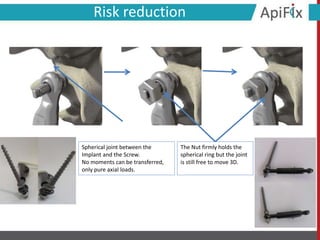
Spherical joint between the
Implant and the Screw.
No moments can be transferred,
only pure axial loads.
The Nut firmly holds the
spherical ring but the joint
is still free to move 3D.
Risk reduction
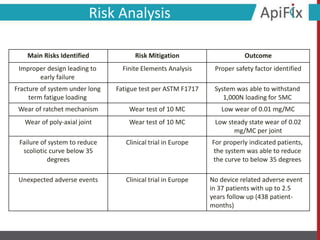
Risk Analysis
OutcomeRisk MitigationMain Risks Identified
Proper safety factor identifiedFinite Elements AnalysisImproper design leading to
early failure
System was able to withstand
1,000N loading for 5MC
Fatigue test per ASTM F1717Fracture of system under long
term fatigue loading
Low wear of 0.01 mg/MCWear test of 10 MCWear of ratchet mechanism
Low steady state wear of 0.02
mg/MC per joint
Wear test of 10 MCWear of poly-axial joint
For properly indicated patients,
the system was able to reduce
the curve to below 35 degrees
Clinical trial in EuropeFailure of system to reduce
scoliotic curve below 35
degrees
No device related adverse event
in 37 patients with up to 2.5
years follow up (438 patient-
months)
Clinical trial in EuropeUnexpected adverse events
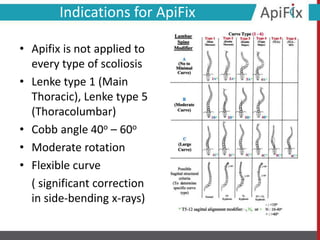
Indications for ApiFix
• Apifix is not applied to
every type of scoliosis
• Lenke type 1 (Main
Thoracic), Lenke type 5
(Thoracolumbar)
• Cobb angle 40ο – 60ο
• Moderate rotation
• Flexible curve
( significant correction
in side-bending x-rays)
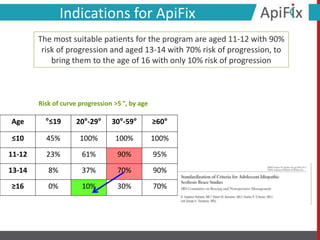
The most suitable patients for the program are aged 11-12 with 90%
risk of progression and aged 13-14 with 70% risk of progression, to
bring them to the age of 16 with only 10% risk of progression
Age °≤19 20°-29° 30°-59° ≥60°
≤10 45% 100% 100% 100%
11-12 23% 61% 90% 95%
13-14 8% 37% 70% 90%
≥16 0% 10% 30% 70%
Risk of curve progression ˃5 °, by age
Indications for ApiFix
Pre-operation
• Scoliosis classification by Lenke
• X-ray evaluation and estimation
of Cobb angle
• Evaluation of flexibility by lateral
bending x-rays
• Radiological and clinical
assessment also by the Certified
Physiotherapist
• Commencement of the exercises
1 month prior to the operation
• Detailed information to the
patient and their family,
expectation management
Post-operation
• Exit of the hospital 1-2 days after
the operation
• Commencement of exercises 2
weeks after the operation
• Radiological assessment at 1,3
and 6 months
• Continuation of the exercises for
at least 6 months
• Detailed information to the
patient and their family about the
results of the treatment
• Long follow-up
Treatment protocol
Pre-operation
• Commencement 1 month prior to the
operation, (3-4 sessions)
• Expectation management, body
awareness, principles of correction,
main goals of treatment
• Improvement of spinal mobility and
flexibility by manual therapy
techniques, massage and exercises
• Teaching of the 5 basic ApiFix
exercises
Post-operation
• 2 weeks - 8 weeks, (6 sessions) :
- Relief of post-operative pain and
stiffness
- ApiFix exercises
• 8 weeks – 6 months, (6 sessions) :
- ApiFix exercises
- Auto-correction exercises based on
Schroth method and Barcelona
Scoliosis Physical Therapy School
(BSPTS) principles, which consist a
holistic approach to treat the whole
spine in AIS, and stabilize the result
Physiotherapeutic Scoliosis Specific Exercises (PSSE)
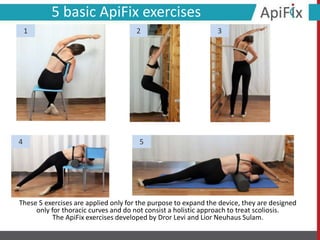
5 basic ApiFix exercises
1 2 3
4 5
These 5 exercises are applied only for the purpose to expand the device, they are designed
only for thoracic curves and do not consist a holistic approach to treat scoliosis.
The ApiFix exercises developed by Dror Levi and Lior Neuhaus Sulam.
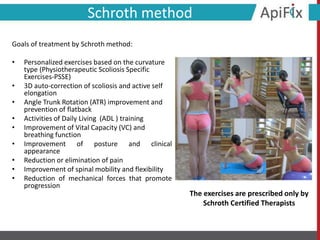
Schroth method
Goals of treatment by Schroth method:
• Personalized exercises based on the curvature
type (Physiotherapeutic Scoliosis Specific
Exercises-PSSE)
• 3D auto-correction of scoliosis and active self
elongation
• Angle Trunk Rotation (ATR) improvement and
prevention of flatback
• Activities of Daily Living (ADL ) training
• Improvement of Vital Capacity (VC) and
breathing function
• Improvement of posture and clinical
appearance
• Reduction or elimination of pain
• Improvement of spinal mobility and flexibility
• Reduction of mechanical forces that promote
progression
The exercises are prescribed only by
Schroth Certified Therapists
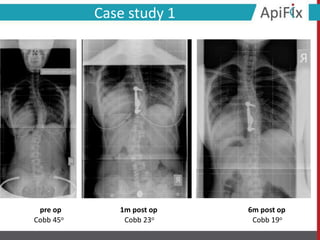
6m post op1m post oppre op
Case study 1
Cobb 45ο Cobb 23ο Cobb 19ο
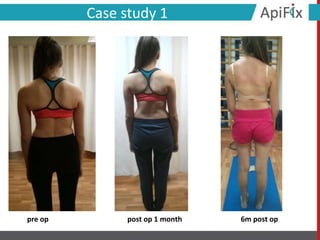
6m post oppost op 1 monthpre op
Case study 1
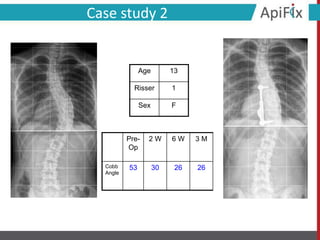
Case study 2
Pre-
Op
2 W 6 W 3 M
Cobb
Angle
53 30 26 26
Age 13
Risser 1
Sex F
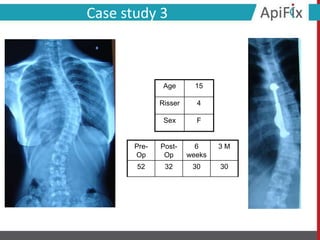
Case study 3
Pre-
Op
Post-
Op
6
weeks
3 M
52 32 30 30
Age 15
Risser 4
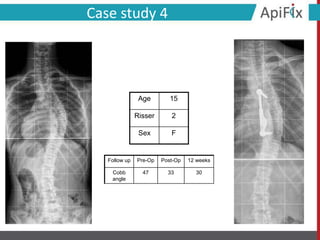
Sex F
Follow up Pre-Op Post-Op 12 weeks
Cobb
angle
47 33 30
Case study 4
Age 15
Risser 2
Sex F
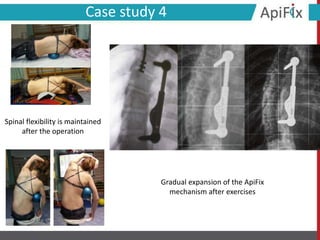
Case study 4
Spinal flexibility is maintained
after the operation
Gradual expansion of the ApiFix
mechanism after exercises
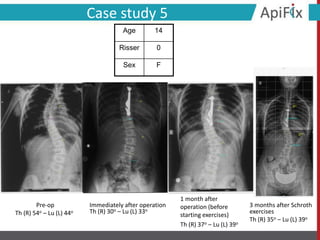
Pre-op
Th (R) 54ο – Lu (L) 44ο
Immediately after operation
Th (R) 30ο – Lu (L) 33ο
1 month after
operation (before
starting exercises)
Th (R) 37ο – Lu (L) 39ο
3 months after Schroth
exercises
Th (R) 35ο – Lu (L) 39ο
Case study 5
Age 14
Risser 0
Sex F
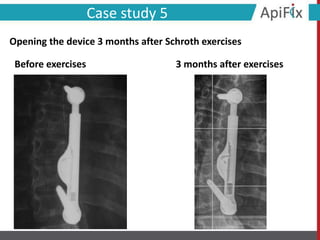
Before exercises
Opening the device 3 months after Schroth exercises
Case study 5
3 months after exercises
Before exercises 3 months after exercises
Case study 5
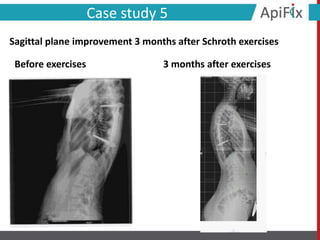
Sagittal plane improvement 3 months after Schroth exercises
Before exercises 3 months after exercises
Case study 5
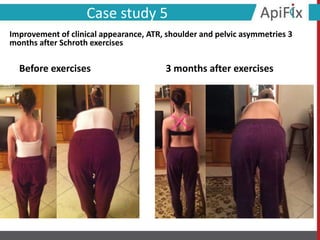
Improvement of clinical appearance, ATR, shoulder and pelvic asymmetries 3
months after Schroth exercises
• Benefits from Schroth method after the ApiFix operation:
- Halt progression of scoliosis, even after the marked progression the first month
after operation and before starting the exercises
- Further opening of the device
- Thoracic Cobb angle improvement from 37ο to 35ο
- Halt progression of the lumbar curvature
- Remarkable improvement of posture, with better symmetry for shoulders and
pelvis
- Slight improvement of ATR, 14ο to 13ο for the thoracic curve, and 9ο to 7ο for the
lumbar curve
- Sagittal plane improvement, with more harmonic kyphosis and lordosis
- Pain elimination
- Psychological improvement
- Improved breathing function and VC
- ADL training
Case study 5
• Difficulties faced during treatment with Schroth method:
- No indication for treatment, double major scoliosis, Lenke type 3
- No slight or moderate rotation (ATR 14ο – 9ο )
- Delayed commencement of exercises (4 weeks after operation)
- Not flexible curvature
- Progression of both curves, thoracic and lumbar, 1 month after
operation
- Risser 0, pre-menarche when starting exercises, so the risk for
proggression was higher
- Lack of trust for the result of the treatment by the family
environment
Case study 5
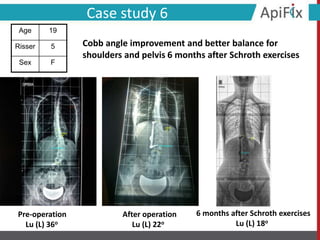
Pre-operation
Lu (L) 36ο
After operation
Lu (L) 22ο
Case study 6
6 months after Schroth exercises
Lu (L) 18ο
Age 19
Risser 5
Sex F
Cobb angle improvement and better balance for
shoulders and pelvis 6 months after Schroth exercises
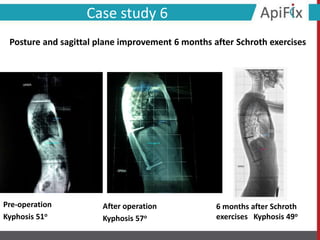
Pre-operation
Kyphosis 51ο
After operation
Kyphosis 57ο
Case study 6
6 months after Schroth
exercises Kyphosis 49ο
Posture and sagittal plane improvement 6 months after Schroth exercises
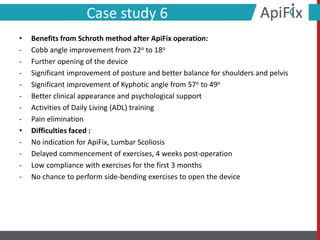
• Benefits from Schroth method after ApiFix operation:
- Cobb angle improvement from 22ο to 18ο
- Further opening of the device
- Significant improvement of posture and better balance for shoulders and pelvis
- Significant improvement of Kyphotic angle from 57ο to 49ο
- Better clinical appearance and psychological support
- Activities of Daily Living (ADL) training
- Pain elimination
• Difficulties faced :
- No indication for ApiFix, Lumbar Scoliosis
- Delayed commencement of exercises, 4 weeks post-operation
- Low compliance with exercises for the first 3 months
- No chance to perform side-bending exercises to open the device
Case study 6
Conclusions- Recommendations
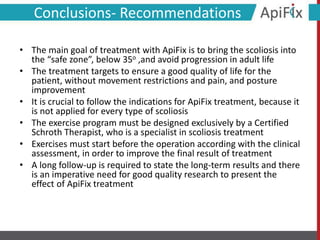
• The main goal of treatment with ApiFix is to bring the scoliosis into
the “safe zone”, below 35ο ,and avoid progression in adult life
• The treatment targets to ensure a good quality of life for the
patient, without movement restrictions and pain, and posture
improvement
• It is crucial to follow the indications for ApiFix treatment, because it
is not applied for every type of scoliosis
• The exercise program must be designed exclusively by a Certified
Schroth Therapist, who is a specialist in scoliosis treatment
• Exercises must start before the operation according with the clinical
assessment, in order to improve the final result of treatment
• A long follow-up is required to state the long-term results and there
is an imperative need for good quality research to present the
effect of ApiFix treatment
THANK YOU
NIKOS KARAVIDAS, MSc, PT
Physiotherapist
Certified Schroth Therapist
Certified SEAS Therapist
McKenzie Therapist

Apifix presentation english version

  • 1.
    Short fixation followedby Specific Physiotherapy Program ApiFix® New minimal invasive method to treat Adolescent Idiopathic Scoliosis Nikos Karavidas, MSc, PT
  • 2.
    Nowadays, there isa missing step between conservative treatment and spinal fusion. This gap can be covered by Apifix, which offers the “internal brace” option. 25°- 40°≤25° ≥50° ApiFix – The “internal brace” ApiFix®
  • 3.
    Treatment process Scoliotic deformity ApiFixImplant attaches to the pedicle with 2 screws – peri apical and a relative correction of the deformity is achieved A miniature ratchet mechanism allows the elongation of an expandable rod The implant gradually elongates by specific Physiotherapeutic exercises, enlarging the distance between the two screws. This gradual correction targets to bring the curvature into the “safe zone” , below 35ο
  • 4.
    Spinal fusion VsApiFix Spinal fusion • Surgical incision approx. 30- 45 cm • Duration of operation 6-8 hours • Hospitalization 6-7 days • Blood loss 800-1500cc Apifix • Surgical incision approx. 10 cm • Duration of operation 45-60 min • Hospitalization 1-2 days • Blood loss 50 cc • No fusion, no effect on growth plates, does not affect growth • Normal range of motion of spine after surgery • Potential option to remove the device after maturity • Option for spinal fusion in the future • Statistically significant lower rate of surgical complications
  • 5.
    ApiFix Typical Long FusionCase ApiFix Concept Apifix acts like an “internal brace”, which combines a minimal invasive surgical procedure with Physiotherapeutic Scoliosis Specific Exercises (PSSE) with Schroth method
  • 6.
    Fatigue Test perASTM F 1717 Testing Jig Test Sample - Test performed by EndoLab GMBH (Germany) - ApiFix Run-out load at 5,000,000 cycles was 1000N - Standard fusion systems of good quality holds around 300N* * Multiaxial Pedicle Screw Designs: Static and Dynamic Mechanical Testing. Ralph E. Stanford et al, Spine Vol. 29, No. 4 , 2004 Run out load [N] of standard fusion systems* and the ApiFix system Fatigue test
  • 7.
    Spherical joint betweenthe Implant and the Screw. No moments can be transferred, only pure axial loads. The Nut firmly holds the spherical ring but the joint is still free to move 3D. Risk reduction
  • 8.
    Risk Analysis OutcomeRisk MitigationMainRisks Identified Proper safety factor identifiedFinite Elements AnalysisImproper design leading to early failure System was able to withstand 1,000N loading for 5MC Fatigue test per ASTM F1717Fracture of system under long term fatigue loading Low wear of 0.01 mg/MCWear test of 10 MCWear of ratchet mechanism Low steady state wear of 0.02 mg/MC per joint Wear test of 10 MCWear of poly-axial joint For properly indicated patients, the system was able to reduce the curve to below 35 degrees Clinical trial in EuropeFailure of system to reduce scoliotic curve below 35 degrees No device related adverse event in 37 patients with up to 2.5 years follow up (438 patient- months) Clinical trial in EuropeUnexpected adverse events
  • 9.
    Indications for ApiFix •Apifix is not applied to every type of scoliosis • Lenke type 1 (Main Thoracic), Lenke type 5 (Thoracolumbar) • Cobb angle 40ο – 60ο • Moderate rotation • Flexible curve ( significant correction in side-bending x-rays)
  • 10.
    The most suitablepatients for the program are aged 11-12 with 90% risk of progression and aged 13-14 with 70% risk of progression, to bring them to the age of 16 with only 10% risk of progression Age °≤19 20°-29° 30°-59° ≥60° ≤10 45% 100% 100% 100% 11-12 23% 61% 90% 95% 13-14 8% 37% 70% 90% ≥16 0% 10% 30% 70% Risk of curve progression ˃5 °, by age Indications for ApiFix
  • 11.
    Pre-operation • Scoliosis classificationby Lenke • X-ray evaluation and estimation of Cobb angle • Evaluation of flexibility by lateral bending x-rays • Radiological and clinical assessment also by the Certified Physiotherapist • Commencement of the exercises 1 month prior to the operation • Detailed information to the patient and their family, expectation management Post-operation • Exit of the hospital 1-2 days after the operation • Commencement of exercises 2 weeks after the operation • Radiological assessment at 1,3 and 6 months • Continuation of the exercises for at least 6 months • Detailed information to the patient and their family about the results of the treatment • Long follow-up Treatment protocol
  • 12.
    Pre-operation • Commencement 1month prior to the operation, (3-4 sessions) • Expectation management, body awareness, principles of correction, main goals of treatment • Improvement of spinal mobility and flexibility by manual therapy techniques, massage and exercises • Teaching of the 5 basic ApiFix exercises Post-operation • 2 weeks - 8 weeks, (6 sessions) : - Relief of post-operative pain and stiffness - ApiFix exercises • 8 weeks – 6 months, (6 sessions) : - ApiFix exercises - Auto-correction exercises based on Schroth method and Barcelona Scoliosis Physical Therapy School (BSPTS) principles, which consist a holistic approach to treat the whole spine in AIS, and stabilize the result Physiotherapeutic Scoliosis Specific Exercises (PSSE)
  • 13.
    5 basic ApiFixexercises 1 2 3 4 5 These 5 exercises are applied only for the purpose to expand the device, they are designed only for thoracic curves and do not consist a holistic approach to treat scoliosis. The ApiFix exercises developed by Dror Levi and Lior Neuhaus Sulam.
  • 14.
    Schroth method Goals oftreatment by Schroth method: • Personalized exercises based on the curvature type (Physiotherapeutic Scoliosis Specific Exercises-PSSE) • 3D auto-correction of scoliosis and active self elongation • Angle Trunk Rotation (ATR) improvement and prevention of flatback • Activities of Daily Living (ADL ) training • Improvement of Vital Capacity (VC) and breathing function • Improvement of posture and clinical appearance • Reduction or elimination of pain • Improvement of spinal mobility and flexibility • Reduction of mechanical forces that promote progression The exercises are prescribed only by Schroth Certified Therapists
  • 15.
    6m post op1mpost oppre op Case study 1 Cobb 45ο Cobb 23ο Cobb 19ο
  • 16.
    6m post oppostop 1 monthpre op Case study 1
  • 17.
    Case study 2 Pre- Op 2W 6 W 3 M Cobb Angle 53 30 26 26 Age 13 Risser 1 Sex F
  • 18.
    Case study 3 Pre- Op Post- Op 6 weeks 3M 52 32 30 30 Age 15 Risser 4 Sex F
  • 19.
    Follow up Pre-OpPost-Op 12 weeks Cobb angle 47 33 30 Case study 4 Age 15 Risser 2 Sex F
  • 20.
    Case study 4 Spinalflexibility is maintained after the operation Gradual expansion of the ApiFix mechanism after exercises
  • 21.
    Pre-op Th (R) 54ο– Lu (L) 44ο Immediately after operation Th (R) 30ο – Lu (L) 33ο 1 month after operation (before starting exercises) Th (R) 37ο – Lu (L) 39ο 3 months after Schroth exercises Th (R) 35ο – Lu (L) 39ο Case study 5 Age 14 Risser 0 Sex F
  • 22.
    Before exercises Opening thedevice 3 months after Schroth exercises Case study 5 3 months after exercises
  • 23.
    Before exercises 3months after exercises Case study 5 Sagittal plane improvement 3 months after Schroth exercises
  • 24.
    Before exercises 3months after exercises Case study 5 Improvement of clinical appearance, ATR, shoulder and pelvic asymmetries 3 months after Schroth exercises
  • 25.
    • Benefits fromSchroth method after the ApiFix operation: - Halt progression of scoliosis, even after the marked progression the first month after operation and before starting the exercises - Further opening of the device - Thoracic Cobb angle improvement from 37ο to 35ο - Halt progression of the lumbar curvature - Remarkable improvement of posture, with better symmetry for shoulders and pelvis - Slight improvement of ATR, 14ο to 13ο for the thoracic curve, and 9ο to 7ο for the lumbar curve - Sagittal plane improvement, with more harmonic kyphosis and lordosis - Pain elimination - Psychological improvement - Improved breathing function and VC - ADL training Case study 5
  • 26.
    • Difficulties facedduring treatment with Schroth method: - No indication for treatment, double major scoliosis, Lenke type 3 - No slight or moderate rotation (ATR 14ο – 9ο ) - Delayed commencement of exercises (4 weeks after operation) - Not flexible curvature - Progression of both curves, thoracic and lumbar, 1 month after operation - Risser 0, pre-menarche when starting exercises, so the risk for proggression was higher - Lack of trust for the result of the treatment by the family environment Case study 5
  • 27.
    Pre-operation Lu (L) 36ο Afteroperation Lu (L) 22ο Case study 6 6 months after Schroth exercises Lu (L) 18ο Age 19 Risser 5 Sex F Cobb angle improvement and better balance for shoulders and pelvis 6 months after Schroth exercises
  • 28.
    Pre-operation Kyphosis 51ο After operation Kyphosis57ο Case study 6 6 months after Schroth exercises Kyphosis 49ο Posture and sagittal plane improvement 6 months after Schroth exercises
  • 29.
    • Benefits fromSchroth method after ApiFix operation: - Cobb angle improvement from 22ο to 18ο - Further opening of the device - Significant improvement of posture and better balance for shoulders and pelvis - Significant improvement of Kyphotic angle from 57ο to 49ο - Better clinical appearance and psychological support - Activities of Daily Living (ADL) training - Pain elimination • Difficulties faced : - No indication for ApiFix, Lumbar Scoliosis - Delayed commencement of exercises, 4 weeks post-operation - Low compliance with exercises for the first 3 months - No chance to perform side-bending exercises to open the device Case study 6
  • 30.
    Conclusions- Recommendations • Themain goal of treatment with ApiFix is to bring the scoliosis into the “safe zone”, below 35ο ,and avoid progression in adult life • The treatment targets to ensure a good quality of life for the patient, without movement restrictions and pain, and posture improvement • It is crucial to follow the indications for ApiFix treatment, because it is not applied for every type of scoliosis • The exercise program must be designed exclusively by a Certified Schroth Therapist, who is a specialist in scoliosis treatment • Exercises must start before the operation according with the clinical assessment, in order to improve the final result of treatment • A long follow-up is required to state the long-term results and there is an imperative need for good quality research to present the effect of ApiFix treatment
  • 31.
    THANK YOU NIKOS KARAVIDAS,MSc, PT Physiotherapist Certified Schroth Therapist Certified SEAS Therapist McKenzie Therapist