COMPETITIONCOMPETITION
PREPARATIONPREPARATION
An athlete faces many challenges in theAn athlete faces many challenges in the
weeks leading into competition. It is crucialweeks leading into competition. It is crucial
that they are adequately prepared;that they are adequately prepared;
physically, mentally, nutritionallyphysically, mentally, nutritionally andand areare
able to recover appropriately. This willable to recover appropriately. This will
ensure that they are able to perform at theirensure that they are able to perform at their
best and avoid injury or illness during highbest and avoid injury or illness during high
stress times.stress times.
‘‘Training’ is preparing the body to tolerateTraining’ is preparing the body to tolerate
changes that occur during exercise and preventchanges that occur during exercise and prevent
premature fatigue.premature fatigue.
The body likes to maintain consistencyThe body likes to maintain consistency
(homeostasis)(homeostasis)
If homeostasis is disrupted or challenged byIf homeostasis is disrupted or challenged by
exercise, they modify or improve themselves soexercise, they modify or improve themselves so
that they will not be disrupted as much the nextthat they will not be disrupted as much the next
time exercise is performed. (called adaptation).time exercise is performed. (called adaptation).
Additional stress can be placed on athletesAdditional stress can be placed on athletes
because of different travel and environmentalbecause of different travel and environmental
conditions at the destinationconditions at the destination
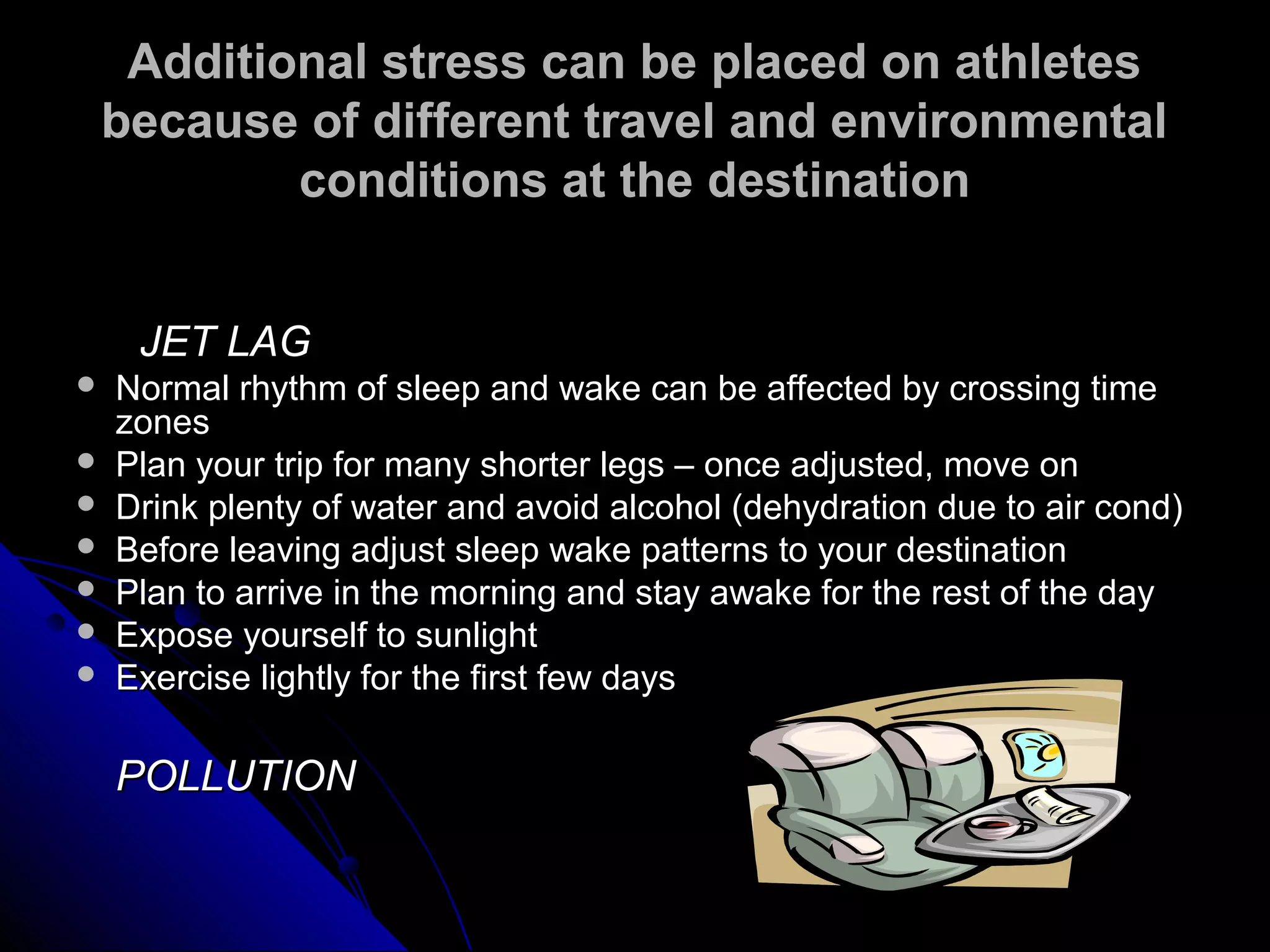
JET LAGJET LAG
 Normal rhythm of sleep and wake can be affected by crossing timeNormal rhythm of sleep and wake can be affected by crossing time
zoneszones
 Plan your trip for many shorter legs – once adjusted, move onPlan your trip for many shorter legs – once adjusted, move on
 Drink plenty of water and avoid alcohol (dehydration due to air cond)Drink plenty of water and avoid alcohol (dehydration due to air cond)
 Before leaving adjust sleep wake patterns to your destinationBefore leaving adjust sleep wake patterns to your destination
 Plan to arrive in the morning and stay awake for the rest of the dayPlan to arrive in the morning and stay awake for the rest of the day
 Expose yourself to sunlightExpose yourself to sunlight
 Exercise lightly for the first few daysExercise lightly for the first few days
POLLUTIONPOLLUTION
ALTITUDEALTITUDE
 AltitudeAltitude
 reduced oxygen concentration (somereduced oxygen concentration (some
events are enhanced due to reduced airevents are enhanced due to reduced air
resistance)resistance)
 Advantages of training at altitude are theAdvantages of training at altitude are the
elevation of enzymes in the aerobicelevation of enzymes in the aerobic
system (these are quickly lost oncesystem (these are quickly lost once
returned to sea levelreturned to sea level
 Disadvantages of training at altitude areDisadvantages of training at altitude are
some athletes suffer from altitudesome athletes suffer from altitude
sickness – reducing training and somesickness – reducing training and some
athletes do not adjust well and are unableathletes do not adjust well and are unable
to train effectivelyto train effectively
HEAT AND HUMIDITYHEAT AND HUMIDITY
 Training increases body temperature – to continue exerciseTraining increases body temperature – to continue exercise
you need to lose heat, which we do by sweating (as it coolsyou need to lose heat, which we do by sweating (as it cools
the skin and then the blood). In high temperature bodythe skin and then the blood). In high temperature body
temperature rises quickly and humidity prevents sweatingtemperature rises quickly and humidity prevents sweating
because of air moisturebecause of air moisture
 Staying cool involvesStaying cool involves
Wear little clothing (increase surface area forWear little clothing (increase surface area for
evaporation)evaporation)
Wear light colored clothing (reflects heat)Wear light colored clothing (reflects heat)
Drink plenty of fluid (weigh to make sure)Drink plenty of fluid (weigh to make sure)
Exercise at cooler parts of the dayExercise at cooler parts of the day
Reduce duration and intensity of sessionsReduce duration and intensity of sessions
If conditions are dangerous cancel eventsIf conditions are dangerous cancel events
Cooling vests introduced by the AIS have been helpfulCooling vests introduced by the AIS have been helpful
COOL AND COLDCOOL AND COLD
CONDITIONSCONDITIONS
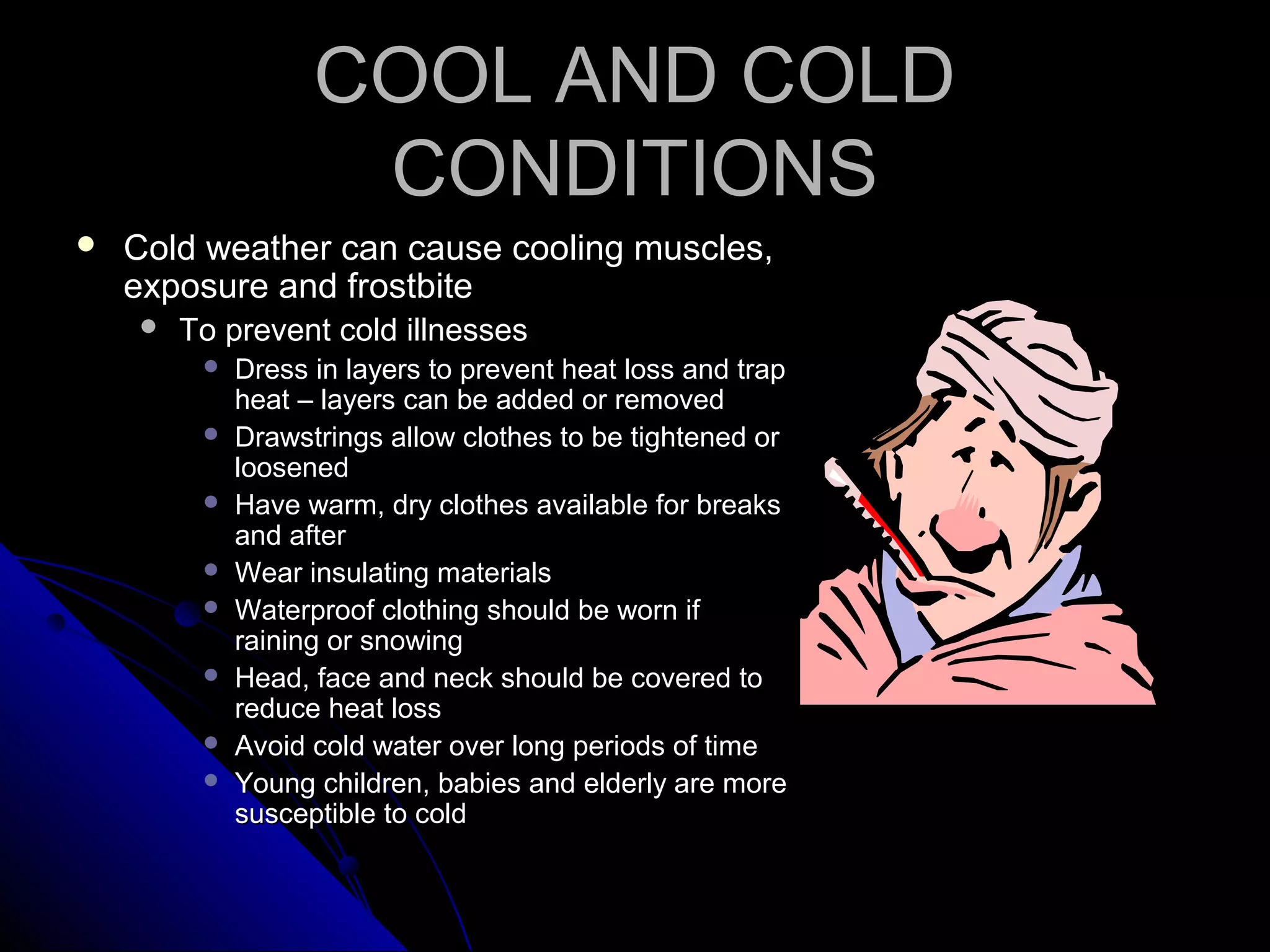
 Cold weather can cause cooling muscles,Cold weather can cause cooling muscles,
exposure and frostbiteexposure and frostbite
 To prevent cold illnessesTo prevent cold illnesses
 Dress in layers to prevent heat loss and trapDress in layers to prevent heat loss and trap
heat – layers can be added or removedheat – layers can be added or removed
 Drawstrings allow clothes to be tightened orDrawstrings allow clothes to be tightened or
loosenedloosened
 Have warm, dry clothes available for breaksHave warm, dry clothes available for breaks
and afterand after
 Wear insulating materialsWear insulating materials
 Waterproof clothing should be worn ifWaterproof clothing should be worn if
raining or snowingraining or snowing
 Head, face and neck should be covered toHead, face and neck should be covered to
reduce heat lossreduce heat loss
 Avoid cold water over long periods of timeAvoid cold water over long periods of time
 Young children, babies and elderly are moreYoung children, babies and elderly are more
susceptible to coldsusceptible to cold
MENTAL PREPERATION – Getting startedMENTAL PREPERATION – Getting started
and staying motivatedand staying motivated
1.1. Think about what you want to get out of your sportThink about what you want to get out of your sport
2.2. Focus on what you want to achieveFocus on what you want to achieve
3.3. Set realistic challengesSet realistic challenges
4.4. Set goals that measure how well you did not who youSet goals that measure how well you did not who you
beatbeat
5.5. Set positive goals that tell you what to do not what notSet positive goals that tell you what to do not what not
to doto do
6.6. Set target dates to achieve goalsSet target dates to achieve goals
7.7. Identify a strategy to achieve goalsIdentify a strategy to achieve goals
8.8. Record your goals and make a commitment to themRecord your goals and make a commitment to them
9.9. Evaluate your goalsEvaluate your goals
10.10. Have other help you achieve your goalsHave other help you achieve your goals
11.11. Keep your goals flexibleKeep your goals flexible
COMPETING AT YOUR BESTCOMPETING AT YOUR BEST
 Arousal controlArousal control
The mind and body are two parts of a whole thatThe mind and body are two parts of a whole that
affect each other. When athletes compete wellaffect each other. When athletes compete well
they are confident, challenged and excited. Whenthey are confident, challenged and excited. When
feeling challenged the brain releases a chemicalfeeling challenged the brain releases a chemical
that makes you feel nervous – these nerves arethat makes you feel nervous – these nerves are
good and improve performance. Worryinggood and improve performance. Worrying
thoughts increase these chemicals, heart rate andthoughts increase these chemicals, heart rate and
perspiration affecting concentration and tighteningperspiration affecting concentration and tightening
muscles – resulting in poor performancemuscles – resulting in poor performance
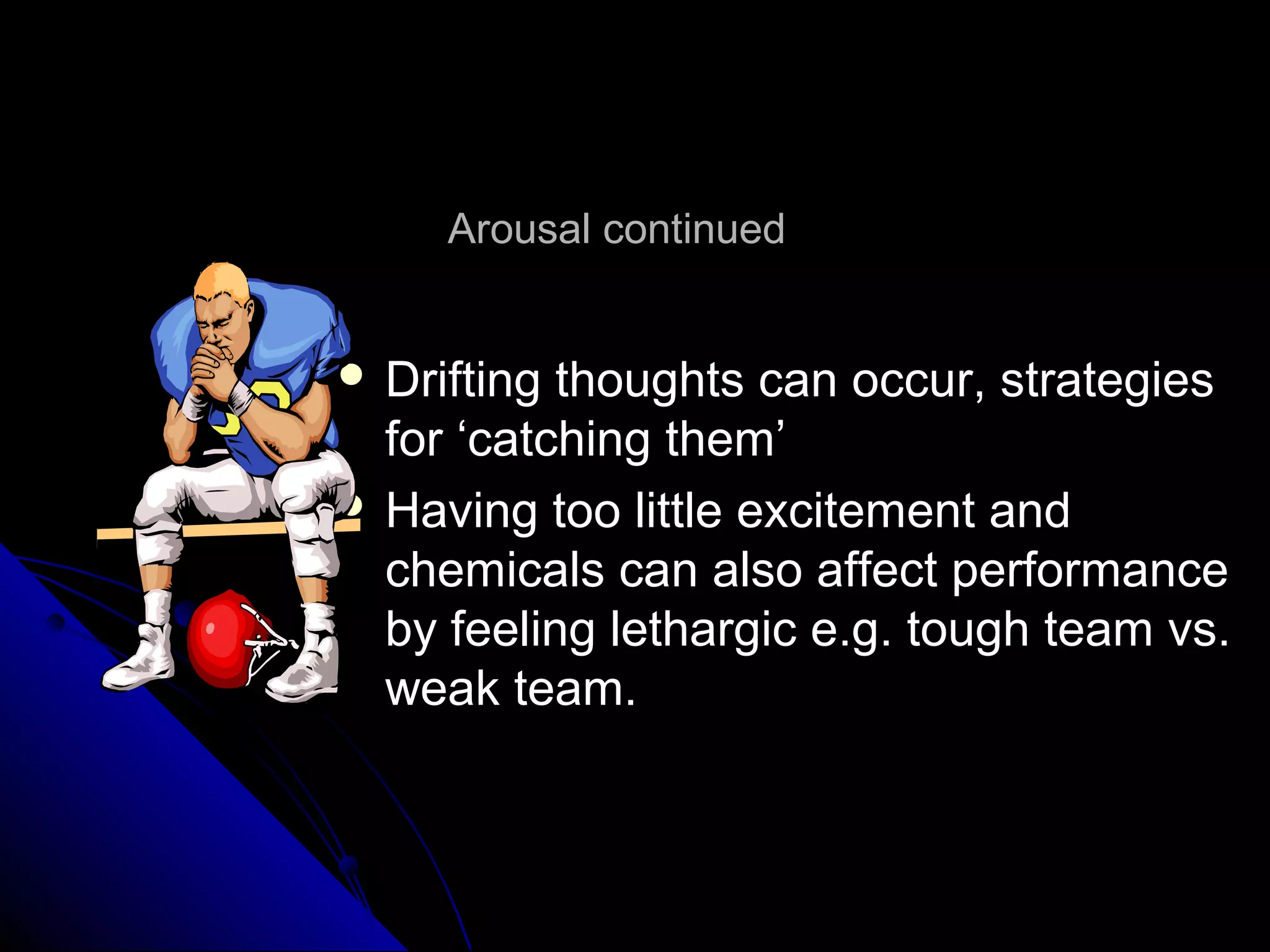
Arousal continuedArousal continued
 Drifting thoughts can occur, strategiesDrifting thoughts can occur, strategies
for ‘catching them’for ‘catching them’
 Having too little excitement andHaving too little excitement and
chemicals can also affect performancechemicals can also affect performance
by feeling lethargic e.g. tough team vs.by feeling lethargic e.g. tough team vs.
weak team.weak team.
Preparing for competitionPreparing for competition
 Many believe that sitting alone and focusing on theirMany believe that sitting alone and focusing on their
sport is beneficial – this is only so if the thoughts aresport is beneficial – this is only so if the thoughts are
constructive and confident, some athletes need to beconstructive and confident, some athletes need to be
chatty to keep away from the negative thoughtschatty to keep away from the negative thoughts
 Switching off is important – it takes time away from yourSwitching off is important – it takes time away from your
sport, relaxes and refreshes you and decreases wastingsport, relaxes and refreshes you and decreases wasting
energy on being anxiousenergy on being anxious
 Switching on is good preparation – like studying for anSwitching on is good preparation – like studying for an
exam rather than just retaining what you learnt in class.exam rather than just retaining what you learnt in class.
Scattered thoughts sometimes distract to the point ofScattered thoughts sometimes distract to the point of
failing to adequately preparefailing to adequately prepare
PREPARING FOR PROBLEMS ANDPREPARING FOR PROBLEMS AND
CHALLENGESCHALLENGES
 Problems that could arise:Problems that could arise:
 In the training environmentIn the training environment
 When traveling with a teamWhen traveling with a team
 New members coming into a teamNew members coming into a team
 Little court timeLittle court time
 Change of coachChange of coach
 Playing a ‘stronger’ teamPlaying a ‘stronger’ team
 Playing a ‘weaker’ teamPlaying a ‘weaker’ team
 In a foreign environmentIn a foreign environment
 What problems could ariseWhat problems could arise
 Making bad decisionsMaking bad decisions
 A good responseA good response
 Best optionsBest options
 Sport is not life – maintain a balanceSport is not life – maintain a balance
CONCENTRATIONCONCENTRATION
 Thinking too much can clutter the mind and burnThinking too much can clutter the mind and burn
energy stressingenergy stressing
 Good concentration is keeping it simple but not soGood concentration is keeping it simple but not so
simple it becomes too narrowsimple it becomes too narrow
 You can only take in so much information so focusYou can only take in so much information so focus
on what is happening not the mistake you just madeon what is happening not the mistake you just made
 Shift your focus at the right times from single focusShift your focus at the right times from single focus
to the big pictureto the big picture
 Concentration need not be at top speed – take timeConcentration need not be at top speed – take time
to watch and observeto watch and observe
MENTAL IMAGERYMENTAL IMAGERY
 Mental imagery is visualising successMental imagery is visualising success
It helps by forming a competition plan – gameIt helps by forming a competition plan – game
strategy and by sending messages to the musclesstrategy and by sending messages to the muscles
involved in the movement, which reinforces nerveinvolved in the movement, which reinforces nerve
pathways and can speed up development ofpathways and can speed up development of
motor pathwaysmotor pathways
It can be negative by sending the wrong messageIt can be negative by sending the wrong message
to your muscles (reinforcing bad technique) byto your muscles (reinforcing bad technique) by
stressing and tightening if you have seen yourselfstressing and tightening if you have seen yourself
perform badly and may reduce confidenceperform badly and may reduce confidence
(altering strategy)(altering strategy)
FLUID PREPARATION –FLUID PREPARATION –
Most athletes do not properly replace fluid loss duringMost athletes do not properly replace fluid loss during
exercise – causing dehydration and negative performanceexercise – causing dehydration and negative performance
 Do not rely on thirst as an indicatorDo not rely on thirst as an indicator
 Monitor your urineMonitor your urine
 Have drinks readily accessibleHave drinks readily accessible
 Avoid drinking caffeine and alcohol – diureticAvoid drinking caffeine and alcohol – diuretic
 Develop good drinking practice (150 – 250 mls /Develop good drinking practice (150 – 250 mls /
15 minutes of exercise)15 minutes of exercise)
 Increase pre exercise drinking in hot conditionsIncrease pre exercise drinking in hot conditions
 Weigh yourself before and after exercise (1 kg =Weigh yourself before and after exercise (1 kg =
1 l fluid)1 l fluid)
 Water is suitable for <90 minute eventsWater is suitable for <90 minute events
 Drink breaks should be scheduled every 15Drink breaks should be scheduled every 15
minutesminutes
 Sports drinks – consider: what you like, cost,Sports drinks – consider: what you like, cost,
concentration, salt content, acidity for toothconcentration, salt content, acidity for tooth
decaydecay
THE PRE EVENT MEALTHE PRE EVENT MEAL
 On Competition day the pre-event meal needs toOn Competition day the pre-event meal needs to
top up glycogen stores and fluid. Try:top up glycogen stores and fluid. Try:
 Larger more substantial meals (cereal, low fat milk,Larger more substantial meals (cereal, low fat milk,
juice) should be consumed 3 – 4 hours prior tojuice) should be consumed 3 – 4 hours prior to
competitioncompetition
 Smaller snacks (sports bars and sports drinks) can beSmaller snacks (sports bars and sports drinks) can be
consumed 1 – 2 hours priorconsumed 1 – 2 hours prior
 Meals and snacks should be high in carbohydratesMeals and snacks should be high in carbohydrates
and low in fatand low in fat
 Eat food that you are comfortable with – now is not aEat food that you are comfortable with – now is not a
good time to try new foodsgood time to try new foods
 If unable to eat solids, try liquid supplementsIf unable to eat solids, try liquid supplements
SUGGESTED PRE-EVENTSUGGESTED PRE-EVENT
MEALSMEALS
 Breakfast cereal with skim milk andBreakfast cereal with skim milk and
fruitfruit
 Toast with baked beans or spaghettiToast with baked beans or spaghetti
 Pancakes with syrup and juice orPancakes with syrup and juice or
sports drinksports drink
 Liquid mealsLiquid meals
 Low fat yogurt, custard or creamedLow fat yogurt, custard or creamed
rice with fruitrice with fruit
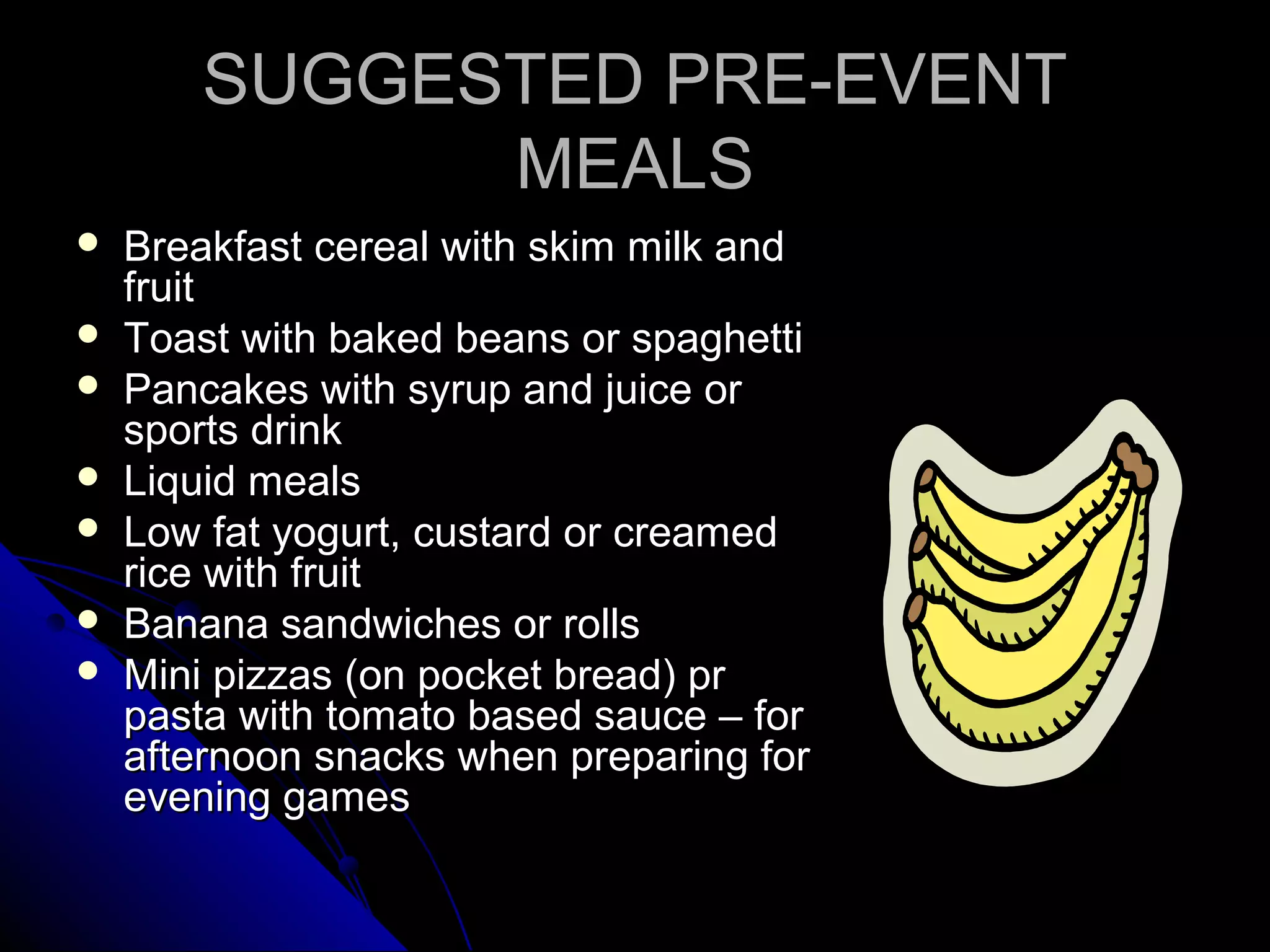
 Banana sandwiches or rollsBanana sandwiches or rolls
 Mini pizzas (on pocket bread) prMini pizzas (on pocket bread) pr
pasta with tomato based sauce – forpasta with tomato based sauce – for
afternoon snacks when preparing forafternoon snacks when preparing for
evening gamesevening games
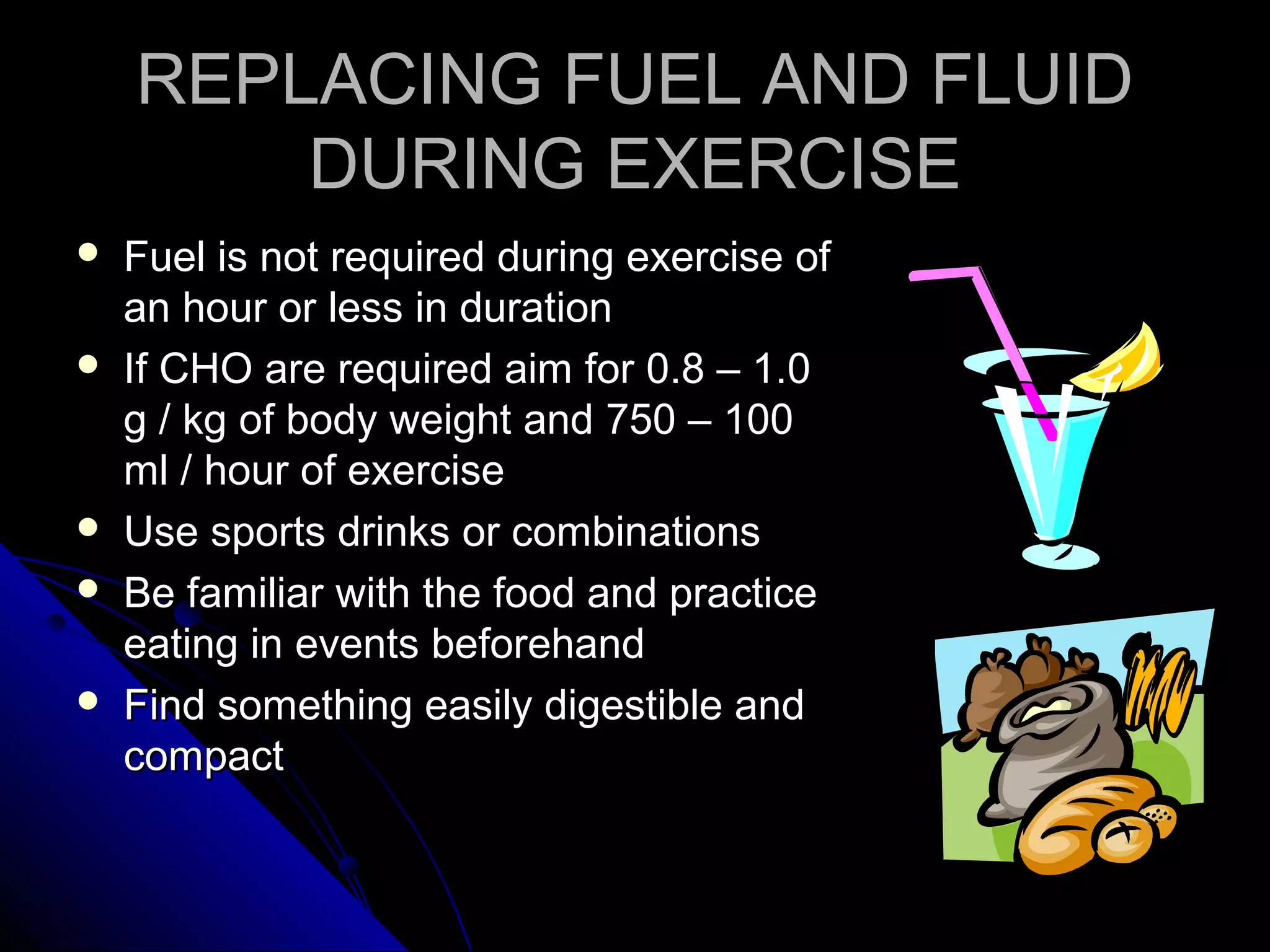
REPLACING FUEL AND FLUIDREPLACING FUEL AND FLUID
DURING EXERCISEDURING EXERCISE
 Fuel is not required during exercise ofFuel is not required during exercise of
an hour or less in durationan hour or less in duration
 If CHO are required aim for 0.8 – 1.0If CHO are required aim for 0.8 – 1.0
g / kg of body weight and 750 – 100g / kg of body weight and 750 – 100
ml / hour of exerciseml / hour of exercise
 Use sports drinks or combinationsUse sports drinks or combinations
 Be familiar with the food and practiceBe familiar with the food and practice
eating in events beforehandeating in events beforehand
 Find something easily digestible andFind something easily digestible and
compactcompact
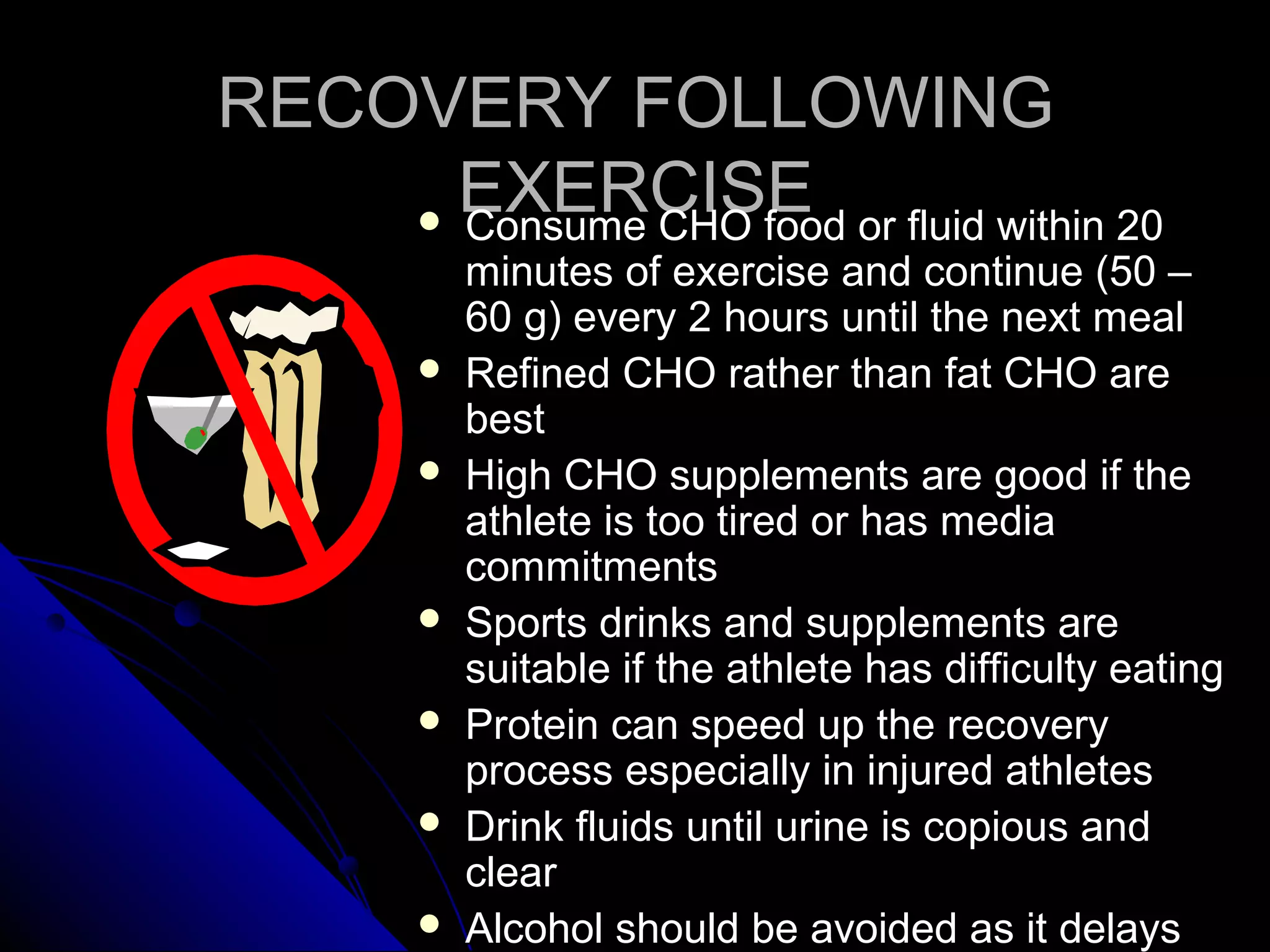
RECOVERY FOLLOWINGRECOVERY FOLLOWING
EXERCISEEXERCISE Consume CHO food or fluid within 20Consume CHO food or fluid within 20
minutes of exercise and continue (50 –minutes of exercise and continue (50 –
60 g) every 2 hours until the next meal60 g) every 2 hours until the next meal
 Refined CHO rather than fat CHO areRefined CHO rather than fat CHO are
bestbest
 High CHO supplements are good if theHigh CHO supplements are good if the
athlete is too tired or has mediaathlete is too tired or has media
commitmentscommitments
 Sports drinks and supplements areSports drinks and supplements are
suitable if the athlete has difficulty eatingsuitable if the athlete has difficulty eating
 Protein can speed up the recoveryProtein can speed up the recovery
process especially in injured athletesprocess especially in injured athletes
 Drink fluids until urine is copious andDrink fluids until urine is copious and
clearclear
 Alcohol should be avoided as it delaysAlcohol should be avoided as it delays
TIPS FOR ATHLETES ON THE MOVETIPS FOR ATHLETES ON THE MOVE ––
Poor planning results in poor performance - PREPAREPoor planning results in poor performance - PREPARE
 Pack a small supply of convenient foods that may not bePack a small supply of convenient foods that may not be
available overseasavailable overseas
 Organise meals in advanceOrganise meals in advance
 Organise ‘Athlete meals’ on planes and take your own waterOrganise ‘Athlete meals’ on planes and take your own water
bottlebottle
 Do not rely on petrol shop foodDo not rely on petrol shop food
 Avoid alcohol (particularly on air-conditioned modes ofAvoid alcohol (particularly on air-conditioned modes of
transport)transport)
 Be prepared to try different CHO foods overseasBe prepared to try different CHO foods overseas
 At exotic locations drink bottled waterAt exotic locations drink bottled water
 ‘‘Travellers trot’ is common – maintain water intake, avoid milkTravellers trot’ is common – maintain water intake, avoid milk
and cheese and gradually introduce food as symptoms settleand cheese and gradually introduce food as symptoms settle
 OTHER FORMS OF RECOVERY ARE ESSENTIALOTHER FORMS OF RECOVERY ARE ESSENTIAL
COPING WITH INJURY /COPING WITH INJURY /
ILLNESSILLNESS
Consistent performance, increased demandsConsistent performance, increased demands
and fatigue can increase the chances of injury /and fatigue can increase the chances of injury /
illnessillness
BLISTERSBLISTERS
 Blisters can be a problem and can prevent theBlisters can be a problem and can prevent the
athlete from performing.athlete from performing.
 Prevent blisters by applying protective covering toPrevent blisters by applying protective covering to
prone areas, wear correctly fitting equipment,prone areas, wear correctly fitting equipment,
toughen the area by alcohol or methylated spirits,toughen the area by alcohol or methylated spirits,
stop friction by applying Vaseline, rub Vaseline onstop friction by applying Vaseline, rub Vaseline on
equipment to soften it, wear correctly fitting socks orequipment to soften it, wear correctly fitting socks or
two pairstwo pairs
 The main points for treatment are: pierce the blisterThe main points for treatment are: pierce the blister
to relieve pressure, apply a protective dressing, soakto relieve pressure, apply a protective dressing, soak
the area in warm salty water, apply ice to reducethe area in warm salty water, apply ice to reduce
swelling, be extremely careful of infectionswelling, be extremely careful of infection
TINEATINEA
 Is a fungal infection affecting feet, groin,Is a fungal infection affecting feet, groin,
underarms and between toes – it may beunderarms and between toes – it may be
inflamed, raw, peeling, itchy and stinginginflamed, raw, peeling, itchy and stinging
 PREVENT SPREAD TO OTHERS – do notPREVENT SPREAD TO OTHERS – do not
share towels, shirts, shoes, socks or clothingshare towels, shirts, shoes, socks or clothing
and wear thongs while in the showerand wear thongs while in the shower
 MANAGEMENT – dry toes carefully, wear openMANAGEMENT – dry toes carefully, wear open
footwear, frequently change socks, antifungalfootwear, frequently change socks, antifungal
powders are available, refer to doctor if extremepowders are available, refer to doctor if extreme
ASTHMAASTHMA
 Be fully preparedBe fully prepared
 Ensure you have appropriate medicationEnsure you have appropriate medication
 Ensure coaching staff are aware of yourEnsure coaching staff are aware of your
condition and of signs of attackscondition and of signs of attacks

Competition preparation

  • 1.
    COMPETITIONCOMPETITION PREPARATIONPREPARATION An athlete facesmany challenges in theAn athlete faces many challenges in the weeks leading into competition. It is crucialweeks leading into competition. It is crucial that they are adequately prepared;that they are adequately prepared; physically, mentally, nutritionallyphysically, mentally, nutritionally andand areare able to recover appropriately. This willable to recover appropriately. This will ensure that they are able to perform at theirensure that they are able to perform at their best and avoid injury or illness during highbest and avoid injury or illness during high stress times.stress times.
  • 2.
    ‘‘Training’ is preparingthe body to tolerateTraining’ is preparing the body to tolerate changes that occur during exercise and preventchanges that occur during exercise and prevent premature fatigue.premature fatigue. The body likes to maintain consistencyThe body likes to maintain consistency (homeostasis)(homeostasis) If homeostasis is disrupted or challenged byIf homeostasis is disrupted or challenged by exercise, they modify or improve themselves soexercise, they modify or improve themselves so that they will not be disrupted as much the nextthat they will not be disrupted as much the next time exercise is performed. (called adaptation).time exercise is performed. (called adaptation).
  • 3.
    Additional stress canbe placed on athletesAdditional stress can be placed on athletes because of different travel and environmentalbecause of different travel and environmental conditions at the destinationconditions at the destination JET LAGJET LAG  Normal rhythm of sleep and wake can be affected by crossing timeNormal rhythm of sleep and wake can be affected by crossing time zoneszones  Plan your trip for many shorter legs – once adjusted, move onPlan your trip for many shorter legs – once adjusted, move on  Drink plenty of water and avoid alcohol (dehydration due to air cond)Drink plenty of water and avoid alcohol (dehydration due to air cond)  Before leaving adjust sleep wake patterns to your destinationBefore leaving adjust sleep wake patterns to your destination  Plan to arrive in the morning and stay awake for the rest of the dayPlan to arrive in the morning and stay awake for the rest of the day  Expose yourself to sunlightExpose yourself to sunlight  Exercise lightly for the first few daysExercise lightly for the first few days POLLUTIONPOLLUTION
  • 4.
    ALTITUDEALTITUDE  AltitudeAltitude  reducedoxygen concentration (somereduced oxygen concentration (some events are enhanced due to reduced airevents are enhanced due to reduced air resistance)resistance)  Advantages of training at altitude are theAdvantages of training at altitude are the elevation of enzymes in the aerobicelevation of enzymes in the aerobic system (these are quickly lost oncesystem (these are quickly lost once returned to sea levelreturned to sea level  Disadvantages of training at altitude areDisadvantages of training at altitude are some athletes suffer from altitudesome athletes suffer from altitude sickness – reducing training and somesickness – reducing training and some athletes do not adjust well and are unableathletes do not adjust well and are unable to train effectivelyto train effectively
  • 5.
    HEAT AND HUMIDITYHEATAND HUMIDITY  Training increases body temperature – to continue exerciseTraining increases body temperature – to continue exercise you need to lose heat, which we do by sweating (as it coolsyou need to lose heat, which we do by sweating (as it cools the skin and then the blood). In high temperature bodythe skin and then the blood). In high temperature body temperature rises quickly and humidity prevents sweatingtemperature rises quickly and humidity prevents sweating because of air moisturebecause of air moisture  Staying cool involvesStaying cool involves Wear little clothing (increase surface area forWear little clothing (increase surface area for evaporation)evaporation) Wear light colored clothing (reflects heat)Wear light colored clothing (reflects heat) Drink plenty of fluid (weigh to make sure)Drink plenty of fluid (weigh to make sure) Exercise at cooler parts of the dayExercise at cooler parts of the day Reduce duration and intensity of sessionsReduce duration and intensity of sessions If conditions are dangerous cancel eventsIf conditions are dangerous cancel events Cooling vests introduced by the AIS have been helpfulCooling vests introduced by the AIS have been helpful
  • 6.
    COOL AND COLDCOOLAND COLD CONDITIONSCONDITIONS  Cold weather can cause cooling muscles,Cold weather can cause cooling muscles, exposure and frostbiteexposure and frostbite  To prevent cold illnessesTo prevent cold illnesses  Dress in layers to prevent heat loss and trapDress in layers to prevent heat loss and trap heat – layers can be added or removedheat – layers can be added or removed  Drawstrings allow clothes to be tightened orDrawstrings allow clothes to be tightened or loosenedloosened  Have warm, dry clothes available for breaksHave warm, dry clothes available for breaks and afterand after  Wear insulating materialsWear insulating materials  Waterproof clothing should be worn ifWaterproof clothing should be worn if raining or snowingraining or snowing  Head, face and neck should be covered toHead, face and neck should be covered to reduce heat lossreduce heat loss  Avoid cold water over long periods of timeAvoid cold water over long periods of time  Young children, babies and elderly are moreYoung children, babies and elderly are more susceptible to coldsusceptible to cold
  • 7.
    MENTAL PREPERATION –Getting startedMENTAL PREPERATION – Getting started and staying motivatedand staying motivated 1.1. Think about what you want to get out of your sportThink about what you want to get out of your sport 2.2. Focus on what you want to achieveFocus on what you want to achieve 3.3. Set realistic challengesSet realistic challenges 4.4. Set goals that measure how well you did not who youSet goals that measure how well you did not who you beatbeat 5.5. Set positive goals that tell you what to do not what notSet positive goals that tell you what to do not what not to doto do 6.6. Set target dates to achieve goalsSet target dates to achieve goals 7.7. Identify a strategy to achieve goalsIdentify a strategy to achieve goals 8.8. Record your goals and make a commitment to themRecord your goals and make a commitment to them 9.9. Evaluate your goalsEvaluate your goals 10.10. Have other help you achieve your goalsHave other help you achieve your goals 11.11. Keep your goals flexibleKeep your goals flexible
  • 8.
    COMPETING AT YOURBESTCOMPETING AT YOUR BEST  Arousal controlArousal control The mind and body are two parts of a whole thatThe mind and body are two parts of a whole that affect each other. When athletes compete wellaffect each other. When athletes compete well they are confident, challenged and excited. Whenthey are confident, challenged and excited. When feeling challenged the brain releases a chemicalfeeling challenged the brain releases a chemical that makes you feel nervous – these nerves arethat makes you feel nervous – these nerves are good and improve performance. Worryinggood and improve performance. Worrying thoughts increase these chemicals, heart rate andthoughts increase these chemicals, heart rate and perspiration affecting concentration and tighteningperspiration affecting concentration and tightening muscles – resulting in poor performancemuscles – resulting in poor performance
  • 9.
    Arousal continuedArousal continued Drifting thoughts can occur, strategiesDrifting thoughts can occur, strategies for ‘catching them’for ‘catching them’  Having too little excitement andHaving too little excitement and chemicals can also affect performancechemicals can also affect performance by feeling lethargic e.g. tough team vs.by feeling lethargic e.g. tough team vs. weak team.weak team.
  • 10.
    Preparing for competitionPreparingfor competition  Many believe that sitting alone and focusing on theirMany believe that sitting alone and focusing on their sport is beneficial – this is only so if the thoughts aresport is beneficial – this is only so if the thoughts are constructive and confident, some athletes need to beconstructive and confident, some athletes need to be chatty to keep away from the negative thoughtschatty to keep away from the negative thoughts  Switching off is important – it takes time away from yourSwitching off is important – it takes time away from your sport, relaxes and refreshes you and decreases wastingsport, relaxes and refreshes you and decreases wasting energy on being anxiousenergy on being anxious  Switching on is good preparation – like studying for anSwitching on is good preparation – like studying for an exam rather than just retaining what you learnt in class.exam rather than just retaining what you learnt in class. Scattered thoughts sometimes distract to the point ofScattered thoughts sometimes distract to the point of failing to adequately preparefailing to adequately prepare
  • 11.
    PREPARING FOR PROBLEMSANDPREPARING FOR PROBLEMS AND CHALLENGESCHALLENGES  Problems that could arise:Problems that could arise:  In the training environmentIn the training environment  When traveling with a teamWhen traveling with a team  New members coming into a teamNew members coming into a team  Little court timeLittle court time  Change of coachChange of coach  Playing a ‘stronger’ teamPlaying a ‘stronger’ team  Playing a ‘weaker’ teamPlaying a ‘weaker’ team  In a foreign environmentIn a foreign environment  What problems could ariseWhat problems could arise  Making bad decisionsMaking bad decisions  A good responseA good response  Best optionsBest options  Sport is not life – maintain a balanceSport is not life – maintain a balance
  • 12.
    CONCENTRATIONCONCENTRATION  Thinking toomuch can clutter the mind and burnThinking too much can clutter the mind and burn energy stressingenergy stressing  Good concentration is keeping it simple but not soGood concentration is keeping it simple but not so simple it becomes too narrowsimple it becomes too narrow  You can only take in so much information so focusYou can only take in so much information so focus on what is happening not the mistake you just madeon what is happening not the mistake you just made  Shift your focus at the right times from single focusShift your focus at the right times from single focus to the big pictureto the big picture  Concentration need not be at top speed – take timeConcentration need not be at top speed – take time to watch and observeto watch and observe
  • 13.
    MENTAL IMAGERYMENTAL IMAGERY Mental imagery is visualising successMental imagery is visualising success It helps by forming a competition plan – gameIt helps by forming a competition plan – game strategy and by sending messages to the musclesstrategy and by sending messages to the muscles involved in the movement, which reinforces nerveinvolved in the movement, which reinforces nerve pathways and can speed up development ofpathways and can speed up development of motor pathwaysmotor pathways It can be negative by sending the wrong messageIt can be negative by sending the wrong message to your muscles (reinforcing bad technique) byto your muscles (reinforcing bad technique) by stressing and tightening if you have seen yourselfstressing and tightening if you have seen yourself perform badly and may reduce confidenceperform badly and may reduce confidence (altering strategy)(altering strategy)
  • 14.
    FLUID PREPARATION –FLUIDPREPARATION – Most athletes do not properly replace fluid loss duringMost athletes do not properly replace fluid loss during exercise – causing dehydration and negative performanceexercise – causing dehydration and negative performance  Do not rely on thirst as an indicatorDo not rely on thirst as an indicator  Monitor your urineMonitor your urine  Have drinks readily accessibleHave drinks readily accessible  Avoid drinking caffeine and alcohol – diureticAvoid drinking caffeine and alcohol – diuretic  Develop good drinking practice (150 – 250 mls /Develop good drinking practice (150 – 250 mls / 15 minutes of exercise)15 minutes of exercise)  Increase pre exercise drinking in hot conditionsIncrease pre exercise drinking in hot conditions  Weigh yourself before and after exercise (1 kg =Weigh yourself before and after exercise (1 kg = 1 l fluid)1 l fluid)  Water is suitable for <90 minute eventsWater is suitable for <90 minute events  Drink breaks should be scheduled every 15Drink breaks should be scheduled every 15 minutesminutes  Sports drinks – consider: what you like, cost,Sports drinks – consider: what you like, cost, concentration, salt content, acidity for toothconcentration, salt content, acidity for tooth decaydecay
  • 15.
    THE PRE EVENTMEALTHE PRE EVENT MEAL  On Competition day the pre-event meal needs toOn Competition day the pre-event meal needs to top up glycogen stores and fluid. Try:top up glycogen stores and fluid. Try:  Larger more substantial meals (cereal, low fat milk,Larger more substantial meals (cereal, low fat milk, juice) should be consumed 3 – 4 hours prior tojuice) should be consumed 3 – 4 hours prior to competitioncompetition  Smaller snacks (sports bars and sports drinks) can beSmaller snacks (sports bars and sports drinks) can be consumed 1 – 2 hours priorconsumed 1 – 2 hours prior  Meals and snacks should be high in carbohydratesMeals and snacks should be high in carbohydrates and low in fatand low in fat  Eat food that you are comfortable with – now is not aEat food that you are comfortable with – now is not a good time to try new foodsgood time to try new foods  If unable to eat solids, try liquid supplementsIf unable to eat solids, try liquid supplements
  • 16.
    SUGGESTED PRE-EVENTSUGGESTED PRE-EVENT MEALSMEALS Breakfast cereal with skim milk andBreakfast cereal with skim milk and fruitfruit  Toast with baked beans or spaghettiToast with baked beans or spaghetti  Pancakes with syrup and juice orPancakes with syrup and juice or sports drinksports drink  Liquid mealsLiquid meals  Low fat yogurt, custard or creamedLow fat yogurt, custard or creamed rice with fruitrice with fruit  Banana sandwiches or rollsBanana sandwiches or rolls  Mini pizzas (on pocket bread) prMini pizzas (on pocket bread) pr pasta with tomato based sauce – forpasta with tomato based sauce – for afternoon snacks when preparing forafternoon snacks when preparing for evening gamesevening games
  • 17.
    REPLACING FUEL ANDFLUIDREPLACING FUEL AND FLUID DURING EXERCISEDURING EXERCISE  Fuel is not required during exercise ofFuel is not required during exercise of an hour or less in durationan hour or less in duration  If CHO are required aim for 0.8 – 1.0If CHO are required aim for 0.8 – 1.0 g / kg of body weight and 750 – 100g / kg of body weight and 750 – 100 ml / hour of exerciseml / hour of exercise  Use sports drinks or combinationsUse sports drinks or combinations  Be familiar with the food and practiceBe familiar with the food and practice eating in events beforehandeating in events beforehand  Find something easily digestible andFind something easily digestible and compactcompact
  • 18.
    RECOVERY FOLLOWINGRECOVERY FOLLOWING EXERCISEEXERCISEConsume CHO food or fluid within 20Consume CHO food or fluid within 20 minutes of exercise and continue (50 –minutes of exercise and continue (50 – 60 g) every 2 hours until the next meal60 g) every 2 hours until the next meal  Refined CHO rather than fat CHO areRefined CHO rather than fat CHO are bestbest  High CHO supplements are good if theHigh CHO supplements are good if the athlete is too tired or has mediaathlete is too tired or has media commitmentscommitments  Sports drinks and supplements areSports drinks and supplements are suitable if the athlete has difficulty eatingsuitable if the athlete has difficulty eating  Protein can speed up the recoveryProtein can speed up the recovery process especially in injured athletesprocess especially in injured athletes  Drink fluids until urine is copious andDrink fluids until urine is copious and clearclear  Alcohol should be avoided as it delaysAlcohol should be avoided as it delays
  • 19.
    TIPS FOR ATHLETESON THE MOVETIPS FOR ATHLETES ON THE MOVE –– Poor planning results in poor performance - PREPAREPoor planning results in poor performance - PREPARE  Pack a small supply of convenient foods that may not bePack a small supply of convenient foods that may not be available overseasavailable overseas  Organise meals in advanceOrganise meals in advance  Organise ‘Athlete meals’ on planes and take your own waterOrganise ‘Athlete meals’ on planes and take your own water bottlebottle  Do not rely on petrol shop foodDo not rely on petrol shop food  Avoid alcohol (particularly on air-conditioned modes ofAvoid alcohol (particularly on air-conditioned modes of transport)transport)  Be prepared to try different CHO foods overseasBe prepared to try different CHO foods overseas  At exotic locations drink bottled waterAt exotic locations drink bottled water  ‘‘Travellers trot’ is common – maintain water intake, avoid milkTravellers trot’ is common – maintain water intake, avoid milk and cheese and gradually introduce food as symptoms settleand cheese and gradually introduce food as symptoms settle  OTHER FORMS OF RECOVERY ARE ESSENTIALOTHER FORMS OF RECOVERY ARE ESSENTIAL
  • 20.
    COPING WITH INJURY/COPING WITH INJURY / ILLNESSILLNESS Consistent performance, increased demandsConsistent performance, increased demands and fatigue can increase the chances of injury /and fatigue can increase the chances of injury / illnessillness
  • 21.
    BLISTERSBLISTERS  Blisters canbe a problem and can prevent theBlisters can be a problem and can prevent the athlete from performing.athlete from performing.  Prevent blisters by applying protective covering toPrevent blisters by applying protective covering to prone areas, wear correctly fitting equipment,prone areas, wear correctly fitting equipment, toughen the area by alcohol or methylated spirits,toughen the area by alcohol or methylated spirits, stop friction by applying Vaseline, rub Vaseline onstop friction by applying Vaseline, rub Vaseline on equipment to soften it, wear correctly fitting socks orequipment to soften it, wear correctly fitting socks or two pairstwo pairs  The main points for treatment are: pierce the blisterThe main points for treatment are: pierce the blister to relieve pressure, apply a protective dressing, soakto relieve pressure, apply a protective dressing, soak the area in warm salty water, apply ice to reducethe area in warm salty water, apply ice to reduce swelling, be extremely careful of infectionswelling, be extremely careful of infection
  • 22.
    TINEATINEA  Is afungal infection affecting feet, groin,Is a fungal infection affecting feet, groin, underarms and between toes – it may beunderarms and between toes – it may be inflamed, raw, peeling, itchy and stinginginflamed, raw, peeling, itchy and stinging  PREVENT SPREAD TO OTHERS – do notPREVENT SPREAD TO OTHERS – do not share towels, shirts, shoes, socks or clothingshare towels, shirts, shoes, socks or clothing and wear thongs while in the showerand wear thongs while in the shower  MANAGEMENT – dry toes carefully, wear openMANAGEMENT – dry toes carefully, wear open footwear, frequently change socks, antifungalfootwear, frequently change socks, antifungal powders are available, refer to doctor if extremepowders are available, refer to doctor if extreme
  • 23.
    ASTHMAASTHMA  Be fullypreparedBe fully prepared  Ensure you have appropriate medicationEnsure you have appropriate medication  Ensure coaching staff are aware of yourEnsure coaching staff are aware of your condition and of signs of attackscondition and of signs of attacks