

©
2024
Yubico
© 2024 Yubico
Passkeys
Developing APIs to enable passwordless authentication
Cody Salas
Sr. Developer Advocate | Solutions Architect @ Yubico
Apidays New York 2024
©
2024
Yubico
©
2024
Yubico
What are passkeys?
©
2024
Yubico
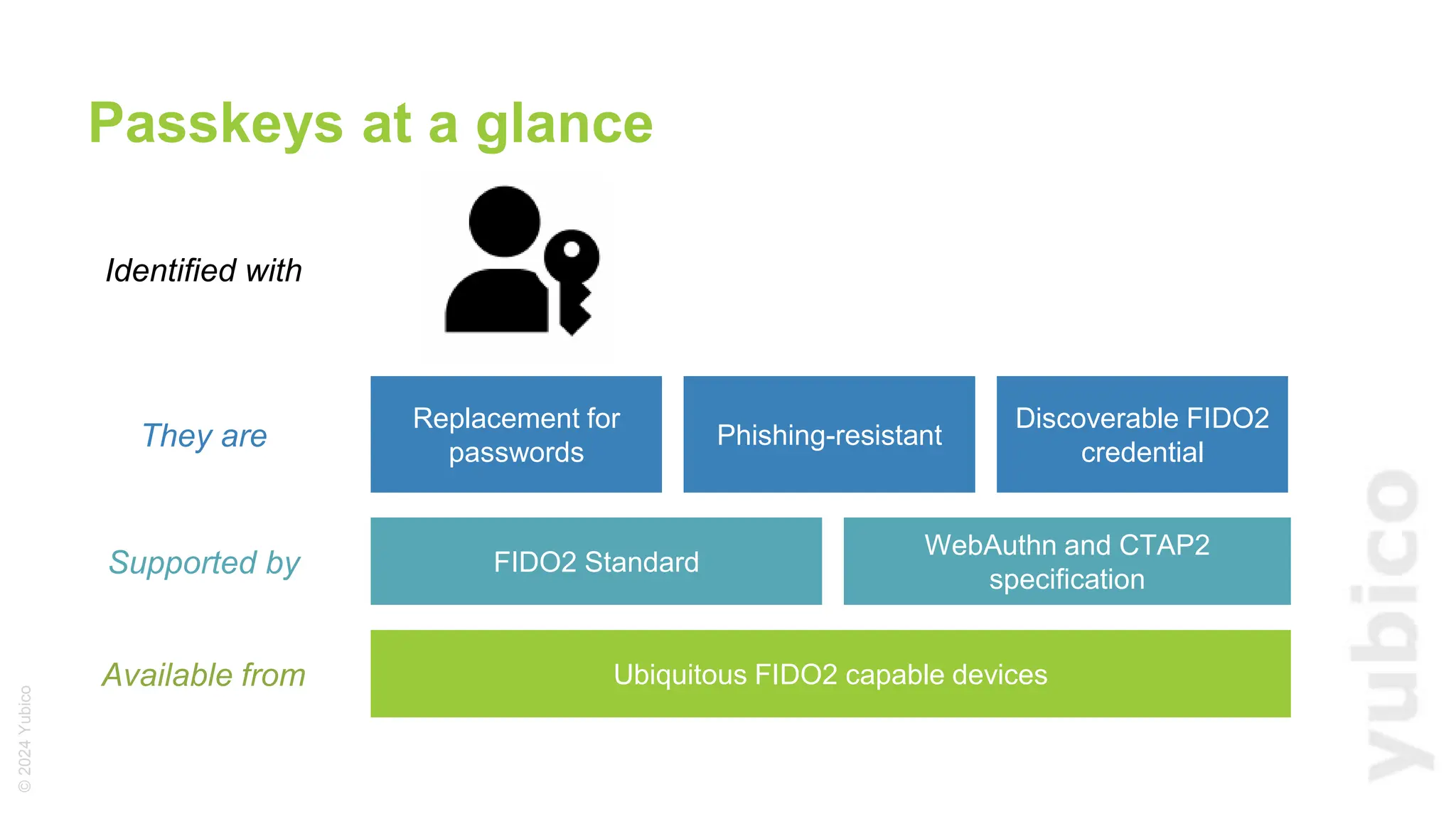
Passkeys at a glance
Replacement for
passwords
Phishing-resistant
Discoverable FIDO2
credential
FIDO2 Standard
WebAuthn and CTAP2
specification
Ubiquitous FIDO2 capable devices
They are
Supported by
Available from
Identified with
©
2024
Yubico
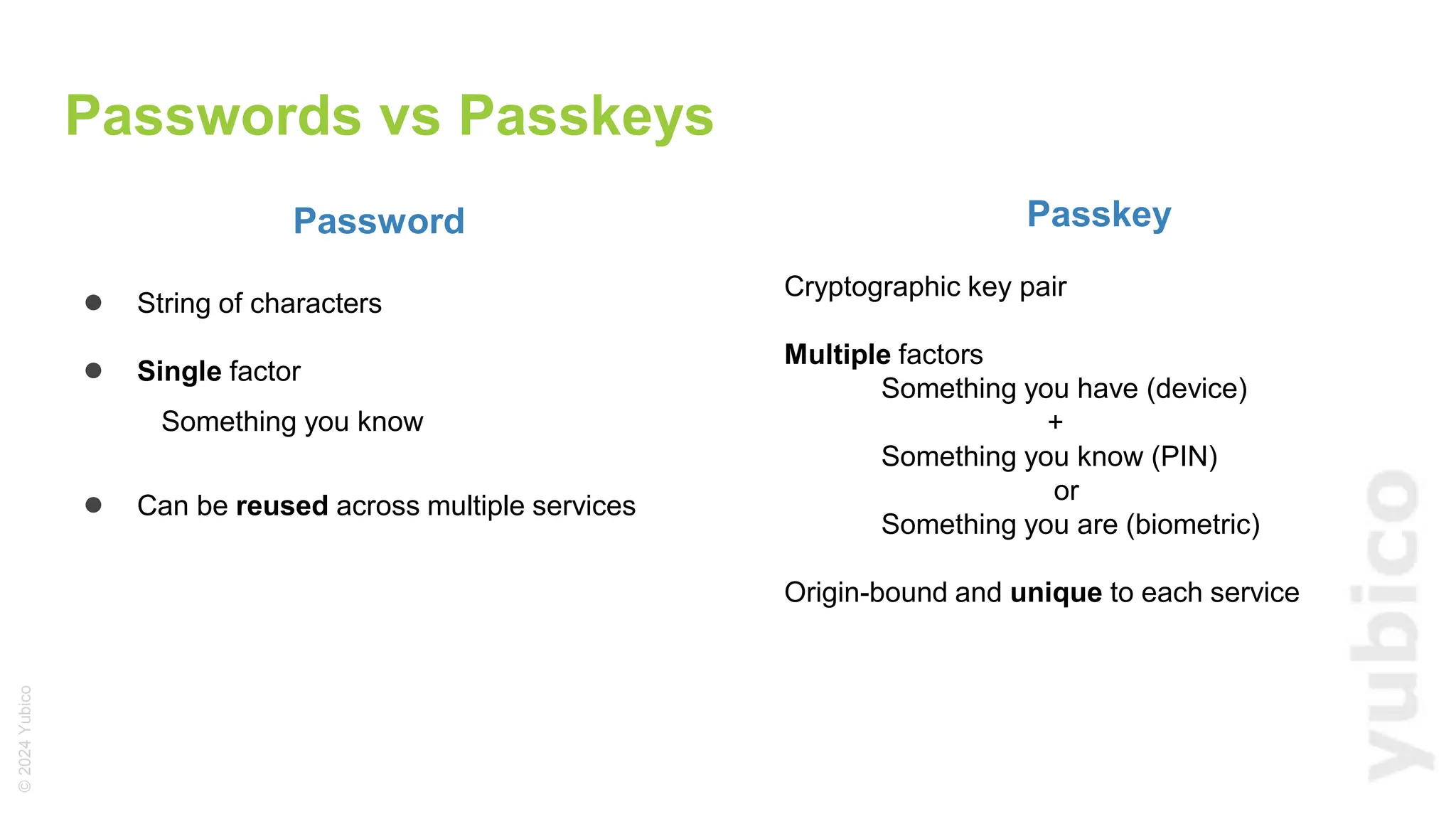
Passwords vs Passkeys
Password
● String of characters
● Single factor
Something you know
● Can be reused across multiple services
Passkey
Cryptographic key pair
Multiple factors
Something you have (device)
+
Something you know (PIN)
or
Something you are (biometric)
Origin-bound and unique to each service
©
2024
Yubico
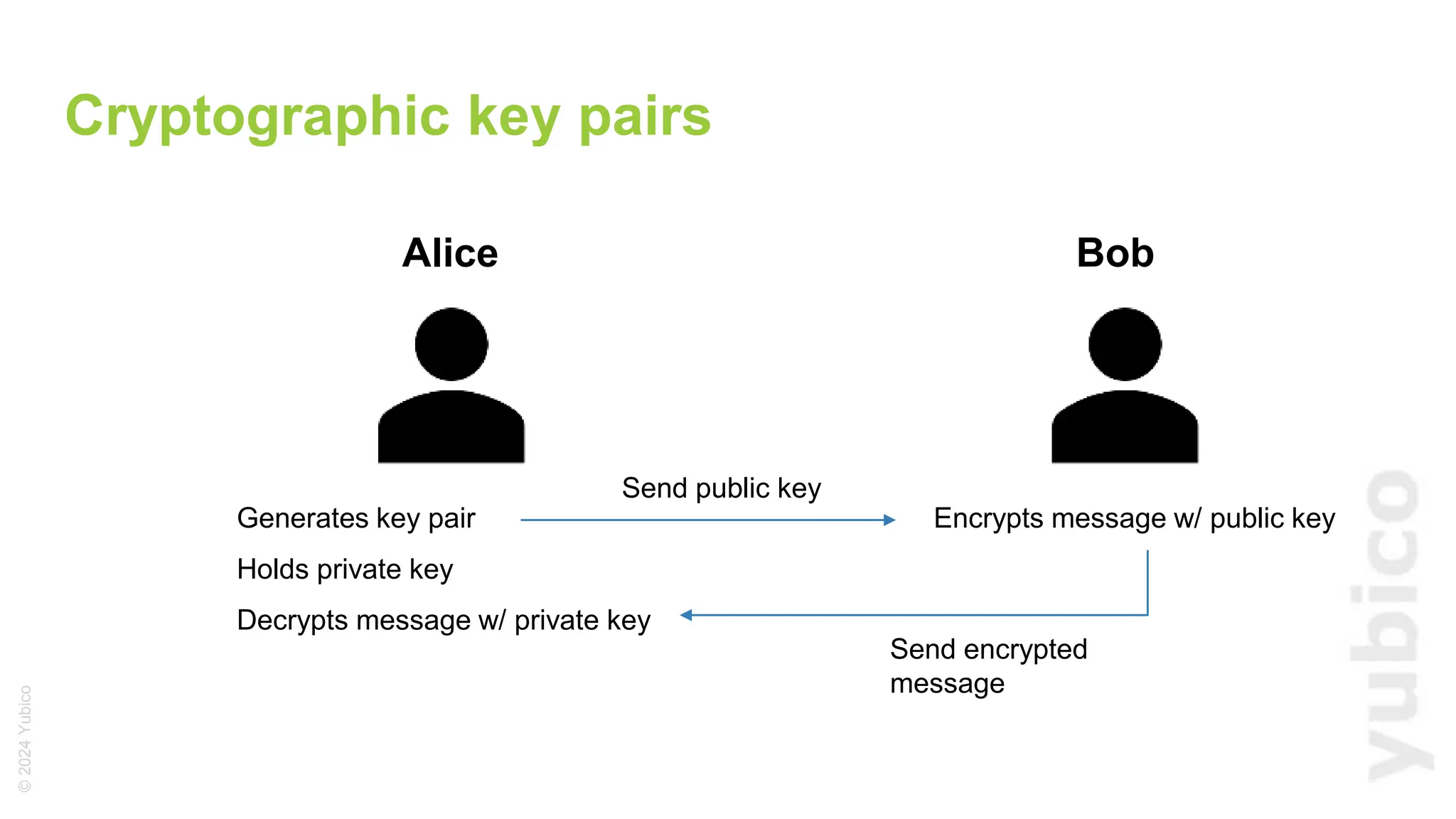
Cryptographic key pairs
Encrypts message w/ public key
Alice Bob
Generates key pair
Holds private key
Decrypts message w/ private key
Send public key
Send encrypted
message
©
2024
Yubico
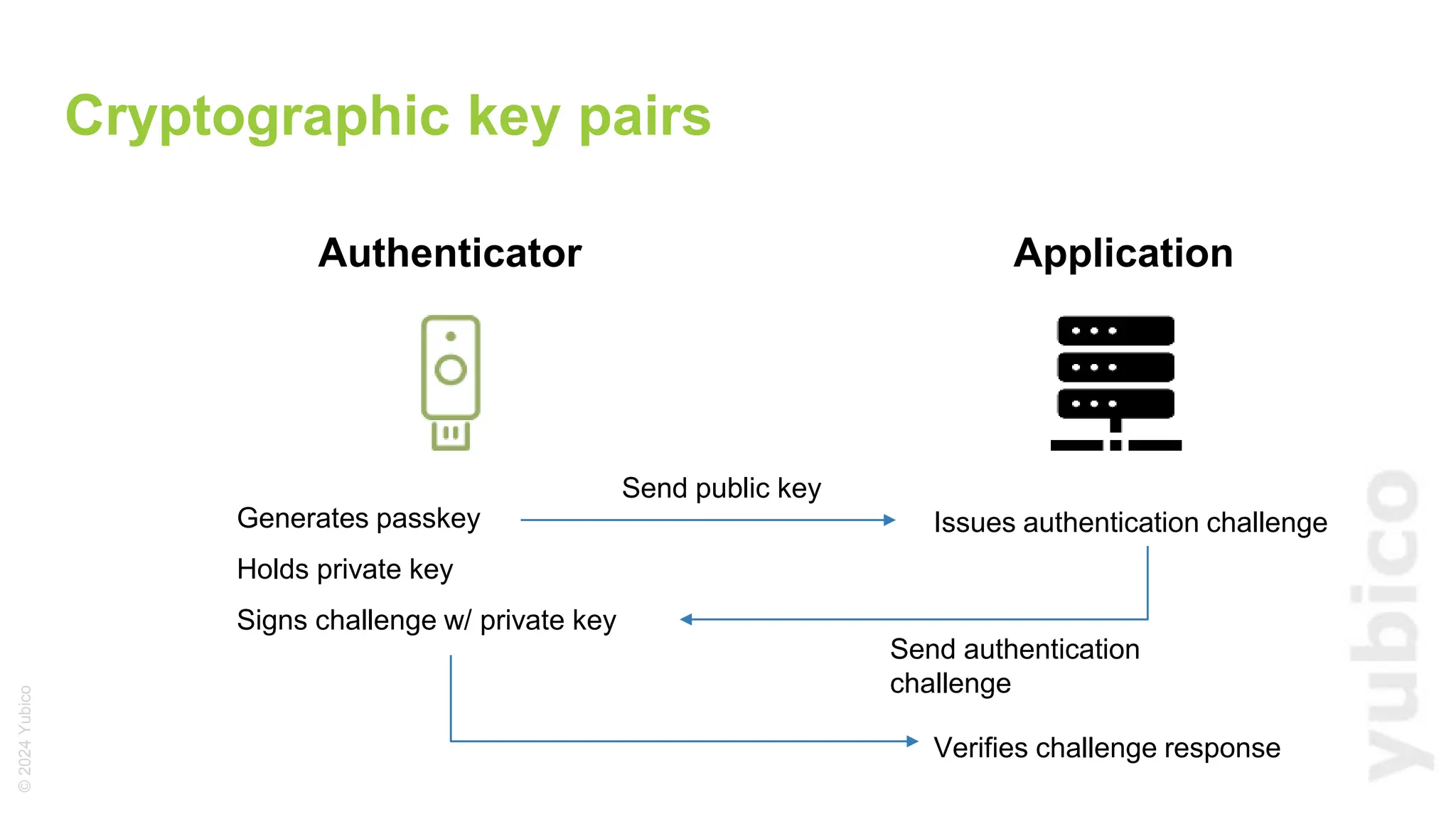
Cryptographic key pairs
Issues authentication challenge
Authenticator Application
Generates passkey
Holds private key
Signs challenge w/ private key
Send public key
Send authentication
challenge
Verifies challenge response
©
2024
Yubico
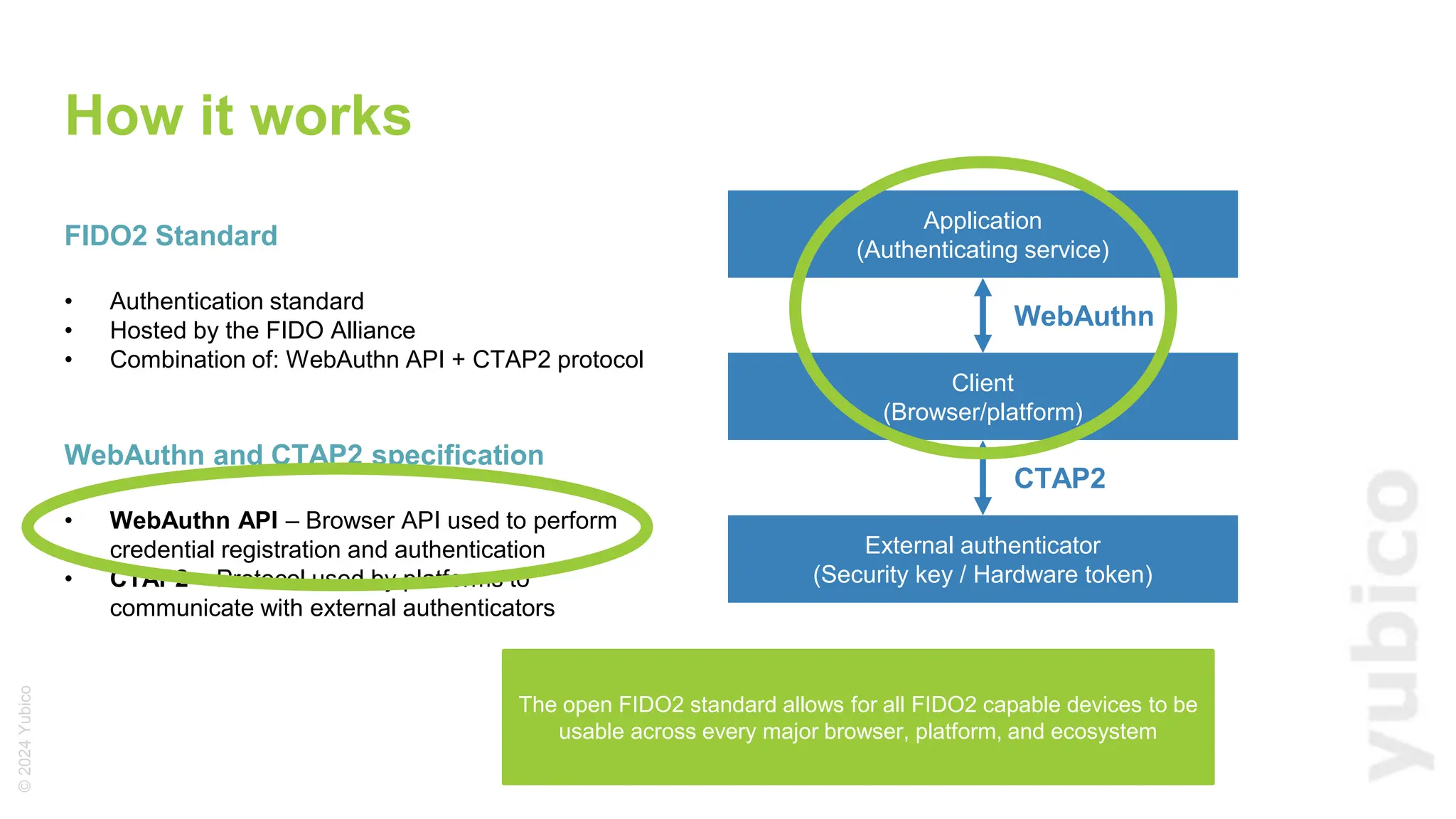
How it works
Application
(Authenticating service)
Client
(Browser/platform)
External authenticator
(Security key / Hardware token)
FIDO2 Standard
WebAuthn and CTAP2 specification
• Authentication standard
• Hosted by the FIDO Alliance
• Combination of: WebAuthn API + CTAP2 protocol
• WebAuthn API – Browser API used to perform
credential registration and authentication
• CTAP2 – Protocol used by platforms to
communicate with external authenticators
WebAuthn
CTAP2
The open FIDO2 standard allows for all FIDO2 capable devices to be
usable across every major browser, platform, and ecosystem
©
2024
Yubico
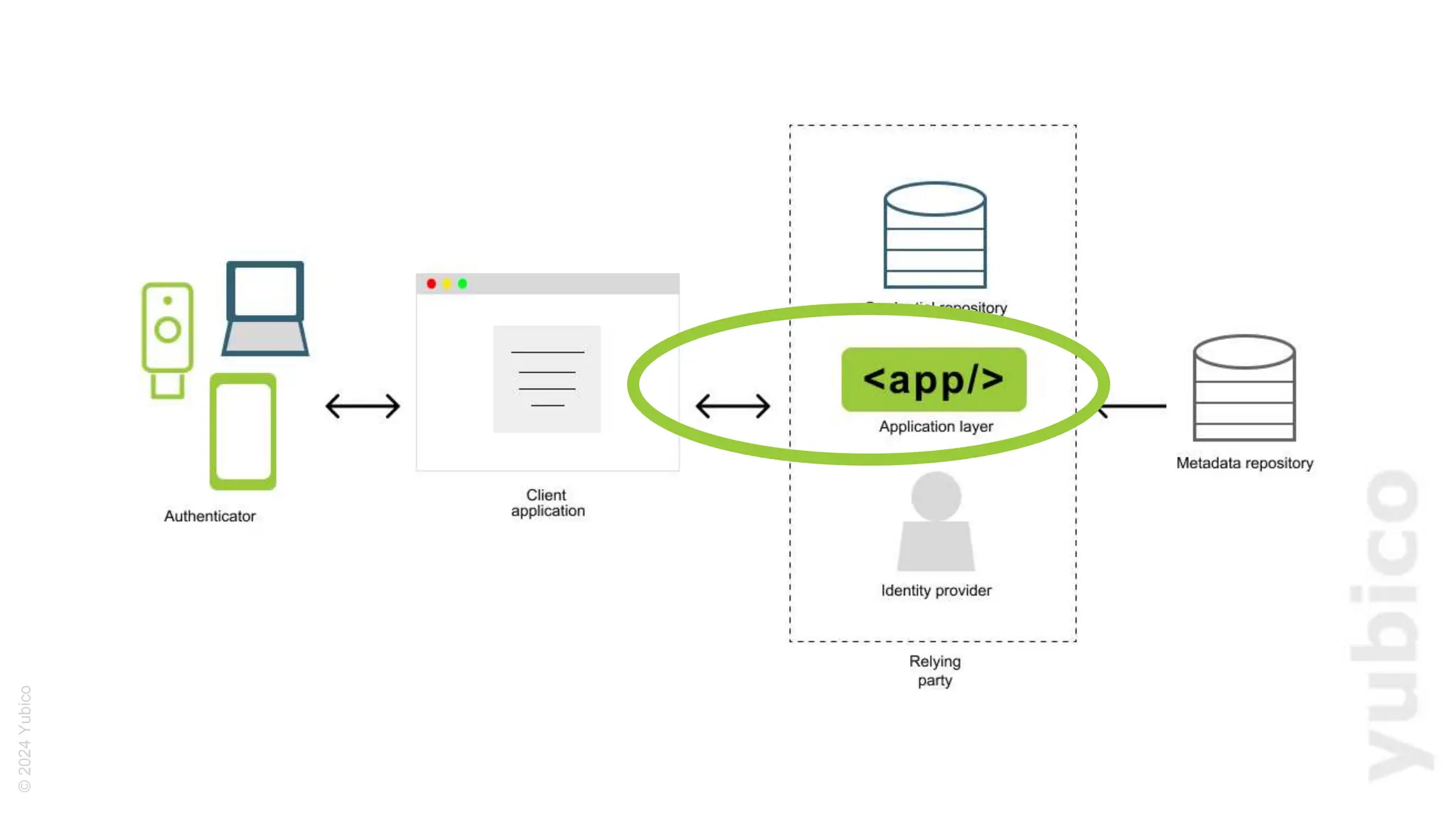
Architecture of a passkey application
©
2024
Yubico
©
2024
Yubico
Relying party server and API
©
2024
Yubico
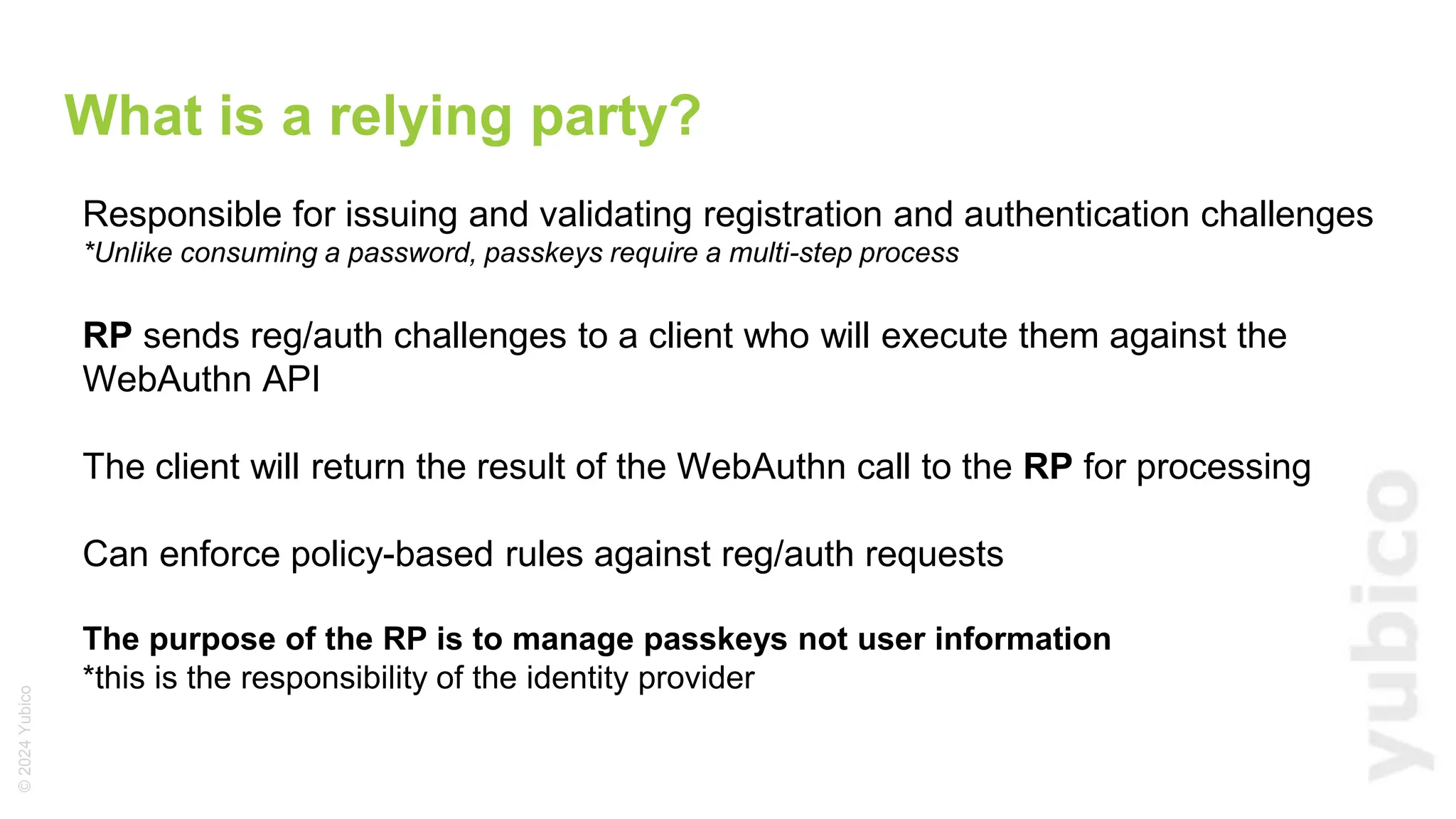
Responsible for issuing and validating registration and authentication challenges
*Unlike consuming a password, passkeys require a multi-step process
RP sends reg/auth challenges to a client who will execute them against the
WebAuthn API
The client will return the result of the WebAuthn call to the RP for processing
Can enforce policy-based rules against reg/auth requests
The purpose of the RP is to manage passkeys not user information
*this is the responsibility of the identity provider
What is a relying party?
©
2024
Yubico
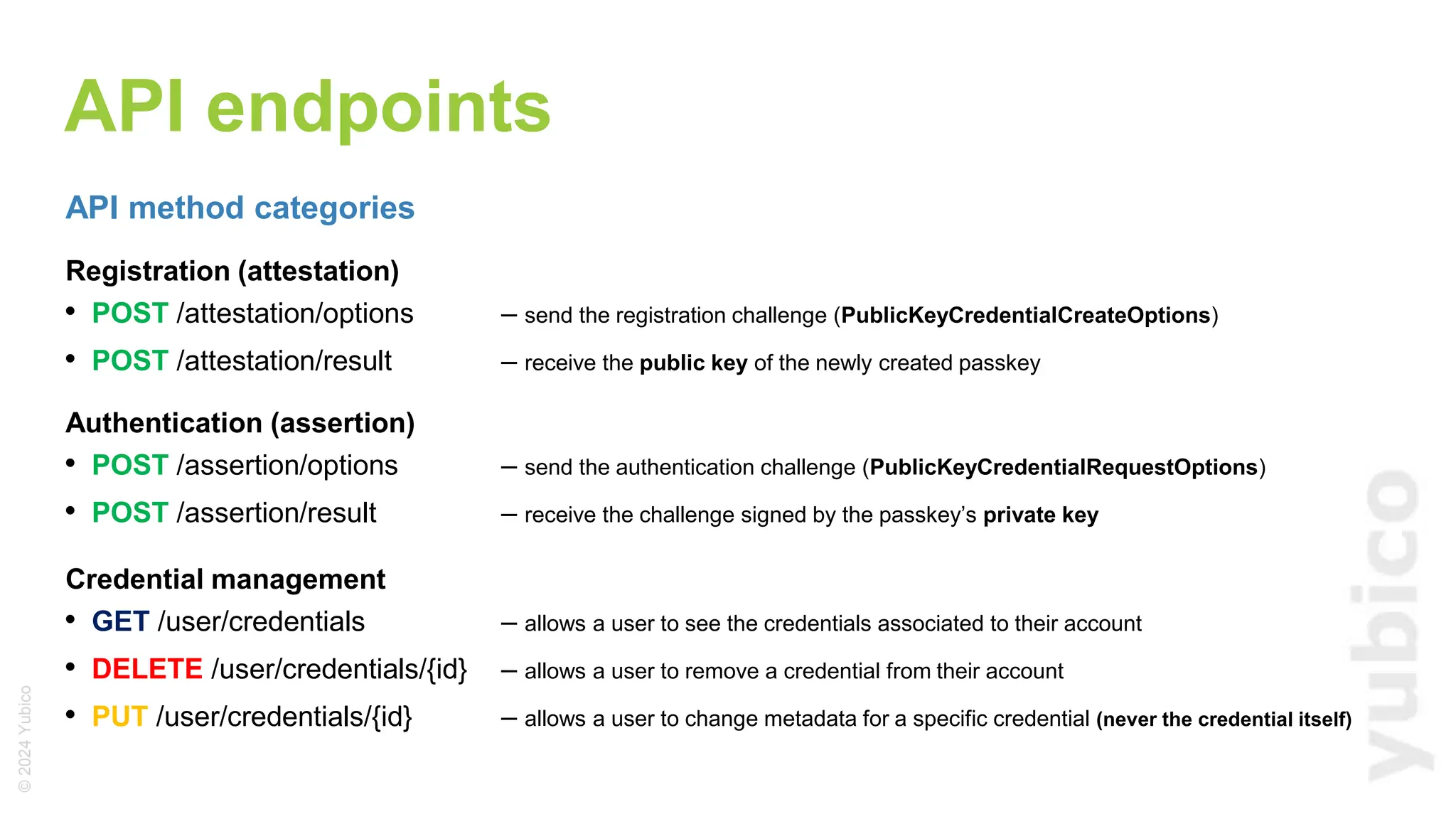
API endpoints
API method categories
Registration (attestation)
• POST /attestation/options – send the registration challenge (PublicKeyCredentialCreateOptions)
• POST /attestation/result – receive the public key of the newly created passkey
Authentication (assertion)
• POST /assertion/options – send the authentication challenge (PublicKeyCredentialRequestOptions)
• POST /assertion/result – receive the challenge signed by the passkey’s private key
Credential management
• GET /user/credentials – allows a user to see the credentials associated to their account
• DELETE /user/credentials/{id} – allows a user to remove a credential from their account
• PUT /user/credentials/{id} – allows a user to change metadata for a specific credential (never the credential itself)
©
2024
Yubico
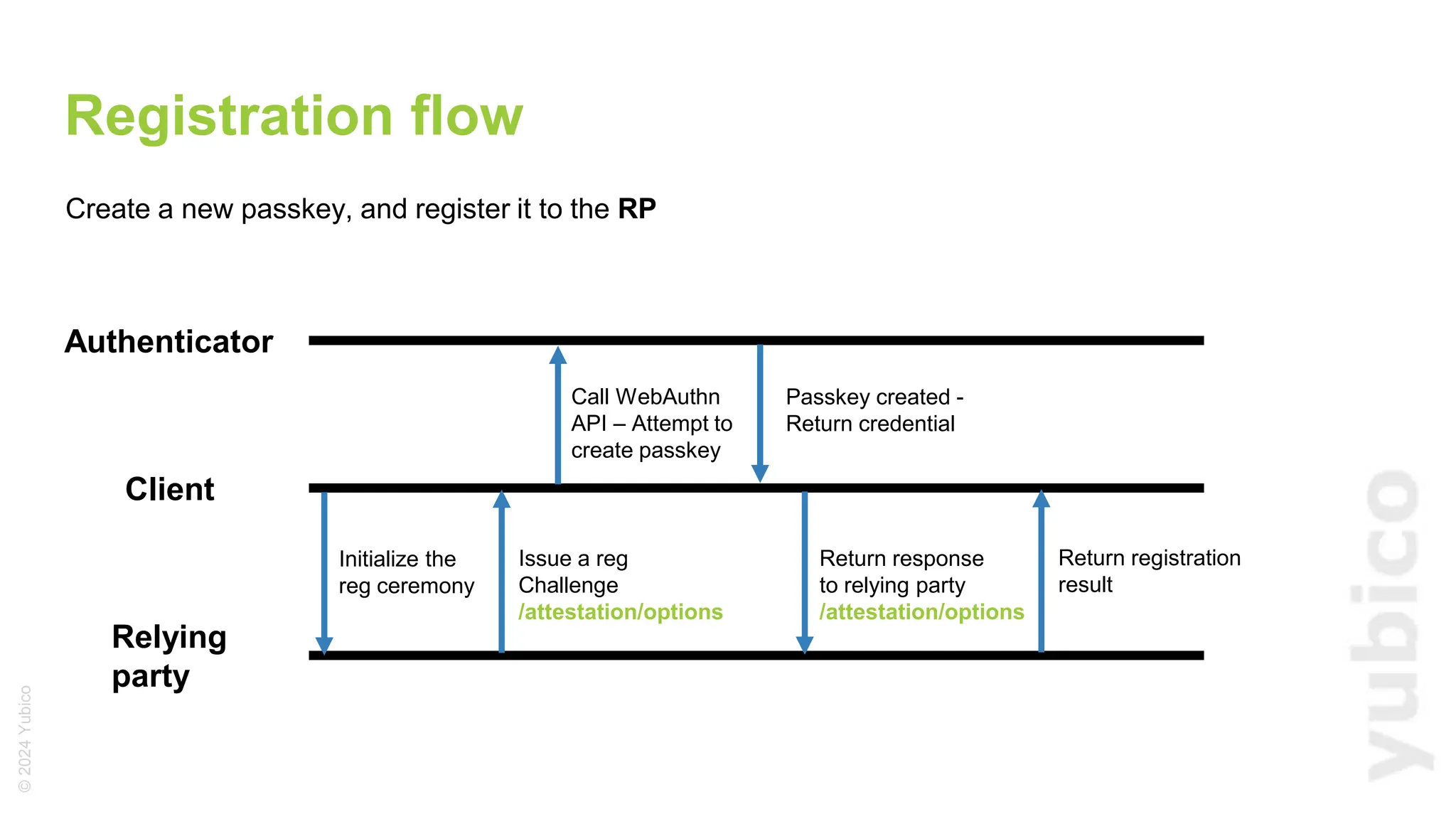
Registration flow
Create a new passkey, and register it to the RP
Authenticator
Client
Relying
party
Initialize the
reg ceremony
Issue a reg
Challenge
/attestation/options
Call WebAuthn
API – Attempt to
create passkey
Passkey created -
Return credential
Return response
to relying party
/attestation/options
Return registration
result
©
2024
Yubico
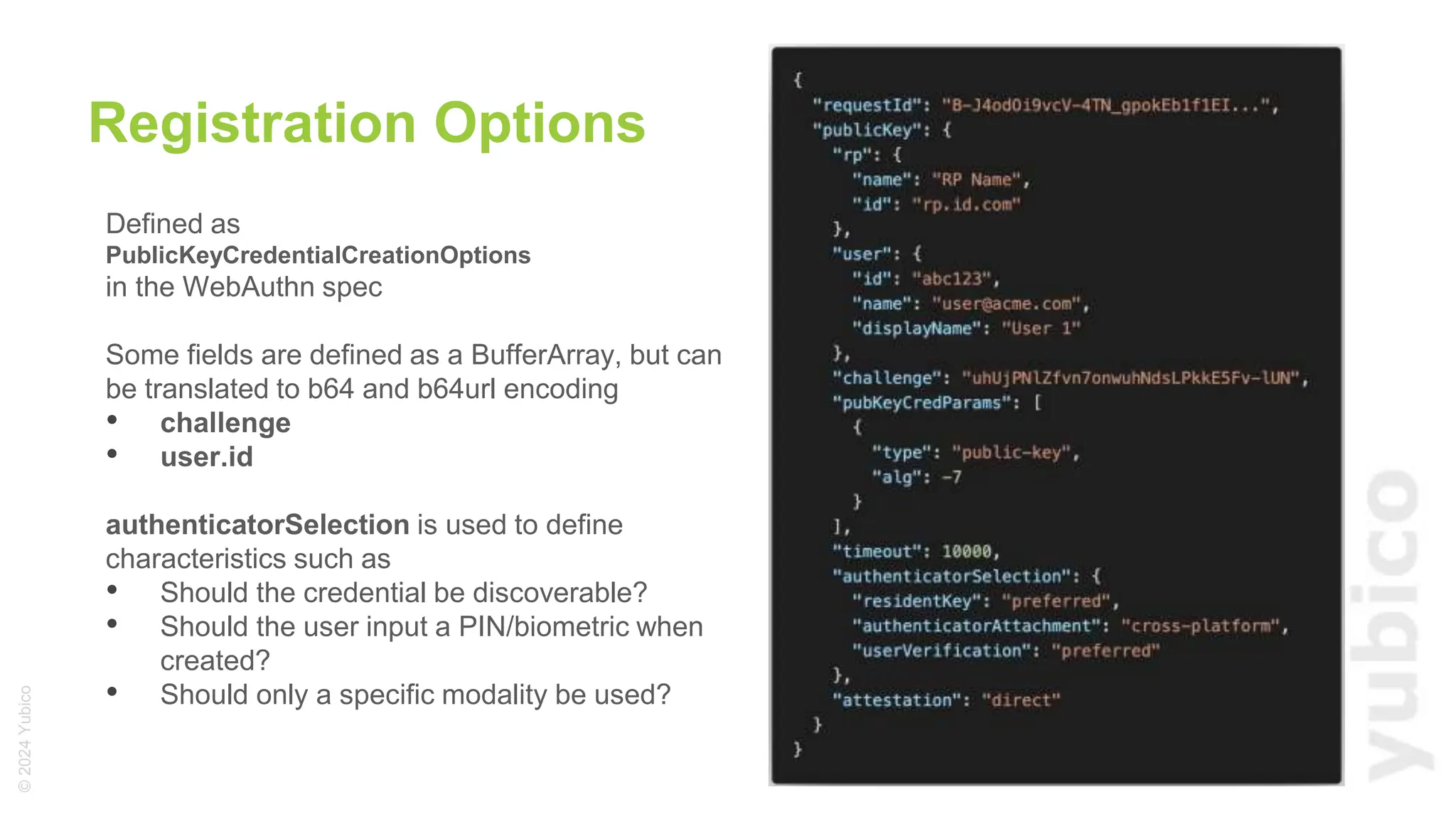
Defined as
PublicKeyCredentialCreationOptions
in the WebAuthn spec
Some fields are defined as a BufferArray, but can
be translated to b64 and b64url encoding
• challenge
• user.id
authenticatorSelection is used to define
characteristics such as
• Should the credential be discoverable?
• Should the user input a PIN/biometric when
created?
• Should only a specific modality be used?
Registration Options
©
2024
Yubico
©
2024
Yubico
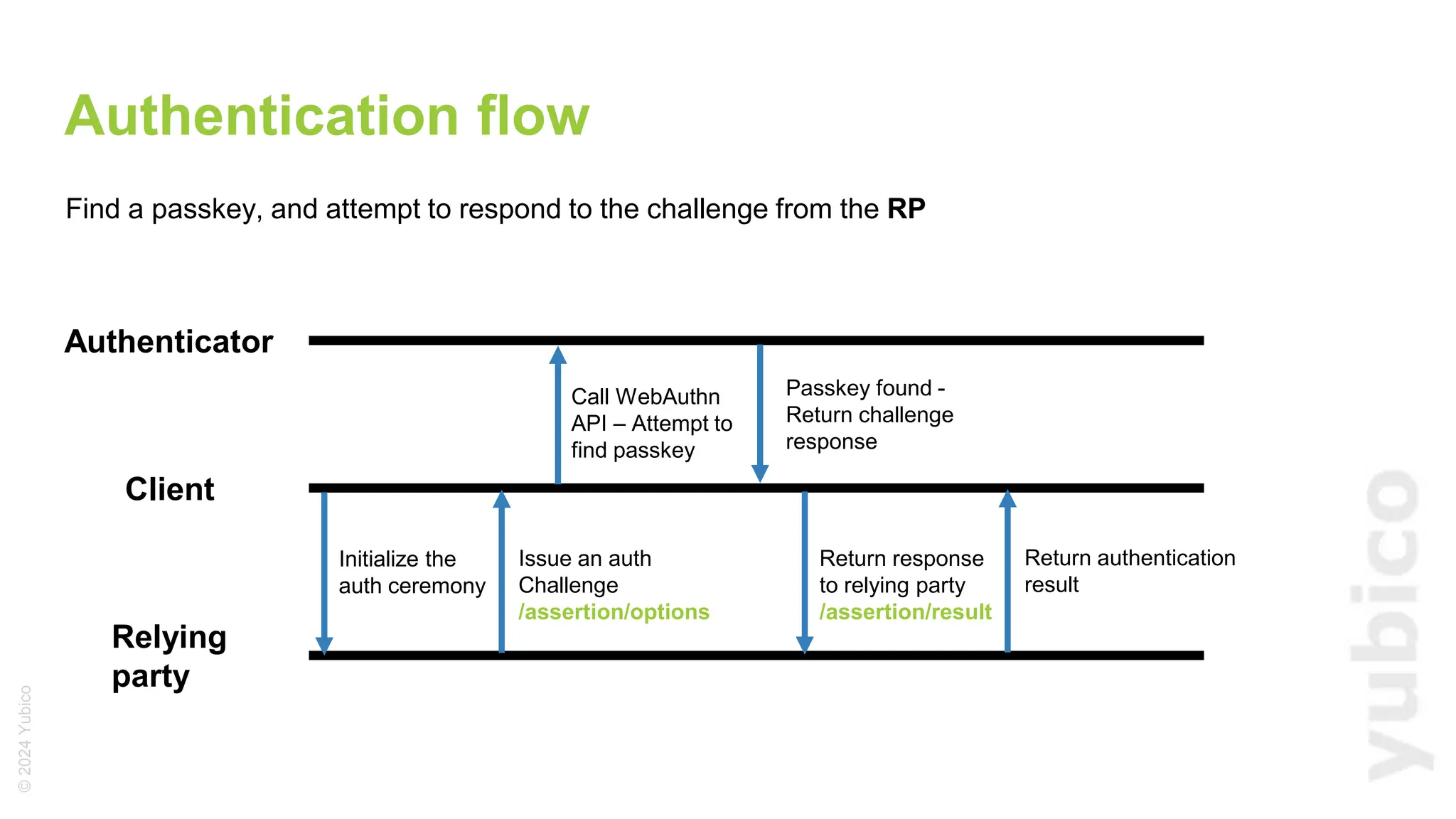
Authentication flow
Find a passkey, and attempt to respond to the challenge from the RP
Authenticator
Client
Relying
party
Initialize the
auth ceremony
Issue an auth
Challenge
/assertion/options
Call WebAuthn
API – Attempt to
find passkey
Passkey found -
Return challenge
response
Return response
to relying party
/assertion/result
Return authentication
result
©
2024
Yubico
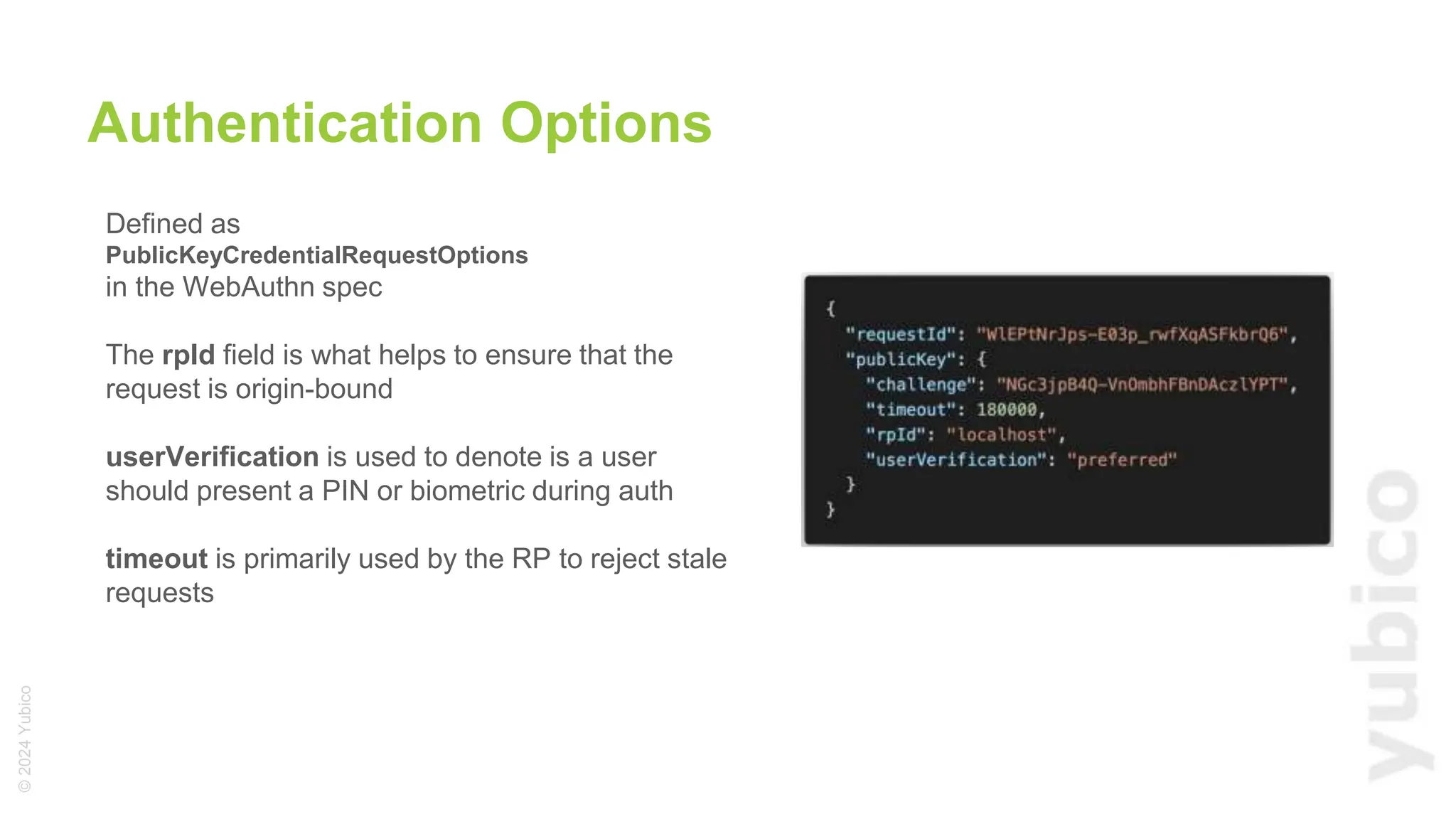
Defined as
PublicKeyCredentialRequestOptions
in the WebAuthn spec
The rpId field is what helps to ensure that the
request is origin-bound
userVerification is used to denote is a user
should present a PIN or biometric during auth
timeout is primarily used by the RP to reject stale
requests
Authentication Options
©
2024
Yubico
©
2024
Yubico
SDKs and libraries
Don’t attempt to build the WebAuthn RP logic and components on your own
There are numerous server-side libraries that can be used
Our example was built using Yubico’s java-webauthn-server library
https://github.com/Yubico/java-webauthn-server
Other libraries can be found on community resources
https://passkeys.dev/docs/tools-libraries/libraries/
©
2024
Yubico
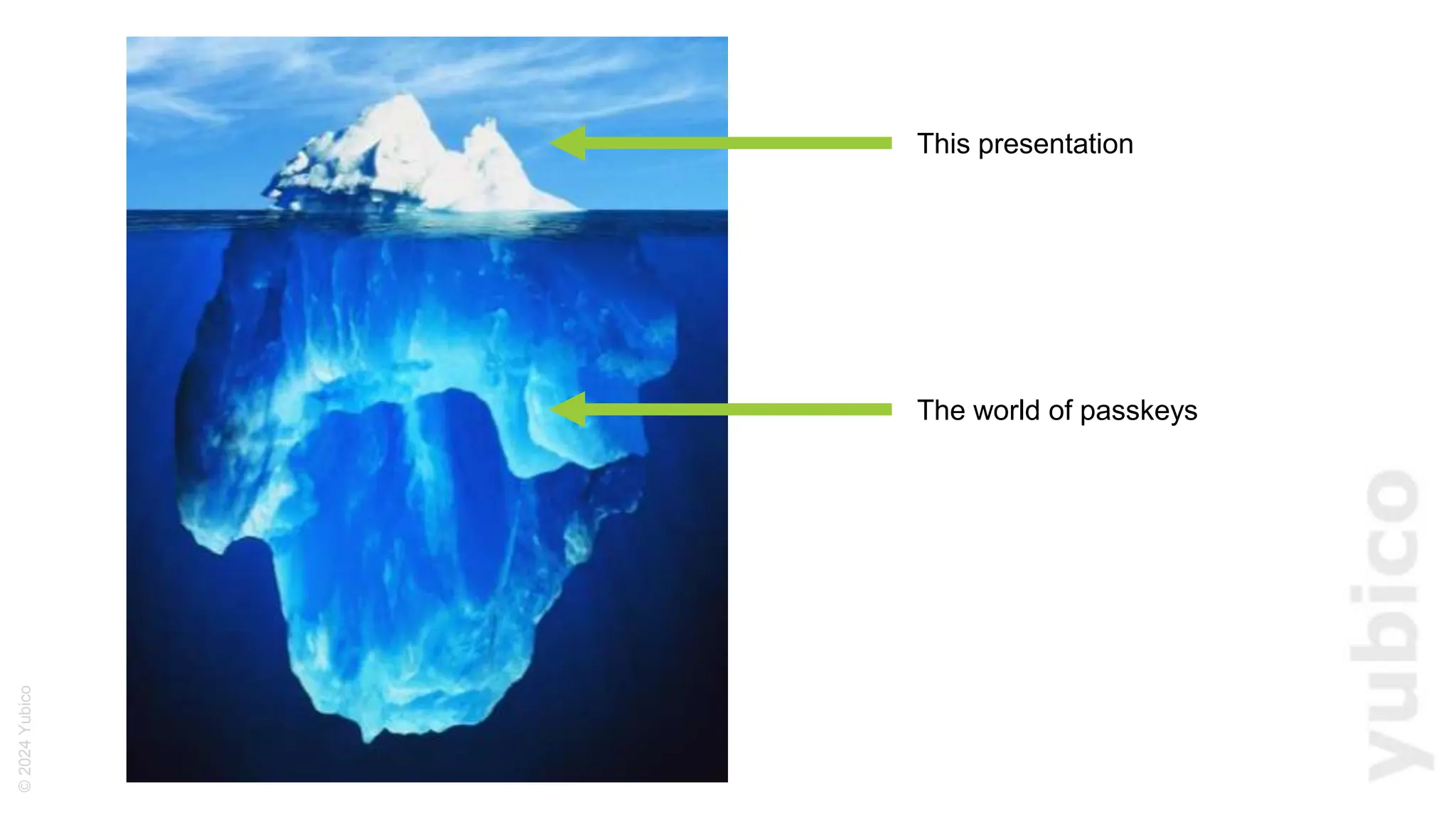
This presentation
The world of passkeys
©
2024
Yubico
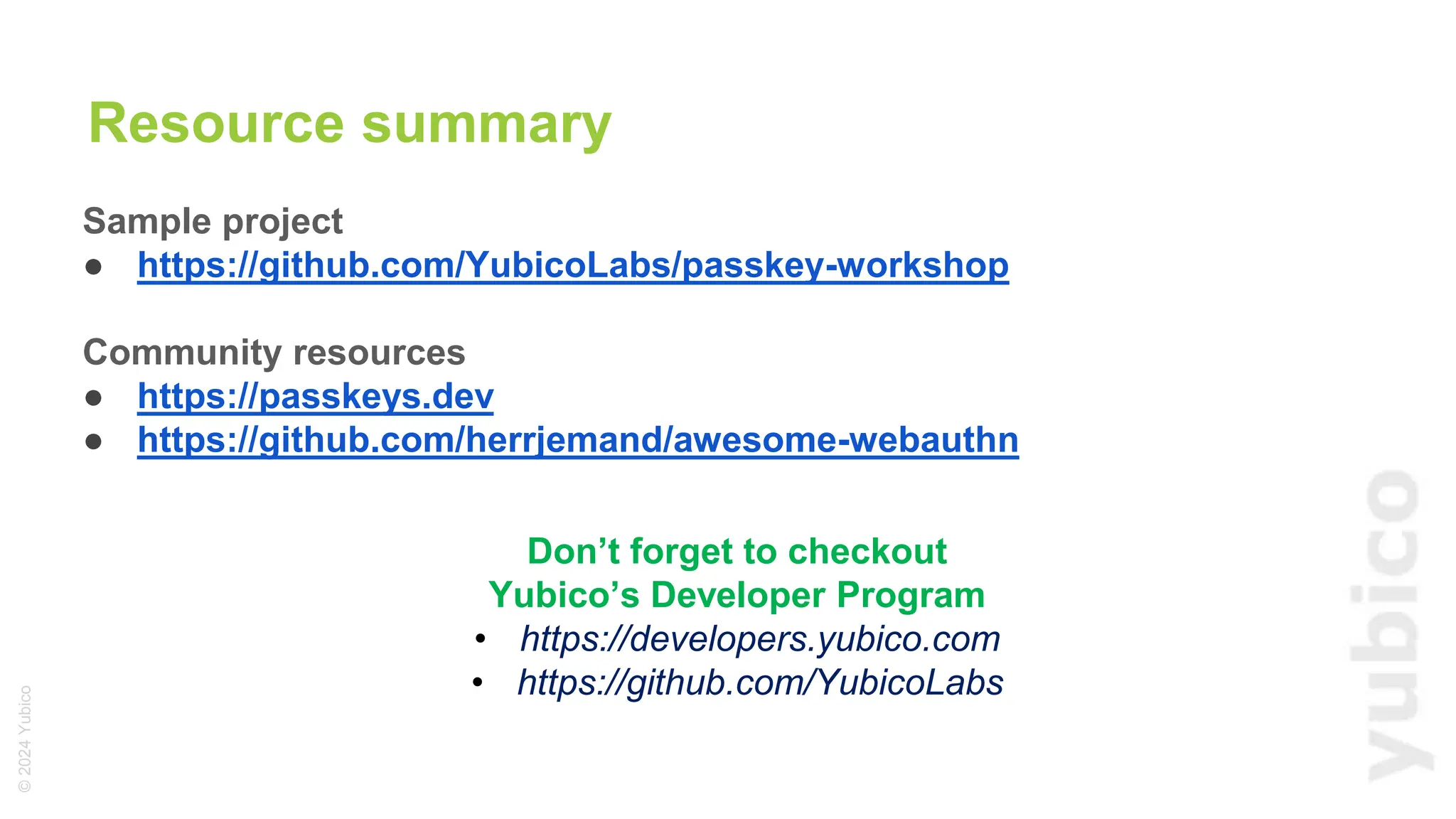
Resource summary
Sample project
● https://github.com/YubicoLabs/passkey-workshop
Community resources
● https://passkeys.dev
● https://github.com/herrjemand/awesome-webauthn
Don’t forget to checkout
Yubico’s Developer Program
• https://developers.yubico.com
• https://github.com/YubicoLabs
©
2024
Yubico
© 2024 Yubico
Questions???
©
2024
Yubico
©
2022
Yubico

Apidays New York 2024 - Passkeys: Developing APIs to enable passwordless authentication by Cody Salas, Yubico

  • 1.
    © 2024 Yubico © 2024 Yubico Passkeys DevelopingAPIs to enable passwordless authentication Cody Salas Sr. Developer Advocate | Solutions Architect @ Yubico Apidays New York 2024
  • 2.
  • 3.
  • 4.
    © 2024 Yubico Passkeys at aglance Replacement for passwords Phishing-resistant Discoverable FIDO2 credential FIDO2 Standard WebAuthn and CTAP2 specification Ubiquitous FIDO2 capable devices They are Supported by Available from Identified with
  • 5.
    © 2024 Yubico Passwords vs Passkeys Password ●String of characters ● Single factor Something you know ● Can be reused across multiple services Passkey Cryptographic key pair Multiple factors Something you have (device) + Something you know (PIN) or Something you are (biometric) Origin-bound and unique to each service
  • 6.
    © 2024 Yubico Cryptographic key pairs Encryptsmessage w/ public key Alice Bob Generates key pair Holds private key Decrypts message w/ private key Send public key Send encrypted message
  • 7.
    © 2024 Yubico Cryptographic key pairs Issuesauthentication challenge Authenticator Application Generates passkey Holds private key Signs challenge w/ private key Send public key Send authentication challenge Verifies challenge response
  • 8.
    © 2024 Yubico How it works Application (Authenticatingservice) Client (Browser/platform) External authenticator (Security key / Hardware token) FIDO2 Standard WebAuthn and CTAP2 specification • Authentication standard • Hosted by the FIDO Alliance • Combination of: WebAuthn API + CTAP2 protocol • WebAuthn API – Browser API used to perform credential registration and authentication • CTAP2 – Protocol used by platforms to communicate with external authenticators WebAuthn CTAP2 The open FIDO2 standard allows for all FIDO2 capable devices to be usable across every major browser, platform, and ecosystem
  • 9.
  • 10.
  • 11.
  • 12.
    © 2024 Yubico Responsible for issuingand validating registration and authentication challenges *Unlike consuming a password, passkeys require a multi-step process RP sends reg/auth challenges to a client who will execute them against the WebAuthn API The client will return the result of the WebAuthn call to the RP for processing Can enforce policy-based rules against reg/auth requests The purpose of the RP is to manage passkeys not user information *this is the responsibility of the identity provider What is a relying party?
  • 13.
    © 2024 Yubico API endpoints API methodcategories Registration (attestation) • POST /attestation/options – send the registration challenge (PublicKeyCredentialCreateOptions) • POST /attestation/result – receive the public key of the newly created passkey Authentication (assertion) • POST /assertion/options – send the authentication challenge (PublicKeyCredentialRequestOptions) • POST /assertion/result – receive the challenge signed by the passkey’s private key Credential management • GET /user/credentials – allows a user to see the credentials associated to their account • DELETE /user/credentials/{id} – allows a user to remove a credential from their account • PUT /user/credentials/{id} – allows a user to change metadata for a specific credential (never the credential itself)
  • 14.
    © 2024 Yubico Registration flow Create anew passkey, and register it to the RP Authenticator Client Relying party Initialize the reg ceremony Issue a reg Challenge /attestation/options Call WebAuthn API – Attempt to create passkey Passkey created - Return credential Return response to relying party /attestation/options Return registration result
  • 15.
    © 2024 Yubico Defined as PublicKeyCredentialCreationOptions in theWebAuthn spec Some fields are defined as a BufferArray, but can be translated to b64 and b64url encoding • challenge • user.id authenticatorSelection is used to define characteristics such as • Should the credential be discoverable? • Should the user input a PIN/biometric when created? • Should only a specific modality be used? Registration Options
  • 16.
  • 17.
    © 2024 Yubico Authentication flow Find apasskey, and attempt to respond to the challenge from the RP Authenticator Client Relying party Initialize the auth ceremony Issue an auth Challenge /assertion/options Call WebAuthn API – Attempt to find passkey Passkey found - Return challenge response Return response to relying party /assertion/result Return authentication result
  • 18.
    © 2024 Yubico Defined as PublicKeyCredentialRequestOptions in theWebAuthn spec The rpId field is what helps to ensure that the request is origin-bound userVerification is used to denote is a user should present a PIN or biometric during auth timeout is primarily used by the RP to reject stale requests Authentication Options
  • 19.
  • 20.
    © 2024 Yubico SDKs and libraries Don’tattempt to build the WebAuthn RP logic and components on your own There are numerous server-side libraries that can be used Our example was built using Yubico’s java-webauthn-server library https://github.com/Yubico/java-webauthn-server Other libraries can be found on community resources https://passkeys.dev/docs/tools-libraries/libraries/
  • 21.
  • 22.
    © 2024 Yubico Resource summary Sample project ●https://github.com/YubicoLabs/passkey-workshop Community resources ● https://passkeys.dev ● https://github.com/herrjemand/awesome-webauthn Don’t forget to checkout Yubico’s Developer Program • https://developers.yubico.com • https://github.com/YubicoLabs
  • 23.
  • 24.