Deployment  of Disaster Information Distribution System and Service Model by NGO Exemplar Platforms 21 st  Century Foundation Association of Digital Culture Taiwan Chinese Taipei   May 10-12, 2010
Agenda Project Initiation Typhoon Morakot Experience Project Importance  Partnership Formed Project Scope Budget (self-funding) Outcomes Conclusion
Project Initiation Typhoon Morakot Experience Project Importance Partnership Selection
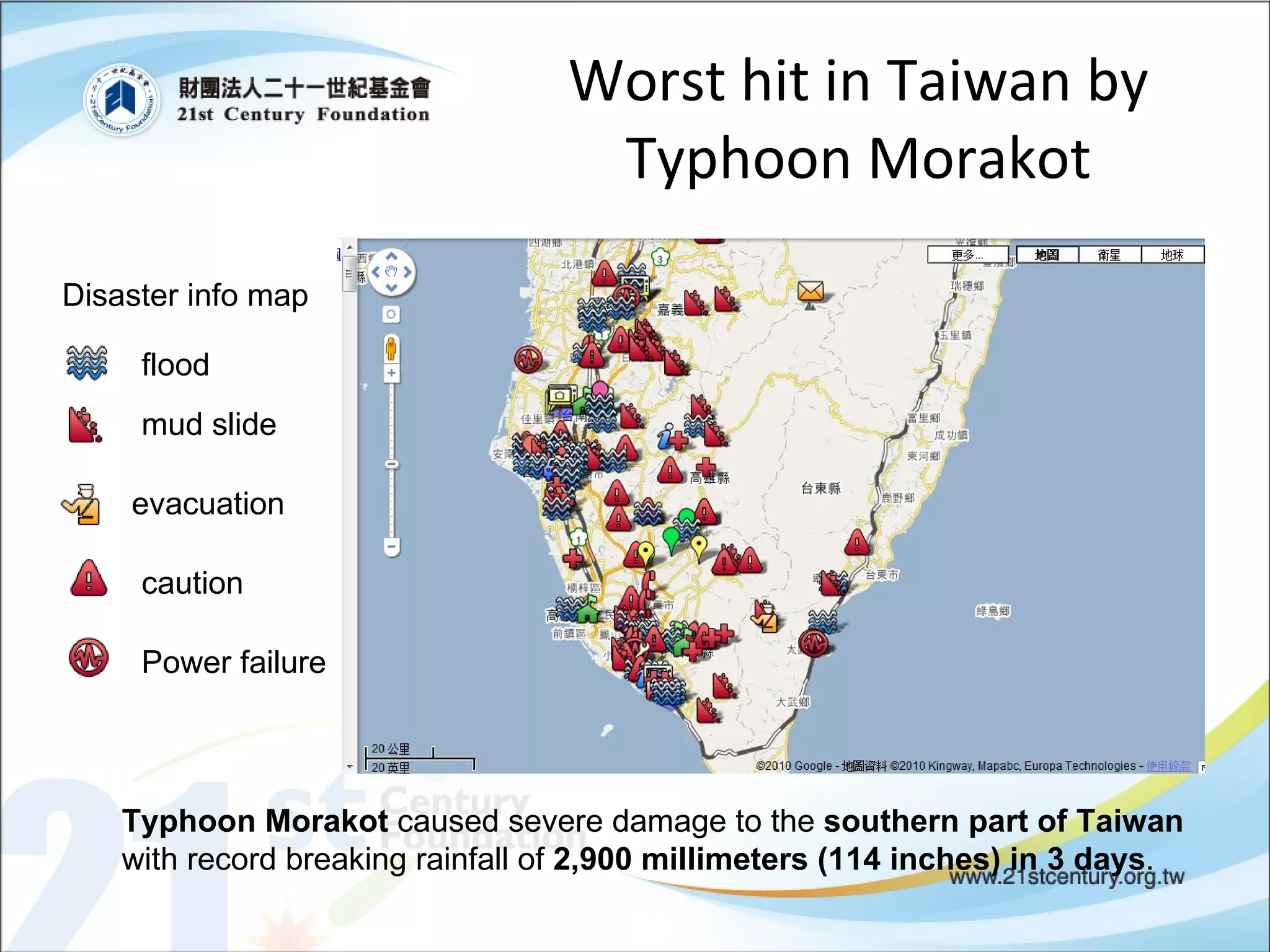
Worst hit in Taiwan by Typhoon Morakot Disaster info map flood mud slide evacuation caution Power failure Typhoon Morakot  caused severe damage to the  southern part of Taiwan  with record breaking rainfall of  2,900 millimeters (114 inches) in 3 days .
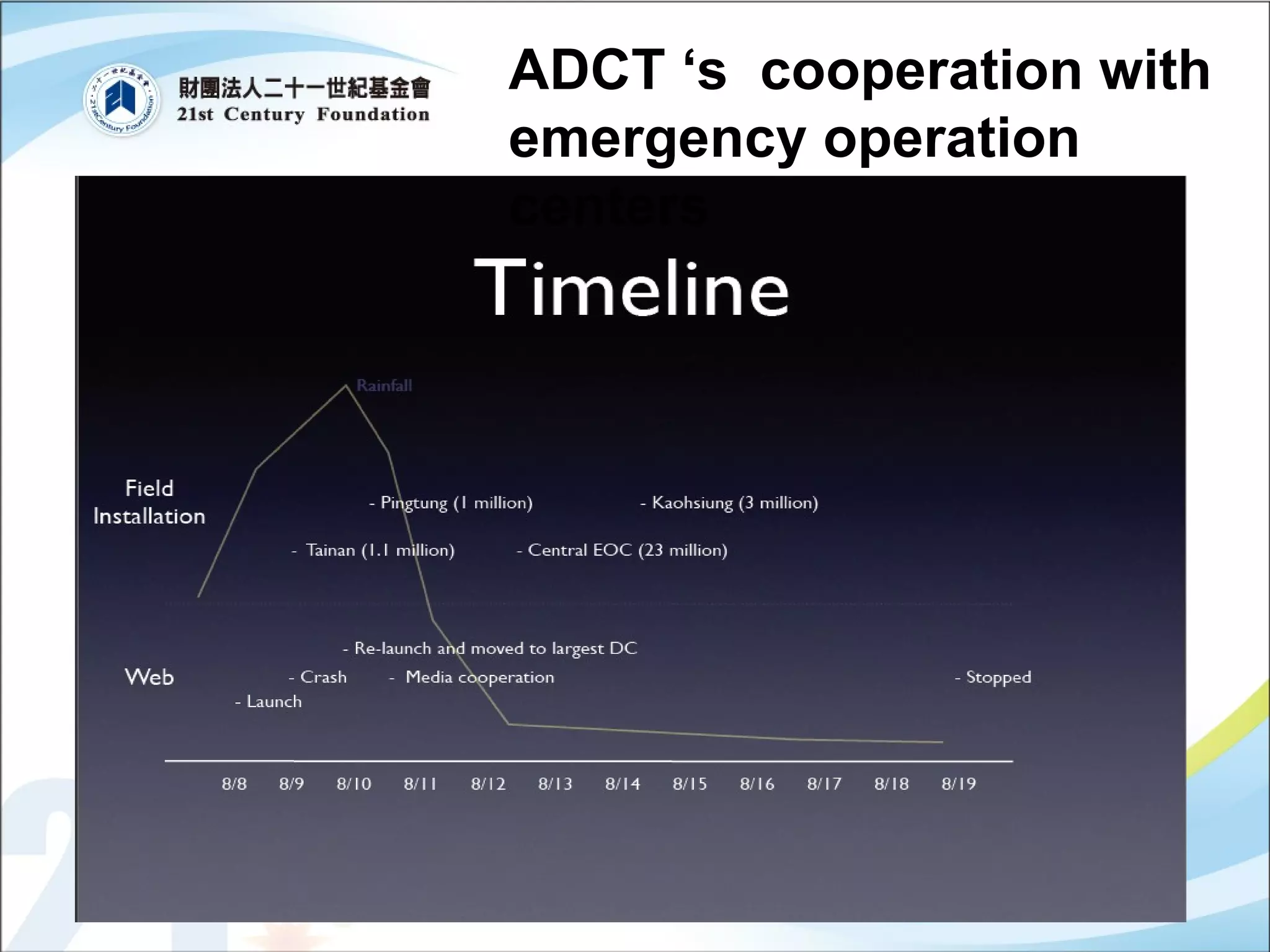
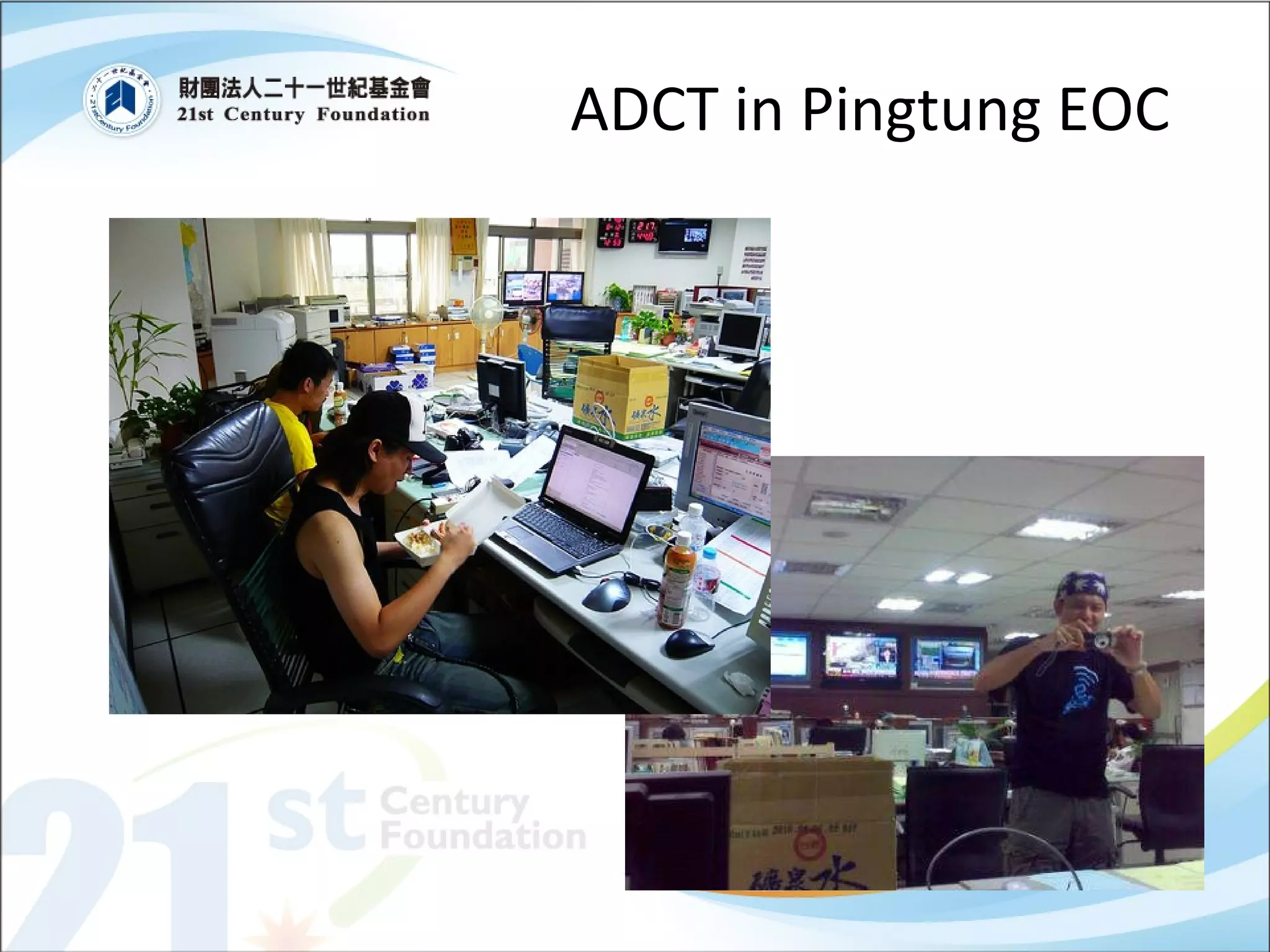
ADCT ‘s  cooperation with emergency operation centers
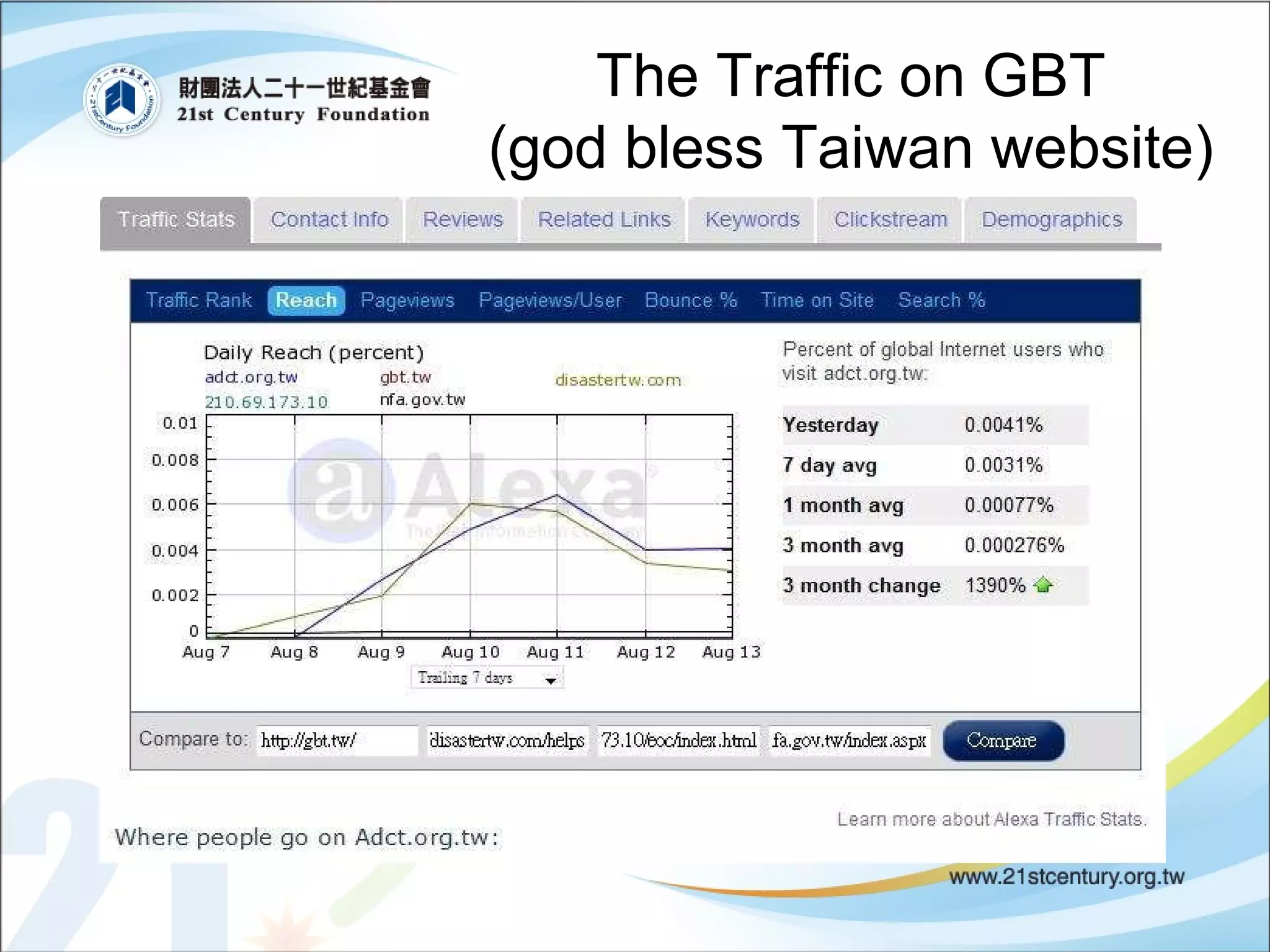
The Traffic on GBT (god bless Taiwan website)
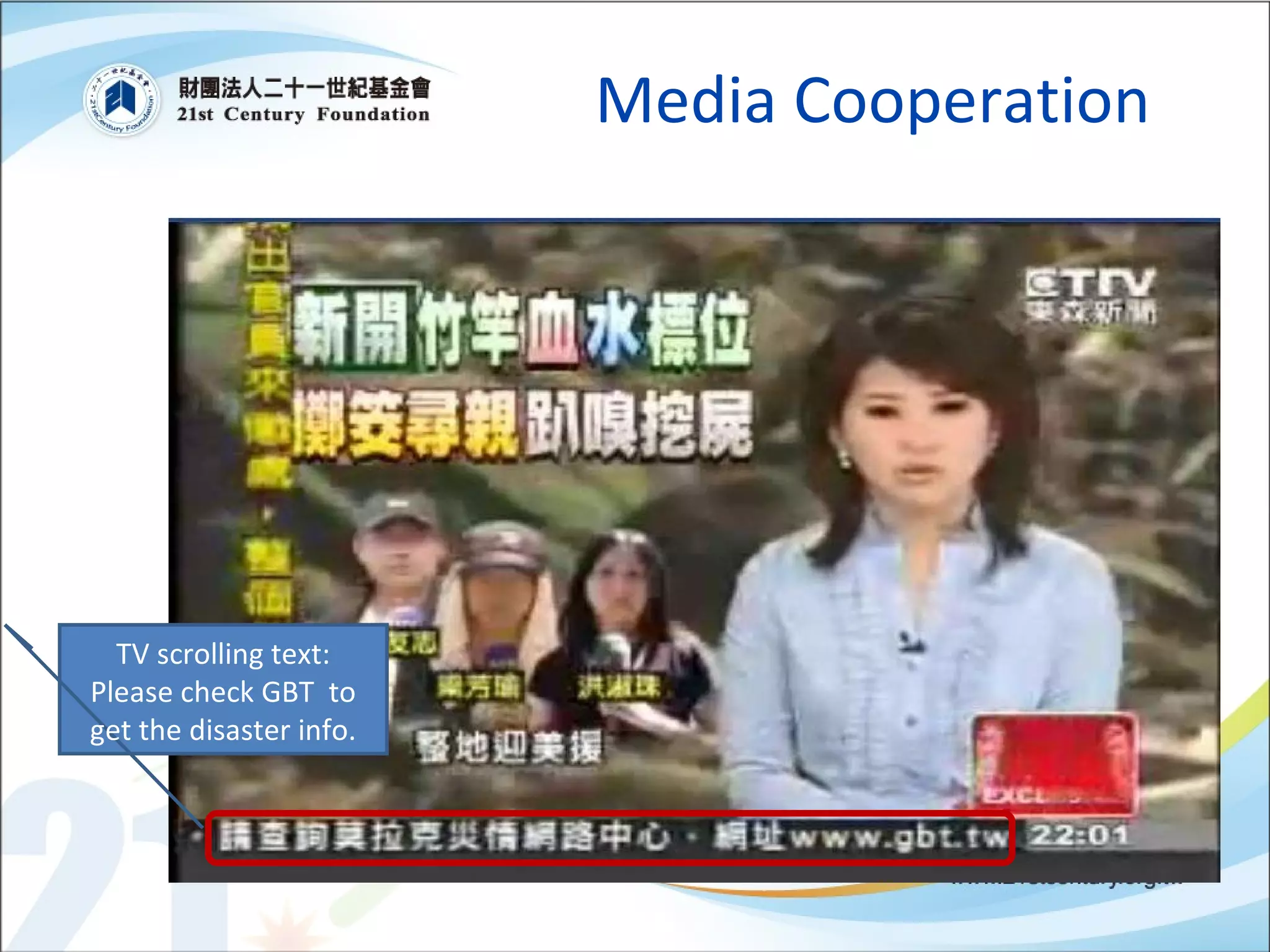
Media Cooperation TV scrolling text: Please check GBT  to get the disaster info.
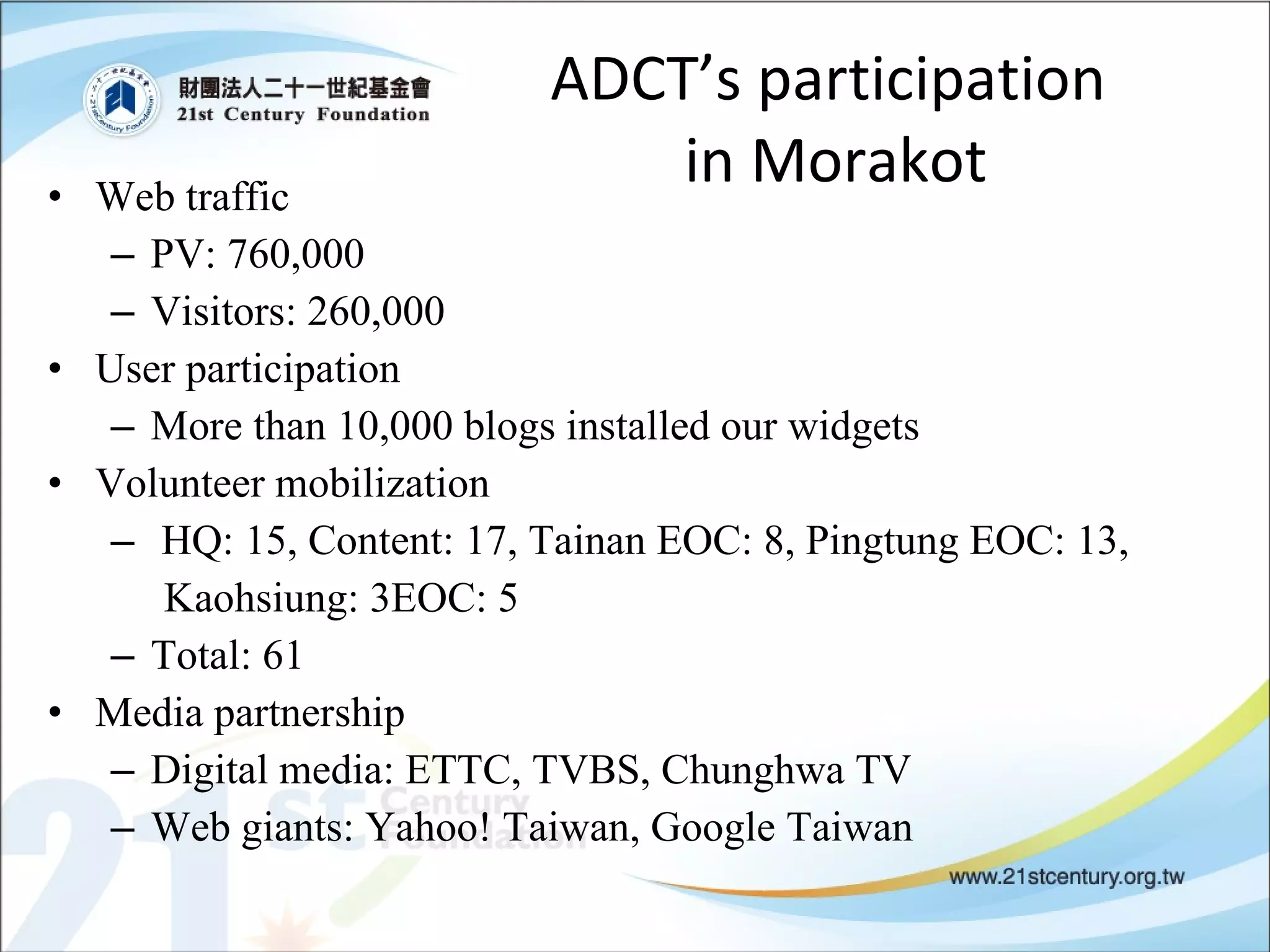
ADCT’s participation  in Morakot Web traffic PV: 760,000 Visitors: 260,000 User participation More than 10,000 blogs installed our widgets Volunteer mobilization HQ: 15, Content: 17, Tainan EOC: 8, Pingtung EOC: 13,  Kaohsiung: 3EOC: 5 Total: 61 Media partnership Digital media: ETTC, TVBS, Chunghwa TV Web giants: Yahoo! Taiwan, Google Taiwan
ADCT in Pingtung EOC
What  ADCT did Aggregating disaster information from only three largest social media Clawing government websites and data Distributing disaster relief information through social media Cooperating with mainstream media Conducting field operations in local and HQ EOCs
Project Initiation Typhoon Morakot Experience Project Importance Partnership Selection
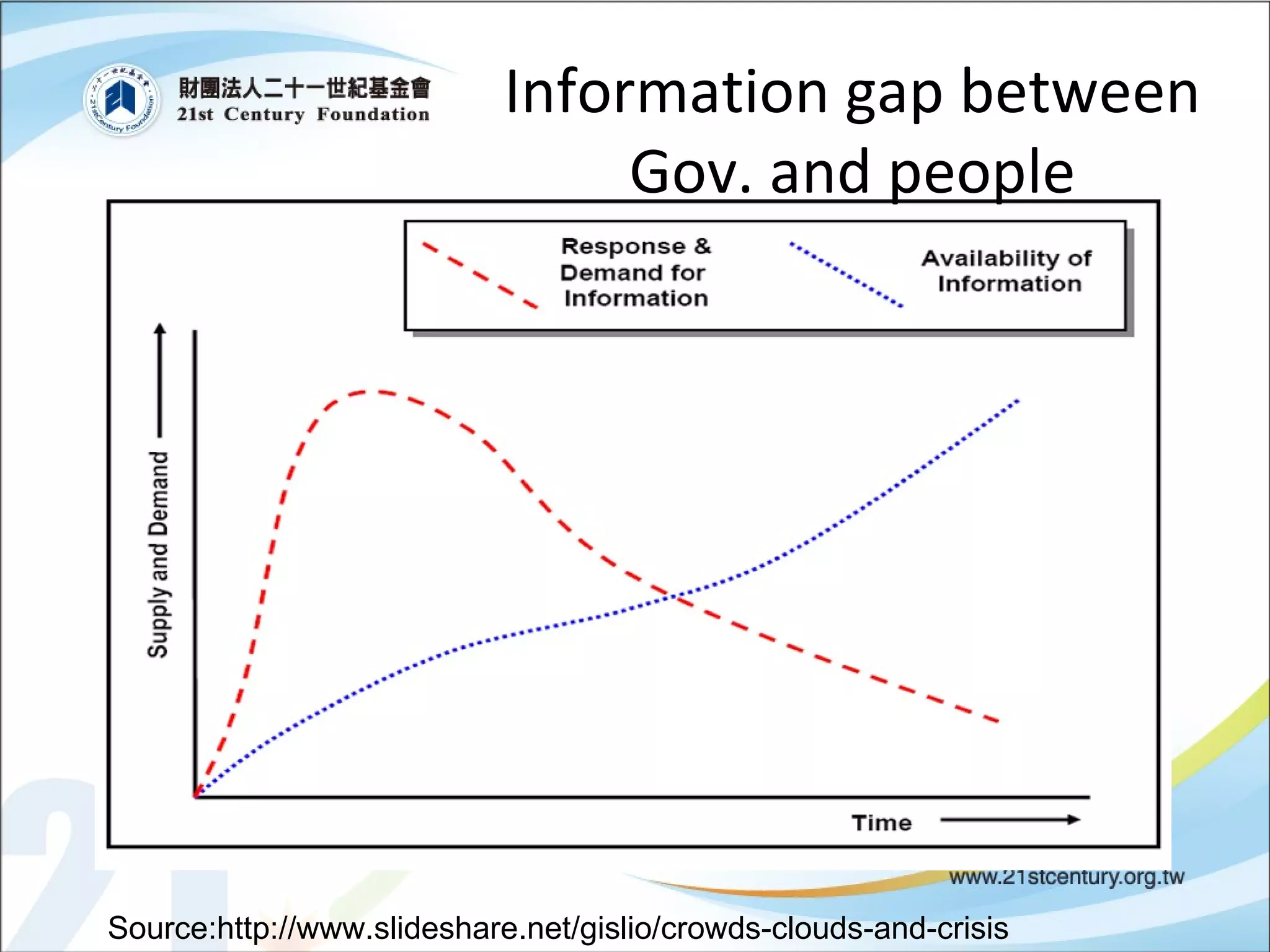
Source:http://www.slideshare.net/gislio/crowds-clouds-and-crisis Information gap between Gov. and people
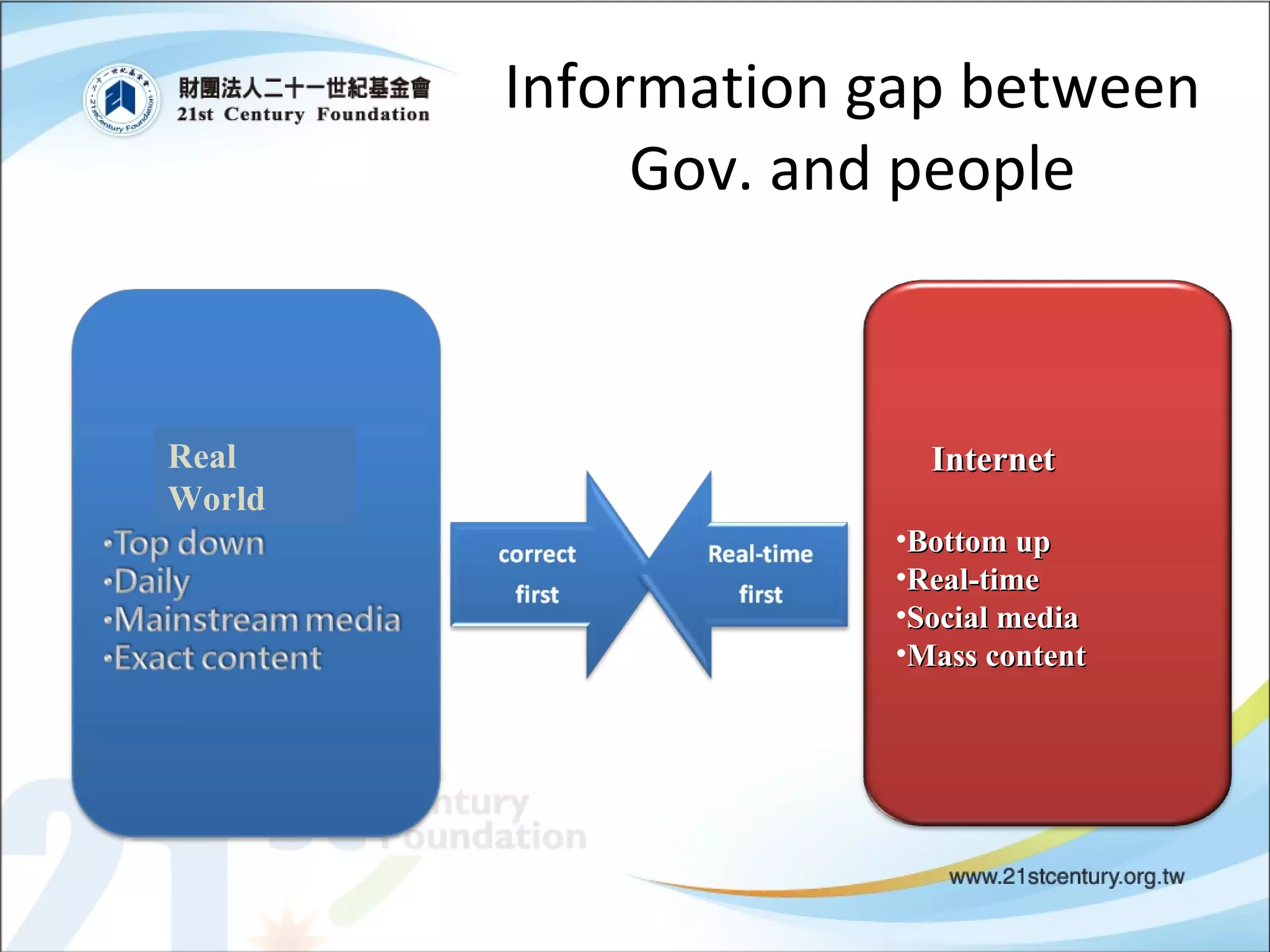
Information gap between Gov. and people Real World Internet Bottom up Real-time Social media Mass content
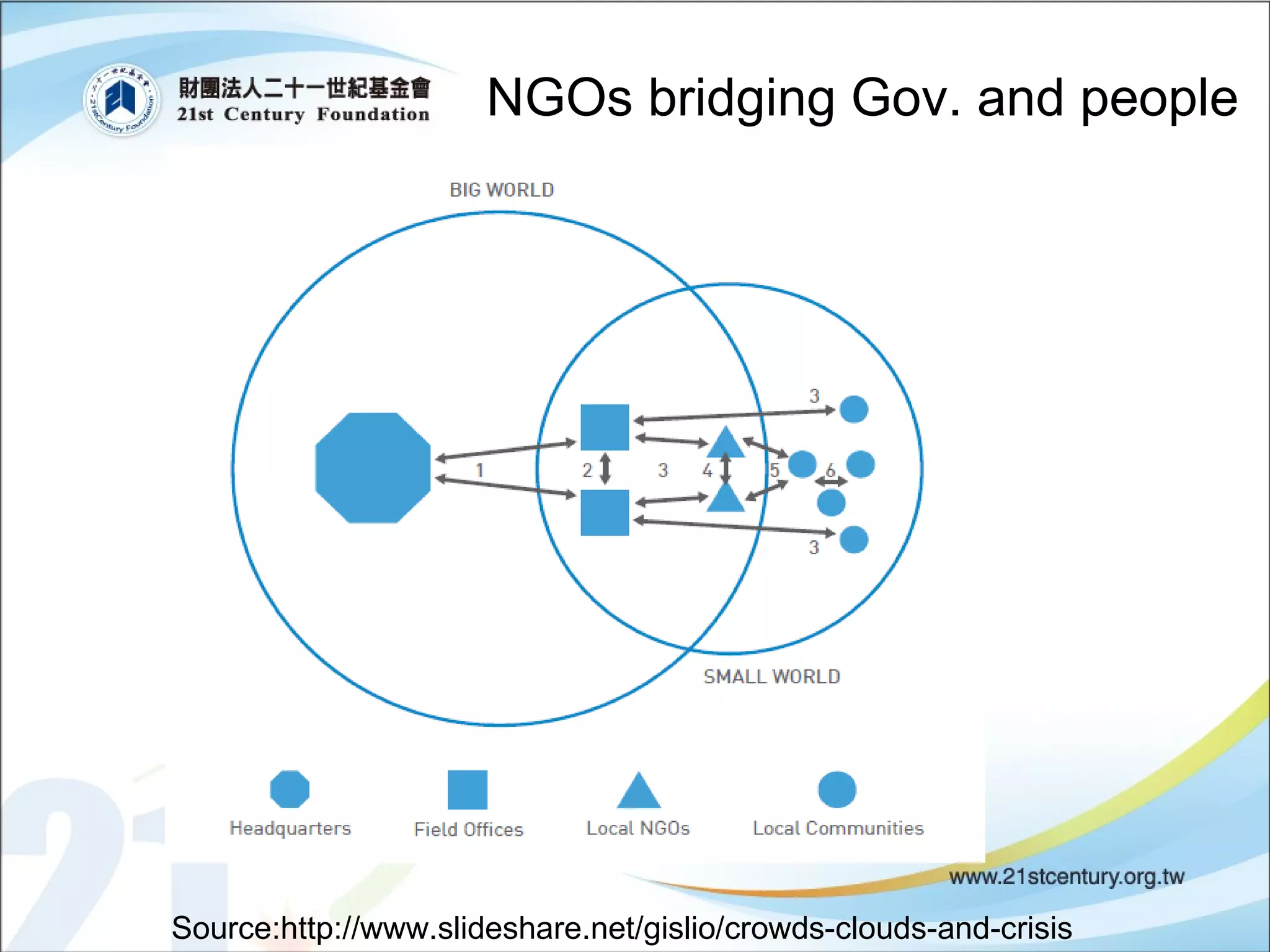
NGOs bridging Gov. and people Source:http://www.slideshare.net/gislio/crowds-clouds-and-crisis
Why NGO? In the area of disaster prevention, the last decade has shown that  governments  have limited information, limited manpower to cope alone with emergency situations.  Real-time information  can get really unorganized and therefore inaccurate. If government receives this information directly, it is hard for them to know where exactly to send their rescue resources. To be timely,  information directly  from citizens in the disaster area is crucial; however, the accuracy gets compromised when there is a flood of real-time information. This is where NGOs come in.
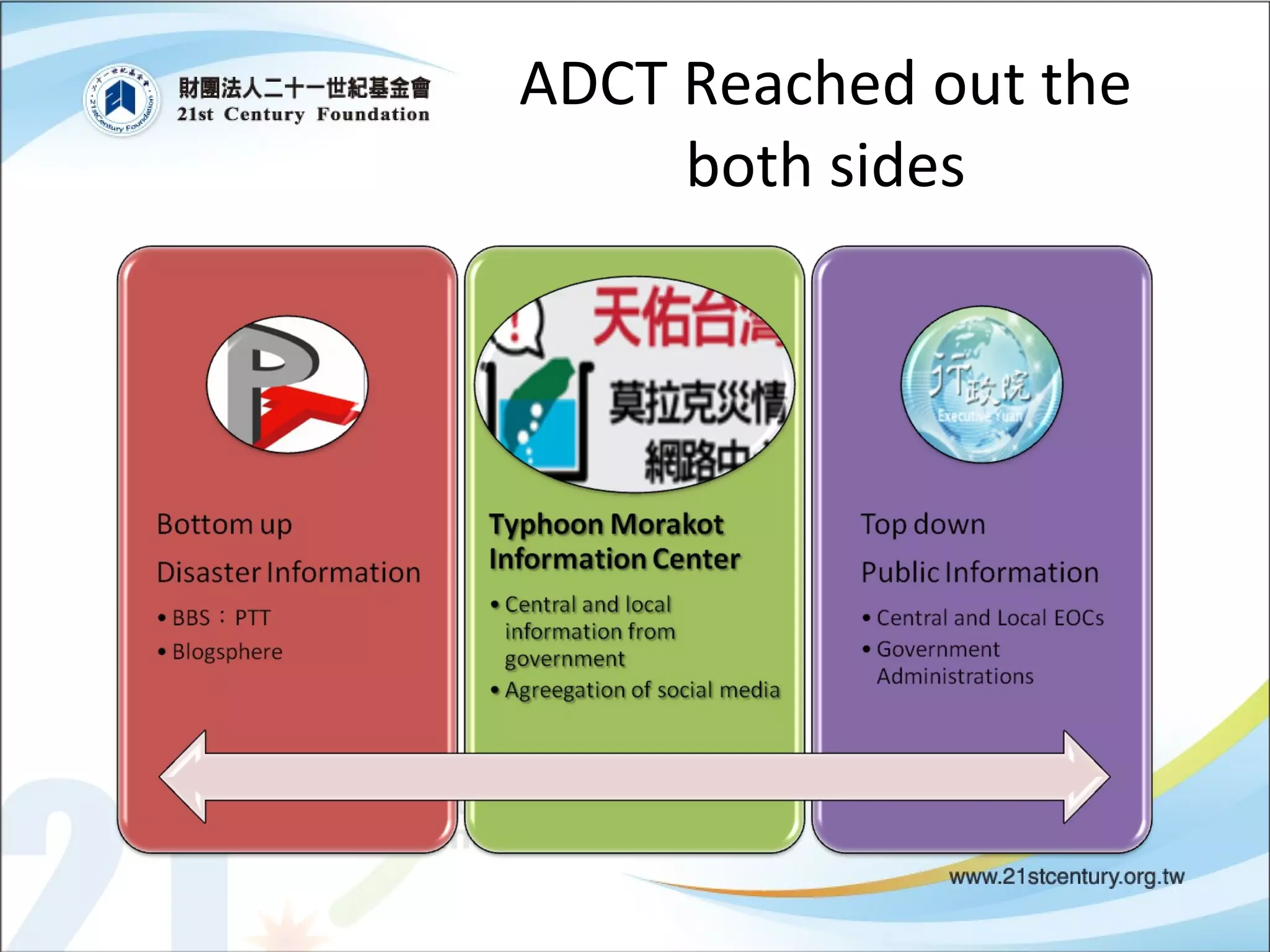
ADCT Reached out the both sides
Project highlights 1. People in this region are asking for more emergency/relief information and governmental transparency to be published online due to the increasing use of social media.  2. The role that NGOs play during disasters is becoming more and more crucial and it is time to develop more consolidatory relationship between public and private sectors.  3.The platform is multilingual and  suitable for a variety of operation systems, and components can be built up immediately.
Project Initiation Typhoon Morakot Experience Project Importance Partnership Selection
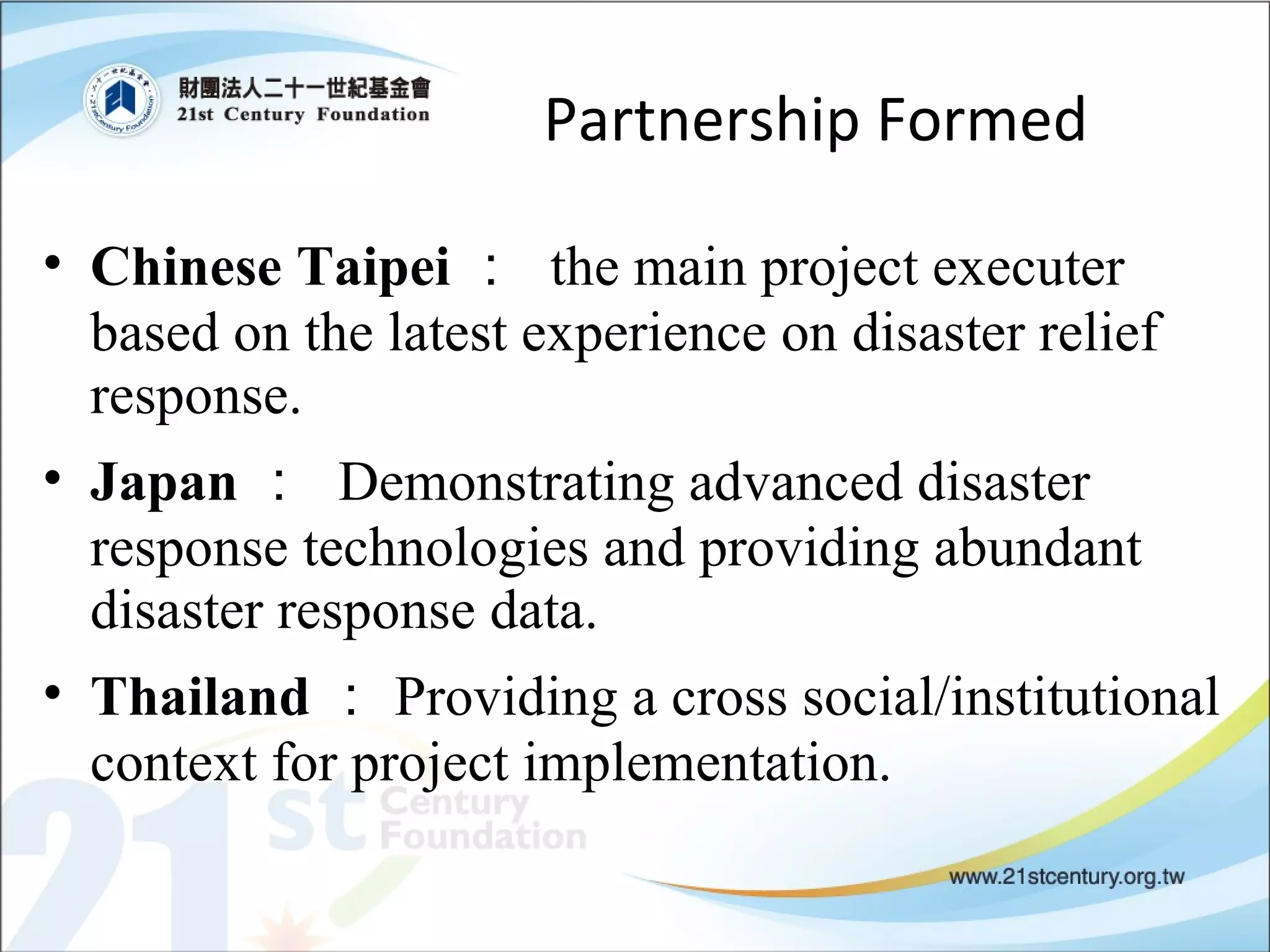
Partnership Formed Chinese Taipei :  the main project executer based on the latest experience on disaster relief response.  Japan :  Demonstrating advanced disaster response technologies and providing abundant disaster response data.  Thailand : Providing a cross social/institutional context for project implementation.
Project Description Project Scope Execution Plan Project Outcomes Potential Influence
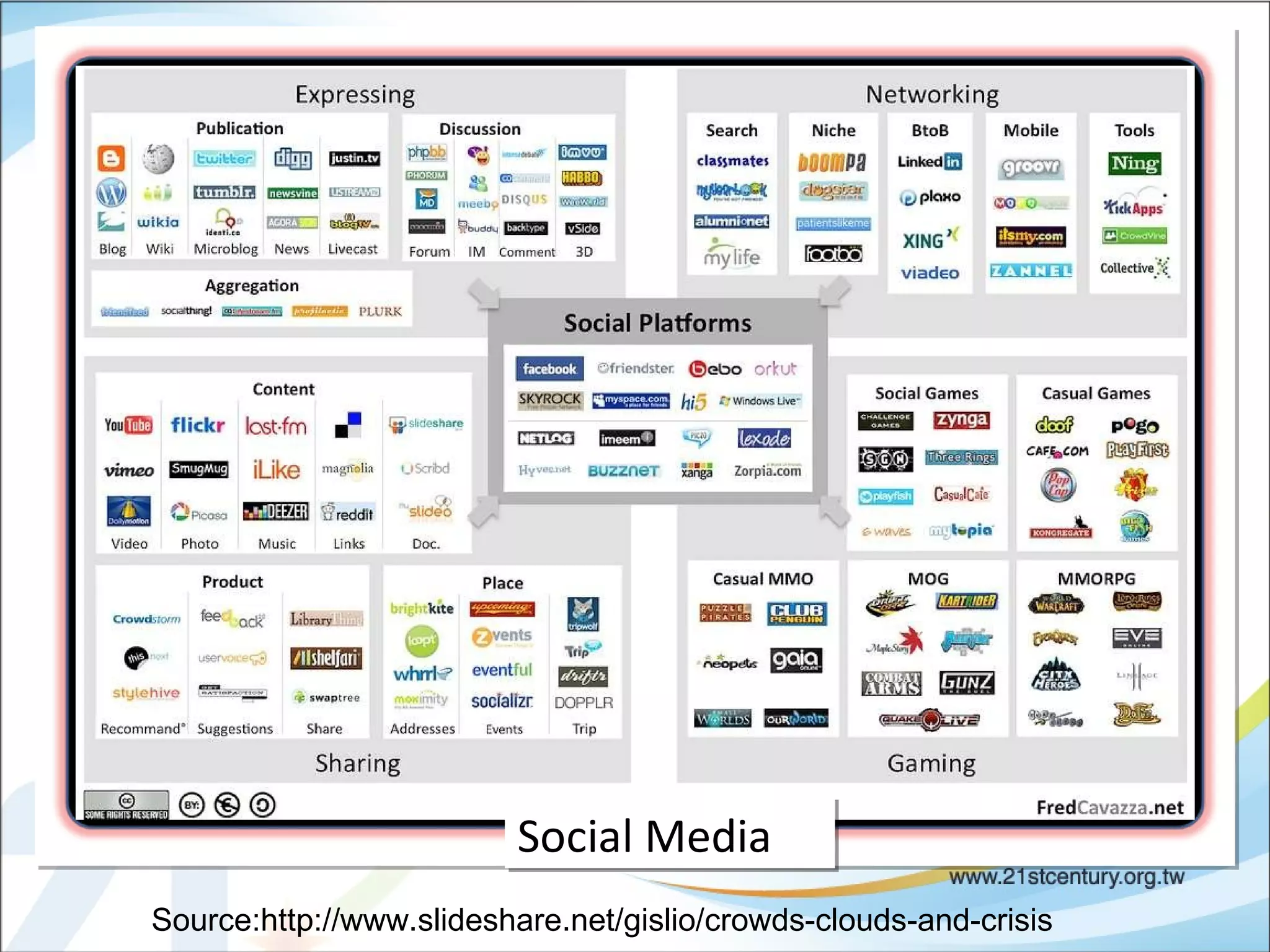
Social Media Source:http://www.slideshare.net/gislio/crowds-clouds-and-crisis
Project Scope To conduct a research of how cloud-computing technology, open source content managing system, and online social media aggregation can be utilized in response to hazards and catastrophes in Asia-Pacific region. To study the experience of how Chinese Taipei NGOs helped to aggregate and distribute disaster/relief-related information.  To establish a partnership between civil organizations and emergency operation centers(EOCs) on information dissemination over the Internet during catastrophes. To build civil disaster information network and an exemplar platform for  relief and supplement. To focus on real-time information sharing and inter –exchange between government  agencies and citizens.
Project Description Project Scope Execution Plan Project Outcomes Potential Influence
Execution Plan to sort out related literature about how new ICT can be integrated into disaster response mechanisms.  to study the nature of disaster information and how it was distributed in the countries of Asia-Pacific region.  to conduct in-depth interviews as how NGOs and government cooperate on message distribution during Typhoon Morakot.  to aggregate the data from literature review and in-depth interviews, and to develop a theoretical model.  to construct an exemplar NGO disaster information distribution platform.  to trial and test this platform, and to develop and modify the guidebook based on the trial results.
Project Description Project Scope Execution Plan Project Outcomes Potential Inluence
Project Outcomes A  report of how new information and communication technologies including cloud-computing, open source content managing system, and online social media can change the landscape of disaster response. A report of how Chinese Taipei NGOs helped the government  to aggregate and distribute disaster/relief information during Morakot Typhoon. Building an exemplar platform of disaster information that can be operated by NGOs. Through actual implementation, this project will invent a partnership relationship between NGO and governmental units.
Project Description Project Scope Execution Plan Project Outcomes Potential Influence
For ICT developers, this project will study into how create a do-able  emergency information system. For government, the social and political stability order can thus be maintained while earning public trust. For public, information are more transparent and immediate so the panic can be decreased. For victims of disaster, the relief efficiency will be leveled up and more sos channels for asking for help are constituted.  Expected Impacts
Expected Impacts This project's results and actual implementation of the example platform will provide TFEP for strengthening member economies' preparedness and their ability to respond to disasters.
Technological Innovation in this Project Data Clawing: developing a data clawing system that collects mass messages generated by  millions of people simultaneously.  Information Aggregation: designing the Semantic-Web that extracts the meaningful user-generated information in avoidance of flooding of simultaneous mass user-oriented messages. High Availability: building a system that can handle millions of requests at short time due to the focal attention from mass people and media.
Conclusion
Conclusion By sharing expertise and collaborating on emergency preparedness issues, APEC members could strengthen their capacity in mitigating, preparing for, and responding to emergencies and disasters.  Partnering NGOs with the EOCs empowers citizens and maximizes the effectiveness of disaster relief. Utilizing Web 2.0-based technologies and concepts to have all citizens collaborate in aggregating useful disaster information and thereby making it true the global village. Channeling disaster information through the Web enables the transparency and accessibility to the information so that citizens are free from the fear lacking of reliable information and therefore creates a collective sense of safety.
 

APEC TEL41 990510

  • 1.
    Deployment ofDisaster Information Distribution System and Service Model by NGO Exemplar Platforms 21 st Century Foundation Association of Digital Culture Taiwan Chinese Taipei May 10-12, 2010
  • 2.
    Agenda Project InitiationTyphoon Morakot Experience Project Importance Partnership Formed Project Scope Budget (self-funding) Outcomes Conclusion
  • 3.
    Project Initiation TyphoonMorakot Experience Project Importance Partnership Selection
  • 4.
    Worst hit inTaiwan by Typhoon Morakot Disaster info map flood mud slide evacuation caution Power failure Typhoon Morakot caused severe damage to the southern part of Taiwan with record breaking rainfall of 2,900 millimeters (114 inches) in 3 days .
  • 5.
    ADCT ‘s cooperation with emergency operation centers
  • 6.
    The Traffic onGBT (god bless Taiwan website)
  • 7.
    Media Cooperation TVscrolling text: Please check GBT to get the disaster info.
  • 8.
    ADCT’s participation in Morakot Web traffic PV: 760,000 Visitors: 260,000 User participation More than 10,000 blogs installed our widgets Volunteer mobilization HQ: 15, Content: 17, Tainan EOC: 8, Pingtung EOC: 13, Kaohsiung: 3EOC: 5 Total: 61 Media partnership Digital media: ETTC, TVBS, Chunghwa TV Web giants: Yahoo! Taiwan, Google Taiwan
  • 9.
  • 10.
    What ADCTdid Aggregating disaster information from only three largest social media Clawing government websites and data Distributing disaster relief information through social media Cooperating with mainstream media Conducting field operations in local and HQ EOCs
  • 11.
    Project Initiation TyphoonMorakot Experience Project Importance Partnership Selection
  • 12.
  • 13.
    Information gap betweenGov. and people Real World Internet Bottom up Real-time Social media Mass content
  • 14.
    NGOs bridging Gov.and people Source:http://www.slideshare.net/gislio/crowds-clouds-and-crisis
  • 15.
    Why NGO? Inthe area of disaster prevention, the last decade has shown that governments have limited information, limited manpower to cope alone with emergency situations. Real-time information can get really unorganized and therefore inaccurate. If government receives this information directly, it is hard for them to know where exactly to send their rescue resources. To be timely, information directly from citizens in the disaster area is crucial; however, the accuracy gets compromised when there is a flood of real-time information. This is where NGOs come in.
  • 16.
    ADCT Reached outthe both sides
  • 17.
    Project highlights 1.People in this region are asking for more emergency/relief information and governmental transparency to be published online due to the increasing use of social media. 2. The role that NGOs play during disasters is becoming more and more crucial and it is time to develop more consolidatory relationship between public and private sectors. 3.The platform is multilingual and suitable for a variety of operation systems, and components can be built up immediately.
  • 18.
    Project Initiation TyphoonMorakot Experience Project Importance Partnership Selection
  • 19.
    Partnership Formed ChineseTaipei : the main project executer based on the latest experience on disaster relief response. Japan : Demonstrating advanced disaster response technologies and providing abundant disaster response data. Thailand : Providing a cross social/institutional context for project implementation.
  • 20.
    Project Description ProjectScope Execution Plan Project Outcomes Potential Influence
  • 21.
  • 22.
    Project Scope Toconduct a research of how cloud-computing technology, open source content managing system, and online social media aggregation can be utilized in response to hazards and catastrophes in Asia-Pacific region. To study the experience of how Chinese Taipei NGOs helped to aggregate and distribute disaster/relief-related information. To establish a partnership between civil organizations and emergency operation centers(EOCs) on information dissemination over the Internet during catastrophes. To build civil disaster information network and an exemplar platform for relief and supplement. To focus on real-time information sharing and inter –exchange between government agencies and citizens.
  • 23.
    Project Description ProjectScope Execution Plan Project Outcomes Potential Influence
  • 24.
    Execution Plan tosort out related literature about how new ICT can be integrated into disaster response mechanisms. to study the nature of disaster information and how it was distributed in the countries of Asia-Pacific region. to conduct in-depth interviews as how NGOs and government cooperate on message distribution during Typhoon Morakot. to aggregate the data from literature review and in-depth interviews, and to develop a theoretical model. to construct an exemplar NGO disaster information distribution platform. to trial and test this platform, and to develop and modify the guidebook based on the trial results.
  • 25.
    Project Description ProjectScope Execution Plan Project Outcomes Potential Inluence
  • 26.
    Project Outcomes A report of how new information and communication technologies including cloud-computing, open source content managing system, and online social media can change the landscape of disaster response. A report of how Chinese Taipei NGOs helped the government to aggregate and distribute disaster/relief information during Morakot Typhoon. Building an exemplar platform of disaster information that can be operated by NGOs. Through actual implementation, this project will invent a partnership relationship between NGO and governmental units.
  • 27.
    Project Description ProjectScope Execution Plan Project Outcomes Potential Influence
  • 28.
    For ICT developers,this project will study into how create a do-able emergency information system. For government, the social and political stability order can thus be maintained while earning public trust. For public, information are more transparent and immediate so the panic can be decreased. For victims of disaster, the relief efficiency will be leveled up and more sos channels for asking for help are constituted. Expected Impacts
  • 29.
    Expected Impacts Thisproject's results and actual implementation of the example platform will provide TFEP for strengthening member economies' preparedness and their ability to respond to disasters.
  • 30.
    Technological Innovation inthis Project Data Clawing: developing a data clawing system that collects mass messages generated by millions of people simultaneously. Information Aggregation: designing the Semantic-Web that extracts the meaningful user-generated information in avoidance of flooding of simultaneous mass user-oriented messages. High Availability: building a system that can handle millions of requests at short time due to the focal attention from mass people and media.
  • 31.
  • 32.
    Conclusion By sharingexpertise and collaborating on emergency preparedness issues, APEC members could strengthen their capacity in mitigating, preparing for, and responding to emergencies and disasters.  Partnering NGOs with the EOCs empowers citizens and maximizes the effectiveness of disaster relief. Utilizing Web 2.0-based technologies and concepts to have all citizens collaborate in aggregating useful disaster information and thereby making it true the global village. Channeling disaster information through the Web enables the transparency and accessibility to the information so that citizens are free from the fear lacking of reliable information and therefore creates a collective sense of safety.
  • 33.

Editor's Notes

  • #2 I am yuntsai chou, deputy director of 21st Century Foundation, a policy think tank from Chinese Taipei, and Gene Hong from ADCT. We are very delighted to present this project proposal to you.
  • #3 Indeed, this project is developed based on our experience in T M. Let me start with this case first and then project scope and expected benefits.
  • #5 As you can see in this graph, the southern part of Taiwan was the most hit area by TM, rainfall reached 114 inches in three days, causing a mudslide where 300 people buried, and thousands homeless. During the disaster, government was devoted into first-hand rescue mission, and not much information released to the public, and it made the whole society chaotic, and demanding more disaster information.