The use of geospatial technologies in digital mapping:
Bringing together communities who innovate crisis response

      Fleming Europe: 2nd Annual Geospatial Conference
                         June 1, 2011
                      Budapest, Hungary

                     Heather Blanchard
                Co Founder, CrisisCommons
                  www.crisiscommons.org
                heather@crisiscommons.org
                 Twitter/Skype: @poplifegirl
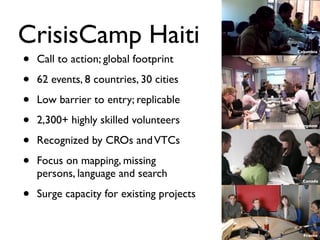
CrisisCamp Haiti
•
                                                Columbia

    Call to action; global footprint

•   62 events, 8 countries, 30 cities

•   Low barrier to entry; replicable

•   2,300+ highly skilled volunteers       United Kingdom


•   Recognized by CROs and VTCs

•   Focus on mapping, missing
    persons, language and search                  Canada


•   Surge capacity for existing projects


                                                   France
What We Learned
•   Disasters can create opportunities for innovation, rules
    relax, people are willing to be open to solutions from
    anywhere

•   Disasters create the rise of the “crisis crowd”

•   Disasters can benefit from existing programs with
    training and leadership have the best change in effectively
    harness the emerging crisis crowd into their existing
    community

•   Disaster response requests need to originate from the
    local area/field
Potential of
Technology Volunteers
• Post-Disaster Basemap: OpenStreetMap
• Remote Building Assessment: GEO-CAN
• Monitoring: Big Idea with the Gulf Coast
  Oil Spill
• Crisis Content/Trends: Japan Earthquake
Need to focus
           on Open Data
• Many emergency management/civil authorities don’t
  have access to tools and resources or partnerships
  they need to harness additional capability/capacity
• Sometimes if there are resources, its limited to one
  person
• Little focus on data preparedness; process
• Focus on data (and its availability) not platforms
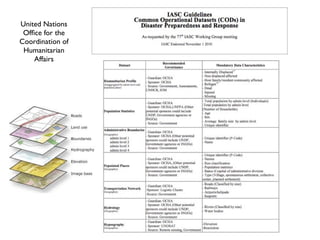
United Nations
 Office for the
Coordination of
 Humanitarian
    Affairs
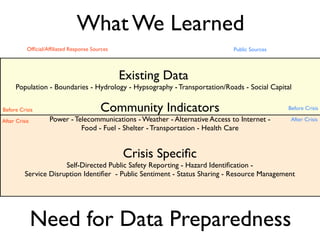
What We Learned
           Official/Affiliated Response Sources                                  Public Sources


                                                Existing Data
      Population - Boundaries - Hydrology - Hypsography - Transportation/Roads - Social Capital

Before Crisis                            Community Indicators                                   Before Crisis

After Crisis        Power - Telecommunications - Weather - Alternative Access to Internet -      After Crisis
                              Food - Fuel - Shelter - Transportation - Health Care


                                                Crisis Specific
                       Self-Directed Public Safety Reporting - Hazard Identification -
          Service Disruption Identifier - Public Sentiment - Status Sharing - Resource Management


               Need for Data Preparedness
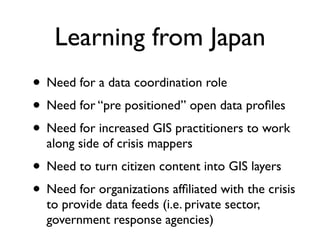
Learning from Japan
• Need for a data coordination role
• Need for “pre positioned” open data profiles
• Need for increased GIS practitioners to work
  along side of crisis mappers
• Need to turn citizen content into GIS layers
• Need for organizations affiliated with the crisis
  to provide data feeds (i.e. private sector,
  government response agencies)
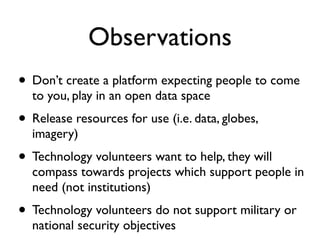
Observations
• Don’t create a platform expecting people to come
  to you, play in an open data space
• Release resources for use (i.e. data, globes,
  imagery)
• Technology volunteers want to help, they will
  compass towards projects which support people in
  need (not institutions)
• Technology volunteers do not support military or
  national security objectives
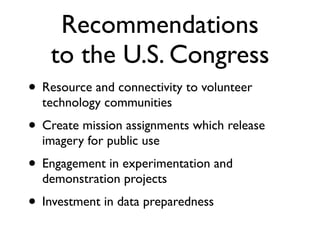
Recommendations
    to the U.S. Congress
• Resource and connectivity to volunteer
  technology communities
• Create mission assignments which release
  imagery for public use
• Engagement in experimentation and
  demonstration projects
• Investment in data preparedness
Questions?
Heather Blanchard
          Co Founder
          CrisisCommons
          heather@crisiscommons.org
          703.593.3823
          twitter/skype: poplifegirl
          www.facebook.com/heather.blanchard
          www.linkedin.com/in/hblancha

Thanks!

2nd Annual Geospatial Conference

  • 1.
    The use ofgeospatial technologies in digital mapping: Bringing together communities who innovate crisis response Fleming Europe: 2nd Annual Geospatial Conference June 1, 2011 Budapest, Hungary Heather Blanchard Co Founder, CrisisCommons www.crisiscommons.org heather@crisiscommons.org Twitter/Skype: @poplifegirl
  • 2.
    CrisisCamp Haiti • Columbia Call to action; global footprint • 62 events, 8 countries, 30 cities • Low barrier to entry; replicable • 2,300+ highly skilled volunteers United Kingdom • Recognized by CROs and VTCs • Focus on mapping, missing persons, language and search Canada • Surge capacity for existing projects France
  • 3.
    What We Learned • Disasters can create opportunities for innovation, rules relax, people are willing to be open to solutions from anywhere • Disasters create the rise of the “crisis crowd” • Disasters can benefit from existing programs with training and leadership have the best change in effectively harness the emerging crisis crowd into their existing community • Disaster response requests need to originate from the local area/field
  • 4.
    Potential of Technology Volunteers •Post-Disaster Basemap: OpenStreetMap • Remote Building Assessment: GEO-CAN • Monitoring: Big Idea with the Gulf Coast Oil Spill • Crisis Content/Trends: Japan Earthquake
  • 5.
    Need to focus on Open Data • Many emergency management/civil authorities don’t have access to tools and resources or partnerships they need to harness additional capability/capacity • Sometimes if there are resources, its limited to one person • Little focus on data preparedness; process • Focus on data (and its availability) not platforms
  • 6.
    United Nations Officefor the Coordination of Humanitarian Affairs
  • 8.
    What We Learned Official/Affiliated Response Sources Public Sources Existing Data Population - Boundaries - Hydrology - Hypsography - Transportation/Roads - Social Capital Before Crisis Community Indicators Before Crisis After Crisis Power - Telecommunications - Weather - Alternative Access to Internet - After Crisis Food - Fuel - Shelter - Transportation - Health Care Crisis Specific Self-Directed Public Safety Reporting - Hazard Identification - Service Disruption Identifier - Public Sentiment - Status Sharing - Resource Management Need for Data Preparedness
  • 9.
    Learning from Japan •Need for a data coordination role • Need for “pre positioned” open data profiles • Need for increased GIS practitioners to work along side of crisis mappers • Need to turn citizen content into GIS layers • Need for organizations affiliated with the crisis to provide data feeds (i.e. private sector, government response agencies)
  • 10.
    Observations • Don’t createa platform expecting people to come to you, play in an open data space • Release resources for use (i.e. data, globes, imagery) • Technology volunteers want to help, they will compass towards projects which support people in need (not institutions) • Technology volunteers do not support military or national security objectives
  • 11.
    Recommendations to the U.S. Congress • Resource and connectivity to volunteer technology communities • Create mission assignments which release imagery for public use • Engagement in experimentation and demonstration projects • Investment in data preparedness
  • 12.
  • 13.
    Heather Blanchard Co Founder CrisisCommons heather@crisiscommons.org 703.593.3823 twitter/skype: poplifegirl www.facebook.com/heather.blanchard www.linkedin.com/in/hblancha Thanks!

Editor's Notes